2. Remarks by the Leader.—Benefits to Be Derived from Field Study. Five minutes.
3. Field Study:—
(a) Newly entered fields, mentioning success which has attended the opening of new fields. A map exercise would add to the interest of the talk. Five minutes.
(b) Alaska. Five minutes.
(c) Italy—population; religious condition of country; where message has been preached; why? results. Five minutes.
(d) Some evidences that the message is going to every nation, kindred, tongue, and people. Five minutes.
4. Prayer and Its Relation to Missions. Ten minutes.
1. The history of the early church is the history of prayer:—
(a) Pentecost ushered in by prayer.
(b) Workers appointed after prayer.
(c) If persecution came, they prayed.
(d) Missionary work inaugurated in prayer.
2. History of modern missions the history of prayer.
(a) Prayer the origin of modern missions. Note experience of Moravians and those interested in missions in Carey’s time; the students at Williams College in the beginning of the first missionary society in America; the origin of the Student Volunteer Movement; the work of the China Inland Mission.
3. Prayer is the only method recognized by Christ for supplying laborers. Matt. 9: 37, 38, and other references on prayer.
Andrew Murray, a man of prayer, portrays in a most vivid and forcible manner the utter dependence of the progress of God’s work upon the prayers of his followers: “How little Christians really feel and mourn the need of laborers in the fields of the world so white to the harvest! And how little they believe that our labor supply depends on prayer,—that prayer will really provide as many ‘as he needeth’! Not that the dearth of laborers is not known and discussed. Not that efforts are not put forth to supply the want. But how little the burden of souls now in darkness is really borne in the faith that the Lord of the harvest will, in answer to prayer, send forth the laborers, and in the solemn conviction that without this prayer, fields ready for reaping may be left to perish. And yet it is so. So wonderful is the surrender of his work into the hands of his church; so dependent has the Lord made himself on them as his body, through whom alone his work can be done; so real is the power which the Lord gives his people to exercise in heaven and earth, that the number of the laborers and the measure of the harvest do actually depend upon their prayer.”
Mr. Robert E. Speer, in his pamphlet, “Prayer and Missions,” which has done so much to awaken the church to prayer, goes to the heart of the subject: “The evangelization of the world in this generation depends first of all upon a revival of prayer. Deeper than the need for men; deeper, far, than the need for money; aye, deep down at the bottom of our spiritless life, is the need for the forgotten secret of prevailing, world-wide prayer. . . . The condition and consequence of such prayers as this is a new outpouring of the Holy Ghost. Nothing short of his own suggestion will prompt the necessary prayer to bring him back again in power.”
Prayer is indeed a power upon which the progress of this message to earth’s remotest bounds does, in very truth, depend. In this work every Seventh-day Adventist young man and young woman may share a part.
(b) A missionary church is one in which the members are intelligent concerning the world-wide work; who have a deep conviction that this work is their work, and a determination to perform it. The basis of such conviction and desire is knowledge.
(c) Ignorance begets indifference, and indifference is one reason—the greatest reason—for ignorance.
Results of Studying the Field:—
(a) Increased information brings increased interest.
(b) Where the heart is, there will the treasure be also—prayers and gifts will follow.
(c) Intelligent missionary interest brings a deeper Christian experience.
(d) It gives a world-wide horizon, which is nothing less than the Spirit of Christ.
(e) A knowledge of the needs and openings arouses enthusiasm to do with the might what the hands find to do.
“Facts are the fingers of God. To know the facts of modern missions is the necessary condition of intelligent interest. Knowledge does not always kindle zeal, but zeal is ‘according to knowledge,’ and will not exist without it. A fire may be fanned with wind, but it must be fed with fuel, and facts are the fuel of this sacred flame, to be gathered, then kindled by God’s Spirit, and then scattered as burning brands, to be as live coals elsewhere. In vain we shall look for an absorbing, engrossing passion for the prompt and universal spread of the gospel, for a full missionary treasury, or full missionary ranks, unless and until the individual believer is brought face to face with those grand facts which make the march of modern missions the marvel and miracle of these latter days.”—“Crisis of Missions.”
NOTE.—The study this month is based upon matter found in the current issue of the Missionary Magazine. After this month the studies will be based upon reports found in the Review and Herald and the Instructor, as the Missionary Magazine will be merged into the Review after the May issue. E. H.
Donald's Vacation
“DONALD! Donald! Donald!” Mrs. Turner stood in the hall a moment, and then, with a queer little smile on her face, turned and went out on the side veranda. A white-bearded, jolly-faced old man looked up expectantly as she came out. They talked a few minutes in low tones.
“I expect you’re right,” the old man said. “He probably needs the lesson.” The smile gone from his face, he took up the lines, and drove the fat white horse out of the yard.
Mrs. Turner went back to her baking.
Up-stairs in his bedroom Donald was making a kite. It was the first day of the spring vacation, and he intended to have it ready should he want to fly it. He had just finished the frame when he heard his mother’s first call.
“She wants me to bring in an armful of wood,” he said to himself. “Sarah can do it just as well’s not. ’Sides, I’ve got to keep at it if I ever get it done. Shouldn’t wonder if the wind’d come up so’s we fellows can fly ’em this afternoon,” and he spread out the stiff paper, and prepared to cut it out.
Donald had got into a bad habit of not starting as soon as he was told to do a thing, and sometimes of not answering when called, but he was not disturbed again.
An hour later he went down-stairs after a drink of water.
“I am sorry you didn’t hear me call, Donald,” said his mother. “Grandpa was here, and wanted you to go out to Uncle Charlie’s with him to stay the rest of the week. Uncle Charlie tapped his sugar-bush Friday, and he thought you would enjoy spending your whole vacation out on the farm.”
“O mama! why didn’t you call—” and then he stopped. He remembered. She had called. “I didn’t s’pose you wanted anything much!” he wailed. “Oh, oh, oh!”
That night Mama Turner had a long talk with him, but nevertheless it was a very sorry-faced little boy who got up Tuesday morning.
Wednesday morning Mama Turner told him he must not let his mistake spoil his whole week’s vacation, and finally he went off up-stairs to finish the kite. He had worked half an hour, perhaps, when he heard his mother in the hall below.
“Donald!” she cried.
Donald waited no second call. His lesson had been bitter, and now he started at once.
“What is it, mama?” he asked, from over the banisters.
“Grandpa is here,” said Mama Turner. “He had to come in for new buckets, and he would like to know if you care —” but Donald waited no longer. He was down-stairs and out on the porch in a twinkling.
“Here, young man, get your rubber boots and your old clothes,” said grandpa, laughing. “We142want a hired man about your size to help in the sugar-bush — that is, if his hearing is good,” he added, his eyes twinkling; and mama assured him that Donald’s had improved since Monday.
—Selected.
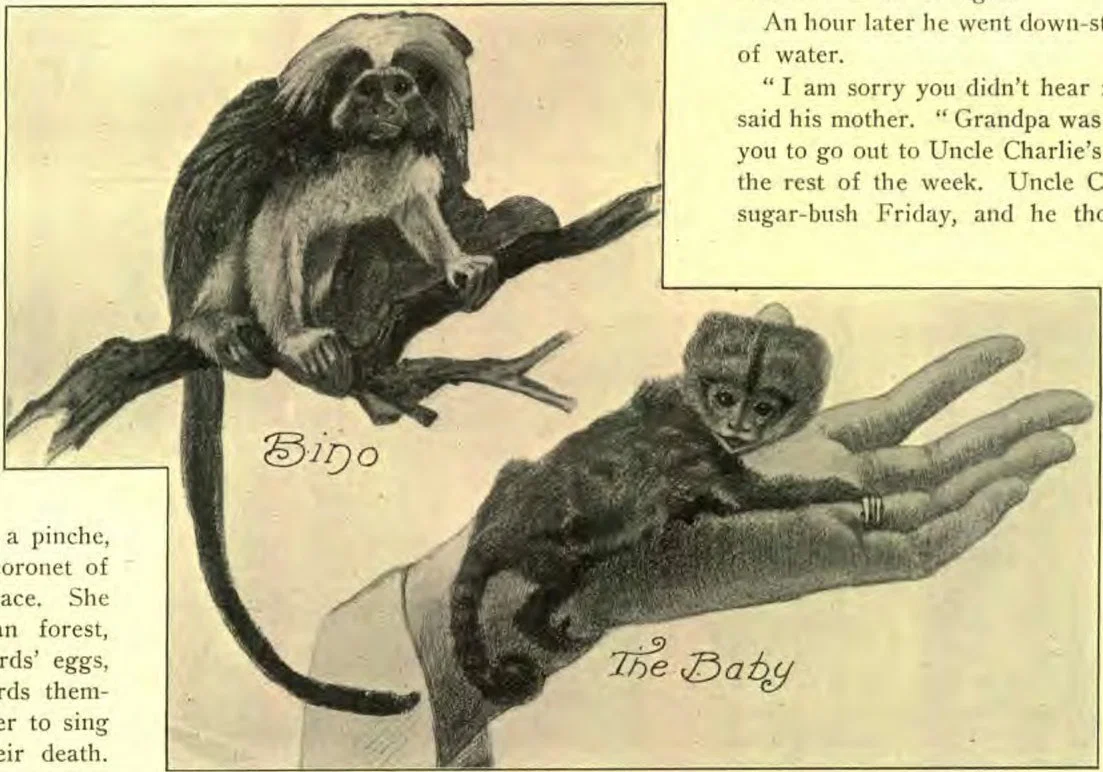
Bino and the Baby
By Justine Ingersoll
Bino
The Baby
YOUNG folks who really love their pet animals want to know how to keep them in health. Misleading books on this vital subject advocate a diet in which bread and milk predominates, whereas there is nothing so deadly to all animals as bread and milk. Let me take Bino and the baby as illustrations. Bino is a pinche, or cotton-head marmoset; a splendid coronet of white hair rises above her coal-black face. She dwelt in the tree-tops of a Brazilian forest, where she lived upon insects, fruit, birds’ eggs, and, I am sorry to say, the young birds themselves. Nature has given her the power to sing so that she can lure her prey to their death. But when I found Bino, she was tied to the platform of a snake-charmer, in the side-show of a circus. The stifling, peanut-laden air, the banging brass band, the staring crowd, and, worst of all, the snakes twisting about the form of her mistress, and darting hungry looks at Bino, had thrown her into a nervous panic. Her wild eyes and piercing screams went to my heart. I tried to buy her, but her mistress could not make up her mind to part with her then. One day, some months after our meeting, a box came to me by express. In it was poor Bino. She was thin, and her coat was rusty. Four years ago that was; now she is fat, and her fur shines with the gloss of health. This is the way I feed her: bananas always, all the year round, baked sweet potatoes, and every variety of fruit; grasshoppers, crickets, “moth millers,” June-bugs, live bait, and meal-worms, which can be had of most bird-dealers, but not a cockroach nor a croton-bug; eggs both raw and hard boiled, the meat of lobsters and crabs, and every day a scrap of raw beef, mutton, or chicken. But I never give her a crumb of bread nor a drop of milk.
The baby was not Bino’s, nor did it belong to her species; but she loved it, and it was “ride a cock-horse” all day long over the fences and up the trees with the baby on her back. When the real mother cried for her child, good nurse Bino would come skirmishing in at the window to give the baby back to its rightful, loving owner.
Bino, the beneficent, is head nurse in my hospital; she soothes the patients, and whatever it is she says to them, they soon lose their fear of me.
To cage a marmoset is like putting a butterfly in a strait-jacket. I have a basket and a piece of flannel in which they curl up at night; this stands in a cage, and here they sleep fourteen good hours; after their breakfast of bananas I open the door, and off my little fairies go, to scale the walls of my room in winter, and to climb the tree-tops in summer.
In the spring and summer Bino and her brothers are often frisking about in the top branches of a near-by elm-tree. Then, when I call to her, she stops her play to answer, and her white topknot shines out from the leaves against the blue sky. Frequently she responds by her musical call, that seems like a clear and sweet, yet strange, song.—Justine Ingersoll, in St. Nicholas.
Four Bedtimes
By Mary L. Paine
“Cluck, cluck, cluck,” said the hen,
“’Tis time this little chick went to bed,
Or you’ll live to be a fowl
Which in the night will prowl,
And be taken for an owl,” she said.
Then, with a single peep,
The chick went off to sleep,
Soft tucked up in its warm feather bed.
“Purr, purr, purr,” said the cat,
“’Tis time this little kit was in bed,
Or you’ll grow up to be a cat
That can not catch a rat,
And you wouldn’t much like that,” she said.
Then the kitten in a trice
Slept, and dreamed of catching mice,
Wrapped in fur in her basket bed.
“Bow-wow-wow,” said the dog,
“’Tis time this little pup was in bed;
For playing in the dark
Will take away your bark,
And you’ll never make your mark,” she said.
Then the puppy stopped his play,
And went to bed straightway,
Curled up on his clean straw bed.
“Come, come, come,” said mama,
“’Tis time this little boy went to bed,
To sleep through the night,
And with the morning light
To awaken fresh and bright,”
she said. But the boy did tease and
tease—
“Let me sit up this once,
please!”
And at last was carried, pouting, off to bed.
—Mary L. Paine.
Beginnings
SMALL the beginning,—even so;
It is the end that we would know.
Think, to what atoms in the earth
The mighty forests owe their birth;
How, on the rain-drops multiplied,
The fleets of giant vessels ride;
How, grain on grain piled up, the sand
Holds the great ocean firm in hand;
How, sometimes from the humblest place
There rises one to rule the race.
Out of a lowly manger came
The World’s Hope,—He of blessèd name!
—Selected.
Preparation of the Hair
By J. Edgar Ross
UNLIKE the practice of most mechanical arts, the braiding and weaving of horsehair requires no tools. The necessary materials can generally be obtained without cost by those who live in the country; and so little hair is required to keep one busy during his spare moments that the horses that furnish it will never miss it.
The Mexicans usually obtain the hair by pulling it from the unfortunate horse’s tail; but this is a cruel and quite unnecessary practice. The object sought is to secure only the long hair, but the same end may be as easily attained without pain to the horse. The hair of a horse’s tail generally hangs in many small bunches that are quite separate from one another, though the hair of each bunch is twisted and snarled together almost beyond hope of untangling. If one of these bunches is cut entirely off, it is liable to leave a noticeable mark; besides, in that way the greater part of the hair secured would be too short. A better way is to take hold of the long hair in one of these bunches, and, holding it taut with one hand, with the other draw a knife across the entire bunch close to the roots. In this way only the hair that is held taut will be severed, while the remainder of the bunch will be uninjured.
Those who live in the city may find it necessary to buy their material from a dealer in horse-hides or from a tannery; but the cost will be very slight.
A mixture of white and black hair is most effective, though plain black should be used if something inconspicuous is desired. Sorrel hair also yields beautiful results; and as it is itself variegated, usually ranging in color from gray to dark-brown, it will need no mixture, though white may be used with it quite effectively. Sorrel hair, however, is quite rare. Most horses have black manes and tails; consequently black hair is not hard to get. White hair is not so common, and, when secured, the ends are often a pale-yellow. This part must not be used, as the contrast between it and the pure-white would be too marked for pleasing results.
The hair will vary considerably in length, but the cut ends should be as even as possible. When a sufficient quantity has been secured, the bunch may be bound together by tying a string around it a few inches from the end. This will keep it from becoming tangled while being washed.
The hair should be thoroughly washed in strong soapsuds, and then rinsed in clean water, to remove all impurities. Otherwise it will hardly be fit to handle.
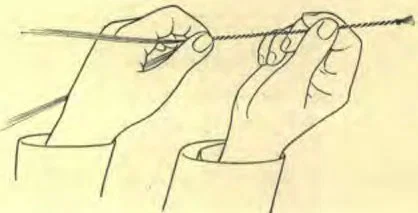
The next step is to twist the hair into threads, or strands. For our present purpose these should contain eight or ten hairs each. Take the tips of the required number of hairs, the longest in the bunch, between the thumb and forefinger of the right hand, and gently draw them from the bunch while the latter is firmly grasped in the left hand at the point where it is bound with the string. If these directions are carefully followed, the hair will never become tangled, nor will that removed draw other hair with it. These hairs must now be bound together by a knot at one end. Consider the hairs a thread, and tie a knot on the end of it, just as you would knot the end of a thread with which you intended to sew on a button. Next separate the thread into two strands of equal size, and while it is held between the thumb and forefinger of the left hand (as shown in the illustration), twist the thread between the thumb and forefinger of the right hand. When the end is reached, tie another knot to prevent the thread from untwisting, and proceed with another till the required number have been twisted.
J. EDGAR ROSS.
THE INTERMEDIATE LESSON
VI—Grass, Herbs, and Trees
(May 10)
“AND God said, Let the earth bring forth grass, the herb yielding seed, and the fruit tree yielding fruit after his kind, whose seed is in itself, upon the earth: and it was so. And the earth brought forth grass, and herb yielding seed after his kind, and the tree yielding fruit, whose seed was in itself, after his kind: and God saw that it was good. And the evening and the morning were the third day.” Gen. 1:11–13.
“Consider the lilies of the field, how they grow.” Matt. 6:28.
“I am the Rose of Sharon, and the Lily of the valleys.” Song of Solomon.
“So is the kingdom of God, as if a man should cast seed into the ground; and should sleep, and rise night and day, and the seed should spring and grow up, he knoweth not how.” Mark 4:26, 27.
(The Scripture texts are the lesson to be studied. Go over these carefully every day, until you know just what each one teaches. Then the following notes will help to a fuller understanding of the lesson. Read them carefully several times. Lastly go over all the questions, and be sure you can answer each one in the words of Scripture.)
The fresh green grass, the beautiful flowers, the waving corn, the stately trees with their load of fruit,—consider how they all grow, and what it is that makes the earth bring them forth from year to year.
Perhaps you think it is the seed; for everything that grows produces seed which provides for the growth of its kind in years to come. But if we want to know the truth about all these things, to get to the beginning of them, and find out what makes them grow, we must go back year by year, until we come to the first plant of each kind, springing up on the third day of creation. Then we shall find that “in the beginning was the Word.”
Every plant that you see in the earth to-day comes from the seed that God sowed on the earth on that day when he said, “Let the earth bring forth grass, the herb yielding seed, and the fruit tree yielding fruit after his kind, whose seed is in itself.” The seed that he put into the ground, that unseen seed from which have come all other seeds that we can see and handle, is “the word of God.”
The grass withers, and the flowers fade; but the word of God, which brought them forth, still lives and works. It is this that is the life of all the seeds that are sown, and that works through them to bring forth again each thing after its kind, to spread a fresh carpet of grass and flowers over the earth, and to produce the harvest of grain and fruit.
So in every springing blade of grass, in every flower of the field, in every tree, we can see the word of God working. Jesus is that Word by whom all things were made. So the beauty of the flowers, the richness of the fruit, the strength143of the grain,—all come from him. It is his life in them that makes the flowers blossom, the fruit ripen, and the grain grow. And if the flowers of earth are so fair, what must be the beauty of Jesus, the true Rose and Lily, from whom they all came, and whose beauty and glory they only dimly reflect?
When we eat the fruits and grains that the earth brings forth, we are really feeding upon him, the True Vine and the Bread of life, who by the word of his mouth makes them all grow.
God told the earth to bring forth the grass and herbs. The dust of the ground had no power of itself to do this. All the power was in the living word, which went forth into the earth, and gave it strength to do the will of God.
All this, Jesus says, is to teach us of his work in our own hearts; for “so is the kingdom of God, as if a man should cast seed into the ground,” and “the kingdom of God is within you.”
We are but dust, with no power of ourselves to do what God tells us. But if we will receive it, his word comes as precious seed into our hearts. And if we keep the word in our hearts, as seed is kept in the ground, it will give us power to do whatever God tells us, just as it gives the earth power to bring forth grass.
As we “consider the lilies, how they grow,” not by trying to, but by the power of God’s word that is in them, we may learn how we also may grow in grace and beauty and purity, to show forth the praises of Jesus, the holy Seed from whom all strength and grace and goodness come.
Questions
What did God say to the earth on the third day, after he had made the seas and the dry land?
How did the earth obey his word?
What did it bring forth?
What did God see about all the things that the earth brought forth?
Were there any thorns and thistles and poisonous plants, as there are now?
What has Jesus told us to consider?
What is it that we are to notice about the lilies?
What is the Seed from which everything grows?
Who is the Word of God that makes all these things?
Then who is the real Rose and Lily?
What are we really feeding upon when we eat the things that grow out of the earth?
Then what is Jesus, by whose word all things are fed?
What is the kingdom of God like?
Where is his kingdom?
What, then, are we to learn from everything that grows?
English History Epitomized
FIRST William the Norman, then William his
son;
Henry, Stephen, and Henry, then Richard and
John;
Next Henry the Third; Edwards one, two, and
three;
Again after Richard three Henrys we see;
Two Edwards, third Richard, if rightly I guess;
Two Henrys, sixth Edward, Queens Mary and
Bess;
Then Jamie the Scot; and Charles, whom they
slew;
Again followed Cromwell; another Charles, too;
Then James called the Second ascended the
throne;
And William and Mary together came on.
Then Anne, Georges four, and fourth William
all reigned.
Next good Queen Victoria, with honor unstained.
And now to the end of the story we come,
As Edward the Seventh ascends to the throne.
—Anon.
Baby and the Barriers
BABY had begun to walk, and it was seen straightway that there were many pitfalls for toddling feet. There were rugs and door-sills to trip over, and then, most serious of all, there were stairs. What should be done about these? Should the tops of stairs be guarded by gates? “Not so,” said baby’s parents. “Baby is not too young to learn the existence of law. He must know that some things are permitted, and some things are forbidden; while at the same time he is given free choice as to which he shall do. Instead of erecting barriers before the stairs, let us put the barriers in baby’s mind.”
So it came to pass that, with little difficulty, the toddler was taught that he must not attempt to walk down-stairs, and must not venture too near the stair landings. In a few days he could be left alone up-stairs, running all through the second story of his home, without any fear that he would fall down-stairs. The barriers had been put up—in baby’s mind.
So it was in other matters. The baby was told that he must not touch the bric-à-brac upon a little table in the parlor. And touch it he would not, though again and again he would go up to the table and reach out his hand toward some pretty trifle, to draw it back with a “No! no! no!” spoken to himself. In the same manner the little fellow’s habits of going to sleep by himself, and eating his meals at regular hours, and a dozen other questions of discipline that belong to a baby’s life, were settled simply by teaching the baby that such was the law.
The incident would be scarcely worth telling, of course, did it apply to none other than this baby, or babies in general. But the question which his parents decided for baby must be decided for every young person by himself. Life is governed by law. Shall law’s barriers, then, be within us, or without us? Shall the young person be hedged about with restraints and rules? Shall he be kept from all possibility of hurt, being guarded and coddled so carefully that many falls will be impossible to him? Or shall he be allowed his liberty, with power to do as he pleases, but with the inclination to do what is right? God’s way, the way that is consistent with noblest character, is the way of the free and untrammeled will. Better right purposes within than rigid prohibitions without.—Well Spring.
The Danger of Self-Pity
“WHEN we pity ourselves, we lose strength at once. Self-pity is the one form of compassion that should never be allowed; its results are invariably evil.”
VI—Faith Is the Victory
(May 10)
MEMORY VERSE: “This is the victory that overcometh the world, even our faith.” 1 John 5:4.
LESSON SCRIPTURES: Same as inserted in synopsis.
Synopsis
Inasmuch as the Word of God is the seed, it follows that every promise by the Word contains sufficient power to fulfill it. “The word of God is quick and powerful,” says Paul, or if we read it literally, we would say: “The word of God is alive,”—it is a living and active power. So, just as a little seed gives promise of a full-grown plant, and has in itself enough stored-up energy to produce it, every promise in God’s word has in itself sufficient life and power to bring it to pass. It is only by faith that we can understand this. Heb. 11:3.
“All the promises of God in him [Christ] are yea, and in him amen.” 2 Cor. 1:20. Yea means “yes;” and amen, “let it be.” Therefore, however many are God’s promises, in Christ is the confirming yes,—he is the fulfillment of them all. In the gift of Christ we have the gift of all things: “in him were all things created, . . . and in him all things hold together.” Col. 1:16, 17, R. V., margin.
But the possession of these things depends wholly upon a living faith in Christ, the living Word, the promised Seed. As soon as one’s faith is centered upon anything else, the power of God’s promise is no longer experienced, and even the visible things already revealed through faith are lost. Thus faith brought the children of Israel out of Egypt into the land of Canaan. Heb. 11:29, 30. They were looking for the establishment of the Lord’s sanctuary, and his everlasting kingdom. Ex. 15:17, 18. If they had hearkened unto him, they would soon have subdued their enemies, the haters of the Lord would have submitted themselves unto him, and their time—Israel’s time—would have endured forever. Ps. 81:13-15. But, losing sight of God’s promise, Israel went into captivity; not only was the heavenly Canaan lost, but the earthly one also. They could not enter into rest, because of their unbelief. Heb. 3:19.
On the other hand, Abraham’s faith laid hold of God’s word. He went out from home and country, not knowing whither he went, looking for a city whose builder and maker is God. By faith he offered up Isaac, considering that God was even able to raise him from the dead. In faith he lived, in faith he died, not having received the promises, but having seen them afar off. Heb. 11:8-19. “Your father Abraham rejoiced to see my day,” says Christ: “and he saw it, and was glad.” John 8:56.
Faith did not give Abraham one foot of land (Acts 7:5), although he had been promised the whole earth; but through faith he laid such hold upon the power in God’s promises that he lived and died as if they had all been fulfilled to him. This was counted to him for righteousness. Rom. 4:22. It made the invisible kingdom a reality to him, so that he saw Christ’s day, and was glad.
Thus faith is the only basis upon which we can deal acceptably with God. Heb. 11:6. God has given a certain measure of it to every man (Rom. 12:3), by which to hear the word, and, moreover, it comes by hearing the word. Rom. 10:17. But if when God speaks, we will not hear, then no faith is exercised, and we can not understand the word sown, and the devil comes and catches it away. Matt. 13:19. It is only by faith that we can understand anything that God does or says.
Questions
What is contained in every promise of the word?
What comparison makes this clear?
What is the nature of this word?
How only can we understand this?
In whom are all God’s promises fulfilled?
In the gift of Christ how much is given?
How only can we realize the full benefit of this gift?
What happened to Israel because they lost sight of the promise?
What would have been the result if they had hearkened to God and believed him?
What did faith lead Abraham to do?
What did he consider that God was able to do?
When he died, what promises had he received in fulfillment?
What had he seen, however?
Although faith did not give Abraham his actual inheritance, what did it do for him? Rom. 4:22.
What, therefore, is the only basis upon which we can deal acceptably with God?
How much is given to every man?
How does faith come?
What happens if we refuse to exercise the faith which God has apportioned us?
Last Chance
If you have changed address since receiving large picture, “Falling Stars at Niagara,” notify F. E. Belden, Battle Creek, Mich., so that the six enlarged illustrated booklets (due with each picture at 39 cts.) shall reach you. Last chance at this price. Forty-five engravings in the booklet. Six copies free with the 22 x 28 picture at 39 cts., postpaid.
Only 125 Copies at Half Price
“THE Farmer’s Guide and Complete Veterinary Doctor Book,” D. Magner’s great rural encyclopedia, contains from 100 to 500 lessons on each of the following topics: Profitable Crops, Restoring Fertility, The Dairy; Training, Feeding, Breeding, and Doctoring Horses; Care of Sheep, Cattle, Hogs, and Poultry in health and disease; Animal Parasites, Fruit Growing, Insect Pests, Spraying, etc.; with a department on law without lawyers, farm law, and numerous other up-to-date facts, including the new system of horse training and breeders’ tables.
Nine hundred and forty-three royal octavo pages. 1200 illustrations. By the famous horse trainer, veterinarian, and humane author, Dr. Magner, who sold the plates of this book to another publisher, and has on hand only these few copies of his last edition, bound in half-red Russia. It weighs five pounds. Regular price, $5; postage 40 cents. Going quick at half price, postage added; total, $2.90, or less than one third of a cent a page, 1200 illustrations thrown in. Money refunded if not satisfactory. Show this to your neighbor farmers. Only 125 copies. Order to-day.
Address Health Library Association, F. E. Belden, manager, Battle Creek, Mich.
Shorthand by Mail
YOUR spare time can be well improved by studying shorthand, and this can be done at small expense to you by taking a mail course at your home. We are using “The Rogers Compendium of the Graham System of Shorthand,” a method arranged especially for home study, and giving an epitome of a system of shorthand acknowledged to be the best, the briefest, and the most complete. The only presentation of Standard Phonography in which all shorthand outlines are written as first learned, thus greatly abbreviating the work on the part of the student. A complete course in thirty lessons, illustrated by facsimile notes, with key. The correction of all students’ papers given special attention by experts. Reasonable tuition rates. If interested, write for full particulars. Practicing stenographers wishing to prepare for rapid reporting work should secure the last twenty lessons.
FIRESIDE CORRESPONDENCE SCHOOL, Battle Creek, Mich.
Personal Service as Response to God's Gift
By E. R. Palmer
Jesus Christ is the response of God to the needs and helplessness of a lost world. Personal service is the response of his children to those same needs, and it reveals the extent of our appreciation of the gift of God. It also reveals the measure of our reception of that gift; for God has so arranged the economy of his love that we receive from him in the true sense only as we impart to others. E. R. Palmer.
SOLID THROUGH TRAINS OF
WIDE VESTIBULE COACHES and PULLMAN SLEEPING CARS BETWEEN
Battle Creek and Chicago, Buffalo, New York, Philadelphia, Toronto, Montreal, Boston
For time-tables, descriptive matter, and information, apply to any representative of the company.