As the complete annual reports from the various parts of our large field have been received, we take pleasure in briefly reviewing the blessings God has so richly showered upon us.
We are truly living in the time of the “loud cry.” Just as the voice of him who cried in the wilderness, “Repent ye,” stirred that generation, so in our day is the message which began in weakness and obscurity, now permeating the ranks not only of the common people, who hear it more gladly, but it is coming to the notice of captains and generals in the Continental armies; it is one of the subjects accorded investigation by the European and Asiatic courts of justice; its principles have been brought to the attention of the kings and queens and of the emperors and empresses of the Old World. We refer to this in no spirit of pride, but only for the encouragement of that little band who have so long been faithful, and whose eyes are ever turned heavenward, while all their powers are earnestly engaged to hasten the coming of that glad day that has been the hope of His people since the world began.
Territory
The General European field embraces the German, the Scandinavian, and the British Union Conferences, and the Latin and the Oriental Union Missions, with an area of 14,700,000 square miles (four times that of the United States), and a population of over 490,000,000—nearly one third of the whole human race. Did these multitudes speak but one language, it would indeed seem no very simple thing for twelve thousand believers to carry the third angel’s message to them; but if we consider the hundreds of languages and dialects represented in our territory, we can but admit that only the divine power of God can accomplish the task before us.
Another Country Entered
Late last summer we began work in an entirely new field by requesting Brother and Sister Jesperson to enter Algeria as medical missionaries under the direction and support of the Latin Union Mission. This country, with Tunis, has a population of six and one-half millions. For a time our workers labored in Blida, but now they are located in the capital, Algiers, which, with its suburbs, contains 139,000 inhabitants, and, seen from the sea, is said to be “one of the grandest, noblest, and most striking cities in the world.”
Statistics
I dare say that we watch our quarterly reports with almost as keen an interest as the eager capitalist observes the returns of his balance-sheet; while he is greatly concerned as to how this or that investment may net him a certain gross income, we feel very anxious to see the large sums of money we are expending, so richly blessed of God that hundreds and thousands of souls may be gathered into the sheepfold of the Good Shepherd every year—and that the more as we know we are “in the time of the latter rain.” Rich, copious showers of blessing are falling, and the dry and parched ground of many hearts is being watered, so that the seed sown may spring up and bear fruit, some thirty, some sixty, and some an hundredfold.
One of the most remarkable evidences of growth seen in the European field the past year is the increase in funds, for the Lord’s treasury is a sort of spiritual thermometer, registering the faithfulness with which our laborers and brethren return to him his own in tithes and offerings. But to consider the figures: in 1904 our tithe was $80,600; last year it was $101,300, or $20,700 more than the previous twelve months, and over $4,000 more than double what it was in 1901. Last year our offerings were $19,760, an increase of $4,700 over 1904, and $3,430 more than twice the reported offerings for 1902. In 1905 we had 402 regular canvassers in the field, and our sales amounted to $184,000; the year before we had 337 canvassers, and the sales amounted to $119,950.
The thirty-first of last December our membership was 12,022, eight more than twice what it was at the close of 1898. The number received during the year is 1,989 (net increase, 994), against 2,200 baptized and accepted by vote, and a net growth of 1,481 in 1904. The gain was less last year than the year before, partly because in 1904 a number of native Russians were received by vote, who, as circumstances afterward demonstrated, had not been sufficiently instructed in the fundamental truths of the message to enable them to remain steadfast during the dark days through which Russia has recently been passing, and partly because so many of our Scandinavian and German Union brethren left Europe for North and South America, and partly because we are trying to keep our church records as clean as possible.
If we consider the number of evangelical workers last year, we find that we had two hundred and eighty-four laborers. That is six more than twice as many as we had in 1900, but one less than we reported at the close of 1904. This is a matter which grieves us very much: some of our workers have had to leave the field on account of failing health; but sadder still, several have12apostatized; for we are also living in the “shaking time,” when men are rapidly, although perhaps to themselves imperceptibly, changing their leaders. Our great need to-day is true, self-denying, experienced workers. As the president of the General European Conference has visited all parts of our field the past year, he has been pained to see how great is the lack of well-trained and efficient laborers who can carry heavy responsibilities. While we have many promising children and youth in training among the three hundred and forty-one students in our twelve European schools, to say nothing of the number connected with our sanitariums, or of the one hundred and ninety-five pupils enrolled in our three mission schools,—one in Iceland, and two in German East Africa,—yet the new recruits supplied from these sources have not been sufficient to fill up the vacancies in our laborers’ ranks, occasioned by loss of health and desertion. Therefore we should pray the Lord of the harvest that he send laborers into his harvest.
Institutional Work
God’s signal blessing has rested upon the thirty publishing, health, and educational institutions of Europe, so that their net gain for 1905 is $39,000. We opened treatment rooms in Constantinople. We successfully moved the Basel Sanitarium and health food factory to the beautiful estate near Gland, and connected with it a small but important Latin Union school. A new dwelling-house has been erected for our employees in Friedensau. The Skodsborg branch sanitarium at Frydenstrand has been purchased by the Danish Conference, and has done better than ever before. As far as we know, not one of our institutions has closed the year 1905 with a loss, and most of them have had fair net earnings. The only insolvent institution we had, cleared two thousand dollars, and is now solvent, with prospects for a better output this year than last. Part of the time our sanitariums have been overcrowded, and most of the year they had all they could comfortably do. Our health food factories have done well. Our schools have been blessed of heaven. Should the merciful Father favor our European institutions a few more seasons, as he has in the past, they will all soon be free from indebtedness.
Last year we issued the following new books: “Daniel and the Revelation,” in Finnish; a “Hygienic Cook-Book,” in German, and one in French; “Coming King,” in Hollandish; “Sabbath Readings,” Vol. III, in German; and “Steps to Christ,” in Russian, Lettonian, and Esthonian. We now have in preparation “Daniel and the Revelation,” in Swedish; “Daniel,” in Danish-Norwegian; “Education” and “Ministry of Healing,” in German; and “Daniel and the Revelation,” in French.
Another matter has received a great deal of attention—the establishment of proper co-operation between our European and American publishing houses, that we may bring about an advantageous interchange of foreign books issued in Europe by their acceptation in the States, while such works as are printed in America will, in turn, be put on the market here. This will save the duplication of editions, and we believe it will meet with the general approval of our people. (Of course there may be some works that would not fit our fields at all, but would sell well in America, and vice versa.) For example, the volume of “Selections from the Testimonies” printed some two years ago in Hamburg, is now being sold in America, while the last number of the “Testimonies,” printed in German by the College View plant, has been furnished also to the European field direct from the States. If carefully carried out, we hope this method will be of advantage to all.
Appropriations From America
All will be glad to learn that through the goodness of God we were able to reduce our American appropriations for the European field to $14,350 for 1905, notwithstanding that we had to carry the Latin Union deficits, which had been met by Latin Union funds the previous year. In view of our having to carry the Latin Union, we at first thought that we would require about $25,000 from the States to tide us over; as the time passed, that was cut down to $20,000, and when the audits were all completed, we saw that we could get on with only $14,350, against more than $17,000 for 1904. Last year $4,600 went to the Latin Union, $4,500 to the British Union, $4,250 to the Orient, and $1,000 to Scandinavia.
Our present estimate for 1906 is: Scandinavia, $700; British Union, $4,000 (or, if they succeed in finding a location for their union publishing house, sanitarium, college, and food factory, $10,000, as this sum has already been promised by our American brethren, in the event of their purchasing such a property); Latin Union, $5,000; and Oriental Union, also $5,000: total, $14,700, or $24,700. We certainly think the friends of the cause in the United States would not regard the appropriations called for any too large, in view of the greatness of our field, the density of its population, and the needs of the people. We trust our request may be granted. We also feel to thank all our true-hearted fellow workers across the sea for the material assistance they have given these lands in the years gone by. God alone, however, can repay them for their generosity; each self-denying act that has been prompted by love to him has been recorded by the ever-present accompanying angel from the courts above, and it will not be forgotten by the One who says, “I have graven thee upon the palms of my hands.”
Our Needs
In addition to more of his Holy Spirit, we need:—
1. A good union institution in Great Britain, where we can have our central sanitarium, our school, our publishing house, and our food factory.
2. Better quarters for the Belfast Sanitarium.
3. An additional building for the accommodation of patients at Skodsborg, as they have recently had to give up the largest villa they had been renting.
4. More perfect arrangements should be made for the education of our youth in Scandinavia.
5. We hope to assist the British Union Conference in the establishment of a mission in British East Africa before the close of 1906.
6. We plan to open a third station in German East Africa by May, 1906. The German Union has found that, although its mission to the heathen has cost $11,000 since it was begun in 1903, yet no other enterprise it has undertaken has so stimulated the interest of our brethren in the spread of the gospel at home and abroad as this, and funds for missionary operations are to-day much more abundant than we think they would have been had not we entered that field.
7. As the Scandinavian Union is now getting a small surplus, it is proposed that it soon think of entering Abyssinia.
8. As the General European Conference treasury had a surplus of a few hundred dollars at the close of 1905, we hope to be permitted to use this means in assisting these proposed missions to the heathen in British East Africa and in Abyssinia.
9. Last, but not least, we need, and we earnestly ask for, the prayers and co-operation of our brethren and sisters in all parts of the great field. We feel that we are a part of the great body of believers, and while we have union among ourselves in Europe, yet we desire that our hearts may be yet more closely knit together in the bond of perfectness, and that the year 1906 shall be the best one we have ever had. Be of good cheer. We are connected with a successful work, and God will shortly finish it in righteousness.
Hamburg.
Led by a Baby
THE baby was alive, although its mother died. The Lushai tribes of eastern Bengal in such cases place the baby in a small pot, and bury it alive with its dead mother. But when its mother died, the missionary told them that was wicked. The Lushais answered, “Wicked or not, there is nothing else to do.” The missionaries tried to coax a Lushai woman to nurse the poor little thing, but the woman shuddered at the thought of nursing a dead woman’s baby. They tried to persuade the people to feed it cow’s milk, but they only laughed at this.
Then the missionaries took the little boy of skin and bones to their own home, and gave it a bottle full of good warm milk. In due time the baby began to grow fat. This was a miracle among the people. The baby is a wonder, because13although his mother is dead, he still lives. More than a year has passed since his thin little lips first laid hold of the bottle, and he has already taught his kinsmen of the hills a lesson, for they bury babies through ignorance, rather than stony-heartedness. He is also becoming a living link between the Lushais and the missionaries, and is preparing the way for them to teach the people the love of a Heavenly Father.—Selected.
On the Panama Canal Strip
By GEO. F. ENOCH
GEO. F. ENOCH
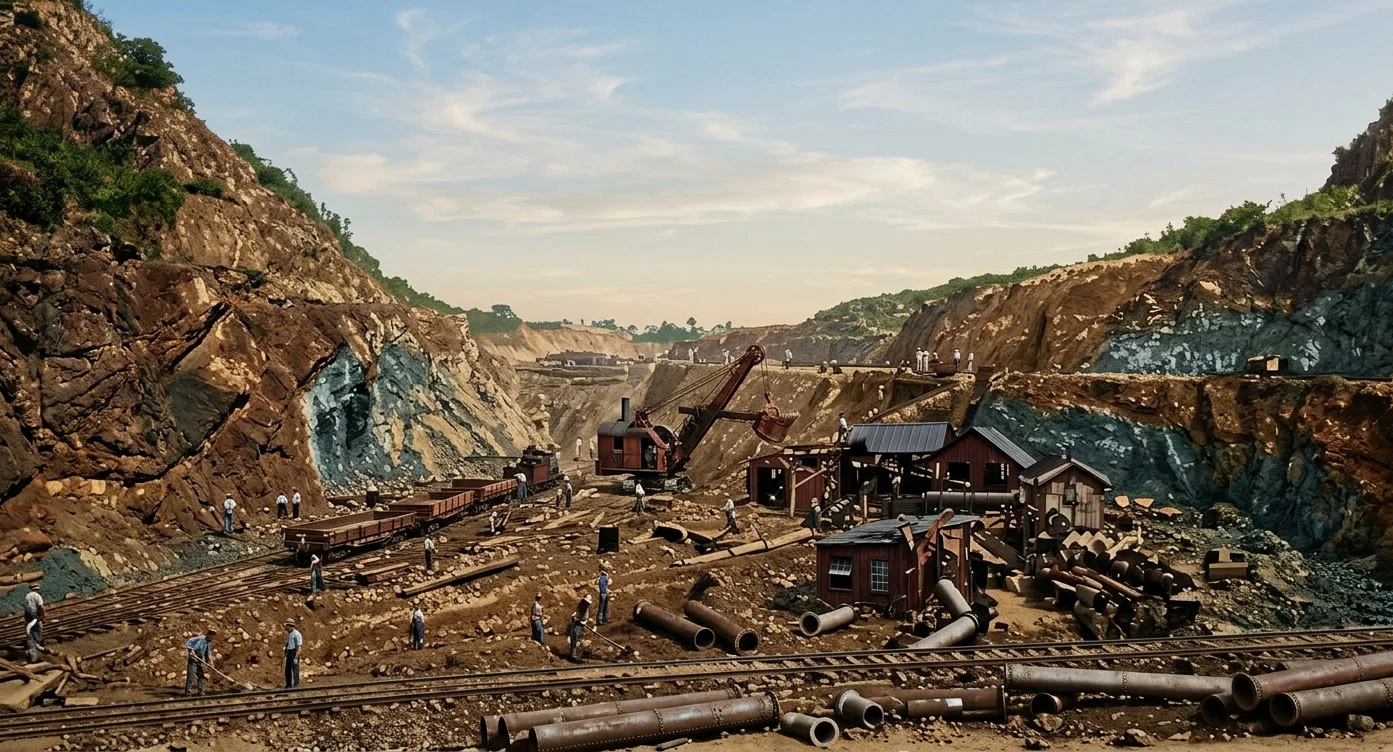
A FEW words concerning the Panama Canal Strip, toward which the eyes of the world, especially Americans, are now turned, will doubtless be of interest to REVIEW readers. The writer, during his recent trip, was agreeably surprised with some features found on the Strip. The Colon of to-day is quite different from the Colon of a year ago. Heroic work has been done in sanitary lines, and the houses, like Jonah's gourd, are going up in a night.
A GLIMPSE OF WORK ON THE CANAL STRIP
The place has a decidedly tropical climate, and a man can not do there what he can do in a cold country. But after eight years' residence at different places in the tropics, I can see no reason why one can not live in the Canal Zone. There is undoubtedly plenty of malaria along the marshes. But malaria is found in all tropical countries, and shall we desert the millions of souls living in that region of the world just because we find malaria there? God forbid that the young men and women of this denomination should be so cowardly as that. The writer is speaking from experience. He has stood by the bedside of faithful laborers, brought down to the very gates of death by tropical diseases, and in his own family he has for long, long months fought the chills and burning fever, and yet he sees no reason why these fields should be deserted or left unentered.
The Moravians in the Guianas have left us a noble example. When they first entered this field, years ago, they lost missionaries almost every year; for a time, I have heard it said, their missionary graves were almost as numer- ous as their converts. But as soon as one soldier fell at his post, another from the home land filled the vacancy, and a great and noble work was done.
Suppose missionary graves do mark our advance into other lands? Who ever heard of a war's being fought without the sacrifice of lives? Who but the traitor and the coward will desert his place on the battle-field, because comrades are falling around him, or because he fears death? Let the young men and women who offer themselves for foreign service in this great world-wide campaign weigh these things well.
We do not say that there is no poetry in these bright, sunshiny countries, with their azure skies, deep-blue seas, and warm-hearted peoples; but there is plenty of prose as well. And as soon as one gets in the midst of new surroundings, among strange people with strange customs, and the first attack of nostalgia comes on, the poetry all disappears; and another mission station will be deserted, unless the missionary makes up his mind to be a missionary in deed as well as in name, choosing the mission- ary's lot as his lot, in sickness or health, for better or worse, as long as the Lord shall give him life. Let us, then, be faithful at our post of duty; and if comrades fall, fill the gaps with new recruits, and press the battle to the very gates. The conflict will soon be over, the battle will be fought, and the victory won.
It hardly seems wise for the worker who comes to the Canal Zone to locate on the coast near the marshes. Funds should be provided to build a house in the highest place along the Strip, say at Empire or Culebra. As the railway gives free passes to missionaries, the entire Strip could be worked from there. In Colon there is enough money in hand at the present time to put up a church building, with a membership of about forty, and more coming in all the time from other islands. Then there is a company up the line at Bohio, and another small company of believers at Panama, on the Pacific. While in Colon, the writer had the privilege of holding open-air meetings with very large congregations that gave the closest atten- tion. The little Bilhorn organ belonging to the church set up on the corner, the preacher standing on a pile of lumber, in the lee of a partly finished building in the full blaze of the electric light, saloons in full swing on the opposite corners, a large crowd, Americans, Englishmen, Chinamen, Spaniards, and West Indians, listening with rapt attention to the Bible explanation of the signs of the times,—all this makes an indelible impression on the mind, and causes one to turn to other duties with regret that such a needy field is left neglected. May God forgive those who are willing to stay at home, in the midst of its peace and plenty, when they might be out in some needy, unwarned portion of the world gathering an abundant harvest of souls.
In regard to the digging of the “big ditch,” the American government is doing a great work. The building of this canal is a tremendous task. It is easy to criticize the man who is undertaking such a task. Usually the critic would not be able to do one half as well. The Americans have many lessons to learn. It will take nearly twice as long to do the same task in the tropics as in the north. There has also been trouble with the labor question, which will continue until the American and the West Indian understand each other. A man can not work in a hot country as in a cold. Even the American will find it necessary to adopt a tropical gait.
We have many faithful believers coming to labor on the Strip from all parts of the West Indies. They are subject to severe trials and tests of faith, and they should have some one to look after their spiritual welfare. Colon is no place to leave any one alone. It is a place of work, wickedness, and whisky. It reminds one of Kipling's Mandalay,—
“Take me somewhere east of Suez,
where the best is as the worst,
Where there ain't no ten commandments, and a man can raise a thirst.”
People as a rule recognize no ten commandments there. The most of them have left their church behind them. Still many of our people are standing firm and true in the midst of the surrounding wickedness, and the banner on which is inscribed the “Commandments of God and the Faith of Jesus” is being uplifted all along the line. For this we are truly thankful.
Barbados.
Malay Literature and Tent Work
From Cooranbong, Australia, Brother R. W. Munson writes: “I am going out into tent work with Brother Fulton soon. I am doing my best to rush through literature in Malay for the workers in Singapore. I have just completed a tract on the second advent, and am well started on ‘Christ Our Saviour.’ I shall probably spend my mornings translating, and my afternoons and evenings in visiting and tent work.”
South Africa
By Hebert J. Edmed
VRYHEID, NATAL.—The little town of Vryheid, once a border town of the Transvaal, was transferred two years ago, for political reasons, to Natal. It is now a very small village, but is in the center of a large district which was the home of some of the wealthiest and best Dutch farmers in the colony. Unfortunately this town with its immense district was completely denuded of its fine farmhouses and cattle during the recent conflict between the Dutch and the English; and now nothing but ruins may be seen in the place of the old farmhouses. At this writing, another cloud gathers over this ruined people. The town happens to be on the borders of Zululand, where the natives are in rebellion, and the guns of the British may be heard from the hills surrounding the town. In the meantime another scourge is threatening to destroy their cattle, for the dread disease rinderpest has broken out, and thus dark days are before this already heart-broken people.
We are thankful that yet another ray of light is shining upon this people, in the third angel's message, which reached the wife and the daughter of one of Vryheid's best residents, while staying at the house of Brother Biessmer two years ago. This woman is the wife of a member of the legislative council of Natal, and has stood stiffly for the truth ever since she heard it. Brother F. C. Ernst also settled on a little farm near by, and as a partially self-supporting worker has been doing good work in the town, with the result that quite a little company have been gathered out. The Hon. C. Birckenstock, who has some of his children attending Union College, Claremont, has donated a large lot of ground for the purpose of building a meeting-house which is to cost one hundred and fifty pounds, and at our conference meeting it was decided to try to help raise the amount required. We are thankful that hard times do not prevent the spread of this glorious message.
HEBERT J. EDMED.
GEO. M. BROWN
By GEO. M. BROWN.
Mexico
TACUBAYA.—On my return from the States I stopped one day at Torreon, where Brother Caviness is now spending some time. The work there is growing, and all seemed of good courage. Brother Blachly lives here. I found him in a very feeble condition, just able to be around a little, but of good courage in the Lord. He is expecting to go to Kansas with his family some time in May, where he will go on a farm, to see if he can not build up his shattered strength. The night before I arrived in Torreon, one of the men who had been the most faithful in attending our meetings died suddenly. He had been at the meetings on Sabbath, apparently in his usual health, and the next morning he was dead. How uncertain is life, and how important that we use wisely the days as they come to us.
Brother and Sister J. C. McCulloch and their daughter, Mrs. May Carr, have moved to Tampico, a seaport with more than sixteen thousand inhabitants on the Gulf of Mexico. Tampico is the terminus of one line of the Mexican Central Railway, and is rapidly growing in population and importance. Many ships of all nations enter the harbor here, and it is planned that Brother and Sister McCulloch work among the sailors. They will be self-supporting, and will, we believe, be blessed of God in doing a great work.
The interest at San Luis Potosi is growing, and the brethren there feel of good courage. Four new Sabbath-keepers were reported from that place last month. Brother John Harzman made a very successful trip through the States of Yucatan, Tabasco, Campeche, and Vera Cruz, selling a large number of papers and tracts, and securing three hundred and forty-two annual and three six-months' subscriptions for El Mensajero de la Verdad, and eleven for La Salud, in the twelve weeks spent in the trip. During the same time, Brother Colunga secured three hundred and seventy-six yearly subscriptions for El Mensajero, and fifty for La Salud, in the States of Durango and Coahuila.
We find that the interests of the work here in Mexico City demand that we secure a more central meeting place, which we shall do as soon as consistent. Homes are being opened here for Bible readings, and we are meeting with many evidences of the preparation of hearts for the reception of the truth.
While the work will move slowly here, we all believe that it is to advance much faster than in the past, and that we shall soon begin to reap some harvest from the seed sowing that has been done.
GEO. M. BROWN
F. W. FIELD
By F. W. Field
Japan
I have just returned to Tokyo after a two weeks' visit to Kobe and Nagasaki. On Sabbath, April 21, we had a good day with the Kobe church. In the afternoon we celebrated the ordinances with them. The following Sabbath Brother Okohira baptized six young people who have recently given themselves to the Lord's service. Four of these are connected with the work at our Japanese sanitarium.
Monday morning I started for Nagasaki, Brother Okohira accompanying me as far as Hiroshima. Here Brother Tatsuguchi has been living and practising dentistry for over a year. Meanwhile he and his wife have been earnestly seeking to impart the light of present truth to others. His two apprentices have begun the observance of the Sabbath, and desire baptism. A local elder in one of the other churches has just begun to observe the Sabbath, but has not yet fully investigated other points of our faith. Hiroshima is an important center, and we are greatly rejoiced to have the truth gain a foothold there.
Tuesday morning I reached Nagasaki, and was met by Brother Kuniya and Dr. Kawasaki. We went at once to Brother Kawasaki's house. Here I saw a number of familiar faces. The workers at the Japanese sanitarium in Kobe have divided forces, and Dr. Kawasaki has already begun a similar work in Nagasaki. Treatment rooms and other conveniences have been fitted up, patients are already coming for treatment and consultation, and the work starts out in a very promising manner.
On Thursday Dr. Lockwood and his wife arrived from Kobe, and remained over Sabbath. We had profitable times in talking over the interests of the work. On Sabbath, after a Bible study on the duties of church-members, the Nagasaki church was organized with nine members. Eight of these come from the Kobe church; one was baptized a few days before. Several others are awaiting baptism, and still others are interested. Brother Kuniya will devote his efforts to the building up of the Nagasaki church for some time to come. Nagasaki is recognized as a difficult field, on account of the strong conservatism of the people, and their settled opposition to foreign ways and a foreign religion. But the outlook for our work is promising, and we are much encouraged. A favorable place for holding meetings has been secured on a prominent street of the city.
Brother Kaname, of Wakamatsu, has recently transferred his business to Shimonoseki15He deals in lacquer ware, and finds a better market in the south. He reports that his agent, or clerk, has become interested in the truth, and has begun the observance of the Sabbath. Thus one more little light is shining in another important center.
So while we can not report large accessions to the truth thus far this year, we rejoice that the truth is spreading, and catching here and there in new places; and we wait and pray with earnest longing for the baptism of power that will make every feeble light a blaze, and put a tongue of fire in every mouth.
F. W. FIELD
Illinois
By L. D. SANTEE
MOLINE.—We have just finished a series of meetings and Bible readings, assisted by our Bible worker, Sister Silver. Last Sabbath eight were baptized, and ten added to the church. Several others are keeping the Sabbath, but are not yet ready to unite with us. When Sister White visited the Tri-City Sanitarium, she said, “If the right course is pursued here, this will be an easy field to work in,” and her words are proving true. Many of the patients are reading our literature. L. D. SANTEE.
New York
By John S. Wightman
BATH.—Sixteen have accepted present truth as the result of work done here since December 8. Some have moved to other places, but all remain firm. We are adding those who remain to the Wallace church, ten miles distant. Baptism has taken place once, and others will be baptized soon. One young lady of talent and pleasing appearance has begun presenting the truth in a distant union church to interested audiences. Two converts have entered the canvassing work. Mrs. Wightman and I are now giving a complete second course of the lectures. One hundred and forty persons are attending, and there seems to be no end in sight, that we may enter upon our tent work. Two hundred thousand pages of literature have been circulated here since December 8. Ten are taking the Signs, and now we wish to see that the REVIEW goes to all.
Surely the Lord has worked with a strong arm here; and to him be all the praise and all the glory, for “without him” we can “do nothing,” and so our insufficiency is fully apparent. We believe and know that the message will triumph despite all opposition.
JOHN S. WIGHTMAN.
India
By W. W. Miller
KARMATAR.— The work is moving along in India, Burma, and Ceylon. I have just returned from a visit to these places, and am greatly encouraged with the outlook. Sister Della Smith is canvassing in Bombay, and enjoys her work very much.
At Bangalore, where Sister Orr and Brother and Sister Meyers are working, the interest is good. I visited many of their readers, and they seemed to take a deep interest in the Bible. While I was there, they invited me to speak. Thirty were present, and at the close of the meeting they said that an interest had been awakened which some one should care for. A letter from Sister Orr this week reports some keeping the Sabbath.
At Colombo I found that as a result of the tent effort, two families are keeping the Sabbath, and others are interested. Willie Meyer has just returned from Avondale, and has taken up the canvassing work. In thirteen days he took orders to the amount of one thousand rupees. Elder Owen is doing some Bible work. The message is onward in Ceylon.
At Rangoon the work is most encouraging. Our laborers there have a hall, and on Sunday and Tuesday evenings they hold public meetings. The house was crowded the two nights I was there.
Elder Votaw and I visited Moulmein, where Brother Maung Maung is working. As we stepped from the boat, he told us there were eight there who desired baptism. Instead of Maung Maung and his sister May May standing alone, as they did last year, they have several others with them. They feel much encouraged, and are very happy in the new truth, as they call it. I spoke to them from Eph. 1:9, 10, and one of the new Sabbath-keepers interpreted.
The Burmese are a much cleaner people than some of the natives of India, and the field seems more hopeful than India, if we look on the outward appearance.
Last Monday I baptized five of our native students, and a Hindi man who accepted the truth through the efforts of Brother Barlow. He is a talented man, and will engage in the work at ten rupees a month (a little more than three dollars). He loves the truth. He gave up his tobacco, and wherever he goes, he speaks of its bad effects. We were out with him in one of the villages. The people, to show their good will to him, brought a pipe, lighted, and ready for him to smoke. He lost no time in telling them why he refused.
We have sent two Bengali workers to East Bengal, to look after the interest, and word comes that the interest is growing, and they are visiting other villages. It does seem to me that a quick work must be done in these villages; for there are thousands in them, and we shall never be able to spend a long time in any one. Jesus, when invited to remain in a city, said, “I must preach the kingdom of God to other cities also.” And if we ever get this message before India’s millions, we must do likewise.
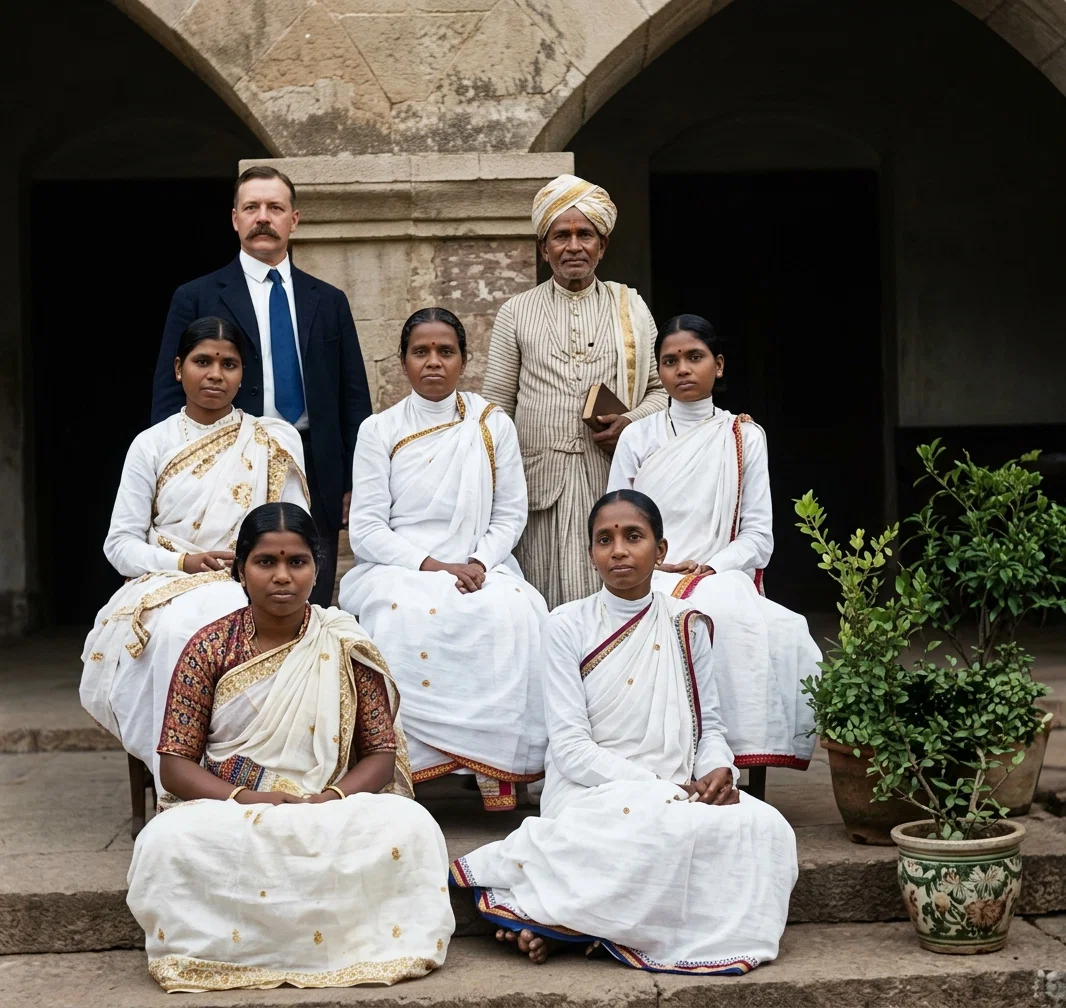
ELDER W. W. MILLER AND CONVERTS RECENTLY BAPTIZED
We are all very happy here in India, and enjoy it more and more as we get acquainted with the people. I was thirteen nights on the train, and eight on the boat, in my visit among the workers, and I never felt better. I went third-class; traveled more than six thousand miles, and my railway and boat fare was less than one hundred rupees.
W. W. MILLER.
Adventist Work Amid Bombay’s Plague
By Carl A. Hansen
BOMBAY.—Since we last wrote you from this place, there has been much excitement and a great deal of moving about among the people. One of the chief causes is the Bubonic plague, which started about two months ago, and strikes everything and everybody that it meets with a blow that almost always means sure death. It was thought by some that Europeans were exempt from this dreadful scourge, but already several of my friends have been taken, and in a few hours were laid to rest. The plague is a peculiar disease. It begins with high fever, and severe pains in the back and limbs. Soon follow swellings under the arms and about the groins and neck, and in a few hours at most a call is made for the coolies to carry the victim to the cremation yard. One very strange thing about it is that a drink of cold water given at certain stages of the disease will produce death in a few minutes. Those in authority state that about twenty-five hundred die from plague every week at present in Bombay. It is plain to see that the work which we should have done years ago must now be done, as the spirit of prophecy states, “under trying circumstances.” Yet we are glad to say that God has taken away our fear of death to a most gratifying degree. We do not know what our fate will be, but if death comes, it will find us at our post.
We are having some success, but of course the work goes slowly in a new place, and especially where the opposition is so strong against our people. We have one French lady who is rejoicing in the truth, and who eagerly grasps every advance ray of light. She told me the other day that she wanted a copy of “Early Writings” as soon as I could get it here. We rejoice that God is impressing these souls with the necessity of the gift of prophecy. At present there are six who are keeping the Sabbath, and we plead with God that he will keep that which we have committed into his hand, and that our little Sabbath-school may soon grow into a large one. Let me say in this connection that one of our number, Brother Marshall, an old sea captain, first heard of the message through Brother Ellery Robinson while he was canvassing in this city, and the other day he asked me to help him write to his former church that he could no longer go with them. This is another encouragement for canvassers. I really believe that the time has come when something can be done for India, and what it needs is the direct stroke of the ministers and Bible workers. Thousands of books and papers have been scattered throughout this vast field by our faithful canvassers, and this has prepared the hearts of many for more aggressive work, and now the great question is, Where are the ministers and Bible workers to hasten over the territory and put on the finishing touches, and bring the people into the truth?
We also need good, consecrated medical workers to move into the cities, and help keep up the Sabbath-school and meetings among these new companies of Sabbath-keepers. There are hundreds of openings for American physicians, dentists, and nurses, etc., where the work could be made self-supporting from the beginning. India is a vast harvest-field; it has the educated class; it has also the teeming ignorant masses. About two hundred and fifty million in India could not tell their name from their neighbor's if they saw it in print; even the mail deliverers often call at my door to have me read to them the names on the letters they are to deliver. So while we need the highest talent we can get to reach the wealthy classes, yet there is plenty of room for the humblest worker from whose heart is tender, and who longs sufficiently for Jesus to come, to leave home and friends to come and help finish the work. India has one fourth of the world's inhabitants, yet it has not to my knowledge a dozen workers who are free to go among the people and preach the message. Let us pray the Lord of the harvest that he will send us laborers16soon. Soon the golden harvest will be over, the sheaves will be gathered, and some one will wear the starry crown.
Now is the time for all to work,
Now in probation’s day;
Soon the angel of mercy will take its flight,
And the harvest pass away.
CARL A. HANSEN.