The apostle asks and answers this question. “For what is your life? It is even a vapor that appeareth for a little time, and then vanisheth away.” Probably a more faithful illustration could not be selected, though inspiration has chosen others also. Job says, “My life is wind;” and, “My days are swifter than a post.” The psalmist exclaims, “My days are consumed like smoke;” and again, “Thou hast made my days as an handbreadth.” Yet David died of good old age, full of years; and Job lived a hundred and forty years after the period of his affliction.
As the grass which groweth up to-day, and to-morrow withereth away; as the fleecy clouds of the morning melt before the sun; as the flower of the field flourishes for a few brief hours, then withers away, so is human life. It is a vain thing upon which to build our hopes or fasten our affections. The Taj Mahal, India’s most beautiful mausoleum, bears this inscription: “This world is a bridge; pass thou over it, but build no house thereon.”
To childhood and youth life does not appear thus brief and vain. But as we go down the declivity, life seems to gain momentum. Days, months, and years, like telegraph-posts and mile-posts, seem to fly more swiftly by, and constantly the thought comes to mind, How time flies! It seems but a few days since we stood at the threshold of our career, looking expectantly to the future. A few years in school, a short period of youthful liberty; then cares, responsibilities, and the real struggle of life. Soon our children stand where we stood as it were but yesterday; friends tell us of gray hairs. A few more seasons, and strength begins to wane, vigor declines, age comes on, decrepitude follows, and once more as helpless children we totter about, wondering where life has gone; perhaps wishing in vain for another chance at the opportunities that come no more; perhaps glad that the vain show is over, and anxious for rest from burdens that vex, and from toil that satisfies not.
But it is not thus that we choose to regard life. Life is a precious opportunity given us in which to prepare for eternity. No matter how brief, it is long enough, if well improved, to gain the object. If long, there is not one day or hour to waste. Are life’s privileges worth enjoying?—That depends on how we use them. A life misspent is ten thousand times worse than vain. Wisely spent, life is a boon of the most inestimable value. An eternity won is the greatest of all prizes. Eternity lost is a calamity of incalculable magnitude.
Our Saviour almost paradoxically states the secret of a successful life when he says: “Whosoever will save his life shall lose it; but whosoever shall lose his life for my sake and the gospel’s, the same shall save it.” The way to save our lives is to give them away! The way to lose them is to try to save them! Selfishness is the one great evil to which life is exposed. Here lurks our danger. Living for self is to love death. To live for God and humanity, is the path of eternal life. Christ Jesus is the life of the world. He gave himself for others. He said, “Except a corn of wheat fall into the ground and die, it abideth alone; but if it die, it bringeth forth much fruit.” Again he said, “Herein is my Father glorified, that ye bear much fruit; so shall ye be my disciples.” Christ died and rose again, and the fruit his sacrifice will bear, who shall measure it? His life was brief, less than half the allotted period of threescore years and ten. He only reached an age when most people reckon their life’s work as but fairly begun; but such a life! How full of glory to God! how full of eternal blessings to the world!
To every one is given the unspeakable privilege of dying with him. With him we may be crucified to sin and self. With him we may walk in newness of life. With him we may forget self in the great effort to help others. Our lives may be placed upon the altar of loving sacrifice, a sweet-smelling savor to God. He will accept the gift, and sanctify it to the good of those upon whom it may be bestowed. Death is not the goal of life, but the way to life lies through the lowly valley of self-sacrifice and self-abnegation. It emerges adorned with the graces of Christ, which minister to human want and weakness.
“’Tis vain to dread the end, for it will come
Whether we hope or fear, or mourn or smile;
‘Dust unto dust’—the stern fatality,
The bourn of life, whatever dreams beguile.”
’Tis vain to lament the brevity or vanity of life. Life is grand and glorious. The Lord has linked it to eternity. Though of itself but a passing shadow, a fleeting cloud, it is a fit precursor to that eternal state where with long life the soul shall be satisfied. O let us seek so to use its every opportunity, so to improve its hours, that, brief as it is, it may be not ours but His who gave it. G. C. T.
COMMANDMENTS THREE, FOUR, AND FIVE.
By Uriah Smith
The Third Commandment.—This commandment brings to view another element essential to true worship, and a right attitude on our part toward God. As the first commandment sets forth the one object of worship, in opposition to false gods, and the second declares the spirituality of true worship, in opposition to outward and sensuous forms, so this commandment shows in what frame of mind all worship should be offered: it should be with that humility and reverence which is becoming to us as creatures, and which is due to God as the Creator.
While it is chiefly violated in common profanity, it has a broader application, and takes in the formal or careless use of God’s name in any connection. Many a giddy prayer, uttered to be heard of men rather than of God; many a flippant sermon, employing the name of God for the exaltation and display of self, would come under the condemnation of this commandment. In short, it shows that God has supreme authority over our speech, and that all our words should be ordered to the honor of his name. In this commandment, as in the preceding, the Lord reserves to himself the matter of dealing with the offender. He says, “I will not hold him guiltless.” He does not say that the civil magistrate shall not hold him guiltless, or inflict any punishment from the standpoint of human government.
Thus by the first three commandments the way is prepared for the introduction of that commandment which fitly closes the first table.
The Fourth Commandment.—This commandment provides for a season of worship, in which all the principles involved in the preceding commandments can be in an especial manner carried out. Of this commandment it will be sufficient to say that it is one of the most beneficent, having in view the noblest purpose, and securing the happiest results, that could well be conceived. It was designed for the benefit of all the human family. The words of Christ, “The Sabbath was made for man;” the historical record in Genesis of its institution; the reason on which it is based, as set forth in the commandment,—all show it to be as comprehensive and universal in its bearing as any institution could possibly be in this world. It covers everything that comes within the bounds of the creation of our heavens and earth, which it is designed to commemorate. Is the Jew any more concerned in the work of creation than the Gentile, that it should be confined to the Jew? Had the patriarchs any more reason to be interested in that work than have we to-day?—No; and from just this one view of the subject, it becomes at once evident that no man can get beyond the design, and out from under the obligation, of the Sabbatic institution, unless he can get off from this earth, and outside of the work of creation. And if men had always and everywhere kept it, the knowledge of the true God would never have been lost, and the worshiping of idols would never have been known in our world.
Thus closes the first table. The precepts that compose it all refer to the direct worship of God. The object of worship, the manner of worship, the spirit of worship, and the time of worship, constitute the ground which it covers. Here are duties and relationships that pertain only to the individual and his God; and into this field human authority and civil enactments have no right to intrude. Here man is responsible to God alone, and must answer to him, and not to his fellow men.
The Fifth Commandment.—When passing to the second table, we are accustomed to say that the commandments of this portion of the decalogue refer to, and govern our relation to, our fellow men. In a general sense this is true; but in another sense it hardly expresses the full idea; for one relationship is singled out, and made the subject of a special commandment,—the fifth,—which we now proceed to consider: “Honor thy father and thy mother: that thy days may be long on the land which the Lord thy God giveth thee.” Very properly this commandment follows the first table; for it partakes of its nature. To the child, till he comes to years of accountability, the parents stand as God; and thus parents, as God’s representatives, are endued with an honor above other men. The first four commandments refer to authority as it comes direct from God to men; the fifth brings to view the authority of God, as transmitted through the hands of men, to others below them. Our duty to our parents is higher than our duty to men in general; and hence this commandment differs from the remaining five, which regulate our relation to our fellow men on the common plane of humanity.
This commandment ordains and protects the family, an institution which stands at the very foundation of society, and without which society itself could not exist. A community of good and well-ordered457state. Children who have learned to respect authority in the home, will respect all other properly constituted authority, as it relates to men, and especially to God.
It will be noticed that the mother is given an equal position with the father, as entitled to the same honor. In this is shown how the Bible and Christianity exalt, instead of degrading, woman. The writer was made painfully aware of the degradation to which woman is subjected by a false religion, when, in Syria, our guide pointed out Syrian fathers who would take their children upon their knees, as they were beginning to talk, and teach them to curse their mothers, and heap upon them every opprobrious epithet known to the language; and they would manifest great glee, in proportion to the success of their wicked efforts. Such is the position in which woman is held in unchristian lands,—an evil which this command would at once correct.
The fifth commandment also shows still further the nature of the law, by bringing to view a promise which could be founded only in love. That this promise was not of a local nature, confined to Israel, Paul shows by using it in Eph. 6:1, 2, to enforce upon children, under the gospel, the duty of obedience to parents, and quoting it as “the first commandment with promise.” Then there must be promises, founded in love, underlying all the commandments, or logic would have compelled him to say that this was the only commandment with promise. It may well be called the first, from the fact that this becomes more prominent in this respect, as the one in which the promise is openly stated. U. S.
In the Question Chair.
By Uriah Smith
[DESIGNED for the consideration of such questions as will be of interest and profit to the general reader. All correspondents should give their names and correct post-office address, that queries not replied to here, may be answered by mail.]
671.— BAPTIZED UNTO MOSES IN THE CLOUD.
Will you please explain (1) 1 Cor. 10:2, “And were all baptized unto Moses in the cloud and in the sea”? Does not this favor the idea of sprinkling as baptism? (2) Josh. 10:12, 13; 2 Kings 20:9–11, in regard to the long day, and the shadow’s going back on the dial of Ahaz. Does this disarrange the reckoning of time in any way? SUBSCRIBER.
Answer.—(1) No argument can be drawn from 1 Cor. 10:2 in behalf of sprinkling. It has no reference to the baptismal ceremony as a church ordinance. If it had, it would prove immersion instead of sprinkling. See the work, “Thoughts on Baptism,” published at this Office. (2) The statement in Joshua and Kings in reference to the long day, and the shadow’s going back on the dial of Ahaz, introduces no confusion in the reckoning of time. In each case there was simply produced a longer day than usual. But the days all followed in order just the same.
672.— ADAM’S CONDITION BEFORE THE FALL.
Was Adam created mortal or immortal? T. E. R.
Ans.—This is an oft-recurring question, but there can be to it only one answer. Adam was not created either mortal or immortal; for those were the very conditions in reference to which he was put on trial. He was on probation, to decide by his own course of conduct whether he would live or die. Life and death were both set before him, and it was for him to choose between the two. So long as he continued innocent, and retained his access to the tree of life, he would live. If he proved disobedient, he was to die. On the line of obedience he would in time become immortal; but he took the path of disobedience, and by his sin became mortal.
673.— SIN AND THE TREE OF LIFE.
Did Adam eat of the tree of life before he sinned? Had he eaten after that, would that have made him an immortal sinner? M. C.
Ans.—Before he fell, Adam had free access to the tree of life, and it would have been very strange if he had not eaten of it during the time while he maintained his innocence. But once eating of it would not insure eternal life. Continual access to it, and repeatedly eating of its fruits, would be necessary. But it would not be consistent to allow a sinner to partake of that which was designed for innocent and holy beings; hence Adam, as soon as he had sinned, was driven out of the garden, and debarred from any further access to the tree.
674.— REPAIRING CHURCHES.
Considering the shortness of time, is it right to use our means to repair our churches? M. W.
Ans.—If such a question could properly be raised at all, it would apply more strongly to the building of new churches, than to the repairing of old ones. But the Master says, “Occupy till I come,” and unless we know that time is so short that the facilities we need could never be used, they should be provided. If a new house of worship is needed, build it. If one needs repairing, repair it, that decent and comfortable places may be provided where persons may listen to the truth.
Does Joel 2:15, 16 teach that children who have not reached years of accountability, should be required to fast? D. J. C.
Ans.—In order for a fast, or a religious exercise of any kind, to be of any virtue, it must be entered upon understandingly, with a sense of its necessity, and with a clear perception of the object in view. This infants cannot do; hence there can be no good object gained by compelling a fast on their part, into the knowledge or spirit of which they of course cannot enter. The same rule would apply here as in baptism. All are commanded to be baptized. But before one can properly take this ordinance, he must be of sufficient age to repent and believe, as these steps are necessary for proper baptism. Mark 16:16; Luke 24:47. But infants cannot do this; hence they are not proper subjects for baptism.
676.— RELIGIOUS LIBERTY.
Please explain how one can at the same time advocate religious liberty and close communion, especially in view of 1 Cor. 11:29, and the example of our Saviour himself in eating with a well-known traitor. O. G. N.
Ans.—Every man has the natural right to worship God according to the dictates of his own conscience, or not to worship at all, if he is so disposed; and no one has any right to interfere with another in this respect, if he does not trespass upon the rights of any one else. This is what is understood by the expression “religious liberty.” But that is not saying that we must fellowship as right every form of religion or non-religion that any one may adopt. We must be governed by our understanding of the teaching of the word of God, as to those whom we are to receive into communion and fellowship, as those who, in our judgment, are following the teachings of the Bible. This is our liberty, and others have the same liberty in regard to ourselves. Often, no doubt, persons come to the Lord’s table, who, in heart, are not worthy, and to whom 1 Cor. 11:29 would apply; but as we can judge only from outward appearances, and cannot read the heart as the Lord does, we cannot judge them. As to Judas, before he yielded to the power of the deceiver, and committed his great sin, he had no doubt given evidence of being affected by the gospel of Christ. At least he had not given evidence that he was hostile to Christ, or would turn traitor to him; for when Christ announced that one would betray him, it seemed that no one was aware that it would be Judas. Such was his standing up to the last interview that Christ had with him; and although Christ knew what Judas was about to do, Judas had not then committed the crime, and Christ passes judgment on no one beforehand. Hence, he could do no other way than to let events pass on in their natural order, till Judas had fully developed himself. U. S.
IN THE PRESENCE OF THE KING.
By G. C. T.
“Blessed is the man whom thou choosest, and causest to approach unto thee, that he may dwell in thy courts.” Thus wrote the psalmist. To dwell in the presence of royalty, to share its splendor and glory, to live in kingly palaces and associate with royal personages, is an honor that ranks next to royalty itself. Let us imagine some hamlet of a kingly state. Word comes to one of the humble dwellers there that the king has chosen him as a companion for himself. He is to prepare at once to go to the royal courts. He is to become a daily associate with the great ruler, an inmate of his grand houses, a lord, and as such to share in all the splendid appointments of such a home. A sense of the honor conferred upon him would almost overwhelm the man. His neighbors would look upon him with awe and with envy. The entire village would be stirred over the great favor thus bestowed upon one of their number. But such things never occur. Human honor and glory rarely or never come to humble people in that way.
What wonder, then, that King David, himself a regal ruler, surrounded with all the glory of an earthly court, should break forth with such an exclamation while contemplating the honor, the unspeakable glory, of the presence of the Lord of heaven and earth, and the privilege of being called by the King himself to such associations? Compared with the glorious majesty of the court of heaven, earthly glory is but the most tawdry show. One word of approval from God is of infinitely more value than all the flattery that men could utter. And yet, behold, the arms of infinite love extended in gracious invitation! To the humblest of men comes the voice of divine compassion inviting them to withdraw from the world, to separate from the unclean contaminations of sin. “And,” says the wonderful message, “I will receive you, and will be a father unto you, and ye shall be my sons and daughters, saith the Lord Almighty.”
Blessed is the man who accepts the call of infinite grace. Blessed is he whose sins are forgiven, whose name is in heaven, whose home is in the court of ineffable glory. Blessed is the man who walks and talks with God. Blessed is he, who, looking up to the heavenly habitation, says, “Our Father.” His heart is the abode of the Deity. A companionship more dear, more intimate, than any earthly association can produce, exists between God and the man whom he chooses and causes to approach unto himself. Truly, blessed is such a man. G. C. T.
A door is oped in heaven; its portals wide
Reveal the glory of the Crucified.
Exalted there the Son of man and God,
Who humbly through this earthly night hath trod,
Now in resplendent day and all divine
Receives the homage of this soul of mine.
I see my Jesus. Not yet may I lay
My trophies at his feet, or joyful say,
“My course is finished, for the race is run;”
The crown of glory hath not yet been won.
But I behold in that all-glorious face;
Whose tender, sweet compassion I can trace,
A conquering Prince who waits to claim domain
He purchased when on Calvary he was slain;
A Saviour who redeems from every sin;
A Captain through whose victory I win.
Not yet hath eye beheld the glory there,
Not yet have words declared the joy to share,
Not yet can heart conceive the rich reward
Which shall be meted by our gracious Lord;
But faith, aspiring, scans the heavenly view,
And knows that Prince her own,—the victory, too;
Beholds where mercy, truth, and judgment meet,
And sees in Jesus triumph made complete.
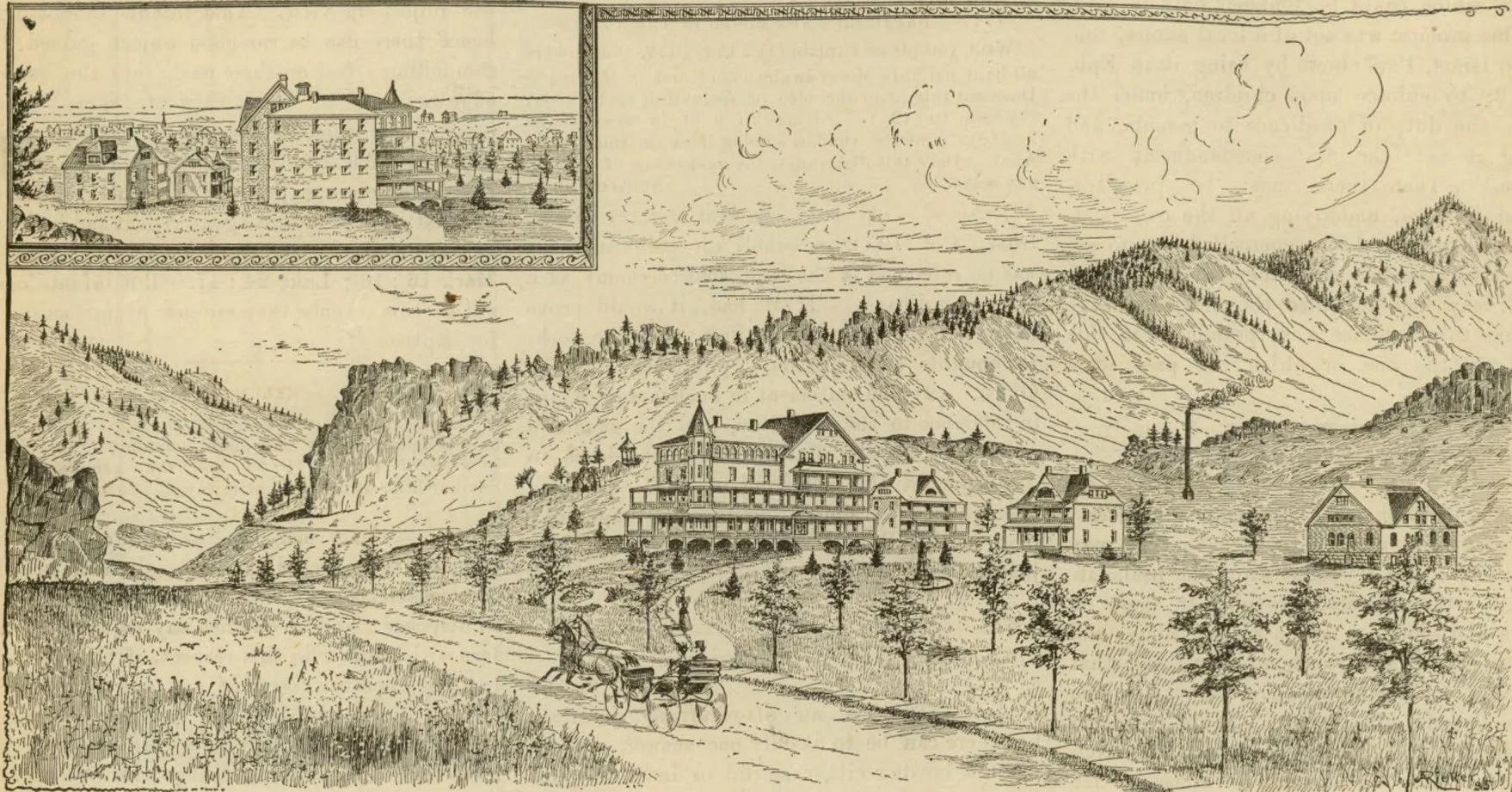
THE BOULDER, COLORADO, SANITARIUM.
THE COLORADO SANITARIUM.
By F. M. Wilcox
Thirty miles northwest from Denver, the capital of Colorado, on the Union Pacific, Denver & Gulf Railroad, lies the pretty little city of Boulder. It is one of the oldest towns in the State; and that which gives it special prominence at the present time, is its possession of the State University, one of the foremost educational institutions west of the Mississippi. Although not standing in the lead as a commercial center, Boulder is a mart of no mean importance. Surrounded by a fertile farming country, and in close proximity to rich mines of coal, silver, and gold, it forms the commercial center of a large section of territory. But though closely identified with mining interests, the city is not a mining town in the common understanding of that term; but possesses every characteristic of a modern, well-ordered and cleanly kept city. The buildings are of wood, stone, and brick, the latter largely predominating. Mountain streams of pure, clear water run through the streets, which are deeply shaded by a rich foliage of overhanging trees. The quiet order which prevails in the town is noteworthy. For years it has been found necessary to employ but one policeman, and it has been said that he, on account of a retiring modesty, cannot always be found when it is desired that he should perform some public function. However that may be, it is but seldom that the quiet peace of the city is disturbed by the midnight marauder or by the friend of the flowing bowl. Theft and robbery are practically unknown.
It is from the scenic and climatic standpoint that Boulder prominently excels. Situated in the dry, bracing atmosphere of the Rockies, in a climate radiant with sunshine, and heavily charged with life-giving ozone, it is entirely removed from malarial and malign influences. This, together with its altitude, fifty-three hundred feet above the level of the sea, makes it a desirable place of residence for those who already enjoy life, and a city of refuge for those, who, having lost their health, desire to win back that priceless treasure. Colorado is now the hospital of the world. From every country and clime people come to find in its invigorating climate, release from disease and restoration of health.
And not alone in the sunny sky and dry, bracing breezes does the invalid find promise of a lengthening of days, but in the scenes of material nature as well. The fertile plain whispers of new life. The lofty, snow-capped peaks, lifting up their hoary heads in splendor and magnificence, speak of strength and endurance. The whole scene is one of hope and inspiration, leading the mind away from the sordid cares of life, and firing the soul with higher and holier motives and purposes. From nature the thoughts turn naturally to nature’s God; and in the leafy bower, in the tender, growing grass, and in the lofty mountain heights, is realized the loving care of a gentle Father as well as the omnipotence of him who comprehends the dust of the earth in a balance and weighs the mountains in scales.
These considerations prompted the erection of our last denominational venture in medical work, the Colorado Sanitarium, which is located at this place. The accompanying cut gives some idea of the institution which has been established. The main building is a four-story brick-and-stone structure, ninety-six feet long, and forty-five feet wide. The large annex on the west gives the building a frontage of over one hundred feet. In close proximity to the main building are two neat cottages. The accommodations thus furnished will permit one hundred patients to find a pleasant and commodious home.
The institution is situated in the most sightly part of the city. From the balconies of the building, a fine panoramic view is presented of the plateau beneath. The pleasant city of Boulder, the distant villages of Marshall and Ni Wot, and the city of Longmont, with the surrounding and intervening country, dotted here and there with little lakelets, present a scene both refreshing and inspiring. In the background, the lofty peaks of the Rockies form a picture of which the eye never tires.
The sanitarium is now well equipped for its work. Over fifty patients, representing some eight or ten different States and Territories, are already enjoying its benefits. Every day witnesses new arrivals, and it will doubtless be but a few weeks before the buildings are crowded to their fullest capacity. The following well-known physicians are connected with the institution: Doctors O. G. Place, W. H. Riley, W. H. Hubbard, G. W. Burleigh, Miss Kate Lindsay, and Mrs. Eva Reed. Dr. Place expects soon to leave the work with which he has been connected from the beginning, and in which he has achieved excellent success, and go to India, to open up the medical missionary work in that important field. It is a cause for sincere regret that Dr. Place is called from the work here, but the long experience and very efficient service of Dr. Riley in connection with the Battle Creek Sanitarium, eminently fit him to take charge of the institution upon Dr. Place’s departure.
To those acquainted with the favorable reception accorded the institution thus far, and with the prospects which are now open before it, it is evident that a very successful future awaits it. Already a number have returned to their homes with the blessings of restored health and strength, and we are satisfied that this class will be greatly increased as the influence of the work widens and extends. But the institution, in order to achieve the highest success, must come in contact with the needy and suffering. The sanitarium cannot go to them; they must come to the sanitarium.459This they cannot do unless they know of its existence and of the advantages they may be able to derive. We sincerely trust that every reader of the REVIEW will feel interested in the enterprise, and will do all in his power to direct to its welcome doors those who may be in need of the benefits it is able to bestow.
It is well known that the climate of Colorado, with such treatments as are employed in our institutions, furnishes a panacea for many ailments. The Colorado Sanitarium is not merely a refuge for consumptives (only about one third of the present number of patients are of that class), but it is designed to give to those suffering from all chronic maladies the same benefits they could receive in similar institutions. It is well known that for disorders of digestion and many kindred diseases, the tonic effect of a high altitude is very beneficial. Many of our people are well acquainted with those in their section who are seeking, on account of their health, a drier and more bracing atmosphere. Why not direct them to the institution where they will be able not only to obtain the climate they desire, but rational methods of treatment as well? A two months’ sojourn at the sanitarium has enabled me to become quite well acquainted with its workings. I am assured of its great value as an agency in our work, and of the possibilities for good which lie before it.
The spiritual interests of the sanitarium family are prosperous. The helpers number some twenty-five or thirty brethren and sisters, who are laboring in love and harmony to advance the interests of the work of God. Regular morning worship is maintained, where all of the helpers and some of the patients come together to seek for strength and wisdom for the day’s duties. Sabbath-school and weekly prayer-meetings are likewise carried on, and Sunday preaching services are conducted in the sanitarium parlor for all who desire to attend. We trust the prayers of our people everywhere will ascend for the success of the work here, and not alone for the work in this field, but for the success of every institution which is among us, and for the work and workers of God throughout the earth.
F. M. WILCOX.
TEXAS
By J. N. Sommerville
March 1 I left home for Cass county, some four miles east of here, to hold meetings. The people were very anxious to hear, and gave me the use of the schoolhouse. There was a large attendance from the beginning. I had held but a few meetings when I was called to the bedside of my companion, who was very ill. After remaining home with her three weeks, I returned to my field of labor, and resumed my work, with a better interest to hear than at first. I remained at that place five weeks. Just before I closed the meetings, a man came from another neighborhood, and invited me to come there and preach. May 22 I went there, and began meetings at once. In the midst of opposition the people came together to consider the matter of my preaching, and the majority of them voted against me; they closed both the schoolhouse and the church against me, but some were determined460that the gospel should be preached, so they built an arbor forty by forty feet, with a seating capacity of five hundred. The first night there were about one hundred in attendance, and the next night the arbor was well filled, and continued so till the close of the meetings. The minister of the Baptist church attacked the truth, but I answered him to his own people, and they saw his man-made doctrine exposed by the word of God. Just before I closed the meetings, the Methodist preacher spoke against the Sabbath, and I spoke twice in answer to his discourse. As a result of my labors at the above-mentioned places, some twenty-five adults have taken their stand for the truth. A good Sabbath-school has been organized. I am now preparing to start for camp-meeting, after which I hope to return and labor during the rest of the summer and fall. I am of good courage in the Lord.
J. N. SOMMERVILLE.
QUEBEC
By J. B. Goodrich
Our camp meeting this year at Waterloo, which has been reported by another, has left an excellent influence on the minds of the people. Some have already taken their stand for the truth as the result of the meeting, and others are interested. It was encouraging to see the good spirit manifested, and the willingness to sacrifice for the cause. In a few minutes two hundred dollars was raised toward canceling the indebtedness of the school building at Fitch Bay, where we have maintained an excellent school the last two years, taught by Brother O. Drown, a graduate from the State normal school of Vermont and also from the South Lancaster Academy. This school has resulted in breaking down much prejudice against us, and caused many to look upon us in a different light than they did before. We feel to thank God and take courage for this. The school has been very well patronized in the place by those not of our faith. God has blessed, and will, in the educational branch of the work.
The cause in this conference looks brighter and more encouraging. When the stream of benevolence dries up, the cause languishes and dies; but when we open wide our hearts and hands to help forward the work, God always gives the increase. O that all of our people might feel the responsibility resting upon them at the present time, when we are so near the day of the Lord’s wrath, when neither our silver nor our gold shall be able to deliver us! The cause greatly needs help, and all can do something.
We thank God for the success that has attended the work the past year, and hope to see more accomplished the year to come. We have but a few more years to work; shall we grow weary and faint by the way? God forbid! If we go back, we shall die; if we stand still, we shall die; if we go forward, we can but die. So we will go forward, trusting in God for victory. J. B. GOODRICH.
THE CALIFORNIA CAMP-MEETING.
By A. J. Breed
In harmony with light that had been given, this meeting was moved from Oakland, where it had been located for a number of years, and held in the city of Alameda. Alameda is only a short distance from Oakland and San Francisco, so the meeting was as central as though it had been held in either city. The conference committee, in planning for the work, thought it would be better, on account of the hard times, to hold several camp-meetings, rather than to try to get a large attendance at the annual meeting. For this reason the meeting was not as large as it has been in former years, yet there were about eight hundred camped upon the grounds. The meeting passed off very pleasantly, and was much enjoyed by all who had its privileges and benefits.
The laborers from abroad were Elder A. T. Jones, and Professor Sutherland, from Walla Walla College. The annual meetings of the different institutions in California have taken much of the time of the camp-meetings, but this year the Publishing Association held its meeting before, and Healdsburg College after, the camp-meeting, which gave more time for other work at the camp-meeting.
The Rural Health Retreat held its annual meeting before the camp-meeting, which gave the time wholly to conference, tract society, and Sabbath-school work. C. H. Jones, president of the Publishing Association, took time to bring before the meeting the interests of the work of the institution, that our brethren throughout the State might see that success was attending the efforts of the publishing interests, and a steady gain was seen in this line of the work.
Professor Howe, with others, was on the grounds to labor in the interests of the college. About seventeen hundred dollars was raised, in cash and pledges, to assist the educational work. Four other camp-meetings are to be held in the State, and we hope our brethren will do what they can, at these meetings, to help the college in its financial matters. The Lord has greatly blessed the California Conference, having established in their midst the publishing house, college, and sanitarium. The publishing house has been running to nearly its utmost capacity for several months. Three new printing-presses have lately been set up, in order to meet the pressing demands upon it.
The canvassing work received careful thought and plans at the meeting. Several students, with others, have gone into the field to sell our publications, a line of work which is as important as any connected with the message. A State agent has been appointed, who will spend a part of his time canvassing, when not obliged to look after the canvassers, assisting and instructing such as need his help.
The educational work was looked after quite carefully, and from present indications, the attendance will be greatly increased the coming year. One thing that will be of much interest to our brethren throughout the State, is that Elder R. S. Owen will again become connected with the college, having charge of the Bible work.
There was a good interest in the meeting from the first. Many were heard to say, “It is the best meeting I have ever attended.” As far as could be seen, a spirit of courage was among the people. This was the spirit of Caleb and Joshua. After coming out of Egypt, and becoming fully established in the truth, the Lord said, “Ye have dwelt long enough in this mount.” Many of these experiences will be lived over again, and from the light now given we know that the time has fully come to “go forward.”
At the close of the meeting, George W. Fraser, Baxter Howe, L. P. Jacobson, and G. W. Rine were ordained to the gospel ministry. The laborers left for their different fields with good courage; and we hope to hear encouraging reports from them as they present the truth to the people. A. J. BREED.