The Youth’s Instructor, Vol. 37, No. 18.

FAITHFUL

The Youth’s Instructor

May 1, 1889

S. D. A. Publishing Association · Battle Creek, Mich. · May 1, 1889

FAITHFUL

TWO boys were at work rigging a small sail-boat. It lay in an inlet on the New Jersey coast, and had been hired from them for the season by a stranger from New York.
“Come along, Bob!” said one of the boys. “It’s all right now. We’ll be too late to see the ball match, if we don’t start at once.”
Bob had taken down some of the old ropes, and had rigged the boat with new ones. The halyards he had not yet examined.
“They’re all right,” urged his companion, trying them,—“strong enough to last for years.”
“No; I’ll put in new halyards. I promised to make a thorough job of it.”
“Then you’ll miss the game. I’m off.”
Tom ran across the fields; Bob hesitated as he looked after him. It was a sharp disappointment to miss the game. The old halyards were worn, but they were still stout.
“They’ll stand this summer well enough,” muttered Bob.
Then, with a quick, decisive movement, he cut them, and proceeded to put in new ropes. “I’ll make the job thorough,” he said.
That very evening the New York gentleman took a party of his friends out for a sail, among them several persons whose lives were especially valuable to the community, and whose death would have been a calamity. When they were a mile from the land, a fierce squall struck the boat. They steered toward the shore. The boat was carrying too much sail for such a wind.
“If your gaff gives way, we are gone!” said a physician in the party, in a low voice.
“It all depends on the halyards. They are new. But there’s a terrific strain on them.”
Every eye in the boat was upon the short, knotted ropes. They creaked ominously; but they bore the strain, and in a short time the boat was driven up on the beach. Bob’s stout bits of new rope had saved the lives of all on board.
Many years ago a poor German emigrant woman sat with her children in the waiting-room of an Eastern station. A lady passing to a train, struck by her look of misery, stopped a moment to speak with her. The story was soon told. Her husband had been buried at sea. She was going to Iowa, and “it was hard to enter a strange world alone with her babies.”
The stranger had but an instant. She pressed a little money into the poor creature’s hand. “Alone?” she said; “why, Jesus is with you! He never will leave you alone.”
Ten years afterward the woman said: “That word gave me courage for all my life. When I was a child, I knew Christ and loved him. I had forgotten him. That chance word brought me back to him. It kept me strong and happy through all my troubles.”
Bob’s faithfulness in doing a “thorough job,” and the good lady’s kindness to a wayfarer, would have been comparatively little to their credit, could they have foreseen the momentous consequences of their actions. Who would not be particular about a rope if he knew beyond a question that human lives would hang upon it within twenty-four hours? The truly faithful souls are those who do their duty, as those two did, no matter how unimportant it may seem in itself, or how remote and uncertain its results.—Youth’s Companion.

THREE LEGENDS OF THE NORTHLAND.

Most of the Indian tribes of North America had a common belief in one invisible God, whom they called the Great Spirit. But their wild, roving forest-life seemed to have had the effect of making them very imaginative and superstitious; for we find that they attempted to explain everything they could not understand, as the work of invisible beings called spirits.
The Ottawa and Chippewa tribes, who long ago dwelt in the region around the northern part of the Great Lakes, were no exception to this rule, and their traditions are full of references to these fanciful beings.
They have a curious story about the origin of Mackinac Island, which runs like this: Once, many, many moons ago, long before the “pale faces” came to North America, some of the wandering tribes of the Ottawas were standing at sunrise upon the little peninsula of Pt. St. Ignace, gazing to the eastward over the blue waters of Lake Huron.
Suddenly, while they were looking, they saw what seemed an enormous turtle, rising from the sparkling surface of the lake; but it proved to be a new island, cast up, as they believed, by some monster that dwelt beneath the waters. They called it Mishemikinock, the Ottawa word for “great turtle.” The shores of Mackinac Island are steep and rocky, and it is thought by some geologists to be a volcanic island. Perhaps it was thrown up by volcanic forces, and the Indians, seeing it, have preserved the story of so wonderful an event through all succeeding generations; who knows?
According to their legends, only two of the first inhabitants of this island, the Mishemackinawgoes, a man and his wife, escaped from the massacre by their enemies, the Senecas. This they did by concealing themselves in one of the caves of the island until their pursuers had departed. Then they put their snow-shoes on so the tracks would appear as if going toward the island, and crossed the ice to the northern shore of Lake Huron. They became disgusted with humanity, and, with their children, lived alone in the great forests. The Ottawas and Chippewas believe to this day that these persons are still in existence as supernatural beings, and roaming through the vast solitudes of the far north. They suppose that they can be seen or not, as they desire; that sometimes they make their presence known to the hunter by throwing a stick or a stone at him, or by striking his dog, or by walking about the wigwam at night, causing the dogs to bark; and sometimes they can be tracked by the hunters, but are never overtaken. Sometimes as an Indian is out hunting or walking in the dark forest, he is suddenly seized with an unearthly fright, as if some great evil were about to happen to him. He feels very much alarmed, but does not know what he is afraid of. Then he recollects; it is one of those spirits, who wants something, and is following him. So he leaves some tobacco, or meat, or something else, and goes on his way undisturbed.
Once in a great while these spirits would appear; and one who was so fortunate as to talk with them was always after regarded as a prophet by his people. They were called “Paw-jwa-tchaw-nish-naw-boy,” which, translated into English, means, “wild, roaming spirit.”
Another of their wonderful stories says that Ne-naw-bo-zboo, a great warrior and prophet, was once swallowed by a great fish. The legend is that once there lived in a certain lake a great fish, that used to swallow the Indians, canoes and all, like swallowing a little clam in its shell. So Ne-naw-bo-zboo went out in his boat, and sang these words as a challenge to the fish: “Mishe-la-me-gwe Pe-le-wi-ko-lish-im, Pe-le-wi-ko-lish-im.” So the fish came up and swallowed him, which was just what he wanted. Then he took his hatchet, and caused the fish so much pain that he ran up on the shore and died, after which the great Ne-naw-bo-zboo went home and smoked his pipe in contentment.
These are examples of the errors people fall into who have not the Bible to teach them the true religion. How thankful we should be that we are not left to grope in darkness, but have the word of God to teach us the way of truth. And how we should try to help, by every means in our power, to send the Bible to all such poor people, who would feel so glad to know of the true God, as he is revealed in his word.
FRED ALLISON HOWE.

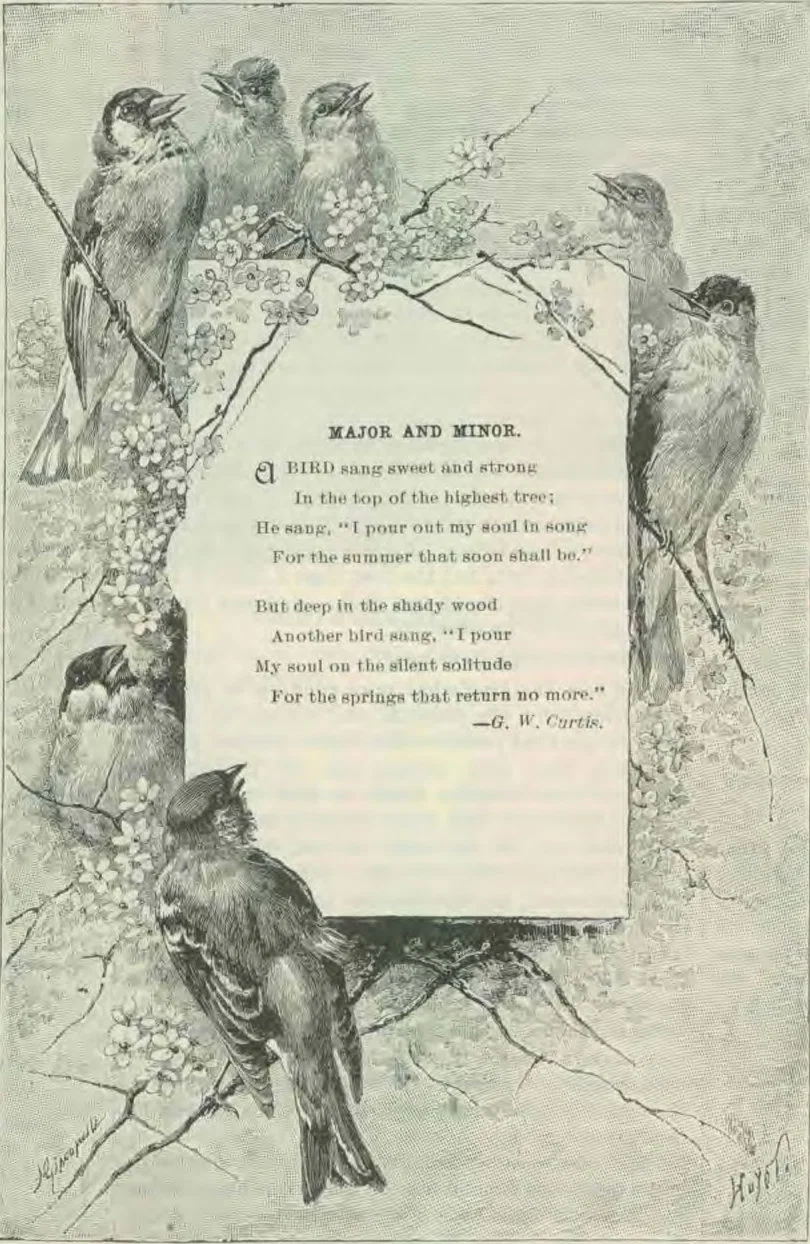
MAJOR AND MINOR.

A BIRD sang sweet and strong In the top of the highest tree; He sang, “I pour out my soul in song For the summer that soon shall be.”
But deep in the shady wood Another bird sang, “I pour My soul on the silent solitude For the springs that return no more.” —G. W. Curtis.

A CURIOUS SIGN-BOARD.

In Chicago, on Wabash Avenue, one of the great Western railroads has erected a huge advertising board, that is a most ingenious and surprising optical illusion. The sign is about ten by twelve feet in size, and erected on a vacant lot, where it can be seen from all directions. In approaching it from the north, these words, printed in white letters thirty inches long, appear:—
GO WEST BY THE
When within a distance of fifty feet of the sign, the words begin to fade away, leaving the board without lettering of any kind; but when within ten feet or so, and until the board has been passed about an equal distance on the south side, the following words appear, first dimly, and at last standing out in bold relief:—
THE GREAT BURLINGTON ROUTE.
After passing the sign, if one should turn back at a distance of say fifty feet, to verify what it was supposed the sign had written upon it, one would be surprised to find that instead of any of the words previously read, the board would then contain these:—
TAKE THE BEST.
Only a close examination will reveal the ingenious deception. The words “the great Burlington route,” are first painted in white on the black background, exactly in the center of the sign-board. Then strips, say two inches thick and wide, painted black, are tacked on the board, a few inches apart, like lath on a ceiling, in a perpendicular position. These strips are beveled on each edge so that the bevel has a width of nearly one and one half inches. On the beveled edges are painted the words seen in approaching or receding from the sign, and of course the words painted on one beveled edge cannot be seen from the other side, nor can the words on either bevel be seen when standing directly in front of the sign, at which time only the words painted on the background are visible. W. S. C.

HOW TO RUN.

Very few boys know how to run.
“Ho! ho!” say a dozen boys. “Just bring on the boy that can run faster than I can.”
But stop a moment. I don’t mean that most boys can’t run fast—I mean they can’t run far. I don’t believe there is one boy in fifty, of those who may read this, who can run a quarter of a mile at a good smart pace, without having to blow like a porpoise by the time he has made his distance. And how many boys are there who can run, fast or slow, a full mile without stopping?
It hardly speaks well for our race, does it, that almost any animal in creation that pretends to run at all can outrun any of us?
Take the smallest terrier-dog you can find that is sound and not a puppy, and try a race with him. He’ll beat you badly. He’ll run a third faster than you can, and ten times as far, and this with legs not more than six inches long. I have a hound so active that he always runs at least seventy-five miles when I stay a day in the woods with him; for he certainly runs more than seven miles an hour, and if I am gone ten hours, you see he must travel about seventy-five miles of distance. And then, a good hound will sometimes follow a fox for two days and nights without stopping, going more than three hundred and fifty miles, and he will do it without eating or sleeping.
Then, you may have heard how some of the runners in the South African tribes will run for long distances—hundreds of miles—carrying dispatches, and making very few stops.
I make these comparisons to show that our boys who cannot run a mile without being badly winded are very poor runners.
But I believe I can tell the boys something that will help them to run better. I was a pretty old boy when I first found it out; but the first time I tried it, I ran a mile and a quarter at one dash. And now I’m going to give you the secret:—
Breathe through your nose!
I had been thinking what poor runners we are, and wondering why the animals can run so far, and it came to me that perhaps this might account for the difference, that they always take air through the nose, while we usually begin to puff through our mouths before we have gone many rods. Some animals, such as the dog and the fox, do open their mouths and pant while running; but they do this to cool themselves, and not because they cannot get air enough through their noses.
I found once, through a sad experience with a pet dog, that dogs must die if their nostrils become stopped. They will breathe through the mouth only while it is forcibly held open; if left to themselves, they always breathe through the nose.
So, possibly, we are intended to take all our breath through the nose, unless necessity drives us to breathe through the mouth.
There are many other reasons why we ought to make our noses furnish all the air to our lungs. One is, the nose is filled with a little forest of hair, which is always kept moist, like all the inner surfaces of the nose, and particles of dust that would otherwise rush into the lungs and make trouble, are caught and kept out by this little hairy network. Then the passages of the nose are longer, and smaller, and more crooked than that of the mouth, so that, as it passes through them, the air becomes warm. But these are only a few reasons why the nose ought not to be switched off and left idle, as so many noses are, while their owners go puffing through their mouths.
All trainers of men for racing and rowing, and all other athletic contests, understand this, and teach their pupils accordingly. If the boys will try this plan, they will soon see what a difference it will make in their endurance. After you have run a few rods holding your mouth tightly closed, there will come a time when it will seem as though you could not get air enough through the nose alone; but don’t give up; keep right on, and in a few moments you will overcome this. A little practice of this method will go far to make you the best runner in the neighborhood.—St. Nicholas.

WHAT THE LITTLE CHINESE GIRLS THINK OF US.

Do you ever think, as you read of the queer ways of our little sisters in other lands, how very odd our ways must seem to them? Mrs. Neal, a missionary in Tungchow, tells us how many eager questions her little Chinese maidens ask about us and our ways:—
“They think it is so ‘happy’ in America,” she says, “because you can live at home and go to school by yourselves, and that you can walk on the streets alone, and can eat at the same table with your older brothers and father, and do not have to wait for the second table, and then eat what they have left.
“Of course, here in school the girls all eat together, in a long dining-room; but when at home, they have generally to wait until all the masculine members of the family are served, when they and their mothers eat what remains. Some Christian families are following our customs in this and a few other ways; but in those where the grandparents and great-grandparents are still living and reigning, the little girls and young women are still made to wait on the men.
“One idea the scholars have about you I am afraid you could not agree with. They say that one reason why they would like to have been born in America is, that it is so easy for you to be good, since your mothers and grandmothers have always been Christians, and you never learn to tell stories and lies, and to deceive people. Everybody here does these things, they say, and it is so much harder to unlearn such habits than for you who never have the same temptations.
“Then they think you are, of course, better Christians than they, and find it easier to serve Christ, and can give more money to the missionary societies. I don’t encourage them in such beliefs, but I do think we ought not to expect so much of a little Chinese girl whose heathenish superstition and fears keep her from doing right, as we do from ourselves who know better than they what is right, and pure, and good.
“My girls love to have me tell them about people I used to know at home, more especially about girls of their ages; what they do, say, wear, and study; how they play, work, and pass their time generally.
“One little colored girl that I used to know, is of special interest; it would amuse you very much to hear the questions they ask about her. One little girl wanted to know if her bones were black, and if she cut her finger, whether it would show black flesh and flow black blood. Now she says she knows we are all alike, except that the Heavenly Father gave her a yellow, me a white, and ‘Tude Brown’ a black skin; only she is still afraid that if she should meet the little colored girl, she would be frightened, and might hurt her feelings.”—Children’s Work for Children.

GOD’S LITTLE FOLDED BUDS.

How good God is to the little buds! How softly he folds them up in his love, Sending the sunbeams down from above In the morning’s rays, in the noontide’s floods, Folding the earth and the planets round, For the good of a little flower of the ground!
A more beautiful thing,—could a mortal ask it?— Than a bud hid away in a satin lining, Nestled down in a dainty casket, Folded in beauty past all divining, Like a little babe, like some mother’s dove, Enrobed in rose and perfumed with love.
Folded! folded! God thought of it Long ago, in his breast of love; Long ago, when the stars were lit, He planned for the flower, in the world above; Touched the great stars and universe round To minister to a flower of the ground.
Have you ever thought how he makes it bloom, Drawing it out of its shell-like coffin, Wooing it up from its earthy tomb,— A beautiful being our hearts to soften, Whispering of loved ones asleep in the earth, To wake in the glad resurrection’s birth?
Oh, how softly God sends his light To the little bud in its narrow cell! Not too strong, and never too bright. He gradates all its measure so well. And the bud may dream in the sun awhile, Till it feels the light and begins to smile.
Softly, softly, the sunlight woos. Creeps just a little under its fold, Till thrills its pulse, and flushes its hues, And opens a little its heart of gold; Till the flower expands, and its heart is won By the love of God, in the light of the sun.
Just so with the showers and the loving dews, Just so with the breezes, just so with the night; The little bud gathers from all its hues,— From the soft, sweet shadow and light. God never hurries, but thrilled by his waking, The little shut bud responds by breaking.
And oh, how glad God is to see it Smiling up in his face of love! And oh, how glad is the breeze to free it! And oh, how glad is the light above! And oh, how glad are the hearts of men For the little flower that’s abloom for them!
I’ve thought, as I’ve looked at the folded leaves, And thought of God and his tender ways, Of some little children at mother’s knees, Who are looking up for her help these days,— Of little buds that are folded yet, With their dainty leaves all frailly set.
I’ve thought of the buds that are shaken roughly, Of the eyes that are drenched with bitter tears, Of dear little hearts that are wounded sorely, Of leaves that are torn in the bud of years; And oh! poor buds, the good Lord of heaven Doesn’t love to see you so cruelly riven.
If he set the planets to bend to a flower, If he poised the earth for its need alway, If he sends the dew and the light each hour, To nourish a bud to the joy of day, If he gives it its perfume and dainty hue, Oh, doesn’t he watch o’er the child-buds too?
Oh, folded buds! there’s a subtle glory Falls over your brows and your innocent eyes, As I think of the beautiful Christ-child story, As I think how he bloomed here beneath the skies; For oh, through him what grace, what power, May flow from the hearts of God’s dear little flowers!
How shall we treat them,—God’s folded buds?— Watch them with love as they flush and wake, Pouring around them in radiant floods The atmosphere that will help them break, Reflecting that love which the children blessed When Jesus gathered the babes to his breast.
He died for the children. His life was given For the little lambs of his fold below, The little flowers that he wants in heaven Are trusted here in a plot to grow, And every day we should pray that we May care for his buds most tenderly.
FANNIE BOLTON.

The Burden of Maintaining a Lie

He who tells a lie is not sensible how great a task he undertakes; for he must be forced to invent twenty more to maintain that one.

DRIVEN OUT.

Do any of you know people who have sometime in their lives been driven out of their homes? If not, may be you know that it often happens that people are turned outdoors, sometimes right into the street.
Cruel landlords often turn poor people out because they cannot pay their rent. Wind, fire, or water sometimes destroys the home, with all its treasures, and many times even the lives of some whose home it was. Can you think of anything more sad?
Supposing some day there should come to your home a great fire, like one that burned in Michigan and Wisconsin a few years ago, or one that has just been burning in South Dakota, destroying everything in the country round about,—wouldn't it be about the sorriest time you ever knew, to have nothing left of your home? Many people upon the earth have had just this kind of trouble, and I suspect they were very homesick afterward, just as you would be if in their places.
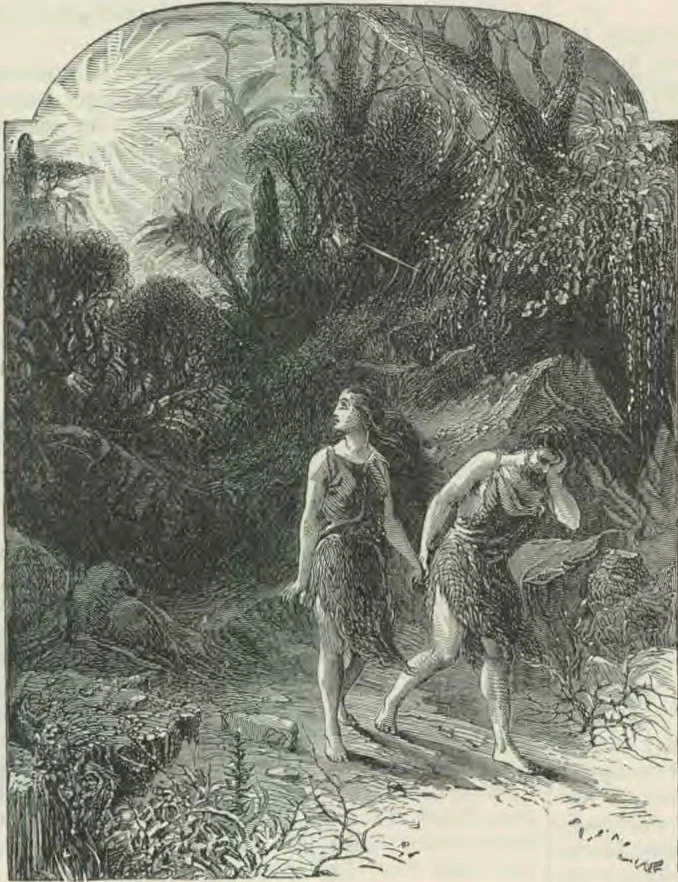
The very first family that lived upon the earth was driven out of home. That was six thousand years ago; but there isn't one of you but that can tell whose home it was, as shown in the picture on this page.
Home with them meant more than it can with us; for, as you know, their home was the beautiful garden of Eden, with the promise that it should be theirs forever and ever if they would obey God.
God had given them everything that was pleasant to the eye. That is a great deal, isn't it? Surely they could not wish for anything more to look at. He had also given them everything they could wish to eat. Of all the good things he gave them, he kept only one tree to himself; only one that they must not touch.
Adam and Eve had never had any wicked thoughts, and they did not once think, as some of us might, “How nice that fruit looks; I don't see why we can't eat that as well as the fruit from the other trees.” They trusted God perfectly, and believed he knew just what was best for them. They were very happy in their Eden home. God, in the form of man, and good angels visited them from time to time; so, don't you see, they hadn't the least thing to make them unhappy.
But one day there came an evil angel to visit them—one that hated God and everything good, and who wanted to make everybody bad and unhappy, like himself. You know his name,—Satan. He had heard of this happy pair in Eden, so he came to upset God's plan.
Satan told Eve that what God had said about the tree wasn't true; that God knew it would make them wise to eat of it. Instead of turning away from the tempter, as she ought to have done, she listened to what he had to say, until he had her in his snare. She ate of the forbidden tree, and gave of it to her husband, who also ate, thus opening the door for all the sin and misery that has since come upon the earth.
May be it did not at first look to them like any great sin they had committed; but God saw it with different eyes than they. He knew that if they would break the only command he gave them, one so easy to keep, he could not trust them. He had told them that if they ate of the tree, they should die; so for that reason, and at that time, their troubles began.
While they were in the garden, everything grew with but little care on their part. Their work was to keep it trimmed and orderly, which was just a pleasure; but from that time onward, God told them they should toil hard, and earn their living by the sweat of the brow. Their troubles and sorrows would increase, too, until they would finally die, and be put into the ground to crumble to dust. And further, he drove them out of their beautiful home, into the great, cold world.
When they were driven from Eden, I think they knew it was God who owned the world instead of Satan, don't you? and that his word should be obeyed to the very letter? Do you suppose there were ever any sorrier people driven from home than were our first parents?
In their great sorrow, God pitied them; and the Saviour, who helped in making the world, felt so deeply for them that he offered to suffer himself for their sin, if God would pardon them. Then a plan was made for those who had broken God's law, that they might be saved. It is by obedience through faith in the Saviour, which I will tell you more about another time.
This plan made Adam glad; and by it I expect, when Eden is restored, he will have his garden back. By the same plan we may have homes in the new earth. Are we so glad for it that we shall be saved by it? M. J. C.

TOMMY'S GEOGRAPHY LESSON.

Tommy came home from school with a cloud on his usually bright face.
Auntie put her arm about her boy, and asked him how he had fared at school, and if he had been perfect in all his lessons.
Tommy knit his brows in a puzzled way, and said: “I knew every one except my g'og'aphy, and I didn't know that at all. It seems if I can't remember how the old maps look; and when Miss May asked me if there were any mountains in New Hampshire, I couldn't remember to save me. I don't s'pose I'll get the prize, just because I can't learn g'og'aphy. If I could only go up in a balloon, and look down on the world, I could see for myself where the mountains an' lakes an' such things are, an' then I'm sure I wouldn't forget.”
This speech of Tommy's on behalf of learning geography by means of a balloon voyage, set auntie's wits to work.
She was anxious to help the little fellow gain the prize he was striving so hard for, and if maps would not answer, some other way of learning his geography lesson might be thought of.
After a second or two she said, “Suppose we play that we are in a balloon, how would that do?”
“Jolly!” exclaimed Tommy. “But then,” the smile fading a little from his rosy lips, “I don't know that I could learn my lesson any better even if I did put my map on the floor, an' stand on a chair to look at it.”
Auntie laughed and said, “That isn't my idea. If you will help me, we will soon be able to look down on something much nicer than a map.”
“All right!” promptly returned Tommy, as he snatched up his hat, and stood ready for any command.
“Has the pile of sand been taken away that I saw a little further down the street yesterday?” asked auntie.
“No'm; I saw it when I came past just now.”
“Then tell cook to give you the two-quart tin pail, and go and ask the men if you may have it twice full of sand.”
In a flash Tommy had gone, and almost before auntie was ready for him, he was back again. “Auntie!” he shouted; “auntie!”
“Here, Tommy,” answered a voice from the direction of his play-room, and rushing in, Tommy found his aunt pinning a huge sheet to the carpet.
“Pour the sand right in the middle of the sheet, and go for more,” and again auntie bent to her work.
When Tommy came back the second time, the sand was smoothed out on the sheet until it was about an inch deep all over.
The second pail was put in a pile by itself a little way from the rest. “Now what'll I do?” demanded Tommy, becoming more excited as the mystery deepened.
“Bring your atlas,” said auntie, “while I look up a few things I think will be useful.”
The atlas was close at hand, and Tommy waited rather impatiently until auntie returned with a bunch of wooden toothpicks, a handful of flat button-molds of different sizes, a sheet of writing paper, and a pair of scissors.
With the scissors auntie commenced cutting the paper into slips about one inch wide and three inches long.
“Now get me the mucilage, and then show me your geography lesson for to-morrow, Tommy,” she said.
The lesson proved to be questions on the map of the New England States, especially New Hampshire; and auntie, picking up the wooden toothpicks, began to form with them the outlines of the State.
“Oh, my!” exclaimed Tommy, “I know what you are going to do. Let me help.”
“To be sure you may help; but put your map in front of you, and shape your State as nearly like that as you can,” said auntie, as she broke the piece of wood in her hand, to form a sudden little curve in the coast line.
Pretty soon, leaving Tommy to lay the outline of New Hampshire by himself, auntie took up one of the slips of paper she had cut, and pasted one end of it neatly around one end of a toothpick, forming a little flag. This proved satisfactory, so she made several more.
“I wish I could make this look like water,” Tommy remarked, after a short silence, as he laid down the sticks for the boundary between New Hampshire and Vermont formed by the Connecticut River.
“Well, so you can,” auntie replied. “Have you any narrow strips of glass?”
Tommy jumped up, drew forth a box from among his toys, and set it down in front of his aunt.
In the box were a great many narrow strips of glass of various widths and lengths, which the glazier had left, after fitting a number of panes in a window. Besides these, there were some old bits of broken mirror.
“This is just what you want, Tommy,” auntie said. “Make your rivers of these strips of glass, and here is a nice large piece of looking-glass for Lake Winnipesaukee, and you can shape it by bringing the sand over the edges.”
“What fun!” exclaimed Tommy. “Let me put it in now.”
“Don't you think it would be better to finish the outline of your State first?” remonstrated auntie.
“Yes,” said Tommy, “I will. I'll put in the Connecticut and the other river, too, and I can pile up real mountains, can't I? Why, I ought to know the White Mountains 'cause I was there last summer, but perhaps I was too close to 'em to see where they were.”
Tommy went on tracing out the river courses with his bits of glass, building up mountains with the extra sand, placing the lakes, and chatting merrily all the while.
When he had about finished, he suddenly cried, “Auntie, we've forgotten the cities!”
Auntie smiled a little as she said, “Is this the first time you have thought of them?”
Then she produced the flags upon which she had written the names of the cities given on the map, and choosing the largest button-molds for the principal cities and smaller ones for the less important, she looked on the map, found the exact spot for a city, and laid a button-mold on it. Then, taking the little flag that bore the name of the city, she pushed its staff through the hole in the button-mold into the sand. This held the flag erect, and kept the city in its place.
Tommy arranged the other cities, and as he planted the last flag-staff, auntie said:—
“Now, we will ascend in our balloon, and take a bird's-eye view of New Hampshire.”
“What's a bird's-eye view?” Tommy asked, as he struggled to his feet, and stood by auntie's side.
But his question was forgotten when, gazing down, he saw beneath him one of the United States in miniature.
He danced and capered around, shouting: “Hooray! I'll go up in a balloon every time to learn my g'og'aphy lesson. I won't forget again that the Connecticut River is between New Hampshire and Vermont, 'cause I put it there myself. What a goose I was not to know the White Mountains were in New Hampshire! Don't they look cunning, auntie? Just like the real ones, only they haven't any snow on top. But I know what I'll”—
Auntie did not hear the rest of the sentence, for Tommy dashed out of the room, to return directly with something held tightly in his chubby hand. This something proved to be salt, which he proceeded to drop carefully, a little at a time, on the top of his mountains.
“There!” Tommy exclaimed, triumphantly, as he straightened up, “now they really are the White Mountains, and have snow on top just like the ones I saw last summer.”
“Yes,” said auntie, “that was a bright idea, and it does look like snow. Now we will pretend we are up in a large balloon, looking down on the State of New Hampshire.”
Then they looked down, and talked of the cities they saw, calling each one by name, and remarked upon the peculiar shape and more peculiar name of the largest lake, and what course the rivers took as they passed through the State.
Several times Tommy descended from his balloon to make some slight alteration in his work, and once he pasted a red star on the flag of the capital “to make it different from the other cities,” he said.
When they gave up the sport, Tommy had learned his lesson, and you may be sure he never forgot it; for “I made the State myself,” he proudly stated to his teacher the next day.
After this first delightful experience, Tommy learned all of his geography lessons with the aid of his sand; and when papa returned, after a two months' absence, he was so pleased with his little boy's progress in the study which had been such a stumbling-block, that he had the tinsmith make a large, shallow tin pan, three feet square and three inches deep, especially to hold Tommy's sand.
The glittering new tin bottom of the pan represented the ocean nicely when islands were to be made, and also when the countries to be represented had a coast line.
The other advantages of the pan were that it could be set upon a table, and the sand could be left in it, and need not be emptied into a box, as it had to be when the sheet was used.—Youth's Companion.

MAY

Who cares now for the chilling winds, The oft-repeated showers, Since gentle May has come at last, And kissed the buds to flowers!
So softly comes she on the earth, We scarce can hear her tread, While from her willing, outstretched hands The springtime seeds are spread.
O, winsome, tender, loving May, We welcome your sweet face; Within our very inmost hearts You'll always find a place.
—Lizbeth B. Comins.
Continue reading: OLD TESTAMENT HISTORY