Your ShelfYour Projects

Signs of the Times, Vol. 38, No. 1.

A New Year's Request
Earlier text: THE REVELATION OF JESUS CHRIST

Christian Science in a Crisis

The New York "World" points out that legal questions which are bound to arise very early will threaten the very existence of the church, and for the settling of which no provision has been made. The reporter talked with the chairman of the board of directors of the mother church, Mr. Archibald McLellan, and he admitted that —
The situation is very critical, and the points you raise are so serious and important that the board has not yet been able to deliberate on them or to plan a course of procedure.
The difficulty lies in the limitations of the board of directors, who can not perform certain functions without the written consent of Mrs. Eddy. Article XXXV, section 3 of the Church Manual reads:
No new tenet or by-law shall be adopted, nor any tenet or by-law amended or annulled, without the written consent of Mary Baker Eddy, the author of the text-book "Science and Health."
No provision is made in the Church Manual for Mrs. Eddy's death. The Church Manual, under "Church Officers," declares:
The church officers shall consist of the pastor emeritus, a board of directors, a president, a clerk, a treasurer, and two readers.
Mrs. Eddy was the pastor emeritus. She is now dead. No provision is made for a new pastor emeritus.
The same difficulty is involved in the chairman of committee on publication. In his election the consent of the pastor emeritus is required in her own handwriting. Then, too, we are told that no meeting can be called for the election of officers without the consent of Mrs. Eddy. Property held by the church is affected by the same provisions.
And there is still more. A simple, Christian, common-sense community acting on Christian equality and Christian principles would never have become so involved.
The revelations of Mrs. Eddy's will thus far offer no solution. Her property was left mostly to the church, $10,000 to her son Geo. W. Glover, and $10,000 to each of his five children, $5,000 to her adopted son, $20,000 to Calvin Frye, smaller sums to several others, and her crown of Diaz diamond breastpin to Mrs. Stetson.
Diphtheria germs often found in the mouth of children several weeks after they have recovered from the disease
The autocracy is dead. Will a democracy succeed? Or will it be an attempted oligarchy and division?
— ★★ —

Dangers of the Water Cup

The wine cup is always dangerous; the water cup may be if we permit it. An article by Alvin Davison, Professor of Biology in Lafayette College, in Good Health for November, shows that tremendous danger lurks—"waits" is perhaps the better word—on the rim and in the very depths of the water cup. One object of the article is to show the necessity of sanitary science in prolonging life, in preventing disease; and the utterly unhygienic and almost criminal carelessness in ordinary drinking, offers a strong argument for the preventive side.
How often it is assumed that as soon as a child is able to get out-of-doors after an attack of scarlet fever or diphtheria all danger is over. But the cut on this page, reproduced from Good Health, shows very clearly that diphtheria germs may be found in the mouth several weeks after recovery, and might infect others by the medium of the common drinking-cup. Look at the swarming bacteria from a drinking-cup, from a space so small that it seems almost invisible. In an experiment three clean sterile glasses filled with sterile water, each used only once by a child, were found to be fruitful of germs. All bore bits of dead skin; one had on its brim approximately 13,000 bacteria; another, 20,000; the third, 28,000. A glass used nine days at a school, bore on its brim not less than 5,000,000 germs, while other millions nested deeper down where saliva had fallen. "Hundreds of dead particles of human skin decaying on the sides of the cup made it a veritable human cemetery." The professor says, "I believe that nine out of ten public cups bear some kind of pathogenic [disease] germs." A guinea-pig inoculated by the germs from one cup died in two days, of pneumonia; inoculation from another cup produced tuberculosis; another, inflammation of the lungs; 37½ per cent of cups examined bore tuberculosis germs. Whole families nearly have become infected with tuberculosis from drinking-cups used by one afflicted with the disease. Measles, pneumonia, tuberculosis, and other unamiable diseases lie hidden in the public drinking-cup. The lesson is, abolish, prohibit, as a deadly enemy, the drinking-cup used by the public or family.
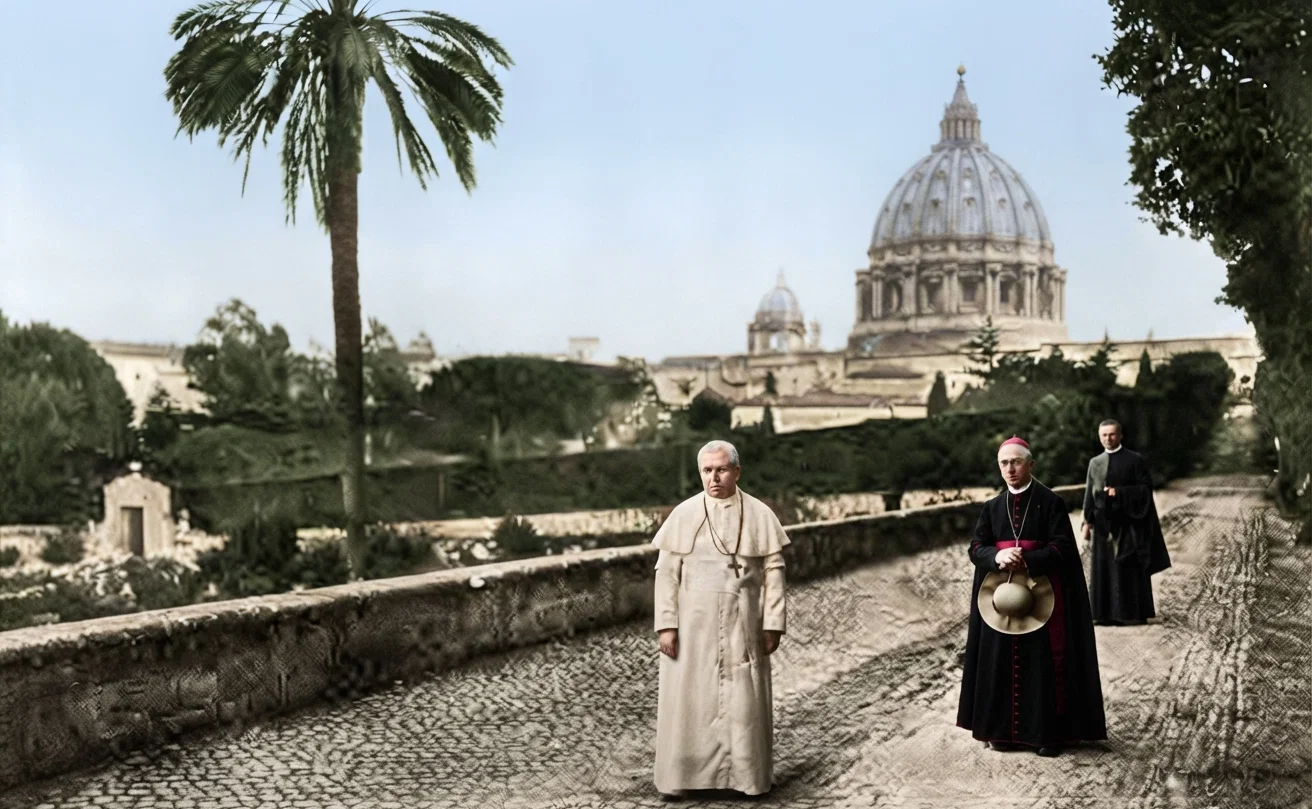
Pope Pius and Cardinal Merry del Val. There are serious problems troubling the Papacy just now, in Portugal, in France, in Spain, in Italy. See article on page 9, and notes elsewhere.

Church and State in Portugal

The decree for the separation of Church and State in Portugal has resulted in a collision between the Republicans and Clericals in different parts of the country. The latter think it is the purpose of the Republicans to extirpate all the customs of the church. The minister of justice denies the accusation, declaring that the new law is designed solely to afford complete liberty of conscience in worship.
— ★★ —

What Would Be Its Fate?

If a California Legislature should pass a Sunday law, what would be its fate? The Oakland "Enquirer" of Dec. 8, 1910, gives us this bit of news:
At the last meeting of the city council that body adopted an ordinance making it illegal — so far as it lay within the power of that body to do so — for barber shops to remain open on Sunday.
The "Enquirer" thinks it illegal, and gives its reasons therefor as follows:
It is the opinion of attorneys, generally, that this measure is unconstitutional, and this view is borne out by a decision of the State Supreme Court, rendered in 1896.
This decision was rendered in the case of Leo Jentzsch of San Francisco, a barber, who was arrested for working on Sunday. Jentzsch was convinced in the police court under section 310½ of the penal code of California, but was released by the Supreme Court on a writ of habeas corpus proceedings, the court declaring that the law is not only special, unjust, and unreasonable in its operation, but works an invasion upon personal liberty, the liberty of free labor.

Here Is the Section

The section of the code under which the defendant was convicted, reads as follows:
Every person who as proprietor, manager, lessee, employee, or agent, keeps open or conducts or causes to be kept open or conducted, any barber shop, bath-house and barber shop, barber shop of a bathing establishment, or hair-dressing establishment, or any place for shaving or hair-dressing, used or conducted in connection with any other place of business or resort, or who engages at work or labor as a barber in any shop or establishment on Sunday, or on a legal holiday, after the hour of twelve o'clock M. of said day, is guilty of a misdemeanor.
The Supreme Court decision was handed down by Justice Henshaw, who said:
It is not easy to see where or how this law protects labor from the unjust exactions of capital. A man's constitutional liberty means more than his personal freedom. It means with many other rights, his right freely to labor, and to own the fruits of his toil. It is a curious law for the protection of labor which punishes the laborer for working. Yet that is precisely what this law does. This laboring barber, engaged in a most respectable, useful, and cleanly pursuit, is singled out from the thousands of his fellows, in other employments, and told that, willy nilly, he shall not work upon holidays and Sundays after twelve o'clock noon. His wishes, tastes, or necessities, are not consulted. If he labors, he is a criminal. Such protection to labor carried a little further would send him from the jail to the poorhouse.
Bacteria found on the 1-200,000th part of the bottom of a school drinking-cup
How comes it that the legislative eye was so keen to discern the needs of the oppressed barber, and yet was blind to his toiling brethren in other vocations? Steam-car and street-car operatives labor through long and weary Sunday hours, so do mill and factory hands. There is no Sunday period of rest, and no protection for the overworked employees of our daily papers. Do these not need rest and protection? The bare suggestion of these considerations shows the injustice and inequality of this law.
But in a law such as this, no reason has or can be shown why the followers of one useful and unobjectionable employment should be debarred from the right to employ labor upon certain days, and others in like classes of employment be not so debarred. If it be constitutional to single out one such class and deny its members the right to labor on one day in the week, it would be constitutional to prohibit them from following their vocation upon six days of the week. When any one class is singled out and put under the criminal ban of a law such as this, the law not only is special, unjust, and unreasonable in its operations, but it works an invasion on individual liberty, the liberty of free labor which it pretends to protect.

The Prisoner Is Discharged

Justice Henshaw's interpretation of the law was concurred in by Temple, J., McFarland, J., Garoutte, J., Harrison, J., Beatty, C. J. Justice Van Fleet concurred in the judgment.
It would seem, therefore, that any convictions made under the ordinance passed by the city council would be set aside in the same way, did any one care to carry the issue further.
Judge Henshaw truly says that "it is a curious law for the protection of labor which punishes the laborer for working. Yet that is precisely what this law does." And this is the logic of every Sunday law. The law is condemned too because it is class legislation; but that is also true of all Sunday legislation. It is demanded ever, for the opinions of a class, and against another class who prefer to observe Sunday in some other way.
Sunday laws of any sort are opening wedges to more vicious legislation. If a man can be prohibited by civil law from laboring one day in the week, he can be prohibited from working three days or seven days. If the law can rightly enforce idleness one day in the week, it can seven days. However honest, sincere, devoted, intelligent Sunday law advocates are (and there are many such), it does not affect the vicious, wicked principle embodied in the legislation, in all religious and class legislation.

News Notes of the Day

One of the girls whom the late John Huyler employed in his factory wrote to the New York Times: "He was never too busy to have a kind and encouraging word to the humblest of his people. He extended his thoughtfulness even to sending his saleswomen to the best chiropodists to ease their aching feet at his own expense. He offered to all membership in the Y. W. C. A. and the privilege of taking music or any other course they desired free of expense. These," she says, "are only a few of the good deeds of this Godlike man."
Eighty more persons have been added to the 150 who have been wounded in religious riots in Calcutta, India. The Mohammedans have a custom of sacrificing cows during a religious ceremony known as the Bakrid festival. The Hindus, to whom the cow is sacred, attacked the Mohammedans, rescuing several of the beasts from stables where they were confined prior to being sacrificed.
That we may eventually expect to see cheek-splits and nose-rings used as badges of social standing, is the opinion of Prof. E. A. Ross of the University of Wisconsin. He thinks that hobble skirts, tube gowns, and peach-basket hats show a decided decline in the intelligence and good sense of the women who adopt such customs.
The Postal Department of the Government has reduced the $17,500,000 deficit by $11,500,000, and at the same time increased the efficiency of the service. Postmaster-General Hitchcock advises that "the entire postal service should be taken out of politics," and that "presidential postmasters of all grades, from the first class to the third, should be placed in the classified civil service." Good; we wish it might be done.
Excessive Expenditures.—Mr. James J. Hill, the noted railway man, points out that between 1892 and 1896—four years—the expenditures of the United States Government were $1,800,000,000, while between 1904 and 1908—four years—they had increased to $3,600,000,000, an amount twice as great.
"Reclaiming the Wayward Girl," by Rheta Childe Dorr, in January Hampton's, is a sad, instructive article: sad because of the growing numbers of wayward girls this civilization is producing; instructive in its description of intelligent and to some extent successful attempts to deal with the problem scientifically. It certainly is a better way than the general old way, but an intelligent Christian way ought to do better. She tells us the sad fact that of 369 girls examined medically one third were found to be "suffering from dangerous contagious maladies, resulting from immorality." And "this state of affairs is not unique." This was in Chicago. All were under sixteen, some were young as ten. Rightfully, justly, the single standard of morality is demanded by the author for boys and girls, nor should girls be cast aside as hopeless outcasts while boys guilty of the same sins are counted reformable. There are some excellent suggestions offered.
— ★ ★ —

Two Cities

THE population of Greater New York increased during the last ten years by 1,329,000. Metropolitan New York, which would include a part of New Jersey, increased by 2,000,000, and would number 7,000,000. Commuting New York would have a population of 7,500,000, a population three times as great as that of the States of California and Nevada combined. This is as large as London.
But there is coming a kingdom—the earth made new; and a greater city—the New Jerusalem, capital of that kingdom, into which all the inhabitants of all the cities of earth could enter; a city 375 miles square; containing 140,625 square miles, or an area greater than the States of New York, Pennsylvania, and Virginia combined; a city which will know no graft, no crime, no oppression, no want, no wo, no sickness, no death. Its water-system is the River of Life. Its light is the Lord God eternal. Its one standard of personal, everlasting citizenship is righteousness, freely furnished by its King. To that citizenship, with all its blessings, all are invited.
It is an interesting story by John Moody and George Kibbe Turner in November McClure's of how one man—John Pierpont Morgan—got control of most of the railway property of the United States east of the Mississippi. In 1858 the greatest corporation in America had about $35,000,000 debt; in 1898 the capital and debt of the New York Central was about $750,000,000; of the Pennsylvania, nearly a billion; and under the influence of one man—Morgan—came capitalization and debt to the amount of two and three quarters billions. The story of James J. Hill and associates in the December number is not less interesting.
A report says that the Chinese Senate, sitting at Pekin, have voted to make effective the imperial order that all Chinese subjects shall cut off their queues. About 50,000 Chinese in the United States will come under the edict. The custom of wearing the queue was forced upon the Chinese nearly two centuries ago, and during all this time the queue has been a sign of their subjection and a pledge of their obedience and allegiance to the Manchu Dynasty.
Great Britain is planning to lay a cable between the home land and Canada which will run from North Scotland by the Faroe Islands to Iceland, then to Greenland, terminating at Labrador. Messages would be sent from Great Britain to Montreal at nine cents a word, and government, press, and deferred messages at five cents a word. It is estimated that this low rate will pay a five per cent interest on the investment.
Winter is intensifying the famine in the Yang-tse-Kiang districts in China. The authorities are endeavoring to suppress the sale of children, which has been so extensive as to be estimated at over a million, the majority of whom are girls. The roadways are dotted with the starving and dead, and the relief committee is now making appeals abroad for aid.
The pope will notify Catholic dignitaries and heads of State not to visit Rome during the jubilee celebration of Italian unity, held under the auspices of the civil government, early in March, at which time the pope will deliver an allocution of protest at the loss of the temporal power of the Papacy.
As the result of an explosion in a coal-mine of the Western Canada Collieries at Bellevue, fifty men were entombed, ten of whom died before rescuers could reach them.
$6,000,000 is too small a sum for the great New York Dreadnought; an eight-hour day will not build her; $1,500,000 more is asked, and the work is at a standstill.

— ★ ★ —

— ★ ★ —

Shiloh: the Man of Sorrows

Copyright 1910, Pacific Press Publishing Association
By Mrs. L. D. Avery-Stuttle

Chapter XLV. The Feast at Bethany

It is six days before the great feast of the Passover is to be held at Jerusalem. The hospitable mansion of Simon of Bethany, once known as "the leper," is crowded with guests.
The tall man with a somewhat cynical and wholly sensual cast of countenance, is Simon, the host. No taint of leprosy disfigures the broad, white brow, or mars the perfect freshness of the ruddy cheek. His manner is suave, genial, and care-free; and a stranger would never have thought it possible that this man had known the agony of a living death for more than two long years.
His devoted wife, Prisca, the daughter of Elkanah the nobleman, is continually by his side.
Martha, the sister of Lazarus, busy with the tasks which have been assigned her, hurries from one room to another, now chatting with Prisca, the mistress, and again giving a word of direction to a servant.
Huldah, the beautiful sister of the scribe Jazer, is conversing earnestly with Zilpha, the gentle wife of Machbor of Jericho.
"Wherefore came not Machbor, thine husband, to the feast?" questions Huldah; "and why art thou so sad? for thine eyes are red with weeping."
"Ah! my heart is verily sad," responds the woman, sighing; "for I spake unto mine husband even yesterday, to accompany me to this feast, and he said, 'I will not go with thee; for why should I meet the Nazarene?' And when I had questioned with him, behold, he told me that the Master had said unto him, 'Go sell that thou hast, if thou wouldest be perfect, and come, follow Me!' But as the Lord liveth, the heart of mine husband is bound up in his possessions; but lo, I have heard the Man say, 'How hardly shall they that have riches enter into the kingdom of heaven!'"
The voice of the woman, Zilpha, trembles; and the tears of a sorrow too deep for words, are filling her gentle eyes.
From this time onward, Machbor, the rich ruler, is no longer associated in the remotest degree with the humble disciples of the Nazarene. The god of this world has blinded his eyes; he has made his choice.
Many others of the guests are known to us; but Jazer, the scribe, is not at the feast. Already the coveted seat in the Sanhedrin has been secured for him; but he is not satisfied. A prey to unhappiness and jealousy, he spends much of his time within the precincts of the temple, miserable and alone. His old-time self-assertive manner has departed, and in his hollow eyes gleam the restless fires of discontent. As for his sister Huldah, who still lingers at Jerusalem, he studiously avoids her.
But Shaphan, the rabbi of Nazareth, true to his awful pledge, is present. Just now he is conversing with the man servant Demas, and seeking to disguise under a loud and blatant manner the madness and hatred and jealousy of his wicked heart.
Close by his side sits Lazarus — the resurrected — the center of all eyes, and the object of all interest. But He for whom the feast is given, the Nazarene Miracle-Worker, has not yet come.
"What thinkest thou, Simon?" began Shaphan. "Thou hast given this feast in honor of the Nazarene Carpenter; now what thinkest thou of Him? Is this Man, as some foolish dreamers declare, the Shiloh of the prophets?"
"I say not so, O rabbi; but of a truth He hath healed me, even as thou very well knowest. And as this Man receiveth neither gold nor silver, I was minded to give Him a feast; for many believe Him to be indeed a mighty prophet."
"It is well, O Simon, that thou shouldest make this Carpenter a feast, albeit He is not select as to the company He keepeth; for behold, He eateth and drinketh with publicans and sinners,—and I have seen this man in company with Barabbas!"
"They be both of them outlaws and sorcerers!" blustered Demas.
"Yes, and I have known the Fellow from His birth. Aha! Aha!" sneered the rabbi, "from His birth have I known Him,—Tubal, my son, and I,—from His very infancy; and no man knoweth His father, save Mary of Nazareth, her who bore Him."
"Yet hath He healed mine husband," interrupted Prisca, the hostess, "and He hath given life to this man Lazarus, who hath been bound by the garments of the tomb for four whole days!" And the woman fixed her gentle eyes upon her guest.
"What sayest thou for thyself, O Lazarus?" questioned another of the company; "for behold, I am a Sadducee, the son of a Sadducee; and how shall I believe in a resurrection from the dead? How—"
"Hast thou verily seen death, O thou young man of Bethany?" interrupted another.
"Hast thou?" chimed in a third; "for of a truth I have heard of thee from afar; and behold, I have journeyed from the coasts of Tyre that I might look upon thy face — the face of him who hath once been dead and now liveth." And the speaker gazed earnestly into the calm, beautiful face of the resurrected man.
"Fools!" interrupted Rabbi Shaphan angrily. "Of a truth ye know nothing at all! Am I not a teacher in Israel? Am I not Shaphan the rabbi? Have I not the rolls of the prophets? Am I not a Pharisee? Said I not that there shall be a resurrection from the dead? But if indeed this man hath been dead, then shall he be able to tell us of those things which are known only by them who have been in the grave. But if he faileth to do this, what more proof need we that he hath not yet seen death, and is an impostor, even as is this Carpenter, and in league with Beelzebub?"
So strong was the prejudice of every Israelite, in favor of the rabbi, that the closest attention was given by the entire company to this ill-timed and boastful speech; seeing which, Shaphan continued:
"Ought not this man, if he hath been long time dead, to be able to tell us somewhat of the Paradise to which he went and from which he came? For," he continued sarcastically, "verily, he is a good man, because he followeth after this Nazarene. Now tell us, where wast thou, O Lazarus? and what sawest thou, while thy body lay in the sepulcher? Aha! Aha! He maketh no answer,—he hesiteth!" sneered Shaphan, as for a moment a deep silence reigned, while the resurrected man fixed his luminous eyes full upon the rabbi.
"Art thou a teacher in Israel, and a Pharisee, and understandest thou not the Scriptures, O rabbi? Wherefore then askest thou me, saying, 'What sawest thou?' for the grave is a place of darkness and silence, as even thus saith the prophet David, 'The dead praise not the Lord, neither any that go down into silence;' and again he saith, 'His breath goeth forth, he returneth to his earth; in that very day his thoughts perish!' Knowest thou not the Scriptures, O rabbi? And again, what saith the Lord by the mouth of the wise man, even King Solomon? Doth He not declare plainly, 'For the living know that they shall die; but the dead know not anything'? But now I live; and I say unto thee that this Jesus Christ is the Son of the living God!"
Just in time to hear these words from the lips of her beloved brother, the woman Martha entered the room, busied with some final preparation for the feast. Lazarus would have spoken further; but with blazing eyes and blatant manner, the rabbi interrupted him:
"Thou art even as Jannes and Jambres, who withstood Moses. Thou also art in league with Beelzebub, even as is thy Master, the Carpenter."
"Wherefore speakest thou thus, O rabbi," exclaimed Martha, "because my brother hath spoken to thee the words of the Most High? Why is thine heart angry? Hath not the wise man said plainly that 'there is no work, nor device, nor knowledge, nor wisdom, in the grave, whither thou goest'? And now of a truth, O rabbi, thou believest in a resurrection from the dead,—as even saith the patriarch Job,—'His sons—'"
"Thou knowest, woman, that I am a Pharisee."
"Verily; and hence thou knowest the words of the patriarch, which he spoke concerning the dead: 'His sons come to honor, and he knoweth it not; they are brought low, but he perceiveth it not of them.' Then why askest thou this my brother to bring thee word from the dark chambers of death, where there is neither wisdom nor device nor knowledge? Knowest thou not that the dead know not anything, but that they shall all rise in the resurrection at the last day? And behold, we have been with the Master, and we have learned of Him. Why should we believe any longer the fables of the heathen?"
The woman had spoken rapidly. Her cheek was flushed, and her eyes shone with unwonted luster, for she perceived that the eyes of all the company were fixed upon her.
"Thou art but a woman; and dost thou instruct me, a teacher of the law, a rabbi, and a master in Israel?"
The face of Rabbi Shaphan had grown livid with rage; and his eyes gleamed like those of a wild animal at bay, as he brought his clenched fist down upon the triclinium.
"I had thought, O Simon, to partake of thy bounty even to-day; but how shall I, Shaphan the rabbi, eat and drink with these people, and with this Nazarene Carpenter, for whom thou hast made this feast? So, verily, I now go up to Jerusalem," he continued, nervously fingering a small wine-bottle which he drew from the folds of his ample abba.
"Behold, I have fetched a bottle of fresh wine,—fresh from the vineyards of Eschol, which one of thy friends, O Lazarus, desired that I bring thee." And with a low bow, the rabbi was gone.
At the same moment, a servant hastily thrust a message into the hand of the resurrected man:
"Let Lazarus of Bethany drink no wine at the feast of Simon to-day."
The message was rudely written, and unsigned. It was from Rufus, the guard of Herod Antipas.

Chapter XLVI. The Compassionate Healer

BEHOLD, the Nazarene cometh,—the Miracle-Worker, for whom Simon hath made the feast!"
The murmur went round the room: "Behold, He cometh who hath raised this man from the dead! Is not this the Messiah of the prophets? See! He cometh with His disciples!"
"Behold!" exclaimed Simon, the host, "I have prepared a dinner for the Nazarene Prophet, because He hath healed me. Who hath shown such honor to this Carpenter as I, Simon of Bethany?"
Every eye was now fixed upon the entrance, and followed every movement of the little band of plainly clad men, even after they were seated at the feast.
But more than one noticed, that day, that the customary kiss of welcome was not given to the Guest of honor, nor had the usual bath been prepared for the tired feet.
"Seest thou?" whispered one of the women in waiting, to another, "seest thou that this Nazarene geteth scant honor from the host, even from Simon? Ought he not to do this Man honor, because He hath healed him? For, behold, I have seen the brow of Simon, and his hair, and his beard, white and horrible as the ashes of a furnace,—white with the pestilence of the leper. But behold him now! for his cheek is ruddy as the new-blown rose of Sharon!"
"Verily," interrupted another, a woman with three children — who desire to teach and have a permanent home, he would like to correspond with them at once.
At the eighth biennial union conference session in Australia the membership was reported as 4,047, showing an increase of 391 over the two preceding years. There are at present 118 churches. Of the 1,126 Sabbath-keepers in New South Wales, 107 await baptism and enrolment.
FROM January to August, 1910, the Review and Herald, a sister publishing house, shipped from Washington, D. C., 508,733 pounds of books, periodicals, and other reading-matter. This is a rate of 2½ cars a month, on a basis of 25,000 pounds to the car, and 30 cars to the year.
THE week of prayer has passed. As we have read the heart-hardened appeals of our sacrificing missionaries in the great white harvest-fields of the world, we plead with the dear Master “to send forth more laborers into the harvest.” In the heavenly garner will be found sheaves gathered “from every nation, kindred, tongue, and people.” Let us continue to pray for more laborers and facilities to hasten the work.
FROM our Jewish paper, The Good Tidings of the Messiah, we note that during last year the Yiddish New Testament and Jewish tracts have been circulated in nearly every State in the Union and in seven foreign countries. Thousands of pages of evangelical reading-matter have been sent to rabbis and other prominent men among the Jewish people. Thus again “the lost sheep of the house of Israel” are sought with the message of the Messiah’s second coming, and there are many who acknowledge “the Lamb of God that taketh away the sin of the world.”
IN an interesting report from Brother F. Hall, covering ten months’ work, we count forty-four who have been baptized among companies of our people in Jamaica, while several Sabbath-schools have been organized. The following is an interesting incident related by Brother Hall: “One morning I had the privilege of baptizing a grandmother, her daughter, and two grandchildren, with four others. This was a glorious occasion. The river bank was thronged with spectators, who looked on with interest. Many went away thoroly convinced that this work is of God.”

The Converted Native as an Evangelist

[We can not vouch for the quotations below, neither do we understand that Brother Rogers does. How much the paper quoted has exaggerated, we do not know. We devoutly wish that all reported is true. God is able and willing to do more than we can ask or think. Ed. S. of T.]
I HAVE read a report of a wonderful native meeting in Central Africa (North Nyasaland). Thousands of recent heathen were so moved by the Holy Spirit, according to report, that they —
began to rise one after another to pray. Their prayers took the line of confession of secret sins. Voices were broken with emotion, and many were weeping aloud. Soon two, or three, or four would be praying at once, each apparently entirely unconscious of the other. Then suddenly there swept over the whole assembly a marvelous and awe-inspiring sound. It reminded the Europeans who were present of nothing else but "a mighty rushing wind." Two thousand five hundred people were praying aloud, confessing sin.
In the afternoon, the women were sent to another place with the hope of better control of the great movement. The men's service proceeded quietly and with great solemnity until near the close.
Again the same scenes broke out. Without warning, and suddenly, a vast emotion seemed to seize the audience, and the whole congregation was bowed, praying aloud. Among the mass of the people there was no appearance of excitement. The praying was subdued and solemn, and every man seemed irresistibly carried along. Sunday morning the service was in the open air, and over seven thousand persons were present. . . . Some men rose to pray. They prayed with a great emotion, and a wonderful wealth of thought and diction. Then suddenly there again fell the irresistible and universal movement. Hundreds of the heathen [the raw unconverted ones.—J. R.] who were present sat awed by what they saw. No one seemed to have any other explanation than that the Spirit of God had come among us. . . . The results so far have been entirely healthy. Sins have been confessed, old feuds forgiven, debts have been paid, indolent and dishonest habits have been renounced. . . . The supreme impression has been — and there were several Europeans present — one of solemn awe before a wonderful outpouring of the Holy Spirit of God.
The above is given somewhat at length, that the feeling of eye-witnesses might be retained as reported in the Nyasaland Times of September 15, 1910.
The superintendent of that mission, than which none among modern missions has experienced more wonderful growth and conversions, says of the work: "It should be kept in mind that such scenes as these are the result of years of faithful, daily teaching, mostly all of which is done by converted native evangelists." Any one especially interested in the mission referred to may find a fuller report in the Missionary Review of the World, January, 1910, under the heading "What God Is Doing in Africa."
What shall we do in Africa, in this time of God's power? Now we may secure to the standard of the great message scores of native evangelists, whom before long it may be impossible to touch with that high standard, "the commandments of God and the faith of Jesus."
By the Lord's special blessing we now have 25 schools, 50 native teachers, about 1000 people enrolled. During the last school year 1,317 were on our records.
While in perplexities many, and buffetings on every hand, God works on, and this gives us courage. JOEL C. ROGERS. Malamulo Mission, Cholo, Nyasaland.
Continue reading: Oesa, Garwhal, India