The Youth’s Instructor, Vol. 32, No. 1.

The Death of the Old Year

The Youth’s Instructor

Jan 2, 1884

S. D. A. Publishing Association · Battle Creek, Mich. · Jan 2, 1884

The Death of the Old Year.

Full knee-deep lies the winter snow, And the winter winds are wearily sighing: Toll ye the church bell sad and slow, And tread softly and speak low, For the Old Year lies a-dying.
Old Year, you must not die; You came to us so readily, You lived with us so steadily; Old Year, you shall not die.
He lieth still; he doth not move; He will not see the dawn of day; He hath no other life above. He gave me a friend and a true, true love, And the New Year will take ’em away.
Old Year, you must not go; So long you have been with us, Such joy you have seen with us; Old Year, you shall not go.
How hard he breathes! over the snow I heard just now the crowing cock; The shadows flicker to and fro; The cricket chirps; the light burns low; ’Tis nearly twelve o’clock. Shake hands before you die. Old Year, we’ll dearly rue for you; What is it we can do for you? Speak out before you die.
His face is growing sharp and thin; Alack! our friend is gone. Close up his eyes; tie up his chin; Step from the corpse, and let him in That standeth there alone, And waiteth at the door.
There’s a new foot on the floor, my friend, And a new face at the door, my friend, A new face at the door. —Tennyson.

THE BEST REVENGE.

“Mamma, what can Paul be doing? Almost every afternoon, for a long time now, he has gone into his workshop, locked the door, and refused to let us in.” “I think maybe he’s commenced some work for Santa Claus; you know papa said yesterday the year was going down hill, and on its way to Christmas,” answered Nettie. “No, it is too early for that,” continued Bell; “what can he be doing, mamma?”
“Indeed I cannot tell, but if it is quite rude to be curious and to trouble him with questions.”
Just at this moment Paul entered, looking flushed and warm, though the day was cool and bracing, and a bright fire burned in the grate. Bell turned toward him with an inquiry in her large brown eyes, but her mother’s words silenced the inquisitive sentence rising to her lips. In a few moments papa joined them, and the sisters were diverted from the subject of curiosity.
The next day, and for a number following, Mrs. Mansfield observed that Paul went immediately to his workshop after returning from school in the afternoon, and remained there alone for half an hour, entering the house later with the same flushed, eager face as upon the evening when the matter was first mentioned. What could it be, the mother queried; nothing wrong, surely; but her boy was not wont to withhold aught from her ever-ready sympathy, and there was an unacknowledged sense of disappointment, day after day, as he continued the habit, yet never alluded to the subject.
One Friday afternoon he entered the sitting-room, heated as usual, and quite excited, and with a sudden impulsive gesture, exclaimed: “Mother, just feel my muscle! I am ever so much stronger than I used to be.” She clasped her slender fingers about his arm, as he drew it back and forth. “Yes, indeed, it is becoming quite full and firm. I will be so glad to see you more robust.”
He had been somewhat delicate, and had always been an object of solicitude to his parents. She passed her hand caressingly over his soft chestnut curls. “How warm you are, dear”—she had never asked a question regarding his occupation in the workshop. She would not force the confidence of her children, but now her eyes looked into his with an unspoken inquiry.
“Well, yes, mother, to tell the truth, I’ve been hard at work, and I do believe I’ll tell you all about it.” With a sudden burst of boyish confidence, he dropped upon a chair at her side, took her hand, and began eagerly: “Now, mother, you mustn’t stand in my way, because it’s got to be done. Cham Nevis says so”—he paused a second.
“What, Paul, what must be done?”
“Why, I must whip Ed Chamberlain; I just can’t stand him any longer. Ever since school opened he has been as mean to me as one boy could be to another; he hides my hat, my books, he spills my ink; indeed I can’t tell what he doesn’t do. I have struck him several times, but he laughs in the most aggravating way, and says he will not fight a boy under his size. So, two months ago, Cham Nevis loaned me a pair of dumb-bells, and helped me hang a sand-bag in the workshop. Every day since then I have practiced faithfully, and now”—with a look of defiance he sprang to his feet, doubled one hand and struck it violently against the other—“now I am ready for him.”
“What do you propose doing!” asked his mother, with a peculiar “still” tone in her voice that the children always understood and unconsciously dreaded.
“Why, I intend to whip Ed Chamberlain, then I guess he’ll find himself mistaken, and let me alone. To-morrow we are to go out nutting, you know, and when he tries some of his usual tricks I will ‘open fire,’ as the boys say.”
He looked into her eyes somewhat anxiously. “Now, now, mother, doesn’t he deserve it?”
“That is possible, Paul; I suppose we all deserve severe punishment sometimes; but can you think of no other way to exhibit your strength, no better, nobler, more manly and Christian way?”
A look of great disappointment crept into his face. “O mother, don’t talk that way, I’ve been thinking about it so long, and just waiting for the time to come. I want to let the boys see what I can do with him.”
“Well, dear, let us think; it may sound very unreasonable in your present frame of mind, but is there no great service you could perform for him; is there no feat of strength which you could accomplish, and by which you could prove your ability to punish him, but show your unwillingness to do so? Do you remember the message sent to Zerubbabel, ‘not by power, nor by might, but by my Spirit, saith the Lord of hosts’? By that Spirit you can overcome the giant of revenge and mortified pride which has built a stronghold in your heart.”
Paul sat with a bowed head and dispirited face, his eyes averted. “O mother, you can’t know how a boy feels about these things.”
“Indeed, dear, I think I can, and, above all, God knows.” They were interrupted, some one entered, and nothing more was said upon the subject, save that it was remembered in the mother’s prayers.
The next morning a merry party of boys called for Paul, and with a hasty kiss on her cheek, a glance for one moment into her earnest eyes, he was gone. The day dragged heavily; her fond mother’s heart followed him through all the long hours, and many times the petition, “Strengthen him, O Lord,” found its way to the ever-listening Ear.
At last, just as the twilight gathered, she heard the merry voices returning, and hastened to the door with a faint sensation of anxiety that would not be banished nor give way before her abiding faith. The party of boys was just pausing at the gate, and could she believe her eyes?—Ed Chamberlain was standing very close to Paul, both hands on his shoulders, saying, “Old fellow, we are friends for life; you will never know how ashamed I am of the past.”
Then Paul came bounding in, threw his arms about her, and drew her to a seat. “O mother, how thankful I am we had that talk yesterday evening! He was treating me all the morning just as usual, but I could not find it in my heart, after what you said, and the way you looked, to carry out my plan, so kept putting it off. Late this afternoon we were all on the shore of Fox River, near the landing, when the steamer came up; as she moved off, he exclaimed, ‘I dare you to untie that skiff and ride the waves in her wake!’ ‘No,’ I answered, ‘mother would not be willing; it is dangerous.’ He gave a loud laugh, exclaiming, ‘Hear that, boys! Mother wouldn’t be willing!’ Only two of the little boys were near, the others had just gone up the bank, but he and I were standing on the pier. He laughed again, and stepped forward, as if to push me in; his foot tripped, and over he went. The water is very deep there, and the current made by the boat drew him under. For a second I was stunned, but when he rose farther out in the water, I had jerked off coat, vest, and shoes, and plunged in. Then—I can’t tell you just how I did it—it was hard work, but I got him to the shore; and just think, mother, I never could have done it but for this—this—muscle. I couldn’t have done it but for our talk. I will surely tell you everything from this day.” “Thank God, thank God,” she murmured, pressing a kiss upon his forehead.
“And now, mother, we will be the best of friends; I can’t tell you all he said to me.”
“O my darling, ‘not by power, nor by might, but by the Spirit of God,’ may you vanquish all the foes that will arise in this life.”—New York Observer.

FROM WINNIE'S WINDOW.

He was walking along the street, gathering the fresh white snow into balls, and throwing it, boy-fashion, in any and every direction. When he came across poor, ragged, forlorn Carl, who had been trying to gather up a little fuel from the streets and alleys, he pelted him as he had done everything else in his way, except well-dressed pedestrians, and laughed to see the miserable fellow cower against the wall.
“Why doesn’t the simpleton throw back, and not just stand there and take it?” he laughed.
It was only sport to him, well-clothed, warm, and vigorous, but to the half-fed, half-clad Carl, suffering already from the stinging cold, every dash of the snow was torture. But his persecutor did not seem to realize it, until suddenly a sweet, childish voice called from a window near,—
“An’t you ’shamed to take what God sends down from heaven, and use it to make folks down here feel bad?”
The well-dressed boy looked up, laughed in an embarrassed way, but dropped the last ball he had molded, and looked at the poor boy more attentively, as if struck with a new thought.
“Did I hurt you?” he asked with careless good nature. “I didn’t mean to do that. Here is a quarter; you can buy yourself some mittens, or— something.” Then he strolled comfortably on, and Carl sped away in an opposite direction.
“That makes it some better,” said Winnie, reflectively. “But wouldn’t it have been nice, auntie, if he’d given him the money without throwing any balls?”
I looked at the wistful face of the little preacher, and thought how often the gifts God sends from heaven are used to “hurt the folks down here;” how riches become the pomp and splendor that lift us away from those we might help; how influence is used to lead astray instead of to guide aright, and “God’s great gift of speech, abused,” wounds and stings where it should bring blessing. Surely the silver would have been better apart from the blows, little Winnie. We learn to find a deep meaning in the Bible words, so often repeated, of God’s “loving-kindness” and “tender mercy,” when we begin to realize how much of earth’s kindness is careless, not loving, and its mercy so very far from tender.—S. S. Visitor.

GREETING

A DOUBLE greeting to the readers of the INSTRUCTOR!
First, we greet you as old-time friends, loved ones in whom we have special interest from our having labored for you in the past; and although it is now four years since that time, yet during these years you have ever been remembered. Our anxiety for the children and youth has never lessened, and we have believed that some of you, at least, were wisely improving your many opportunities.
As we again sustain this close relationship to you, we would renew the acquaintance. We not only hope to know you better, but to love you more; and, assisted by our co-worker, we shall spare no pains in our efforts to make the paper in every way an instructor to the children and youth.
We have been relieved from some of the responsibilities which necessarily require much attention, that we may devote the more time to your interests; but what we shall need above all else, and without which our labors will avail nothing, is the blessing of God; therefore we ask you to unite your prayers with ours that the editors of the INSTRUCTOR may be led by the Spirit of God in all their efforts for the young.
It is with feelings of sadness that we refer to the changes in the INSTRUCTOR family circle during these intervening years. We are aware that some of the loved ones are missing, that the great enemy of mankind has invaded our ranks and laid some low in death. We pause a moment to “weep with those who weep.” But Jesus, the Lifegiver, will bring them again from the land of the enemy; therefore let us not weep as do others, but spare our tears for the living, and labor for their salvation.
But here is a company of new faces, newly found friends, who have become members of the same Band. All have a hearty welcome who unite their interests with the INSTRUCTOR family.
And now we greet you all, both old friends and new friends, with a Happy New Year.
If simply wishing brought happiness, we should have a glad and happy year. We cannot see into the future, and we cannot judge of it by the past, whether it will bring to us most of joy or sorrow, until the months come along; but this we may know, that if our lives are filled up with loving words and good deeds, so that at the close of each day we can present a clean record, we shall have a glad and happy year.
We are living in peculiar times, when strange events are startling the world, causing men's hearts to fail them for fear; yet even in these times, if we will perfect Christian characters, we may have confidence to ask God's protecting power over us, and may abide in his mercy. Thus it would seem that we may have a happy year.
“We do not know what the year shall be; But, Lord, the darkness is light to thee. Our way is open, thou knowest all, Nor can any evil our hearts enthrall, Since thou art ruling! O give to us The faith that shall ever trust thee thus; And then, come sorrow, or want, or shame, Forward we go as in thy great name.”
M. J. C.

OUR HERO.

Perhaps there is not a boy in the United States who has not heard the story of that other boy who lived more than a hundred years ago, the one, I mean, who owned a little hatchet and went here and there trying its bright, keen blade on everything he met, and then said those words that will never be forgotten, “I cannot tell a lie.”
Not every one, though, knows the other good and pleasant things that are told of the great General Washington when he was young. He was true, brave, and noble, and was a leader and ruler even then. When the other boys had disputes or quarrels, they always called upon George Washington to settle them, as if what he said must be the right thing.
The miserable, sneaking boys, who thought it good fun to torture a kitten, or tease a little girl, or hoot at a beggar, did not like to be caught at it by this noble-minded schoolmate, who scorned to be guilty of anything so small.
He was fond of fun, though—real, pure fun. No shout or laugh was merrier than his on the playground. One of his favorite amusements was to arrange his playmates in companies, pretending that they were soldiers and he was their leader, marching and countermarching them, the whole ending up in a great battle, of course always coming off victorious, and so these play battles were pictures of what was really to happen in the years that lay before him.
This boy, whose laugh was the merriest, who could out-wrestle and out-run his mates, carried his whole soul into the schoolroom as well. Perhaps this was one reason of his after greatness; he could not be half-hearted in anything he undertook. “This one thing I do,” seemed to be his motto during school hours.
And it brought its reward, too, as faithful study is always sure to do; for he always thoroughly mastered his lessons.
He had great taste for mathematics, and was soon beyond simple arithmetic, studying geometry, trigonometry, and surveying. He spent much of his time surveying the lots around the school-house.
He used to make little books of foolscap paper, and copy different things into them. Among them were copies of forms used by men in transacting business,—bonds, notes, etc. Extracts from poems he wrote here, too; but the most remarkable for a boy to copy were some rules of conduct. Here are some of them:—
“Gaze not on the marks and blemishes of another, and ask not how they came.
“What you may speak in secret to your friend, deliver not before others.
“Let your recreations be manful, not sinful.
“When you speak of God, or his attributes, let it be seriously and in reverence.
“Honor and obey your parents, although they be poor.
“Labor to keep alive in your heart that little spark of celestial fire called conscience.”
Are they deep? Study them. The one who copied them was only thirteen at the time. The years that followed proved, though, that he must have squared his life by them. Not only did he keep the “little spark” alive, but it shone, it blazed.
The love, obedience, and honor he gave his mother, was something wonderful. When he was made president, he went to bid his aged mother good-by. The thought that he might never see her again made him very sad, and the grand general leaned his head on his mother’s shoulder and wept.
“Go, my son,” she said, “and may Heaven and your mother’s blessing be with you always.”
It was not strange that a boy like himself should become a man that a nation loved and honored, and that when he went to take his place in the presidential chair, the whole country with one voice shouted, “Long live Washington!” nor that they poured out from mountains and valleys to welcome him as he passed along, strewing flowers before him and singing,—
“Strew your hero’s way with flowers.”
—Marcia McDonald.

WHAT IS TRUE COURAGE?

I read the other day of a young girl, who, seeing far out on the water a capsized boat, with a man clinging to it, seized her own boat, in which she was accustomed to row about in the smooth waters of the bay, and went to save the life of the unfortunate man. She had never been out in such rough water, and her strength was scarcely sufficient for the task she had undertaken. But she succeeded, and rowed back to shore with the half-drowned man in the boat. She had risked her life to save another’s! Was it a praiseworthy act? Who thinks otherwise?
About the same time I read of a man who undertook to swim the rapids of Niagara, and who lost his life in the attempt. And people had only a pitying contempt for the courage that could thus throw away the life that God gave. Perhaps the likelihood that the feat would be successful, was as great in the one case as in the other; yet we commend the courage of the one, and condemn the folly of the other. What makes the difference? A strong man, capable of being very useful in saving life, because of the very accomplishment which brought him to disaster, threw away his life, risking all, that he might, if successful, gain a few dollars. A frail young girl risks all for a human life! Here was the difference, love of money and love of humanity. When I read the account of the sad end of the misguided man, I said, Here’s a thought for the boys; Don’t be foolhardy! Don’t risk that which does not belong to you. You are not your own, you are bought with a price, and, except at the command of your Master, you have no right to jeopardize your life. I trust you will not flinch when he leads you into danger, but when you would rush into peril unbidden, remember this, there is no merit in foolhardiness.—Selected.

NEW-TESTAMENT HISTORY.

LESSON 168.—REVIEW.

1. WHAT plan does Paul suggest to the Corinthians for prompt and systematic giving? 1 Cor. 16:2, 3.
2. What does he say about visiting them in person? Verses 5–9.
3. Why does he propose to remain in Ephesus till Pentecost? Verses 8, 9.
4. How does he commend Timothy to their kind attention? Verses 10, 11.
5. What does he say about Apollos? Verse 12.
6. What kind admonitions does he give them? Verses 13, 14.
7. What does he say about the house of Stephanas, and of the respect that should be shown to such? Verses 15, 16.
8. Who comforted Paul in all his tribulation? 2 Cor. 1:4.
9. What did this enable him to do?
10. What gave Paul confidence in the Corinthians? —Since they were willing to suffer for Christ, he knew that they would partake of the consolation which all true disciples enjoy. Verse 7.
11. What does Paul say about troubles in Asia? Verse 8.
12. Who delivered Paul and his fellow-workers? Verses 9, 10.
13. How does Paul give the Corinthians credit for a part in securing this deliverance? Verse 11.
14. What characterized the conduct of Paul and his associates? Verse 12.
15. Why had Paul deferred a proposed visit to them? Verse 23.
16. What had God done for Paul? Verses 21, 22.
17. How did Paul hope to help his brethren? Verse 24.
18. What alone would enable them to stand?
19. What was Paul’s state of mind while writing his former letter to them? Chap. 2:4.
20. How does he teach a forgiving spirit toward those who had been in error? Verses 7, 8, 11.
21. How does Paul speak of the glorious ministry that had been given him? Chap. 3:7–9.
22. What does he claim as a proof of the genuineness of his work in that ministry? Verse 2.
23. To whom does he give all the glory? Verse 5.
24. How does Paul describe the transforming effect of the Spirit of God upon the heart? Verse 18.
25. What prompted the apostles to perseverance, and to the renouncing of all dishonesty and craftiness? Chap. 4:1, 2.
26. How are people made blind to the glorious truths of the gospel? Verses 3, 4.
27. How did the apostles receive the glorious light which shows the pathway to heaven? Verse 6.
28. What becomes necessary in order that God may be recognized as the author of all good? Verse 7.
29. Under what circumstances did the apostles labor? Verses 8–10.
30. What hope enabled them to bear up under hardships and persecutions, and to persist in their work, even unto death? Verse 14.
31. How may present afflictions be regarded? Verse 17.
32. What may be said of their continuance, when compared with that of the glory they may help us to obtain?
33. On what must we keep our minds fixed if we would follow the example of the apostles? Verse 18.
34. How does Paul compare the things that can be seen with the things that can be grasped only by faith?

THE OLD MONK'S LESSON.

THERE was once an old monk, who was walking through a forest with a little boy by his side. The old man suddenly stopped and pointed to four plants close at hand. The first was just beginning to peep above the ground, the second had rooted itself pretty well into the earth, the third was a little shrub, while the fourth and last was a full-sized tree. Then the old monk said to his young companion, “Pull up the first.”
The boy easily pulled it up with his fingers.
“Now, pull up the second.”
The child obeyed, but it did not come up as easily as the first.
“And the third.”
Then the boy had to put forth all his strength, and use both arms, before he succeeded in uprooting it.
“And now,” said the master, “try your hand upon the fourth.”
But lo! the trunk of the tall tree, grasped in the arms of the child, scarcely shook its leaves; and the little fellow found it impossible to tear its roots from the earth. Then the wise old monk said,—
“This, my son, is just what happens with our passions. When they are very young and weak, one may, by a little watchfulness over self, and the help of a little self-denial, easily tear them up; but if we let them cast their roots deep down into our souls, then no human power can uproot them—the almighty hand of the Creator alone can pluck them out. For this reason, my child, watch well over yourself, and study to keep your passions in check.”—Selected.

WEEKLY REVIEWS.

It is well for a teacher to review briefly the lesson of the day at the close of each recitation. The more important points touched in the first examination of the lesson are worthy of repetition, to fasten them in the memory, to give them new prominence, and to show their mutual relations. Five minutes spent in this way will often be more effective in teaching the truth of the day's lesson, and giving the scholars a sense of it as a whole, than all the time before taken. For lack of this kind of review, many a class separates without a clear idea and positive impression of the lesson in the mind of one of its scholars. This brief review need not interfere with earnest words from the teacher in the spiritual application of the lesson, if he desires to close with them. They can as well follow the review as follow the first statement of the lesson truths.
However brief is the time allotted to the lesson, a share of that time should be given to review. It is better to say one thing twice over, or ten times over, and have it understood and remembered, than to say two things, or ten, but once, and have them misconceived or quickly forgotten. Whatever is worth teaching to a scholar is worth reviewing. Indeed, if it is not reviewed it can hardly be said to be taught. And subsequent reviews are more likely to be effective through a prompt review on the day of first teaching.
A few minutes may profitably be given to a review of the last Sabbath's lesson, at the opening of each class recitation. Scholars who learned that lesson well have it now but faintly, if at all, in mind. A review will bring it up afresh. Its truths are perhaps essential to a full understanding of to-day's lesson. At all events, it is important to keep up the connection of the series of lessons.—H. Clay Trumbull.

FAITH AND WORKS.

A TEACHER was heard to pray earnestly in a teachers’ meeting that the Lord would teach him the next day’s lesson, enlighten his mind, fill his heart with zeal, and thoroughly fit him for his class duties, in order that he should be able to bring the knowledge of the truth to the souls of his scholars. The prayer in itself was one to which every teacher could say Amen. And yet, in the case of him who offered it, it was felt by some to be a waste of time and breath; for that teacher was one of those who habitually neglect the study of their lessons, and otherwise fail of preparation for their class work. He never visited his scholars at their homes. He took no more pains to become acquainted with his scholars than with his lesson. Why should his prayer be heard? It was the prayer of indolence, not of living, acting faith. Prayer is absolutely essential to a teacher’s preparation; but hard work and faithful study are an essential evidence of that faith which makes prayer effectual. While it is true that however thoroughly the superintendent or teacher has otherwise prepared himself, if he has neglected prayer in his preparation, he will be still unfitted for his duties; it is also true that, no matter how much and how fervently he prays, if he does no more than this, his preparation will still be imperfect and incomplete; for God does not put a lesson already studied into our minds while we are asleep, nor use us merely as mechanical mouth-pieces through which to apply it to the hearts of the scholars. But he gives us the means, the gifts and opportunities for ascertaining, understanding, imparting, illustrating, and applying his truth. We are to diligently and prayerfully use these means. If we refuse to do this, the failure and sin are ours; and no amount of word-prayers will ever atone for our failure just here.—S. S. Times.

THE FIRST HOMES IN AMERICA.

MANY years ago, when this country was new, it was all covered over with great forests. There were no nice fields of wheat and corn, no good farm houses, no cities, no villages. The Indians were the only people who lived here, and as they got their living mostly by hunting and fishing, they did not need to cut down the trees, and plant vegetables and grain. The Indian women, though, did plant a few things, such as corn, potatoes, and tobacco.
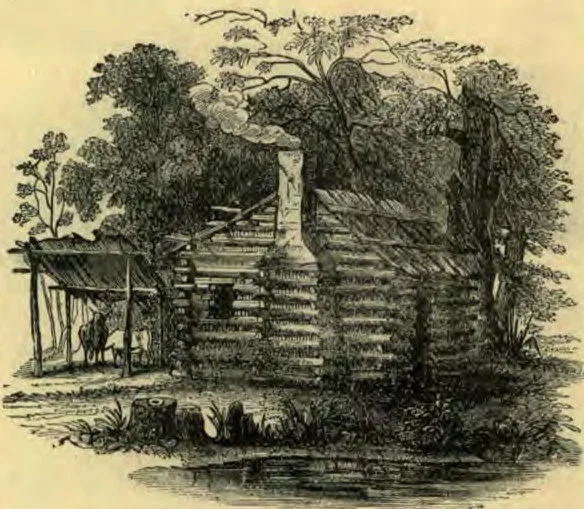
After a time some white men came across the ocean, and settled in the new country. They chopped down the great trees, and of the logs made just such houses as this one you see in the picture. In building these houses they cut notches in the ends of the logs, and laid them so that the end of one log fitted in the notch cut in the end of the other. Of course these logs couldn't be made to fit tight together, so the cracks were stopped up with dried moss or clay. The chimney was built on the outside, at one end, and in it, and opening into the room was a huge fireplace, so large that great logs could be rolled into it. All the houses had these fireplaces, for the people didn't know very much about stoves.
After they had built their houses, they set to work to clear the land. To do this, they made fires around the roots of the trees, and when the trees were dead, planted their corn. They did not have any such good farming tools as we have now-a-days, so they tilled the land very much as the Indians did. The Indians had hoes made of flat bones, tied to the ends of sticks, and many of the white men at first had no better tools than these to work with. It took them a long while to hoe just a little ground, but the land was rich, so that things grew if they didn't get a very good hoeing. By and by rude plows were brought over from England, and then the farmers could work faster.
They had no stores where they could go to buy calico and flannel to make up into clothes. So they cut the wool off their own sheep, and spun it into yarn on their spinning wheels; then they put the yarn into looms and wove it into cloth. If you will ask your grandmothers how they did the spinning and weaving, I have no doubt but that they will tell you, for they used to do the same thing themselves when they were girls.
When there was a new house to be built, the neighbors came from all around to help. They often lived miles away from each other, but they were neighbors for all that. When the corn was ripe in the fall, the farmers made husking bees, and went to help one another husk corn. This was about all the visiting they had time to do, and they made the most of it.
Their roads were not very good; in fact, they were so busy at first in building houses and raising crops that they didn't think to make any roads, they just had little foot-paths through the woods. By and by they made themselves two-wheeled carts, and then they began to make roads from one house to another. They had no schools for their little boys and girls to go to, and so, as the children grew up, they learned very little except what their folks taught them. But if they didn't know so much about books as we do now, they did know how to work, and to work with a will.
Altogether the people did not have a very easy time in making their new homes; for their cattle used to get lost in the woods, and sometimes they could not find them; then the wolves would eat up their sheep and calves. The Indians didn't like it because the white people took away the land that they used to have to hunt in, and they sometimes burned the settlers' houses and destroyed their crops. And when the people went to meeting in their little log meeting-houses, they always carried their guns for fear of the Indians and wild animals.
But in spite of all these troubles the people kept right on clearing the land and building towns and villages, until our country has grown to be the largest nation on the earth. Did you ever stop to think what hardships the people had to go through with before we could have railroads and steamships to ride on, good schools to go to, and safe homes to live in? W. E. L.

LITTLE BIRD WITH BOSOM RED.

WHEN the winds of winter blow, And the air is thick with snow, Drifting over hill and hollow, Whitening all the naked trees, Then the bluebird and the jay And the oriole fly away, Where the bobolink and swallow Flew before them at their ease.
You may look, and look in vain, For you will not see again Any flash of blue or yellow Flitting door and window by; They have spread their dainty wings, All the sunshine-loving things, Gone to pipe away their mellow Tunes beneath a Southern sky.
But we are not left alone, Though the summer birds have flown, Though the honey-bees have vanished, And the katydids are dead; Still a cheery, ringing note From a dear melodious throat, Tells that winter has not banished “Little bird with bosom red.”
Pipe away, you bonny bird! Sweeter song I never heard, For it seems to say, “Remember! God, our Father, sits above; Though the world is full of wrong, Though the winter days are long, He can fill the bleak December With the sunshine of his love.”
—St. Nicholas.

The Habit of Truthfulness in Little Things

THERE are persons whom you can always believe, because you know they have the habit of telling the truth. They do not “color” a story or enlarge a bit of news, in order to make it sound fine or strange. There are others whom you hardly know whether to believe or not, because they “stretch” things so. Cultivate the habit of telling the truth in little things as well as in great ones.

Bad Habits as Thistles of the Heart

Bad habits are the thistles of heart, and every indulgence of them is a seed from which comes forth a crop of wild weeds.

WORKERS WANTED!

THE INSTRUCTOR should have a great many more readers than it has at the present time. Filled as it is every week with a great variety of excellent reading matter suited to the wants of children and youth, and being free from the sensational trash in which so many so-called youth’s papers abound, our paper should go to ten subscribers where it now visits one. And this might be accomplished, if the proper efforts were put forth. To help in attaining this end, we make the following

SPECIAL PREMIUM OFFER.

For every new subscription, accompanied with 85 cents, we will give

THE SUNSHINE SERIES,

consisting of a package of ten beautiful pamphlets of 32 pages each. These comprise a choice collection of sketches, stories, poems, etc., adapted to the wants of children, and contain more reading matter than can be found in many dollar books.
Our young friends will certainly be able to obtain many new subscriptions by calling the attention of their schoolmates and friends to this liberal offer. For only 10 cents in addition to the regular subscription price, each new subscriber obtains the paper one year and the above mentioned valuable premium. Will not each one of our readers determine to obtain at least one new subscriber to the INSTRUCTOR the present season? Many can accomplish more than this. Let all do something.
As an inducement to our readers to begin this work of gathering in subscribers, we publish the following
Continue reading: LIST OF PRIZES,