The Youth’s Instructor, Vol. 31, No. 39.

CEDAR BIRDS

The Youth’s Instructor

Sep 26, 1883

S. D. A. Publishing Association · Battle Creek, Mich. · Sep 26, 1883

CEDAR BIRDS.
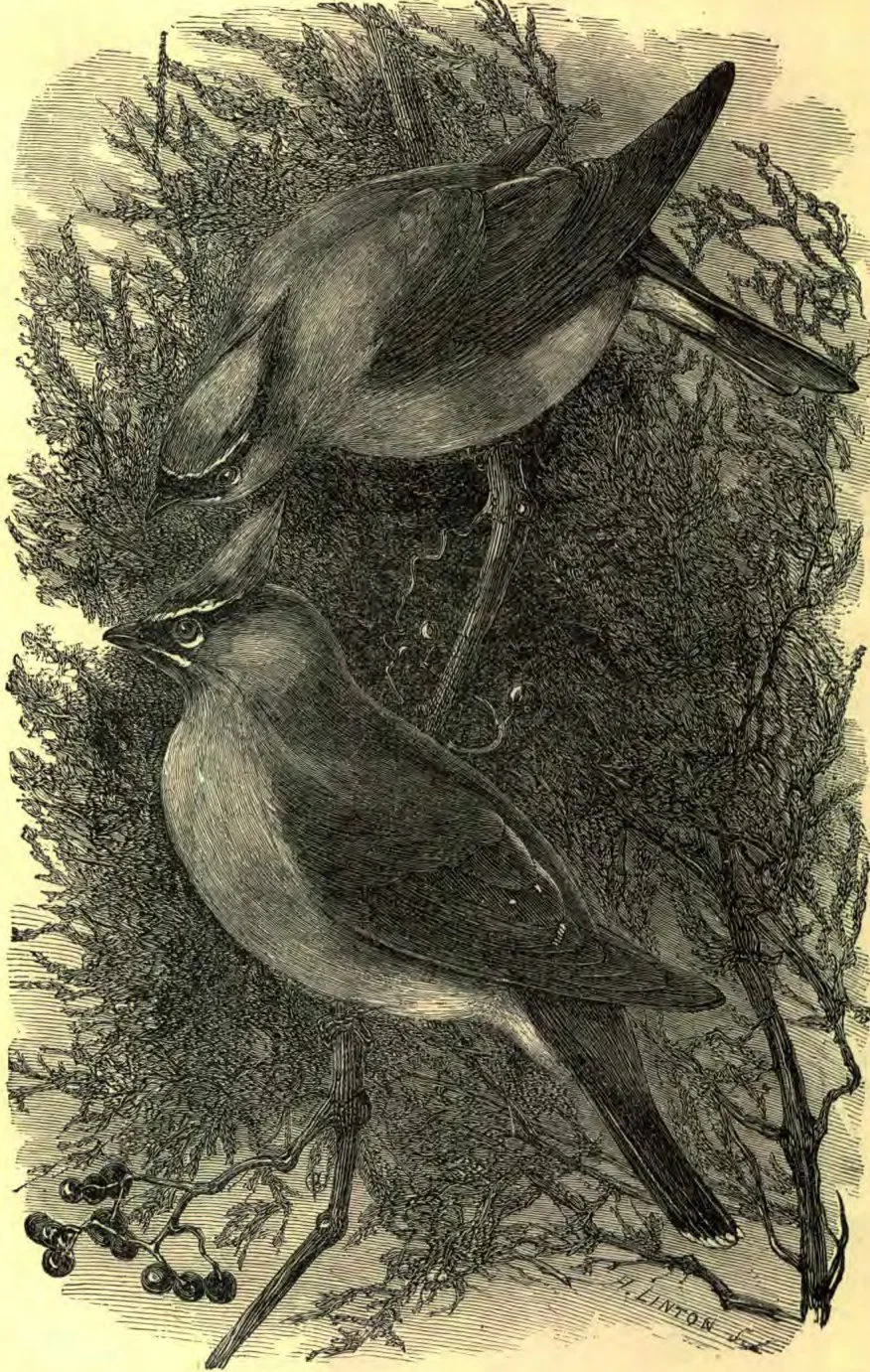
Our picture gives a good representation of the cedar birds, or chatterers, though it is difficult to tell why the latter name is applied to them, as they are said to be the most silent of birds at all seasons of the year.
The cedar bird is quite pretty; the upper part of the body is fawn-colored, and the breast is yellow. The wings are slaty-blue, as is also the tail, which deepens into black. The tips of the tail-feathers are bright yellow. On the head is a long, pointed crest, that can be raised up nearly perpendicular. On the shorter wing-feathers are usually found wax-like tips, which are simply extensions of the shaft. These are shown quite plainly on the wing of the lower bird in the picture.
These birds are found in different parts of the United States at different times in the year. In summer they go in large numbers to the Blue Mountains, where they feed on the blue berries growing there in such abundance. Later, in October, they descend to level country, where they eat almost all kinds of berries, but especially those of the red cedar, of which they are very fond. In early summer they begin their robberies among the cherry trees, and nothing will drive them off except a loaded gun. They eat largely of insects as well as fruits.
They build their nests in the month of June, sometimes upon the red cedar, but oftener on some orchard tree. Says an eminent naturalist, who has been an eye-witness to the general habits of the bird: “The nest is large for the size of the bird, fixed in the forked or horizontal branch of an apple-tree, ten or twelve feet from the ground; outwardly and at the bottom is laid a mass of coarse, dry stalks of grass, and the inside is lined wholly with very fine stalks of the same material. The eggs are three or four, of a dingy bluish white, thick at the great end, tapering suddenly, and becoming very narrow at the other; marked with small roundish spots of black of various sizes and shades, and the great end is of a pale dull purplish tinge, marked likewise with various shades of purple and black. About the last week of June the young are hatched, and are at first fed on insects and their larvae, but as they advance in growth, on berries of various kinds. The female, if disturbed, darts from the nest in alarm to a considerable distance; no notes of wailing are heard from either parent, nor are they ever seen, notwithstanding you are in the tree examining the nest and the young. These nests are less frequently found than many others, owing not only to the comparatively few numbers of the bird, but to the remarkable muteness of the species.”
In the fall they have, by their gormandizing, grown to such portly proportions that they offer a tempting mark to the sportsman, who thus supplies the demand for them in the markets of the large towns. W. E. L.

Attending to the Little Things

It behooves us to look well to the littles in our dealings with others, and in our being and doing before God. It is by our littles that we have power for good or for ill among our fellows; it is by our littles that our character is shaped and shown; and it is by our littles that we are finally and fairly judged of God.

SEPTEMBER

Sweet is the voice that calls From babbling waterfalls In meadows where the downy seeds are flying; And soft the breezes blow, And eddying come and go In faded gardens where the rose is dying.
Among the stubbled corn The blithe quail pipes at morn, The merry partridge drums in hidden places, And glittering insects gleam Above the reedy stream, Where busy spiders spin their filmy laces.
At eve, cool shadows fall Across the garden wall, And on the clustered grapes to purple turning; And pearly vapors lie Along the eastern sky, While the broad harvest-moon is redly burning.
Ah, soon on field and hill The wind shall whistle chill, And patriarch swallows call their flocks together, To fly from frost and snow, And seek for lands where blow The fairer blossoms of a balmier weather.
The cricket chirps all day, “O fairest summer, stay!” The squirrel eyes askance the chestnuts browning; The wild fowl fly afar Above the foamy bar, And hasten southward ere the skies are frowning.
Now comes a fragrant breeze Through the dark cedar trees, And round about my temples fondly lingers In gentle playfulness, Like to the soft caress Bestowed in happier days by loving fingers.
Yet, though a sense of grief Comes with the falling leaf, And memory makes the summer doubly pleasant, In all my autumn dreams A future summer gleams, Passing the fairest glories of the present.
—George Arnold.

BE BRAVE, BOYS.

To be brave is to be willing to suffer rather than do wrong, or in order to do good. The Bible has a great deal to say about bravery. All the great and good men in the Bible were brave men. Abraham was a brave man; he dared to leave his home, and friends, and native country, and go out into a strange land, in order to worship God. Joseph was a brave man, and kept up a good heart in slavery, and in prison in Egypt, and dared to do right and confess God to be his God when he was brought out of his dungeon into the court of Pharaoh. Moses was a brave man, and was not afraid to obey God, and lead the children of Israel out through the wilderness to a land he knew nothing about. David was a brave boy, and was not afraid to attack the lion and the bear when he was left to defend his father’s sheep. So all through the Bible; all its great and good men were brave men. They dared to do right. They were willing to suffer for the sake of doing right. The boy or man, or girl or woman, who is not willing to suffer for the sake of doing good, is a coward.
In stories the boys and girls who are brave are very apt not to suffer, after all. Their bravery saves them. It is sometimes so in real life. Daniel was brave, and God saved him from the lions. The three Hebrew children were brave, and were willing to be cast into a fiery furnace rather than worship an idol; God saved them, and they were not burned. George Washington was brave, and he was not killed in battle; Luther was brave, and dared to do right and speak the truth, but he was not burned or tortured. But a great many men and boys have suffered, although they were brave; yes, because they were brave. They might have escaped the suffering, but they chose to suffer, and even die, rather than do wrong. And they did suffer and die.
Henry Maag was a factory boy in Cincinnati. The factory caught fire. Instead of running out to save himself, he ran upstairs to tell the girls on the fourth floor. The stairways were filled with smoke, and in going down, after giving the alarm to the girls, he lost his way. Instead of leaving the main floor, he went down into the cellar. Thence there was no escape. There his dead body was found the following day. It was in a kneeling posture. He was a brave boy.
A train on the Pennsylvania railroad was running thirty and forty miles an hour. The fireman threw open the door of the furnace to put in coal, and the flames burst out with a tremendous blaze and roar. They caught on the woodwork and enveloped the engineer. He could have jumped from the engine and saved his life; but if he had, the train would have rushed on, and the flames would have rushed back and burned the passengers. He would not desert his post. He seized the lever, reversed the engine, and stood still amid the flames until the train stopped. The lives of all the passengers were saved, but he was so badly burned that he died in a few hours. He was a martyr to his duty. He was a brave man.
At the time of the gold fever in California, a man went from England to the diggings, and after awhile sent money for his wife and child to follow him. While on the voyage, a fire broke out in the ship. With their utmost efforts the sailors could not extinguish it. The boats were got out; the strong pushed into them, the weak were left to their fate. As the last boat was moving off, the mother pleaded for her boy. The sailors said there was not room for both, they would take one. The mother kissed her son, handed him over the side of the vessel, and gave him this message to his father: “Tell him,” she said, “if you live to see him, that I died to save you.” He escaped—she died. She was willing to die to save another. She was a brave woman.
This was the very spirit of Jesus Christ, who suffered that he might make others happy, and died that he might make others live. Be brave, boys! You cannot be like Christ unless you are willing to suffer for the sake of others.—Selected.

THE SHENANDOAH VALLEY

Written for the INSTRUCTOR.

THE SHENANDOAH VALLEY.

A few weeks ago, while in the old State of Virginia, I spent two weeks in the valley of the Shenandoah River, which runs north-east between the Blue Ridge and the Alleghany Mountains, emptying into the Potomac at Harper’s Ferry. The old river is certainly a beautiful one, with its moss-covered banks and the weeping willows and sprays of vine hanging from the trees and overshadowing its waters.
In the dry season of the year the river is quite low, so that it is easily forded with teams, and we even crossed it on an old dam that the water had left high and dry. But in the rainy season it rises very rapidly, sometimes gaining in a few hours the height of twenty feet, flooding the cellars some rods from its usual banks. At these times it is of course impossible to ford the river, and so they use ferry-boats, bridges being few. These ferry-boats are made of heavy plank, and are just large enough to admit one horse and wagon. The people are carried over in row-boats.
Some of our Northern boys would think it very fine to drive as these Virginians do. They use four horses, the driver riding the near hind pony, and never getting into the wagon at all. The reason of this is soon seen as we climb the mountain sides. It would be very hard for two horses to pull a load up the hills, for there are so many of them; in fact it is all hills and valleys. I thought the people were very kind to put four horses on their heavy loads. Of course they have nice carriages that they drive with one horse; but the heavy loads are always drawn by four horses.
The Blue Ridge Mountains on the east of the valley are so named because of the blue mist that continually hangs over them, giving them at a distance a blue appearance. These mountains rise 2,000 to 4,000 feet above the tide-level, and are so densely wooded that it is difficult to discover, as you stand at the foot, any break in the bank of tree-tops.
The prettiest view I had of the valley was from a little place called Valley View Springs, on the side of the Massanutten Mountain. (Massanutten is an Indian name, meaning Blue Mountain.) Our camp-meeting was held half a mile farther down the mountain; and on Monday morning, while the tents were being taken down, a company of us rambled off up to the Springs, where we refreshed ourselves with the fine mineral water, which is the great attraction of the place, and then went out to view the scenery. I thought the place was rightly named, for it commanded a very extensive view of the valley beneath. We climbed to the top of a hill near the hotel, and as the eye followed the outlines of the hills and dales, I thought nature had indeed reveled in her happiest dream on the banks of the beautiful stream. Low at our feet gilded the quiet waters; while beyond, undulating as the waves of the ocean, lay the low-lands, every inch of them cultivated; and here and there the pretty farm-houses peeped out from shady groves.
A little to the left is New Market, made famous by the battle fought there May 15, 1864, between General Sigel, commander of the Union troops, and General Breckenridge, commander of the rebel force. Sigel was defeated, losing about six hundred in killed and wounded, and fifty taken prisoners, besides several pieces of artillery. For this piece of ill-luck he was promptly relieved of his command by the government. The battle ground is now cultivated, and many are the relics the delving plow brings to light, of the scenes of bloodshed known to us only in story.
Looking to the right, we see Mount Jackson. It looks as if it might be a mile or two from New Market. I was surprised when they told me it was seven. It hardly seemed possible that the eye could take in such an extent of country as was in plain sight there.
Following the upward grade of the hill-tops, the view gradually broadened till, with one grand sweep, it took in one hundred miles of unbroken mountain chain. Surely the ribs of the earth seem strong, and well able to bear the jars and shocks of earth’s commotion; but they, too, shall melt away in the last great day.
M. A. STEWARD.

PATIENCE

Every lily in the meadow Waits in patience for the rain; Every daisy in the shadow Waits till sunshine comes again; Every birdie in its home-nest Waits for food, nor waits in vain.
Dearest Saviour, it is written, “Be ye patient,” in thy word; Make me patient as the lily Or the daisy or the bird. Give me, Lord, thy tranquil spirit, Never by a passion stirred.

Run From Sinful Associations Like Asahel

It is said of Asahel, the son of Zeruiah, that he was as “light of foot as a wild roe.” 2 Sam. 2:18. The wise man says, “My son, if sinners entice thee, consent thou not.” There are many who do not at first mean to consent; but they look on and think about it, and before they are well aware of it, they are drawn into sin. The true plan is to get out of the way as soon as possible. Run for your life from all sinful associations. Like Asahel, be “light of foot as a wild roe.” Many voices will call you back; you will be reviled; sneered at, laughed at, perhaps persecuted; but never mind, do right, and God will bless you in it.

UPRIGHTNESS IS STRENGTH.

A LITTLE boy was once playing in the library of Frederick the Great, his grand-uncle. Frederick opened a book of French fables, and asked the boy to translate one. He did it in splendid style, and the king praised him warmly. The honest little fellow at once confessed, “Your Majesty, I had that fable for my lesson with the tutor the other day.”
The king was more delighted with the prince’s honesty than with his cleverness, laid aside his work, took the boy out for a walk in the gardens, feelingly advised him to be true and upright in all his dealings as he had been in the library, and showed him how easily he might yield to lies, and so darken his whole life. They had just reached the lofty obelisk that still stands at the palace gate at Potsdam, when the king, pointing to it, said, “Look at this high thing: (sa droiture fait sa force),—its uprightness is its strength. You know that a tall monument would soon become a heap of ruins, if it were not straight. Remember this morning, my good Fritz,” he added, “perhaps thou wilt think of it when I am gone.” Fritz did think of it. When he was King Frederick William III., and father of the present Emperor of Germany, he used often thankfully to quote the advice, and recommend it to his family and friends. For king and commoner, for man and boy, for woman and girl alike, uprightness is strength and happiness.—Bible Children.

NEW-TESTAMENT HISTORY.

LESSON 154.—PAUL'S FIRST EPISTLES.

Some have supposed that Paul's epistles to the Thessalonians were written from Athens, but it seems much more probable that they were written during his long stay in Corinth, and while he was suffering under the fierce persecutions that were brought upon him there. Paul's love for the brethren at Thessalonica was very ardent. In speaking of his labors among them, he says: “We were willing to have imparted unto you, not the gospel of God only, but also our own souls, because ye were dear unto us.” Again, they were among some of the fiercest persecutors that the apostle had met, and his anxiety for them was the greater on that account. He had greatly desired to see them, and more than once had purposed to make them a visit; but to use his own words, “Satan hindered.” Finding that he could not go himself, he sent Timothy to establish and comfort them. When Timothy returned, he gave such a good report of their faith and charity, and of their desire to see Paul, that, although he was in the midst of affliction and distress, he was greatly comforted. He says: “For now we live, if ye stand fast in the Lord.” It seems that Paul's heart was so drawn out toward them, that he felt constrained to talk to them by letter, since he could not be with them in person. He wanted to express his love and gratitude for their constancy under afflictions and tribulation; he wanted to encourage them to persevere in well-doing; and furthermore, he wished to correct some errors of doctrine into which they were falling.
In opening his letter, he associates with himself Silvanus and Timothy. First, he invokes the blessing of God upon them, and assures them that their work of faith, their labor of love, and their patient hope in the Lord Jesus, is constantly borne in mind; that he remembers them in his prayers, and thanks God for giving him such good fruit of his labor. He reminds them how the power of God attended his preaching when he was among them, praises them for receiving the truth under affliction, and for being an example to all about them. He says: “For you sounded out the word of the Lord, not only in Macedonia and Achaia, but also in every place your faith to Godward is spread abroad.” He says it had not been necessary for him to speak of his own work among them; for all the people about them bore witness of their turning from their idols to serve the living and true God, and that they were waiting for his Son from heaven, even Jesus Christ, who has been raised from the dead.
Paul then calls attention to the circumstances under which he came among them. Although he and Silas had just been imprisoned at Philippi, they were none the less bold in speaking the gospel at Thessalonica; neither did they modify the truth, or speak flattering words for the sake of pleasing men and thus escaping persecution. He says: “Nor of men sought we glory, neither of you nor yet of others; . . . but we were gentle among you, even as a nurse cherisheth her children.” After further calling them to witness to the meekness and faithfulness with which he and Silas had labored among them, he praises God that they received the truth as coming from God himself. He says that in their endurance under persecution, they have imitated the example of the churches of God in Judea. He tells them that they have suffered from their own countrymen the same things that the churches in Judea have suffered from the Jews. In speaking of the unbelieving Jews, he says that they please not God, and are contrary to all men; that they have killed not only their own prophets, but even the Lord Jesus; and that they have persecuted himself and Silas, even forbidding them to speak the word of truth to the Gentiles that they might be saved.
He admonishes them not to be moved by the afflictions they have to suffer, and reminds them that he had plainly told them beforehand that they would have to suffer tribulation. So great had been his anxiety for them, however, that he had sent Timothy to see how they were doing; for he feared that the tempter might be too strong for them, and cause them to give up their faith; but now, since he has learned of their steadfastness, he knows not how to praise God enough. He says they are his glory and joy, and should they prove faithful, they will be, at the coming of the Lord Jesus, his crown of rejoicing. He says that although absent in body, his heart is with them, and that he prays day and night for the privilege of visiting them, and perfecting that which is lacking in their faith. He implores the blessing of God upon them, saying, “The Lord make you to increase and abound in love one toward another and toward all men, even as we do toward you.”

QUESTIONS.

  1. To what church did Paul write the first of his recorded epistles?—To the Thessalonians.
  2. Where was he when he wrote them?
  3. How did he regard the brethren at Thessalonica?
  4. How does he show this in speaking of his labors among them? 1 Thess. 2: 8.
  5. What increased Paul's anxiety for these brethren?
  6. Why had he not gratified his strong desire to see them? 1 Thess. 2: 18.
  7. Not being able to go to them himself, how did he seek to establish and comfort them? Chapter 3: 1, 2.
  8. How was Paul affected by Timothy's report concerning them? Verse 7.
  9. How did he give expression to his feelings? Verse 8.
  10. What did his love and gratitude prompt him to do?
  11. What other purpose had he in writing?
  12. With whom does he associate himself in opening this letter? 1 Thess. 1: 1.
  13. What did he first do?
  14. Of what did he assure them? Verses 2, 3.
  15. Of what did he remind them? Verse 5.
  16. For what did he praise them?
  17. What did he say about their success in spreading the truth? Verse 8.
  18. Why had it not been necessary for him to speak of his own work among them?
  19. To what does Paul then call attention? Chapter 2: 1.
  20. How had he and Silas shown their faithfulness and their trust in God? Verse 2.
  21. How was their preaching in marked contrast with some that is heard in modern times? Verses 4, 5.
  22. What does Paul himself say about the motives and manners of himself and those who were with him? Verses 6, 7.
  23. After calling upon the Thessalonians to witness to the example of meekness and faithfulness set before them, for what does he praise God? Verses 9–13.
  24. Whom does he say they have imitated in their endurance under persecution? Verse 14.
  25. What does he say in speaking of the unbelieving Jews? Verse 15.
  26. What enormous crime had they committed?
  27. How did they still show their selfish and cruel disposition? Verse 16.
  28. Of what does Paul admonish the Thessalonians? Chapter 3: 3.
  29. Of what does he remind them? Verse 4.
  30. What fears had he before sending Timothy to them?
  31. How does he now feel, after having learned of their steadfastness?
  32. What does he say of them? Chapter 2: 19, 20.
  33. For what did he pray day and night? Chapter 3: 10.
  34. How does he implore the blessing of God upon them? Verse 12.

From Antioch to Thessalonica.

After the council at Jerusalem concerning circumcision, Paul took with him Silas, one of the men who had been sent with him and Barnabas from Jerusalem to confirm the message to the Gentile brethren, and leaving Antioch, where he had been stopping for some time, he set out to visit the churches which he had raised up during his first mission to the Gentiles. Of these it is not probable that more than some of the most important are named in the Scriptures; so in just what particular cities were “the churches” which he “confirmed” in his journey through “Syria and Cilicia,” we do not know.
Leaving Antioch by the bridge over the Orontes, he would cross Mt. Amanus by the gorge which was anciently called the “Syrian Gates,” and is now known as the Beilan Pass. The old Roman road leads near the coast, and he would soon come to Alexandria, named for the great conqueror, and then to Issus, where he once gained a great victory. There were other cities on his route across the Cilician plain, which we may easily imagine him as visiting, for there must have been Christians in some of them. And one place we may feel quite sure that he did not pass by,—Tarsus, his own native city, where it seems very natural to suppose there was a flourishing church. It must have been indeed a cause of gratitude as he walked the streets so familiar to him, to know that even some families had turned “from idols to serve the living and true God.”
The old Roman road from Tarsus led northward through wild ravines, among wooded slopes, and over sunny plains, till it came to the Taurus Mountains, which the travelers must cross to go into Lycaonia, where were the cities of Lystra, Derbe, and Iconium. There were many passes through the mountains, but the “great pass,” described as “a rent, or fissure, in the mountain chain extending from north to south through a distance of eighty miles,” and known in ancient times as the “Cilician Gates,” is thought to be the one through which their road would lead.
After crossing the mountains, the apostle in his journey along the main road comes first to Derbe; and of this second visit we have as few particulars as of his first. But Lystra he remembers as the place where they were ready to worship him one day and to stone him the next. Here he finds Timothy, who from a child had been taught in the Scriptures by his godly mother and grandmother, and so fitted to be a comfort, support, and companion for the apostle.
We have no mention of Paul’s visiting Iconium or Antioch at this time, but it seems hardly probable that he should leave the Christians at these places unvisited, when it would be so little, if any, out of his way to go to them. We know that he next journeyed northward through the rather indefinitely bounded regions of Phrygia and Galatia. Here he also delivered to the churches the message sent by the apostles and elders from Jerusalem, and everywhere established them in the “most holy faith.” Paul had it in mind to put forth further efforts in these parts, but God had called him to extend the field of his labors. So they pushed on to Troas, a city of classic interest on the shores of the Ægean Sea.
As the travelers rested here at Troas after their long journey, Paul heard in a night vision that beseeching call, “Come over and help us.” And when the morning dawned, and the men of Troas returned to their labors, among those who were busy about the shipping in the harbor were the apostle and his companions, seeking for a passage to Europe. It is easy to follow them in their passage, for they took a straight course to the island of Samothracia, and the second day arrived at Neapolis, a sea-port of Macedonia, where they landed. From here they no doubt proceeded on foot to Philippi, a city some ten miles from Neapolis. A ridge of elevated land which connects the range of Pangaeus with the higher mountains in the interior of Thrace, is crossed between Neapolis and Philippi. We can imagine the travelers stopping on this height to take in the extensive and magnificent sea view opened up before their eyes to the south.
The region about Philippi is one of many historic memories. On the plain of Philippi was fought that famous battle between Brutus and Antony, where disheartened and defeated, both Brutus and Cassius fell by their own swords. And now the great apostles had come to the same place, to win a greater victory than that of Philippi, and to found a more enduring empire than that of Rome. It was at this place that the apostles were dragged before the authorities by the masters of the damsel who had a spirit of divination. Here, while they were thrust in the innermost prison, with their feet fast in the stocks, they sang praises to God; and in that night he wrought great things both for them and the jailer.
Leaving Philippi on the morrow, Paul and Silas set out for Thessalonica by the old Roman road known as Via Egnatia. On the way, he first stopped at the city of Amphipolis, some thirty-three miles from Philippi; then at Apollonia, some thirty miles farther on, and about thirty-seven from Thessalonica. Both of these stopping places were important towns, and possess much historic interest. The ancient name of Amphipolis was the “Nine Ways,” from the great number of Thracian and Macedonian roads which met at that point. The first part of the Roman Way from Amphipolis to Apollonia led between high cliffs and the sea, and the rest of the way across a beautiful plain. From Apollonia to Thessalonica the road passed through a long valley, or rather, a succession of plains, where the level spaces were richly wooded with forest trees and the nearer hills covered to their summits with olives.
Thessalonica was the capital of a province and a “free city,” and was a town of no little importance. A sister of Alexander the Great was called Thessalonica, and from her the city was named. It was a city which from its very situation seemed destined to prosperity, and was a very appropriate place for one of the starting points of the gospel in Europe. No city has had a more distinguished Christian history than Thessalonica, and the apostle well writes to the Thessalonians as those to whom great interests were committed. E. B. G.

SOMETHING TO BE GLAD FOR.

I am very glad about one thing to-day," said little Harriet, thoughtfully, as she sat by her mother's side in the evening, rocking her kitten to sleep, in her low rocking-chair.
“What is that?” asked her mother, with a smile; “some good thing you have done?”
“No, mother, but a bad one I didn't do.”
Harriet had a way of telling her mother her thoughts; and I cannot tell you what a blessing that was to the little girl; how many good lessons she learned which she would otherwise have missed; how many wrong things were set right; and how many little tender vines of goodness were trained and encouraged by her dear mother's loving words, which without them might have drooped and withered.
“What was the wrong thing you were tempted to do, Hattie?”
“Well, mother, Laura Powers spoke very unkindly to me because she lost her place in the class, and I was at the head; she tried hard to make me angry, and I did get very angry. Then I thought of some hard speeches I wished to make to her. But I didn't, mother. I am so glad I didn't. I was ashamed about it afterward, when I thought it over, and I prayed God to forgive me, just as you taught me to.”
There was a gentle arm slipped around the little girl's shoulders, and mother's cheek bent down over the shining, golden head.
“I am glad, too, my darling. If there is anything we are ever glad for, it is that we left unsaid bitter words that rose up in our hearts. Always think, when you are tempted to say them, ‘How glad I shall be, by and by, if I do not.’ Jesus bore all his evil treatment meekly. He could pray for the forgiveness of his worst enemies. Try always to be like him, my darling; then you will be really happy, and will be fitting yourself for a home where all is happiness, because all is love.”—Selected.

“SOMEBODY ELSE.”

A LADY was walking quietly along the city street, when the door of a house flew open, and a boy shot out with a whoop like a wild Indian. Once on the pavement, he danced around a curb-stone, and then raced down the street in great haste, for it was evident, by the books under his arm, that he was going to school. The lady was thinking to herself what thoughtless, noisy creatures healthy boys always are, when just a few yards before her she saw something yellow lying on the stones. Coming nearer, she fancied it was a pine shaving, and looked after the boy again. She saw him suddenly stop short in a crowd of people at a crossing, coming back as fast as he had gone. He reached the shaving just before she did, and picked up, not a shaving at all, but a long, slimy banana-skin. Flinging it into a refuse barrel, he waited only long enough to say, “Somebody might have slipped on it,” and was off again.
It was a little thing to do; but that one glance of the boy’s clear, gray eyes, and that simple, earnest sentence, made the lady’s heart very warm toward the noisy fellow. He had not slipped himself; he was far past the danger, and when one is in a hurry, it is a great bother to go twice over the same ground. But the “somebody else” might slip; and so for the sake of this unknown somebody, the hurrying boy came back, and it may be, saved the life or limbs of a feeble old man, or a little child. He might have said, “I can’t wait to go back—it’s none of my doing, and so it’s none of my business;” but he made it his business, and in this showed a trait of character which promised well for the future. There is nothing nobler on earth than this taking care that “somebody else” shall not suffer needlessly. The child who grows up with such a spirit always active in him, will do much to make his home happy, and will be likely to win many friends.—Selected.

Lightening Others' Burdens Brings Our Own Blessing

Few people can do great things in this world, but everybody can make some one's burden lighter; everybody can sometimes help another; and in so doing, we shall find our own troubles disappearing. In blessing others, we shall ourselves be blessed.

Letter Budget.

Jennie Losee, of Richfield, Mich., writes: I am eleven years old. I like to read the INSTRUCTOR. We have thirteen miles to go to Sabbath-school. I get my lessons in Book No. 3. I went with papa and mamma to the Flint camp-meeting, and got acquainted with the editor. I am trying to be a good girl, so that I can live on the new earth.”
Mary Getzlaff writes from Good Thunder, Minn. She says: “I am a German girl, ten years old. I have three sisters and one brother. We used to keep Sunday; but since Bro. Hill preached here, we keep the Lord’s Sabbath. We go to Sabbath-school, where we get the YOUTH’S INSTRUCTOR. We want to be good. Pray for us.”
Charlie Blake writes from Alma Center, Wisconsin. He says: “I am six years old. I go to day-school and Sabbath-school. I get Sabbath-school lessons in Book No. 1. I am going to camp-meeting, at Merrillon, this fall. The meeting is to be four miles from home. I want to be a good boy.”
Tommy Waite sends us a letter from Silas, Alabama, in which he says: “I wrote one letter to the Budget a long time ago, when Miss V. A. Merriam was editor. As I do not often see in the INSTRUCTOR a letter from this part of the country, I thought I would write again. I go to Sabbath-school, and like it very much. I have been going to day-school to my aunt. We have magnolia trees here, and they have large white blossoms, which are very fragrant. The cotton plant also grows here. This has a great many blossoms from June to September; they are white the first day, and red the second, after which they fall off. It is so dry this year that cotton is not doing much. We are looking forward with interest to our camp-meeting, that is to be held the 4th of October. I want to be a good boy, and have a home with you in the kingdom, where we can see Christ, and live with him.”
Continue reading: LITTLE BELL