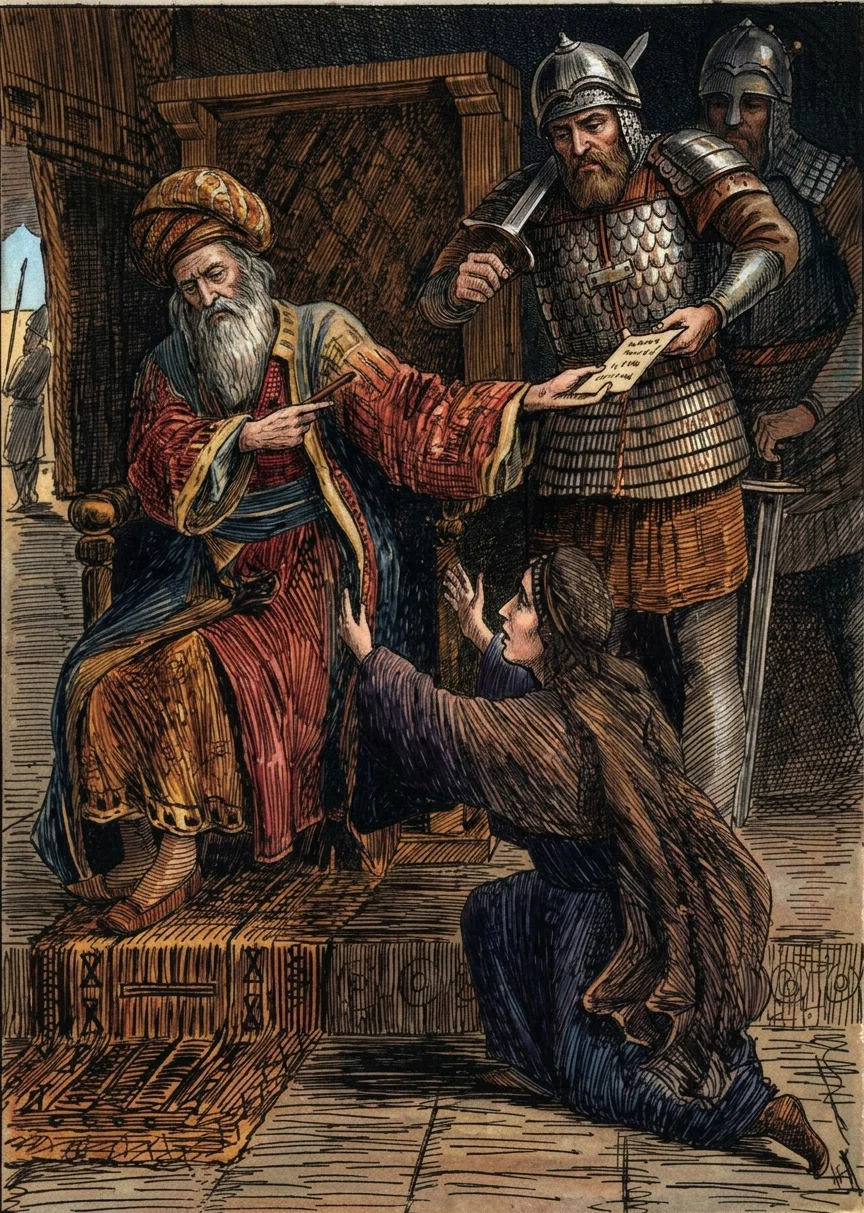
“AND he spake a parable unto them to this end, that men ought always to pray, and not to faint; saying, There was in a city a judge, which feared not God, neither regarded man; and there was a widow in that city; and she came unto him, saying, Avenge me of mine adversary. And he would not for a while; but afterward he said within himself, Tho I fear not God, nor regard man; yet because this widow troubleth me, I will avenge her, lest by her continual coming she weary me. And the Lord said, Hear what the unjust judge saith. And shall not God avenge his own elect, which cry day and night unto him, tho he bear long with them? I tell you that he will avenge them speedily. Nevertheless, when the Son of man cometh, shall he find faith on the earth?”
This judge was a man appointed by the law to give decisions upon cases that were brought before him. He had no love or reverence for God, and therefore no unselfish love for his neighbor. He had no regard for the rights of men. Judges were required to show a special attention to widows; but this man cared nothing for the rights of any. The Lord gave instruction through the prophet Jeremiah as to what judges should do for those who called upon them. “Thus saith the Lord: Execute ye judgment and righteousness, and deliver the spoiled out of the hand of the oppressor, and do no wrong; do no violence to the stranger, the fatherless, nor the widow, neither shed innocent blood in this place.” The widow and the fatherless were objects of the Lord’s special care, but those who feared not God, who had no regard for their fellow-men, took advantage of the cases of those who were helpless and destitute. A judge unfaithful to his trust suffered might to triumph over right.
The widow who came to plead with the unjust judge to avenge her of her adversary was determined that the judge should attend to her case. For a while he refrained from answering her request, but afterwards, because he was getting weary of the continual coming of the widow, he said that he would avenge her. In the position which he occupied, the judge could have immediately delivered this woman from her oppressors, but he had no disposition to do so. Instead of delivering her, he united with her adversaries to do that which would bring oppression upon her. For a long time justice was delayed, but at length because of sheer weariness on account of her persistent importunity, he decided to do the act that he should have done long before.
What revelations will be made in the day of final reckoning that will show how much suffering unjust judges have brought upon their fellow-men! It will be made manifest that their injustice has not come upon men because of ignorance of what were their rights, but because they were unmindful of the privileges that God had given to their fellow-men. Tho they stood as judges, they themselves brought upon men terrible oppression, and assisted the robber, the thief, in robbing their fellow-men. The day is coming when these judges will be arrayed before the throne of eternal justice, and will have to give an account before Him who is the judge of both the quick and the dead. When the books are opened and men are judged according to the works written in the books, sentence will be pronounced against the evil judges who have brought so great oppression upon the innocent and the helpless. They will be called upon to behold every deed of injustice, and to see the sufferings that they have thereby caused their fellow-men.
Those actions that had the appearance of external propriety, and even of goodness, will be unmasked, and the hypocrisy of men will be seen in its true character. Those who do a deed of justice simply to rid themselves of the trouble of listening to the pitiful tales of suffering that the afflicted pour into their ears, are placed in sharp contrast with the all-merciful, all-pitiful Father, who considers the appeals of his suffering children with infinite compassion and love. The Lord calls upon men and angels to hear what the unjust judge said. Heaven is cognizant of the actions of men. The Lord places in contrast the spirit and action of the unjust judge with his own Spirit and action, saying: “And shall not God avenge his own elect, which cry day and night unto him, tho he bear long with them? I tell you that he will avenge them speedily.”
These words are to administer comfort to all those who are oppressed. God hears the cries of his children. Jesus gives them the assurance that God has not forsaken, that he will come forth to vindicate their cause. There is One who has suffered in their behalf, who has borne with them their sorrows and afflictions, and who will appear as their deliverer. The people of God who suffer persecutions for their faith, who are falsified, scorned, and derided, are often tempted to think themselves forsaken of God. To the eyes of men they are in the minority, and to all appearances their enemies triumph over them, yet let them not violate their conscience; for the Lord will give them a signal victory. God will hear the humble prayers of his contrite ones. “For thus saith the high and lofty One that inhabiteth eternity, whose name is Holy: I dwell in the high and holy place, with him also that is of a contrite and humble spirit, to revive the spirit of the humble, and to revive the heart of the contrite ones.”
The question is asked, “And shall not God avenge his own elect?” The elect of God are the objects of his special care. Of his people Christ said, “Ye are the light of the world.” The elect are those whom God has made the6depository of sacred responsibilities. They are those whom God has called out of darkness into his marvelous light, to show forth his praises, and to shine as lights amid the moral darkness of the world. The unjust judge had no special interest in the widow who importuned him for deliverance, yet to get rid of her pitiful appeal, he heard her plea, and delivered her from her adversary. But how different is the attitude of God toward his children! “God so loved the world, that he gave his only-begotten Son, that whosoever believeth in him should not perish, but have everlasting life.” He loves his people with infinite love. God has from the beginning chosen us for salvation through sanctification of the Spirit and belief of the truth.
We are called to be laborers together with God. The Lord has a particular regard for those who are chosen and faithful, who cry day and night unto him. It may seem that the trials and sufferings continue, and that God does not regard them. Delay may seem long; but their prayers are not in vain; for he will avenge them speedily, that is, at last, and in a way not expected by them, when the most trying point is reached. There is no danger that the Lord will neglect to hear the prayers of his people. He will be true to his word. The danger is that his tried, tempted people will become discouraged and will not persevere in prayer, so that God will avenge them of all that wicked men have brought upon them. The Lord asks: “Can a mother forget her sucking child, that she should not have compassion on the son of her womb? yea, they may forget, yet will I not forget thee.”
(Concluded next week.)
Two Reformations—Type and Antitype
By I. E. Kimball
ZION AND BABYLON. NO. 5.
BY I. E. KIMBALL.
Two Reformations—Type and Antitype.
THE concluding work in the building of the typical temple came in the times of Ezra and Nehemiah. Then a third decree for the consummation of the work was promulgated, B.C. 457. These three decrees are put together by the God of heaven; thus we read: “And they builded, and finished it, according to the commandment of the God of Israel, and according to the decree [margin] of Cyrus, and Darius, and Artaxerxes king of Persia.” Ezra 6:14. It took all that the three wrote to make up the full decree for the restoration. Thus from the time of Artaxerxes, who finished the decree, the longest prophetic period of the Bible dates—the period of 2,300 years of Dan. 8:14, which brings us to the final decree of the God of heaven for the finishing of the Gospel temple, the finishing of the mystery of God, at the conclusion of that period; and the announcement of the time when their work began, is marked in Rev. 10:6, 7, etc. So from the times of the early Reformation we are brought down to the year 1844 for the last decree. Then the great announcement went to the world: “Fear God, and give glory to him; for the hour of his judgment is come.”
I have marked how wonderfully propitious the decree which finished the temple of old. All the coffers of the province of Babylon were thrown open, and abundant provision was made. Many thousand now returned from Babylon; but this was a period of reformation, and withal the work dragged slowly for a time. The holy seed commingled with the world, and a radical separation had to take place; but they went up with full determination to finish the work.
It will be noticed by reading the decree in the seventh chapter of Ezra that it pertained more especially to the teaching of the law. Ezra “prepared his heart to seek the law of the Lord, and to do it, and to teach in Israel statutes and judgments.”
About the first thing accomplished was the separation of the holy seed, who were amalgamating with the world. Of this work we read in the eighth chapter of Nehemiah how the people gathered together as one man, and Ezra stood before them on a pulpit erected for the occasion; how he blessed the God of heaven, opened the book and read, and how Joshua with the Levites and Nehemiah caused the people to understand; how they wept when they heard the law; for they were convinced of the law as transgressors; how the people were stilled with the assurance that they should rather rejoice, and that the “joy of the Lord was their strength;” and, finally, how they celebrated the feast of tabernacles, an unmistakable type of the day of eternal deliverance, and the people entered into a solemn league and covenant of obedience.
Now it will be seen that it is more than coincidental that the last work in the restitution of our own times is witnessing just such a reformation. This world will never appreciate the work begun in 1844. William Miller and his coadjutors believed in the speedy restoration and conclusion of the work. A backslidden church was warned, and the cry was raised, “Babylon is fallen.” About fifty thousand came out from various communions; they declared the proximity of the second advent of Christ, and the immediate finishing of the mystery of God. The message stirred the world in almost an unprecedented way. It sounded out to the ends of the earth. Such was the inauguration of the closing work for the church of Christ.
That message is onward still with a mighty cry—going over all the earth—the same things spoken, the same explanations given. There was, indeed, a mistake in the conjecture that the cleansing of the sanctuary meant the cleansing of the world by fire. The period of 2,300 years foretold, ended in 1844. “Then shall the sanctuary be cleansed.” Their opinion that this cleansing would be by fire was a mistake, but that opinion was no part of the Bible message. Their mistake was immediately rectified when they saw that the typical cleansing of the worldly sanctuary foreshadowed, not a fiery visitation, but the taking away of sin, preparatory to the appearance of the Lord. Of this one may learn more fully by consulting a work on “The Sanctuary and Its Cleansing.”
Separation from the world was effected, and is now being effected. The decree of Artaxerxes, under which anciently the people finished their labors, was more particularly for the restitution of the temple service in full and of the law of God. When the people heard the law, they wept; so now many are being convinced of transgression.
Reformation on the Sabbath.
If one will look carefully to the teachings of Isaiah, Jeremiah, and Ezekiel, and consult also 2 Chronicles 36 and Leviticus 26, he will be fully persuaded that Sabbath transgression was the primal cause of Israel’s overthrow, and of the Babylonian captivity, for the Sabbath was the sign and seal to certify to them that the God who sanctified them was the living God—Jehovah—who had created all things. The Babylonians served another God. Israel never forgot the Lord when they kept the Sabbath.
A reformation on the Sabbath would have saved Israel even at the last moment. Jer. 17:24-26. So in the return from the captivity it would be natural and we would expect them to give special attention to the Sabbath law, and this they did. Neh. 9:14; 13:17, 18.
So, since 1844, this point has especially engaged the attention of the church of Christ: The Sabbath as a sign, a witness of our recognition of him, as opposed to the “mark of the beast,” a counterfeit institution, which shows subservience to the Catholic authority and power. This sealing of the servants of God with the sign of God in their foreheads has gone steadily forward.
But I must notice Nehemiah’s work as a supplement to Ezra’s, when the walls and gates which at the first were set up, but broken down again, were finally restored. “Let us arise and build,” said Nehemiah. Then a trio of notable men called it rebellion, mocked, and ridiculed; but “the people had a mind to work.” The dwellers in Jerusalem began to build in earnest over against their own houses, and were helped by the brethren from all quarters. Then the Arabians, Ammonites, and Ashdodites conspired to fight, and so put an end to it. And Judah weakened, and said, “We are not able to build;” but Nehemiah encouraged them, and with the sword in one hand and implements for labor in the other, they finished.
But this was not accomplished until another and more weighty matter was settled. It was a day of utmost scarcity, and some of the people and their wives were terribly burdened, while the rich reveled in plenty. The poor had mortgaged to the rich to get corn to eat because of the dearth; some had borrowed money for the king’s tribute upon their houses and lands, and they even brought their children into bondage to get food; neither could they redeem their children. But the rich gave back the lands and vineyards, and equality was more fully established. Many of the nobles even were sworn to Tobiah, the enemy, and the work went hard; but Nehemiah pulled through, and the walls and gates were completely restored.
Now the Gospel city, the holy city, has walls and bulwarks of salvation (Isa. 26:1, 2), which were set up when the foundation in Christ was laid 1,800 years ago. This salvation is to be again fully restored. As then they built over against their own houses, so now it remains for each to bring salvation into his own life and household, so that, as with Job, there may be a hedge about him and his house and all that he hath on every side. And the gates of “praise,” which open for the gentiles, must be restored. God, like a mighty guardian, all powerful to save, will make his salvation known to all who trust and fully obey.
All promises to Israel are sure to-day. All should be animated with the thought that the work is about to be finished; none should fear the derision of enemies or the drawn sword; none should say, “We are not able;” none should now be as an oppressor of the poorer brethren. God would not have some eased, and others burdened. Pentecostal times will witness free distribution as every man has need.
GOD'S LAW.
The following is worthy of careful reading in these days, when God's law is despised not only by worldlings, but by professed Christian ministers and teachers. It is from a sermon by Rev. John Knox Wright, B.D. (Presbyterian), of Spallumcheen, B.C., printed in the current number of the Homiletic Review:—
The Law Came Straight from God to Man.
Man was not left to discover or reason it out for himself. The law is not a constitution agreed upon among men for self-government. It came direct from the Moral Governor of the universe, in such form and by such means that it is impossible either to mistake its meaning or to question its authority. God wrought it into man's very being at the creation. The breath breathed into man's nostrils, by which he was made a living soul, was the breath of moral purity and beauty, and it gave a moral nature and a sense of moral obligation. Man always bears the mark and echoes the voice of his Creator. Indeed, so essential and indestructible an element of man's make-up was the moral law that, notwithstanding the ruin and corruption and degradation of sin, it is true of man everywhere and always that he has the law written in his heart, and that his conscience bears witness, his thoughts the meanwhile accusing or else excusing one another.
This same law was given of God to Moses in Horeb. The Lord, manifesting his presence upon the mount in thick darkness, lightnings, clouds, and fire, first uttered the Ten Commandments with an audible voice unto all the people of Israel; and then, having written them with his own finger upon two slabs of stone, delivered them in this form to his servant. Moses did not compose this law, he did not even write it at the dictation of God. God himself spoke it and wrote it, and gave it to Moses in a complete, durable form. It was no new law, but the original law of creation and conscience. In its promulgation at Horeb the divine law was set upon the candlestick of human language, that it might give light to all dwelling upon the earth.
Throughout all the Scriptures it is declared that God was the Author of the moral law, and that he has the right to demand and the power to enforce obedience.
The Law Is Enforced by the Most Powerful Sanctions.
To it are attached promises of blessing and reward, and threatenings of curse and punishment. In the very terms of the law itself we find a muttering of wrath against disobedience, which sinks into a sweet whisper of mercy and favor toward those who love and fear the Lord.—“I the Lord thy God am a jealous God, visiting the iniquity of the fathers upon the children unto the third and fourth generation of them that hate me; and showing mercy unto thousands of them that love me, and keep my commandments.”
The rewards of obedience are great, precious, and sure. The punishments of transgression are severe, terrible, and certain. These rewards and punishments are both temporal and eternal. Both have had their testimony all along the past history of the world. Nations and men have prospered and flourished, or have met with suffering, disaster, and ruin, according to their estimate and treatment of the moral law. The sanctions of the law are powerful because they come from the hand of Him who is omniscient in wisdom, righteous in judgment, and omnipotent in might. O, doubt it not, my brother, God is exceeding jealous for the honor of his law!
The Law Has Necessary, Universal, and Perpetual Authority.
1. Necessary. Man's obligation to keep the law does not depend upon his own profession or resolution. Some people excuse themselves in reference to a certain looseness of conduct by saying that they make no profession of religion, or that they have very liberal views. They say that it is quite proper and necessary that professing Christians should recognize the authority of the law, but they contend that every man has the right to judge for himself. Brethren, this is all wrong; no man has the right to set his judgment, or opinion, or prejudice, or wilfulness, against the plain, positive precepts of the divine law. The authority of the law is due to its divine authorship. Obligation to it depends upon the moral nature of man, and upon his necessary relations to God. Between God, the Moral Governor, and man—an intelligent, responsible, moral creature—there is necessarily the moral law. It must be so; it is so.
2. Thus it must be evident that obligation to the moral law is universal. Wherever you find the moral faculty, the moral law has authority; there is no man without the moral faculty, therefore all men are under obligation to the law.
3. Thus also the authority of the law is perpetual. God can not change. His government over all rational, responsible creatures must always be moral government. The law is a perfect, absolute, unalterable standard for all men in all ages. It is the pure, changeless word of God, which liveth and abideth forever.
The Law Is the Basis and Shall Be the Crown and Glory of the Gospel.
Brethren, this may seem a strange statement, but I hope to make it clear to you, and to convince you of its truthfulness. The Gospel did not destroy the law. It did not lower its standards. It was not intended as an apology for its severity. The Gospel honors and magnifies the law, declaring that it is holy, just, and good. Owing to the corruption and weakness of man, the law had been broken and dishonored, so that that which was ordained unto life, became a minister of death, a revealer of guilt, a witness of condemnation. There were some things which the law could not do—not because of any weakness or imperfection in itself, but because of the fallen, corrupt condition of human nature. The law could not pardon a transgression, therefore it could not give life and salvation to guilty sinners.
It gave the knowledge of sin, measured the extent of man's weakness and the depth of his fall—thus it prepared for the exhibition of pardoning mercy and saving grace by showing the necessity for it.
Then again the law determined the plan of salvation and the provisions necessary, so that in the exercise of mercy the divine righteousness might be preserved and declared, so that God might be just in justifying every one that believeth. The law must be magnified and satisfied, man's guilt must be taken away, and his debt paid; so it was necessary that the Lawgiver himself should come, and in the nature of man, as his surety and ransom, fulfil all righteousness and put away sin by the sacrifice of himself. The absolute immutable perfection of the law rendered Calvary necessary in the scheme of human redemption. It is here that mercy and truth meet together, that righteousness and peace kiss each other.
Still further, the condition of pardon and salvation under the Gospel—which is faith—is determined by the law. What is faith but the recognition and acceptance of the truth that Christ in our behalf made a full satisfaction to the law, and took away our guilt, and canceled the sentence of condemnation by the sacrifice of himself. Our faith must look up through Christ to the holiness and justice of God, of which the law was the expression, for justification and peace. This is what Paul means when he says: “Do we then make void the law through faith? God forbid; yea, we establish the law.” Thus we must see that the law is the basis of the Gospel—determining its plan, and provisions, and conditions of salvation.
But there is more to be told. Through Christ Jesus comes the renewal of man's nature and the gift of life and power, so that men who were dead in trespasses and sins, and under the carnal mind, and led captive by the devil at his will, are caused to love and delight in, and are enabled to obey, the law. Thus we read: “What the law could not do, in that it was weak through the flesh, God sending his own Son in the likeness of sinful flesh, and for sin, condemned sin in the flesh; that the righteousness of the law might be fulfilled in us, who walk not after the flesh, but after the Spirit.” The weakness and imperfection were not in the law itself—but altogether in man. In saving man from guilt and penalty and restoring him to righteousness and favor, God stamps again his own image upon his creature, and gives a new communication of his own nature, and a fresh infusion of his Spirit—so that man may go forward again in the original line of development, and rise to honor, reward, and happiness by obedience and service according to the high, pure standard of the moral law.
The law is always the same. The motives to obedience are higher and the power stronger because of full satisfaction and8reconciliation, and the free gift of life and salvation through the redemption of Christ. Through love and gratitude we obey and serve and follow, and seek to prove what is the good and acceptable and perfect will of God our Father.
Delighting in the free divine mercy which pitied us in our low and lost condition, which took us from the horrible pit and miry clay, which called us from darkness to light, from banishment to favor and fellowship, from guilt to pardon, from penalty to reward and blessing, we become followers of God as dear children, and put on the new man, which after God is renewed day by day in knowledge, righteousness, and true holiness.
The crown and glory of the Gospel come to each man when the law of God is enthroned in his heart and manifested in his life and conduct.
It is said that in ancient times some laws were put into verse so that the people might learn to sing them. Brethren, through the grace and Spirit of Christ, God's law becomes poetry to us and his statutes a song. The law and the Gospel shall rejoice and reign together when the sons of God, forever victorious over weakness and sin, shall sing the song of Moses and the Lamb in the heavenly mansions of their Father.
O, surely, brethren, we can not give too earnest heed to these words of the prophet, “Remember ye the law”!
THE EVENING AND THE MORNING.
By Clyde Scott Chase
BY CLYDE SCOTT CHASE.
O’er this lost, erring world, like a mantle of gloom,
And o’er sin-burdened souls in their sorrow and wailing,
The curse of Jehovah—
The sentence of doom—
Long rested, like blight on the frail apple-bloom,
And strong hearts of men became fearful and failing.
But, lo! from the east a bright angel ascends,
And from him all darkness and doubt flee away.
O’er e’en the worst sinners
His shining face bends,
While God’s own white seal unto them he extends,
And their night becomes changed into beautiful day.
CALIFORNIA'S POSITION THE TRUE ONE.
By W. N. G.
During the recent discussion in the Congressional House of Representatives on the subject of appropriations for religious institutions, Mr. Johnson, of California, voiced the position of his state in a very emphatic utterance. We take the following from his remarks, as they appear in the Congressional Record of April 2:—
“I voted with the majority of the House, some weeks ago, in favor of striking out sectarian appropriations, not because I was opposed to any particular religion, for I am not, nor because I belong to any political society, for I do not, but because I believe in the complete divorcement of church and state. I regard any appropriation to one religious association as equally wrong with any other, and shall and will consistently so vote. . . . I care not what religion is taught, I am unalterably opposed to the appropriation of any public money to any sectarian institution. I do not follow those who make war on only one religion and except all others. They are not true to the noble American doctrine that church and state must be forever divorced in our country; they are mischief makers. The only salutary rule is to oppose giving public money to any and all sectarian institutions. I believe in the doctrine laid down in the constitution of my own state of California, that no public money shall be appropriated for sectarian institutions.”
“Section 22 of article 4, constitution of California, contains these words, namely:—
“And no money shall ever be appropriated or drawn from the state treasury for the use or benefit of any corporation, association, asylum, hospital, or any other institution not under the exclusive management and control of the state as a state institution, nor shall any grant or donation of property ever be made thereto by the state. . . .”
“And section 30 of the same article 4 of the constitution of California contains the following words, namely:—
“Neither the Legislature nor any county, city, and county township, school district, or other municipal corporation, shall ever make an appropriation or pay from any public fund whatever, or grant anything to or in aid of any religious sect, church, creed, or sectarian purpose, or help to support or sustain any school, college, university, hospital, or other institution controlled by any religious creed, church, or sectarian denomination whatever; nor shall any grant or donation of personal property or real estate ever be made by the state, or any city, city and county, town, or other municipal corporation, for any religious creed, church, or sectarian purpose whatever.”
“The state reserves the right to grant aid to institutions ‘for the support and maintenance of minor orphans or half orphans, or abandoned children, or aged persons in indigent circumstances,’ with the condition that the state has the right to inquire at any time into the management of such institutions, and that reports shall be made to the Legislature and published with the laws at each session.”
“These are noble words; they express the true doctrine; they voice the sentiment of the people of California. They should be adopted by the people of every state in the Union. They act as a safeguard to the treasury and a protection from religious zeal, which often runs to bigotry. We had a long and hard fight to get that incorporated into our Constitution. We carried it by a large majority.”
The first occasion to which Mr. Johnson refers was the action of the House in striking out all appropriations for Catholic Indian schools, while the special matter under consideration at the time this speech was made was an appropriation for Howard University, a Congregational institution at Washington. The pertinence of his remarks, as of the speech of Mr. McRae, of Arkansas, published last week, is accentuated by the fact that Congress denied the Catholic appropriations, while the Congregational allowance was granted. This action bids fair to force a religious sentiment into the next congressional elections, if not into the coming presidential campaign. Already it has been resented by certain members of Congress, Mr. Fitzgerald, of Massachusetts, having made a speech designed to emphasize the inconsistency of the House, and charging the adverse action in regard to the Catholic appropriations directly to the influence of the American Protective Association, commonly known as the “A. P. A.” In the course of his remarks the9speaker introduced the following, which he alleged is the oath taken by every member of the association:—
“I do most solemnly swear that I will not allow any one a member of the Roman Catholic Church to become a member of this order, I knowing him to be such; that I will use my influence to promote the interests of Protestants everywhere in the world; that I will not employ a Roman Catholic in any capacity if I can procure the services of a Protestant; that I will not aid in maintaining or building by my resources any Roman Catholic Church or institution of their sect or creed whatsoever, but will do all in my power to retard and break down the power of the Pope; that I will not enter into a controversy with a Roman Catholic upon the subject of this order, nor will I enter into any agreement with a Roman Catholic to strike or create a disturbance whereby the Roman Catholic employees may undermine and substitute the Protestant; that in all grievances I will seek only Protestants and counsel with them to the exclusion of all Roman Catholics, and will not make known to them anything of any nature matured at such conferences; that I will not countenance the nomination in any caucus or convention of a Roman Catholic for any office in the gift of the people, and that I will not vote for nor counsel others to vote for a Roman Catholic, but will vote only for a Protestant; that I will endeavor at all times to place the political positions of this government in the hands of Protestants. To all of which I do most solemnly promise and swear, so help me God.”
These things give evidence that Congress, having once committed itself to the principle of church and state union in even a limited degree, will find it extremely difficult, if not impossible, to let go.