The American Sentinel, Vol. 10, No. 34.

ROME AND THE BIBLE
Earlier text: ROME AND THE BIBLE

PROGRESS OF NATIONAL REFORM.

The Christian Statesman, of August 10, published an article upon the progress of National Reform, in which it recounts with evident satisfaction, the conquests made by the National Reform movement since its inauguration in 1863.
“A little over thirty years ago,” says the Statesman, “a few National Reformers went about our country lecturing on the kingship of Christ. They were met with a very cool reception.” “But,” continues the Statesman, “the workers never lost heart; they continued holding their local meetings and national conventions and sending out their literature.”
The publication of the Christian Statesman was commenced in 1867. At that time the entire daily press of the country was opposed to the movement; and “the religious weeklies with rare exception,” says the Statesman, “were also hostile, or at the best utterly indifferent. It was not simply the idea of a constitutional acknowledgment of Christ as King that was regarded as so impracticable or absurd, but the idea of the kingship itself. The thought seemed to prevail on every hand, even among the members of the evangelical churches, that the truth of Christ’s kingly office was a theological doctrine with which civil government and nations had nothing to do.”
“But,” exclaims the Statesman, “what a marvelous change is witnessed to-day! The ‘Good Citizenship’ movement of the Christian Endeavor Society is only one of many indications as to the moral revolution that has taken place. Papers are springing into existence to advocate the truth that Jesus Christ is the Saviour and Governor of the nation. The Christian Statesman, once so lonely, now has plenty of company in the maintenance of this truth. And the National Reform Association is now not the only organization for the dissemination of the principles of Christian civil government. Other societies are being organized throughout our land with such avowed aims as the following, which we quote from document No. 11 of the series issued by the National Christian Citizenship League: ‘It already has auxiliaries in various States and Territories, and exists for the following purposes: 1. To reveal Jesus Christ as the Saviour of the State and nation as well as of the individual. 2. To make Christian principles operative in public affairs. 3. To unite the followers of Christ in consistent, harmonious, and aggressive action for these purposes.’”
This is, as the Statesman very properly says, taking up the very same work that the National Reform Association has been engaging in for over thirty years; and what that movement is, the Statesman then proceeds to define: It is to incorporate the fundamental principles of Christian civil government into our nation’s fundamental law. In short, National Reform means a man-made theocracy. It means men ruling in the place of God; it means an image to the papacy, for the papacy is the man of sin, sitting in the temple of God, showing himself that he is God. And National Reform, whether called by that name or whether dubbed “Christian Citizenship,” is practically the same thing; it is a new papacy, an image of the power that has its seat upon the seven hills.
It is all very well enough to talk about making the law of God the fundamental rule of national life; but who is to define the law of God? As Richard M. Johnson so tersely expressed in 1829: “Among all the religious persecutions with which almost every page of modern history is stained, no victim ever suffered but for the violation of what government denominated the law of God.”
Persecution is inseparable from the assumption to rule in the place of God. It was for this reason that our forefathers sought to establish in this country a purely secular government.
This principle was recognized by the Presbytery of Hanover in Virginia; when, in 1776, it addressed to the Virginia House of Assembly a memorial in which occurred these words:—
It is at least impossible for the magistrate to adjudge the right of preference among the various sects that profess the Christian faith, without erecting a claim to infallibility, which would lead us back to the church of Rome.
Whoever assumes to decide a religious question for anybody else, assumes the prerogative of infallibility as truly as does the pope of Rome, and thus leads all who follow him, back to the church of Rome; and this the government must do if it shall undertake to make the law of God the fundamental law of the land. It must decide what the law of God is, and having decided what it is, it must decide what it means, as was done in the World’s Fair Sunday legislation when Congress decided that the fourth commandment now requires the observance of Sunday. National Reform means that such questions shall not only be discussed and decided in the halls of Congress, but in our courts of justice; and it is to such a regime as this that not only the Christian Statesman and the National Reform Association, but all the auxiliaries to which the Statesman has referred, are pledged. And it is such a regime as this that the SENTINEL has opposed and will ever continue to oppose.

OBSOLETE SUNDAY LAWS.

[The Havre de Grace (Md.) Republican, August 17.]
THERE is just now a spasmodic effort, in various sections of the country, to revive and enforce the old, antiquated and obsolete Sunday laws. As public sentiment had relegated these old, puritanic blue laws to the shades of oblivion, the attempt to enforce them at this late day, provokes resistance and conflict. The decisions of the magistrates and courts before whom cases of violation of the law are made, are varied and conflicting as to what, in their judgment, constitute works of necessity. The only way to avoid these bitter and costly judicial conflicts is to abide strictly by the Constitution of the United States.
We take the ground, which we think cannot be successfully controverted, namely, that all Sunday laws violate the letter and spirit of the Constitution.
The Constitution is a civil compact, and wholly secular. While guaranteeing religious freedom to all, it does not enjoin, but prohibits religious tests of any kind.
Sunday observance is a religious requirement of the varied religious sects, though they differ greatly as to the day and the manner of keeping it—which non-sectarians are in no wise bound to observe.
The State has no right to meddle in the matter of the religious faith of the citizen. If it did it might, with equal propriety, require the observance of baptism or any creedal article of faith.
. . . . .
This is not a Christian or religious, but a civil government of the whole people, administered for the material interests of the Christian, Jew and unbelieving citizen.
The State has no right to supervene or meddle with the spiritual belief of the citizen; that should be left to the individual conscience. Such interference is, and always has been, destructive of personal liberty.
History gives voluminous and emphatic testimony that mixing politics and religion, the uniting of Church and State, and all attempts of civil government to regulate the spiritual affairs and beliefs of the people, have engendered the most bitter animosities, caused the most fiendish atrocities, and drenched old mother earth with the best blood of the race.

MORE PRESS COMMENTS CONCERNING RELIGIOUS PERSECUTION IN TENNESSEE.

“Modern Inquisition.”

[From the Evening News, Erie, Pa., July 20.]
EIGHT Adventists have been put into the chain-gang in Tennessee for desecration of the sabbath. They observe Saturday with rigid piety as their day of rest, and work Sunday. It is a disgrace to any State in the nation to think that such puritanical idiocy still exists. The Constitution of the United States permits every man, woman and child to worship God according to the dictates of their own conscience.
The Adventists believe that Saturday is the Sabbath, and according to their religion they are entitled to work on Sunday. They disturb nobody by it, and it has been our experience that they were in almost every instance excellent citizens. It is an outrage on justice that such a thing should happen.

The Persecution of Mr. Allison.

[From the Nashua (N. H.) Telegraph, June 15, 1895.]
THE State of Georgia has a Sunday law that is calculated to make angels weep and bigots rejoice. Under its drastic provisions, one J. Q. Allison, of Douglasville, has been meanly prosecuted and unjustly sentenced to pay the sum of $22.05 or serve twelve months in the chain-gang. What was Mr. Allison’s crime? Nothing more than to have plowed up a garden spot on his own land on a Sunday. The work was performed quietly in a spot which could not be seen from the highway, or the homes of his neighbors. Therefore he disturbed no one. . . . Mr. Allison is a Seventh-day Adventist, who has conscientious scruples against working on Saturday, the Sabbath, and hence follows his regular occupation on the other days of the week, sometimes quietly performing labor on Sunday.
But while Mr. Allison religiously keeps the real Sabbath, he is prosecuted by some mean individual or official for the so-called misdemeanor of “Sabbath-breaking,” which means in this case “Sunday-breaking.” Mr. Allison conducted his own defense, denying nothing save that Sunday is the Sabbath and that he disturbed his neighbors in performing his work. For that matter, his neighbors who testified did not claim to have been disturbed. On the contrary, they testified that Mr. Allison was a good man, and that there was nothing in the world against him. It is not every keeper of Sunday who could get as good a title as this from his neighbors.
But it seems that some one learned that Mr. Allison did work on Sunday, collected evidence of that fact, and had him summoned into court for violation of the State law. In our opinion, this was a despicable action which should have been rebuked by the court by the complete acquittal of the defendant. But Mr. Allison was declared guilty, and the judge administered a sentence which in the default of the payment of money was of the most rigorous character. The Judge disclaimed religious persecution, but said that the laws of the State must be enforced. We wonder what this judge would do with a gang of lynchers or ballot-box stuffers.
The best thing Georgia can do is to reform her Sunday laws and catch and convict her real criminals. The unchristian treatment of Mr. Allison deserves the contempt of mankind.

“Bigotry and Tyranny.”

[From the Echo, Broadway, Va., Aug. 2.]
THE Adventists are good citizens and a religious people, observing what their consciences tell them to be right, and their belief is based upon the Bible as many another sect. They have as good a right to observe the day they set apart for their Sabbath and work on the day that other people take for religious worship, as these other denominations have for calling the first day of the week sabbath. It is belittling to religion to persecute these people; it breathes of the bigotry and tyranny of the ancients. As the United States is supposed to be a free country for religious worship of all creeds, we doubt the constitutionality of the law that imprisons these Seventh-day Adventists for working on Sunday.

“A Disgrace to Our Age.”

[From the Universalist Herald, Notasulga, Ala., August 1.]
It is a disgrace to our age and country that religious persecution is carried on in Tennessee against the Seventh-day Adventists. These are good people, who hold that Saturday is the proper day to keep as the Sabbath, and not Sunday. Therefore they do on Sunday what they would on any other day,—keeping Saturday as the Sabbath. For this some of them have been thrown into jail, where they now linger. The Constitution of the United States guarantees to every man religious liberty; therefore, to persecute these people because they do not observe our sabbath, but Saturday, is grossly wrong and intolerant.
The Adventists are said to be an orderly, Christian people, and to persecute them as indicated, is violative of the Christian spirit and the laws of our country. Let this foul blot on Tennessee be speedily wiped out.

Should Be Promptly Repealed.

[From the Indicator, Pueblo, Col., July 27.]
It seems impossible that in this day and age, just at the close of this enlightened century with the facts of a dark past to serve as beacon lights, that religious persecution should be practiced in any part of the Union, and yet the information comes from Tennessee to the effect that eight Christian men have been imprisoned for working on Sunday. They are Adventists, or seventh-day observers, and according to the teaching of their church, they worshiped on Saturday and labored on Sunday if they chose. Because these men worked on Sunday, therefore, they were arrested, tried, convicted and imprisoned. This was early in July, and the chances are that they are now doing service in the chain-gang like common culprits. It is no excuse to say that the laws of the State provide for such cases. Such a law is a libel on the fair name of Tennessee, and an outrage on our boasted freedom. There is no more room in this country for miserable religious persecution and intolerance, and all such laws in conflict with the spirit of the Constitution which guarantees the right of every citizen to worship as his conscience directs, should be repealed promptly, and thus a disgrace wiped from the statute books.

Our Fundamental Law Violated.

[From the Brown County Republican, Mt. Sterling, Ill., July 25.]
THE fundamental law of this land guarantees to all the right to worship God according to the dictates of conscience, and the law of God sets aside the seventh day as a day of rest, in which no labor shall be done. The first day of the week is the man-made sabbath, and because these men persist in observing the law of God rather than the law of man, they are made to suffer persecution from alleged Christians who have no love of justice in their souls.
It is not claimed that these men disturbed the peace of others or are a menace to the safety of the State, but are persecuted simply through religious intolerance. The very men who are most active in this persecution raise no objection to founderies, mills, and railroads running on Sunday, nor in fact do they care for everything running wide open on that day unless the person engaged in this work is a Seventh-day Adventist. That makes all the difference, and the poor man who is observing the law of God is jerked up and heavily fined and forced upon the chain-gang. Every lover of justice should condemn this inhuman treatment of Christian citizens, and demand the repeal of all laws that dictate how or when one shall worship God.

Liberty Only For the Majority.

[From the Centralia (Wis.) Enterprise, July 27.]
FOR over a century Americans have been prating about liberty. Ever since that memorable Fourth of July, 1776, their one theme has been liberty.
My country 'tis of thee, Sweet land of liberty, has been the burden of their song since then. Many Americans have prated about liberty so long and so incessantly, that their intelligence and their conscience have become ossified. Their notions about liberty are the narrow and perverted. Liberty to them means the liberty of the majority.
July 3, on the eve of the nation’s anniversary of independence, there were sentenced at Dayton, Rhea County, Tenn., eight innocent men to a ninety days’ term in the county jail at hard labor. This means that they will be worked in the chain-gang along with felons of every shade and depth of crime. The Enterprise said “innocent men.” They were innocent—innocent of any wrong doing. But they did not agree with the majority. That was all the crime they were guilty of. The majority observed the first day of the week by abstaining from work; these condemned men observed the seventh day. That was all. But the majority have enacted a law which makes it compulsory to observe the first day of the week. That is their idea of liberty. The minority, a handful of Seventh-day Adventists, observed their Sabbath and went about their work the next day, the day set by the majority for abstaining from work. The work these men did was quiet, unobtrusive; yet the majority evidently thought their liberties and social good order endangered, and eight innocent men were sent to the chain-gang. This is an instance of American liberty of speech and conscience. This is American justice.
Justice—what a stupid farce it becomes when an ignorant, fanatic majority can thus send unoffending men to the chain-gang for going about their work on Sunday. People guilty of enacting and enforcing such barbarous laws have no conception of true liberty.

Injustice of the Sunday Law in Tennessee

THE Knoxville Sentinel, in commenting upon the Tennessee prosecutions, while evidently seeking to do justice to the victims of the Sunday law, makes this statement:—
The Adventist who has observed the seventh day as the day of rest and has labored on the Christian sabbath, has no right to complain because he is punished for his violation of the civil law if all other infringers are likewise punished.
This view of the case is faulty. If the law is a just one, the Adventist has no right to complain if he is punished for violating it, whether other violators are punished or not, any more than the thief or murderer has a right to complain if he is imprisoned, while others like himself roam at large. No man has a right to complain of justice. The injustice lies in the law itself. The Adventists do not clamor for the imprisonment of other violators of the Sunday law, but on the contrary, ask for liberty for all men in the matter of Sunday observance. They do not feel aggrieved because others around them are not imprisoned for Sunday labor; they desire that those, as well as themselves, should be free from all coercion in matters of religious belief; provided, of course, that such belief does not invade another's rights.

RELIGIOUS PERSECUTION IN ILLINOIS.

Summerdale, Ill., August 22, 1895.
C. P. BOLLMAN—Dear Brother: In reply to your request of the 20th, would briefly say: I was arrested July 28 (Sunday) by a Roman Catholic police officer on complaint of a Mrs. Miller (a Congregationalist), who knew I was keeping the seventh-day Sabbath. I was taken in the police patrol wagon between two officers to two different police stations; and failing to give bonds, I was locked up with a criminal. The Sunday work for which I was arrested was some light carpenter work, with windows and doors closed, so as not to disturb anyone. After some counsel with some of the brethren, I concluded to waive my examination at the police court the following day and appear before the grand jury. My bond was fixed at $300.
Our dear heavenly Father bestowed much of his grace and good Spirit upon me to freely speak and testify to the officers and prisoners out of my Bible which I carried with me. We have shared much Christian love and sympathy from our dear Sabbath-keeping brethren.
I belong to no creed, but try to obey the Bible and do the will of my Heavenly Father. We have meeting privileges with Seventh-day Adventist brethren.
What is in store for us when the case is to be tried next month we know not as yet. But even if the Lord permits that I should be thrown into prison, I know his sustaining grace and presence will be with me. It will probably be hardest for my dear wife and little ones.
Faithfully your brother in Christ,
O. W. PEARSON.

WE WILL HELP YOU.

“How I wish all my friends could read that SENTINEL,” is a sentiment expressed by many of our readers on receiving some special number of the SENTINEL; but as it costs one cent each to mail the SENTINEL, many have, for this reason, used but a limited number of papers in this way. Here are offers which will enable you to send a single issue of the SENTINEL to scores, yes, hundreds of your friends for the first cost of the paper, without the additional postage:—

OFFER No. 1.

Send a list of the names and addresses of your friends, plainly written, and we will send the SENTINEL you name to any number of names for one and a quarter cents each.

OFFER No. 2.

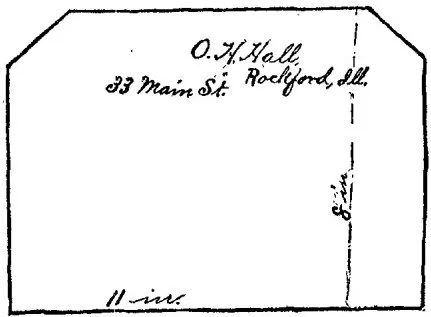
Send us wrappers, shaped and addressed similarly to the following cut, and we will send the SENTINEL you desire to one hundred names for one dollar.
Wrappers of thin manilla paper are the best. Be careful to write the names and addresses plainly, and write them about an inch and a half from the edge. The wrappers should be about eight by eleven inches; with the corners clipped, as in cut. In mailing the wrappers to us, don’t fold them but roll them.
Try one of these plans on our excellent extra of August 15. Keep these directions for future reference.

Ice Seller Arrested Under Sunday Law

AN Italian was arrested a few days since in this city for selling ice on Sunday in a crowded quarter. When arraigned before Magistrate Cornell, his honor said:—
It's a crying shame to arrest a man for selling ice in the tenement districts. Why, ice is a necessity on such a close, hot day as this. I wish I could let you go, Bacco; but, unfortunately, as the law stands, I must hold you in $100 for Special Sessions.
Commenting upon this, a contemporary asks: “What can be said in defense of a law when even the judges on the bench declare that it is a ‘crying shame’ to enforce it?”
The question is pertinent; but is not this one equally so? What shall be said of a magistrate who will blindly hold a man for selling ice on a hot Sunday in a crowded city, under a statute which permits works of “necessity and charity,” and defines necessity as including “whatever is needful during the day for the good order, health, or comfort of the community?” Bad as is the statute the magistrate had no occasion under it to hold the man who sold ice. However, the primary fault is with the statute. “Bad laws,” said Edmund Burke, “are the worst sort of tyranny. They derive a particular malignity from the wisdom and soundness of the rest of our institutions.”

A DICTIONARY of the BIBLE:

COMPRISING ITS
Antiquities, Biography, Geography, Natural History and Literature,
WITH THE
Latest Researches and References to the Revised Version of the New Testament,
WITH EIGHT COLORED MAPS
AND
FOUR HUNDRED AND FORTY ILLUSTRATIONS.
By Wm. Smith, LL.D.
Revised and Edited by Revs. F. N. and M. A. Peloubet.
Price, post-paid, $2.00

FACTS : FOR : THE : TIMES,

—CONTINUED—
—CONTAINING—
Historical Extracts, Candid Admissions from Authors, ancient and modern, on the live questions of the present hour, political and religious.

A BOOK FOR THE TIMES.

A compilation of facts that are astounding, by Students of Biblical and Historical Research.
340 pages. Wine-colored cloth binding.
PRICE, Post-paid, - - - 75 cents.
PACIFIC PRESS, 43 Bond Street, New York City.
Oakland, Cal. Kansas City, Mo.

The Story of Pitcairn Island

BY ROSALIND AMELIA YOUNG,
A Native Daughter.
PITCAIRN ISLAND, one of the volcanic gems of the Pacific, has been heard of wherever the English language has been spoken. The story of the working out of the problem of human life on its limited territory

Reads stranger and more thrillingly

in many respects than a romance. But most if not all of the tales told and books printed have either been too fragmentary, or incorrect and misleading. It will be interesting to the friends of that miniature world to know that

An Authentic History

has been written, and that by a native of the island, one to the manor born. The title of the new work appears above. It is written by Miss Rosa Young, one of the direct descendants of the mutineers of the Bounty. The book, of 256 pages, is a plain, unvarnished tale of Pitcairn and its inhabitants from its settlement to the year 1894. It is written with a

Charming Simplicity of Style

which refreshes the reader and invites a continued perusal. This work is illustrated with 26 engravings by the half-tone process, and its 23 chapters have each a neatly engraved heading.
PRICE $1.00, POSTPAID.
Thousands can be sold by those who will canvass their neighborhood. Address any State Tract Society, or
Pacific Press Publishing Company,
Kansas City, Mo. Oakland, Cal. New York City.

BAGSTER'S - COMPREHENSIVE - TEACHERS' - BIBLE

BIBLES

BAGSTER'S - COMPREHENSIVE - TEACHERS' - BIBLE.

Emerald Type. Size—8½ x 5½ x 1¼ inches.
Swedish Morocco, improved divinity circuit, leather lined to edge, round corners, red under gold edges, with Illustrations, 14 Maps, Concordance, Helps, etc. Post paid, $5.00

GENUINE : OXFORD : TEACHERS' : BIBLES.

Minion Type. Size—5 x 7¾ inches.
Fine Levant Morocco (brown), divinity circuit, calf lined, round corners, gold edges, Maps, Concordance, and many other valuable helps. Post paid, $5.00

LARGE . TYPE . BIBLES

FOR THOSE WITH POOR EYESIGHT.

French Morocco, limp covers, round corners, side and back title in gold, gilt edges, Family Register and Maps. Post paid, $2.00
ADDRESS,
PACIFIC PRESS PUBLISHING CO.,
43 BOND STREET, NEW YORK.
KANSAS CITY, MO. OAKLAND, CAL.

CYCLONE WASHER!

We Have Struck It! The Champion of All Machines.
It washes in the most satisfactory manner the clothes of farmers, machinists, engineers, and bricklayers, cleaning the dirty collars and cuffs without rubbing. The work is effected by the compressed air forcing the water through the fabric, and therefore without wear to the material washed. The washing done cleaner, quicker, better, and in half the time. No tired feeling. A child of ten can operate it. Satisfaction guaranteed. Agents Wanted in every county. For particulars and circulars address,
COON BROS., 131-137 So. Washington St., Battle Creek, Mich.

WANTS TO SET HIMSELF RIGHT.

REFERRING to our illustrated number of August 15, a Knoxville, Tenn., pastor, writes us as follows:—
EDITORS AMERICAN SENTINEL:
Gentlemen: Having given a partial quotation of an interview which I accorded a reporter for the SENTINEL, a daily paper of this city, on the subject of the punishment of the Tennessee Adventists for violation of the Sunday laws of the State of Tennessee, I ask that you do me the justice of publishing the closing paragraph of that same interview, as follows:—
“As to so-called Sunday laws, I believe they could, and certainly should be so framed as to duly respect the conscience of the subject. It is to be regretted that a body of religionists who conscientiously regard some other day of the week than Sunday as sanctified to holy purposes cannot, under the existing laws of our commonwealth, have their conscience respected. I believe, however, they would themselves prefer the enforcement of the law as it exists, to having its provisions disregarded at the expense of correct public notions touching the supremacy of the law. Perhaps in this I credit them with a patriotism their lips would disclaim. However, I think not.”
I have no doubt you will give the foregoing a place in your paper, together with so much of this letter as may be needful. That you will be as careful to send marked copies of the paper in which it shall appear, to various sources in this city, as you were to furnish the same sources with your issue of the 15th inst. cannot be questioned.
Very truly yours,
THOS. C. WARNER.
Pastor First M. E. Church.
Knoxville, Tenn., August 21st, 1895.
We cheerfully comply with Mr. Warner’s request, though we do not see that it alters the case materially. We quoted only a portion of the interview because we had not space for all of it, and because his opinion of what a Sunday law ought to be could not affect his deliberate judgment that—
The question of righteousness should never decide whether an existing law is to be enforced or not. Is it the law of the land? That question settled in the affirmative, then let the law be enforced. If the law is unjust, if it works hardship to innocent persons, still let it be executed so long as it remains upon the statute books.
We said before, and we say again, that this being Mr. Warner’s deliberate conviction, he must have said the same thing in the glare of the fires that consumed the martyrs in France or Spain, or at the foot of the gallows tree whereon the Protestants of Holland were executed; for it was all only the enforcement of civil law. We are glad that Mr. Warner’s better self revolts at the logic of the words which his lips uttered. The country can well dispense with the “loyalty” which says: “If a law is unjust, if it works hardship to innocent persons, still let it be enforced so long as it remains upon the statute books.”
Mr. Warner has not exactly retracted this unguarded utterance, but we are glad to believe that he spoke without realizing that he thereby justified all the crimes which have been committed in the name of law in this wicked world; and their name is legion.

Religious Persecution in Illinois

READ the letter on page 270, under the heading, “Religious Persecution in Illinois.”

Extra Copies of the Illustrated Sentinel Available

Extra copies of the illustrated SENTINEL, of August 15, can still be furnished at the usual price, $1 per hundred, or $8 per thousand. It is a number of exceptional value, and ought to have a much wider circulation than has yet been given it.

Southern Chain-Gangs and Religious Persecution

NUMBER 35 of the SENTINEL, dated September 5, will contain an illustrated article on Southern chain-gangs and their relation to religious persecution. This article, besides being illustrated, will give the writer’s personal observations in Atlanta, besides much other valuable and reliable information. We will also republish in this number, by request, the illustrated article, “In the Chain-gang Under the Flag,” which appeared in the SENTINEL of August 1. This paper will be furnished at the usual price, $1 per hundred or $8 per thousand. It will also be furnished in any quantity on the terms offered on the preceding page.

Mrs. Bateham Protests Sunday Law Persecution of Adventists

MRS. J. C. BATEHAM, Superintendent of the Sabbath Observance Department of the Woman’s Christian Temperance Union, has an article in the Christian Statesman, of August 3, in which she protests mildly against the persecution of Seventh-day Adventists in Tennessee, and says:—
A clause providing exemption for those who conscientiously observe Saturday instead of Sunday, and are careful not to disturb the rest of others, should always be inserted even if those provisions may occasionally be abused. . . . Courtesy and the Golden Rule require that even at partial expense of uniformity the consciences of the minority should be protected.
This statement does credit to Mrs. Bateham’s heart. It is perhaps all that could be expected of one in her position. It does seem that almost everyone ought to be able to see that all Sunday legislation is improper, and that all Sunday-law enforcement savors of religious persecution. Mrs. Bateham can see this in the case of the enforcement of the so-called law against Adventists in Tennessee. She says, “It savors of religious persecution, which, looked at on the lowest plain, is thoroughly impolitic since making martyrs for conscience always increases the following, and nothing more prejudices the onlooker than appearance of lack of fair play.”
This is indeed looking at the matter from the “lowest plain.” But we do not attribute this motive to the lady in question; we believe that it is her innate sense of justice that leads her to protest against persecution. Having seen and admitted so much, may she be enabled to see more.

Reply to the Sabbath Recorder on Persecution

THE Sabbath Recorder thinks our strictures of August 1, unjust, and complains that we quoted only a part of what it said. We can only say that we had no intention to be unfair; nor do we think that we did our contemporary any injustice, though our criticism was probably unnecessarily caustic. This latter we regret. We still think, however, that one unacquainted with the facts in the case, could get no other impression from the Recorder’s note than that some, at least, of the persecuted Seventh-day Adventists had been unnecessarily offensive to their neighbors, and had thus needlessly brought trouble upon themselves. This we deny in toto, and base our denial not upon the unsupported assertion of the Adventists themselves, but upon the sworn testimony of the State’s witnesses in the several cases. We are sure that in not a single one of the scores of cases tried during the past ten years in several different States, has there been any evidence of aggravation. The annoyance charged has all been of the kind that is begotten of bigotry and intolerance, and is born of an unwillingness on the part of the persecutors to award to others equal rights with themselves.
Continue reading: MORE TENNESSEE INJUSTICE