LEAVING Shanghai on March 17, on a small eight-hundred-ton boat that had been in service for over thirty-two years, I reached Amoy in three days, where our general meeting, which was attended by most of the workers of the Southeast China Mission, was in progress. The foreign workers present were Elder W. C. Hankins, Elder B. L. Anderson and wife, and the writer. The object of the meeting was to hold an institute for the evangelists, Bible workers, and colporteurs in that mission field; and in addition to the Chinese workers belonging in that field, Evangelists Keh, from Shanghai, and Ang, from Swatow, were present throughout the entire meeting. The day services were given up to the study of Bible doctrines, and methods and plans of work. Regular preaching services were conducted in the evening, and were fairly well attended.
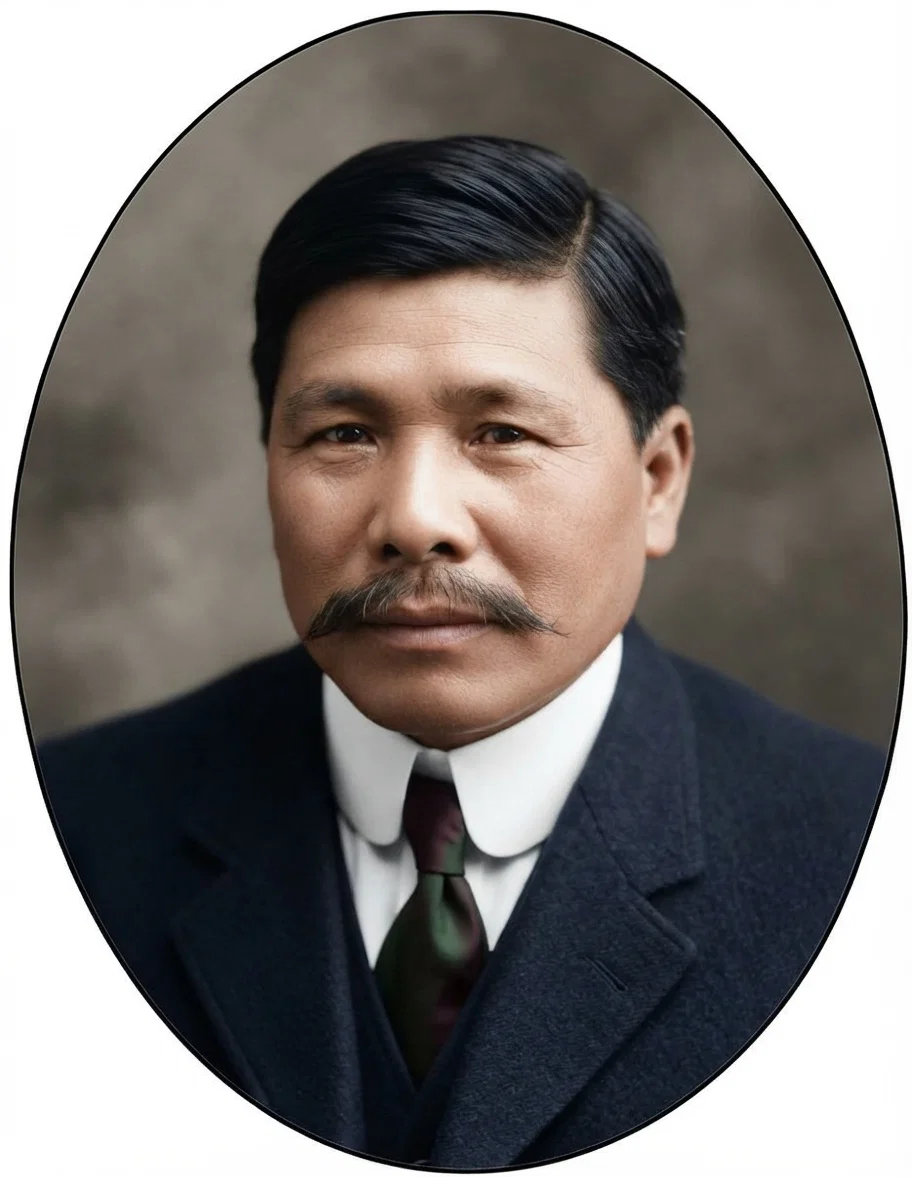
After the sermon on Sabbath morning, Evangelist Ang Tsu Kiet was ordained to the work of the gospel ministry. Brother Ang is the second ordained evangelist we have proclaiming the third angel's message to the millions of China. He is a promising, consecrated man, with a well-trained family of six girls and one boy, who, together with his devoted wife, are united in the worship of the true God. Not only is he devout and sincere, but he is also a very pleasant, capable man, having been a mandarin. Even since professing the truth, he has been urged to accept an official appointment from which he would receive a large salary. He declined this opportunity for worldly gain and advancement, and has given his whole heart and life to the preaching of the third angel's message. His home is in Swatow, and he speaks the Swatow dialect.
In Amoy two schools are conducted, one for girls, and the other for boys. In the girls' school we have two teachers, and fifty-six students, all but two of whom are day-students. In the boys' school, with thirty enrolled students, fifteen are day-students. The others are roomed and boarded, about one half of whom pay for their food, others being supported by the mission.
At Chin Chow also a school is conducted, with an attendance of seventy students, five of whom are girls. At Hui An another school is in operation, with an attendance of twenty students; and at Tang Chu a school of fifteen students is just starting. All these are day-schools, the students living at home, and being supported by their parents. The future alone can tell what benefits the cause of God may derive from these schools. Much depends upon the management, the consecration of the teachers, and the proper following up and supplementing of the work of the teachers by those in charge of the schools.
The Southeast China Mission has three foreign families, also nine native evangelists and four colporteurs. However, as Elder W. C. Hankins and family are in the United States on furlough this year, there are really but two foreign families in this field at the present time. One of the native colporteurs is working in Formosa, where he has taken eight hundred annual subscriptions for our Chinese paper. One person has already begun keeping the Sabbath on that island. This is the first-fruits of the third angel's message in Formosa, with its population of three and one-half millions. About one thousand copies of the monthly Chinese paper go to the province of Fukien, besides the annual subscriptions. These papers are sold from house to house by the colporteurs, evangelists, and foreign workers. During the closing meeting four Chinese students from the Amoy school sang, in English, the beautiful hymn "Almost Home." The words, the rendering, and the occasion combined to make the song most effective. Surely the desire of all hearts in these neglected, difficult fields is to reach speedily that goodly land. But before that glad day can come, a mighty work must be done, to accomplish which there must be the outpouring of the Holy Spirit. Five persons were baptized at this place.
ANG TSU KIET
At Swatow we found Brother and Sister W. F. Hills of good courage, enjoying the work, and making progress in the study of the language. The brethren there like them much, and there is a great work before them, which can be done only by the blessing of God. No other field in China is more promising, nor is there any territory seemingly more ripe for the third angel's message, than that of Swatow.
In the evening Brother Keh and I sailed for Hongkong, where I spent two days visiting Brother and Sister S. A. Nagel and Sisters Ida and Gertrude Thompson. Brother Nagel was unable to remain in
Wai Chow, his field of labor, and had come to Hongkong, waiting the settlement of conditions in the interior. He and the Sisters Thompson were engaged in Bible work, and had some interested families whom they were expecting to accept the message. We had intended to visit Wai Chow on Friday; but Thursday night Elder George Harlow came to Hongkong, and told us that it was not safe for us to venture into that territory, and he could not advise that we carry out our plan. I therefore went to Canton with Brother Harlow, where it had been planned to hold the general meeting for the South China Mission. However, Canton was in such a state of unrest that it was decided to hold the meeting in Fat Shan, about an hour's ride by boat and train from Canton. Here we had a good meeting.
I greatly enjoyed my trip in the south, and hope that the conditions in the interior will soon warrant the return of our workers to their stations, and the carrying forward with great activity of the work committed to their trust. Brother J. P. Anderson has been at his Wai Chow station during the entire time, his wife remaining in Canton and taking charge of the Bethel school. The workers in the south are of good courage. The Lord has many precious souls in that field for us to search out and train for his kingdom. I have never before visited the field when I felt so much encouraged, nor saw such a desire on the part of the workers to preach the message and to bring souls to Christ. It was with sorrow that I bade them good-by and returned to Shanghai.
G. W. PETTIT
By G. W. Pettit
How India Is Related to the $300,000 Fund
G. W. PETTIT
THE writer has been in India only a short time, yet it has been his privilege to travel more than thirteen hundred miles, to meet a number of our workers, and to see some of our mission stations where aggressive evangelistic work is being carried on. Some of these places have been greatly benefited by a small amount from the $300,000 Fund, and others ought to be, but patiently wait their turn when funds are in the treasury.
Our people are loyal, and our missionaries in India all appreciate that fact, and willingly endure many hardships in order to save funds for other needy fields. The work in India has been wonderfully strengthened by the money received from the $300,000 Fund and by other liberal offerings. Schools, a printing plant, and mission bungalows (where no place could be found fit for our workers to carry on their work) have been built. In many places only native huts are obtainable, and these are built of mud, without even a floor, with thatched roofs of straw, and without light or ventilation. Often these huts are in plague districts, where filth in its worst form abounds.
Last week the writer visited one of12our stations where two young women are working hard to teach the natives the truth, and are compelled to live in not only insanitary quarters, but in the midst of a native district infected with disease. There they work without complaint, and risk not only health but life for the sake of this message. These two Seventh-day Adventist girls are the only foreigners in the large native district or within a radius of over twenty-five miles. They drink water from a well in which it is not uncommon for some poor native to put an end to his miseries. The mission superintendent longs to better the situation in many of these places, and would gladly do it were it in his power; but better quarters are not obtainable, and funds are lacking to secure the place to put up necessary buildings.
I am certain our people at home will rally to the call, and will help complete the $300,000 Fund by paying pledges, etc., before the fund is finally closed on July 1. No object more worthy has ever been before our people. Already it has placed our work on vantage-ground in many places in India, and has been the means of strengthening our institutional work, and of saving the lives of men and women who have nobly placed themselves on the altar of sacrifice. It has brought courage to those in charge of the work, as well as to the other workers in the field who are more favorably situated on account of climate and the possibility of securing comfortable places in which to live.
The writer, having been called to India to labor for the English-speaking people in the great centers of population, can find quite comfortable European houses in which to live. But not so with his coworkers in the native villages. Then, too, those working in European districts can secure vegetables, tropical fruits, and sometimes fresh fruits of the home land, such as strawberries, pears, etc.; but those in the native villages can seldom secure these.
Let us remember by our prayers and means these dear workers, almost nerve-wrecked, in these trying climates, and come to the rescue in the last grand effort to complete the $300,000 Fund, which with God's blessing will be a mighty factor in bringing many a jewel into the kingdom from India's millions now carrying the heavy load of darkened heathenism, superstition, disease, and famine. "Lift, brother, lift!"
Memories
By Harriett I. Morse Farnum
FACES and forms beloved of yore
Are changed and gone away,
And silence spreads her soft wing o'er
The home that was so gay
With tender word, with song, with smile,
With loving, helpful deeds;
But lengthened mile or weary while
Were scattered thick with seeds
That burst and grow, as to and fro
Life's pend'lum swings alone,
And mem'ry calls from sacred halls
Each word and deed and tone.
Though hid away in dust to-day,
Those fragile, transient flowers,
Once passing fair with fragrance rare,
Still beautify the hours;
For bygone brings her hoarded things;
And all the lessons taught
Come trooping home, nor try to roam,
As once—the truant thought!
Though life seemed brief as summer leaf,
And men may count them lost,
Yet nevermore, while skies bend o'er,
Or falls the wintry frost,
To earth is goodness lost.
And so we live, and courage give
To comrades in the fray,
Who'll view through tears the vanished years
When we have passed away,
No life is brief that lends relief
When, stag'ring 'neath a load,
Despair assails, hope almost fails,
Along a heavy road.
The song we sing, or pain we bring,
To lives with ours enwrought,
May pass from mind, nor leave behind
The tracery it ought;
But years and years of joy or tears
May waft their balm or sting;
No puny pen of mortal men
Can half the record bring.
A mighty world of mighty deeds
Throngs round us all the time.
Thoughts, words, and deeds, like mystic seeds,
Attest, at harvest prime,
And seal the tome of Time.
Then, every sigh will cease,
When righteousness and peace,
In undisputed sway,
Chase all the mists away.
Peterborough, Ontario.
Camp-Meeting Rules
By George Henry Heald
HERE is a set of camp-meeting rules prepared for the use of construction camps, and recommended by the Journal American Medical Association for summer camps. Many of the cautions given here might well be heeded in our camp-meetings:—
"1. Open windows must be carefully screened to exclude flies and mosquitoes.
"2. No food shall stand about uncovered except at meal-time.
"3. Water from brooks and creeks must not be used for drinking or cooking purposes.
"4. All kitchen waste, solid or liquid, must be put in tightly covered tins, or into garbage holes and every evening covered with earth.
"5. Dry-closet pails must be emptied frequently, and the contents covered with earth or otherwise satisfactorily disposed of, and not allowed to become a nuisance.
"6. The camp closets must be used exclusively.
"7. No paper nor rubbish must be scattered about the camp. Such material must be collected and burned or buried.
"8. Mosquito pools in or about the camp must be treated with kerosene or other oil at least every ten days, or oftener if found necessary.
"9. Weeds and grass must be kept short about the camp.
"10. All dead animals found around the camp must be immediately buried or otherwise disposed of.
"11. Proper precautions must be taken against infectious diseases.
"12. All other sanitary rules shall be strictly enforced as made or ordered by the State board of health."
This is an admirable set of rules for the summer camp, and should be borne in mind by any of our readers who expect to camp for recreation or for health, or on a colporteur tour. Our readers should also remember that the Review and Herald publishes a tract on "Camp Sanitation," which can be obtained either directly or from your State tract society. The price is two cents a single copy, by mail; in quantities, 3/4 cent.
G. H. HEALD, M. D.
Southern Oregon Camp-Meeting
By F. S. Bunch
The recent camp-meeting was the best ever held in Southern Oregon, or, as nearly all expressed it, the best we ever attended. It seemed as if all hearts were set to seek the Lord at the beginning of the meeting. There was no need for the ministers to work for a revival, for every meeting was a revival because of the presence of the Holy Spirit. From the first, the deep, quiet moving of the Spirit of God was noticed, and the manifestation of the presence of God increased day by day till the meeting closed.
It was somewhat of a disappointment to us that none of the General Conference men were present at this meeting, but the Lord was present, and his presence was more than all else. We were glad to have Elder A. O. Tait with us one day. Elders C. W. Flaiz and W. F. Martin represented the union conference.
The meetings of the conference were harmonious throughout. The guiding hand of God was evident in all the business transactions. But little change was made in the personnel of the officers. Elder F. S. Bunch was reelected president, and Brother J. P. Wheeler secretary13and treasurer. The members of the executive committee are F. S. Bunch, W. E. Cook, A. D. Owens, J. C. Dutcher, and T. G. Bunch. The office of vice-president was abolished by an amendment to the constitution.
All departmental secretaries are appointed by the executive committee. The following appointments have been made by the committee: Secretary of Sabbath-school, young people's, and educational departments, Miss Grace Davison; religious liberty secretary, Elder T. G. Bunch; State agent, J. A. Holton.
Ministerial credentials were issued to F. S. Bunch, R. W. Airey, C. J. Cole, and T. G. Bunch. Honorary credentials were given to B. C. Tabor. The conference voted ministerial license to E. H. Emmerson, F. A. Hartley, and Lowell Tupper. The executive committee afterward voted a license to E. M. Babcock, J. P. Wheeler, J. A. Holton, Mrs. C. J. Cole, Mrs. Mary C. Wilson, and Miss Grace Davison were granted missionary credentials.
The outlook is favorable for a good year's work in Southern Oregon. Our courage is good as we enter the conflict again to assist in finishing the work and to hasten the coming of our King.
F. S. BUNCH.
Whatsoever a Man Soweth
"WHATSOEVER a man soweth, that shall he also reap."
God’s Gifts Require Humility
By Frederick Brotherton Meyer
I used to think that God's gifts were on shelves one above the other, and that the taller we grew in Christian character, the easier we should reach them. I find now that God's gifts are on shelves one beneath the other, and that it is not a question of growing taller, but of stooping lower, and that we have to go down, always down, to get his best gifts. —Rev. F. B. Meyer.
The Auditors' Convention
By H. E. Rogers
In order to give more careful consideration to methods of work in the various union conferences, and if possible to recommend a uniform method of accounting and reporting for all our conferences and institutions, the General Conference arranged for holding a convention of the union conference auditors in the United States and Canada. This convention was held in Takoma Park, May 21-26, and was attended by thirty auditors, treasurers, and representatives of institutions. All the auditors of union conferences in North America were present, with one exception. Elder W. T. Knox acted as chairman of the meetings.
This was the first meeting of this nature ever called by the General Conference. The necessity of calling it, as well as the advantage to be realized in the future, will be understood when it is stated that the auditors who attended this meeting are now auditing annually between twelve and fifteen million dollars.
Prior to the convention, persons were assigned various topics upon which they were requested to prepare papers, covering such questions as: "Sane Business Principles for Operating Institutions;" "Advantage to Be Gained by Uniform System;" "The Most Important Features to Be Introduced in Planning a System for Denominational Accounting Covering All Lines of Work;" "Banking;" "Duties of an Auditor;" "Methods in Auditing;" "Duties of a Conference Treasurer Outside of His Office;" "How Our Educational Institutions May Cooperate in Improving the Accounting of the Denomination;" "Forms of Financial Statements."
Opportunity was given for a full discussion of each paper, which afforded an exchange of thought regarding the best methods in the subjects considered. This phase of the meeting was very helpful, and enabled the convention to arrive at decisions with reference to systematic methods in dealing with such questions as the following:—
Inventory of land, of buildings, and of improvements; depreciation of various classes of personal property and of buildings; methods in auditing; cooperation between conference officials and educational institutions in endeavoring to secure practical work for students of our commercial schools; the necessity of raising the standard of training for the education of business men; the preparation of a new form of record book for use by church treasurers, which shall be kept in duplicate, which duplicate may be readily transmitted with remittance to the conference treasurer, thus greatly lessening the work on the part of both officials; keeping separate sets of books for each of the following departments: the legal corporation, the conference department or the evangelical work, the missionary department or the tract society, the educational institution, the publishing house, and the sanitarium; that church property (in which the conference association has made no investment) should not be listed on the books of the association among its assets, but its value and other information recorded in a real-estate register, which register is to be prepared by a committee named, with power to act.
The convention disapproved the use of the voucher check system for general use in this denomination; and recommend that "a duplicate deposit slip of every bank deposit should be retained on file, and that deposit slips be explanatory for all checks deposited, unless another record is kept."
In order that comparisons may be made in the reports of various institutions, it is necessary that our auditors agree upon a uniform method of doing their work, especially in the matter of depreciation, and whether or not interest shall be considered an operating loss. If some institutions, in making up their annual statements, regard interest as an operating loss, and others do not, great differences obtain, and comparative results can not thus be secured. The convention therefore voted that interest should be figured as an operating loss.
In considering the work necessary in tract society journals, it was voted to recommend two columns, one for merchandise and one for periodicals.
It was voted that all church, local, and union treasurers conform as closely as possible to the plan of making monthly remittances, as recommended by the General Conference.
It was also voted to recommend that the union conference auditor be recognized as the official auditor of local conferences, and to ask that the General Conference Committee recommend to the various local conferences the advisability of having the conference treasurer act as the auditor of the local church accounts, or if he can not do the work, that he be held responsible for the performance of this work.
After a thorough consideration of the forms for accounting to be recommended for general use, and an exhibit and careful study of the various forms in use at the present, it was voted to refer this question to the General Conference Committee for further consideration, in the effort to unite upon a systematic form.
It was voted that H. H. Hamilton, C. L. Kilgore, B. B. Smith, E. C. Taylor, and C. C. Pulver be a committee to prepare bookkeeping sets for use in educational institutions, which shall embody the systems used in our institutions and conferences.
This was a very profitable meeting. Many questions of a technical nature were carefully considered, and concert of action agreed upon; but since these are not of general interest, only this brief outline is presented. The action of the convention on all the questions discussed was unanimous, and it is confidently believed that the results of the work done at this meeting will be plainly seen in the future of this cause.
A comprehensive report is now in preparation, and will soon appear in pamphlet form, announcement regarding the price of which will be made in due time.
H. E. ROGERS,
Secretary.
Wisconsin
By William H. Thurston
FOR some time I have desired to write of the work in Wisconsin. Last year our annual reports were better than those of the previous year, and this year shows a decided gain over last year. There seems to be more of the spirit of oneness and unity manifested among the believers, and a coming up onto a higher plane of Christian living. We are instructed that union with Christ and with one another is our only safety, and this brings success.
Our schools have had a prosperous year, and workers are going into the vineyard to labor for souls. Prof. C. L. Stone has responded to a call to take charge of the Southern Training-School, at Graysville, Tenn.; and Prof. E. E. Gardener, of South Lancaster, Mass., has been elected principal of Bethel Academy. The principals of the other schools will probably remain the same the ensuing year. On the whole, our church-schools are improving in methods and in character, and others will be started in September. All church-school teachers who expect to teach the coming year are required to attend the summer school at Berrien Springs, June 12 to July 26.
Our sanitarium work is in a prosperous condition, and the annual report shows an encouraging gain financially, and the spiritual work is showing greater results. The Lord is blessing the faithful services of those associated in the sanitarium.
When the heart turns to the Lord, the veil is taken away, and success follows. Considerable has been done with "Ministry of Healing" by some, and but little by others. We are thankful for what has been accomplished, but none can say we have done our best. When all are converted to the plan and heartily engage in the work, much more will be accomplished. It is the doers who are blessed, and who in turn are a blessing to others. We are selling this book, and also soliciting offerings, to relieve the burden of debt. It is not a question whether we can pay off the indebtedness; it is a question whether we will do it. It is quite largely the belief that we will, and the work moves on.
We are not satisfied with what we have done for foreign missions, but we have been so hampered with debts on every hand that it has been hard to meet all demands. However, we are hoping and praying and giving, and the outlook is growing brighter. Our workers are all having some success. It is not so much the question of more work, but better work. The openings for labor are in-14creasing, and people here and there are accepting Christ. Our book work is being revived, and we have a prospect of more canvassers in the field this year than we have had for many years.
Our tract society work is building up, and prosperity is attending the efforts. The Sabbath-school work is prospering, and the offerings are increasing.
We are nearing the time of our annual conference and camp-meeting. This meeting will be held in Wausau, June 20-30. Wausau has a population of about twenty thousand, and this will be our first annual conference and camp-meeting held there. The citizens are expecting a profitable time, and it certainly should be such to those of our faith. We hope for a good attendance. The help and counsel of our people are much needed at this time, and they need the meeting. Aside from local and union workers, experienced help is promised from the General Conference. It is not only a privilege to attend these annual gatherings, but it is our duty, as far as possible, to be present.
This is a brief sketch of the situation in our conference, and of what is being done. Come to the camp-meeting and see and hear for yourselves, and then join in counsel and plans for the future work in our State. This is your work, your responsibility, and the blessing awaits you. When we all unitedly engage in the work with watching and prayer, prosperity will be ours, under God. It is the Lord's work, and we are laborers together with him. We are safe when united with Christ and with one another. Let all come to the camp-meeting and share the burdens as well as the blessings. Heb. 10:23-25.
W. H. THURSTON.
Remember June 29
By G. B. Thompson
JUNE 29 is the date of the next thirteenth Sabbath offering to be taken in our Sabbath-schools.
The brethren in South Africa, continually urged on to new conquests by the terrible need of lost millions, have been endeavoring to open a new mission station in the Dark Continent. Some time ago they made a request from the government for a grant of land in the Selukwe Reserve in Mashonaland. The government has recently acceded to their request and given us this desirable tract, which is reported to be well watered, fertile, and well adapted as a mission station where the banner of the truth can be unfurled.
Pastor R. C. Porter, president of the South African Union Conference, wrote a very touching appeal some months ago, asking for an appropriation that would enable them to undertake the work of erecting buildings, and otherwise equipping the station with the things that are necessary to carry forward the work properly. But for lack of funds the General Conference Committee was forced to deny the request, and let millions still sit and wait in darkness.
But we are glad they need wait no longer. The General Conference Committee has invited our Sabbath-schools in the United States and Canada to give the thirteenth Sabbath donations to the opening of this station in the Selukwe Reserve. The thirteenth Sabbath comes June 29. Thus our Sabbath-schools, which have furnished means to pioneer the way with the message into so many lands, have an opportunity fully to establish another mission station in the midst of heathen darkness. Should more be donated than is actually needed to open this station, the surplus will be used in the dark land of Africa.
We look for a liberal response in all our Sabbath-schools to this call on June 29. Some will perhaps wish to give quite liberal donations. Many will give dollars. Whole conferences have already adopted the idea of having a "dollar day" each quarter in the Sabbath-schools. The idea is a good one. The thirteenth Sabbath is a good time for churches that are behind on the Fifteen-cent-a-week Fund to make up their deficit.
G. B. THOMPSON.
Experiences in Mexico
By G. W. Caviness
WHEN traveling in Mexico, I am frequently reminded of a selection that I used to read when a boy going to school. It was with reference to the Indians, and began something as follows:—
"Not many years ago, where you now sit, encircled with all that exalts and embellishes civilized life, the rank thistle nodded in the wind, and the wild fox dug his hole unscared. Beneath the same sun that shines for you, the Indian hunter pursued the panting deer. Gazing on the same moon that smiles on you, the Indian lover wooed his dusky mate. Here lived and loved another race of beings."
When one leaves the lines of railroad travel for a short distance, he finds himself almost entirely out of civilization. Instead of rank thistle, it is the cactus and other thorny vegetation that meet his sight. Within a very few rods of where one of our companies meet for religious services, I saw two foxes trot down the path, leap over the wall, and disappear; and in the near-by mountains the Indian hunter still pursues the panting deer; and venison is found for sale in many markets. The Indian lover still wooes his dusky mate, and it has been my privilege to perform the marriage ceremony for a few of them. This brings us to the most common difficulties we have in Mexico.
Here lives and loves another race of beings, with other customs, practises, and ideals, many of which are not in harmony with the gospel of Jesus Christ. The state does not recognize ecclesiastical marriage. The Catholic Church teaches that civil marriage is no marriage at all, and that those who live together married only by the state are living in adultery; and yet it charges so much for its services that the poor are unable to pay, and so thousands of them live together without any ceremony, either of church or of state. Of course, under such conditions, if those so living together desire to separate, there is nothing to prevent their doing so. Frequently we find that those who accept the truth were married in earlier days, and having separated for some cause or other, are now living in harmony with neither the laws of God nor of man. Neither church nor state admits divorce for any cause, but the people separate just the same, and then go and live with some one else. Some of these cases are exceedingly difficult to arrange in harmony with the Word of God.
The charges of the church are high. We know this is true from the fact that a servant girl of our acquaintance desired to be married by the church. She asked the priest how much it would cost, and he told her twenty-two dollars. Very few of the poor people can possibly get together this sum of money, their wages being so low that it requires almost every cent for their daily living. This girl and her intended husband could not pay the price, and so got along without any ceremony whatever.
Many of the poor people that live in the country are honest, earnest, and sincere; but they certainly have to encounter many difficulties. It is a great pleasure to preach the gospel to them. Many times recently I have thought of the words of the Saviour, "And the poor have the gospel preached to them." There is a great deal to be done among the poor in Mexico. It will have to be done under difficulties, and at some expense. The financial returns will be very small, for these people are unable to give much for the support of the work. Yet in the providence of God, this last message will be preached even to these poor, ignorant Mexicans who live in the remote parts of the country.
G. W. CAVINESS.
The Work in Virginia
By W. J. Stone
I HAVE now been in Virginia a little over six months. The first two months were devoted to getting acquainted with the work and to formulating plans for the future. Extensive repairs have been made in the Richmond church building, a schoolroom has been fitted up, and a church-school started.
Meetings have been held by our workers during this time at Richmond, Norfolk, Lynchburg, Guinea Mills, and Rileyville, and a number of our churches have been visited.
Two series of meetings, each of three months' duration, have been conducted in Richmond,—one for white people and one for colored people. We read in "Testimonies for the Church," Vol. IX, page 111, that "a well-balanced work can be carried on best when a training-school for Bible workers is in progress."
In harmony with this instruction we decided to hold an institute in connection with each of these efforts. We sent out invitations to our churches to send in persons to receive instruction in Bible study, healthful living, healthful combination of foods, simple treatments, and gospel medical missionary work.
We had quite a good representation at these institutes, and also had the assistance of these persons in our public efforts. We found this a profitable means of educating workers, and the assistance rendered in distributing notices, singing, selling literature, etc., was valuable.
In these efforts at Richmond we combined the evangelical and the medical work, making the medical feature — visiting the sick and giving free treatments — very prominent. This allayed prejudice, and opened many doors to us. Brethren J. H. N. Tindall and C. E. Garnsey had charge of the effort for the white people. Thus far twenty-two have been baptized and received into the First Seventh-day Adventist Church at Richmond. Eleven others have offered themselves for baptism; and still others are keeping the Sabbath. Several persons15have been converted under the labors of Brother J. B. Mallory for the colored people.
Elder Stewart Kime held a series of meetings at Rileyville, and quite a number made a start for the kingdom. He baptized ten at that place.
Fifty persons have begun the observance of the Lord's Sabbath in the Virginia Conference thus far this year. We attribute the progress that has been made largely to the combining of the evangelical and the medical work, and are planning to combine this work in three tent efforts this summer.
We are glad to report that we have secured an efficient faculty for the Shenandoah Valley Training Academy, who are on the ground. The whole premises are being put in good condition, and we believe the coming year will be the most successful in the school's history. Any one wishing to correspond with the school can address Prof. J. H. Smith, New Market, Va. W. J. STONE.