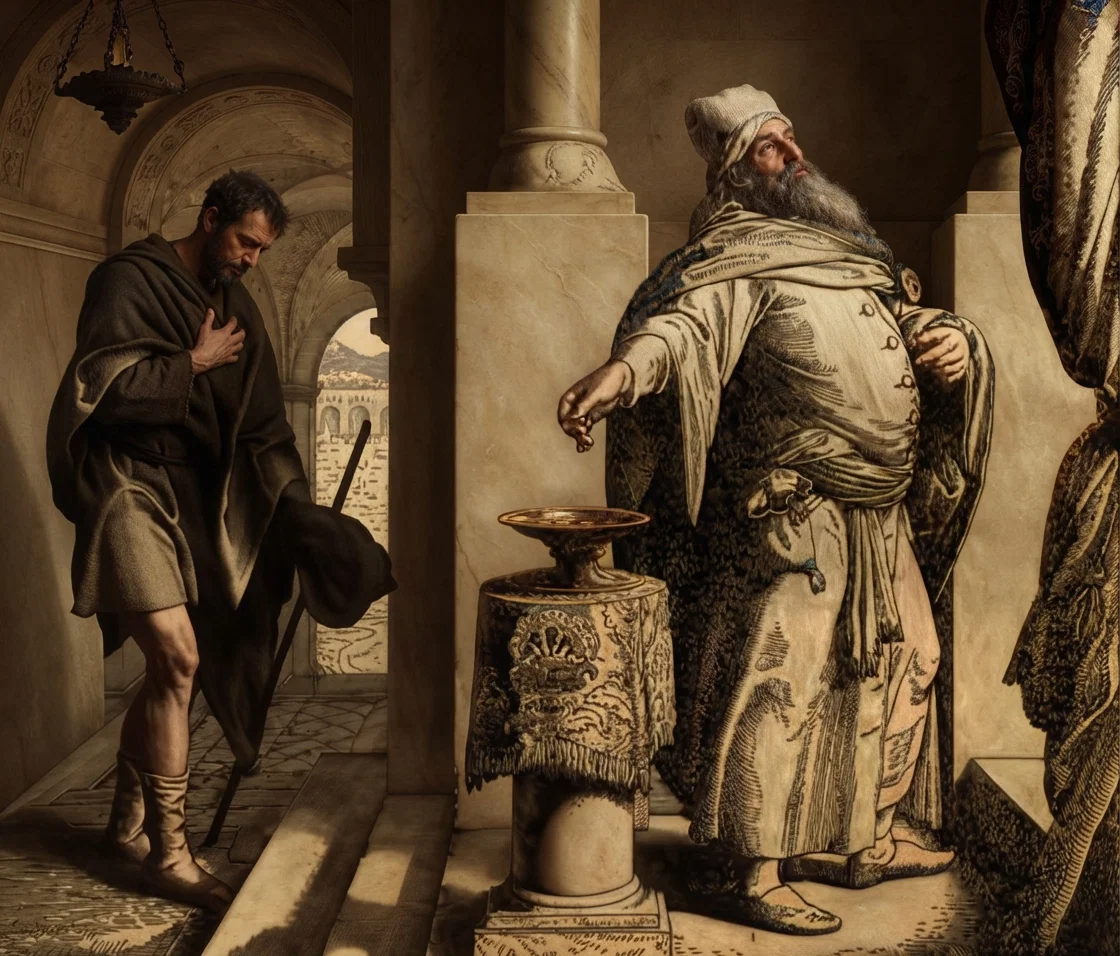
"AND He spake this parable unto certain which trusted in themselves that they were righteous, and despised others: Two men went up into the temple to pray; the one a Pharisee, and the other a publican. The Pharisee stood and prayed thus with himself, God, I thank thee, that I am not as other men are, extortioners, unjust, adulterers, or even as this publican. I fast twice in the week, I give tithes of all that I possess. And the publican, standing afar off, would not lift up so much as his eyes unto heaven, but smote upon his breast, saying, God be merciful to me a sinner. I tell you, this man went down to his house justified rather than the other; for every one that exalteth himself shall be abased; and he that humbleth himself shall be exalted." This parable was spoken to show the need of true humility.
THE PHARISEE AND THE PUBLICAN.
Both these men are represented as resorting to the same place for prayer. Both came to meet with God. But what a contrast there was between them! One was full of self-praise. He looked it, he walked it, he prayed it; the other realized fully his own nothingness. The Pharisee was looked upon as righteous before God, and thus he was in his own estimation. The publican, in his humility, looked upon himself as having no claim to the mercy or approval of God.
"God, I thank thee, that I am not as other men are, . . . or even as this publican," the Pharisee prayed proudly. The publican would not so much as lift his eyes to heaven, but smote upon his breast, saying, "God be merciful to me a sinner." The Searcher of hearts looked down upon both men, and he discerned the value of each prayer. He looks not on the outward appearance; he judges not as man judges. He does not value man according to his rank, talent, education, or position. "To this man will I look," he declares, "even to him that is poor, and of a contrite spirit, and trembleth at my word." He saw that the Pharisee was full of self-importance and self-righteousness, and the record was made against his name, "Weighed in the balances, and found wanting." His self-righteous prayer was unanswered. But the poor publican, who could only say, "God be merciful to me a sinner," moved the pity of the Lord; and his prayer was accepted. "I tell you," said Christ, "this man went down to his house justified rather than the other; for every one that exalteth himself shall be abased, and he that humbleth himself shall be exalted."
"God, I thank thee, that I am not as other men are." This prayer represents the prayers of many. They think that because they perform outward religious duties, they are entitled to the approval of God. Like the Pharisee, they say, "God, I thank thee that I am not as other men are." But they are self-centered and self-sufficient, and, altho they pray, they are unblessed of God. He says to them: "Because thou sayest, I am rich, and increased with goods, and have need of nothing; and knowest not that thou art wretched, and miserable, and poor, and blind, and naked; I counsel thee to buy of me gold tried in the fire, that thou mayest be rich; and white raiment, that thou mayest be clothed, and that the shame of thy nakedness do not appear; and anoint thine eyes with eye-salve, that thou mayest see."
The Majesty of heaven humbled himself from the highest authority, from the position of one equal with God, to the lowest place, that of a servant. His home was in Nazareth, a place proverbial for its wickedness. His parents were among the lowly poor. His trade was that of a carpenter, and he labored with his hands to do his part in sustaining the family. In order to save sinful man, he left his riches, his splendor, his honor, his glory, for a life of humility, shame, and reproach. He came not to be ministered unto, but to minister. He came not to do his own will, but the will of Him that judgeth righteously. From his lips were heard the words, "I can of mine own self do nothing." His humility did not consist in a low estimate of his own character and qualifications, but in humbling himself to fallen humanity, in order to raise them with him to a higher life.
A Distinguishing Characteristic of God's People.
Among the peculiarities which should distinguish God's people from the world is their humility. That man is nearest God, and is the most honored of him, who has the least self-importance and self-righteousness, the least trust and confidence in self, who waits on God in humble trusting faith. Instead of being ambitious to be equal with each other in honor and position, or perhaps even higher, we should seek to be the humble, faithful servants of Christ.
Christ has invited us: "Come unto me, all ye that labor and are heavy laden, and I will give you rest. Take my yoke upon you, and learn of me; for I am meek and lowly in heart; and ye shall find rest unto your souls." In humility and lowliness of mind we find great peace and strength. They shine brightest who feel most their own weakness; for such make Christ their righteousness. God brings men over this ground again and again, increasing the pressure until perfect humility and a transformation of character bring them into harmony with Christ, and they are victors over themselves.
In self-love, self-exaltation, and pride, there is great weakness; but in humility there is great strength. Pride and self-importance, when compared with humility and lowliness, are indeed weakness. It was our Saviour's gentleness, his plain, unassuming manners, that made him a conqueror of hearts. But in our separation from God, in our pride and darkness, we are constantly seeking to elevate ourselves, forgetting that lowliness of mind is power.
True humility means working for God, trusting entirely to his guidance. God looks down from heaven with pleasure on the trusting, believing ones who have a full sense of their dependence on him. To such he delights to give when they ask him. "He satisfieth the longing soul, and filleth the hungry soul with good things." "The meek shall eat and be satisfied; they shall praise the Lord that seek him." "He that putteth his trust in me shall possess the land, and shall inherit my holy mountain." Through good and bad report, through darkness, through all the antagonism of the agencies of Satan, the Sun of Righteousness calmly shines on, searching out evil, repressing sin, and reviving the spirit of the humble and contrite ones.6"Thus saith the high and lofty One that inhabiteth eternity, whose name is Holy; I dwell in the high and holy place, with him also that is of a contrite and humble spirit, to revive the spirit of the humble, and to revive the heart of the contrite ones." "God hath chosen the weak things of the world to confound the things which are mighty; and base things of the world, and things which are despised, hath God chosen, yea, and things which are not, to bring to naught things that are; that no flesh should glory in his presence."
MRS. E. G. WHITE.
IN WHOM SHALL WE TRUST?
By W. N. G.
POPE LEO XIII. sustains an army of 600 men to guard himself and the Vatican, and to keep up the dignity of a temporal kingdom. He poses as the vicar of Christ on earth, and the successor of Peter. But Jesus went everywhere among the people, and spoke openly, knowing that the rulers of the Jews were plotting against his life all the time. Where was his army of protection? We find an answer in Gethsemane. Jesus was there arrested by a mob—"a great multitude with swords and staves, from the chief priests and elders of the people." He knew that the next day his life would be sacrificed on the cross. If ever he needed protection it was then.
"Then came they, and laid hands on Jesus, and took him. And, behold, one of them which were with Jesus stretched out his hand, and drew his sword, and struck a servant of the high priest's, and smote off his ear. Then said Jesus unto him, Put up again thy sword into his place; for all they that take the sword shall perish with the sword. Thinkest thou that I can not now pray to my Father, and he shall presently give me more than twelve legions of angels?" Matt. 26: 50-53.
Here was an army of angels at his command, but he did not even ask for them. Think of a professed vicegerent or representative of Christ depending upon an army of men! or upon human law or power for the furtherance of the interests of his cause. When he was about to ascend into heaven, he commissioned his disciples to carry on the work in the earth which he had begun, saying to them, "All power is given unto me in heaven and in earth. Go ye therefore." Did they need any more power, or any further guarantee?—Surely no more could be asked. Would their successors need any further assurance?—If they would, here it is: "Lo, I am with you alway, even unto the end of the earth."
But where was Peter's temporal kingdom, his Vatican, and his human guard of armed men? His writings are silent in regard to them. He too was in Gethsemane, and he had a sword, and used it on one man. But we hear no more of it after the Lord told him to put it up. No more human army, no more carnal weapons for Peter. He had other business on hand, as we learn from his words "to them that have obtained like precious faith:"—
"Seeing then that all these things shall be dissolved, what manner of persons ought ye to be in all holy conversation and godliness, looking for and hastening unto the coming of the day of God, wherein the heavens being on fire shall be dissolved, and the elements shall melt with fervent heat? Nevertheless we, according to his promise, look for new heavens and a new earth, wherein dwelleth righteousness. Wherefore, beloved, seeing that ye look for such things, be diligent, that ye may be found of him in peace, without spot and blameless." 2 Peter 3: 11-14.
Nowhere does Peter suggest the idea of self-defense on the part of any Christian. On the contrary, he says, "If, when ye do well, and suffer for it, ye take it patiently, this is acceptable with God." How different from his assumed successor, who deems it the duty not only of the church, but of earthly kingdoms to fight all his alleged injuries, and sustain his claims to both spiritual and temporal sovereignty! Peter's understanding of the Christian's position was that it was one of humble submission to actual wrong. "For even hereunto were ye called; because Christ also suffered for us, leaving us an example, that ye should follow his steps: . . . who, when he was reviled, reviled not again; when he suffered, he threatened not; but committed himself [not to the forces of temporal power, but] to him that judgeth righteously." See 1 Peter 2: 20-23.
Peter had no time to build up something to be dissolved with fervent heat. He was hasting the coming of something permanent; a new heavens and a new earth, wherein dwelleth not carnal controversy, but peace; not a strife for temporal power, but righteousness. It would be well for Leo XIII. and all others to remember those words of Jesus: "All they that take the sword shall perish with the sword." Let us also remember the words of David: "The Lord is my rock, and my fortress, and my deliverer; my God, my strength, in whom I will trust; my buckler, and the horn of my salvation, and my high tower. I will call upon the Lord, who is worthy to be praised; so shall I be saved from mine enemies." Ps. 18: 1, 2.
DAVID AND CHRIST.
By J. E. Evans
CHRIST is the central figure of the Psalms, as he is of all the other scriptures. Even the term David is used for the Son of David. Note the following passages:—
"Afterward shall the children of Israel return, and seek the Lord their God, and David their king; and shall fear the Lord and his goodness in the latter days." Hosea 3:5. "But they shall serve the Lord their God, and David their king, whom I will raise up unto them." Jer. 30:9. "And I the Lord will be their God, and my servant David a prince among them." Eze. 34:24. "And David my servant shall be king over them. . . . And my servant David shall be their prince forever." Eze. 37:24, 25. The prophecy of Hosea was written a little before the captivity of the kingdom of Israel, or about 300 years after the death of David. Jeremiah began to prophesy in the latter part of the seventh century before Christ, and continued his work into the sixth. Ezekiel followed, and prophesied for more than twenty years, while David was born B.C. 1085, and lived seventy years.
Thus is it made clear to all that the scriptures quoted above apply to Christ, who is yet to sit upon the throne of his father David. Luke 1:32. It will be seen that the reference in Ezekiel tells of that which is to be after the resurrection. The question naturally arises, Did Christ recognize this relation? Let us read: "While the Pharisees were gathered together, Jesus asked them, saying, What think ye of Christ? whose Son is he? They say unto him, The son of David. He saith unto them, How then doth David in spirit call him Lord, saying, The Lord said unto my Lord, Sit thou on my right hand, till I make thine enemies thy footstool? If David then call him Lord, how is he his son? And no man was able to answer him a word; neither durst any man from that day forth ask him any more questions." Matt. 22:41-46. They did not understand the Scriptures. We see that they knew he was to be called the Son of David, but they did not understand the scriptures which taught it. So it is to-day.
Even those disciples who walked and talked with the Lord did not then fully understand those scriptures. "And he said unto them, These are the words which I spake unto you, while I was yet with you, that all things must be fulfilled, which are written in the law of Moses, and in the prophets, and in the Psalms, concerning me. Then opened he their understanding, that they might understand the Scriptures."
J. E. EVANS.
New Orleans, La.
THE ZIONIST CONVENTION.
By M. E. K.
The Jewish conference, known as the "Zionist Congress," lately held by certain Jews at Basel, Switzerland, is now over, and what was there done, and what its promoters hope to do, is now given to the world. The conference is evidence that there is great unrest on the part of many Israelites; and there is no doubt that their condition in many lands is very deplorable.
The idea of the conference is again to build up Zion, or, in other words, in some way to re-establish the Jews in the land of their fathers. The idea has always had a strong fascination to the Jews. Their religion and the land of Palestine are closely connected. In the days of Julian, the apostate emperor of Rome, he, in order to prove that Christ's predictions were not true, gave permission to the Jews to rebuild their city. Thousands of Jews repaired there, and, in their enthusiasm, the Jewish ladies carried away the débris which it was necessary to remove, in mantles of silk. But their work was interrupted by subterranean explosions, which Gibbons tries to explain in a natural manner, and, finally, the death of Julian by a Parthian arrow put an end to Jewish hopes. During the long ages when Christian and Saracen were contending for the land of Palestine, the Jews remained indifferent. Nor could they hope to regain their land as long as Turkey remained a strong power. The drying up of Turkey, then, is the evident cause of the hope that has sprung up in so many Jewish hearts of regaining their own land.
As might be expected, those who favor the project are largely in those countries not very far removed from Palestine, and also where the Jews are oppressed. The Jews of the United States, Great Britain, and France take little interest in the movement, but those who live in Germany, Austria, Russia, and other countries, where the anti-Semitic feeling is strong, and where the Jews are made to feel it, either in the laws or in the many other ways in which it may be expressed, are ready to welcome anything for a change, and so they are looking to Palestine.
That the reader may see the plan that is to be pursued by those who are proposing this enterprise, the following program of their work is given:—
The aim of Zionism is to create for the Jewish people a publicly, legally assured home in Palestine. In order to attain this object the congress adopts the following means:—
1. To promote the settlement in Palestine of Jewish agriculturists, handicraftsmen, industrialists and men following professions.
2. The centralization of the entire Jewish people by means of general institutions agreeably to the laws of the land.
3. To strengthen Jewish sentiments and national self-consciousness.
4. To obtain the sanction of governments to the carrying out of the objects of Zionism.
It will be seen at once that the second and fourth points of this program will be very difficult to carry out. The 'laws of the land' must be consulted, and these are Turkish laws. Former colonies of small dimensions, both of7Jews and of Christians, which have been located in Palestine, have been subjected to very close surveillance by the Turkish Government, which has regarded them with suspicion, and made their existence there very undesirable. How, then, will it likely fare with a very large emigration of Jews who go there with the expressed hope and intention of sometime gaining their independence and becoming a State? The very idea will place them under the well-grounded suspicion of the Turkish Government, which will probably nip the scheme in the bud, or, in other words, will confine it to a resolution in conference.
More than this, not only must the Turkish Government be satisfied with their intentions, but other governments also, and, indeed, it seems to be the intention and hope of the Zionists to induce other governments to bring some kind of a pressure to bear upon Turkey so that she will consent to the movement. If the opposition of the Turkish authorities may be called impediment No. 1, the opposition of other governments may be called impediment No. 2. These governments are not particularly eager to drive the Jews out of their country into Turkey. Tho they may not love them, they want to keep them just the same.
But some may say, If God says, Let my people go, then those governments will have to do so. Surely, but we are not aware that they are now God's people, or that he has promised them a return to that land. Nations, like individuals, have a probationary time given to them. The Jewish nation is no exception to this. No other nation was ever blessed and favored so much; no other nation ever sinned so deeply, and no other nation has suffered such terrible punishment. Since the destruction of Jerusalem in A.D. 70, the history of Israel is a tragedy written in blood and tears. Israel is an object lesson to the world, to each individual, of the danger there is in rejecting Christ. And will the Lord now smile upon the efforts of that people to re-establish themselves, while still unrepentant, while still counting the blood of the covenant an unholy thing, in that land where for many centuries they rebelled against him, where they killed their Prince and Saviour? Reason would say no, and, in this case, reason and revelation are in harmony.
Reference has been made in this article to the supposed attitude of the European governments in regard to this proposed Jewish immigration to Palestine. We will discuss this point a little further, in relation to one of the governments—Russia. It is the fixed determination of Russia to take possession of all the lands of the Turkish Empire, both in Europe and Asia; and the probability is that this hope will be at some time consummated. The weakening of Turkey is therefore an object of prime importance to Russia. But would Russia give consent that there should be established in Turkey the nucleus of another State to oppose her possession of Turkey? And should Russia take Palestine, and so rule over all the Jews who may be there, what better off will the great mass of Russian Jews be, who think of going to Turkey, then than now? Turkey is always more tolerant than Russia. With so poor a prospect of a refuge in Turkey, and with the probability of a Russian conquest of the country at no distant time, the hope of an independent Jewish State in Palestine dwindles to an insignificant speck.
The only land to which the Jew can ever look with hope is the antitypical Canaan, the land promised to Abraham, but in which he obtained no inheritance—the new earth, in which shall dwell the righteous—and the only way that the Jew, or any one else, can obtain an inheritance there is by Jesus Christ. For 'if ye be Christ's, then are ye Abraham's seed, and heirs according to the promise.' Only in that faith will the poor Jew ever find rest to his troubled soul.
M. E. K.
THE APOSTLES AND THE SABBATH.
By W. L. ILES
(Continued.)
The Lord's Day.
"I [JOHN] was in the spirit on the Lord's day, and heard behind me a great voice, as of a trumpet, saying, I am Alpha and Omega, the first and the last." Rev. 1:10, 11. John had been banished to the isle of Patmos, and there the Lord gave him by vision revelations of himself and the future. These revelations were given on the "Lord's day." They were given on a day the Lord claims as his. This text emphatically disproves the theory that we have no Sabbath, or rest day, in this dispensation, and that all days are alike, and that one day is no more holy than another. There is one day of each week that the Lord claims as his. That day which he claims is the "Christian" Sabbath. The Sabbath of the New Testament is the Lord's day. The seventh day is the Sabbath of the New Testament, therefore the seventh day is the "Lord's day."
God never gave to man but six days of the week for him to use. The seventh day he has reserved for himself, and therefore it is called the "Lord's day." When man takes the Lord's day, and appropriates it to himself, he is stealing the Lord's time. The man who withholds from the Lord his tithe, robs the Lord. Mal. 3:8. And he who takes the Lord's time and spends it upon himself, also robs the Lord. God says, "Six days shalt thou labor, and do all thy work; but the seventh day is the Sabbath of the Lord thy God; in it thou shalt not do any work." Six days are given to us in which we may work, but the seventh day has not been given to man. The Lord says, "In it thou shalt not do any work." It is the "Sabbath of the Lord," or the "Lord's day."
"Sabbath" means rest. And when it says, "The seventh day is the Sabbath of the Lord," it is equivalent to the expression, "The seventh day is the rest of the Lord." The Lord's rest is in it. He rested upon the seventh day when he made the heavens and the earth, and thus it became his rest day. He worked upon the first day; then how can that day become his rest day? If it was not reserved by the Lord, but given to man for a work day, how can it be the "Lord's day"? The day which the Lord reserved for himself, he blessed and sanctified. The "Lord's day," then, is a holy day, for the Lord blessed it. It is set apart for a sacred or holy use, for the Lord sanctified it. To summarize, the seventh day is therefore the "Lord's day," for the following reasons:—
1. It never was given to man, but reserved by the Lord, to be devoted to him and his worship. See Isa. 58:13.
2. The Lord's rest is in the day. It is called the "Sabbath of the Lord," or the rest of the Lord. That day which has the Lord's rest in it must be the "Lord's day."
3. The Lord's blessing is upon it, and it is holy. The six other days are working days, and can not properly be called the "Lord's day."
4. The Lord sanctified the day. It was separated from the other days, to be devoted to the Lord, and most emphatically it is the "Lord's day."
Some claim that the first day of the week is the "Lord's day." Why should man make such a claim, if the Lord never claimed it as his? Where in the Bible is the text that says the Lord claims that day as his? Where is the text that says it was blessed or sanctified? The apostles, in speaking of the first day, always call it "the first day of the week." John wrote his Gospel after he wrote the Revelation, and there he calls it the "first day of the week." If Christ is "Lord of the Sabbath," then the Sabbath is the "Lord's day." Mark 2:28. W. L. ILES.
ENDURING HARDSHIPS FOR CHRIST'S SAKE.
By John G. Woolley
ENDURANCE is the supreme trait of Christian service. One can scarcely get a sight of Jesus without loving him, and wishing to follow him; but to 'stick' when the trail gets blind and steep, and the earth slips under the feet, and the sun is down, and the night falling—that is different. It is practically no trouble to get a crowd to cheer for a right principle, but it is quite another matter to get a man to plod on after it, alone, when the meeting is over. And in general the lack of virtue in men is not defective vision or want of pure desire, but inability to 'stay.' A 'two hundred and twenty yards' dash' is fun, but many a fine fellow, when the course is a mile, comes to the home stretch with a sick stomach, and pitches on his head in the fourth quarter as helpless as a bag of bran.
The phrase 'enduring hardships' suggests terrible things,—persecution, inquisition, death,—to this add 'missionary topic,' and one thinks of expatriation, fever, cannibalism. But really these tragic things do not call for endurance more than others which sound like trifles by comparison. The drawn fist, the scourge, the crown of thorns, were, I reckon, small matters to Jesus, compared to the indifferent look on Peter's face when he stood warming in the hall.
Peter went down in a great trial, it is true; but the great body of the account against 'want of endurance' is made up of little cowardices which, in general estimation, do not 'count' at all.
Prosperity breaks more saints than adversity. It requires greater endurance to keep true on an increasing salary than in the face of beggary. A fat mailing list has swamped many a high ideal.
Increasing popularity has made a spiritual pimp of many a man. To be mobbed is not so great a strain of character as to be coddled. If bad men hate and threaten a Christian man, he may grow in grace the more; but if they applaud him, he is in deadly peril. If they nominate him for office, he is all but lost. If he seeks their nomination or their support, he is a weakling and probably a fraud.
Many a fine young Christian man has been debauched in his politics by an appointment upon a committee of prominent—and nasty—citizens to welcome a distinguished man to the town.
It is the settled policy of politicians to invite weak or vain or ambitious ministers to pray at the convention, to 'fix,' that is, corrupt them. The placid face of a rich parishioner has made a sneak of many a man.
A ruffian's club would only rouse the courage in some men who will eat dirt under a presiding elder's smile.
One of the nicest operations of the program committee is to scuttle independence by a8shrewd distribution of places on the program or portrait sketches in the newspapers.—John G. Woolley.
INCREASE OF CANCER.
MUCH has been said about the fearful increase of the "great white plague," as tuberculosis, or pulmonary consumption, is often called; but it seems from medical statistics that tuberculosis is not alone in this advance upon the race. It has a mighty auxiliary in carcinoma, or cancer. The leading medical journal of this country, the Medical Record, of New York, in its issue of July 3, in an exhaustive article by Roswell Park, A.M., M.D., Professor of Surgery in the University of Buffalo, gives us the following facts:—
"In 1840, in England, the proportion of deaths from cancer to the total mortality rate was 1 in 129; in 1880 this had risen to 1 in 28, which shows that in England the death rate from cancer is now about four times greater than fifty years ago. Williams estimates that at least 40,000 persons are now suffering from cancer in England and Wales, whereas in 1840 the number was only about 5,500. Should the disease increase in the future at the same relative rate, it will become one of the commonest of all. This augmented mortality corresponds with increase of population in wealth and improvement in general sanitary conditions. . . . In 1861, in England, there were 376 deaths from cancer to the million of population; twenty-five years later there were 610. During this quarter of a century the number of deaths from phthisis [consumption] per million has diminished to three-fifths of the number at its commencement.
"In the twenty years from 1870 to 1890 the increase in mortality from cancer in England is as follows: In 1870, 384 to the million; in 1880, 468; in 1890, 590. Accepting these published figures from the registrar-general's report, it would appear that the mortality has increased by 53 per cent. Nevertheless, it is not quite so bad as this, because the diagnosis of obscure cases is now more accurate than it was twenty-five years ago.
"From a tabulation of the deaths within our own State of New York during ten years, from 1885 to 1895, I find that during this time there have been reported 30,692 deaths from cancer. Doubtless in a few of these cases there may have been a mistake in diagnosis, which will, however, be abundantly atoned for, and more, by the deaths which were really due to cancer and ascribed to some other cause. In 1885 there were 1,882 deaths from this cause; in 1890, 2,878, and in 1895, 3,454. In other words, in the last year of this decade the total number of deaths from cancer was twice that of its first year,9which may be interpreted as meaning that the death rate has increased much more rapidly than has the population. During this same decade, also, the number of deaths from all causes has increased only from 80,000 to 121,000. During the last five years of this decade epidemic influenza alone caused 35,000 of the 121,000 deaths. It will therefore be seen how rapidly the cancer death rate is creeping up."
It is not decisively known whether the disease is hereditary, but the predisposition to cancer seems to be. It has been noted as especially manifest in surviving members of tuberculous families.
The most potent factors in causing cancers seem to be "high feeding" and "easy living." Among the hard-working classes, where the struggle for existence is the most severe, cancer is rare. Dr. Park has little faith in the theory that cancer is caused by injury, except in rare instances.
From the above and other indications of the increase of malignant diseases, our readers will see the importance of living according to nature's laws, that the life of the God of nature may sustain and invigorate them. Simple, unstimulating, yet nourishing diet of grains and fruits, abundance of fresh air, and plenty of exercise and a clear conscience, are the best of nature's remedies; and God will work through these, his remedies.
THE FULNESS OF THE BIBLE.
By George F. Pentecost, D.D.
THIS is the day in which all the critics are saying to us that we have made a tremendous mistake in not dealing with the Bible as literature, and a great many people are afraid because some one has said, perhaps not because they desired to exalt or magnify God's Word, but they have at least indirectly sought to undermine the traditional faith in God's Word, and they have termed it literature in order to get rid of what they describe as a superstitious reverence for the Book, so that they go at it as a surgeon would dissect a body, hunting for the soul of it. But you can not in this way find the inspiration of God's Bible any more than you can find the human soul by cutting up and dissecting the body. The Bible is the summum bonum of all literature. There never was such literature in all this world as is found in the Bible.
A few people can tell us something about the life of Plato or Socrates or the thousand kings of Greece and Rome, but millions will tell you something about Abraham and Isaac and Jacob and Moses and Isaiah, the judges of Israel and the prophets of Israel, and of Peter and James and John and Paul—these are the men that have made the centuries that have come after them.
The Bible is the best history the world has ever had, because it was a history every line of which was guarded and superintended by the Spirit of God. There is no such poetry in all this world as is found in the Bible. It has outlived the poets of Greece and of Rome.
The Bible in itself has power to give you culture. Do you want philosophy? the first word of the Bible, which is also the last word of human philosophy and the science of the nineteenth century, "In the beginning God." That is science. That is the last word of science. The Bible had all the secrets of science and philosophy before modern or Greek philosophy was born.
Do we want to study geology? behold, he is the Rock of ages. Do we want to study astronomy? behold, he is the bright and morning star. Do we want to study botany? behold, he is the Lily of the valley and the chiefest among ten thousand. Do we want to study biology? behold, "I am the way, the truth, and the life." He is the secret of life. There is not a science in this world that is not suggested by that matchless, peerless Christ, who is the living embodiment, the flower of art, and the inspiration of every page of that divine Book. With the Bible in your hand, without knowing Greek or Hebrew, or any of the dead languages, you have the secret and the key of literature.—Geo. F. Pentecost, D.D.
The Lord Cares for Us
By John Hall
WE are the portion the Lord takes out of the hand of his enemy and ours, and he cares for us as such. A love that is everlasting, a care that is likened to that which guards the pupil of the eye, a fidelity of attachment to which the mother's love finds no parallel—these have been expended on us, and are still in operation toward us. Can it be doubted, then, that he cares for us?—Dr. John Hall.
Light and Darkness
By Light
LIGHT does not commingle with darkness. Think not to progress in the Christian life while harboring hatred or ill-will against thy brother.—Light.
Question Corner
By Editor
"Enquire, and make search, and ask diligently."
No. 644. The Sea of Glass.
Is "THE sea of glass" above, or here below?
The "sea of glass," or the sea as clear as glass, or crystal, is mentioned in Rev. 4:6 and 15:2. It is before the throne of God, and is therefore now in heaven. It is typified by the lavers before the ancient tabernacle and temple. See Ex. 30:18; 1 Kings 7:38. It would be a fitting type of the purifying power of the blood or life of Christ, and the Spirit of God.
Origin of the Irish
No. 645. Origin of the Irish.
Of what descent, or, in other words, what nationality, did the Irish, pagan or papal, spring from? It must be before 753 B.C.
Why before B.C. 753? They are a branch of the Japhetic family, probably through Gomer. Gen. 6:3. They are of the Aryan race, of which the Germans, Celts, Gaelic, Cymric, are branches. The Irish are Celts. The Highland Scotch, Gaelic. The Welsh, Cymric. The Irish were once pagans even as were the English. They are not necessarily papal.
Will you kindly explain to me Col. 2:14: "Blotting out the handwriting of ordinances that was against us, which was contrary to us, and took it out of the way, nailing it to the cross."
The text refers doubtless to all those ceremonies and ordinances which grew up because of the entrance of sin, with especial reference to the old covenant in which the professed people of God promised in themselves to do God's law. See Ex. 19:7, 8; 24:3-8. Could they have kept God's law, that covenant would have been perfectly proper; but they could not, and their transgression made their covenant or bond against them. Many of the types and ceremonies of the Levitical law were ordained for a disobedient and gainsaying people, bringing their sin constantly to remembrance, but the ordinances could not take the sin away. Heb. 10:1-4. But Christ is the offering which could take away the sin, because he could take away the enmity of the carnal heart which produces sin (Eph. 2:15; Rom. 8:7); therefore the apostle declares: "And you being dead through your trespasses and the uncircumcision of your flesh, you I say, did he quicken together with him, having forgiven us all our trespasses; having blotted out the bond written in ordinances that were against us, which was contrary to us [because of our transgression]; and he hath taken it out of the way, nailing it to the cross." Col. 2:13, 14. R. V. To put it briefly, that which our Lord destroyed is the power of sin, of which all the "carnal ordinances" of the past were symbolical; and the freedom from sin is for all who will accept it by faith.
Knowledge of the Sabbath
By Editor
No. 647. Knowledge of the Sabbath.
DEUT. 5:3. Does it mean that they had no knowledge of the Sabbath before the manna?
Our correspondent must have given the wrong reference; for Deut. 5:3 mentions neither the Sabbath nor the manna. Deut. 8:3 tells us that the children of Israel knew naught of the manna till the Lord gave it to them in the wilderness. In all probability many if not most of the Israelites knew of the Sabbath in Egypt; but they could not there keep it. Moses and Aaron evidently pointed out to them their duty, and they attempted to keep the Sabbath. Pharaoh then brings his charge against these servants of God: "Wherefore do ye, Moses and Aaron, let [hinder] the people from their works? get you unto your burdens. And Pharaoh said, Behold, the people of the land now are many, and ye make them rest from their burdens." Ex. 5:4, 5. It was because of this refusal of Pharaoh that Moses demanded of the king: "Thus saith the Lord, Let my people go, that they may serve me." Ex. 8:1. And when the Lord brought them out of Egypt, where they could not serve him, into the wilderness, where they could, the test of their service was their observance of his Sabbath. Ex. 16:4, 27, 28.