The Youth’s Instructor, Vol. 36, No. 29.

LININGS

The Youth’s Instructor

Jul 18, 1888

S. D. A. Publishing Association · Battle Creek, Mich. · Jul 18, 1888

LININGS

Nay, nay, dear child, I cannot let you slight Those inner stitches on your gown's fair hem Because, you say, they will be out of sight, And no stern critic will discover them.
“You do but build a most inviting hedge, Behind which falsehood and deceit may lurk, When you embroider fair the outer edge, And to the inner give no honest work.
“The silken chain of habit which you wear So lightly now upon your careless youth Will strengthen, strand by strand; then have a care! Else it may throttle the sweet soul of truth.
“I hold that every stitch untruly set Weaves a soiled thread along your web of fate; And each deceitful seam may prove a net To hurt and hinder, trust me, soon or late.
“Ah, dearest child, on everything you do Let the white seal of honor stamp its grace. Keep all your soul as clean with Heaven's dew As the pink flower of your tender face.
“God makes no clumsy linings. Mark this bloom! A ‘fairy's glove;’ and though it grives my heart To send the smallest blossom to its tomb, We'll tear the dainty little glove apart.
“In this and every flower that we behold, From crimson robe to pansy's purple vest, God sews the velvet on the inner fold, And makes His linings fairer than the rest.
“Is it not perfect, from the slender stem To the brown dapples on the curling rim? God folds not carelessly the foxglove's hem; Then try, my little child, to be like Him.
—May Riley Smith, in N. Y. Observer.

“THE PEOPLE THIRSTED THERE FOR WATER.”
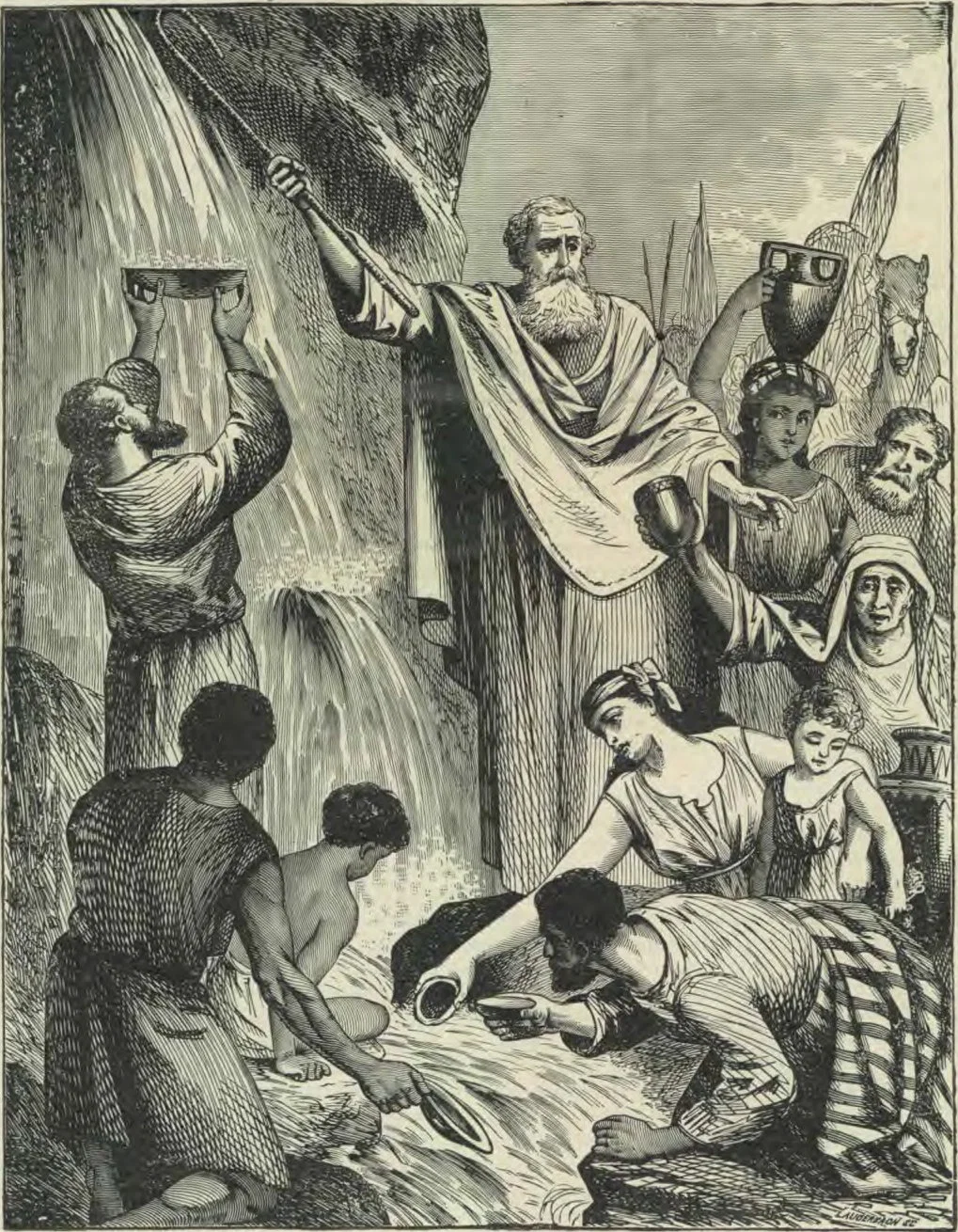
Moses, God's chosen leader to conduct his people from Egypt to the land of Canaan, is pursuing his journey at the head of the armies of Israel, following an unerring Guide, and protected by an irresistible Power. Having been delivered from the hand of the Egyptians,—
“Their chieftains all fallen, though their bows were still bent; Their legions all sunk, though their shafts were unspent: The horse and his rider o'erwhelmed in the sea; Jehovah triumphant, and Israel free,”
this vast body sing that most wonderful song of deliverance recorded in the fifteenth chapter of Exodus, feeling that—
“Our slavery is finished, our labor is done; Our tasks are relinquished, our march is begun.”
They were just released from most oppressive and cruel bondage, and were hastening to the home of their fathers, which promised land they hoped soon to have in peaceful possession. One would suppose that after all the hardships they had endured in Egypt, relief from them would make them very patient and amiable; but on the contrary, they were fault-finding and exacting, complaining of their food and drink, even accusing Moses of bringing them with their cattle out of Egypt to die with thirst.
In thus chiding Moses, they were really finding fault with God who sent him, and charging God foolishly. For Moses's sake the Lord bore with them, sweetening the bitter waters at Marah, providing them manna and flesh in the desert, and miraculously giving them water from the flinty rock.
Already in their short journey to Rephidim, which was but a little way from Horeb, their murmurings were so great that Moses cried out to the Lord for help, saying that the people were almost ready to stone him. They had come up to a place where there was no water, and instead of trusting God, and waiting till he should show his salvation, they indulged in sinful thoughts, and talked very wickedly to Moses. But notwithstanding their murmurings and rebel-
lious feelings, the Lord mercifully spared them, and instructed Moses to smite the rock, from whence issued a stream of pure water which followed them a long way in their travels.
Continuing their journey until they reached the wilderness of Paran, Moses sent spies to see what the land was. But they all returned, save Caleb and Joshua, with an evil report, which put such rebellion into the hearts of the people that they were about to choose a leader and go back to Egypt. The Lord was so much displeased with them, that but for the intercession of Moses he would have disinherited and destroyed them. For his own name's sake and the greatness of his mercy he spared them, but declared, “All those men which have seen my glory and my miracles, which I did in Egypt and the wilderness, and have tempted me now these ten times, and have not hearkened to my voice, surely they shall not see the land which I swore unto their fathers.” He says further, “Your carcasses shall fall in this wilderness;” “your children shall wander here forty years;” and for that length of time “shall ye bear your iniquities,” “save Caleb, the son of Jephunneh, and Joshua, the son of Nun.”
A full description of their wanderings and journeyings, and of their fall by the way, as predicted, is recorded in the “Books of Moses.” This we will pass over, until they reach the borders of Canaan, in the fortieth year of their journey. The fathers being nearly all dead, their children are now the principal actors in the scene. As they approach Canaan, they come upon higher ground, and the stream which had followed them is stopped, so that again the congregation have no water. Like their fathers before them, the children fall to murmuring and chiding, or quarreling, with Moses.
Again from a rock the Lord commands Moses to supply them with water. Upon this occasion he bids him speak to the rock. But Moses is so wearied with their rebellions that for the first time it is recorded of him that “he spake unadvisedly with his lips;” “Hear, now, ye rebels! must we fetch you water out of this rock?” as though he and Aaron could do it by their own power.
Contrary to God's order, too, instead of speaking to the rock, he smites it twice, thus manifesting impatience. How easily God could have humbled them by withholding the stream. He gave the supply, as he had promised, but he delivered to this humble servant the sad message: “Because ye believed me not, to sanctify me in the eyes of the children of Israel, therefore ye shall not bring this congregation into the land which I have given them.”
Were it not that the infinite God sentenced Moses, poor finite man might think he was too severely dealt with. Moses had borne with their murmurings and jealousies all those forty years, and at times was so afflicted and discouraged in consequence that he would yield to the temptation to ask God to let him die. And now that the journey was made, and they were just ready to set their feet upon the long-desired land of Canaan, he must turn aside from those he had loved so well that he would rather his own name might be blotted out of God's book than they should be destroyed, and go by himself to die.
Moses was forgiven. His mistake did not shut him out of the heavenly Canaan; but the effect of lightly regarding his sin would not prove salutary upon those disaffected ones, as Moses himself knew, therefore he must needs come under the power of Death. And so, at the command of God, this faithful servant ascends Mount Nebo, there to die, while his heart is with his people on the plains below. As he reaches the highest summit of the mount, God grants him from that elevated point a sight of the promised land. Perhaps the last scene which met his gaze before he closed his eyes in death, was a view of this long-coveted rest.
Ancient Israel was a type of God's people in this, the last, generation, and the things which “happened unto them were for ensamples, and were written for our admonition upon whom the ends of the world are come.” Yet for all the light of their experiences, how faithfully the type is met in the antitype; for now, as then, murmuring and rebellion have place in the heart, and are causing many to turn aside to fables. It would seem as if the accumulated evidence of six thousand years confirmatory of God's faithfulness with those who walk uprightly would remove all cause for distrust and fault-finding. That we are traveling over the same ground as did Israel anciently, is evidence that the heart is not right with God; and as there remains but little time to secure a title to the heavenly inheritance, the borders of which we have almost reached, let us at once and forever banish unbelief, and make our right doubly sure.
M. J. C.

Centaur the Magnanimous.

Round the supper-table in the dining-room of a little inn that was perched on the top of a snowy mountain in Switzerland, several travelers were seated. I was one of them, having been there since the evening before. The landlord, coming in with the first dish, looked round the table.
“Where is the young French gentleman, M. Belvoir?” he asked. “He was here at dinner, and when he went out late this afternoon, he said he would be back in an hour.”
There was no reply. The young man was a stranger to us, and where he went, or what he did, would have been of no moment to us, but for one circumstance, something which had occurred that very day at dinner, and which had disgusted us all so much that his absence had been felt quite a relief. For, as we were seated at our midday meal, a magnificent dog, half St. Bernard, half Newfoundland, belonging to our landlord, had come up to M. Belvoir, and caressingly shoved his beautiful head under the young man’s elbow, causing him to drop some food, which, contrary to our idea of good manners, he was conveying to his mouth upon his knife. We were all startled at the furious exclamation that passed the Frenchman’s lips, but we were far more shocked when, rising from the table, he turned and kicked the poor animal.
Centaur (this was the dog’s name) gave one mournful cry, and limped sorrowfully away. Then followed some hasty words spoken by several of us, and to these M. Belvoir had replied with no little show of temper; and when at last he took himself off, we tried to soothe our indignation by offering all sorts of delicate attentions to Centaur, so as to make up to the noble brute, as best we might, for what he had suffered.
This, then, was what had occurred at midday; but now, as soon as our supper was dispatched, the landlord said, “Gentlemen, a severe snow-storm came on just about dusk, and I fear M. Belvoir may have lost his way. We must make up a party and look for him, or he may perish. Centaur will go with us and help in the search.”
Away we all went. The snow had ceased to fall now, and a cold moon was rising. Centaur was still lame, but he cantered cheerfully forward on three legs, looking for the trail of the lost man. For a long time we sought fruitlessly, but at last we heard Centaur’s deep bark, and ran toward the spot where he stood scratching up the snow; as we drew nearer, we saw the noble creature stoop and lick a hand that lay on the snow. He did this with a low whine of trouble, as though he mourned that there was no response. One of the tourists, an Englishman, who was walking by my side, called out impulsively:—
“Hurrah! Centaur has found him, and paid him back like a Christian—a kiss for a blow!”
“Hush!” said I; “the man may be dead.”
But he was not. We got him out from under the snow, and rubbed him, and poured brandy down his throat, and made the stagnated blood circulate again. And when the Frenchman opened his eyes, the first sight that greeted him was the eager face of the dog; and the first sound that he heard was the joyful yelp when the rigid hands Centaur had been licking began to move again.
M. Belvoir gave the forgiving brute one look. Then, with a burst of repentant, thankful tears, he flung his arms round this dumb friend’s neck, and sobbed like a child. There was not a dry eye among us, men though we were; and there was not one of us that night who had not learned a lesson of generous forgiveness and gentle charity from that great-hearted creature. As we wended slowly back to our inn, one little text recurred to me again and again, with a persistence which sent home to my heart the lesson I had learned, and I prayed God that I might never forget it. It was only a text of five words—easy enough to remember; and it comes back to me now with the old force and beauty when I think of Centaur: “Go and do thou likewise.”—Child’s Companion.

DIAMONDS

THEIR DISCOVERY IN SOUTH AFRICA; THE EXCITEMENT AND HARDSHIPS IT CAUSED.
The land which now includes the Diamond Fields of Africa was, but a few years ago, considered almost worthless, being scarcely suitable for grazing, and much less for agriculture. A few natives and numerous wild animals were its sole inhabitants. Apparently nothing in that dreary waste invited the attention of the white man. But not far beneath the surface of this gloomy, barren land lay hidden stores of precious gems of untold value, which, when brought to light, caused a large immigration from every nation on the globe.
The story of how these gems were discovered is narrated in various ways, but the facts are these: Early in the year 1867, a trader, John O’Reilly by name, traveling southward from the Orange River, rested his oxen at a Dutch stock farm named “De Ralk” [The Chalk or Lime], the property of one Schalk van Niekerk; and this is Mr. O’Reilly’s account of what he saw there, given in a letter addressed to the governor of Cape Colony: “In March, 1867, I was on my way to Colesburg from the Junction of the Vaal and Orange Rivers; I outspanned [unyoked] at Mr. Niekerk’s farm, where I saw a beautiful lot of Orange River stones on his table, and which I examined. I told Niekerk they were very pretty. He showed me another lot, out of which I at once picked the ‘first diamond.’ I asked him for it, and he told me I could have it. I took it at once to Hope Town, and made Mr. Chalmers, Civil Commissioner, aware of the discovery. I then took it to the Acting Civil Commissioner, and he sent it to Dr. Atherstone, of Graham’s Town, who forwarded it to Cape Town.”
I have had the pleasure of meeting Dr. Atherstone and talking with him concerning the matter. He told me that one day he received a small package (I think he stated by mail), and on opening it, found a little rough stone, neatly and carefully packed. The next day came a letter stating where the stone was found, and requesting him to examine it. After doing so, the doctor wrote the following reply to the Colesburg commissioner, Mr. Bayes: “I congratulate you on the stone you sent me. It is a veritable diamond, weighs 21¼ carats, and is worth £500 [about $2,500]. It spoiled all the jeweler’s files in Graham’s Town; and where that came from, there must be lots more.”
Dr. Atherstone’s opinion was confirmed by the Crown jewellers in London, Eng., to whom the stone was sent for inspection, and it was subsequently purchased at the above valuation by an ex-governor of Cape Colony. One would think it no more than right that the kind-hearted farmer, Mr. Niekerk, should have shared a part of the proceeds; but as it often occurs, the first possessor did not receive any benefit. Mr. Bayes and Mr. O’Reilly divided the spoils between themselves, and, as might be expected, were well satisfied. They lost no time in returning to the place of the first discovery, where others soon joined in the exciting search. How eagerly they sought for those “goodly pearls!” Home duties were sorely neglected; the prospect of immediate wealth absorbed their whole attention. But this first excitement was of short duration. Not so many of those eagerly sought gems came to sight as they had expected. Their fancies of finding fortunes with little effort soon vanished, and for two years the existence of diamond fields in South Africa was a matter of discussion.
But soon these first dreams of fancy were realized. In 1869, Mr. Van Niekerk, who unknowingly had given away £500 to Mr. O’Reilly, in the form of the “first diamond” of South Africa, displayed more wisdom in the purchase of a large stone from a Hottentot, for which he gave live-stock to the value of £400 [about $2,000] and immediately sold the stone for over £10,000 [$50,000]. This diamond was termed “The Star of South Africa.” It weighed 83½ carats in the “rough,” and was estimated in June, 1870, to be worth £25,000 [nearly $125,000]. It now acts a part in representing the wealth of the Countess of Dudley. Its present weight is 46½ carats, 37 carats being removed in cutting and polishing it. The finding of this costly stone caused a large “rush” of diggers to the vicinity where it was found; but curious as it may appear, though the earliest finds occurred in that district (Hope District), no mine has been discovered there.
Careful prospecting soon proved that the banks of the Vaal River were rich in diamonds. In 1870, a large population, numbering not less than 10,000, had spread itself along the river, constant recruits arriving from all parts of South Africa, and various other parts of the world. Among these was a “goodly sprinkling of Yankees,” and other keen-witted miners, who added valuable experience gained in California and Australia.
In the latter part of 1870, diamonds were discovered some twenty miles further south, near the place where the town of Kimberley now stands. The news of this caused many of the river diggings to be abandoned, as large numbers of the miners rushed to the new scene of discovery. These diggings are located on the Dutoitspan and Bultfontein farms. As might be expected, neither the river diggings nor the newly opened mines were at first sufficiently rich to support so large an influx of workers, while the change from the green banks and shady trees of the Vaal River, to the desert sands of Dutoitspan, where water, even for domestic purposes, was almost a luxury, and at times quite unobtainable, was not conducive to cheer the spirits of men whose hopes of speedy fortune were darkened by disappointment.
Scarcely could a more dreary existence be fancied than that of early life on these diamond fields. Of comforts it could be said they had not even a taste. Canvas was almost the sole protection afforded them from the burning sun. Those who did have wooden or iron shanties were considered as lords living in kingly palaces. The lack of good food and pure water caused disease, and many a poor fellow who had expected to find an Eldorado on the Fields, realized only misery and death. A fever, known by the Cape Colonists as “Camp Fever,” took away many of these diamond-seekers; and to-day it still exists as a terror to the inhabitants of the Diamond Fields. Although the Fields are distant only 650 miles from Cape Town and 500 from Port Elizabeth, the journey from the latter port occupied a month, and from the former six weeks. The mode of traveling was in a springless ox-wagon drawn by ten or sixteen yoke of oxen. The cost per passenger was not less than £50 [nearly $250].
To-day a far different scene is presented. The railway which has placed the Diamond Fields within thirty hours’ journey from the coast, now daily supplies the inhabitants with all the luxuries the Colony affords. Large water-works have been established, which not only provide the thirsty people with plenty of water, but also the extremely thirsty land. By this addition of plenty of water the land is made productive, and the ambitious people have planted thousands of trees, which are converting the desert into a fruitful land. In this vicinity known as “The Diamond Fields,” are situated four regular diggings, and by two government proclamations issued in 1874 and 1882, these deposits were declared “Mines,” with the respective titles, “Dutoitspan Mine,” “De Beers’ Mine,” “Kimberley Mine,” and “Bultfontein Mine.”
R. S. ANTHONY.
South Africa.

Do Not Mock the Afflicted

Fun over deformity is the meanest possible expression of a thoroughly mean person. A person—boy, girl, man, or woman—that would laugh at and deride the blindness of one and the tottering steps of another, the limping gait of this one or the stuttering lips of that one, would hardly be deserving of pity if plunged into all the above infirmities combined. Do not mock the man for what he cannot help, and for the very cross that may speedily burden your own heart.—Glad Tidings.

NOTES AND COMMENTS.

Question 5.—The idea must be distinctly kept in mind that the cleansing of the sanctuary did not relate to physical uncleanness, but to the sins of the people. The language of the texts under consideration makes this clear. The work was accomplished by means of blood, and blood is not an agent in cleansing from physical uncleanness. The reason Paul assigns why this cleansing is performed with blood is because without the shedding of blood there is no remission of sin. Remission is the putting away of sin, and that is the very work to be accomplished by the cleansing of the sanctuary. The etymology and signification of the word “atonement,” show the same idea,—at-one-ment—bringing into harmony with. It is sin that separates one from God, and the purpose of the atonement is to reconcile the subjects to God, by effectually disposing of the sins that separate them from God.
Questions 8, 9, and 10.—It is presumed that nearly all are familiar with the proofs of the correctness of the dates and conclusions given in the replies that accompany questions 8 and 9. But a brief recapitulation will not be out of place here.
To a certain question that the prophet Daniel heard one saint ask another, the reply was given in these words: “Unto two thousand and three hundred days, then shall the sanctuary be cleansed.” Dan. 8:13, 14. In ascertaining the beginning of this period of 2,300 days, we first consider a statement found in Dan. 9:25: “From the going forth of the commandment to restore and to build Jerusalem, unto the Messiah the Prince, shall be seven weeks, and threescore and two weeks.” The words are those of the angel Gabriel in explaining Daniel’s vision. It is not necessary in this connection to demonstrate that the “seven weeks, and threescore and two weeks” (sixty-nine weeks) are prophetic time, each day standing for a year, and consequently signify 483 years, and that these 483 years are the first 483 of the 2,300. Scott, the commentator, says: “The date of the going forth of the decree to restore and rebuild Jerusalem, . . . is generally fixed to the commission granted to Ezra by Artaxerxes in the seventh year of his reign.” Other eminent commentators agree with Mr. Scott.
Ezra commenced his journey to Jerusalem the first day of the first month, which corresponds approximately to our April. He did not arrive at Jerusalem until the fifth month, so that the decree to restore and build the city did not take effect at Jerusalem until autumn. Ezra 7:9. By the 7th verse of the same chapter we learn that this decree was issued “in the seventh year of Artaxerxes the king,” and this, according to the chronology given in the margin of the Bible, was B. C. 457. With this as a starting-point, we are to reckon “seven weeks, threescore and two weeks”—69 weeks, or 483 years—and reach “Messiah the Prince.” Christ was baptized in the autumn of A. D. 27, and entered upon his public ministry. From the autumn of B. C. 457 to the autumn of A. D. 27, is just 483 years.
Christ was to “confirm the covenant with many for one week; and in the midst of the week” be cut off. His ministry lasted three years and a half, and then he was crucified, leaving the remainder of the prophetic week of confirming the covenant to be fulfilled by his disciples. Thus the seventy full weeks reached to the autumn of A. D. 34. With a starting-point thus firmly established, it is but a simple problem to ascertain that the 2,300 days, or years, ended in A. D. 1844, which brings us to the cleansing of the sanctuary.
The angel of Rev. 14:6, 7—the first of the series of three—proclaims, among other things, “Fear God and give glory to him; for the hour of his judgment is come.” It having been demonstrated that by the cleansing of the sanctuary is signified a work of judgment, and that this work commenced in 1844, the conclusion is irresistible that the message of this angel was due at that date. Historical facts demonstrate beyond the possibility of doubt that just such a work as is described in the text under consideration, commenced to be performed in the earth at the time specified. The great burden of the Advent proclamation of 1843-4 was time—“the hour of God’s judgment is come.” The rejection of that message by the masses prepared the way for the proclamation of the second angel’s message, of Rev. 14:8, “Babylon is fallen,” etc. History also testifies that just such a movement followed the first message.
It is noticeable that the counterpart of the “falling away” that occurred after the first preaching of the gospel, is found in the actual results of the rejection of the first angel’s message. But the full significance of this striking coincident will appear as we progress in the study of these lessons.

QUEER CUSTOMS.

WE are told that in Tonquin gourmandizing is one of the most prominent national characteristics of the people. The Tonquinese, it seems, talk of “eating a shop” for “going shopping,” and “eating a theft” for “stealing.” So, too, if you want to say, “How do you do?” to a native, you should ask him how many plats he had for breakfast. The imperial chief cook is a person of great consequence; he serves up twelve or fifteen dinners to the emperor daily. Public dinners are a great institution; and, when the guests can eat no more, they carry off the remainder of the dinner with them “without secrecy or shame.”
If we should go to Galicia, we should find that in wet weather the peasants, male and female, protect themselves under great hoods or capotes made of a fine straw, which is held together in a peak over their heads, and descends in layers like a coachman’s cape, right down to their heels. Thus, in wet weather, a stranger often sees a cow attached by a cord to what appears to be a haycock. But, after a time, the haycock begins to move, and presently reveals itself as a Galician peasant smoking a cigarette.
If you go to Corea, you must expect to see smoking. Tobacco is to Corea what opium is to China and drink to England. The Corean goes about with his pipe, about three feet long, held in one hand, while with the other he tries to do whatever work he is at, whether it is digging with a spade or any other employment. The result is that fifteen men can do the work of only three, for nothing will induce a Corean to relinquish his pipe for a moment. Another great impediment to work is their dress, on account of their long, loose sleeves, into which they crowd every thing they want to carry. This has been recognized as such a nuisance by the king that he issued a proclamation against long sleeves, ordering his subjects to adopt short, tight sleeves, which he wore himself; but the order was utterly disregarded, and the people still keep their long pipes and their long sleeves. What a nuisance the tobacco habit is!—S. S. Classmate.

THE KING'S EXAMPLE.

ONCE Sultan Nushirvan the Just, hunting, Stopped in an open field to take a lunch. He wanted salt, and to a servant said, “Go, get some at the nearest house, but pay The price the peasant asks.” “Great king,” exclaimed The servant, “thou art lord o’er all this realm; Why take the pains to buy a little salt?” “It is a little thing,” said Nushirvan, “And so, at first, was all the evil whose Most monstrous load now presses on the world. Were there no little wrongs, no great would be. If I from off a poor man’s tree should pluck A single apple, straight my slaves would rob The whole tree to its roots; if I should seize Five eggs, my ministers at once would snatch A hundred hens. Therefore strict justice must I, even in unimportant acts, observe. Bring salt, but pay the peasant what he asks.” —Alger’s Oriental Poetry.

SOME STARTLING FIGURES.

What startling results one finds in our railway statistics! We have 340,000 miles of track—enough to girdle the earth a dozen times, with several thousand miles left for side-tracks. More than half of these lines were laid down at a cost of $6,000,000,000—enough to pay the public debt four times over. There are 50,000 engines, 50,000 passenger coaches, and a million freight-cars; and over 4,000 patents have been taken out for inventions in railway machinery and appliances. Every year 300,000,000 tons of freight are carried. For moving this freight the companies receive an average of 1.29 cents per ton per mile, and for each passenger carried they get 2.51 cents per mile. It requires a half-million employees to run all these roads. And yet it was only fifty-six years ago that Peter Cooper ran the first steam car from Baltimore to Ellicott's Mills at the unparalleled speed of a mile in every four and a third minutes!—Exchange.

THE LATE EMPEROR WILLIAM.

The cast of the late Emperor William of Germany's head, taken after death, was intended for the Empress Augusta alone, and the mold has been broken by command of the family, in order that only one example shall exist. This cast shows how curiously small the Emperor's head was, and wonderfully produces the network of tiny wrinkles on his forehead, due to his great age and many anxieties. During his long life of 91 years, the Emperor William saw pass away the reigns of 78 European rulers—6 Popes, 6 Sultans, 8 Emperors, and 58 Kings and Queens, of whom only four survive—the ex-Queen Isabella and ex-King Amadeus of Spain, the deposed Francis II. of Naples, and the ex-Sultan Murad V. He survived all the 21 Presidents of the United States, from Washington to Arthur, except one, ex-President Hayes. Within his military career, the late Emperor personally took part in four campaigns, and served 723 days in the field, 337 days in the war of 1813-15, 126 days in the Baden campaign of 1849, 35 in the Austrian-Prussian struggle of 1866, and 225 in the Franco-German war of 1870-71.—Sel.

IMMENSE SPIDER WEB.

LIEUTENANT W. SMYTH, of the British Royal Navy, in his “Narrative of a Journey from Lima to Para,” published some years ago, gives the following extraordinary account of a spider’s web he saw at Pachiza, on the river Huayabamba, in Peru: “The web was twenty-five feet in hight, near fifty feet long, and was suspended from the trees. The threads were very strong, and it had the empty sloughs of thousands of insects hanging on it. It appeared to be the habitation of a great number of spiders of a larger size than we ever saw in England.”
Our little spiders are supposed to be on the lookout constantly for unwary flies; but a spider with a house fifty feet long could invite a large-sized animal into his parlor, and be sure of having room enough.—Christian Advocate.

RECAPITULATION

As this lesson concludes, for the present, a consideration of the “time of the message,” it will be well to recapitulate briefly.
LESSON 1.—Successive rise and fall of the four universal kingdoms—Babylon, Medo-Persia, Grecia, and Rome; division of the Roman Empire; the rise, character, work, and fall of the Papacy. Time, from B. C. 677 to A. D. 1798,—2475 years.
LESSON 2.—Rise of the earthly power represented by Rev. 13:11; namely, the United States of America.
LESSON 3.—Connection between the three angel’s messages and the three woes of Rev. 8:13, and relation to the fifth, sixth, and seventh trumpet angels; identity between the sixth trumpet angel and Mohammedan rule, that ended in 1840.
LESSON 4.—Incidents of the seventh trumpet angel, reaching from 1840 to the final establishment of Christ’s kingdom; identity between a portion of those incidents and those of the first angel’s message.
LESSON 5.—Cleansing of the heavenly sanctuary; identity between that work and the burden of the first angel’s message; the second angel’s message; parallel between the apostasy that followed the rejection of the first preaching of the gospel, and that which followed the rejection of the first message.

THE THIRD ANGEL'S MESSAGE.

LESSON 5.—THE TIME OF THE MESSAGE.

(Concluded).
INTRODUCTION.—In considering the seventh trumpet angel, in the previous lesson, it was found that among other features that were to be reached under the sounding of that angel, was a work of judgment. The purpose of the present lesson is to connect this work of judgment with the cleansing of the heavenly sanctuary, showing the two to be identical. By considering the date of the commencement of the cleansing of the sanctuary, the time when the first angel's message is due may be ascertained.

QUESTIONS.

1. WHAT was the purpose of the sanctuary and the service of the Levitical priesthood? Ans.—It was a figure of the sanctuary and service of the priesthood of Christ. Heb. 9: 9, 22, 23, 11, 12, 24.
2. In the figure, how often was the service completed? Lev. 16: 34; Heb. 9: 7.
3. In the reality, how often will it be completed? Heb. 9: 12, 24-26; 10: 3, 10.
4. What was that day's service called which was performed on the last day of the annual service of the earthly sanctuary? Ans.—The atonement, cleansing of the sanctuary, and “reconciling” the sanctuary. Lev. 16: 19, 20, 33.
5. What made it necessary to cleanse, or reconcile, this sanctuary? Lev. 16: 16, 30, 34.
6. Is the heavenly sanctuary to be purified, cleansed, or reconciled? Heb. 9: 23; Col. 1: 20.
7. What says the prophecy on this? Dan. 8: 14.
8. When did this period of time begin? Ans.—B. C. 456½. Dan. 9: 25; Ezra 7: 7-26.
9. When did it end? Ans.—A. D. 1844. For 2300—456½ = 1843½ = 1844.
10. Then when did the cleansing of the heavenly sanctuary begin?
11. In the figure, what was done with those who had not their sins taken away by the work of atonement? Ans.—They were cut off without mercy; their probation was ended. Lev. 23: 29, 30.
12. As this sanctuary service was all in behalf of sinners, and as all who would not partake of it were cut off without remedy, what, in effect, was that work of atonement? Ans.—A work of judgment.
13. When the seventh trumpet angel should begin to sound, what, among other things, was then to come? Ans.—The time of the dead that they should be judged. Rev. 11: 18.
14. What says the angel of Rev. 14: 6, 7?
15. What, then, is the date of the message of Rev. 14: 6, 7? Ans.—A. D. 1844.
16. Was there such a message given at that time?
17. What was the result of the rejection of that message? Rev. 14: 8.
18. What was the result of the “falling away” after the first preaching of the gospel? 2. Thes. 2: 3, 4.
Continue reading: THE RIVER HORSE