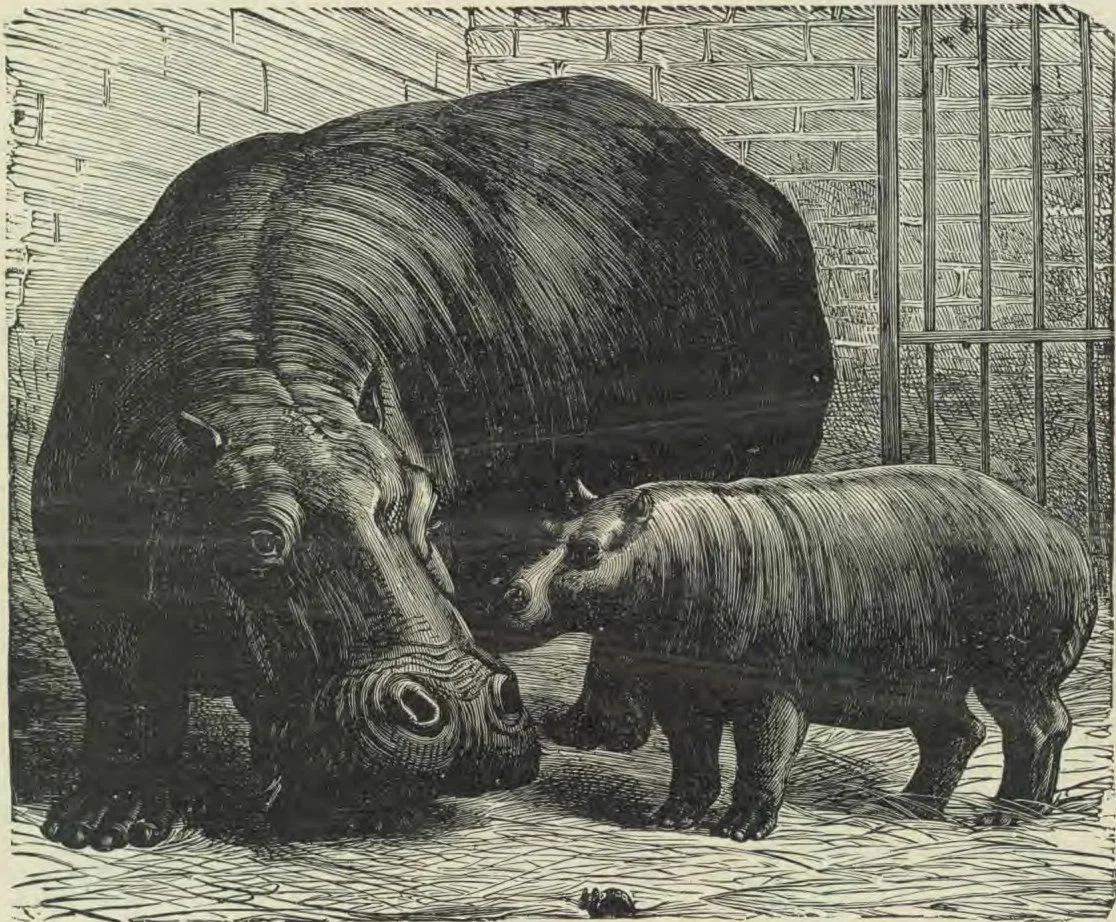
If we were to travel up the wild, reedy river banks of Africa, we might come across such a great, ungainly animal as this one shown in the picture. It is called the hippopotamus, from two words that mean horse and river.
This great, clumsy animal is usually fourteen feet long from the tip of its nose to the tip of its tail. Just think of meeting an animal as long as an ordinary living room! This old giant’s mouth is two feet wide, and down this cavernous opening he can put five or six bushels of vegetable stuff at one meal, without any trouble at all to himself. His ears seem much too small for him, as they are only three or four inches long. He has four large tusks in his mouth, which he uses in hooking up grass from the river bed, and an array of such gleaming white teeth as would make you shudder when you think how he might use them. His chocolate-colored hide is covered with an oily substance, and is in some places an inch and a half thick. When the skin is taken from the dead animal, it is drawn off in strips, like so many planks.
The hippopotami live in herds of twenty or thirty. They sleep most of the time during the day, but at night they leave the river banks, and go out to hunt their enormous suppers. If any farmer has been so unfortunate as to plant a rice-field in their neighborhood, they are sure to find it. They stand listening upon the banks for an hour or two at dusk; and if they hear no noises, they make a raid on the rice-fields, tramping down and destroying more grain with their great awkward feet than they take into their stomachs.
To be sure the farmer does not like these friendly visits from his giant neighbors. So he makes up his mind to put an end to them. He digs a deep pit in their path, puts a sharp stake upright in the bottom of it, and covers the whole with loose brush and grass, so that it looks like undisturbed ground. Then he goes home to wait.
The hippopotami remember the inviting rice-field, and at night set out on another friendly visit. They go lumbering along until within a step of the fatal trap, when they stop, smell the ground, give a knowing grunt, and go around another way. Sometimes, however, one falls in, and then the farmer is glad; for he not only eats his flesh, but sells the ivory tusks and other parts of the animal for a good price.
A traveler on the banks of the Simpopo river once saw a colony of these animals. “We heard,” he said, “the sea-cows bellowing, and approaching somewhat nearer, beheld a wonderful and interesting sight. On a sandy promontory of the island stood about thirty cows and calves; while in the pool opposite and a little farther down, stood about twenty more sea-cows, with their heads above water. About fifty yards below, again shoving out their heads, were eight or ten immense fellows, and a hundred yards below these, in the middle of the stream, stood another herd of eight or ten. The sea-cows lay close together in the mire, and had not the least objection to the others laying their heads on them in an affectionate manner.”
The little calves are carried on their mother’s necks; and as they cannot remain long under water, they are often brought to the surface to breathe.
This is supposed to be the animal called “behemoth” in the Bible; for Job says of him: “He eateth grass as an ox.” “His bones are as strong pieces of brass, his bones are like bars of iron.” “He lieth under the shady trees, in the covert of the reeds and fens. The shady trees cover him with their shadow; the willows of the brook compass him about.”
W. E. L.
THE ENDLESS STORY.
By Emilie Poulsson
A TINY drop of water
Within the ocean lay;
A coaxing sunbeam caught her,
And bore her far away;
Up, up—and higher still—they go
With gentle motion, soft and slow.
A little cloud lay sleeping
Upon the azure sky;
But soon she fell a-weeping,
As cold the wind rushed by,
And cried and cried herself away—
It was a very rainy day!
The little raindrops, sinking,
Ran trickling through the ground,
And set the rootlets drinking
In all the country round;
But some with laughing murmur said,
“We'll farther go;” and on they sped.
A little spring came dripping
The moss and ferns among,
A silver rill went tripping
And singing sweet along,
And calling others to its side,
Until it rolled—a river's tide!
And with the ocean blending,
At last its waters run,
“Then is the story ending?”
Why, no! 'Tis just begun—
For in the ocean, as before,
The drop of water lay once more.
—Emilie Poulsson.
LONESOME
By S. O. James
A LITTLE girl once said to her father, “Papa, I’m so lonesome I don’t know how to live.”
The father replied, “Well, dear, I’m sorry for you, and I believe that you do not yet know how to live. Now as for me, I have no time to get lonesome. I feel that I must work for the Lord, with my hands and feet and my head—with all there is of me and all the time. And this is not hard; for I love his service, and when I thus do, he comes and abides with me, and he is good company, I assure you. Will you not thus invite him into your heart, my daughter, and see if your ‘hours will not glide sweet away while leaning on his word’?”
When we work for Jesus, we have no time to be lonesome. S. O. JAMES.
Letter Budget.
CORINNE BOARDMAN writes from Chittenden Co., Vt. She says: “Dear Budget, I thought I would write you a letter. I am a little girl eight years old. I live near Lake Champlain. I go to day school, and read in the second reader. I study in Book No. 2 at Sabbath-school. I have a little brother and sister, and we all keep the Sabbath except papa. We have kept it two years and a half. I give a penny to the Sabbath-school every Sabbath, and put one every week into the missionary box. I went to the Vergennes camp-meeting. I like the INSTRUCTOR, and send my love to its readers. Papa writes this for me.”
BARBARA MEAD, of Solano Co., Cal., writes: “Perhaps you would like to hear from me, a little girl living away back in the mountains. I am six years old, and have two little sisters. I have never been to school, so cannot write. Mamma writes for me. When I learn to write, I will write myself. I like the INSTRUCTOR. When we read it, we give it to some of my little friends. We keep the Sabbath with our parents, and have Sabbath-school at our house. My little sister three years old and I learn our lessons in Book No. 1. We can see away across the Plains, and see the snow on the Sierra Nevada Mountains. We are trying to be good girls, so we can be saved.”
The next is a letter from El Dorado Springs, Mo., written by DEE FISHER, who says: “I am quite sure you have never received a letter from this place, so I will write. Papa, mamma, sister, and I are all there are in our family. We have all kept the Sabbath about five years. We have taken the INSTRUCTOR all this time. I don’t think we could very well do without it. Tent meetings were held here last summer, which were good and interesting, and two or three signed the covenant. We have a Sabbath-school of about thirty-two members. I went to camp-meeting last fall at Nevada, Mo., which is twenty-five miles from here. I never enjoyed myself better. It was my first camp-meeting. My sister and I were baptized. I am in room No. 7 at the day school. Another girl and I are the only scholars in my room who keep the Sabbath. There are so many temptations, it is not so easy to be a Christian while going to school. I want you to pray for me, that I may overcome all my sins and at last meet you in heaven. Perhaps some of the readers of the INSTRUCTOR have heard of El Dorado Springs, as it is a good health and summer resort. I think it is a real nice place to live in. Its population is about 2500. We have lived here about a year.”
Then we have a letter from Renville Co., Minn., written by HOPE SPICER, a little girl eight years old. She says: “My sister wrote a letter to the Budget about a year ago, which has not been published, so I thought I would write. We keep the Sabbath with our parents, and hope we shall all be saved in the new earth. My sister takes the INSTRUCTOR, and I like to hear it read. It is a splendid paper. Mamma has Sabbath-school at home. Some other children come to her school. I like to be in the Sabbath-school class. I study Book No. 2. Mamma is going to get No. 3. We go through each book twice, so as to remember our lessons better. There are no other Sabbath-keepers here, and we are twenty miles from meeting, so we do not often go. We have a cow and calf, some chickens, and a dog and cat.”
LOLA BURMAN writes a letter from Grant Co., Dak. She says: “I am twelve years old. I have seven sisters, five of them married, and two brothers. All but four of them, with my parents, keep the Sabbath. One of my sisters is deaf. She takes the INSTRUCTOR, and I love to read the stories and letters in it. I go to day school and Sabbath-school, and study in Book No. 3. I am trying to do missionary work by taking papers to school. If this letter is printed, I will write again and tell about the Bible reading we have. I am trying to keep the commandments of God, and hope to meet you all in the earth made new.”