JESUS CHRIST is a fact. His character and influence are facts. They can not be brushed aside or ignored by burying them under the general facts of human life. It is true that all other men have sinned, but that does not annul the fact of Christ’s sinlessness. It is true that no other man has ever wielded such an influence; but that does not dispose of the fact of his influence. “When it is a question of the character of an individual,” says Dr. D. W. Forrest, “we have no right to judge of him by generalization, however broadly founded, drawn from the actions of others, but solely by what the facts of his own life testify.” Our field of vision must be broadened, and our generalizations loosened up, to allow for all the facts. Whatever facts there are, we have to reckon with. Because one of these is unlike all the others, does not entitle us to throw out the one troublesome fact. It proves, in the case of Christ, to be the one fact worth all the rest.—Selected.
In God's Good Time
By John A. Howell
In God's good time we'll see the reason
why
To some he gives, to others must deny;
We shall not think it strange, or wonder
then,
Why different gifts he gives to different
men.
In God's good time the feet we thought
so strong
We'll find could not have run the jour-
ney long;
The willing hand had palsied ’ere it
wrought;
In mercy God denied them what they
sought.
In God's good time, the will that was
most weak
We'll learn was stayed by cross it did
not seek;
The careless heart had trifled all its
days;
In mercy, God with shadows spread its
ways.
In God's good time no sigh will seek
release
For that which now we deem would
grant us peace;
We'll know that, had we cast ourselves
the lot,
The path had led where peace abideth
not.
In God's good time we'll understand the
pain,
Which now we feel, was big for us with
gain;
That, had we travailed less, the child
of strength
Would never from the soul have leaped
at length.
In God's good time, with all life's les-
sons learned,
The purpose in this training then dis-
cerned,
We shall not think it strange, or wonder
then,
Why different gifts God gave to differ-
ent men.
— John A. Howell.
The Prohibition Movement in the South
By Booker T. Washington
A FEW months ago a well-known New York publisher said to me that in his opinion the next great issue in this country was to be the liquor traffic. At the time, I confess, his words made very little impression upon me. A few months later when Birmingham “went dry,” I remembered the publisher’s prophecy. Prohibition has long been popular in the country districts, but no one expected to see it triumph in the cities, and particularly not in Birmingham, where the population is so largely made up of the foreign laboring classes to whom some form of alcoholic beverage has come to be regarded as almost a necessity of life. The fact that a man in New York had so understood what I may call the “social weather” as to practically force a change in public sentiment sufficient to bring about this result, indicated to me that there were some forces at work in the South which did not appear on the surface.
As I have said, prohibition has long been popular in the country districts of the South. The method by which it was secured there is what is known as the “beat” system. Laws were passed prohibiting the sale of liquor within a certain radius of a schoolhouse or church. In other places the dispensary system was established.
The dispensary was generally a storehouse with nothing but liquor on its shelves. But it was not a lounging place; there were no chairs, no table, and no one was allowed to drink on the premises where the liquor was purchased. Before the last legislature met, twenty-two of the sixty-seven counties of Alabama were dry, fifteen had dispensaries, twenty-one had licensed saloons, and nine had dispensaries and saloons. But the people in the districts became tired of the dispensary. Although drinking on the premises was not permitted, it brought into existence other places where loungers might gather and drink the liquor they obtained there. At the last legislature a bill was passed which permitted prohibition by counties. This meant that the anti-saloon men intended to drive liquor out of the small towns, where it had taken refuge.
But the strongholds of the liquor traffic were the big cities like Birmingham, Montgomery, and Mobile. It was not expected that the agitation would succeed there. One motive for prohibition heretofore has been the effect of liquor on the negro; it tends to destroy his value as a farm laborer. That was urged as a reason for doing away with the traffic in the country districts. But there was a stronger reason for doing away with liquor in the cities. That was because it tended to make the city negro a criminal.
The prison system of Alabama, as of other Southern States, has been a very profitable investment. To a large extent it has paid the expenses of the school system of the State. The labor which the prison provides is cheap, and Southerners have not the same prejudice as Northerners against that kind of labor. But the Atlanta riot, in calling attention to the enormous amount of crime which existed in that and other Southern cities, aroused the better people of the city to a sense of moral responsibility for its existence. It was only too clear that among the negro as well as the white population this crime was very closely associated with the so-called “dives,” that had been allowed to exist in the city. It needed only a little investigation to show that these places were pouring a moral poison into the veins of the lower strata of the population,—white and black,—and that in the end this poison must infect the whole people. These breeding places of crime produced the conditions which made the Atlanta riot possible. But it was this Atlanta riot which resulted in clearing Atlanta of its saloons, and it was, to a large extent, the example of Atlanta which Birmingham followed.
I am convinced that, if we look far enough into this movement, we shall find that there is a deep-rooted feeling in the masses of the law-abiding citizens in the South, that some thorough-going measures must be taken to reduce the enormous amount of crime that exists in the Southern States. My observation has led me to believe that this feeling has taken hold of many men who have themselves been addicted to the liquor habit: that the present temperance movement is, in short, a very deep and genuine one, a sort of moral revolution.—Booker T. Washington, in the Southern Workman.
Learning to Swim
FROM the reception hall came the sound of merry voices. Out in the sitting-room Aunt Janet moved impatiently. Her silks rustled stiffly.
“Really, Mary, I wish Agnes had more independence. That Redmond girl treated her shamefully only last week, and yet there is Agnes talking as sweetly as if nothing had happened. I never should stand it.”
Mrs. Holmes looked up at the hard, bitter lines in her sister’s face, listened again to the sweet voice of her daughter as its gentle tones came drifting in to them, and replied,— “I do not think Agnes lacks spirit. You know how she used to resent a slight. But lately—”
The hall door closed. There came a breath of the outside wintry air, and a young girl dropped on a stool at her aunt’s feet.
“Agnes,” began her aunt, severely, “how can you treat that girl as a friend? She has been saying the meanest things about you. Mrs. Brown told me—”
“Stop, auntie!” cried Agnes, putting her fingers in her ears. “Please don’t repeat it. I do not want to know.”
“Why not?”
A moment’s silence. Then a brave face was lifted to the stern one above it. “Because, auntie, I am learning to swim.” Turning from her aunt’s astonished gaze, she looked straight into her mother’s face—into the eyes so sure to understand.
“You remember, mama, at the sea-shore last summer, what a time I had13learning to swim. My head would go down, and I come up sputtering, with such a dreadful taste in my mouth. My teacher said, ‘Keep your head up, and your mouth closed, and you will be all right.’”
“So, auntie, if I listen to all the gossip afloat, I am sure to go down with it, and come up sputtering. It makes me feel badly all over. But if I keep my ears and mouth closed, and my head up, I have a lovely time riding the breakers. It is so much more fun than to be sputtering all the time.”
“Humph!” said her aunt; but her silks actually rustled a little more softly.
—The Youth’s Companion.
CLAUDE D. AC MOODY
By Claude D. AcMoody
Notes Along the Way—No. 2
CLAUDE D. AC MOODY
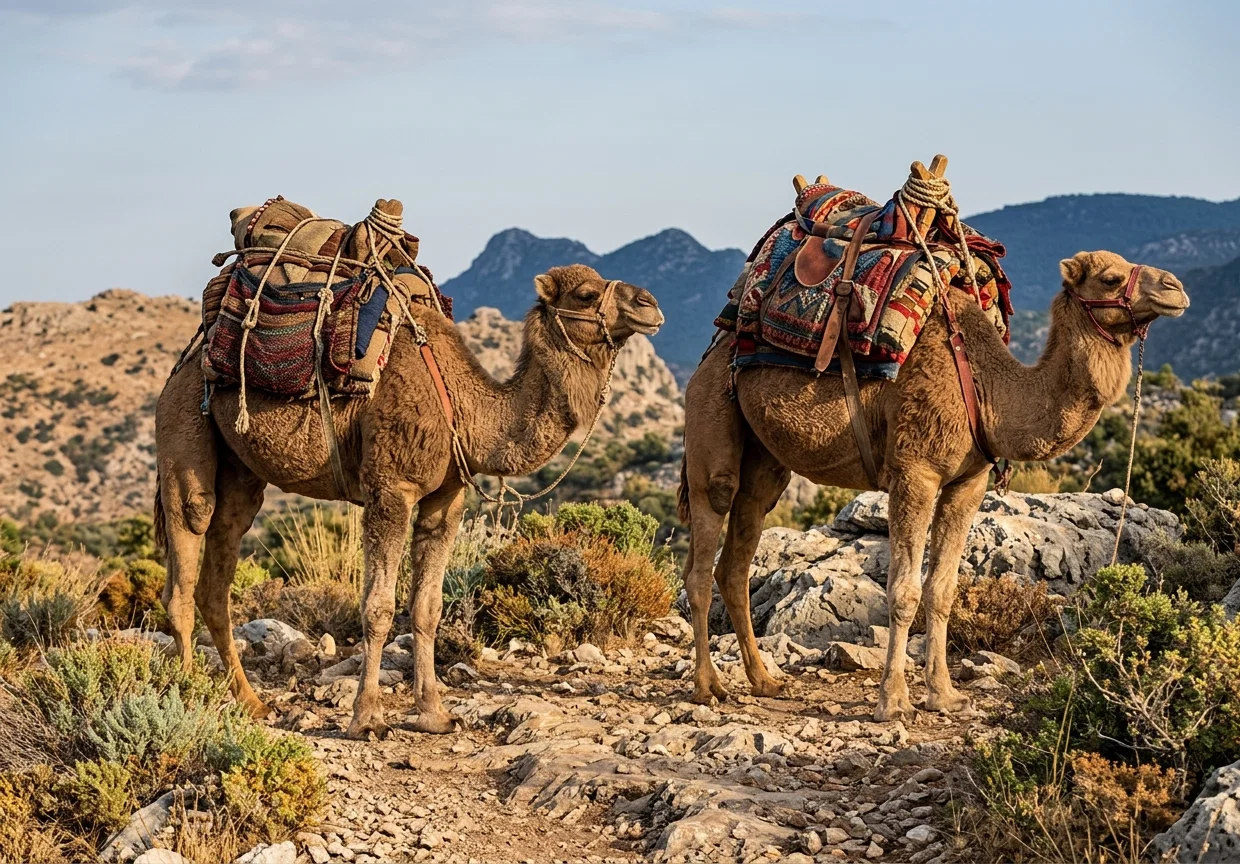
LOADED CAMELS, TURKEY
CHENGILER, MARCH 13, 1908.—We arrived here yesterday afternoon at a little past four o’clock, after two and three-quarters’ hours on horseback. We crossed over the ridge of the mountains lying between the Sea of Marmora and Lake Nicæa. I have seen many soul-inspiring views, too majestic, too grand to describe, but I never beheld an expanse of country which I felt less able to describe than the view spread before us yesterday as we crossed the crest of the divide. All eastern Marmora lay stretched beneath us, dyed in deepest blue. Even the Princes Islands, which are but mountains cast up in the sea, lay beneath, and over their tops, and to the farther shore lay Constantinople. To the left lay the Lake of Nicæa, now known as Isnik Lake, only a degree less blue than Marmora. Old Nicæa, where the first council of the Christian church convened under the auspices of the Emperor Constantine, was just out of sight behind a low point of mountain jutting out into Isnik Lake so as to hide from view the farther end of the lake. Before us, and a little to the left, and beyond a lower ridge of mountains, rose the peak of the Asiatic Olympus, clad in snow. South-eastward from Olympus ran a ridge also clad in white. All this was visible to the naked eye; but with a glass the grandeur of the view was greatly enhanced. Dotted over plain and hill were many villages. For several minutes our trail followed the narrow crest of the divide, and then swiftly descended into the village where we have just passed the night with an isolated young brother. As we descended, the great plain of lower Isnik lay before us, in the midst of which is situated the old Turkish city of Bazarkoi (Bazaar Village).
We leave in a few moments for Seuleus, where we shall find a good company of believers. The brother with whom we have passed the night will accompany us, and enjoy the meetings to be held there.
SEULEUS, MARCH 17.—We reached this village by a five and one half-hour horseback ride from Chengiler. Descending into the plain, we journeyed around the north end of Isnik Lake, and then for an hour and a half climbed mountains by a steep trail. The path lay along the edge of a beautiful gorge, but many times the horse swayed too close to the edge for the comfort of the rider. We reached here just before Sabbath.
This company consists of nine members. The Sabbath-keepers in Turkey do not have the weekly visits of denominational papers, and volumes of books to refer to, as do our American brethren. Some of these companies are indeed isolated but for the visit of the missionary occasionally. For four days we have had three meetings every day, and much of the time between meetings has been occupied in answering questions and in talking concerning the truth with the brethren privately. This little company raised about eighty dollars in tithes and offerings during the year 1907. Early in the morning we first leave for Brusa. We leave these brethren renewed in courage, and strong in the faith.
BRUSA, MARCH 25.—We arrived here one week ago to-day after a drive of forty-five miles by carriage from Seuleus. The road is very good all the way. One thing can be said for Turkish carriage roads,—though they are few and far between, what few there are are very well built. Along the best roads, yol bashi (road-master) houses are built every few kilometers. These are about the size of the ordinary railroad section-houses seen along the railways in America. Eighteen miles from Seuleus, and twenty-two miles from Brusa, we passed through the little city of Gemlik, situated at the point of a bay which creeps inland between the mountains from the Sea of Marmora. This city is situated very nearly on the site of the ancient Roman city of Cius. I have never been able, either by inquiry or personal observation, to find any ruins of the ancient city worth mentioning. Generally the Turkish government has exercised great14care in preserving the various crumbling and decaying monuments of the earlier days of this country. Gemlik, being a very prosperous little seaport, seems to tolerate nothing but new, well-constructed buildings, and ruins and old buildings are destroyed. In the majority of cities and villages, however, the aged and weather-beaten appearance of the buildings is very noticeable. On the road from Gemlik to Brusa the yol bashi houses are built of nicely cut stone. Real skill is shown in the mason work, which is finished and pointed neatly. They are roofed with prettily laid yellowish-red tile. In fact, this gives a good idea of the general neatness and care shown all along the way in the construction of the road, its grading, bridges, etc. The accompanying photograph I took last fall, when covering this same drive. I was able to get very close to the camels as they were standing at rest but a little way from the road. They posed well.
During the week spent here I have enjoyed meeting with the few believers in their homes, encouraging them, studying the truth with them, and holding Bible lessons in the evening. Communion service was held Sabbath. Our greatest difficulty here is a place of meeting. The city is several miles in length, and the brethren live at the two extremes, and there is no central place for meeting. This is the place where the government caused our brethren considerable trouble last summer; several were arrested and fined for being found meeting together. The local head of the Protestant community has been greatly against us, but on this trip and also upon my visit last fall I have made it my business to gain his friendship to a degree. This was made possible by a friendly letter written to him by the Protestant millet bashi (church civil head) of Ismidt in behalf of our people. The latter is a friend to our brethren in the Ismidt district. We are proceeding with our work peaceably again. Through this endeavor to gain a proper understanding with the Protestant millet bashi here, he granted the proper paper to one of our Greek sisters to enable her to present herself to the government to secure a passport for England, whither she goes to take the nurses’ course at the Caterham Sanitarium. She made her application then for her passport and was refused. It is on this account that I am being held over here a few days longer than I had planned. I have carried the case to the local British consul (Brusa having a population of one hundred thousand, and being quite a commercial point), who has taken the matter up with the governor-general of the Brusa vilayet. On calling upon the consul last evening, he had not received final word; but he expressed his opinion that there was no question that the passport would be granted. This rejoices the sister, for she is anxious to enter upon her course. The foregoing gives but a faint idea of the methods necessary to the accomplishment of almost anything in this country. Careful pushing, forward, diplomatic working, is the only way to see a thing through. There are times when mandatory manners assist one’s progress; but by experience and care, one has to learn when to force, and when to submit.
I expect to leave to-morrow by a little narrow-gauge railroad, which will carry me to Moudania seaport in about two hours. From there it is seven or eight hours by steamer to Constantinople. I am parting from my interpreter here. Day before yesterday he started to return by land to the Ismidt country. Being an Armenian, and holding his civil private paper out of the old Gregorian Church, the government does not permit him to go by Constantinople. I leave the little company rejoicing in the Lord, their chief sadness just at present consisting in their having to part with the missionary on the morrow.
Constantinople.
What Alcohol Does
By Louise C. Purrington
FIRST, for the moderate drinker who never really gets drunk! Dr. Pierret says of unconscious alcoholism, the result is a successive giving out of vital organs, the stomach, liver, kidneys, etc., and the worst effects are found in the children of these moderate drinkers,—a special race, weak and constantly deteriorating. The moderate drinker because of his daily alcoholic dose is undergoing incipient paralysis; his appetite is the gradual enslaver of his entire organism; every organ and tissue is involved, and some day an accident or illness lays him low, and the life goes out or trembles in the balance because the enfeebled system has no rallying power.
To illustrate: a man high in authority, lovable and beloved, and wise in public affairs, lay for many days with death hovering over him, his case being considered by the physicians as almost, if not altogether, hopeless. The complication of diseases might possibly be resisted, but the complication of alcohol would not easily be overcome. “Unconscious alcoholism” suddenly becomes regnant in the history of the patient, the vitality is lowered, and the patient is without recuperative force. This slowly acquired deterioration from the alcoholic poison is not only inimical to recovery, but is transmitted, and children are likewise susceptible and without rallying power.
The craving for drink is unquestionably hereditary.—Louise C. Purrington, M. D.
Saloons Among the Nez Perce Indians Abolished
THIRTY-FIVE saloons in Nez Percé and Idaho counties, in the panhandle of Idaho, southeast of Spokane, have been put out of business through a decision handed down by the Supreme Court of the United States affirming the judgment of the federal court of Idaho in the case against George Dick, an Indian, convicted on the charge of selling liquor on the Nez Percé Reservation, and sentenced to serve a term in the penitentiary. The decision is sweeping, and may be interpreted to mean that saloons on other reservations in the Northwest are to be put under the ban.
Work on the Borders of Abyssinia
By Rev. Louis Meyer
THOUGH Abyssinia proper has been closed to European missionaries (Protestant) since the year 1868, another effort to reach its inhabitants from its borders has been going on during the last years.
The Swedish Evangelical National Society sent out its missionaries at first to the heathen Cunamas, a tribe on the borders of Abyssinia. The work, at first quite promising, had to be abandoned on account of fever among the laborers and political difficulties in the country. Then the faithful missionaries settled west of Massowah in the small village of Ailet. A few years later a school for native boys was opened at Monkullu, a little farther west from Massowah. Its firstling was Onesimus, a heathen Galla slave, who was educated in Sweden, and proved a great help in missionary work.
The heat around Massowah was almost unbearable to these missionaries from the north of Europe. Fever caused the death of victim after victim. Yet faithfully they remained upon their post of duty fifteen long years, fresh soldiers of the cross taking the place of fallen ones at once, until at last they could enter the province of Eritrea [on the northeast border of Abyssinia. Map on the first page] which had become an Italian colony, after bloody battles. At last they were on the borders of coveted, firmly-closed Abyssinia, and in the very mountains to which they had often looked with ardent desire. Three stations have been founded in the province of Hamasen, which touches Tigre, the northern province of Abyssinia. Of these stations (Zarega, Belesa, and Asmara) Asmara is the most important, because the printing-house is located there, and much Christian literature has come from its presses already. It is said that the late Ras Makonnen ordered a copy of each product of these presses.
At first the Swedish missionaries intended to work from within the Abyssinian Church, like Heyling; but the opposition of the priests forced them to build churches, and to organize congregations. They are aided by native helpers, whom they educated for the work. The most prominent one of the native helpers is Tajelcny, an Abyssinian from the province of Amhara. He seems to enjoy the favor of the governor, and it is reported that the king said to him, “Be of good courage, and fear not. None who highly esteems the Bible is hated in my domain.”
Tokens of a spiritual awakening in the country reached by these Swedish missionaries, part of which country belonged to Abyssinia until a few years ago, are numerous. From many places comes the news that Abyssinian Christians begin to search the Bible; and in Schumanegos the evangelicals, thrown out of the church by the priests, have built a church of their own. Among the Gallas, south of Abyssinia, a few souls have been won to Christ by pupils of the Swedish missionaries in Eritrea.
The Swedish National Society has on the borders of Abyssinia ten stations and outstations; thirty-four missionaries, men and women; thirty-two native workers; fifteen schools; 356 scholars; a hospital and dispensary; a printing-house, and 566 professed Evangelical Christians, of whom 252 are communicants.
West of Abyssinia, in Omdurman, near the ruins of Khartum, the missionaries of the British Church Missionary Society have begun the preaching of the gospel, and the wonderfully prosperous Egyptian mission of the United Presbyterian Church of America is reaching farther and farther south from Egypt. Surely, it looks to the observer as if siege is being laid to dark Abyssinia with its decayed Christian church by Christian forces which surround it almost in a circle, and as if the time of its opening unto these forces can not be far away. Sooner or later, it must come, for the Lord has promised that the gospel shall triumph.—Rev. Louis Meyer, in Missionary Review of the World.
The Land of the Morning Calm
By Addie Carnahan Smith
ADDIE CARNAHAN SMITH
ANOTHER spring has come—our third one in Korea. The grass is green, and the hillsides are beautified with flowers, but there are not many trees to add to the natural beauty of the landscape. As the expression, “The land of the morning calm,” has often appeared in the papers, I wonder if many have realized that there is more truth than poetry in it. Usually at sunrise there is a decided calm, not a leaf is stirring. It is so soothing to be out at that time; but within an hour or two the wind begins to blow, gently at first, with increasing velocity until, by noon, it is so strong that it is quite impossible to keep a hat on. No doubt this accounts for the custom of the men wearing their hats with ribbons tied under the chin, and of the women wearing long strips of cloth tied around the head.
Autumn is the most pleasant season here, the winters being quite severe, the summer very warm and moist, and the15spring extremely windy. But the climate is considered quite healthful. We have enjoyed as good health so far, I think, as we did in America. But the unsanitary condition of the cities and villages makes it unpleasant and unsafe in regard to health, when one is thrown out among the natives, where he can not take proper care of himself, and necessary precaution about food and drinking water.
The spirit of calm is not resting upon this country just now. There are said to be more robbers at present than at any time in the past. Within the last week we have heard of six near-by villages having been raided by bands of robbers. At one village they obtained some money from two houses, and at a liquor shop they drank all the whisky. Then, as a dog had just been butchered, they ordered it dressed and cooked, and ate all of it. No doubt one reason for there being so many more robbers than usual is because the new emperor, on taking his seat one year ago, proclaimed liberty to all the prisoners.
There is another lawless band—the Euipyongs—who are opposed to Japanese influence. Travelers are attacked by them. Japanese are killed without mercy. When a Korean is seized, and he pleads innocent of favoring Japan, he is asked why he has short hair (those who are in favor of Japan usually shingle their hair); if he says because he is a Christian, he is then commanded to sing and pray; and if he is able to do this, he is let go, but if unable, he is killed. Many have been tested in this way. Many Japanese and Koreans have lost their lives during the past year at the hands of this lawless band.
Surely this nation needs the knowledge of the saving truths of the gospel.
Soonan, Korea.
Preparatory to Entering Tibet
TIBET has long held out against missionary advances. Even the introduction of the Bible itself has not been permitted, and it is only recently that an agent of the British and Foreign Bible Society, armed with a government passport, was able to make a successful trip to a town in the interior, distributing portions of the Scriptures. In his report to the Society, he stated that from what he saw and experienced during this visit, in his judgment the time was not ripe for entering Tibet with the Scriptures.
In view of the above, the following clipping from a late copy of a Shanghai paper, sent us by Dr. H. W. Miller, will be of interest. The Lord has ways for opening Tibet to the light of the gospel which in his own good time he will bring about, and it is quite possible that the movement tending to its annexation to China proper may be his chosen method for bringing about this desirable end. The article runs thus:—
“As the proposal to reorganize Tibet into a province on the same basis as those of China proper requires the personal sanction of the Dalai lama, or Buddhist pontiff, it has been decided by the Pekin government to invite him to the capital for a conference with the emperor. For this purpose the following procedure will be followed by advice of the ministries of rites and of dependencies: A special imperial decree is to be sent to the governor of Shansi, at the provincial capital of Taiyuan, commanding him to request the presence in Pekin of the Dalai lama, who is now at the great temple of Wutaishan, about eighty miles distant from Taiyuan. A special high official will also be sent to Wutaishan to arrange with the pontiff as to the date of his arrival in Pekin16for audience, which will then be telegraphed to his majesty. As soon as this is made known, the governor of Shansi is to send a high official to Wutaishan to escort the Dalai lama to Taiyuan; preparations are to be made all along the route for the comfort of the pontiff and his large retinue. As the Dalai lama approaches within thirty li of Taiyuan, the governor is to meet him and give welcome in the name of the emperor, and then escort the party into the city. The party will proceed to Pekin by way of Pao-ting, the capital of Chihli province, and when within a day’s march of that city will be welcomed by the viceroy of the province in the name of his imperial majesty. Arrived within the environs of Pekin, the pontiff is to be received by the members of the ministry of dependencies, the comptrollers-general of the imperial household, the general commanding the infantry division of the imperial guards, and the governor of Pekin, who will welcome him once more in the name of the emperor. A large body of troops and a military band will also be in attendance to escort the illustrious guest within the city walls of the imperial capital as far as the Huang Sze, or Yellow Temple, where the pontiff and his party will reside during their sojourn in Pekin. Special ceremonies also have been arranged for the pontiff’s audience with his liege lord, Kuang Hsu. According to these it is proposed that his majesty will rise from his throne upon the approach of the Dalai lama, and having received the latter’s obeisances, will ask him to take a seat on a bamboo couch specially placed at right angles to the throne. Refreshments will then be served, and the emperor will, among other subjects, converse with the pontiff on the conditions of Tibet. After the audience numerous gifts will be bestowed by the emperor and empress dowager upon their illustrious visitor, and a grand banquet will be given to him. When the Dalai lama leaves Pekin, a farewell banquet is to be given, at which the emperor will not be present, but will appoint certain ministers of the presence and members of the ministry of dependencies, and comptrollers-general of the imperial household department to act as hosts on the imperial behalf. Ministers of the presence and grand chamberlains will escort the Buddhist pontiff as far as Pao-ting, and on his return journey to Tibet he is to be welcomed and escorted a certain distance by the viceroys and governors, through whose provinces the party will pass on their way westward.”
Spain
By MRS. FRANK S. BOND
MRS. FRANK S. BOND
WE are thankful to be engaged once more in the Master's service. Our kind Heavenly Father has graciously spared our lives, and we believe he has spared us for a purpose.
The needs of this people, which for so many centuries has been bound under Roman superstitions, appeal to our hearts. I wish it were possible for me to frame language with which to portray the awful conditions existing here. Could I do so, it might be that some of those in the home land would be impressed to come over and help us make known the saving power of God's truth.
In a special sense do the conditions and needs of the Spanish women appeal to me. As I think of the many disadvantages at which they are placed from their infancy, my sympathies go out to them. In the first place, when only a few months old, the bodies of all girl babies are incased in that awful invention of the evil one, the corset. While in China only the feet are bound, here almost all the important organs of the body are forced out of their normal positions.
Another element which has played a great part in the deterioration of this people is wine. Women, as well as men, indulge freely in its use. It also makes up a part of the daily menu of little children. It is easy to understand what must be the results of such customs as these.
The majority of the people are poor, and many of the mothers are compelled to go out from their homes, to assist in gaining a livelihood for their families. Thus the influence in the homes is not such as to develop strong characters.
COUNTRY HOUSE IN SPAIN
Morality is almost an unknown factor in this country. Immorality is fostered on every hand. It is even encouraged and taught by those who pretend to be the teachers of the people, the priests. At the taking of the first communion, and at the confessional, wrong ideas and evil thoughts are put into the heads of little girls just entering their teens. This is not, as some would have us believe, merely the imagination of some fertile brain, but it is the truth, pure and simple.
It is estimated by the most reliable authorities that not more than fifty or sixty per cent of the Spanish people are able to read and write. If this be true of the whole population, we believe we are safe in saying that not more than twenty per cent of the women have this ability. This lamentable condition is due largely to the scarcity of educational facilities. While Rome boasts of a great educational system, from our observation in this country we are convinced that where there may be one school, there are hundreds of other places which need them, where they do not exist.
As is well known, Spain, in every sense of the word, is a priest-ridden country, and because of the illiteracy of the women, they are more susceptible to the errors taught by Rome than are the men.
At present my husband and his brother are conducting a series of meetings here in Valencia, and I am glad to report a good attendance. Of those who come, there are a goodly number who seem much interested, and of these the majority are women. Several have already asked for studies in their homes, and some have expressed their desire to keep the Sabbath. These meetings have been in progress only a little over three weeks, so we can not yet say what the results will be. We hold five night services each week, and Sabbath-school in the afternoon. There were thirty-two present at our Sabbath-school to-day, most of whom are adults. The attendance at night has averaged nearly one hundred.
The great need of this field is consecrated workers, to enter the many great cities to be found here. We ask an interest in the prayers of God's people for the success of the work here.
Valencia.
East Caribbean Conference
By Philip Giddings
At the meetings of the West Indian Union Committee held in conjunction with the West Caribbean Conference session in Trinidad, Port of Spain, Dec. 15, 1907, there were present L. E. Wellman, President; H. C. J. Walleker, Vice-president; Philip Giddings, Secretary; also J. Matthews, F. G. Lane, J. G. Dasent, W. D. Forde, and A. A. Clarke.
Being out of our territory of a voting constituency, no regular session of the conference was held. There were, however, council meetings relative to some plans of work for the coming year. The following were some of the resolutions adopted:—
That Mrs. L. E. Wellman be appointed Sabbath-school secretary of the conference.
That Mrs. P. Giddings be secretary of the Young People’s Work.
That our conference workers push the sale of “Christ’s Object Lessons” to realize funds to apply to the West Indian Training-school; and to solicit subscriptions for the Caribbean Watchman.
That Brother A. A. Clarke be asked to connect with Elder F. G. Lane in tent work in the Leeward Islands.
St. Thomas, with adjoining islands, being so near the Porto Rican mission, it was advised that it connect therewith. This step was accordingly taken.
Since the return to their fields the workers have been sowing diligently, and here and there reaping some fruits. Brother F. G. Lane (Antigua) has baptized several, and has since gone to Montserrat, a neighboring island, to open up work. In St. Lucia, where Brother W. D. Forde is, thirteen were baptized recently. Poor as they are, they have decided to lay plans to build a church. One poor sister sold a house, and gave the greater part of the proceeds to the church fund.
In St. Vincent Brother J. G. Dasent reports eight baptized by Elder Wellman, with as many more being prepared for the rite. In Dominica, we are still at our church building, which is now nearing completion. We have necessarily gone on slowly, having at times to stop, pray, and wait for funds. Up to date it has cost us $559.05. Small as this may seem to our brethren, it represents much labor and sacrifice. Our carpenter, Brother Thomas Mass, formerly a Catholic, worked steadily on the church for months, and refused any remuneration.
I have not much to report in evangelistic lines. One little Catholic girl, who has been attending our services for some time, came for her music lesson, looking sad. Mrs. Giddings asked her what was the matter. She said her mother was going to take her to the Catholic Church for her first communion, but she did not want to go. We knew we could do nothing, so we asked the Lord to help the child, and change the mother’s purpose. The Sunday came; but the mother, instead of taking the child to the Catholic Church, came with her to our meeting that Sunday night. At the close of the meeting, she thanked us for what we were doing for her child.
A lady who was interested in the Sabbath question was given by her minister a paper published somewhere in the Southern States in which was an article against Seventh-day Adventism and Mrs. White. The truths of healthful living, dress and diet reform, etc., were all mangled. I was passing when she called me to read and explain. When I finished, she said, “They gave me that paper to prejudice me against the Sabbath; but the seventh day is the Sabbath day, and I will keep it.” She has been faithful since.
The teacher of the government school has been with us for four Sabbaths. She is convinced, as are also her mother and father. They have not fully identified themselves yet, though they have come to meetings. We are praying that they may follow fully.
A few Sundays ago two Catholic converts went with me to a village to have a meeting. Drunken men and women, boys and girls, surrounded us, and made such noise and confusion that we could not speak to them. I have planned to visit them again, and get, if possible, some of our literature among the few intelligent and reading ones. So few read, and some understand so little of what they do read. We ask the prayers of our brethren and sisters.