The report of the Middle Russian annual meeting was written while making the trip from Moscow to Kief. The distance between the two cities by railway is about six hundred miles. It required over twenty hours by what is considered a fast train in Russia to make the trip. We traveled through great stretches of forest and only partially developed country. Had the masses of the people a fair degree of enlightenment, and did the government provide a just and liberal administration, the country would provide ample resources for a vastly larger population than it now possesses. The villages contain anywhere from a few hundreds to many thousands of people, whose condition is little better than serfdom.
The houses, which, are very low, one-story structures, are scattered about with little apparent attempt to place them in orderly arrangement. A large percentage are covered with very heavily thatched roofs. The windows are very few, as are also the smoke flues. Many of the houses have no chimneys whatever, the smoke from large stoves or ovens contributing to the warmth for the occupants of such houses.
Scattered throughout the country near the villages are many old-fashioned windmills. These provide the only means to the millions of country people in Russia for grinding their grain. Naturally, the product of such mills is not of the finest quality, but the peasants are accustomed to very coarse bread.
There is one striking feature to be seen in every village—the orthodox church. A very wretched-looking village is almost sure to have a beautiful church. For many miles the gilded and painted domes and pinnacles can be seen by travelers. Another feature, just as striking as the ever-present church, is the never-present school. None of the villages has a school. This fact seems incredible to the inhabitants of more enlightened lands. Though the millions of priests boast that their church possesses the true faith, yet scarcely any attempt is made to render it possible for the masses to read the Word of life.
As we approached Kief, the country looked somewhat richer, and, to a little greater extent, subdued by the efforts of the inhabitants. We entered the fertile valley of the River Dnieper. There we saw many signs of considerable commercial activity.
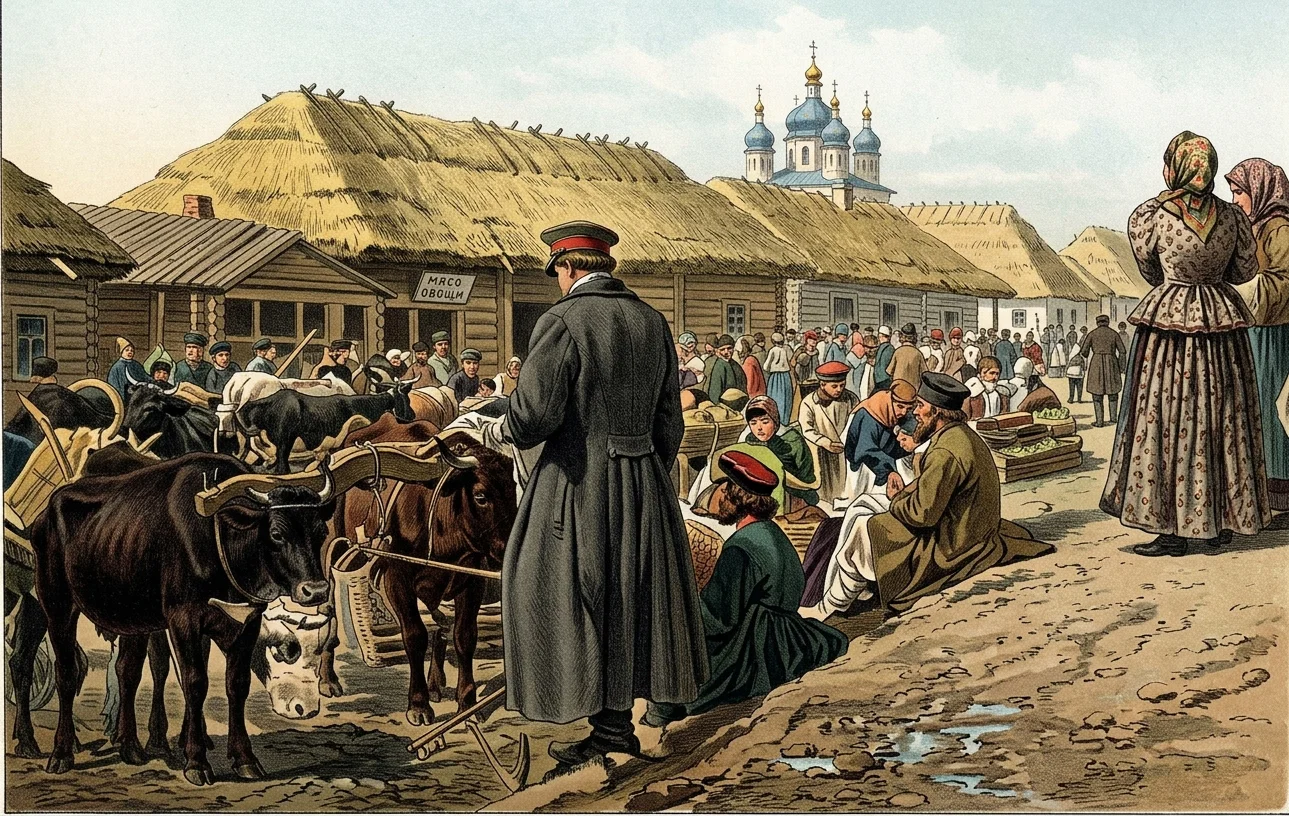
MARKET AMONG THE “LITTLE RUSSIANS”
Kief is regarded as Russia's holy city, or Jerusalem. It possesses many large churches, but that which gives to it special distinction is the famous Lavra, which is a sacred shrine for all Russia. There is a beautiful spot of ground enclosed just outside the city on the bank of the river. Within this enclosure is one very costly church, besides several others less imposing. There is also a cloister where many monks reside. Foods and many other articles are manufactured here. There are a number of shops where many things appertaining to the Greek Catholic Church may be obtained at rather high prices. There are underground passages somewhat similar to the catacombs at Rome. In these passages may be seen many open coffins containing the supposed remains of dead saints. Whatever may be in a coffin, it is always thoroughly concealed from view by thick mantles. To the Lavra there come annually hundreds of thousands of pilgrims from all parts of the great empire. We were informed that about twenty-five thousand visit the place daily during the summer season. The pilgrims are lavish in their exhibitions of idolatrous worship of saints and "holy" things.
The attendance of our people at the Little Russia meeting in Kief, held March 2-6, was good, and many people of the city attended the afternoon and evening services. It was in Kief that Elder J. T. Boettcher had the privilege of presenting some of the leading points of our message to a large company of Greek Catholic priests about two years ago. The city has been much agitated over the matter ever since. For a month before our meeting opened, the newspapers had been printing articles regarding the coming conference. Scarcely had we entered our room in a hotel, when a leading newspaper representative came8to interview us. During the entire time of the meeting, this man, with others from other papers, attended our services. Several papers printed long reports of our meetings daily. Almost without exception the reports were fair and favorable.
From the first, a high official from the ministry of religion (government department) at St. Petersburg was with us, to observe our meetings. The government at Kief also had its special police officer present at all services. Besides these, a special missionary of the Greek Church, from St. Petersburg, honored all the meetings with his presence, and he seemed to be attended by a local man of similar character. These men seemed to watch closely for some point on which they might bring a charge against us. From day to day there were also in attendance from three to six priests. They manifested a very keen interest in all that was said and done, and it was evident that these priests had a considerable number of their partizans in the hall. Such circumstances, and such observers, place those acting a leading part under a severe strain.
The priests almost daily challenged Brother Boettcher to hold a public debate with them. Finally, on the Sabbath, they presented a formal written challenge, and desired an immediate reply. This was given in writing, by calling their attention to Neh. 6: 3, and they seemed to accept this as final. Their evident purpose was to divert the efforts of Elder Boettcher from our regular meetings, where we studiously avoided doing or saying anything which could possibly offend the government officials. Had the challenge to debate been accepted, great confusion would have characterized the debates, with the possible result of closing our important annual meeting.
There was some attempt to disturb the Sunday afternoon service, when one of our younger brethren spoke, in the absence of Elder Boettcher and the writer. When we arrived for the double evening service, the police officer expressed fear of trouble in that, the final meeting. He took the precaution to secure the services of eight additional police officers. The writer spoke the first hour, on "The Home of the Redeemed." A few minutes after the sermon began, about twenty young students, who had entered the place of meeting for the purpose of making a demonstration, arose and tramped heavily out of the hall. Doubtless they were deterred from any further demonstration by the presence of the extra police who were distributed about the hall. The places of the students were at once taken by persons anxious to gain admittance. Every foot of standing room was occupied. Elder Boettcher devoted the second hour of the service to a very interesting lecture on health and temperance.
In spite of the surveillance and opposition, the annual meeting of the Little Russian Mission ran well from the beginning, and closed most encouragingly. The believers were encouraged to press forward in the conflict, and their confidence in the movement was much strengthened. Apparently many people not of our faith received favorable impressions, for the very manifest influence of God's Spirit was with us.
Just as we arrived in Kief, we received the sad news of the arrest and conviction of Brother J. Pilkewitsch, a licentiate in the employ of the Little Russian Mission. His wife resides in Kief, but he had been working among the villages. He was charged with having spoken against the orthodox religion of the country. Fifty witnesses were permitted to bear false witness against him, while his witnesses were not permitted to testify. As the result, he was convicted, and sentenced to two-years' imprisonment. Elder Boettcher sent this brother's wife to investigate the matter, as he could not go himself, but he will exert every possible influence to bring about Brother Pilkewitsch's release. We should all pray that our dear brother may not be required to serve out the full time of this unjust sentence.
The special missionary from St. Petersburg, supported by the priests, conducted a three-nights' meeting in opposition to us, immediately following the close of our conference. Before we left Kief, at twelve o'clock Monday night, a Russian brother reported to us fully of the first meeting, which had been held that evening in a very large hall crowded with people. The St. Petersburg man's speech was a most bitter attack upon us. We believe God will overrule for the furtherance of his cause, not only in Kief, but also in all Russia.
The membership of the Little Russian field is now 502. A net gain of 100 was made last year, and the tithe for the year amounted to $1,325. Brother J. Ierk, and his small force of coworkers in that field, are full of courage for the future. They greatly need the aid of our prayers of faith.
A Clean Mouth
Now and then one hears incredible stories of persons otherwise apparently intelligent and cleanly, going round for months, and even years, with their mouths full of germ-laden, aching, decaying teeth.
These persons will give the most ridiculous reasons for their unclean folly. They are too busy, or they have an insane dread of the dentist, or some such nonsense. In the very poor and very ignorant all this may be understood and forgiven, but in other classes it is unpardonable.
Very few of those who are children to-day will be able to say by and by that they suffer on account of neglect of their teeth in youth, but many adults can honestly say so now. The science of dentistry, and the mechanics by means of which that science is applied, have made enormous strides of late, and will undoubtedly continue to advance in the future.
It is universally accepted that a clean surface does not decay. All decay is caused by germs, and the germs can not multiply and work evil unless particles of food are left on, under, or between the teeth. When these particles are so left, they become softened by the saliva, and then afford lodgment for certain germs which excite an acid fermentation. The acid so formed attacks the enamel of the teeth, and this is finally perforated.
Now the door is opened for the germs of decay to enter. In this minute opening in the enamel they find a sheltered spot where they can increase, and by their action cause the destruction of the vulnerable dentine.
This whole process of the formation of the destructive acid may take place within a single day, if the toilet of the mouth is neglected.
Seeing how easy it is for this destructive work to be started, one should make trips to the dentist very regularly, that damage already done may be repaired, and that the deposits which settle on the teeth in the form of tartar may be cleaned away. This tartar does serious damage as long as it is allowed to stay, and it can not be removed by any home treatment.—Selected.
THE RUSSIAN POLICEMAN
The Russian Union Conference Meeting
By Ludwig Richard Conradi
L. R. CONRADI
AFTER the union conference committee meeting in western Europe, the writer left Hamburg on March 10, and reached Mitau, Russia, March 14. Mitau is a city of about forty thousand inhabitants, and the seat of the governor of Courland, and there the Russian Union Conference meeting was to be held, from the fifteenth to the twenty-first. This city has quite a large German population; the rest are Lettonians, and there are but few Russians. The population being Protestant, everything was quite favorable to the holding of the union conference gathering. The brethren had secured a large empty house in which to care for most of the delegates, but so many came in from abroad that they were obliged to lodge the union conference committee in a hotel, and board them at this house. There is a church here of fifty-four members, and the brethren have fitted up a meeting-hall holding about two hundred people. For the meetings in the evenings and Sabbath and Sunday they had secured one of the best halls in the town, with a seating capacity of about five hundred. The general meeting of the Baltic Conference, which has now a membership of 755, was also to be held, and from the very first it was evident that our small local hall was entirely inadequate to seat the people, and so our meetings had to be transferred to the large hall. The Russian government had sent a special officer from St. Petersburg, and he with one to three of the police officers of the city, attended every meeting, and took careful notes of all our proceedings and sermons.
Elders W. J. Fitzgerald and J. T. Boettcher, who had attended together three of the local gatherings, came from Riga the same night that I arrived. We at once began our auditing, and thus this was fully out of the way before our meeting commenced. Though we were not allowed to advertise, yet there was a large outside attendance at all the services. We had several Bible studies during the day, at 7 P. M. a sermon translated into Lettonian, Esthonian, and Russian, and at 8:30 a straight German sermon. The truth had a telling effect on the many hearers as they came from night to night, though the speakers had to be very careful in what they said. No collection or gathering of funds was allowed in any of the meetings; thus our people were entirely deprived of the privilege of giving. On Thursday night the writer had a well-attended meeting in the city of Riga, which is about an hour's ride from Mitau.
The great size of the present Russian Union Conference is apparent when we say that some of its delegates had to be longer on the cars than it would take to go from Europe to America. Several came from central Asia and central Siberia.9And not only the vastness of the territory appeals to us, but also the immense population, of over 150,000,000, which increases faster by natural growth than the United States by all its immigration.
Last year not less than 748 were added to our membership in this union conference, bringing up the membership to 3,668, while the tithe increased from $11,400 to $15,600. The appropriations called for were $5,700, but when we finished the audits, we found that $6,700 was needed; and this need would have been still greater had not the Baltic Conference nobly stepped forward and paid a second tithe of $400. Putting these figures together, we find that $22,000 was spent last year in Russia for gospel work, and the results were over 700 members added: surely a rich harvest for the money spent. There are only 24 ordained ministers and licentiates, and 23 Bible workers employed, making an average of nearly 15 members gained by each worker. These figures speak volumes. Though the Russian Union Conference was organized only two years ago, yet, in view of the vastness of the field and the work to be done, it was evident to every one that a division into two union conferences in the near future would greatly facilitate the carrying on of the work, and aid in the proper supervision.
From the experience gained in holding the seven general meetings in the winter of 1909 and 1910, it was very evident that we could not, under the liberty now granted, make the success of the work that we could under ordinary circumstances. We could not consider our needs—to create suitable institutions, and to provide the necessary means; we could not consider the financial support of the conferences and union conferences; we could not even conduct a good social meeting; so all felt that as the laws concerning such general meetings are still pending, it would be wiser to drop our fall meetings for 1910, and to spend the time in building up the old churches and in raising up new ones.
It was also apparent that our next step must be the securing of a suitable building for the publishing work in Riga, as all were unanimous that Riga was the most convenient place in Russia for such purposes, from every standpoint. Thus the Hamburg house was invited to secure property for its branch office there.
The Russian Union Conference is now composed of three conferences and six mission fields, and if proper attention is given, several new conferences can be organized this year; as the Little Russian Mission field has 500 members, and the East Russian 388. If this is done, the West Russian Union Conference will still have three good conferences and several large mission fields, and include all of European Russia as far as the Caucasus and within 100 miles of the Volga; while the East Russian Union Conference will have the Caucasian and the East Russian conferences, and three or four mission fields in Siberia and central Asia. The first will probably have a population of 100,000,000, with about 2,150 members; the other, of 50,000,000, with over 1,500 members.
As to the institutions: we are glad that there are over thirty students from Russia now in Friedensau, and that the school has a fully equipped Russian department, and that the educational work can thus go on until a suitable place is found and the necessary liberty is obtained to locate the educational and medical work in convenient places for both union conferences.
We had excellent Sabbath services. The Lord indeed came near to his people. Two promising men were ordained to the ministry. Additional workers were also secured for Siberia, and arrangements were made for the union conference president to visit that field during this year. As we heard our German, Russian, and Lettonian choirs singing alternately their beautiful hymns in praise to the Lord; as we listened to the speakers in these tongues, and also in the Esthonian as they gave the message to the people; and as we noted the hundreds of members present from all parts of this vast empire, representing Europe and all of northern and central Asia, the tears in their eyes testifying to the presence of the good Spirit of God, we felt that there was no question but that a strong united work was developing, which had indeed a wonderful future.
The careful supervision of our work by the highest authority, as well as by local officers, secures for the government a better understanding of our work than it would ever have gained if it simply had listened to the distorted reports of some of the priests. Thus we have cause for thankfulness to God in this respect. As our people parted, they not only expressed their thanks to God for all his blessings, but also to the workers who had ministered unto their spiritual wants, and all sent most cordial greetings to our brethren in Europe and America who assisted their work by their prayers and their means.
The Pan-American Railway
THE Pan-American Railway is getting nearer and nearer to actuality. By next July, when a bridge shall have been completed across the Suchiate River in Central America, it will be possible to go from New York to Guatemala City all the way by rail. In a few more years through trains for Panama should be running out of New York.
China’s Crusade Against Foot Binding
OPTIMISTIC Chinese are talking as if foot binding were given up in China, but the fact is that in the interior no improvement is yet to be noticed. Dr. Morrison, of the London Times, estimates that in the whole empire only one out of twenty of the women and girls over eight is blessed with natural feet. But the Chinese government is in earnest in the crusade against foot binding, and within three months the ministry of education has forbidden any girl to be admitted to school who dresses in foreign clothes or has unnatural feet.
The Prisons of New Guinea
By Edith M. Carr
EDITH M. CARR
ONE would scarcely recognize the prisons in Papua, for they have no high walls, prison bars, or sentries such as are seen in other countries. They are simply surrounded with a small wire fence. Prisoners are all working during the day, making roads or helping in the various government workshops; some are used at times as messengers. Many of those working on the roads have their feet chained, but only those who have attempted to escape or the dangerous criminals are treated in this way. They work nine hours each day, and at sunset are locked up for the night.
There are twelve prisons in the territory, with about four hundred prisoners in all, one hundred of these being at Port Moresby, of which only a small proportion are women. On the imprisonment of a native, all personal effects are taken from him, to be returned at the expiration of his sentence. As a rule discharged prisoners are eagerly sought for by European employers, as they know something of the English language and have learned how to use horses, tools, etc. They are therefore preferred to the raw recruit. Long-sentence prisoners are generally sent to work at the various government nurseries, while some who have proved trustworthy are employed as wardens. Prisoners receive one and one-half pounds of rice daily, and each week one pound of biscuits, half a pound of meat, half a pound of sugar, one-quarter pound of soap, and one stick of tobacco. This is varied by the use of cocoanuts and other native food grown by the prisoners, which they prefer to imported food. Friends are allowed to visit the prison on Sunday afternoons.
The crimes for which these individuals are imprisoned are cannibalism, murder, adultery, sorcery, desertion, and breaking various laws made by the government especially for the natives.
Although one might expect to see a hardened lot of criminals, with the exception of one or two they are no different in appearance from the ordinary natives.
Papuans have at different times been hanged for the murder of white men, but seldom suffer the death penalty for killing other natives, from two to ten years in jail generally being the punishment. One boy, who is cook to the head jailer, is serving a long sentence for killing his mother. On being asked why he did it, he replied, “Because she was too old to work in the garden, and would be better out of the way.”
Preaching service is conducted every Sunday morning at the prison by a teacher of the London Missionary Society, and attendance on the part of all is compulsory. While we give of our means to missions to help these darkened people, let us not forget to pray for them also, that some may accept the message of salvation which proclaims “liberty to the captives, and the opening of the prison to them that are bound.”
Editorial
By W. A. S.
A Critic in Error Over an Interesting Piece of History
An opponent of our work goes into hasty print as criticizing “Thoughts on Daniel” for placing the vision of the 2300 days of Daniel 8, and the explanation by the angel, of Daniel 9, in the same year.
The critic finds that the marginal dates in the common version place the third year of Belshazzar, of Daniel 8, in B. C. 553, and the first year of Darius, of Daniel 9, in B. C. 538—with an intervening period of fifteen years. Moreover, he says Josephus and other ancient authorities so place it.
But some things have taken place in historical study since the days of those ancient authors and the printing of the marginal dates in King James’s Version.
The length of time between these two chapters is not essentially material to the interpretation of the prophecy. In fact, in all the editions of “Thoughts on Daniel” up to recent years, the same chronology as that of the marginal dates was followed, and the comments on Daniel 9 opened with the explanation that “a period of fifteen years is consequently passed over between these two chapters.” But later editions have placed the dates in harmony with the well-established facts of modern researches in Babylonian history.
The facts in this story are of interest, though doubtless pretty well known to most of our readers. Inasmuch as no trace was found in secular history of this King Belshazzar, it was concluded that the Belshazzar of Daniel must have been the Nabonadius of Greek and Persian history, the last king of Babylon. This Nabonadius assumed the throne in B. C. 555, and reigned seventeen years. And as Belshazzar was assumed to be only another name used by Daniel for the same king, “the third year of the reign of King Belshazzar” (Dan. 8:1) was placed in 553, fifteen years before the fall of Babylon. This satisfied friends of the Bible story. But all along unfriendly critics discounted the book of Daniel for bringing in the name of Belshazzar, a character unknown to secular history. This apparent discrepancy in Daniel encouraged the critics in their effort to make out this prophetic book a partly fanciful compilation of later times.
But about the beginning of this last generation, when light from the prophetic word was to shine forth, men began to explore the ruins of old Chaldea and Assyria. Books of clay and libraries were unearthed, that had been buried under the sands of over two millenniums. And lo, the very stones spoke out in confirmation of the words of Inspiration. The books of clay told what the Greek and Persian historians had failed to tell—of a Belshazzar who was not Nabonadius at all, but the son of Nabonadius, associated with his father as king in the last years of Babylon.
This has been one of the A B C’s of history, at least since the publication of Rawlinson’s “Ancient Monarchies.” In chapter eight, of his “Fourth Monarchy,” Rawlinson tells of this kingly association of Belshazzar with his father, and in a foot-note adds:—
The proof of this association is contained in the cylinders of Nabonadius, found at Mugheir, where the protection of the gods is asked for Nabu-nadid and his son Bel-shar-uzur, who are coupled together in a way that implies the co-sovereignty of the latter. (“British Museum Series,” Vol. I, Pl. 68, No. 1.) The date of the association was, at the latest, B. C. 540, Nabonadius’s fifteenth year, since the third year of Belshazzar is mentioned in Daniel (8:1).
Here is one of the various inscriptions telling of Belshazzar:—
Myself, Nabo-nid, king of Babylon, in the fear of thy great divinity preserve me.
My life unto distant days
abundantly prolong,
and of Bel-sar-ussur,
my eldest son,
the offspring of my body,
the awe of thy great divinity
fix thou firmly in his heart,
that he may never fall
into sin
and that his glory may endure.
—“Records of the Past,” Old Series, Vol. II, page 148.
The note quoted from Rawlinson places the date of Belshazzar’s joint kingship with his father in 540. This would make his third year 538, the year of Babylon’s fall; and the same year was the “first year of Darius,” the Median. Therefore the historical probability is that the vision of the 2300 days of Daniel 8 was in the year that Babylon fell, and that the explanation by the angel of the time prophecy in Daniel 9 was the same year, possibly but a few weeks or a few months later. The exact time, however, can not be positively settled.
These facts of history fit the Bible narrative exactly. In that last stand, Nabonadius was in the field, while Belshazzar held the capital. When the doom of Babylon was hastening to overtake the young ruler the very night of his sacrilegious feast, and the invisible hand wrote the divine sentence in fiery letters on the wall, Belshazzar promised Daniel that if he read the writing he should be “the third ruler in the kingdom.” Dan. 5:16. Belshazzar himself was second ruler, and the highest place he could bestow was that of third ruler.
Again, in the vision of Daniel 8 the prophecy begins with Medo-Persia, leaving out Babylon altogether. This would seem strange if, according to the old Greek view of chronology, Babylon’s course had yet fifteen years to run. But now that it is established beyond question that the vision of Daniel 8 was in the last days of Babylon, it seems most natural that the view given should begin with Medo-Persia, just at hand.
Still again, it is interesting to note that the eighth chapter closes with the angel’s explanation of the vision, making all clear up to the long prophetic period of the 2300 years, reaching to the cleansing of the sanctuary. This time prophecy, which was a most important feature, was not explained. And Daniel said of the vision that “none understood it.” This was in the third year of Belshazzar, evidently his last year. Chapter nine opens with the first of Darius, just a little later, and the angel appears to Daniel, saying, “Understand the matter, and consider the vision.”
Then was given the explanation that forever fixes the date of the beginning of the great prophetic period that reaches to 1844, when the time of the cleansing of the sanctuary was to come, the opening of the judgment hour in heaven. And true to the sure word of prophecy, as the days of 1844 drew near, there arose the great advent movement proclaiming the judgment hour at hand; and following close came the third angel’s message, which is rapidly spreading from land to land with its call to reformation and its cry of the coming of the Lord.
This movement arose at the right time; it is bearing the very message of the prophecy, bringing out a people keeping the commandments of God and the faith of Jesus. Not one thing has failed in the fulfilment. Things like this do not come by chance. As Daniel told the unbelieving scoffers at Belshazzar’s feast, the Most High ruleth in the kingdoms of men; and in these last days also he is carrying out the purposes of his own will. Let those who turn from this work to criticize it and lead off in factional movements, remember that if this be not the right advent movement of the prophecy, it is forever too late for the right one to arise. But this movement bears all the stamp of the genuine, and we are hastening on into the time of shaking and of the latter rain that is to see the finishing of the work. W. A. S.