The Youth's Instructor, Vol. LI, No. 16

A Call to You

The Youth's Instructor

April 23, 1903

Review and Herald Publishing Company · Battle Creek, Michigan · April 23, 1903

A Call to You

Introduction

MY DEAR YOUNG FRIENDS OF THE INSTRUCTOR FAMILY: Through the kindness of the Editor I am to write for your paper a few notes of travel in our mission fields.
You have all read of the delegates who were sent to Europe nearly a year ago with the object of becoming better acquainted with these great countries about which we have heard so much, and in behalf of which we have, for about twenty-five years, been sending our dear workers and friends to carry to them the gospel message of Jesus’ soon coming.
I will try to tell you about some of the interesting places which we saw; the manners and customs of the people; and various incidents connected with our travels, in the hope that some word may be dropped which will prove good seed in your hearts, and grow and develop in your lives until you are prepared to volunteer as soldiers of the cross in the great countries which have hardly been touched by the gospel.
Please remember that these notes of travel are not written simply to interest you, or give you information about these foreign lands. There are many books of travel which you can read, and perhaps have read, which will give you the facts about these countries. My object is to tell you the things which we saw, believing that your hearts will be stirred as the hearts of our delegates have been.

A Call to You

The needs of foreign fields are calling with a mighty voice to the young people of this denomination, and many are responding to the call. It is time, even now during your schooldays, to begin to think seriously of your future work in connection with the giving of the third angel’s message. Do not plan for worldly business. Do not, I entreat you, settle down with the idea that you will never be able to do anything for the Lord. If you do your best, if you improve the little opportunities, if you study faithfully, and do your duty in the Sabbath-school and in the church, God will develop in you the talents which you need for doing greater things in future years.
The world is holding out great inducements to the young. It offers wealth and honorable positions and power; but, as you well know if you think of it seriously for a moment, the whole world offers nothing so precious as the privilege of being a co-laborer with Jesus Christ. He left his home and came to this world, which was indeed a foreign land,—much more foreign to him, and the glory he had enjoyed, than the most distant heathen country is to us. The privilege of following his example is indeed a precious one.

Life’s Most Precious Privilege

Several years ago I attended a great missionary meeting in the city of Melbourne, Australia. At this meeting we had the privilege of hearing a few words from Dr. Hudson Taylor, who, for many years, has been superintendent of the great Chinese Inland Mission. His wife, his son, and his son’s wife were also present, and gave their testimony and appeal in behalf of China.
I shall never forget the earnest words spoken by the son’s wife. She is a beautiful woman, well educated, and possessing many talents and accomplishments; yet she was dressed simply, and her whole soul seemed to be wrapped up in the interests of the women of China. As she came forward before the great congregation, she reached out her hand to them, and began with these words: “Life holds no privilege more precious than that of giving itself in service for the lost.”
Ah! this is life’s greatest privilege, to give itself.

Begin Your Preparation Now

Dear young friends, as you study your books, and work in and about your homes, remember that these little duties are only the preparation for work in the wide fields where the grain is rapidly ripening for the world’s great harvest. Your preparation for mission work should begin now, while you are young. The Lord has great respect for the serious thoughts and plans of even a little child; and the things we have thought about and prayed about in our childhood are likely to develop under the hand of God’s providences until we are able to occupy some little place in the Master’s work. Instead of spending your time reading light, useless books, obtain some good books on mission work and foreign travels.

The Influence of a Devoted Teacher

About fifteen years ago, when I was attending school in South Lancaster, one of our teachers arranged to read Sabbath afternoons with ten or twelve of the boys and girls who were likely not to spend Sabbath afternoon as profitably as they should. She selected the life of Adoniram Judson. We enjoyed these readings very much, and they made a lasting impression upon our minds. The touching accounts of his sacrifice and labors often stirred our hearts, and we could not keep back the tears; and I am sure that in many of our hearts, permanent impressions were made; for, with only one or two exceptions, the members of that little reading-circle have scattered out through the wide world as missionaries and active workers for the Lord.

God Co-operates with a Schoolboy’s Plans

Years ago two young men, still in their teens, who were attending school in an Eastern college, went out one Sunday afternoon for a stroll in the fields. They had been doing Christian work among their schoolmates, and were now going to a quiet place where they could converse and pray together about their work. They sat down beside an old haystack; and, after a little, their conversation drifted to what their life-work should be. Both had been impressed that they ought to prepare for mission work in heathen lands; and they closed their little counsel by kneeling before the Lord to consecrate themselves for that service. Five years later one of these young men, Adoniram Judson, was on his way to India. He was the first to open up that dark country with the light of the gospel. His early devotion and consecration enabled him to persevere for thirty years before even visiting his native land. The first fourteen years of that time were spent in earnest, self-sacrificing labor before he had the blessed privilege of seeing his first convert.

This Is the World’s Most Needy Hour

The call of the present hour is even more imperative than the call which came from God to Judson directing him toward India. The time has come when the preaching of the gospel must be finished. The work must be closed up speedily; and hundreds of young men and women, strong in faith and mighty in the Scriptures, are needed to go to every nation under heaven to proclaim the third angel’s message. The careless, the selfish, the ease-loving, can not do this work. No!

Our Best Is Not Too Much

“Christ wants the best. He, in the far-off ages, Once claimed the firstling of the flock, the finest of the wheat; And still he asks his own, with gentlest pleading, To lay their highest hopes and brightest talents at his feet. He’ll not forget the feeblest service, humblest love; He only asks that of our store we give to him the best we have.
“And is our best too much? O friends! let us remember How once our Lord poured out his soul for us, And in the prime of his mysterious manhood Gave up his precious life upon the cross! The Lord of lords, by whom the worlds were made, Through bitter grief and tears gave us the best he had.”
Men are wanted,—
“To be courageous like Joshua. To be self-reliant like Nehemiah. To be obedient like Abraham. To be persevering like Jacob. To be decisive like Moses. To be administrative like Solomon. To be above reproach like Daniel. To be long-suffering like Paul. To be prayerful like Elijah. To be master of passions like Joseph. To be bold like Peter. To be self-surrendered like Noah. To be godlike like Enoch.”

Are You Willing to Give All?

The Lord wants men and women who love him more than their own lives and all in the world,—workers who can despise riches and worldly honor and fame; who would rather lay down their lives with the Master than live without him; who are willing to leave home and all the loved ones, never to return; whose every act will be prompted by that greater love for the lost which the world can not understand nor take away.
As you read the articles which are furnished from time to time for this department in your paper, do not permit the attractions of foreign travel to beguile you into thinking that to go to another land as a foreign missionary means simply a voyage at sea, an opportunity to see wonderful things in strange lands, etc. To become a foreign missionary, one must give his all. His life, his ambition, his hopes, must all be swallowed up in the one great life and ambition and hope which God gives to those who are willing to leave all and follow him.
We are all interested in these missionaries whether they are our most intimate loved ones or not. We watch the papers for notices of their departure; and our hearts rejoice as we read of the many recruits who are volunteering so rapidly for service at the front. Yes, we love all the missionaries. For years we have had a part in their good work by dropping our pennies, nickels, and dimes into the Sabbath-school offering for foreign missions. We have given our ten-cent weekly offerings for their support. We have done more than this. If we have not expressed it openly, and volunteered as missionaries, we have secretly longed to go ourselves to the dark lands beyond the sea. Foreign missions have often been the topic of conversation at the fireside. The reports in the papers have been read aloud by our parents; and thousands of children have inwardly said, “Some day I will go.”

A Mother Points the Way

I remember as vividly as if it were only yesterday a revelation which my own dear mother made to me when I was ten years of age. One beautiful Sabbath afternoon she asked me, as she often did, to go for a walk with her. When we were alone, she said that she wished to give to me a very precious secret which she had treasured in her own heart since my birth. She said: “You were my first baby boy. When you were given to me, I took you in my arms and thanked God that he had given me a son; and I there dedicated you to the service of Christ wherever he might call you in this or in a foreign land.” The assurance that I had been thus set apart to a definite work by the prayers of a devoted mother made a lasting impression upon my mind; and that fact served as a beacon light while walking the slippery paths of childhood and youth, and became an anchor to save me from drifting. Thousands of consecrated mothers have thus pointed the way to their little ones; and our children and youth have many such treasures stored in their hearts which reveal themselves when the day comes for their call; and they respond, “Here am I; send me.”
By all these experiences our hearts have become wedded to the foreign mission fields, and we take a personal interest in every missionary who is sent abroad.
Shall we not, dear young Christians, daily offer up a prayer for the safety of our missionaries, many of whom are subjected to constant dangers by land and sea? Let us pray; also, that the blessed gospel of Jesus Christ and the good news of his coming may speedily go to the world, his kingdom soon come, and his will be done in earth as it is in heaven. E. R. PALMER.

VII—What Is in a Seed?

HAVE you heard it said that the acorn contains the oak? And did you stop to think what this means? If in this lesson it can be made plain, first, what is in the acorn, and every other seed, I shall be satisfied.
Take a grain of Indian corn. Corn is selected because it is so common, and I want you to have some kernels before you while reading this. I am using some yellow dent while writing. Notice the difference of the two sides of the kernel. One side is smooth and all alike in color. On the other side is a hollow space that looks as if it were scooped out with a rounded ditching spade. This space is whiter than other parts.
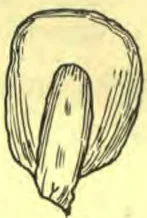
With a pen-knife you can easily remove the hull from this hollow space. “There is life in the seed,” and it is now opening before you. See how soft this part of the kernel is, while the rest is as hard as flint. In the middle of this soft part lies a little round peg (like Fig. 2).
God's Golden Grains.
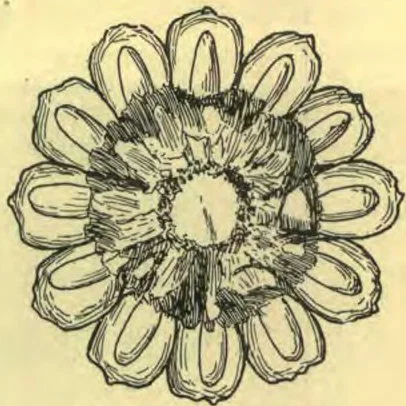
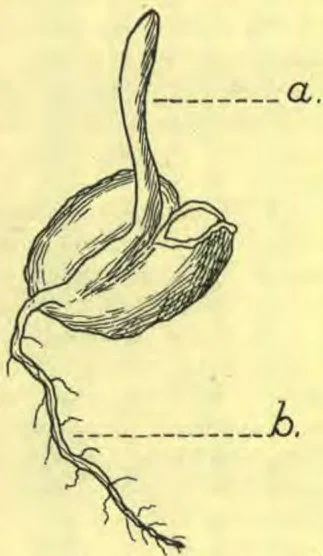
This soft part which we are examining, shown in Fig. 1, is called the “embryo;” and embryo means “the beginning of a living thing.” The part that I have named a peg is usually called the “plumule.” The plumule has in it the beginning of two things; for the first blade seen above ground after planting comes from its upper end, and the first root going down into the ground comes from its lower end. This first root is called the “primary.” Both the plumule and the primary are shown in Fig. 3.
I hope you can get a whole ear of yellow dent corn. Such a piece of God’s handiwork is beautiful to all who look for beauty in common things. See its shape of beauty, its rows of gold, its shades of color! But, especially, I want you to break it in two, so you can observe the perfect arrangement of kernels. As you look down upon the lower part of the ear, the large end, all the embryos face you. As kernel crowds upon kernel, it seems that the soft, delicate life in the embryo might be crushed, had not a protected place been prepared for it. But as it is, the smooth side of one kernel can not press into the hollowed embryo side of the next.
Fig. 1: Indian Corn, showing embryo.
What else is in this seed, or kernel, of corn besides the embryo? One word tells the story,—food. It is, first, food for the plant which is to grow from this seed. As the little root and blade first begin their growth, they feed upon the stored-up food in the kernel itself. It is also a perfect food for man and beast, as it contains one part of albumen and seven parts of starch. It is interesting to know that 2,523,648,312 bushels of shelled corn were produced in the United States last year. If this were distributed among the seventy-six million inhabitants, each person would have thirty-three bushels, or over five pounds for every person each day of the year. This is more than three times the amount necessary for a man’s daily food.
We may now name the parts of our kernel of corn, and having that before us, we see what is in every seed; for all are alike in their general arrangement:—
  1. The outer covering, or husk.
  2. The store of food.
  3. The embryo enfolding the undeveloped plant.
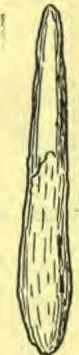
Fig. 2: Enfolded corn plant from embryo. Enlarged seven times.
As in the corn, so in the acorn,—the plant and the tree lie wrapped up in their food-house, ready to come forth at their Maker’s call.
There is almost an infinite variety in form, size, and color of seeds. All contain the life placed within them by God, and that life waits only for favorable conditions to spring into activity and produce another organization like the one from which it came.
The first law of the seed is that it will produce a plant and a seed after its kind,—the “herb yielding seed . . . after its kind.” Gen. 1:11, R. V.
Since it is now planting time, I must give you some lines from an old English author: “In the stealing steps of spring, our quiet, silent, abiding lessons, the deep morals of our natural world, begin. Out of what is committed now, gently, or with careful labor, to the earth’s bosom, come the earth’s character, life, dress, habits, for the circling dance of months and seasons. The time of seeds, looking forward to results, is the time of weightiest, most instructive thought, most solemn warning. Text after text has the divine in spiring Spirit condescended to draw out of this part of the book of nature, rewriting it in the book of grace.”
Fig. 3: A new plant beginning; (a) plumule; (b) primary root.
The selection of seed for planting is important. “Whatsoever a man soweth, that shall he also reap.” As the child resembles its parent in character and appearance, so the grain harvested will resemble the seed sown. Select the best seed of the variety you wish to grow. This is now a well-established principle of agriculture. The superintendent of the seed department at one of our State agricultural colleges said to me, “We are learning more and more to appreciate the importance of selecting the largest and best quality of seed.”
I hope you will sow some seed of your own this year. Plant something for food or for ornament. It will be instructive and interesting for you to care for the seed, and observe its growth. And when you sow or plant, remember to put in plenty of seed. “He which soweth sparingly shall reap also sparingly; and he which soweth bountifully shall reap also bountifully.” The seed has enemies, and some of it may be destroyed. Then there are the birds, the squirrels, and the worms. They all consider that they have a right to their daily bread, and you can hardly convince them otherwise. Plant enough so they may have their share, and you have abundance left. J. C. ROGERS.

April Lilacs

I CAN see their purple clusters hanging yonder by the well; I can almost catch the incense that we youngsters used to smell When we stood with dripping pitcher, in the early morning light, Bending down to plunge our faces where the dew-drops sparkled bright.
O the fragrance of the lilacs in the shifting April days, Ere the frailer flowers have opened all along the garden ways! What heart-cheering hope and promise to our longing souls they bring, Making every breeze a bearer of the message of the Spring!
How the summer farmhouse chambers used to swim with odors rare, As we set great bowls of lilacs on the mantels, everywhere! How the musty parlor sweetened, till it smelled of far Cathay, With the great cascades of blossoms pouring all their hearts away!
Precious gift to God's dear country are the sturdy lilac-trees, Growing old and gnarled and twisted, like a grandsire's wrists and knees — Growing old, but growing sweeter, every season that God gives, Like a heart so set to loving that it mellows while it lives.
— James Buckham.

The Pulse Family

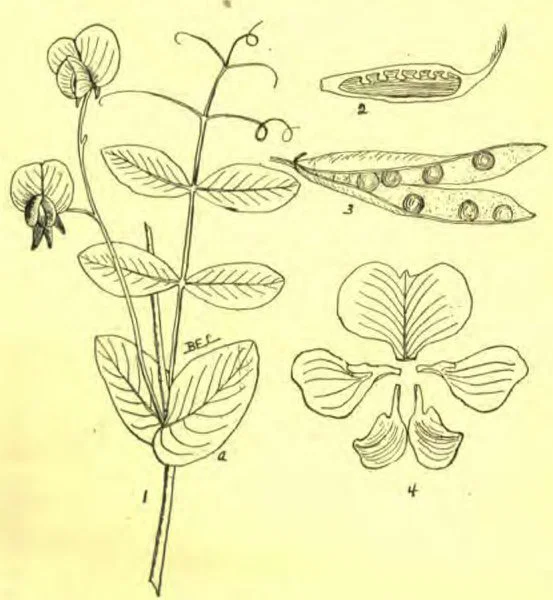
The Pulse (Leguminosae) family includes all such plants as peas, beans, lentils, clovers, locust trees, the redbud, or Judas-tree, and many others, which produce that sort of fruit known as a “legume.” By referring to Fig. 3, it will be seen that the legume is a one-celled pod, which, at maturity, opens down both edges, or sutures, while the seeds are all attached along one suture.
Fig. 1: The common garden pea.
Fig. 1, a: Stipules.
Fig. 2: Young pod, containing rudimentary seeds.
Fig. 3: Mature pod.
Fig. 4: Petals of garden pea.
Fig. 1: The common garden pea. Fig. 1, a: Stipules. Fig. 2: Young pod, containing rudimentary seeds. Fig. 3: Mature pod. Fig. 4: Petals of garden pea.
Most of the plants, as all of those mentioned above, have the petals unequal, and usually five in number. (Fig. 4.) This family is noted for the beauty of its flowers, and the great variety and value of its products. Few if any of the plants are of a poisonous nature.
The Common Garden Pea (Pisum sativum) has long been recognized as an important food plant. The leaves are compound, usually with two pairs of leaflets, the common petiole, or leaf-stalk, being terminated by a branching tendril which aids the plant in climbing. (Fig. 1.)
The action of the tendril is curious indeed. If there is no support at hand, it remains straight or slightly curved at the extremity, reaching about in search of some neighboring plant or other object which, when it has found, it grasps eagerly, and twines about it. At the same time the middle portion of the tendril coils up so as to draw the plant nearer its support.
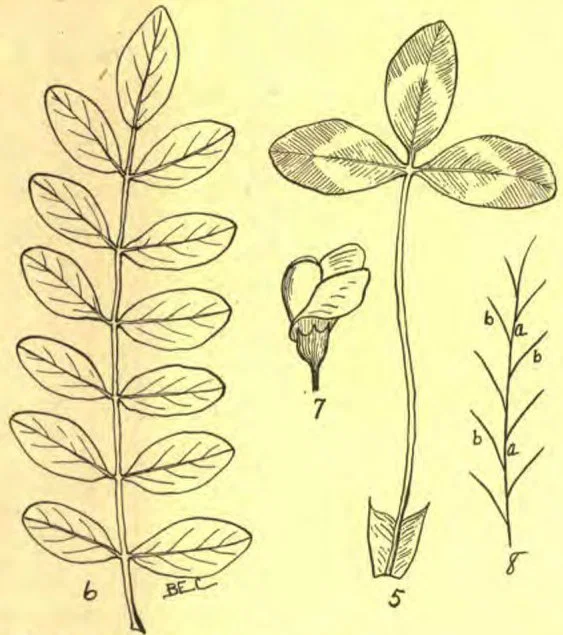
Fig. 5: Leaf of red clover.
Fig. 6: Leaf of common locust tree.
Fig. 7: Flower of common locust tree.
Fig. 8: Diagram showing the arrangement of flowers in a raceme: (a) Common peduncle; (b) Pedicles.
Fig. 5: Leaf of red clover. Fig. 6: Leaf of common locust tree. Fig. 7: Flower of common locust tree. Fig. 8: Diagram showing the arrangement of flowers in a raceme: (a) Common peduncle; (b) Pedicles.
At the point where the leaf-stalk is attached to the stem, are two leaf-like appendages called “stipules.” In most plants the stipules are small or absent, but the Garden Pea has them remarkably large. (Fig. 1, a.) The flowers are large and of various colors.
There are many varieties of the Garden Pea, some only a few inches high, and others several feet, requiring brush or some similar support to keep them from lying flat upon the ground.
In order to insure a supply of fresh green peas throughout the season, there should be several plantings two or three weeks apart, beginning with the earlier varieties about the first of April if the weather will permit. Peas contain much less nutrition while green than when ripe, but are more easily digested. The two forms of dried peas most commonly used for food are the split peas, from which the hulls have been removed; and the green, or Scotch, peas.
The Sweet Pea (Lathyrus odoratus) is nearly related to the Garden Pea, but is cultivated only for its sweet-scented, handsome flowers.
The Common Garden Bean (Phaseolus vulgaris) is another plant of great value to mankind. There are many varieties in cultivation, some of them being twining plants, and growing to a considerable height, as the Pole Beans, while others are dwarf, as the Bush Beans. The flowers are of various colors.
Beans differ from peas in many ways, but noticeably in the absence of tendrils, and in having only small stipules. As to the nutritive value, there is no great difference between peas and beans, although, according to good authority, green peas contain nearly twice as much nourishment as string-beans.
The Lima Bean (Phaseolus lunatus) is a twining plant, with greenish-white flowers, broad, curved pods, and large, flat seeds. As stated concerning the Common Garden Bean, there are many varieties, some of them being known as Bush or Dwarf Limas.
The Common Lentil (Lens esculenta) is a slender plant about one foot high. The leaves are compound, with several pairs of leaflets. The flowers are small, white or purplish, and the fruit is a small, broad pod containing two seeds the shape of a double convex lens. It was the shape of the Lentil seeds that gave the name to the glass lens used for magnifying.
Lentils have about the same nutritive value as peas or beans. All are somewhat difficult to digest, but when properly prepared and used in moderate quantity, can be digested by the majority of persons, and make excellent substitutes for flesh foods. They should be thoroughly cooked, and in general it is advisable to remove the hulls by means of a colander.
Of the many species of clover, the Red and White Clovers are probably the most common and the best known. The first of these (Trifolium pratense) is extensively cultivated for hay. The compound leaves consist of three more or less oval-shaped leaflets, which are frequently notched at the end, and often have a pale spot on the face. (Fig. 5.) The rose-purple, sweet-scented flowers are sessile, and crowded in dense heads. Each head is closely surrounded by the uppermost leaves of the stem.
The White Clover (Trifolium repens) is common everywhere in lawns, pastures, and fields. The leaves are compound, with three heart-shaped leaflets, having the broader notched end at the apex, and the narrower end at the base, where the petiole is attached. Both leaf-stalks and flower-stalks are long and slender. The flowers are white, arranged in loose heads, with each flower borne on a short pedicel of its own. White Clover is extensively used in grass mixtures for both lawns and pastures.
In this connection should be mentioned Alfalfa (Medicago sativa), which in some places is extensively cultivated for green fodder or for hay.
The Common Locust Tree, or False Acacia (Robinia Pseudacacia), is a rapidly growing tree, which is said to attain its greatest perfection in Kentucky and Tennessee, where it often grows to the height of ninety feet, with a diameter of four feet. Its timber is strong and durable, and largely used in ship-building, and for railway ties and fence posts.
The leaves of the Locust Tree are compound, with numerous leaflets. (Fig. 6.) The large, showy, white or rose-colored, fragrant flowers are borne in loose clusters, each flower having a short stalk, or pedicel, of its own, which is attached to a common peduncle. (Figs. 7 and 8). This form of flower cluster is called a raceme. The fruit is a pod from four to six inches long.
The Honey Locust (Gleditschia triacanthos) may be known by the large thorns, the small, greenish, inconspicuous flowers, and the long, flat pods, from nine to twenty inches in length, often twisted or curved.
The American Redbud, or Judas-Tree (Cercis Canadensis), is a small tree which is very ornamental in spring, when the leafless branches are covered with the small, but exceedingly numerous, pinkish-red flowers. The leaves are large, rounded, heart-shaped, and appear later than the flowers.
Such are a few of the plants belonging to the Pulse family. There are many others of interest, but space will not permit us to describe more of them here. There is one important fact, however, that we must not neglect to mention in speaking of the leguminous plants.
Nitrogen is one of the most important nutritive substances used by plants, and it is abundant in all parts of the world, seventy-nine per cent of the air we breathe consisting of this element. Since it is so plentiful, one would naturally think that plants never suffer for lack of this kind of food, but such is not the case. It has long been known that plants in general are unable to make use of the free nitrogen in the atmosphere, but must obtain all their nitrogenous food from the soil in the form of soluble nitrogen compounds.
In order to understand what this means, one must understand the nature of chemical compounds, and how they differ from mixtures. If we mix together sand and salt, each of the substances retains its original characteristics, and we have a mixture, but we do not have a chemical compound. When two substances combine chemically, both lose their individuality, and an entirely new substance is formed. In the atmosphere the nitrogen is mixed with oxygen, but not chemically combined. From this it will be understood how the nitrogen compounds of the soil differ from the free nitrogen of the atmosphere.
If the soil is lacking in these essential nutritive substances, plants will not make a vigorous or rapid growth. As each crop that is removed from the soil removes a large amount of the nitrogen, it can readily be seen that if it is not replaced in some way, the soil will become exhausted in a few years.
By careful study and extensive experiments, it has been found that the leguminous plants can make use of the uncombined nitrogen of the atmosphere, which other plants are unable to do, and thus they always have an inexhaustible supply of this substance. Such plants as beans, peas, clovers, and others belonging to the same family, will grow and do well in soil that is devoid of nitrogen compounds.
When these plants are plowed under, as clover and some others often are, the nitrogen which was obtained from the atmosphere, and which has entered into the composition of the plant tissues, is deposited in the soil in compounds which can be utilized by other kinds of plants.
Experiments have recently been made with alfalfa to ascertain its value as a fertilizer. Alfalfa was grown upon the same land five years in succession, being cut for hay each year, so that only the stubble and roots were left in the soil. At the end of five years other crops were grown on the same soil, with the result that each acre produced from eight dollars to twelve dollars in wheat, sixteen dollars in oats, and sixteen dollars in potatoes, more than land which had grown potatoes or grain before. This increase in value was produced without the outlay of a single cent for fertilizers, and is a good example of what may be accomplished by the proper rotation of crops.
From this brief account, a somewhat general idea may be obtained of the importance of the leguminous plants in any system of crop rotation.
The manner in which these plants are enabled to make use of uncombined nitrogen is of considerable interest. When peas, beans, or other leguminous plants are carefully removed from the soil, and the roots washed, there are found on many of the roots small, fleshy tubercles, about the size of a pin-head. If a small section of one of these tubercles is examined under a high-power microscope, it is seen to be swarming with exceedingly minute bacteria, which in some way put the free nitrogen of the atmosphere into forms which can be assimilated by the plants. How it is done is not definitely known.
These tubercles grow sparingly or not at all on the roots of plants that are grown in soil rich in nitrogen compounds, as in such soil they are not needed; and they are not found on very young plants, as it requires a considerable time for their development.
Thus we see that though the soil was cursed and rendered less fertile as a result of sin, the Lord has made provision whereby its fertility may be retained if it is properly cultivated.
B. E. CRAWFORD.
Continue reading: Thoughts That Help