FRUITS, instead of encouraging rheumatic or gouty conditions, are the greatest aids in overcoming all tendency to these conditions. If fruits are eaten at the beginning of a meal composed largely of starches, or throughout the meal, they may favor fermentation, and the acids formed will lower the alkalinity of the blood, and favor the retention of acid wastes and the tendency to a rheumatic diathesis. It is quite important that fruits should be eaten at or near the close of the meal. As antiseptics and germicides, acid and subacid fruits are valuable. The juice of the grape is destructive to the germ of typhoid fever in three or four minutes. Citric acid found in lemons and oranges will destroy cholera germs. What is true of these is in a measure true of all fruit juices. For those who are infirm and have enfeebled stomachs, the advice given by Paul to Timothy is still the same: “Use a little wine for thy stomach’s sake and thine often infirmities.”
So far as the nutritive value is concerned, grape juice contains eight times the amount of nutriment found in the same quantity of beef tea, and orange juice five times the amount. Beef tea is possibly the very worst thing that could be given a sick person whose digestion is impaired. It is food for germs, not for the sick. It favors putrefaction and auto-intoxication, while the fruit juices destroy germs and prevent the decay of the protein foods. Infants that do not10thrive on milk can usually be benefited by giving them orange juice between feedings. It supplies an acid which prevents putrefactive changes in the food, and also supplies that much-needed property, vitamine.
There are a great many foods to feel skeptical about, but fruit is not one of them. When the stomach is diseased, there may be conditions in which for a time certain fruits are not indicated, but very frequently the inability to eat fruit is traceable to some dietetic error in its combination with other foods, or to the time and manner of eating it. One ill-advised meal often creates trouble for a week, so that nothing agrees well. The best thing to do in such a case is to give the stomach complete rest for a day or so, drinking distilled water freely.
As a rule, meals come too close together. The stomach should have time to dispose of one meal before another is introduced. A short period of rest after the meals are digested, is better still. The muscles of the stomach need rest after active work, just as do the muscles of the arm. The glands need time to be recharged with a supply of a good quality of gastric juice. At least five hours should intervene between meals. Nothing in the form of food should pass the lips between meals.
Not more than three meals should be taken daily. The evening meal should be light, and composed of food which can be easily digested. For men and women of sedentary habits and for brain workers, two meals daily are preferable. The additional rest obtained by the stomach enables it to digest the meals better. As much actual nourishment may be obtained from two meals as from three, and there would not be the same danger of foods’ fermenting or decaying in the stomach.
The last meal of the day should be taken at least three or four hours before retiring. If there is an all-gone feeling at night before retiring, do not eat. It is not food the stomach is pleading for. It needs rest. A drink of cold water is about all that is needed, or at most some fruit juice or an orange. By morning the all-gone feeling will have vanished, showing that not food but rest was what the stomach was demanding.
Very hot and very cold foods and drinks should as a rule be avoided. Hot foods and hot drinks are debilitating to the throat and to the stomach. The tendency to sore throat is frequently traceable to the use of hot soups, hot drinks, and hot vegetables. The free drinking of hot water, in the belief that it is beneficial, is a mistake. It has made many a dyspeptic. In cases of gastric catarrh a drink of hot water half an hour before meals may be beneficial for a short time, as it aids in ridding the stomach of mucus, and thus prepares it for the meal.
Iced foods and drinks should also be avoided. It is unnatural to introduce ice into the stomach. It delays digestion, and in time injures the most vigorous stomach. In some conditions in which the stomach is highly inflamed, iced foods or drinks can be introduced for a short time with benefit, as they allay the irritation and reduce the inflammation. They are then a remedial agency.
Food should not be eaten when one is fatigued or exhausted; normal digestion is then impossible. When one is fatigued, complete relaxation and a rest before eating, even if no more than ten minutes, will prove to be of great benefit.
As a rule, a short period of rest before meals is beneficial, especially when one is in a hurry or excited. It is not well to lie down to sleep or rest after meals. A short, brisk walk in the open air, with the head erect and shoulders back, is beneficial after meals. Violent exercise should be avoided. Neither is it advisable to do brain work immediately after meals. It tends to draw the blood away from the organs of digestion, and thus delays that process. Half an hour spent in the open air after meals is not time lost.
The extremities should be warm during mealtime. Cold drives back the blood and congests the vital organs. The congested condition of the digestive organs retards the digestion of the food. Mental influence may greatly aid or may retard digestion. Worry, despondency, impatience, and irritability all act injuriously. A good motto is, Never eat when “mad or sad or bad; only when glad.” It pays to cultivate cheerful, hopeful thoughts.
The meal hour should be made the most enjoyable season of the day. Never should unpleasant topics be discussed, and children should not have their faults and mistakes rehearsed. It should be a real family reunion. Not merely should thanks be offered in a formal manner before meals, but the food should be eaten “with gladness and singleness of heart.”
THE NEED OF INCREASED FOOD PRODUCTION
By F. I. Richardson
F. I. RICHARDSON
The situation concerning the food question has become so serious that the governments of Europe some time ago, in order to eliminate waste, took control of the food supplies, and recently our own country has considered it necessary to do something to solve the food problem, and Mr. Herbert Hoover has been appointed to the personal oversight of the conservation of food in the United States.
A brief review of the situation will serve to show the alarming conditions that prevail, and how necessary it is to economize.
God placed man on the earth and gave him fruits and vegetables in abundance. He had only to pluck them and eat. The serpent enticed him to eat of the forbidden fruit. This brought a curse upon the earth, and it was decreed that from that time man should earn his bread by the sweat of his face. Of Adam’s sons, Abel was a keeper of sheep, and Cain a tiller of the ground, evidently showing that God designed that the people should be engaged in pastoral and agricultural pursuits. If this plan had been followed, all would have been producers, and there would have been no lack. So the present slogan, “Back to the farm,” is in harmony with God’s first plan.
There is far greater need for more to engage in raising crops now than there was at that time, for the earth will not produce as it used to. According to the New York Tribune, the Farmers’ Club, in reporting the failure of the wheat crop in the State of Ohio, states that the average number of bushels per acre for the State between the years 1851 and 1865 was only eleven. This fearful condition is now becoming apparent in the Western and Southern States.
In “Letters to Voltaire,” pages 260, 262, we find the following: “In many distributions of land made not only under the kings of Rome, but four hundred years after its foundation, about 300 B. C., every citizen or planter got but two acres of ground.” These planters’ families, it is said, averaged six persons. Eighty acres or more are now required for a family of six.
The old earth is wearing out. See Isa. 51: 6. Not only is the soil failing to produce bountiful crops, but diseases are attacking the fruit trees, and destructive worms and insects are preying upon nearly everything that grows. According to Joel 1: 1-20 these conditions are to be world-wide. And besides all this, millions of bushels of grain are being sent to the bottom of the ocean by submarines, and millions of men have been taken from the farms to the army. Surely any one can see that the world is certainly facing starvation.
With this outlook before us, shall we not put in practice the request of Mr. Hoover to eliminate all waste? He says:
“The waste in food amounts at least to fifty dollars a year for every family in America. The waste of a single ounce of food each day in every home means a yearly waste of nearly five hundred million pounds of food. The waste of a single slice of bread each day in every home means the daily waste of a million loaves of bread. The thousand million dollars of needless waste which thus takes place yearly in the households of America can and should be stopped.”
But to all who will heed the admonition to move out into the country and till the soil, and obey the commands11of God, there is a brighter side. The promise to God’s children is, “Bread shall be given him; his waters shall be sure.” Isa. 33: 16. “Trust in the Lord, and do good; so shalt thou dwell in the land, and verily thou shalt be fed.” Ps. 37: 3.
Covina, Cal.
THE BANANA
By L. L. Caviness
L. L. CAVINESS
The banana seems to be coming into its own as an important article of diet these days. Drs. Victor C. Myers and Anton R. Rose present in the Journal of the American Medical Association, a report extremely favorable to the food value of this fruit. We quote only a portion of the interesting article, which tells the condition in which the fruit should be for eating, and a little about its food value:
“Our nutritional studies on the banana indicate that, when thoroughly ripe, it is one of our most valuable fruits; but there are many other reasons why this subject commands interest from a physician’s point of view. . . .”
“Raw fruits can be consumed to advantage only when they are thoroughly ripe, and the banana is certainly no exception to this rule. Perhaps the worst criticism that can be made with regard to bananas is that they are frequently sold and eaten when they are not thoroughly ripe. This is in part due to a popular misconception that bananas should not be eaten after the appearance of brownish tints on the peel. The yellow color of the skin is not in itself sufficient evidence of ripeness; in fact, under certain climatic conditions the fruit may be entirely yellow and still be so underripe that its consumption in large amounts would be followed by discomfort. When the yellow of the peel takes on a golden hue and begins to speckle with brown shades, it may safely be considered fully ripe. The spread of the brown coloration does not condemn the fruit as overripe so long as the pulp inside shows no signs of fermentative decomposition. . . .”
“Bananas have a higher caloric value than any of our other common fruits. Unlike most other fruits, they are always in season.
“When fully ripe, that is, when the starch has been almost completely changed to sugar, the experiments here reported show that the carbohydrates of the banana are well absorbed from the intestine. As sold in the market, however, bananas are frequently not sufficiently ripe to be consumed to advantage immediately; and it would seem that gastrointestinal disturbances, when attributed to the banana, were referable to this cause. It may be said in general regarding our own experiments, that no ill effects, discomfort, or distaste were noted even after the consumption of large quantities of the ripe fruit for several days.”
Inasmuch as the price of bananas has not materially advanced, greater use of this highly nutritious fruit should suggest itself in these days of high cost of living.
MADRAS, SOUTH INDIA
By P. C. Poley
. P. C. POLEY
The history of the making of Madras had its beginning in the year 1640. In that year the rajah of Chandragiri, a descendant of the Hindu sovereign of Beejanuggur, granted to the English a strip of territory on the Coromandel Coast, five miles in length and one mile in breadth. The new station was called Lennipattanam, after the name of the father of the local ruler.
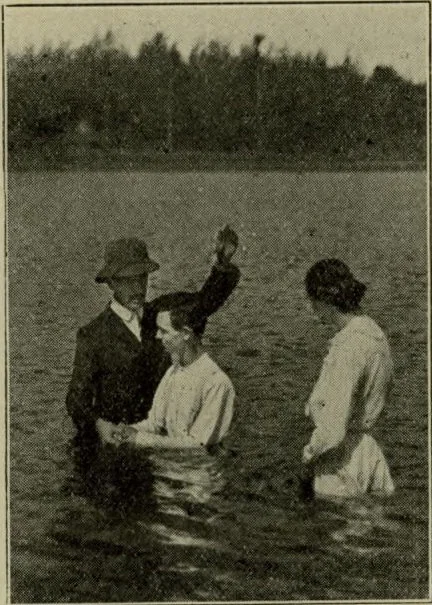
Baptism in Madras, South India
Madras (or Lennipattanam, as it is still called by the Tamil people) is today the first city in importance in south India. The mass of the people are Hindus, speaking Tamil or Telugu; but a surprisingly large number, even among the lower classes, speak English in addition to their mother tongue. Both the Roman Catholic and the Protestant missions have established well-organized and influential churches.
The third angel’s message was first publicly proclaimed in this city in February, 1916. A hall was rented and fitted up as a meeting place in the district of Vepery. Brother Asirvatham, our Tamil evangelist, has had charge of the Tamil services, and he has met with an encouraging response among the people for whom he has labored. Fruits have already appeared.
Services in English have also been held by our European force of workers for the large English and Anglo-Indian population. Our public effort drew a good class of hearers. Several substantial families have already taken their stand for the truths they have been investigating, and these are developing a zeal for the work of saving their friends and neighbors. A home missionary society has been organized. In December, 1916, and in February of this year, baptismal services were conducted by Elder J. S. James, giving us an addition of ten to our local membership.
Vepery, Madras.
"WHETHER I LIVE OR DIE, I WILL NOT GIVE UP CHRIST"
By R. C. Wangerin
R. C. WANGERIN
The oft-repeated testimony of one of our faithful Korean deacons is, "Whether I live or die, I will not give up Christ." The missionaries found this man and his family living in ignorance and the grossest superstition, without hope, and without God in this world.
Upon being taught to read and write, and the first principles of Christ and Christian living, they readily forsook all their former life of nothingness,—their gods of straw, wood, and stone,—and accepted Him who now is all and in all to them.
The family is now well organized. The children are of good behavior. They regularly attend church, and systematically pay tithes and offerings from their income.
This is truly one of the modern miracles of missions. Often will this12deacon exhort to faithfulness, concluding with the words, "Whether I live or die, I will not give up Christ."
The Best Translation of the Bible
“THE best translation of the Bible is the translation of its precepts into your own experience.”
Where Faith Begins, Anxiety Ends
“WHERE faith begins, anxiety ends; where anxiety begins, faith ends.”
FILIPINO COLPORTEURS
By R. E. Stewart
R. E. STEWART
A COLPORTEURS’ institute was recently held in Manila. The workers are scattering the printed page “like the leaves of autumn” here in the Philippines. Their ages range from fifteen to sixty years, and every one is an earnest worker in this great cause. They are spending their whole time and strength in giving this last message of mercy to their people, who are living in the darkness of ignorance and superstition. Each one of these “boys” has had some exciting and interesting experiences while engaged in this work. Some of them have passed through danger to life and limb, but they look upon these trials as the common lot of those who engage in such a definite and progressive work for the Lord.
Last year these “boys” sold thousands of books containing the message for this time, and today many are rejoicing in the truth brought to their homes by these earnest colporteurs.
“THE SPLENDOR OF GOD IN PROVIDENCE”
By T. E. Bowen
T. E. BOWEN
The above splendid motto was used by the treasurer of the China Inland Mission, Mr. J. N. Hayward, when giving his annual report in London, May 8, 1917. There are several very encouraging features in this report which are well worth careful study, three of which follow. They illustrate how God is able to provide in a financial way for the giving of the gospel in dark heathen lands, and at the same time keep up a healthy expansion in the work, when men, after doing their part faithfully, and that, too, without incurring debt, truly trust him to provide.
After referring to their anxiety regarding the work of the mission when the war began, Mr. Hayward cites his apprehension as to what would result when a certain legacy in England of £140,000 should have been used up. This legacy, the donor had stipulated, must be treated as a yearly income, and not as a working capital, £12,500 being annually devoted to the regular work of the mission. He then says:
“I remember I used to sit in my office and reflect that this £12,500 a year would not go on very long; and I often wondered what was going to happen when it ceased. Such a help was it to us that as much as thirty per cent of our expenditure in China was sometimes met from that legacy. By 1915 it was practically exhausted. There was just a little remnant of it remaining. During that year only one per cent of our expenditure was met from the Morton fund, and yet we had more money to spend upon the work in China in 1915 than in any other year of the mission’s history. How the Lord made up for the deficiency caused by the cessation of the Morton legacy I cannot tell. The only thing I do know is that although it ceased, the Lord in his own way provided, and we had more money to spend upon the work. I believe it can be honestly said to the glory of God, that although the receipt of that money made an immense difference to the mission and led to considerable expansion, it is true to say that the cessation of it has hardly been perceived, and has not resulted in any contraction of the work.”
It is usually the case that when we, in our finiteness, learn to look upon something as an absolute essential, God by some providence permits the staff upon which we lean to be removed, in order that we may open our eyes in wonderment to behold another of his gracious providences expanding before us, usually more full and complete than the other. Mr. Hayward goes on to say:
“I recall another example of ‘The Splendor of God in Providence.’ A few years ago we were passing through a time of considerable straitness of funds. We had sent out our remittances to the workers in the field, and could not but feel that the amount was inadequate; but we could not send more than we had. Of course there was a good deal of prayer about the matter. Just at that time there was given to the mission the largest single donation that we have ever received. That amount was telegraphed out to China, and very soon we had the joy of sending throughout the field, to all our workers, what I think they had never had before, an extra remittance out of due time, and it caused, I am sure, abounding thanksgiving to flow to the Lord from many hearts.”
This is another example of how God provides when the last of the funds in the treasury is sent out. The governments at war are advocating economy on the one hand and the non-hoarding of funds on the other. This has been the method advocated by the Lord Jesus since he preached his first sermon on the mount. “Gather up the fragments . . . that nothing be lost,” and, “Lay not up for yourselves treasures upon earth.”
Mr. Marshall Broomhall, in writing a book on “Faith and Facts,” reproduced in it a picture of Mr. Hayward’s cash books in Shanghai, from 1889 to 1907, concerning which it was stated that this row of books contained 68,750 entries of money paid out to missionaries and workers in the China Inland Mission, totaling the splendid sum of £660,000. To this record Mr. Hayward adds this further report:
“There have been a further 25,000 entries made, and altogether the row of books, now about twenty-three or twenty-four volumes, contains entries of 94,000 payments, eight million taels, or £1,100,000 sterling. That is, of course, the expenditure in China only. The entries in these books strikingly illustrate the Lord’s gracious dealings with us in financial supplies.”
And the striking thing about it all,—about this “splendor of God in providence,”—is, that not one shilling of all these entries on the China Inland Mission’s account books was paid out to laborers in the vineyard before having been received in actual working gifts to the mission. To this point Mr. Hayward testifies:
“Not one farthing of that money was spent before it was actually received for the Lord’s work. There is not a single entry of any bank interest for overdrafts. We do not know such a thing in the China Inland Mission. There is not a single instance of a deficit balance on any page of those twenty-three or twenty-four volumes. There is a balance in hand on every day of the twenty-eight years as on every day that preceded them since the mission was founded. Sometimes the funds have been low, but the barrel of meal has not wasted nor has the cruse of oil failed.”
“Just one final word. What is the lesson, dear friends, for you and me engaged in doing our part in this work? The lesson for us, surely, emphasized by all these experiences, is that we must in living faith put the Lord before the problems, and count on him; and in the future, as in the past, no good thing will he withhold.”
Truly this is a powerful testimony in favor of God’s ability to provide for his own work in the earth. The way may be difficult to us. It may even seem that disaster is but a step ahead. But when we in “living faith put the Lord before the problems, and count on him,” we shall find we have reckoned wisely; and though—
“It may not be my way;
It may not be thy way;
But yet, in his own way,
The Lord will provide.”
In the finishing of God’s work in the earth, we believe that as we come back more and more to this principle of providing the funds before launching enterprises which involve the expenditure of means, we shall see exemplified “the splendor of God in providence.” This has been illustrated in a striking manner in our own foreign mission expansion, in which no debts have accumulated in all the years of its history. It is in the Red Sea, and the swelling Jordan experiences that God gets to himself greatest glory. We must not limit the Holy One of Israel, nor forget his own question, “Is anything too hard for the Lord?” We must also bear in mind the fact that there is a wide difference between faith and presumption, even though at times it is difficult to discern between them. That which God has promised he is “able also to perform.” And in the fulfilment of his promises we shall see more and more, as difficulties thicken about us, “the splendor of God in providence.”
A SABBATH KEEPER IN FORMOSA
By H. Kuniya
H. KUNIYA
NAKAMURA SAN was a real Christian lady. She had been reading the Bible for several years, and had been under the instruction of the pastors of several different denominations, yet was not satisfied with what she was taught. She had joined no church.
I found her one day while visiting from house to house, and soon began to study the Bible with her. When tent meetings were opened, she attended regularly. She soon found what she had been looking for all these years, and is very happy in the truth. She is meeting great opposition, as do all Japanese women who accept the message. But she stands firm, and comes to all the meetings in all kinds of weather. Often she walks the two miles in the deep snow, in her bare feet, her little boy on her back. She frequently has meetings at her home for her neighbors and friends. She talks about the Saviour to every one she meets.
She spends some time every week working with our magazines and tracts, and writes to friends in other parts of the country. Through her letters and the reading matter sent, one sister in Formosa, and as far as we know the very first on that island, has begun to keep the Sabbath.
Formosa has had no living teacher, but we rejoice that through the efforts of this faithful woman the truth has entered that place. Surely the Lord is going before us to prepare the way in these difficult fields for his last message, and is willing to use any instrument, however humble, to give this great warning to the world.
KENNETH AND HIS MOTHER
By Dorothy Canfield Fisher
A few years ago, while waiting on a landing wharf at one of our pretty inland lakes for the daily steamer to arrive, and carry me on to the nearest railway station, I chatted with a chance acquaintance, a wholesomely athletic-looking, well-dressed, youngish middle-aged woman, who had brought her bag of golf clubs and her youngest boy down to the pier to meet her husband coming up from the city. The child, a thoughtful-looking, large boy of six, was happily engaged in running up and down the other side of the wide pier, towing after him in the water a toy boat tied to a string.
After a time his mother noticed how near to the edge he was, gave a start, and called out: “O Kenneth! come here!” Kenneth looked around surprised, and hesitated about the disposition of his precious boat. His mother prescribed his course for him in detail. “Pull your boat right up out of the water, dear, and bring it here.” Kenneth obeyed, his face a study of anxiety, doubt, and uncertainty as he approached his mother. She laid her hand on his shoulder and said, in a pleasant voice: “I don’t want you to play in the water, dear. Just stand right here near mother till daddy’s steamer comes in.” Kenneth’s face changed tragically into horrified astonishment and grief. “But, mamma—” he began in a voice of vehement protest. His mother laid a well-manicured hand gently over his mouth. “No teasing, Kenneth. You know mother never allows you to tease.”
Above this extempore gag Kenneth’s big eyes blazed furiously. He tore her hand away and began again, struggling hysterically to speak before she could stop him: “But, mamma, the water there—”
At the sight and touch of the child’s sudden burst of violence his mother flared up into a responsive heat. “KENNETH!” she cried threateningly in the awful tone one uses to quell an unruly dog. She did not, as a matter of fact, lay a finger upon him, but that tone was ominously resonant with the reminder to Kenneth that she could, if she thought best, inflict any humiliation, any pain upon him. His face glared whitely up at her for an instant. He looked startlingly to me like a little trapped wild animal, turning in a last frenzy of despair upon its gigantic pursuer. His mother’s face set like flint.
During the moment in which they confronted each other, the question at issue between them was quite nakedly the old, old question of personal supremacy. For a whole moment Kenneth held his own, stiffened into unnatural strength by the extremity of his emotion. But he was, after all, but six years old, and knew himself to be quite without recourse or possibility of appeal in the hands of his mother. His fierce little attempt at self-defense crumbled. He hid his face in the crook of his elbow and began to cry wildly.
His mother drew a long breath of relief, as at a danger passed, and turned to me: “If you never let them get ahead of you, you never have any trouble with them,” she said, quite audibly, “but you must always be on your guard, and never let the first hint of disobedience pass by.”
After this statement of her creed we tried to return to the conventionalities, and to chat of the trivialities which were occupying us before the incident occurred; but the raging sobs which proceeded from the little figure of crushed rebellion were hardly an enlivening accompaniment to small talk.
“O, dear! Aren’t children unreasonable!” said his mother to me with a note half of exasperation, half of honest regret. “All you want to do is to take care of them, and keep them from drowning, and then they make it so hard for you!”
After a time of uneasy silence she roused herself with an effort as to another hard task, and said gently to the child, whose paroxysm of tears had now subsided to spasmodic heavings and sighs: “Kenneth, dear, do you know you were rude to mother just now? You struck my hand.” She held up a white, shapely hand, pointing to a quite invisible mark upon it. “You know mother never allows you to strike at anybody. Tell mother you’re sorry you did it.”
Kenneth drew away shiveringly from his mother’s caressing hand and shook his head, still hidden in his arm. His mother went on voicing her request in ingeniously varied forms: “I know my little boy is sorry he was naughty. Tell mother you’re sorry, dear. You didn’t mean to hurt mother, did you? I know you didn’t mean to hurt your own mother. Just say you didn’t mean to, Kenneth.”
Kenneth shrank away farther from his mother’s touch, and shook his bowed head obstinately.
His mother looked pained and sorrowful, and began again coaxingly: “Kenneth, darling! It’s nothing hard to do; just say a few words—just say you’re—”
I arose hastily and walked to the other side of the pier, finding the little scene intolerably painful. And as I leaned over the railing, trying to shut my ears to the steady urging murmur back of me, I noticed something that electrified me. I knew now what Kenneth had been trying to say. The beach ran up rapidly under the wide pier, and the water where Kenneth had been playing with his boat was the merest film over the sand. Rejoicing greatly, I turned hastily back with this good news, but it occurred to me that to tell it was a pleasure which really belonged to the child’s mother. I scribbled on the edge of the newspaper I held: “The water is deep only on our side of the pier. Where your little boy was playing, it is not more than four inches deep,” and dropped it in her lap. I could hardly wait for her to read it, and with an inexpressible pleasure I savored in advance the sweetness of what was to follow, the misunderstanding cleared up, the child restored to his innocent pleasure, and reconciled to his mother. What happened was this:
She read my message in silence, and handed it back to me with a gentle shake of her head. “I never allow anything to interfere with the discipline of my children,” she explained, veiling her meaning from the child by a careful choice of big words. “Any mother with experience knows that it is absolutely fatal to reverse a decision. The question is one of discipline now. Children must learn that when mother says a thing—”14
She turned again to Kenneth, now sunk down upon the pier in a limp heap of misery. “Come, Kenneth, dear, tell mother you’re sorry,” she insisted, adding: “If you don’t, dear, I’m afraid that I can’t let you stay down and meet daddy. Daddy does not want naughty boys to meet him.”
At this threat, which apparently cut deep into the quick of an immense desire, Kenneth looked up for the first time, showing a pale, tear-stained face, fairly ravaged with anger and revolt. He bore not the slightest resemblance to the child who only a few moments before had been cheerfully trotting up and down in the sunshine, watching his boat dance over the shallows. His mother saw that she had chanced upon a powerful screw, and turned it hard to induce the child to do what she could not conceive of doing herself,—to admit having been in the wrong. “No, dear, you can’t stay here to wave your handkerchief at daddy when he leans over the rail to look for you unless you’ll say you’re sorry for hurting mother.”
As he hesitated, torn visibly by the violence of his desire to stay, she threw all her personality into her persuasion (it sounded oddly like teasing to me): “Kenneth, dear, what makes you so obstinate? Say it to please mother! Just say you’re sorry! Just nod your head!”
Kenneth looked into her pleading eyes with a hard expression, and, jumping to his feet, ran madly down the pier and along the shore road. His mother turned to me sadly: “Why will children be so naughty and make such scenes? Poor little Kenneth! He wants his way so! It’s so hard for him to be good!” She added: “I know just what he’ll do. He’ll go home and fling himself down on his bed and sulk till dinner time. Well, it is hard on him to miss his father. He adores him so. I’ll stop on the way home, and buy him some candy.”
I make no comment upon this story, reproduced from life with a photographic accuracy which I defy any reader to impugn. I hope that no comment is necessary. Kenneth touched my life only during that brief half hour. I have never seen him since he ran wildly away. But to his memory I dedicate the above attempt to do a little clear thinking on a problem which greatly concerns his welfare. —Dorothy Canfield Fisher, in “Mothers and Children.”
A POEM FOR PARENTS
By Lee Shippey
THERE is a poem I have read,
And which is quoted far,
Advising boys to be the sort
Their mothers think they are;
But I would nobler be than that,
And bear love’s oriflamme,
If I could only be the man
My youngsters think I am.
I’d be the bravest man alive,
The stanchest ever born,
The greatest and most versatile
That could the world adorn,
And, if I chose, far doughtier
In strife than any other,
And very near as good and wise
And sensible as mother.
Ah, parents! what are precepts all
When little children grow
To learn we are not quite the sort
They thought they used to know?
We could make home a dearer place,
And life more perfect far,
If we strove more to be the folks
Our babies think we are.
— Lee Shippey.
OUR HOMES
By Mrs. I. H. Evans
Conducted by Mrs. I. H. Evans, Takoma Park, Washington, D. C.
Through the columns of this department, hints will be given on all matters pertaining to the home life. Short articles and letters are solicited from home makers, telling of their everyday experiences,—their joys and sorrows, their failures and successes.