Synopsis This interesting prophecy of the seven trumpets portrays the downfall of nations during the Christian era. The first article of the series, in our issue of August 29, gave a general view of this desolation as it began to unroll before the ancient prophet. The trumpets were shown to be the symbols of war, referring definitely to the mighty irruptions from the barbaric hordes that swept over the Roman Empire, dethroning her from the position of proud mistress of empires.
The first trumpet symbolized the wars waged by the renowned Alaric and his victorious Goths. Hail, fire, and blood falling upon the earth is the prophetic description. Rome was pillaged, was humbled in the dust. The fulfillment of the second trumpet is found in the conquests of Italy and Africa by the Vandals under the terrible Genseric.
The third trumpet was fulfilled by the Huns under the leadership of Attila, called the "scourge of God." The prophetic description was fulfilled. His career was brilliant, but short. His light went out like the snuffing of a candle.
"AND the fourth angel sounded, and the third part of the sun was smitten, and the third part of the moon, and the third part of the stars; that the third part of them should be darkened, and the day should not shine for the third part of it, and the night in like manner." Rev. 8: 12.
No bloody wars, desolations on land or sea, are here foreshadowed, as was the case under the former trumpets. This symbolic language seems rather to indicate that the blows of the fourth trumpet strike at a higher sphere than the ordinary theater of battles. This sphere is compared to the firmament of heaven and its luminaries, in opposition to the earth, the sea, and the rivers. The great change to take place in the political world will be brought about in a peaceful manner, like the going out of a lamp. The great Roman Empire is dying. The only thing left now is to bury it. How well these symbols were fulfilled in the closing chapter of the history of the empire of the West will be seen in what follows.
A Festering Mass of Corruption
BUT before we pass on to what might be called the decent burial of the empire, we must take a general look at the situation of this old, huge, decrepit body, tottering under the repeated onslaughts of the barbarians.
The moral condition of the so-called Christian empire at the time of the invasions called loudly for the terrible judgments sent by the hand of the omnipotent Ruler of the nations. A well-known Catholic writer and historian, often quoted in these articles — Chateaubriand — draws the following picture of Christian Rome at the time of the invasions:
"Dignities, age, profession, religion, did not put a stop to the fury of debauchery. In the midst of provinces in flames, the people could not tear themselves away from the amusements of the circus and the theater. Rome is sacked, and the fugitive Romans come to Carthage, still Roman for a few days, there to exhibit their depravity. Four times Treves is invaded; but in the midst of these bloody ruins, the remaining portion of its citizens sit upon the deserted seats of its amphitheater.
'Fugitives of the city of Treves,' exclaims Salvian, 'you are asking the emperor for the permission to reopen the theater and the circus; but where is the city, where are the people, in behalf of whom this request is made?'
Abandoned to Pleasure
"THE fall of Cologne takes place in the midst of a general orgy; the leading citizens were not in a condition to leave the table when the enemy, having mastered the walls, was pouring into the city. Nearly every house in Carthage was a house of ill fame. . . . Genseric arrives: outside the din of arms, inside the noise of amusements; the voice of the dying and the voice of a drunken population mix up together; hardly can the cries of the victims of war be distinguished from the acclamations of the crowds which fill the circus."—"Etudes Historiques," pages 427-440.
As to the extent of the desolations that followed the passing of the barbarians, the same historian speaks of them in language which recalls that of the inspired revelator when eleven times he repeats the phrase, "the third part of the earth," "of the grass," "of the trees," "of the sea," "of the ships," "of the rivers," "of the creatures in them," etc. Chateaubriand says: "It is impossible to-day to form more than a meager idea of the spectacle which was offered by the Roman world during the incursions of the barbarians: the third (perhaps the half) [italics ours] of the population of Europe and of part of Africa was mown down by war, pestilence, and famine."
The World's Moving Day
THIS writer continues: "The spoils of the empire passed over to the barbarians. The chariots of Goths and Huns, the barges of Saxons and Vandals, were loaded with all that the arts of Greece and the luxury of Rome had accumulated during so many centuries. The world had come to its moving day. . . . Society was shaken off from its very foundations.
"Fleeing from the barbarians of Europe, the Romans sought refuge in Africa and in Asia; but in those far-away provinces, they found other barbarians. Thus driven from the heart of the empire to the extremities, and thrown back from the frontiers to the center, the earth had become a hunting ground, in which the people were chased by a circle of hunters. . . . The wilderness moved about with the barbarians; it changed places as they marched, and spread itself upon the face of the most fertile provinces. In countries where unnumbered nations had thrived, there remained only the earth and the sky."
The empire was dying; it only needed to be buried. And this is what takes place under the fourth trumpet, to which we must now turn our attention.
The Empire's Last Convulsions
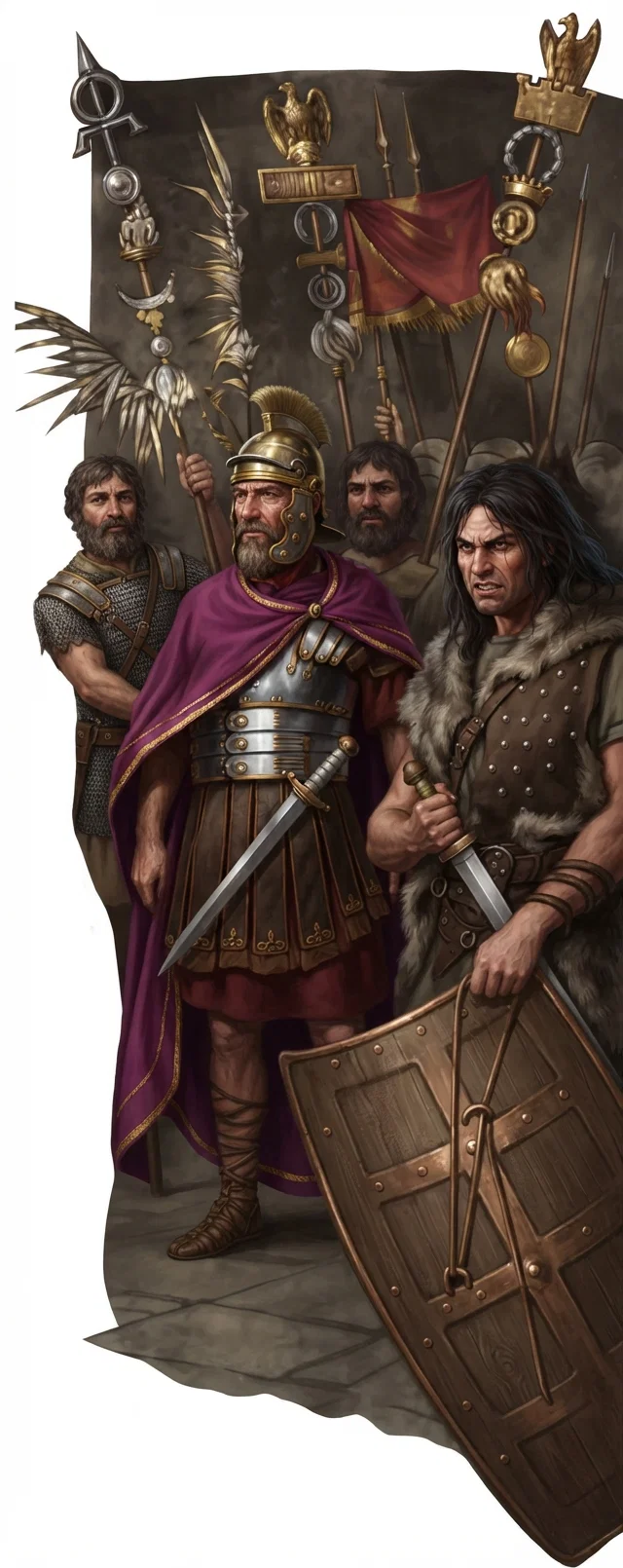
THE remains of Attila's nomadic warriors were lost in the steppes of southern Russia, while the barbarian nations that had served under his standards asserted their independence. Many of them, Heruli, Burgundians, Alani, and others, enlisted in the army of confederates that the emperor Majorian had formed for the defense of Italy, the only remaining portion of the Western empire. This skeleton of an empire had for several years been in a state of anarchy. The old Romans were at the mercy of the very barbarians whom they paid to defend them. The Suevi had for several years had the upper hand in Roman affairs, making and deposing several emperors in succession. The imperial dignity had become a puppet in the hands of strangers, who, for some reason, dared not ascend the throne of Augustus, Diocletian, and Constantine. Ricimer, says a historian, had "tramped on the ruins of Italy, exercised the power, without assuming the title."
In the space of twenty-one years, not less than nine emperors had occupied the throne in quick succession. "This calamitous period," says Sismondi, "comprises the last convulsions of the empire of the West" (455-476).
The arrival of the disordered bands of confederates from the collapse of Attila's army made matters worse if possible. Two men who had served under Attila, Orestes and Odoacer, now vied with each other as arbiters of the dying empire. The former succeeded in placing upon the throne a barbarian youth in the person of his son Romulus, a beautiful lad of fourteen. But it was decreed in the counsels of the Almighty that Rome must die, and not be rejuvenated by any of the barbarian nations. The iron monarchy6that had ruled the world for over six hundred years must pass away, and be divided among its conquerors, never more to be resuscitated. The first barbarian emperor who dared to sit on the throne was to be its last occupant.
The Death Blow Administered
It came about as follows: The barbarian confederates, who were, as we have seen, the last defenders of Rome, tiring of adventures, wished to establish themselves permanently, like the other barbarians who had created kingdoms in Gaul, Spain, and elsewhere. They asked for the third (notice this number) part of the lands of Italy as their portion. Orestes, whose little son had just been appointed emperor, refused to accede to their wish. Their demand, however, was soon granted by Odoacer, Orestes' rival.
'The army of Italy,' says Montesquieu, 'composed of strangers, required what had been granted to other less civilized nations: under Odoacer, it formed an autocracy, which gave itself the third [italics ours] of the lands of Italy; it was a death blow to that empire.'
Odoacer placed himself at the head of a rebellion in which Orestes was killed, and the remains of the agonizing empire fell into Odoacer's hands. He chose rather to be at the head of a barbarian kingdom than to take upon himself the dangerous and miserable dignity of a Roman emperor. He resolved, says Gibbon, to abolish 'that useless and expensive office.'
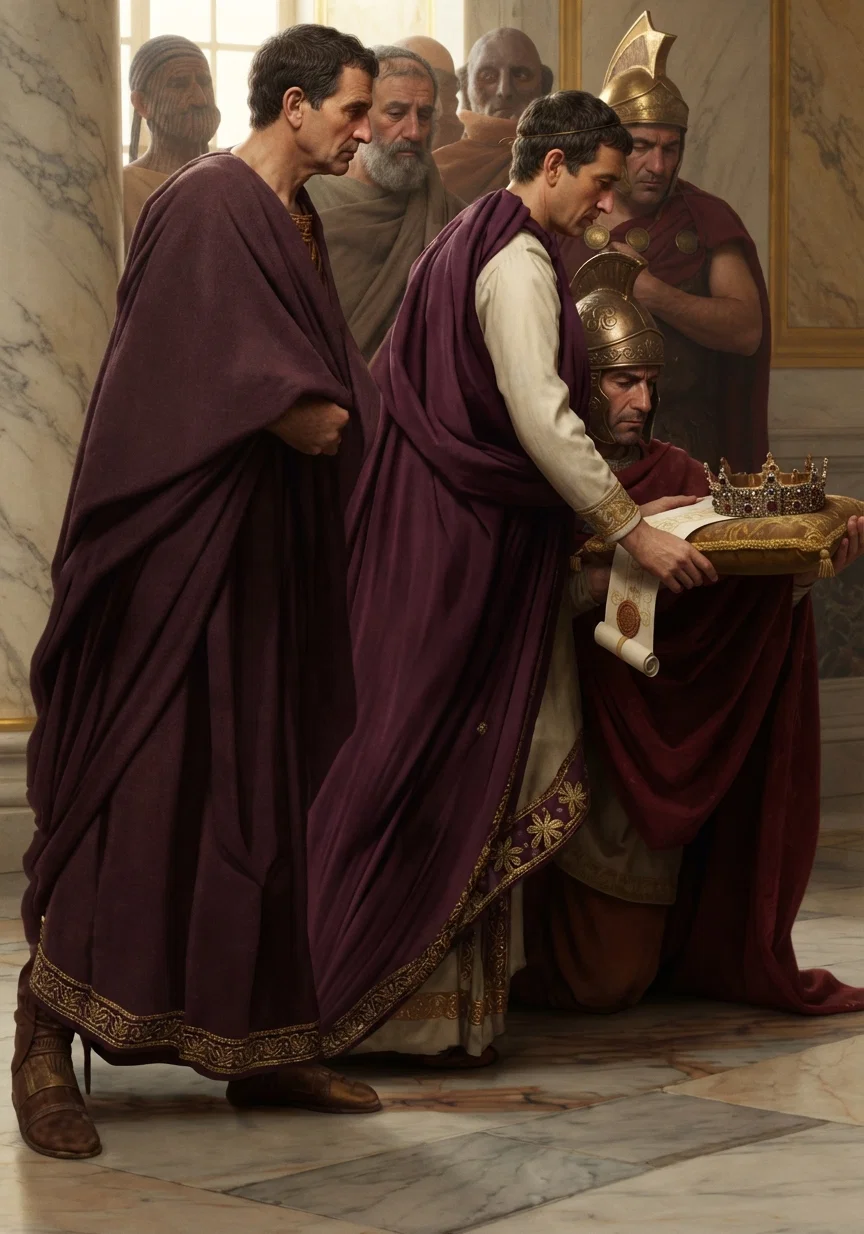
At his order, the young Romulus sent his resignation to the Roman senate. That august assembly, 'in their last act of obedience to a Roman prince,' addressed a unanimous letter to Zeno, the emperor of the East, by which 'they solemnly disclaimed the necessity, or even the wish, of continuing any longer the imperial succession in Italy.' (Gibbon.) The imperial ornaments were sent to Constantinople. Odoacer, proclaimed king of Italy by his soldiers, received from Zeno the title of patrician, while to Romulus was granted an honorable pension.
Breathing Its Last
THUS, almost without the shedding of blood, like the peaceful scene of a deathbed, or rather like a lamp going out for lack of oil, did that empire which had been the terror of the world for centuries, breathe out its last. Its sun, to speak with the prophecy, had set by the submissive abdication of a boy. 'In the year 476,' says Vulliet, 'the power of the Cæsars of the West went out [italics ours] slowly and silently in the person of a child; and a seventh barbarian kingdom, the kingdom of the Heruli, found itself established in the very center of the ancient Roman empire.' Jerome, speaking of the event, said that the 'light of the world was extinguished.'
Two generals sent to Italy by the emperor of the East, Belisarius and Narses, abolished what still remained of the imperial dignities. In 541 the consulate, and in 552 the senate, were also abolished. The consulate, in its relation to the imperial dignity, may well be compared, as in the prophecy, to the moon, which is a reflection of the light of the sun; while the Roman senate, composed of three hundred senators, may properly be symbolized by the stars of the empire. See Gen. 37: 9-11.
The Lights Extinguished
THUS, exactly as the prophecy of the fourth trumpet had foretold,—in the 'third part of the earth,' all the lights of the political sky of the Roman Empire of the West had become extinct. The appalling catastrophe predicted had come. The power that had ruled the third part of the world was a thing of the past. But listen: Three more trumpets yet are coming; and of these, the revelator says:
'And I saw, and I heard an eagle, flying in midheaven, saying with a great voice, Woe, woe, woe, for them that dwell on the earth, by reason of the other voices of the trumpet of the three angels, who are yet to sound.' Rev. 8: 13.
The Call for Life-Savers
By Newton Evans, M. D.
“The world will soon become one vast battle field. Shall we train our youth to take life, or to save it?”
By Newton Evans, M. D.
President of College of Medical Evangelists
Courtesy "Illustrated London News"
WE are all informed only too well regarding the outstanding features of the great world war that has now been in progress for more than two years, and that shows no signs of abating in fury, but rather is growing worse.
But we are not all so well informed as to the remarkable conditions in the medical world which necessarily accompany this titanic struggle. From week to week, there appear in the great medical journals of this country articles and letters dealing with the medical and health conditions of the countries at war. In these articles, one is continually impressed with the importunate demand for doctors and nurses, not only on the field of battle, and in the field hospitals and base hospitals, but also to look after the sick and afflicted in private life.
This insistent and imperative demand is shown in many ways, especially as related to the conditions of medical education. In England and other of the countries at war, medical students are hurried through their courses, and are put into practice after three or four years of study, instead of five, as usually required. In Austria, the education required for entrance into medical schools is reduced by several years.
Not Enough Doctors to Go Around
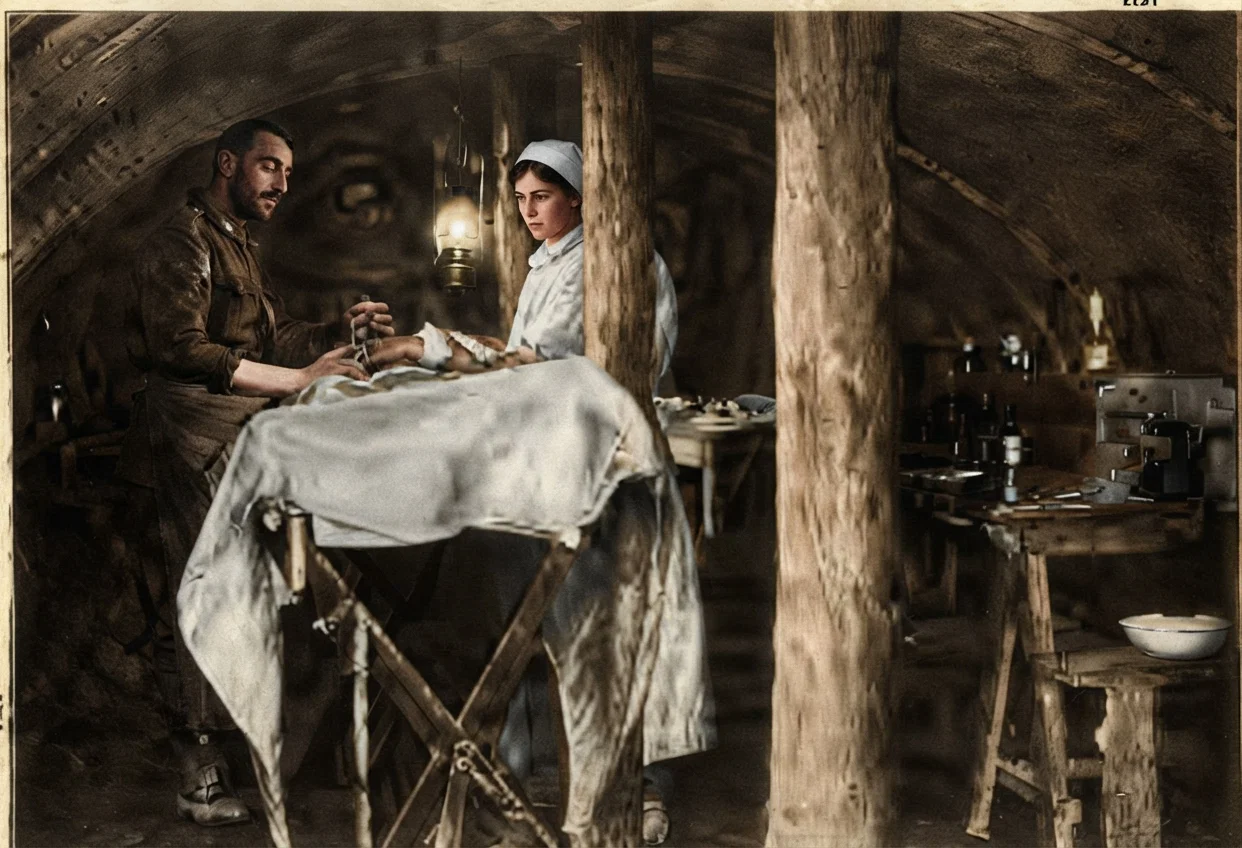
MANY of us are more or less acquainted with the commendable and heroic work of the great numbers of American physicians, surgeons, and nurses in the war zones, and particularly those who are organized into the American Hospital corps, especially in France.
The following, taken from four news items in a New Zealand newspaper, is illustrative of many similar items, and portrays actual conditions:
“The minister of internal affairs . . . has additional burdens laid on his shoulders just now, by the scarcity of doctors. . . . The Wellington doctors are so dreadfully overworked. . . . The war has decreased the supply without lessening the demand. . . . Doctors are wanted for the back blocks, for county hospitals, and for similar institutions, and they cannot be got in the numbers required. Mr. Russell is deluged with correspondence on the subject, and is giving it his sympathetic attention, but there are simply not enough doctors to go around.”
To Slay or to Save?
THESE conditions serve to call to the minds of Christians the question of their personal attitude toward the problem of bearing arms and slaying their fellow men in time of war. Certainly, in view of the basis of our belief—the law of God and the faith of Jesus Christ—no Christian should enter lightly into a course of action which demands the deliberate and direct destruction of the lives of our fellow men. In those countries where it is necessary to take an active part in the war, Christians should seek a place in the medical corps. There the only work would be to save life, and not to take it.
The question is still before us, Should our young men be prepared to save life, or must they be forced into service behind the guns in this war and those that are to follow? There are so many hundreds of thousands in training to take human life, should there not be hundreds and thousands in training to save life, and in this service, to minister also the word of God?
Believing that these war conditions will become more and more general, and that the demand for medical men will accordingly increase, would it not be well for many scores of young men to prepare themselves to minister to these thousands who are wounded every month? Just as great is the demand for women physicians to labor among the women and children who, under the straitened circumstances of war and the attendant lack of proper food and protection, are falling easy prey to disease.
Exempting Religious Objectors
A LETTER from an anxious mother in California came to my desk some time ago. This mother has three sons. She wants them to get such a training that their efficiency as medical men will make it unnecessary for them to serve in the army except as savers of life and ministers of light.
A mother in another state recently sent a plea for us to send some “literature along the medical missionary line” to her son, “who is now on the Mexican border.” She explains that “he chose public school work. . . . While there, he drilled with the National Guards. . . . He was at the normal in — for the summer studying, and was rudely summoned to report for duty on the Mexican border.” Do you know what this means? If your son should be summoned, would he go to save life, or to take it?
In the British countries, the question of “religious objectors” is receiving much attention. A member of the New Zealand Parliament, in discussing the matter of exempting the Quakers and other “religious objectors” from military service, on the grounds that such service is contrary to their religious belief, recently said that “religious objectors” had for many years not been allowed to escape military service in England. “Though I cannot understand their views,” he said, “I recognize these people are consistent, and have in past generations suffered untold miseries rather than forego their principles.”
“These people,” he further said, “are not shirkers.” He referred to valuable noncombatant work done by them in France, they being exempted from active service, on condition that they perform equivalent noncombatant work.
Another member, Mr. Poole, “recorded his recognition of the splendid efforts of the Quakers in humanitarian work. He saw difficulties, but hoped the government would do no injustice to a worthy class.”
What does all this discussion in the Wellington Parliament mean?—Every man’s service is needed by his country. If, because of “religious scruples,” he will not go and fight, he must be able to render “valuable noncombatant service.” What service could be more valuable than that of a physician or a nurse? Hospital physicians, surgeons, sanitation officers, and nurses will be greatly needed when this country of ours becomes involved.
In homes bereft of fathers and sons, there is great need for the comforting word of God. Where could a more needy field be found than among the perishing soldiers or in the sorrowing homes? Who could more appropriately speak to these of the love and care of the heavenly Father than the physician or nurse who ministers to their physical needs? The world will soon become one vast battle field. Shall we train our youth to take life, or to save it? Which?
Daily Consecration
"HOWEVER complete may have been our consecration at conversion, it will avail us nothing unless, it be renewed daily; but a consecration that embraces the actual present is fresh, genuine, and acceptable to God."
Drawing Near to God
"WHEN it becomes the habit of the soul to converse with God, the power of the evil one is broken; for Satan cannot abide near the soul that draws nigh unto God."
The Great Awakening in Princeton
By Tyler E. Bowen
(Concluding Article)
What Happened at the Cotton Church
By TYLER E. BOWEN
This article concludes Mr. Bowen's interesting series. Great truths have been presented in an absorbing story form. Doubtless you have friends in whose hands you will wish to place the five numbers of the "Signs of the Times" containing the recital of Princeton's great awakening. If any of the back numbers are missing, they can be obtained from the publishers. EDITOR.
IT was early in June. Princeton had already begun to take on a changed appearance. Thriving places of business occupied the fine corner locations and other good places in the city where the saloons had held forth. The police force had been reduced by more than one half. The jail had only a few inmates, most of these being long-term victims of drunken rows; and the city was really different.
"I have just learned to-day," said Mr. Wilkinson, as Tom Jones sat down beside him on the suburban-bound trolley, "that we are to have a cotton church out our way."
"Is that so? Where?"
"Down on the corner of Thirty-third and Pine streets. Its services are to begin a week from Sunday night."
"I wonder who the folks are."
"Don't know for sure, but I think they are the same people who had those big meetings in the hall last winter."
"Well, if that's the case, I am going," said Tom.
"I want to go myself. Yes, here it is in to-night's paper. Evangelists S. F. Cummings and R. E. Lockwood to be in charge. We will watch the papers for further notices."
Present-Day Problems
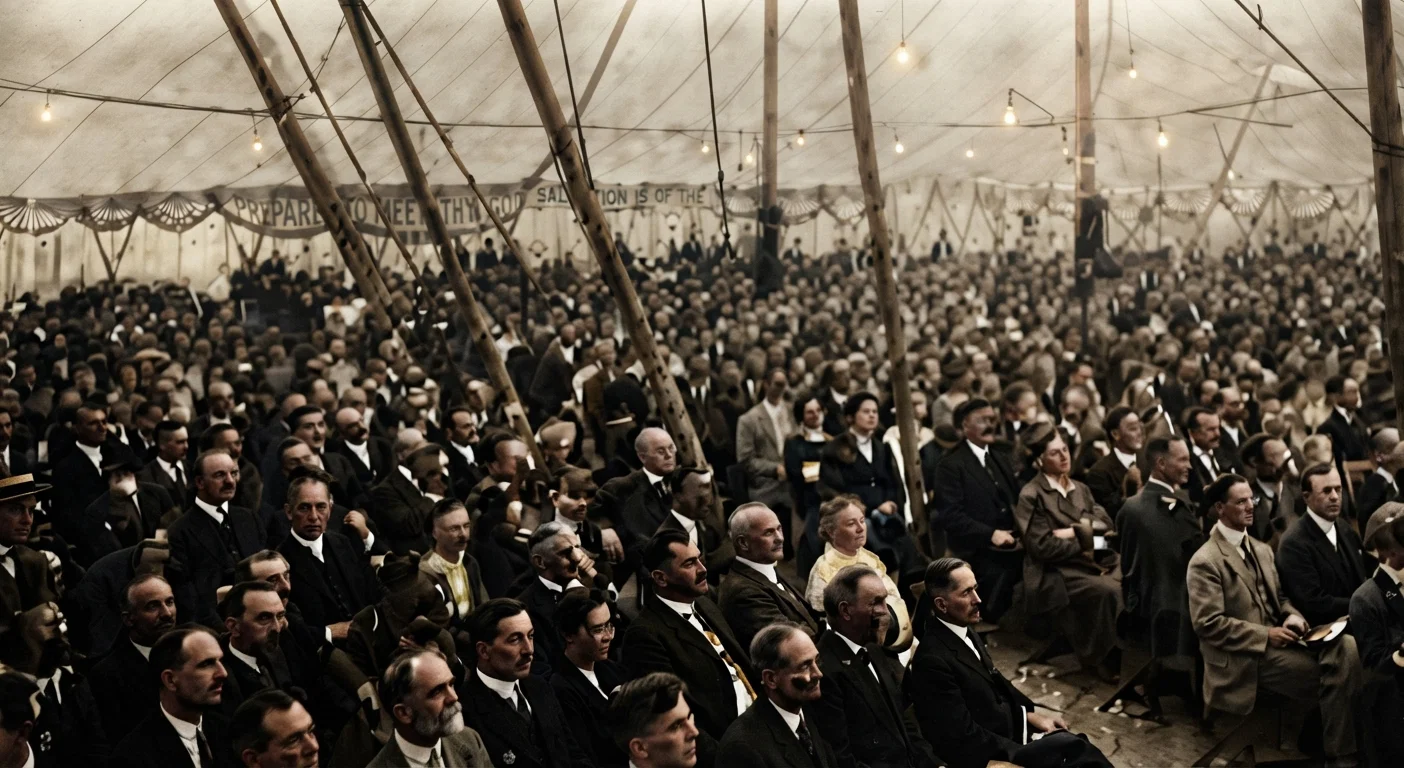
A NEAT, large tent auditorium was soon up on the beautiful corner lot. It was comfortably seated with chairs, the platform was tastefully arranged, well lettered Scripture mottoes adorned the interior, and the tent was lighted with electricity. Everything was in readiness for that first Sunday night service.
It was a lovely evening, and the tent was packed with people. There were many, like Tom Jones and D. K. Wilkinson, who wanted to hear a connected line of Scripture that might throw some light upon present-day conditions and problems which were really troubling them. Besides such as these, there were many others there out of sheer curiosity.
That evening, Mr. Cummings took for his subject the question Pilate asked Jesus on the day of the Lord's mock trial, "What is truth?" He showed that the most important thing in the world to know and cling to is the truth. Among other things, he said: "Like Pilate of old, many ask, 'What is truth?' and as he did on that occasion, before they get Jesus' answer, they go out into the rabble of the world, the confusion of business and gain getting, and hence really never get God's clear answer as to what truth is. Jesus, in that last prayer with His disciples, said, 'Sanctify them through Thy truth: Thy word is truth.' Thus God's word, all of it, is the truth. No one knows what truth is unless he knows what the Bible says.
The next night, the meetings on Thirty-third and Pine closed with a large audience in attendance.
Dust Off Your Bibles
"ALL questions of belief must be brought to the test of the word of God — the Scriptures. Doctrines that cannot endure the test of the application of the Scriptures, have no truth in them. All falsehoods sooner or later will perish. It behooves us, therefore, to study the word of God. That Word will explain its own deep mysteries, if we but study it. In all the subjects to be considered from this desk while we remain with you, this test of 'What is truth?' is to be the measuring rod.
"No doubt things will be presented that will at first seem strange to you; but we earnestly invite your candid thought to each subject, with this burning question of Pilate's ever uppermost in your minds, 'What is truth?' You should get out your Bibles. Dust them off, and begin to hunt through them as for hid treasures. We should be very glad to have you bring your own Bibles with you to the tent. Read for yourselves the passages quoted.
The Good Old-Fashioned Days
"We do not ask you to take our word for it. Prove for yourselves 'what is truth,' by searching the Book of books, the one Book that is the unerring standard by which we all must ascertain 'what is truth,' and by which we are to be judged in the last day."
On the way home that night, Mr. Wilkinson said to his wife: "To me, that sounded good. It brings up afresh some of those good old early Methodist days my father and mother used to talk about, when Bible religion was in vogue; when the preachers stuck to the Bible, and gave some meat that was really 'meat in due season.' I am going to take Mr. Cummings's challenge, and prove 'what is truth' by finding what my own Bible says."
"But if you don't know, then you are not accountable. The Lord will not punish you for anything you don't know about. I am not very anxious to find out, for I may have to give up some things I don't want to give up," retorted Mrs. Wilkinson.
"Possibly the Lord will hold us accountable for what He knows we might have known," suggested Mr. Wilkinson.
Found in Grandmother's Bible
THOSE meetings continued just ten weeks. It was astonishing that so many subjects could be found in that old grandmother's Bible, so largely discarded by the preachers of to-day. "The History of the World in Advance," in several lines of prophecy, was given. "What Daniel Knew of Present-Day Events," "Do Men Have Immortality by Nature?" "Jesus Our Sin Bearer," "Our One Mediator," "Jesus at Work Now — Where?" "When Is Christ to Become King?" "Is There Bible Authority for Infant Sprinkling?" "When Is God's Law to Be Done Away?" "The Christian's Sabbath," "What Takes
Place During the Millennium?", "The Place Jesus Has Prepared for Saints — Where Is It?" "Events Showing the End of the World Nigh," were some of the many other equally interesting topics considered.
Twoscore Take Up the Cross
ONE night about two weeks before the tent was to come down, late in the summer, Mr. Cummings, at the close of an earnest discourse upon the subject of "The Importance of Walking in the Light, Lest Darkness Come upon You," invited all who would like to take their stand upon the truth of God's word, and walk in the pathway of His commandments, to arise.
Among those first to get up were D. K. Wilkinson, Tom Jones and his wife, Mrs. Lewis and her rescued-from-a-drunkard's-grave Ed, and about twoscore others who had, like these, been studying their Bibles. Many of these who arose had hitherto made no profession of religion, nor been members of any of the churches in Princeton.
The next Sabbath (Saturday), these who had arisen, and any others who desired, were invited to come to the tent at ten o'clock. A good sized Sabbath school was that morning organized, and classes were formed for all, including the children. Mrs. Lockwood had for some time been having children's meetings just before evening service, two evenings each week. Following the Sabbath school, Evangelist Lockwood spoke a few minutes on "The Blessedness of Taking Up the Cross and Following Jesus."
A "Sheep-Stealing" Business
AT the close of the short sermon, opportunity was given all to speak. It was a blessed meeting. Eyes filled with tears as different ones told of their joy in finding the truth, and of the perfect satisfaction they had experienced in stepping out from the world to follow in the footsteps of Jesus in the keeping of His Father's commandments. In Brother Wilkinson's testimony, after expressing his gratitude to God for what he had learned at the tent, and for the precious truths found in his Bible, he referred to a thrust he had heard a few evenings before about the work done at the tent being "simply a sheep-stealing business."
"I have been thinking about that expression," Brother Wilkinson said. "Yes, indeed, stolen away from the sandy foundation of 'papal traditions' and 'doctrines of men,' and brought to the sure foundation of God's holy word; stolen away from the law-nailed-to-the-cross8delusion, and guided into the shining pathway of God's blessed commandments; stolen away from the lulling-to-sleep fallacy of the age-to-come theory, and awakened to sense that the day of salvation is almost over, and that the day of the pouring out of God's wrath upon a sinful, disobedient world is nigh at hand. For all this blessed deliverance, I for one am devoutly thankful to my heavenly Father.' Many hearty 'Amens' were heard as he took his seat.
One week from that day, thirty-two went down 'into the water,' as did Philip and the eunuch, to be buried with their Lord in baptism, arising from their watery graves to walk with their Lord 'in newness of life'—Christ's instituted ordinance to commemorate His death and resurrection. A church was then organized. The next night, the meetings on Thirty-third and Pine closed with a large audience in attendance.
Cotton Gives Way to Brick
THE last announcement read from the desk was this: 'We take this occasion to invite all our friends in Princeton to join us in raising funds for the purchase of materials to erect a church on this lot, already purchased, which has been so beautifully dedicated to the gospel by the presentation of the truth from this desk night after night the past few weeks. Subscription papers are prepared, so that should any of the friends here to-night consider it a privilege to assist in the purchase of materials for the erection of a church on this spot, to be dedicated to the further worship of God, they can do so. Such assistance will be thankfully received.'
'(Signed)
'D. K. Wilkinson.
'Thomas Jones.
'Edward Lewis.'
BEFORE the severe winter weather set in, a neat little church edifice adorned the corner of Thirty-third and Pine streets in Princeton, where met, as the weeks went by, an ever growing congregation of believers, whose aim, in all their daily walk and conversation, is to keep the commandments of God, including the stigmatized 'Jewish Sabbath,' and to keep burning brightly upon the altars of their hearts 'the faith of Jesus.'