THIS is the age of monopolies. Most of these monopolies are originated, engineered, and controlled by a small group of men, who organize and manipulate them for self-interest. The “public good” is the plea when men seek to launch such enterprises; but when once they are launched, the suffering public often learns that they were in reality launched for the personal benefit of a few men.
Catching this characteristic spirit of modernism, churches and religious societies are confederating for the “public good.” Their slogan is the same as that of other monopolies; but a careful analysis reveals the fact that they are confederating for the purpose of control of their fellow men through a religious monopoly.
Satan is the great originator of self-serving confederation movements. The first one was started in heaven. See Ezekiel 28. Under the usual cry of the “good” of the subjects of the kingdom of God, it was brought forward in Eden. Gen. 3: 1-5. Its real purpose is revealed in the prophecy of Isaiah: “How art thou fallen from heaven, O Lucifer, son of the morning! how art thou cut down to the ground, which didst weaken the nations! For thou hast said in thine heart, I will ascend into heaven, I will exalt my throne above the stars of God: I will sit also upon the mount of the congregation, in the sides of the north: I will ascend above the heights of the clouds; I will be like the Most High.” Isa. 14: 12-14.
Wrecked the Lives of Angels
The object of the first great confederacy was monopoly control of the kingdom of God. It was launched in the interests of Satan, its leader. That movement wrecked the pure lives of angels, and cast Satan and all his followers out of heaven. “And there was war in heaven: Michael and His angels fought against the dragon; and the dragon fought and his angels, and prevailed not; neither was their place found any more in heaven. And the great dragon was cast out, that old serpent, called the devil, and Satan, which deceiveth the whole world: he was cast out into the earth, and his angels were cast out with him. And I heard a loud voice saying in heaven, Now is come salvation, and strength, and the kingdom of our God, and the power of His Christ: for the accuser of our brethren is cast down, which accused them before our God day and night.” Rev. 12: 7-10.
It was an antichristian movement. It presupposed that Christ was incapable of running the government of the kingdom of God on a right basis; that the exalted position Satan should occupy was disregarded, and a confederacy was required to establish it on a proper basis. Its foundation was laid in unbelief in the power, wisdom, and goodness of God. Turning from dependence upon that power for the control of the kingdom of God, it sought to control Christ’s kingdom by creature confederacy and force. But it failed. It ended in ruin to those engaging in the undertaking.
The kingdom of God still exists, with Christ in control, even though these mightiest of heavenly beings confederated to control it. They lost it, and were cast as “profane” out of the kingdom.
Would Crown Christ King by Force
A modern movement, based on the same unbelief in the capability of Christ to care for the interests of His kingdom, is again sweeping over the earth. It began in a religion-by-force movement in 1863, under the auspices of the National Reform Association, which was organized January 27, 1864, with the avowed object to “indicate that this is a Christian nation, and place all the Christian laws, institutions, and usages of our government on an undeniable legal basis in the fundamental law of the land.” (Article 2, National Reform constitution.)
Inspired by the spirit of this movement, the late Miss Frances Willard, president of the Woman’s Christian Temperance Union, said:
“The Woman’s Christian Temperance Union, local, state, national, and world-wide, has one vital, organic thought, one all-absorbing purpose, one undying enthusiasm, and that is that Christ shall be this world’s king. . . . The kingdom of Christ must enter the realm of law through the gateway of politics.”—President’s annual address, in convention, Nashville, 1887.
This sounds beautiful to a professed Christian, inexperienced and uninformed in the results of enforced religion. It is the very same issue over which the Jews accused and the Romans executed Christ upon Calvary. They had a law; and by that law, they said, He ought to die, because He made Himself the Son of God. (John 19: 7.)
Christ’s unqualified denunciation of all attempts to enthrone Him as this world’s king through religio-political confederation movements is given in His emphatic statement, “My kingdom is not of this world.” The movement to establish the kingdom of Christ in this world by force and worldly methods is here most emphatically repudiated by Christ. It is positively antichristian.
Develops Fawning Hypocrites
The more recent movements that have developed for the purpose of establishing religion by force are:
The Federation of Churches.
The Church Peace Union.
The League to Enforce Peace.
The World-Court League.
The World Conference on Faith and Order.
Religious legislation in Congress.
All these movements are seeking the one end of control by force in affairs of religion, which can, in the very nature of things, but defeat the purpose of true religious faith.
Christ’s declaration is, “He that believeth and is baptized shall be saved.” Faith is voluntary. To enforce it is impossible. To attempt to do so is to develop a horde of fawning hypocrites instead of a body of children of faith. The history of the fourth century and onward is an illustration of the results of religious legislation. The Bible was chained to the desks of the clergy, and the people had it doled out to them in the way best suited to the ends to be accomplished by the clergy. Faith was persecuted, and hypocrisy honored.
Confederate Only to Be Broken
But these very confederation movements are signs that the end of the world and the time for the establishment of the kingdom of Christ are at hand. Isa. 8: 17. In predicting their coming just before the second advent of Christ, the prophet Isaiah warned the world against them in the following forceful utterance: “For the Lord spake thus to me with a strong hand, and instructed me that I should not walk in the way of this people, saying, Say ye not, A confederacy, to all them to whom this people shall say, A confederacy; neither fear ye their fear, nor be afraid.” Isa. 8: 11, 12.
There is no mistaking this Heaven-sent warning against such last-day confederacies. They will come with great pomp, and denunciation of those who walk in the ways of God’s word. They have confederated because they fear that God’s work is imperiled, and that unless they confederate and denounce and persecute opposers of their views, it will fail. But their words and denunciations are not approved of God, and will not stand. “Associate yourselves, O ye people, and ye shall be broken in pieces; and give ear, all ye of far countries: gird yourselves, and ye shall be broken in pieces; gird yourselves, and ye shall be broken in pieces. Take counsel together, and it shall come to naught; speak the word, and it shall not stand: for God is with us.” Isa. 8: 9, 10.
Then follows the rallying call to all children of faith: “That I should not walk in the way of this people, . . . neither fear ye their fear, nor be afraid. Sanctify the Lord662of hosts Himself; and let Him be your fear, and let Him be your dread.” Isa. 8: 11-13.
Couldn't Meet the Competition
This fear that God is unable to care for His work unaided by religious legislation is the basis of all the religious legislation that has ever cursed the world. Egypt of old thought they owned Israel, body and soul. They feared that their gods could not withstand the competition of another system of religion, so they attempted, by national control of religious convictions, to compel Israel to worship according to their creed. God in His displeasure sent an ultimatum to Pharaoh. He demanded, “Let My people go, that they may serve Me,” or I will visit Egypt with mighty judgments.
Egypt refused to grant freedom of religious worship, and the ten plagues upon Egypt followed. Every plague was a challenge to Egyptian divinities to assert their power in support of their creed in the face of God’s judgments. That nation, humiliated and confounded under the mighty judgments of God, was at last glad to release Israel to freedom of worship, and leave the control of God’s work and people to Himself.
Beginning in the fourth century, a church confederacy obtained religious control by civil enactments. The most unchristian intolerance and persecution resulted, until, through the Reformation movement, men of faith arose, who believed that God was capable of the religious control of His people, and the supremacy of that system of ecclesiasticism was broken, and the world was again liberated, that men might exercise, unmolested, their God-given right of individual liberty to worship God.
The Reformation movement was based upon the declaration of Christ: “And if any man hear My words, and believe not, I judge him not: for I came not to judge the world, but to save the world. He that rejecteth Me, and receiveth not My words, hath one that judgeth him: the word that I have spoken,7the same shall judge him in the last day.” John 12: 47, 48.
The Christianizing of Politics
A modern federation movement, embracing, in principle, all that Jehovah condemned in Egypt, and all that the fourth century federation movement embraced, has been inaugurated. Its object is very clearly stated in an official program of the Christian Citizenship convention, June 29 to July 6, 1913, as follows:
“The object and inspiration of all effort is the establishment of the kingdom of God. . . . In the application and realization of these principles, there are some definite lines of action which are vital. Our work in behalf of the Christianization of the political and social order must move along four lines: education, agitation, legislation, and law enforcement. . . . This conference should consider the various subjects that are vital to the welfare of the people, and should adopt such measures as are to be promoted by education, agitation, legislation, and law enforcement.”
To establish the kingdom of God by political legislation is the real purpose of the entire federation movement. It is Satan’s mighty attempt to fulfill the prophecies relating to the establishment of the kingdom of God by Christ at His second advent. When the real restoration of that kingdom takes place, Christ will sit upon the throne of His glory. Before Him will be gathered all nations; and He, not confederacies of man, will restore the kingdom of God. Matt. 25: 31.
The KEY of the BOTTOMLESS PIT
By Jean Vuilleumier
From "Daniel and the Revelation"
SYNOPSIS: The seven trumpets of Revelation 8 and 9 have been shown to be symbols of war, referring definitely to the mighty irruptions from the barbaric hordes that swept over the Roman Empire, dethroning her from the position of proud mistress of nations.
The first trumpet symbolized the wars waged by the renowned Alaric and his victorious Goths. Hail, fire, and blood falling upon the earth is the prophetic description. Rome was pillaged, was humbled in the dust. The fulfillment of the second trumpet is found in the conquests of Italy and Africa by the Vandals under the terrible Genseric.
The third trumpet was fulfilled by the Huns under the leadership of Attila, called the "scourge of God." The fourth trumpet signified the career of Odoacer, leader of the Heruli and other tribes, and completed the downfall of Western Rome, putting an end to the rule of the Cæsars. Rome was now broken into fragments, and the modern nations of western Europe were planted.
WHILE western Europe, occupied by new nations, and infused with a new blood, had received a further lease of life, in the eastern portion of the Roman Empire, the same process of apostasy which had caused the ruin of the western empire was ripening into political and social decay.
"Since its baneful triumph under Constantine, the eastern Christian church had rapidly degenerated. Worldliness and pagan customs had taken possession of it; sectarianism and religious strife had smothered charity; the violent persecutions of the Christian emperors had exasperated the people who still held to the old [pagan] faith; and finally the simple and sanctifying religion of the first three centuries, or, in other words, worship in spirit and in truth, had given room to a mass of superstitious practices, of acts of veneration to the virgin, the saints, the martyrs, and their images."—Vulliet, "History of the Church," page 103.
"As regards morality, the Greek empire had made little progress since the times of Arcadius. The scepter passed into the hands of a succession of usurpers, many of whom owed their rank to crime and even parricide. The people, depraved by the example of its sovereigns, were made up of a half-pagan mass, only superficially changed by the teachings of Jesus Christ, their devotions consisting only in ceremonies, where the cross was everywhere in evidence, but the religion of the cross almost unseen. . . . The principal object of worship was the virgin Mary, honored in splendid processions, and adored in her images, above all by the population of the convents. . . .
Crumbling to Its Fall
"The court cultured, superstitious, and vile, the people ingenious and degraded, having a taste for art but devoid of genius; minds bowed down by the absolute power of the state on the one hand, and under the tyranny of the ecclesiastical power on the other,— such was the condition, at this time, of the Greek church.' . . . The pulpit uttered only grandiloquent and empty declamations on the virtues and the miracles of the saints, which led Alexis Comnenus to remark that if the nations living in his empire were profoundly ignorant of religion, it was because those who should teach them were either incapable or did not care. . . .
"The empire of Byzantium was . . . more than ever . . . a prey to the same languid condition, the same disorganization, which had formerly hastened the fall of the empire of the west. All kinds of despotism were heavy upon the unfortunate Greeks. Jews, Nestorians, Monophysites, dissenters of all classes, exposed to all kinds of vexations and persecutions, had not only lost their interest in defending the country against invaders, but longed for a new régime of whatever sort. In this situation, let this decrepit empire be the object of a sudden attack on the part of an impetuous nation, filled with the ardor of youth and with religious and military enthusiasm, and marked by a simplicity of life which the Greek had lost long ago,— and the result of the encounter will not be doubtful."—Chastel, "Hist. du Christianisme," volume 3, pages 13, 34, 35.
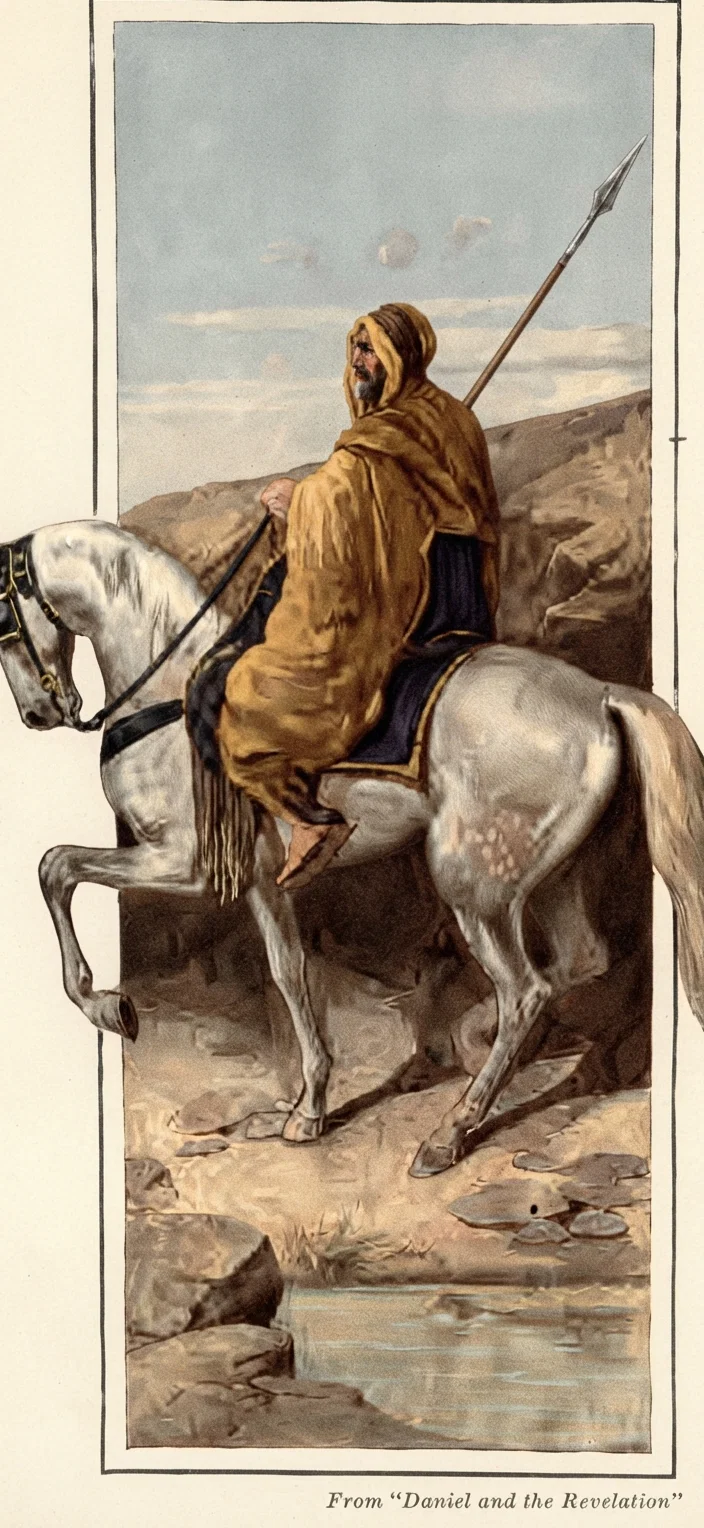
This is exactly what took place under the Arabian invasion, of which a graphic description is given, five hundred years before it began, in the language of the fifth trumpet. The splendid imagery of this prophetic description is universally recognized among interpreters as a fit picture of the Saracenic or Arabian conquests in the eastern, southern, and southwestern portions of the Roman world.
"And the fifth angel sounded, and I saw a star from heaven fall unto the earth: and there was given to him the key of the pit of the abyss." Rev. 9: 1.
In the third trumpet, "a great star" had fallen "upon the third part of the rivers." This was Attila and his hordes, who covered "the third part" of the empire. Here the "star" falls indefinitely "upon the earth," east and west. And while Attila and his empire were to vanish as a meteor, the new conquerors were to continue "five months," or, as we shall see, one hundred fifty years. But in either case, the new masters of the world were to be led out by a great war genius called a star.
Mohammed, the founder of the Mohammedan power, appears not only as one of the great empire builders of history, but also as the originator of a new religion, which to-day claims the respect of one hundred eighty millions of adherents.
"And he opened the pit of the abyss; and there went up a smoke out of the pit, as the smoke of a great furnace; and the sun and the air were darkened by reason of the smoke of the pit." Verse 2.
"The pit of the abyss" designates the wild and barren regions of the Arabian deserts. The original word here is the one used elsewhere in the Scriptures to describe the earth in its chaotic condition before creation, and after the great earthquake at the second coming of Christ. See Gen. 1: 2 and Rev. 20: 3, where thehôm in the Hebrew and abussos in the Greek are translated "deep" and "abyss." The "key," or power to arouse their slumbering populations, is "given" to Mohammed.
"Roaming across their deserts [italics ours] and plains, with no social, political, or religious bond, the Arabian tribes consumed their strength in meaningless and bloody discussions. . . . They seemed to be condemned to an eternal sleep, when there appeared a man who was to change the face of the world. Legislator, warrior, and prophet, Mohammed . . . was to make out of these disorganized, nomadic tribes a people who should march to the conquest of the world; and out of a chaos of superstitions, a new religion whose devotees would cause the West to tremble for several centuries."—De la Jonquiere, "History of the Ottoman Empire," pages 63, 64.
Gross Immoralities Glorified
"The smoke of a great furnace" that darkens the sun and the air, clearly designates the false religion of Islam, which seeks to obliterate Jesus Christ as the Sun of Righteousness7and "the Light of the world." "The essence of Mohammedanism is to repudiate Christianity — that is, the system of religion of which Christ is the center — and to substitute a system in which Mohammed holds a place next to God Himself. Our Lord is allowed [by the doctrine of Islam] to have been a holy man, a messenger from God; but His place as the object of man's worship, love, and hope is denied Him. His miraculous conception and birth are denied."
"Islamism," says a Mohammedan doctor, "rests on five foundations, of which the first is the confession of God, that there is no other God beside Him, and that Mohammed is His prophet; the second is the offering up of prayer at stated intervals; the third, the giving of alms; the fourth, fasting during the month Ramadan; and the fifth is the pilgrimage664to Mecca, which every person must perform who is able." In vain do we look here for a true appreciation of sin, for an atonement for God's broken law, for God's pardoning love, for the grace of regeneration. Prayer, almsgiving, and fasting — not faith — become the means of salvation.
A great part of the Koran is said to be nonsense, while some of it is grossly immoral and profane. Polygamy is allowed to the extent of four wives, while the caliph is permitted to choose as many as he wishes. Friday is made the day of rest, at the expense of the day of Jehovah.
As redeeming features, the Koran forbids the use of wine and swine flesh, and the worship and the veneration of images of any kind — a threefold protest against the abuses of Eastern and Western Christianity. Fatalism was used as a mighty factor in war, while Paradise was promised to every one who fell in battle, and Paradise is described as a place for the enjoyment of all the scale of sensual pleasures.
The Secret of Their Invincible Ardor
"And out of the smoke came forth locusts upon the earth; and power was given them, as the scorpions of the earth have power." Verse 3.
It was the smoke, or false religion, of the Arabian prophet which made warriors of his believers. It was in the name of Allah that the Mussulman hordes started upon the conquest of the world. It was the promise that those who should fall in war would go straight to Paradise which infused the Arabs with such invincible ardor in their battles. In his testament, Mohammed said: "Finish my work, extend everywhere the empire of Islam. The earth belongs to God; to you He offers it."
"Fight," he said, "even to extermination. Some few among you will fall in the struggle. For those who perish, Paradise; for the survivors, victory." "The Mussulman," says the Koran, "is a soldier in the service of God; he enrolls himself by conscience; the handling of arms is for him a religious duty."
With admirable fitness, the Saracen invaders are compared to locusts. "The inhabitants of Syria," wrote Volney, "have noticed that locusts generally come from the deserts of Arabia." We read the same fact in Ex. 10: 13. To the summons of the caliph, the king of Persia made this bold answer: "What leads you to make war upon us? . . . What are you but a nation of paupers scattered like vile insects [italics mine] upon the sand?" (Lamartine's "History of Turkey," volume 1, page 125.)
Conquered 36,000 Towns
"And power was given them" by the One who overrules human events, and whose decrees are beyond all human resistance. Mohammed called himself "the sword of God." The first battle in the Mohammedan conquest occurred in 623; in 630, war upon the Roman Empire was solemnly declared. Mohammed died two years later, and "was succeeded by Abu-Bekr, the father of his favorite wife Aisha. . . . Within thirty years from his death, his followers had conquered the whole of Syria, Egypt, and Mesopotamia, and had overthrown the empire of the Persians.
"The second of his four great successors, Caliph Omar, took Jerusalem in the year 637, and built on the site of the temple the mosque which has since been called by his name. It was he also who, three years afterward, destroyed the great library of Alexandria, declaring that no books were needed beside the Koran. 'During the reign of Omar,' says the Mohammedan historian, 'the Saracens conquered 36,000 cities, towns, and castles, destroyed four thousand Christian, Magian, and pagan temples, and erected fourteen hundred mosques.'"
"The third caliph, Othman, . . . extended the conquests of Omar, and with them the new religion. Persia was entirely subdued; the north of Africa, and some of the islands in the Mediterranean, . . . almost the whole of Asia [Asia Minor excepted], was subdued during the time of the first four caliphs; and in the reign of the caliph of Damascus [A. D. 675], the empire penetrated as far as Tangier and the Atlantic. A few years later, the entire north of Africa was part of the empire, as far as the straits of Gibraltar.
Swept from Persian Gulf to Atlantic
"In 711, Spain, on the north of those straits, was successfully invaded by the Arab conquerors, who retained possession of that part of Europe until 1492. Under Solyman, the greater part of Asia Minor was conquered — that is, in A. D. 717; . . . and about the same time, the northern parts of India were subdued. The armies had even penetrated into the south of France; and it was not until the defeat of Abdur Rahman by Charles Martel in 732 that there seemed any hope of preventing what Mohammed had directed his followers to accomplish — the subjugation of the whole world to his rule and religion. . . . For some centuries, the empire founded on the basis of this religion [italics mine] covered as large a surface of the globe as the Roman Empire had done in the most prosperous days of the Cæsars." ("Encyclopedia of Religious Knowledge," article "Mohammed.")
Summing up this whole conquest, a historian says: "One hundred years after the birth of this Arab Mohammed, his name, joined to that of the Almighty, was called out from ten thousand minarets, five times daily, from the Persian Gulf to the Atlantic, and his new religion was sweeping everything before it in three continents."
The fifth trumpet had come.
The FOOLISH FORTUNE BUILDER
By Ellen G. White
"Thou fool, this night thy soul shall be required of thee."
By the late
ELLEN G. WHITE
"AND He spake a parable unto them, saying, The ground of a certain rich man brought forth plentifully: and he thought within himself, saying, What shall I do, because I have no room where to bestow my fruits? And he said, This will I do: I will pull down my barns, and build greater; and there will I bestow all my fruits and my goods. And I will say to my soul, Soul, thou hast much goods laid up for many years; take thine ease, eat, drink, and be merry. But God said unto him, Thou fool, this night thy soul shall be required of thee: then whose shall those things be, which thou hast provided? So is he that layeth up treasure for himself, and is not rich toward God." Luke 12: 16-21.
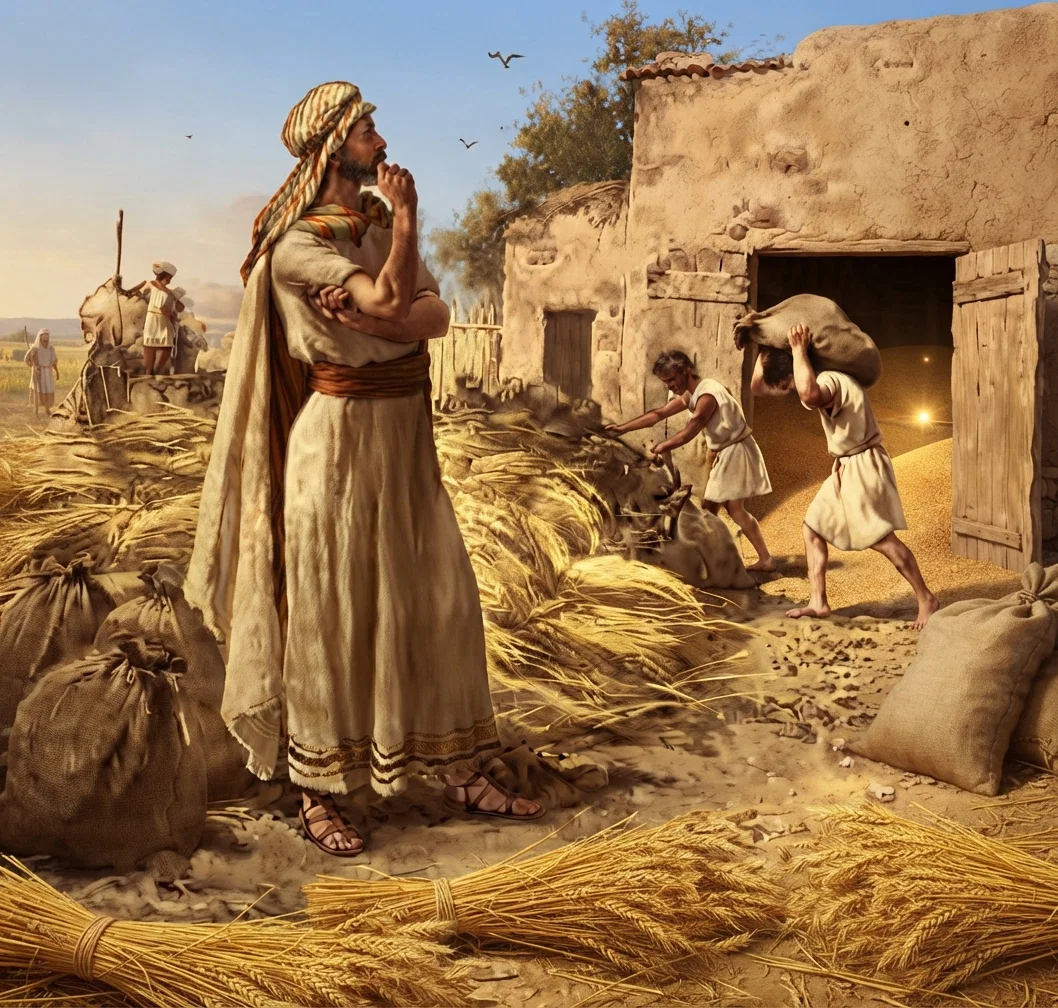
By the parable of the foolish rich man, Christ showed the folly of those who make the world their all. This man had received everything from God. The sun had been permitted to shine upon his land; for its rays fall on the just and on the unjust. The showers of heaven descend on the evil and on the good. The Lord had caused vegetation to flourish, and the fields to bring forth abundantly. The rich man was in perplexity as to what he should do with his produce. His barns were full to overflowing, and he had no place to put the surplus of his harvest. He did not think of God, from whom all his mercies had come. He did not realize that God had made him a steward of His goods, that he might help the needy. He had a blessed opportunity of being God's almoner, but he thought only of ministering to his own comfort.
Steeled His Heart to Their Cries
The situation of the poor, the orphan, the widow, the suffering, the afflicted, was brought to this rich man's attention; there were many places in which to bestow his goods. He could easily have relieved himself of a portion of his abundance, and many homes would have been freed from want, many who were hungry would have been fed, many naked clothed, many hearts made glad, many prayers for bread and clothing answered, and a melody of praise would have ascended to heaven.
The Lord had heard the prayers of the needy, and of His goodness He had prepared for the poor. Abundant provision for the wants of many had been made in the blessings bestowed upon the rich man. But he closed his heart to the cry of the needy, and said to his servants: "This will I do: I will pull down my barns, and build greater; and there will I bestow all my fruits and my goods. And I will say to my soul, Soul, thou hast much goods laid up for many years; take thine ease, eat, drink, and be merry."
This man's aims were no higher than those of the beasts that perish. He lived as if there were no God, no heaven, no future life; as if everything he possessed were his own, and he owed nothing to God or man. The psalmist described this rich man when he wrote, "The fool hath said in his heart, There is no God." Ps. 14: 1.
Worthless in a Moment
This man has lived and planned for self. He sees that the future is abundantly provided for; there is nothing for him now but to treasure and enjoy the fruits of his labors. He regards himself as favored above other men, and takes credit to himself for his wise management. He is honored by his fellow townsmen as a man of good judgment and a prosperous citizen. For "men will praise thee, when thou doest well to thyself." Ps. 49: 18.
But "the wisdom of this world is foolishness with God." While the rich man is looking forward to years of enjoyment, the Lord is making far different plans. The message comes to this unfaithful steward, "Thou fool, this night thy soul shall be required of thee." Here is a demand that money cannot supply. The wealth he has treasured can purchase no reprieve. In one moment, that which he has toiled through his whole life to secure becomes worthless to him. "Then whose shall those things be, which thou hast provided?" His broad fields and well filled granaries pass from under his control. "He heapeth up riches, and knoweth not who shall gather them." Ps. 39: 6.
The only thing that would be of value to him now, he has not secured. In living for self, he has rejected that divine love which would have flowed out in mercy to his fellow men. Thus he has rejected life. For God is love, and love is life. This man has chosen the earthly rather than the spiritual, and with the earthly he must pass away. "Man that is in honor, and understandeth not, is like the beasts that perish." Ps. 49: 20.
Messengers of Doom Answer
"So is he that layeth up treasure for himself, and is not rich toward God." The picture is true for all time. You may plan for merely selfish good, you may gather together treasure, you may build mansions great and high, as did the builders of ancient Babylon; but you cannot build wall so high or gate so strong as to shut out the messengers of doom. Belshazzar the king "feasted in his palace," and "praised the gods of gold, and of silver, of brass, of iron, of wood, and of stone." But the hand of One invisible wrote upon his walls the words of doom, and the tread of hostile armies was heard at his palace gates. "In that night was Belshazzar the king of the Chaldeans slain," and an alien monarch sat upon the throne.
To live for self is to perish. Covetousness, the desire of benefit for self's sake, cuts the soul off from life. It is the spirit of Satan to get, to draw to self. It is the spirit of Christ to give, to sacrifice self for the good of others. "And this is the record, that God hath given to us eternal life, and this life is in His Son. He that hath the Son hath life; and he that hath not the Son of God hath not life."
Wherefore He says, "Take heed, and beware of covetousness: for a man's life consisteth not in the abundance of the things which he possesseth."
No Escape From Doom
"You may gather together treasure, you may build mansions great and high, as did the builders of ancient Babylon; but you cannot build wall so high or gate so strong as to shut out the messengers of doom."