News Notes on Science, Industry, and Public Affairs
Page 2
The Youth’s Instructor
Jul 17, 1917
Review and Herald Publishing Assn. · Takoma Park Station, Washington, D. C. · Jul 17, 1917
News Notes on Science, Industry, and Public Affairs
Successful natural-color motion pictures are now being produced.
Wisconsin has voted to submit the question of prohibition to the electorate in 1918.
If we were on the moon, looking at the “full earth,” its light would be forty times as bright as the full moon is to us.
The United States Envelope Company, Springfield, Massachusetts, will give 750,000 envelopes daily for the use of United States soldiers.
Flies naturally collect at the upper part of a door, and enter there when the door is opened. With the two-part screen door children can pass out and in without giving the flies the slightest chance to enter the house.
Dr. William R. Brooks, director of the Smith Observatory, Geneva, New York, and professor of astronomy in two colleges, has discovered twenty-seven comets. He holds the world's record with the exception of the French astronomer Pons, who discovered twenty-eight.
At the Chicago post office, mail is sorted by means of a mechanical system which is operated by a typewriter-like device. This system can do the work of thirty men. The operator glances quickly at the address on the envelope as it passes into view before him, and presses the key which corresponds. This sets the levers of the mechanism at the right combination, and passes the envelope on down into one of the pigeon-holes beneath.
The Nebraska Woman's Educational Club, in counseling women what conventions to follow that they might favorably impress legislators before whom they appear, to enlist their coöperation in behalf of public questions, advise among other things that the women “dress decorously,” saying: “Legislators dislike extravagance in feminine attire. Modesty and neatness in dress go far in a day.” This partiality to simplicity in dress is not confined to legislators.
The government lists States in which, after July 1, it will be unlawful to mail letters, postal cards, or publications containing liquor advertisements as: Alabama, Arizona, Arkansas, Colorado, Georgia, Idaho, Indiana, Maine, Michigan, Mississippi, Montana, Nebraska, North Carolina, North Dakota, Oklahoma, Oregon, South Carolina, South Dakota, Utah, Virginia, Washington, and West Virginia. Also Kent County, Delaware, and ninety-one towns in Connecticut. The ban is effective in New Hampshire May 1, 1918, while in Rhode Island it applies to cities and towns that have voted dry.
Mr. Elmer A. Sperry, of Brooklyn, the inventor of the first electric arc light, is also the inventor of the world's most powerful searchlight. It sends forth a beam as brilliant as the sun at eight o'clock in the morning or four in the afternoon, New York latitude. A newspaper may be read by it at a distance of thirty miles. The heat of its focused beam will set paper afire at a distance of 250 feet. Its light is equal to more than 1,250,000,000 candles. If one stands in the beam of the Sperry lamp at any distance closer than 300 feet, the skin will be burned. At that distance the skin peels. It can be used for signaling at any distance up to 100 miles.
America is fast gaining her independence, so far as being dependent upon Germany for coal-tar dyes. There are now in this country twenty or more firms which are manufacturing dyestuffs. One of these, which three years ago was turning out three million pounds of dyestuffs a year by using imported intermediates, is today manufacturing its own intermediates, and can turn out thirty million pounds per annum. Another company, employing fifty men in 1914 and capitalized for only $75,000, today employs a thousand men and is capitalized for $5,000,000.
Mr. Edison, regarded as the greatest inventor of the age, has taken out over nine hundred patents for inventions and improvements that have done much to add to the comfort and happiness of the world. Now the people of two continents are looking to him as the man who may possibly discover a weapon against the submarine—and so invent peace.
The American government on May 9 assumed the immediate financial burden of Belgian relief, arranging to lend the French and Belgian governments jointly $75,000,000, to be expended by the American Belgian Relief Commission, the money to be advanced in monthly instalments of $7,500,000 to Belgium and $5,000,000 to France.
Great Britain has arranged with Portugal for the lease of sixty of the seventy-six German merchant steamers seized by Portugal when she entered the war. It is understood that England is to pay Portugal a rental of $7,000,000 a year.
Lieutenant Woodworth, the great-grandson of Samuel Woodworth, the author of “The Old Oaken Bucket,” was recently killed in an aëroplane accident in France. He was in war service.
The head of the great Krupp gun works of Germany is Gustov von Bohler, husband of Bertha Krupp. He is the grandson of a former general in the United States army.
Great Britain is using about 70,000 motorcyclists, of whom 40,000 are employed as dispatch riders, and the remainder chiefly in the machine-gun corps.
Eighty-eight corporations and individuals were indicted by the Federal grand jury for conspiring to monopolize interstate commerce in onions.
Don't Squander, Don't Hoard: A Wartime Motto
“Don't squander; don't hoard,” is offered as the dual motto to be followed by Americans during the war. True servants of God have ever followed this motto; for it is but a combination of the Saviour's two commands, “Gather up the fragments that remain, that nothing be lost,” and, “Lay not up for yourselves treasures upon earth.”
Chance Meetings and the Destiny of Nations
“A CHANCE meeting, a casual word, a moment’s delay in keeping an engagement, may change the destiny of nations as well as of men.”
Proper and Improper Reading
By Mrs. William Hines
MRS. WILLIAM HINES
BEAUTY of sentiment, nobility of thought, and refinement of manner come not so much by endowment or chance as by daily striving for purity and excellence. Of all the varied means of self-improvement, there is no other so beneficial and at the same time so widely available as reading. One who acquires a taste for good reading carries a key of happiness which the world cannot take from him. Sir John Herschel said: “If I were to pray for a taste which would stand by me under every variety of circumstance, and be a source of happiness and cheerfulness to me through life, and a shield against its ills, however things might go amiss and the world frown upon me, it would be a taste for good reading.”
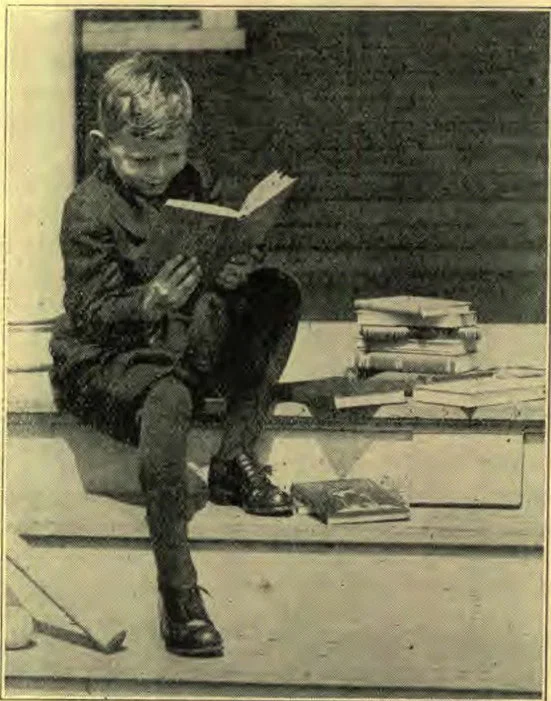
This boy has stopped playing ball to read the new Missionary Volunteer Reading Course books. You can see that he is pleased with what he is reading, and so will every boy and girl be pleased who is provided with this excellent assortment of books. Do not delay to place your order with your tract society.
The most valuable part of a human being’s equipment for life is the mind; but, like any fine tool, it is worthless or harmful unless its owner is skilled in its use and care. So the most valuable preparation for life is the training of the mind to know, love, and seek for the best and highest thoughts and motives, as well as training it to keen, deep, well-controlled habits of thinking. This training can be obtained in two ways — by choosing good companions, and by reading good books. Every one is not permitted to associate with the noblest and most cultured persons, but all may associate with the noblest of books,—the Bible,—and with other books which draw their nobility from the Bible, such as the biographies of worthy men and women, histories of God’s providence among the nations, and accurate descriptions of the world and its people.
The Reading Course presents from year to year the right opportunity for this training and association with the highest, and it is our loss if we do not seize these opportunities, which offer a culture and a mental training to be obtained by no other means. The method of studying the books of the Reading Course gives a priceless training in habits of observation and reflection.
To one who was in danger of losing her Christian experience through indulgence in light reading, Sister White wrote:
“You are indulging an evil which threatens to destroy your spirituality. It will eclipse all the beauty and interest of the sacred pages. It is love for storybooks, tales, and other reading which does not have an influence for good upon the mind that is in any way dedicated to the service of God. It produces a false, unhealthy excitement, fevers the imagination, unfits the mind for usefulness, and disqualifies it for any spiritual exercise. It weans the soul from prayer and love of spiritual things. Reading that will throw light upon the Sacred Volume and quicken your desire and diligence to study it, is not dangerous, but beneficial. You were represented to me with your eyes turned from the Sacred Book, and intently fixed upon exciting books, which are death to religion. The oftener and more diligently you peruse the Scriptures, the more beautiful will they appear, and the less relish will you have for light reading. The daily study of the Scriptures will have a sanctifying influence on your mind. You will breathe a heavenly atmosphere. Bind this precious volume to your hearts. It will prove to you a friend and guide in perplexity.”—“Testimonies for the Church,” Vol. I, pp. 241, 242.
In giving instruction to the children of Israel regarding their king when they should come into the Promised Land, the Lord said:
“It shall be, when he sitteth upon the throne of his kingdom, that he shall write him a copy of this law in a book of that which is before the priests the Levites: and it shall be with him, and he shall read therein all the days of his life: that he may learn to fear the Lord his God, to keep all the words of this law and these statutes, to do them: that his heart be not lifted up above his brethren, and that he turn not aside from the commandment, to the right hand, or to the left: to the end that he may prolong his days in his kingdom, he, and his children, in the midst of Israel.”
Paul’s instruction to Timothy was, “Till I come, give attendance to reading.”
If the farmer wishes a good harvest in the fall, he begins his work early, and continues all the spring and summer preparing the soil, planting the seed, and cultivating the growing crops. If he does not spend his time well during the spring and summer, he will not have a good harvest. Just so with the youth (and older persons, too); if we fail to improve our time well during the present, we shall in the future be no better off for having lived; worse still, if the time has been ill spent, we shall be going backward instead of forward.
It is true in more senses than one that “the pen is mightier than the sword.” If employed in writing truth, the pen can move the heart when the sword4cannot; but if it is employed by the wicked and depraved, it is more destructive than the sword; for it not only destroys the usefulness of the life that now is, but also causes the loss of that which is to come. The sword kills bodies, but the pen ruins characters.
A few years ago, in a city in central Indiana, a number of railroad ties and other things were found on a railway track. They had been placed there to wreck a passenger train, soon to pass. A number of boys about twelve or thirteen years of age, who had been reading of such things in exciting tales, and were desirous of emulating their favorite characters, had planned to wreck the train.
No one can feed exclusively upon daily newspapers, magazines, and stories, and develop a Christian character. Let us forever turn away from dangerous reading matter, and fill our minds with the good, the noble, and the true! Most important of all, the uses to which reading may be applied is that of encouragement to noble living and elevation of character.
It requires time to reach any ideal of worth. Economy of time is essential for success in any undertaking, especially in carrying out a plan of self-improvement, but such economy will pay large dividends. Gladstone said: “Believe me when I tell you that thrift of time will repay you in afterlife with a usury of profit beyond your most confident dreams. And the waste of it will make you dwindle alike in intelligence and in moral stature beyond your darkest reckonings.”
To form a taste for good books is to keep the best of company, and have it when we want it. We should select our books as we choose our companions. We should not take every one on the street for companions, neither should we read everything that passes under the name of literature, but choose only the best.
Much care should be exercised in the selection of the material to be admitted into the storerooms of the mind. It is not a question of merely filling the space; the material should be useful, that which will prove of value along the journey of life, as well as valuable at the end of the journey. In many respects life is like a grocery box—its value in the world’s great market depends chiefly upon what is put into it.
The influence of reading is very great, preparing the individual for life eternal or death eternal. Robert E. Speer said, “A low mind cannot long remain low when filled with great words, which cannot be kept down, but soar aloft to God.”
National Prohibition
The Independent vigorously appeals for national prohibition as a war measure. The editor says:
“There are two compelling reasons why we should do away with the manufacture and sale of intoxicating beverages during the war.
“One is that to make beer and whisky uses up food; and to win the war we need every pound of food we can get—not to drink, but to eat.
“The other is that the drinking of beer and whisky uses up human efficiency; and to win the war we need every ounce of human efficiency that we can conserve.
“What we need here and now is national prohibition.”
The two arguments are sound; and they argue for national prohibition, both in time of peace and in time of war.
The Bible Proves Itself
“THE best evidence of the Bible being the word of God is to be found between its covers. It proves itself.”—Charles Hodge.
The Man Who Translated the New Testament for the Icelanders
By S. Roxana Wince
ODDER GOTTSCHALKSEN,—who ever heard tell of such a name, so odd and so hard to pronounce! It sounds like a German name, and I think it must be, for Odder’s father was a bishop who studied under Martin Luther, and Luther, we know, was a German.
Odder’s father had taught him that salvation can come only through Jesus. He loved the doctrine, and was very happy when he could teach it to others. Later in life he went to Iceland, that bleak northern island of which we know so little. Here he acted as secretary to a Roman Catholic bishop, and had to be very careful not to let him know what he was teaching. For the Catholics believe that their priests are the mediators through whom men get the forgiveness of their sins, and that the dead Virgin Mary and other dead people can fill the same office on behalf of those who have sinned, and that outside of the Roman Catholic Church, and without confessing to her priests, there is no salvation for any one. But Odder was satisfied to believe in and obey the gospel of Jesus as the New Testament taught.
Odder had quite a library for those days, but his books were Greek and Latin, and the poor Icelanders could not read them. They must have the sweet New Testament story in their own language, so in an old cow stable fitted up as a study, he went to work to translate it. Every spare moment was utilized.
But Romish spies must have watched Odder, for they found out what he was doing, and told the bishop. He was very angry, and threatened to excommunicate every person who believed the new doctrine, for Odder was teaching as well as translating. To excommunicate is to cut one off from the church, and Roman Catholics think that that is a dreadful thing, because an excommunicated person, according to their view, has no hope of a happy hereafter.
But people had already become too wise to be frightened; they knew the bishop could not cut them off from future life, and they did not care for his curses, so the teaching and the translating went on. When all the New Testament had been put into Icelandic words, it was taken to Copenhagen and printed. Christian III was the king of Denmark then. It was by his order that Odder’s Testament was put into the printer’s hands, so he, too, must have learned that we cannot be saved by a poor mortal priest.
A few years later the whole Bible was translated and printed in the Icelandic language. The Icelanders were very happy to get it. They studied it diligently, and believed and followed its teachings. Odder’s work still has an influence over his adopted country, the Icelanders being a good, quiet people, happy in their cold Northern home.
You never heard of Odder Gottschalksen before, but you will remember him now. You will love his name and set it very high. It is a brave thing to do to go against men to please God, and great and lasting results are sure to follow when the battle is won. Fear only God. Follow him. Do his work. Fight his battles. Then the stars set in your crowns will shine for endless ages.
Luther was born in 1483, and died in 1546, but having those dates does not fix the time of Gottschalksen’s translation of the Scriptures into Icelandic; but as Christian III established Lutheranism in Denmark in 1536, the translation must have been made about the time of Luther’s death. S. ROXANA WINCE.
Easy Lessons in Lettering
By Harry H. Hamilton
_By Harry H. Hamilton_
Have you not had occasion to write in printing on paper or blackboard, and wished that you were able to print such matter neatly, making it artistically attractive? Many persons have expressed such a desire to the writer of this article. It is with a view to helping young people who will persistently practice, that this series of lessons is offered in the INSTRUCTOR.
It is well to mention just here that faithful practice will bring the reward; but a person cannot by merely reading over these lessons and admiring the plates of letters, expect his enthusiasm, minus persistent practice, to make him master of this useful art.
The lessons will be made simple, and but few styles of letters will be introduced, as it will be more profitable to master two or three styles of letters, than to perfunctorily exploit a great number of alphabets.
Materials Required
In the work of this series but few materials are required, and their cost will not exceed $1.50. A No. 4 Esterbrook’s Text Writer Pen, Nos. 5H, 2B, and 4B lead pencils, chalk crayons, marking and shading pens, and a flat brush. White Bristol board with smooth surface is used for pen lettering. For practice work penmanship paper may be used. The most satisfactory ink is Chinese or Japanese ink sticks, which are put in solution on an inkstone or slab. Water is placed on the slab and the stick of ink is rubbed to solution on the surface of the slab. An inkstone usually costs about thirty-five cents, the stick of ink from five to thirty-five cents. A slab with a shallow well about three sixteenths of an inch deep is ideal. This material may be procured from novelty and art houses or from dealers in Oriental wares.
How to Hold and Dip Pen
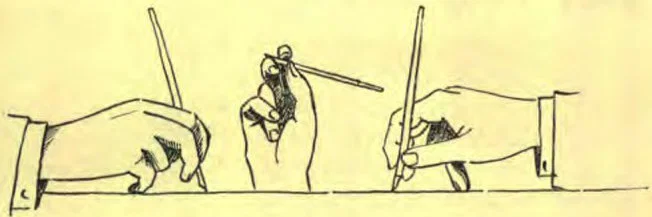
The pen should be held in a nearly vertical position; the broad, flat point should be at an angle of forty-five degrees with the line of writing, as shown by the drawings of the pen point, in the plate. This is the position of the pen whether for the text writer or shading pens, and for all letters whose extremities show that they are made with this slant. The position of the point is always at a slant of forty-five degrees.
While one of the best methods for holding the pen is that shown in the drawing, there are persons who find it difficult to hold the third finger against the palm of the hand, or even back of the little finger. This method is good because text lettering is done by finger motion, and when the third finger is removed from the path of the second in its upward and downward sweep, there is much greater freedom of action than could otherwise be had.
The pen must not be dipped deeper than about one eighth of an inch. If the eye of the pen be filled, the ink will flow off at the first touch and blot. Shallow dipping gives the best results, and it will be necessary to dip the pen several times for some of the letters.
Directions for Making Letters
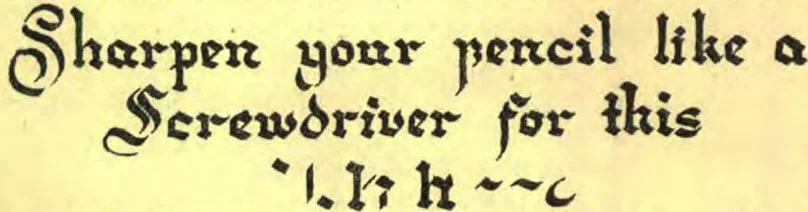
Sharpen your pencil like a Screwdriver for this
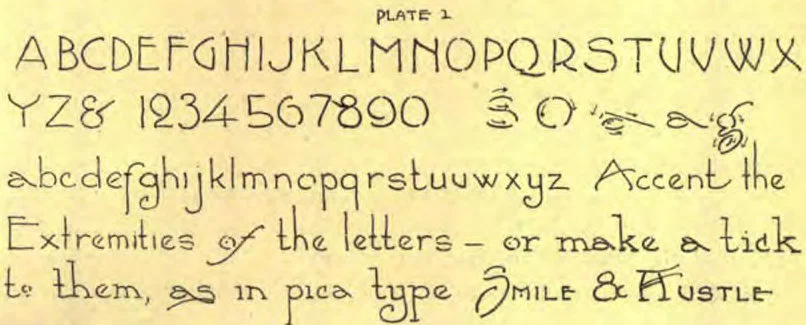
For Plate I, rule with a No. 5H pencil two faint parallel lines one-eighth inch apart. Use a straight-edge, and make the guide lines so light that they will not be noticeable when the letters which you are to make with a No. 2B pencil are written between the lines.
The method of the stroke in lettering with pen or pencil is the same as that of using a brush. A brush will not write upward when held properly. This alphabet is the foundation of all the plates to follow. Notice that the extremities of the letters are accented slightly. Though your letters in your first efforts may not be expertly made, yet your lines will appear well if the letters be evenly spaced and all their stems vertical.
The broad letters are made with a No. 4B pencil sharpened to a flat point like a screw driver. The dim guide lines are one-fourth inch apart for the small letters.
PLATE 1
Spinach Stems Yield Paper Rivaling Japanese Paper
A horticulturist in France, M. de Noyer, claims to have made from the stems of spinach a paper which is as strong and delicate as Japanese paper.
Suggestive Missionary Program
SONG BY CONGREGATION
PRAYER
SCRIPTURE LESSON
SONG BY CHILDREN
RECITATIONS AND CONCERT EXERCISES
The Garden of God
Plan of Salvation Illustrated
The Burning Ice
A Prophetic Drill
Traps
The Guest
QUARTET
RECITATIONS AND CONCERT EXERCISES
Africa’s Need
A Cry from the Foreign Fields
The Sick Children of the Heathen World
China’s First Native Women Doctors
An Illustrated Exercise
Two Dying Women in India
With All the Heart
OFFERING
OFFERTORY PRAYER
MUSIC
BENEDICTION
Scripture Exercise
[Have a boy or girl with a good voice stand at the rear of room and ask the questions. Let answers be given by several children on the platform. Some answers to be given by all in concert, and some by one person alone.]
Who are missionaries?
“We are ambassadors therefore on behalf of Christ, as though God were entreating by us: we beseech you on behalf of Christ, be ye reconciled to God.”
Are there enough missionaries?
“The harvest truly is plenteous, but the laborers are few.”
What is our duty, then?
“Pray ye therefore the Lord of the harvest, that he send forth laborers into his harvest.”
What is the state of the heathen world?
“The dark places of the earth are full of the habitations of cruelty.”
What can take away its darkness?
“Then spake Jesus again unto them, saying, I am the light of the world: he that followeth me shall not walk in darkness, but shall have the light of life.”
Why do they not worship the true God?
“How shall they believe in him of whom they have not heard? and how shall they hear without a preacher? and how shall they preach, except they be sent?”
Do the heathen want the gospel?
“A vision appeared to Paul in the night: There was a man of Macedonia standing, beseeching him, and saying, Come over into Macedonia, and help us.”
Have the gospel messages always been gladly received by the heathen?
“Some fell upon stony places, . . . some fell among thorns, . . . and other fell into good ground.”
Does God care for the heathen?
“Thus saith the Lord God, Behold, I will lift up mine hand to the nations.”
Did Jesus come to save them?
“Other sheep I have, which are not of this fold: them also I must bring.”
Who are sent to bring them in?
“Ye shall be witnesses unto me . . . unto the uttermost part of the earth.”
Who sends these witnesses?
“Then said Jesus to them, . . . As my Father hath sent me, even so send I you.”
What is the “great commission”?
“Go ye therefore, and make disciples of all the nations, baptizing them into the name of the Father and of the Son and of the Holy Spirit.”
Who were the first missionaries?
“The Holy Spirit said, Separate me Barnabas and Saul for the work whereunto I have called them.”
Can children be missionaries?
“The Syrians . . . had brought away captive out of the land of Israel a little maid; . . . and she said unto her mistress, Would God my lord were with the prophet that is in Samaria! Then would he recover him of his leprosy.”
Is there any danger in a missionary life?
“Ye shall be hated of all men for my name’s sake.”
What have missionaries suffered?
“They were stoned, they were sawn asunder, were tempted, were slain with the sword: they wandered about . . . destitute, afflicted, tormented.”
Why did Jesus permit this?
“The disciple is not above his master, nor the servant above his lord.”
What help has Jesus promised?
“Lo, I am with you alway, even unto the end of the world.”
What have missionaries accomplished?
“The people that walked in darkness have seen a great light: they that dwell in the land of the shadow of death, upon them hath the light shined.”
Has God promised them success?
“From the rising of the sun even unto the going down of the same my name shall be great among the Gentiles.”7
What reward has Jesus promised?
“They that turn many to righteousness [shall shine] as the stars forever and ever.”
When will missions end?
“This gospel of the kingdom shall be preached in the whole world for a testimony unto all the nations; and then shall the end come.”
What will then be the state of the world?
“The earth shall be full of the knowledge of the Lord, as the waters cover the sea.”