[An exercise for primary children. The number used to outline the garden depends upon your own choice. Use the oldest boys for this. Six will be required—one at each corner, and two at the center front. These hold the ends of long ropes, wrapped with green grape paper, thus inclosing the garden. Use as many boys as you wish. The other children are grouped in three divisions. The first is composed of Cradle Roll members, and all who wish to join it. The second division consists of other children up to six years old. The third division consists of still older children. Have the front of the garden far enough from the front of the platform to allow the children to come onto the platform. The children come up from the front to the platform, on each side, third division first. Choose the best speakers for the recitations. These head their divisions.]
First Child:
What is this garden so fair we see
As we journey along life's way,
This beautiful Sabbath in sunny July?
What fair spot is this, I pray?
First Boy:
The garden you see is the Garden of God;
We call it the Sabbath school.
For Christ and the church its endeavor grand,
And its motto, the Golden Rule.
Second Child:
May we enter?
Second Boy:
O yes, swing wide the gates—
The gates of the Garden of God.
[Two boys at center front step back, thus opening the gates.]
Gatekeepers:
Pass in little children, and grow for God,
Growing wiser and better each day.
[Children pass in and take places in one or more semicircles, toward back. Gates close again.]
All Sing (tune, “Precious Jewels”):
In the Garden of God there is room for the children;
Like the fair Rose of Sharon each day we shall grow;
We're growing for Jesus, we're growing for Jesus,
We shall bloom for the Saviour, who loves us we know.
Third Child:
We are glad to be here in the Garden of God,
In his own dear Sabbath school;
We shall grow up to work for Christ and the church,
And to practice his golden rule.
All:
“Whatsoever ye would that men should do to you, do ye even so to them.”
Fourth Child:
“Even a child is known by his doings, whether his work be pure, and whether it be right.”
Fifth Child:
“Train up a child in the way he should go: and when he is old, he will not depart from it.”
Sixth Child:
“Remember now thy Creator in the days of thy youth.”
[Second division come onto platform, and one speaks.]
First Beginner:
We are the little beginners,
Just starting the Christian way.
Second Beginner:
May we enter the beautiful Garden of God
Through the gates of the Children's Day?
Third Boy:
Yes, dear Beginners, enter in
Ere yet your hearts are stained with sin;
Swing back each beautiful garden gate;
No little child outside must wait.
[Gatekeepers open gates, while reciting.]
Gatekeepers:
In the Sabbath school there is room for all;
Enter the garden, ye children small.
[Children pass in and group themselves in front of third division. All of second division recite.]
We're glad to be here in the Garden of God
On this beautiful Children's Day;
We'll look to the Saviour in prayer and in praise,
And try to grow like him each day.
Third Beginner:
“We love Him, because he first loved us.”
All:
“Those that seek me early shall find me.”
All Sing:
We will grow in God's garden with love and thanksgiving,
We will grow for the Saviour, his praises we'll sing;
We're growing for Jesus, we're growing for Jesus,
For the heavenly Gardener, our Master and King.
[First division comes on platform.]
First Cradle Roll Child:
We are the Cradle Roll children;
May we, too, enter there?
Second Cradle Roll Child:
We'd like to be flowers for Jesus,
And grow in his garden fair.
Fourth Boy:
Open the gates, let them open wide,
So the Cradle Roll children may pass inside.
[Gatekeepers open gates and recite.]
Gatekeepers:
Come in, little ones, there is room for you;
For fairer blossoms there never grew.
All:
“Suffer the little children to come unto me, and forbid them not, for of such is the kingdom of God.”
[All the Cradle Roll children recite.]
In the Garden of God we'll try to grow
And bloom for Jesus, we love him so.
All Sing:
Like the roses and the lilies, the children are growing,
Like the fair, swaying daisies that everywhere nod;
We're growing for Jesus, we're growing for Jesus,
We children are blossoms in the Garden of God.
[One of the older children now recites:]
If you want us to grow in the Garden of God,
In his church and his Sabbath school,
Remember, we follow where parents have trod;
And this is a very good rule:
Come to Sabbath school with us, and help us to grow;
'Twill be good for the children, and you, too, I know.
Gatekeepers (opening gates):
Through the fair gates of Children's Day,
Pass on, little children, and go your way.
[Children pass out, and off platform, singing.]
All Sing:
At home or at school, at our work, play, or lessons,
If we follow the path that our Master has trod;
If we love him and serve him, we still shall be growing,
We still shall be growing in the Garden of God.
[When all have passed out, the boys forming garden follow.]
— Selected and adapted.
Plan of Salvation Illustrated
By Stemple White
[For four girls.]
[Enter first girl, and quotes Gen. 1: 26, 27, and Eccl. 7: 29, then holds up a glass of clear water containing a little copperas, and says:]
“Just like this glass of water clear,
Was man before the fall;
But when he sinned [drops a little tannic acid in glass],
How things were changed!
The curse is seen in all.”
[Steps back on rostrum.]
[Enter second girl, stirs glass of water until all turns black, then holds up and says, after quoting Jer. 17: 9 and Rom. 8: 7:]
“Behold the sad condition of mankind since the fall,
Enslaved by sin from birth to death, condemnation upon all.
No power to keep God’s holy law, no hope of God or heaven;
Forever lost to righteousness. Sin is the awful leaven.”
[Steps back on rostrum.]
[Enter third girl. Quotes 1 John 1: 9, and then says:]
“Education, wealth, nor pedigree can save us from our sin;
Calvary’s crimson stream alone can cleanse the one who
plunges in.
[Drops in glass a little oxalic acid.]8
Thus born again and saved from sin, he loves all God’s precepts;
With holy power he’s kept each hour, and walks in Jesus’ steps.”
[Steps back on rostrum.]
[Enter fourth girl. Quotes Rev. 22: 14; Matt. 24: 14; and Rev. 14: 12; then stirs contents of glass until all is clear, holds it up, and says:]
“There is power in the blood of our Saviour to keep
From falling in sin from week unto week.
He’s preparing a people in his kingdom to live.
O accept of his mercy! your heart to him give;
Have no part with the devil in his war against God,
Some day every sinner will return back to sod.
Get in harmony with the Father, his law, and his Son,
That in ages to come we all may be one.”
[Quotes Isa. 45: 18; 66: 22, 23, and steps back on rostrum with other girls. All sing, “There Is Power in the Blood.”]
STEMPLE WHITE.
A Prophetic Drill
By Stemple White
“GREAT NATIONS IN DIVINE PROPHECY”
[By six boys, using a sectional metallic image to illustrate Nebuchadnezzar’s dream.]
[Enter first boy.]
“NEBUCHADNEZZAR, king of Babylon, a monarch proud and bold, Received from God a dream in which world kingdoms were foretold. The head of gold was Babylon, that ruled in pride and sin; By sword in conquest it went forth and hammered people in Submission to its wicked rule,—opposed the law of God; So wicked Babylon must fall by Medo-Persia’s rod: And so it fell [removing head from sectional metal man], to rise no more, its glory passed away; Then Medo-Persia took its place in universal sway.”
[Exit boy.]
[Enter second boy.]
“This nation, too, opposed God’s law,—united church and state; In Daniel’s persecution, was shown religious hate. Its glory, too, must perish; and it was humbled low By Alexander, Grecia’s prince, who struck the fatal blow.”
[Remove silver section, then exit.]
[Enter third boy.]
“A world lay prostrate at his feet, and Alexander wept That he might have another world, yet this he never kept. This king became a slave to drink, was ruined by alcohol; His countrymen indulged the cup—one cause of Grecia’s fall. Wage war against the old saloon, let’s put the whole State dry; These people drank themselves to death, so Grecia passes by.”
[Remove brass section, then exit.]
[Enter fourth boy.]
“Iron monarchy of Rome ruled all with iron rod; She fed God’s saints to ravenous beasts, and killed the Son of God. In vain Rome warred against God’s Word, though a despot in her day; The barbarous tribes divided Rome, and thus she passed away.”
[Remove legs of iron, then exit.]
[Enter fifth boy, holds up feet section while speaking.]
“These nations still exist today, as shown in ages past; Some strong, some weak, yet separate as long as time shall last. That Christ’s kingdom soon will come, was declared by one who knows; Not set up by sword or ballot, but by smiting on the toes.”
[Exit.]
[Enter sixth boy, and points to special chart illustrations of the second advent and resurrection scene.]
“In the glory of the Father, in the glory of the Son; In the glory of holy angels, who accompany the Holy One, Will the Saviour, soon descending, close the drama of the day; Raise the dead, reward his people, whom the angels bear away. When the earth, renewed, appeareth from the first of last great day, In Edenic form and beauty, here the saints, eternal, stay. In this universal kingdom, joy and peace is everywhere; Jesus reigns in love triumphant, no more sorrow over there.”
[Following this exercise, “Look for the Waymarks” may be sung.]
STEMPLE WHITE.
The Burning Ice
[Make a small hole in a block of ice and fill it with spirits of camphor. At beginning of third verse the child reciting should light the spirits with a taper. It will appear that the ice is burning.]
THE sunlight of the Word of God
Is like the sunlight from the sky
Which smiles upon the frozen sod,
And life starts there to beautify;
It beams upon the ice-bound brook,
Whose fetters quickly melt away —
So is the sunlight of this Book,
A melting, liberating ray.
This Book shines into valleys where
But gloom and death have been,
And many joys awaken there,
And souls throw off the chains of sin.
It finds the swamps of human life
Where fever breeds and serpents crawl,
Where all that would destroy is rife,
And shining there it ends them all.
[Lighting the ice.]
I cause this block of ice to burn
With glowing heat — by some device;
And thus I seem to overturn
The laws we know to govern ice.
And so the Bible touches hearts
So cold and dead, so lost to shame
There seems no hope; but soon it starts
In them a pure and holy flame.
— Selected.
Traps: A Recitation Exercise for Five Boys
By Elizabeth F. Guptill
Traps
[An exercise for five boys, each carrying a banner, fastened to a staff tail enough to rest upon the floor, and be easily held steady. On one side of the banners are the letters to spell “Traps,” on the other side the letters to spell “Jesus.” Boys enter singly, march down to center, around leader in circle, then two pass to each side of him, and all pass to front together, banners spelling “Traps.”]
All:
There are traps all around you. Beware, O beware!
Or your feet will slip into some terrible snare.
First:
Keep a watch over your temper and tongue,
Traps for the unwary are they;
“Little,” you say? Ah, they hold you so fast,
That alone you can ne’er break away.
Second:
Rudeness—a rough and ungainly trap—
Yet it catches us, boys. You see,
The boy who is boorish and rude and unkind,
Will never a gentleman be.
Third:
Anger. The boy who “gets mad” too quick,
In this terrible trap will fall;
Anger to murder sometimes grows;
So beware of the fight and brawl.
Fourth:
Passion’s a twin to anger. These traps
Together we often find;
With a cheery whistle we’ll pass them by,
And keep a forgiving mind.
Fifth:
Sloth and self are two yawning traps,
Waiting for you and for me;
But a lazy, selfish boy will ne’er
A good Christian worker be.
All:
But how avoid these waiting traps?
We’ve a talisman ’gainst them all;
The boy with this talisman in his heart,
Will into no one of them fall.
[Now, as each speaks, let him turn his banner, thus spelling the word “Jesus.”]
First: Just ask the Lord to help you,
Second: Endeavor his will to do;
Third: Succor he’ll send in time of need,
Fourth: Unto me and unto you.
Fifth:
Serve him with joy and gladness,
And he will be your friend,
And ever walk beside you
Unto your journey’s end.
All:
This is our talisman—the Name
That from temptation frees us;
That guides us ’mongst the traps and snares,
That sacred name of Jesus.
— Elizabeth F. Guptill.
Africa’s Need
[A young man or a young woman.]
GREAT sorrow has come to the heart of every pioneer missionary in Africa over the unnecessary sacrifice of life among the native peoples. When twins are born, the lives of the mother and the babes are required, for twins are an omen of great evil. When a chief is sick, it is claimed that he is bewitched, and the lives of those supposed to be implicated are demanded, even though he recovers. If he dies, others must die to do him honor. One of the strongest reasons some of the natives give for not becoming Christians is the fear that they would have to forego the honors of a “red sunset,” or bloody burial. Every poor chieflet demands his right to drag down with him to the nether world at least one or two splendid specimens of the human kind. And the demands are that the living sacrifice shall have no blemish. One chief required the death of two thousand persons to expiate his death.
Mr. Dan Crawford, who has spent a quarter of a century with Africa’s dark people, refers to an incident with which he was acquainted that is appalling in its gruesomeness. The native involved was a chief, a personal friend of Mr. Crawford. When he died, a whole town was completely wiped out that he might have a truly “vermilion sunset.” “When the chief felt that he was about to die, he made his last stand, retreating to a huge cave, resolved to die grandly, impressively, and magnificently,—die with all his people around him like a winding sheet.” Long before this he had secretly made preparation for a startling sunset. He had selected a large limestone cave with only one opening. In this he had placed food and firewood in abundance, and the accumulated ivory of years. When he was about to die, he ordered the town to bear him to his last resting place. This they did willingly, unconscious of the fate that awaited them. When they were all within the cave, the enemy, by secret orders from the chief, rushed upon them and heaped rocks and earth before the opening, so that exit was impossible. The long days passed, days in which the great bluebottle flies hummed in and out of the chinks of the rocks to tell the tale of corruption.
Listen! Out through one of the limestone chinks a gentle telltale moan of a human being is heard. There it is again. “We are all dead; O let me out!” it wails. Warriors on the outside are shaking with fear at this voice from the tomb. Nanga pleads for disentombment, offering to part gladly with feet and10hands if she is found to have told aught but the truth. At last she, with two others more dead than alive, are extricated from the cruel débris. “They bring a gruesome tale from that land of the dead, a tale of slow, lingering emaciation and dissolution. First the food failed, then the fagots, and then came the exasperated expedients for firewood. All the old gunstocks and spear shafts were burned off first. Then the gleaming tusks of ivory were fed to the flames. Thus died the chief in his glory, heated at a funeral blaze of burning ivory, emperor’s fuel, it is called.” Such scenes beggar description.
And here we sit in these civilized lands and allow such dark practices to go on without a protest, making but little if any attempt to give these deceived ones a knowledge of the infinite value of human life when purchased by the death of the Son of God. If we ourselves cannot carry to the heathen the good news of salvation, we can give of our means that others may go. Then, too, our missionaries are always in need of money to answer the insistent demands that hourly confront them. We can give still more, that they may answer these calls that perplex their souls. Then we can give, give, and give again and again, till the Master stops giving to us.
The Guest
By Augusta Albertson
IN Jewry had I dwelt of old,
The Master would have supped with me,
And I his handmaid would have been,
Like Martha — she of Bethany.
For him the table had been set,
For him the upper room prepared,
And all my best of oil and nard
With him had willingly been shared.
Then, when he left my cottage door
And to the temple made his way,
I with the children would have strewn
Palm branches in his path that day;
My voice with theirs had been upraised
To lift the anthem clear and sweet,
To David’s Son and David’s Lord,
Along the crowded city street.
And when, throughout the starry night,
Amidst the olive trees he wept,
Not far away would I have prayed,
And with him would have vigil kept.
And when the dolorous path he trod
Up the steep road to Calvary,
Like Simon, at his side would I
Have borne for him the heavy tree.
Shamefast, heartbroken, I had stood
Beneath the cross whereon he died,
The while the sun looked down aghast
To see its Maker crucified;
And hope within my heart had sprung
To see, like Aaron’s rod of old,
Beside the rod on which he hung,
The flower of penitence unfold.
Perhaps the honor had been mine
To give that precious body room
For sepulture, and to have been
Among the earliest at the tomb,
When, bearing spices rare, they came,
Ere yet the shadowy night had fled,
And found, amazed, the broken seal,
And seen, where they had laid him dead,
Angelic guards, in glistening white,
And heard with joy their message sweet;
Then, in the glowing Easter light,
I would have fallen at his feet
With Mary, whom he called by name;
Or journeyed with the two when he
They loved and mourned as lost drew near,
And made it plain that Calvary —
The blood sweat — the cruel scourge —
The bitter cross on which he died —
Were but the lot the prophet saw
For him who must be glorified.
This to my heart I oft had said,
And once again thus ran my thoughts:
Had I been there in Jesus’ day,
How willingly would I have wrought
For him, as did the faithful few;
How glad to seize the chance to prove
Myself a follower of the Lord,
With all my goods and all my love.
’Twas Easter eve; the first brave flowers
Of spring were budding ’neath the snow;
There lingered yet the wintry chill
That northern climes in April know.
I sat beside my cozy fire,
The flames cast shadows on the wall,
When suddenly, I know not how,
I seemed to hear my Master call.
He called my name; I thrilled to think
The risen Christ had come to be
My guest. In accents low he said,
“And wouldst thou minister to me?”
“Yea, Lord, thou knowest that I would,
If thou wilt only show me how.”
Tender, and low, and lover-like,
He answered me: “I need thee now.”
“Lift up thine eyes — the world is sad,
Its cup of sorrow overflows;
Today is my Gethsemane,
The nations’ sorrows are my woes.
I weep alone where widowhood
And orphanage lift up their cry;
I grope in darkness, being blind;
That lonely prisoner is—I;
“I toss in speechless agony,
Or moan upon my narrow bed;
I weep beside my ruined home;
I perish for a crust of bread.
Think not what once thou wouldst have done
Hadst thou been there in Galilee,—
Where any child of earth has need,
There thou canst minister to me.”
While thus he spoke, my little room
Grew strangely large and strangely bright,
And when he vanished, a perfume,
Like Easter lilies, filled the night.
The light has vanished; the perfume
Is mingled with the breath of spring;
But life can never be the same,
And service is a nobler thing.
I see the world with open eyes,—
The world of need, the world of sin,—
And when the voice of duty calls,
I bid the Lord Christ enter in.
—Augusta Albertson, in the Christian Herald.
The Sick Children of the Heathen World
A LADY missionary in Korea was called over the mountains to see a woman whose little boy was sick with a tumor of the abdomen. On asking what had been done, she learned that he had received the usual needle treatment of the Korean native doctor. This needle treatment consists of piercing the body with sharp instruments, as pins, needles, or nails. This child had had perhaps a hundred such piercings. There were great sores on his body. In this treatment no effort is made to avoid infection, so the results oftentimes far exceed in seriousness the disease itself. So painful is the needle treatment that when the boy saw this missionary he was wild with fear, thinking he should again be subjected to the terrible process. His shrieks were heart-piercing, and he trembled from sheer fright.
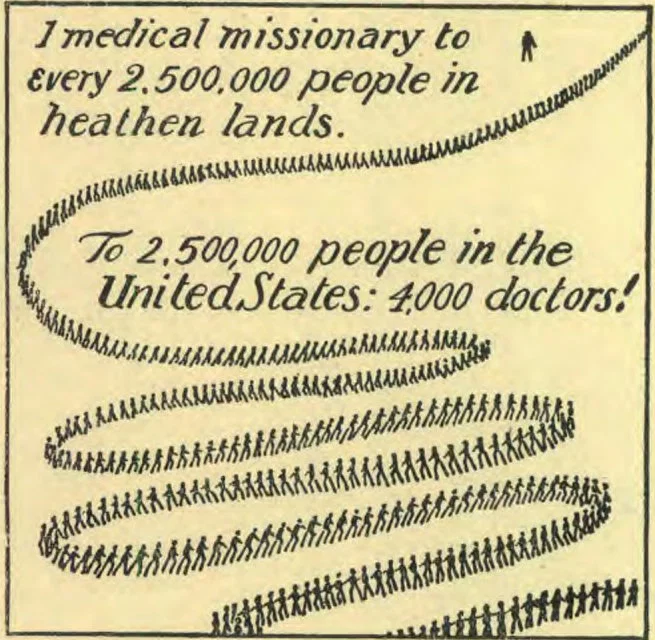
This little fellow is only one of hundreds that suffer daily from the same ignorant, inhuman treatment, and all because the Christian missionary has waited so long to go to Korea, and because that even now there are so few missionaries in that country. If all the doctors and nurses and all the hospitals, except 160, and Chicago alone has more than this number, were taken out of the United States, then we could appreciate a little of Korea’s need of medical missions. In fact there is but one medical missionary to every 2,500,000 people in heathen lands, while in America there are 4,000 to every 2,500,000. The picture represents Korea’s one lone medical missionary and a long procession of our United States doctors, but these are only a small part of the 4,000.
Heathenism is about the same the world over. In China the killing of infants is horribly common. A lady missionary in South China once asked a group of women how many of them had destroyed their baby girls, and all confessed to having killed at least one, while one acknowledged that she had destroyed five. It may be that death is preferable to the suffering that must have come to many of these had they11lived; for the needle treatment, burning with hot irons, and other horrible measures are resorted to in the attempt to drive out the evil spirit which is believed to be the cause of pain. A common prescription of the Chinese doctor is —
Powdered snake .................... 2 parts
Centipedes ........................ 6 parts
Scorpions ......................... 4 parts
Wasps and their nests ............. 1 part
Toads ............................. 20 parts
Grind thoroughly, mix with honey, and make into pills. Two to be taken four times daily. Broth made from the living flesh of one’s own child is sometimes administered to the sick.
Only in lands where the Great Physician is known is the sick child properly cared for; “and two infants out of every three in the world look up into the faces of mothers who can tell them no words of the world’s Saviour.” The children of India, walking four abreast and two feet apart, would make a procession five thousand miles long, or as far as from New York to San Francisco and two thirds of the way back. Few of these when sick can have rational medical treatment. They become helpless victims of the ignorant native doctors. Is it not time that we do what we can — all that we can — to uphold and strengthen the hands of the educated medical men and women who are now in these heathen countries, and then do still more to secure the means for greatly increasing their number? “Love never asks, How much must I do? but, How much can I do?”
A Cry from the Foreign Fields
[For one of the older boys.]
PETER CAMERON SCOTT, in one of his missionary tours, gives a touching description of what was accomplished after having preached Jesus for nearly two hours or more. A very old heathen African, having most attentively listened, came tottering up to where he stood, and after asking a few most searching questions, became satisfied that the blood of Jesus could cleanse away even his sins, and while opening his heart to the Saviour closed his conversation by asking with deep pathos, in trembling tones, while the tears glistened in his eyes: “Why didn’t you tell us the story sooner? why didn’t you let us know?” This led to the writing of the following poem:
“A Cry from Africa
“Why didn’t you tell us sooner?”
The words came sad and low:
“Oh, ye who know the gospel truth,
Why didn’t you let us know?
The Saviour died for all the world,
He died to save from woe,
But we never heard the story;
Why didn’t you let us know?
“We appeal to you, O Christians,
In lands beyond the sea;
Why didn’t you tell us sooner,
Christ died for you and me?
Nineteen hundred years have passed
Since disciples were told to go
To the uttermost parts of the earth and teach;
Why didn’t you let us know?
“You say you are Christ’s disciples,
That you try his work to do;
And yet his very last command
Is disobeyed by you!
’Tis, indeed, a wonderful story:
He loved the whole world so,
That he came and died to save us—
But you didn’t let us know.
“O souls redeemed by Jesus,
Think what your Lord hath done!
He came to earth and suffered,
And died for every one;
He expects you now to tell it,
As on your way you go—
But you kept the message from us;
Why didn’t you let us know?
“Hear this pathetic cry of ours,
O dwellers in Christian lands;
For the heathen stand before you
With pleading, outstretched hands.
You may not be able to come yourself,
But some in your stead can go;
Will you not send us teachers?
Will you not let us know?”