Your ShelfYour Projects

Signs of the Times, Vol. 36, No. 24.

On the Mount

Signs of the Times

Jun 23, 1909

Pacific Press Publishing Association · Mountain View, California · Jun 23, 1909

On the Mount

Not always on the mount may we Rapt in the heavenly vision be; The shores of thought and feeling know The Spirit’s tidal ebb and flow.
Lord, it is good abiding here— We cry, the heavenly Presence near; The vision vanishes, our eyes Are lifted into vacant skies!
Yet hath one such exalted hour Upon the soul redeeming power, And in its strength through after days We travel our appointed ways;
Till all the lowly vale grows bright, Transfigured in remembered light, And in untiring souls we bear The freshness of the upper air.
The mount for vision,—but below The paths of daily duty go, And nobler life therein shall own The pattern on the mountain shown.
— Fred Lucian Hosmer

OUR BIBLE BAND

Schedule for Week Ending July 3, 1909.

Morning Evening
Su. June 27 Job 8, 9, 10 Acts 8:26-40
Mo. “ 28 “ 11, 12, 13 “ 9:1-21
Tu. “ 29 “ 14, 15, 16 “ 9:22-43
We. “ 30 “ 17, 18, 19 “ 10:1-23
Th. July 1 “ 20, 21 “ 10:24-48
Fr. “ 2 “ 22, 23, 24 “ 11
Sa. “ 3 “ 25, 26, 27 “ 12

Suggestive Notes.

The week’s reading in the Old Testament begins with Job 8 and concludes with Job 27. At its close, Job’s friends have ceased to trouble him with their constant accusations, implied and otherwise, and our week’s reading stops in the middle of Job’s last reply. It may not always be well for us to follow just the order given for the day. We may wish to read farther; sometimes it is well to bring these accusations and responses together.
Our evening readings in the New Testament begin with Acts 8:26 and close with chapter 12. We have the account of Philip’s guidance by the Spirit in order that he may meet the Ethiopian eunuch; the arrest and conversion of Saul from his mad work of persecution; the healing of Dorcas by Peter; the vision relating to Cornelius the Roman centurion and his conversion; the death of James the brother of John; the miraculous release of Peter from prison; and the horrible death of Herod. All are graphically portrayed.

Question Corner

[To Our Inquirers.—(1) The name and address of all who ask questions must accompany questions, not necessarily for publication, in token of good faith, and that we may reply by letter if thought best. All communications will be considered confidential if so desired, and no name will be published unless requested. But we have no time to give to anonymous or unsigned epistles or articles. (2) Let the questions be to the point. Do not say, “Explain Josh. 7:1-8,” but state the thing upon which help is desired. (3) Questions can not be answered immediately in this department. Sometimes it will mean a month or more of waiting. We can not reply to the same question frequently. Read answers to other questions; you may find reply to yours. (4) Members of the Bible Band will kindly enclose stamp if answer is desired by letter. Others will please enclose ten cents. This does not begin to meet expenses oftentimes. (5) “Foolish . . . questions avoid.”]

2865.—What Is Meant by the Pronouns?

Matthew 11:11 reads: “Yet he that is but little in the kingdom of heaven, is greater than he.” A.R.V. What is meant by the first “he” and also the second “he”? J. A.
The second is John the Baptist. That is very clear. “There has not risen a greater than John the Baptist, yet he that is little in the kingdom of heaven is greater than he.” This can not mean in character or mission, because our Lord has told us of the character that he possessed, and He has also told us of the great mission that he had as the herald of the Most High. What then is meant by “greater”? We should understand, simply greater in opportunity, in privilege, than was John the Baptist. John came as the messenger of Christ, a marvelous and glorious work he did. He went forth in “the spirit and power of Elijah;” multitudes listened to him; and yet he was destined to see the One whom he predicted come, His work grow greater and greater, while his own work should wane until his sun set, seemingly, in utter darkness. Yet he joyed in seeing Christ’s work increase. This he tells us in John 3:29, 30. But he who should come into the church in the fulness of light brought by our Lord and manifest through the resurrection of Christ, however small he might be,—any one who would accept of all these gracious privileges,—would have greater opportunity and blessing in this life, than did John. So the first “he” refers to whoever it may be that accepted and accepts still of the kingdom of the Lord Jesus Christ in the fulness of light that He has given; and the second “he” refers to John.

2866.—Finished the Work.

In the American Revised Version it is said that God finished His work on the seventh day. Gen. 2:2. Does it not imply labor to finish a thing? Is not “ended” or “ceased” better? H. G.
The word “finished” seems to be a good rendering of the Hebrew in that place. It is frequently rendered “finish” elsewhere. (See Ex. 40:33; Ruth 3:18; 1 Kings 6:9, 14, 38; Ezra 6:14, et al.) “Finish” comes from the Latin finis, end. “Ended” we would have preferred. God used just a week, a period of seven days, in making the earth a home for man. The earth was not complete, its cycle of days was not complete, man’s home-period was not complete till rounded out by the crowning day of God, the memorial of His power, the sign between Himself and His people. This part of God’s work was wrought by God’s resting on the seventh day and forever establishing that day as His rest day, even as He established the earth forever. How He finished His work for man on that day is told in Gen. 2:2, 3. The making of the Sabbath was a part of the Creator’s work for man; for “the Sabbath was made for man.” Mark 2:27.

2867.—“Lead, Kindly Light.”

I note what the SIGNS says about the hymn, “Lead, Kindly Light.” It is found in “Christ in Song.” Have the errors been eliminated in that book? I have carefully read it and do not see the errors. Will you point them out? A READER.
Yes, “Lead, Kindly Light” is in “Christ in Song,” and also in “Hymns and Tunes.” The music of Dykes, to which it is set, we believe has helped to perpetuate the poem which should never have found place in Protestant song-books. In the first place it was written by Newman when he was on the way from the Protestant Episcopal Church (or Church of England) to the Roman Catholic Church. Newman’s “kindly light” was leading him from gloom to greater gloom; from much tradition mixed with Scripture to more tradition which places Holy Scripture secondary. Newman came to that place in his experience where he could not trust in his personal relationship with God. He wanted something on which to lean, something which would set aside individual responsibility, and make another party responsible. He found this in the Roman Catholic Church. And we do not believe that the spirit of the writer when he wrote the hymn can be divorced from the words. Their influence will be to carry the spirit of the writer. We sing, and Scripturally, “Not far from home, O blessed thought;” for thus saith the Lord, “Look up, and lift up your heads; for your redemption draweth nigh;” “Know that it is near, even at the doors;” “The path of the just is as a shining light, which shineth more and more, even unto the perfect day.” Can we believe these, and then sing “I am far from home”? The “kindly light” of Newman was human tradition. Do you not want a greater, truer light, even the light of God’s word? Then what are the “angel faces” that he had “loved” and “lost awhile”?

2868.—Psalms 8: 4-8.—L.

That David refers to man in this scripture, and man in general, is evident from the fourth verse: “What is man, that Thou art mindful of him? and the son of man, that Thou visitest him?” True it is that this scripture is quoted in Hebrews 2, but it is there also applied to man and to Christ Jesus, because He was made man. The argument of the first two chapters of Hebrews is that He who was one with the Father and who inherited the name of the Father, came clear down to the human level in order to save man. The quotation in Hebrews, verses 6 to 8, applies to man, and the writer truly declares: “But now we see not yet all things subjected to him,” but we do see “Him who hath been made a little lower than the angels, even Jesus, because of the suffering of death crowned with glory and honor, that by the grace of God He should taste of death for every man,” and the 11th verse declares that “both He that sanctifieth and they are sanctified are all of one: for which cause He is not ashamed to call them brethren.” He took upon Himself that low estate, lower than the angels, just the same as man was created, so there can be no question whatever that the scripture in the 8th psalm is a reference to man in general; but the passage is used in Hebrews to show that our Lord Himself took upon Him man’s nature.

2869.—Freemasonry and Christianity.

Should Christians belong to lodges of Freemasons or Odd Fellows? A. H. G.
We know no necessity for it. We see several reasons against it. (1) Jesus said: “I spake openly to the world; . . . and in secret have I said nothing.” John 18:20. He instructed His chosen disciples to preach “upon the housetops” what they had heard by the ear, what had been taught them in private. Matt. 10:27. God’s wondrous blessings are free to all who by faith appropriate them. He has especial regard for the poor, the weak, the needy, the infirm; but it is such people that Freemasonry and other secret societies prohibit. These secret organizations are at the best only mutual benefit associations and social clubs, life and accident insurance societies, with very high premiums and possible benefits. The extrajudicial oaths, with the oftentimes fearful and unnatural penalties, are contrary to every principle of Christianity. The benevolent acts are of necessity exercised in behalf of those who have contributed to the society or are connected by family ties to the “lodge.” Christianity on the other hand inculcates doing good to all as opportunity offers. That there are sincere believers in Christ who are Freemasons we would not for a moment deny; but to us it seems that they have an erroneous idea of true benevolence as exercised in these secret orders, and they also have a very low conception of the breadth, scope, work, and spirit which ought to be in and actuate the church of Christ. To turn from the church of Christ, from true union with Christ, to any lodge or organization, such as Freemasonry or Odd Fellows, is like turning from the cool-flowing, life-giving waters of the mountain to the brackish waters stored in the broken cisterns of men.

2870.—Fasting Forty Days.

Jesus fasted forty days and nights. Should we not do the same to follow in His steps? I. J. S.
The fact that Jesus is our example does not imply that we should do the identical things that He did. In all moral decisions, in the living out of great moral principles, He is our example. 1 John 2:6. He was absolutely submissive to the Father’s will; we should be. He rendered implicit obedience to God; so should we. Jesus fasted that He might overcome the power of appetite in the flesh and overthrow the dominion of sin in the flesh. If we had to meet all the power of darkness single-handed and alone, as did He, the forty days’ fast might be necessary. But to fast forty days just to follow Him would be works of supererogation not required by God. If we would partake of that fast, let us lay hold of Christ by faith.
“But is not fasting necessary?”—Doubtless it is. Going without physical food for a time makes us feel weak, but it clears up the mind, makes us more sensible of our frailty, more susceptible to the impression of the truth of God, and helps us more fully to realize our dependence upon God. We should learn by such fasts that as our bodily powers become weak without sufficient food, so do our spiritual natures unless fed upon God’s word. If we are gross livers, it gives opportunity for rest to various bodily functions and organs. The professed Christian who would enjoin such a duty as a fast of forty days on each disciple of Christ, would do well to feed a multitude of five thousand or raise a dead man, and then be crucified and rise again. Christ is our example in submitting to God’s will, in overcoming and walking above sin; and He is also the mighty Helper in this work. Let faith lay hold of Him, and His fast is ours.

In the Synagog at Nazareth

By Mrs. E. G. White
Christ in the Synagog at Nazareth
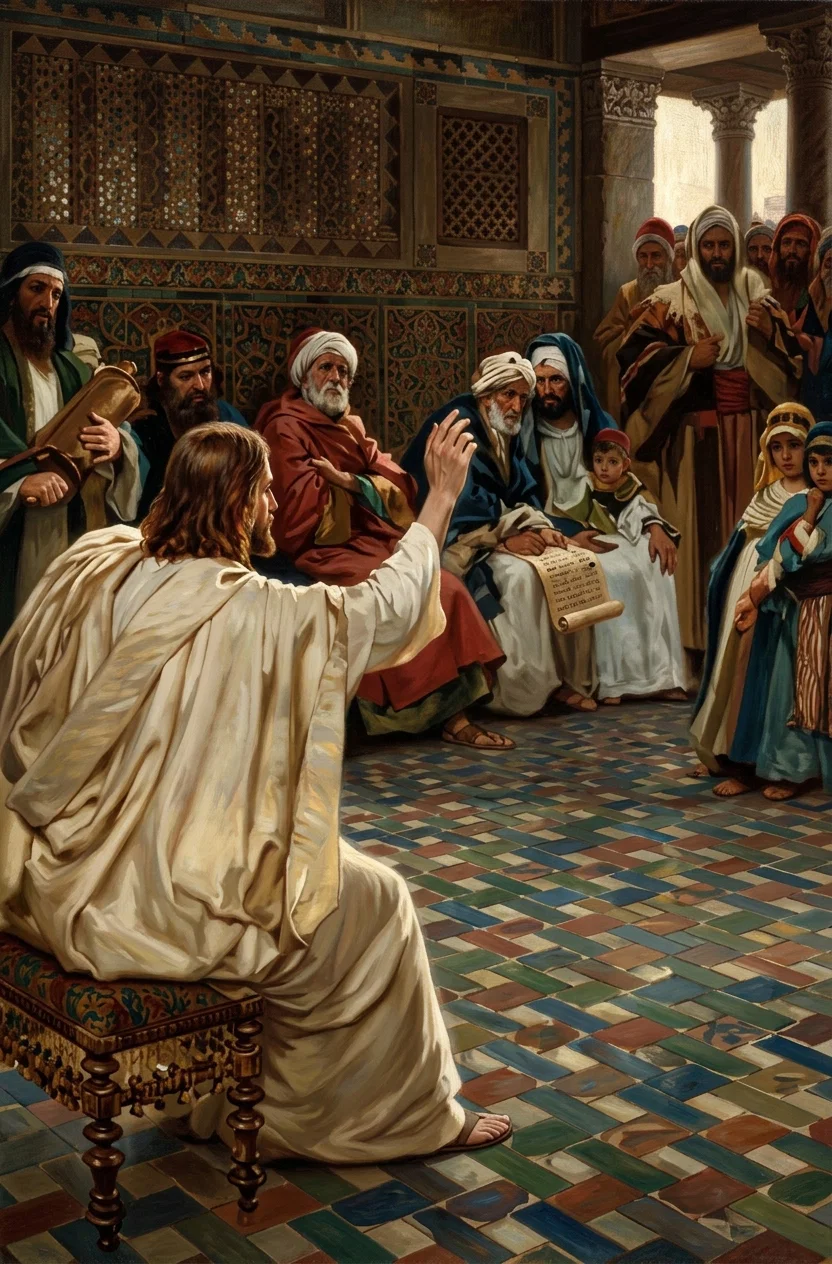
In the early part of His ministry in Galilee, Jesus visited Nazareth, the home of His early years. During His childhood and youth, Jesus had worshiped among His brethren in the synagog at Nazareth. Since the opening of His ministry He had been absent from them, but they had not been ignorant of what had befallen Him. As He again appeared among them, their interest and expectation were excited to the highest pitch. Here were the familiar forms and faces of those whom He had known from infancy. Here were His mother, His brothers and sisters, and all eyes were turned upon Him as He entered the synagog upon the Sabbath day, and took His place among the worshipers.
In the regular service for the day, the elder read from the prophets, and exhorted the people still to hope for the coming One, who would bring in a glorious reign, and banish all oppression. He sought to encourage his hearers by rehearsing the evidence that the Messiah’s coming was near. He described the glory of His advent, keeping prominent the thought that He would appear at the head of armies to deliver Israel.
When a rabbi was present at the synagog, he was expected to deliver the sermon, and any Israelite might give the reading from the prophets. Upon this Sabbath Jesus was requested to take part in the service. He “stood up to read, and there was delivered unto Him a roll of the prophet Isaiah.” The scripture which He read was one that was understood as referring to the Messiah.
“The Spirit of the Lord is upon Me, Because He hath anointed Me to preach the Gospel to the poor; He hath sent Me to heal the broken-hearted, To preach deliverance to the captives, And recovering of sight to the blind, To set at liberty them that are bruised, To preach the acceptable year of the Lord.”
“And He closed the roll, and gave it back to the attendant; . . . and the eyes of all in the synagog were fastened on Him. . . . And all bare Him witness, and wondered at the words of grace that proceeded out of His mouth.”
Jesus stood before the people as a living expositor of the prophecies concerning Himself. Explaining the words He had read He spoke of the Messiah as a reliever of the oppressed, a liberator of captives, a healer of the afflicted, restoring sight to the blind, and revealing to the world the light of truth. His impressive manner and the wonderful import of His words thrilled the hearers with a power they had never felt before. The tide of divine influence broke every barrier down; like Moses, they beheld the Invisible. As their hearts were moved upon by the Holy Spirit, they responded with fervent amens and praises to the Lord.
But when Jesus announced, “This day is this scripture fulfilled in your ears,” they were suddenly recalled to think of themselves, and of the claims of Him who had been addressing them. They, Israelites, children of Abraham, had been represented as in bondage. They had been addressed as prisoners to be delivered from the power of evil; as in darkness, and needing the light of truth. Their pride was offended, and their fears were aroused. The words of Jesus indicated that His work for them was to be altogether different from what they desired. Their deeds might be investigated too closely. Notwithstanding their exactness in outward ceremonies, they shrank from inspection by those clear, searching eyes.
Who is this Jesus, they questioned. He who had claimed for Himself the glory of the Messiah, was the son of a carpenter, and had worked at His trade with His father Joseph. They had seen Him toiling up and down the hills, they were acquainted with His brothers and sisters, and knew His life and labors. They had seen Him develop from childhood to youth, and from youth to manhood. Altho His life had been spotless, they would not believe that He was the promised One.
What a contrast between His teaching in regard to the new kingdom and that which they had heard from their elder! Jesus had said nothing of delivering them from the Romans. They had heard of His miracles, and had hoped that His power would be exercised for their advantage; but they had seen no indication of such purpose.
As they opened the door to doubt, their hearts became so much the harder for having been momentarily softened. Satan was determined that blind eyes should not that day be opened, nor souls bound in slavery be set at liberty. With intense energy he worked to fasten them in unbelief. They made no account of the sign already given, when they had been stirred by the conviction that it was their Redeemer who addressed them.
But Jesus now gave them an evidence of His divinity by revealing their secret thoughts. “He said to them, Doubtless ye will say unto Me this parable, Physician, heal Thyself; whatsoever we have heard done at Capernaum, do also here in Thine own country. And He said, Verily I say unto you, No prophet is acceptable in his own country. But of a truth I say unto you, There were many widows in Israel in the days of Elijah, when the heaven was shut up three years and six months, when there came a great famine over all the land; and unto none of them was Elijah sent, but only to Zarephath, in the land of Sidon, unto a woman that was a widow. And there were many lepers in Israel; in the time of Elisha the prophet; but none of them was cleansed, but only Naaman the Syrian.” By this relation of events in the lives of the prophets, Jesus met the questionings of His hearers.
The servants whom God had chosen for a special work, were not allowed to labor for a hard-hearted and unbelieving people. But those who had hearts to feel and faith to believe were especially favored with evidences of His power through the prophets. In the days of Elijah, Israel had departed from God. They clung to their sins, and rejected the warnings of the Spirit through the Lord’s messengers. Thus they cut themselves off from the channel by which God’s blessing could come to them. The Lord passed by the homes of Israel, and found a refuge for His servant in a heathen land, with a woman who did not belong to the chosen people. But this woman was favored because she had followed the light she had received, and her heart was open to the greater light that God sent her through His prophet.
The words of Jesus to His hearers in the synagog struck at the root of their self-righteousness, pressing home upon them the bitter truth that they had departed from God, and forfeited their claim to be His people. Every word cut like a knife as their real condition was set before them. They now scorned the faith with which Jesus had at first inspired them. They would not admit that He who had sprung from poverty and lowliness was other than a common man.
Their unbelief bred malice. Satan controlled them, and in wrath they cried out against the Saviour. They had turned from Him whose mission it was to heal and restore; now they manifested the attributes of the destroyer.
When Jesus referred to the blessings given to the Gentiles, the fierce national pride of His hearers was aroused, and His words were drowned in a tumult of voices. These people had prided themselves on keeping the law; but now that their prejudices were offended, they were ready to commit murder. The assembly broke up, and laying hands upon Jesus, they thrust Him from the synagog, and out of the city. All seemed eager for His destruction. They hurried Him to the brow of a precipice, intending to cast Him down headlong. Shouts and maledictions filled the air. Some were casting stones at Him, when suddenly He disappeared from among them. The heavenly messengers who had been by His side in the synagog were with Him in the midst of that maddened throng. They shut Him in from His enemies, and conducted Him to a place of safety.
So angels protected Lot, and led him out safely from the midst of Sodom. So they protected Elisha in the little mountain city. When the encircling hills were filled with the horses and chariots of the king of Syria, and the great host of his armed men, Elisha beheld the nearer hillslope covered with the armies of God,—horses and chariots of fire round about the servant of the Lord. So, in all ages, angels have been near to Christ’s faithful followers. The vast confederacy of evil is arrayed against all who would overcome; but Christ would have us look to the things which are not seen, to the armies of heaven encamped about all who love God, to deliver them. From what dangers, seen and unseen, we have been preserved through the interposition of the angels, we shall never know, until in the light of eternity we see the providences of God. Then we shall know that the whole family of heaven was interested in the family here below, and that messengers from the throne of God attended our steps from day to day.

The Coming of the Redeemer

By Geo. A. Snyder
“He shall send forth His angels”

VI. The Hope of the Church

The church of God has ever looked forward to the glorious appearing of the Saviour as the crowning event of her earthly pilgrimage. Enoch stands out as a shining example among the first of those who were called out from the world to walk with God, and of him we read, in Jude 14, 15, that he prophesied, saying: “Behold, the Lord cometh with ten thousand of His saints, to execute judgment upon all.”
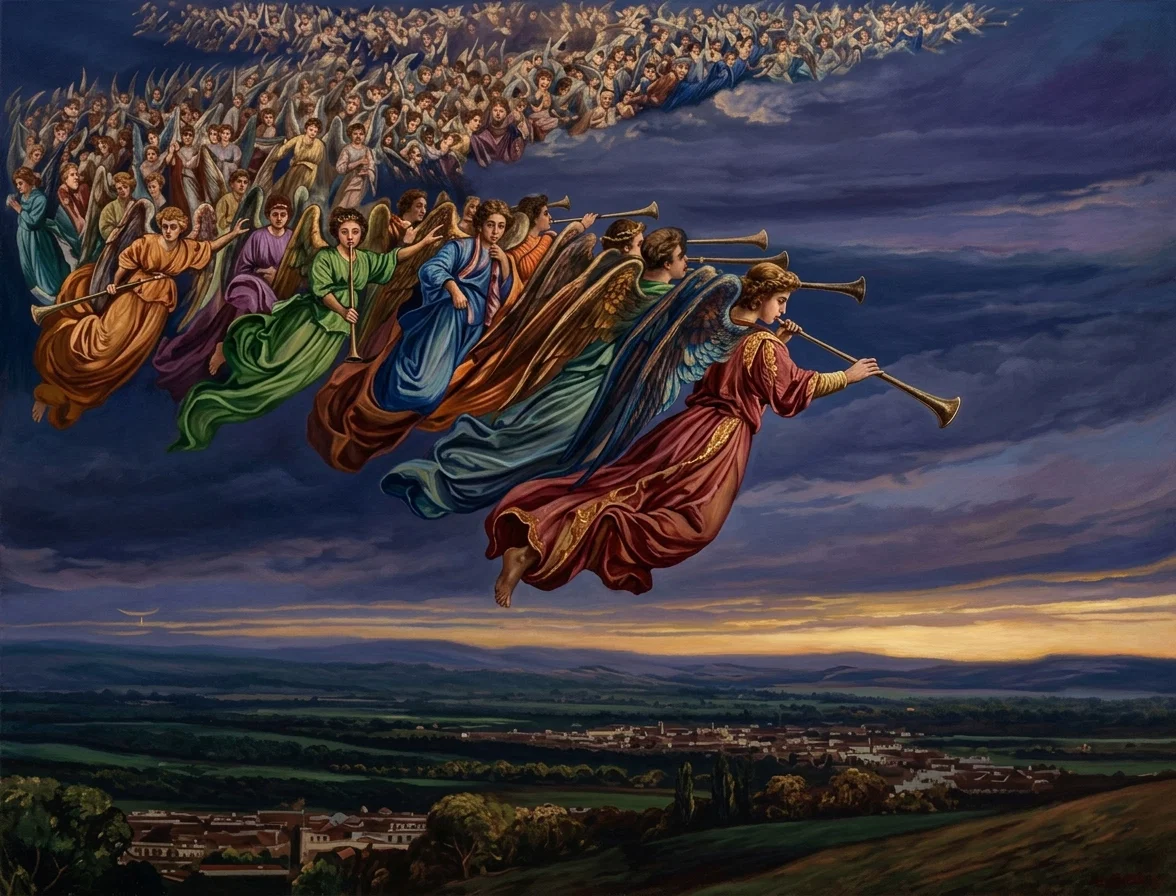
The scope of God’s promise to Abraham, according to Rom. 4:13, was that he should be heir of the whole world; and in Acts 7:5, Stephen declares that Abraham, in his lifetime, received “not so much as to set his foot on” of the promised inheritance. Abraham was promised that his seed should number as the stars of heaven, or the sand of the seashore; and in Gal. 3:29, we read: “If ye be Christ’s, then are ye Abraham’s seed, and heirs according to the promise.” Millions of God’s children have fallen asleep in death since that promise was made to Abraham, and they are all “heirs according to the promise.” In 1 Thess. 4:13-18, we learn that at Christ’s second advent all that countless multitude of saints who are sleeping in the dust will be roused by the trumpet blast of the Archangel, and with the living saints caught up to meet the Saviour in the air.
Then, and not until then, will Abraham see the fulfilment of the promise that his seed should number as the stars of heaven. Then, and not until then, will that countless company of the redeemed of all ages be marshaled upon the fields of glory, and raise the anthem of victory that marks the beginning of their entrance upon the long promised inheritance of the seed of Abraham. Then, and not until then, will the high hope of the church of God meet the beginning of its full fruition. If it were not for the second coming of Christ and the resurrection of the righteous, the hope of the church would be only a shadowy dream.
In 1 Cor. 15:16-18, we read that if the dead rise not, “then they also which are fallen asleep in Christ are perished.” The hope that is grounded upon Christ’s coming and the resurrection will carry the old ship of Zion over the harbor bar into the haven of rest at last. Any other hope will leave its devotees helplessly strewn upon the ragged rocks of despair.
If we should expunge from the New Testament every passage that breathes the blessed hope of immortality at the second advent, we would have little left but cheerless history. Paul stood before Felix and confounded his accusers by affirming his hope “that there shall be a resurrection of the dead.” Before Agrippa he declared: “I stand and am judged for the hope of the promise made of God unto our fathers: unto which promise our twelve tribes, instantly serving God day and night, hope to come. . . . Why should it be thought a thing incredible with you that God should raise the dead?” Who would presume to blot from the apocalyptic scroll the vision of those white-robed armies of the upper kingdom that form the shining escort of the King of Glory on His triumphal return to the earth?—Not one; for “if any man shall take away from the words of the book of this prophecy, God shall take away his part out of the book of life, and out of the holy city.” Rev. 22:19.
No true follower of the Lamb can fail to echo back the thrill of joy that runs through the testimony of the beloved disciple when he says: “Beloved, now are we the sons of God, and it doth not yet appear what we shall be: but we know that when He shall appear, we shall be like Him; for we shall see Him as He is. And every man that hath this hope in him purifieth himself, even as He is pure.” 1 John 3: 2, 3. As the mind becomes imbued with this hope, ardent activity in preparing to meet the Saviour takes hold of every faculty of our being, and we become like running water—self-purifying. “The grace of God that bringeth salvation hath appeared to all men, teaching us that, denying ungodliness and worldly lusts, we should live soberly, righteously, and godly, in this present world; looking for that blessed hope, and the glorious appearing of the great God and our Saviour, Jesus Christ.” Titus 2: 11-13.
The apostle Paul, when nearing the close of his life, expressed his hope of future reward thus: “I am now ready to be offered, and the time of my departure is at hand. . . . Henceforth there is laid up for me a crown of righteousness, which the Lord, the righteous Judge, shall give me at that day: and not to me only, but unto all them also that love His appearing.” 2 Tim. 4: 6-8. This bright hope gives to every dark cloud of earthly sorrow a tinge of heavenly light. Even from death’s dark valley the eye of faith can discern the beams of the morning above the mountain barrier. Around the bedside of one of God’s dying children gathers the weeping family longing for one last look of recognition; but from the wreck of failing faculties there comes no response. Just as the shadow of death is stealing over the scene the mother tenderly says to the children, “He will know us when Jesus comes.” The dying man’s features light up as with the last gleam of day, and with a smile upon his countenance he exclaims: “Come, precious Jesus! Come quickly!” Thanks be unto God for that blessed hope which still abides when every other hope is forgotten, and every other name is written in the dust.

“Thou Shalt Take No Gift”

By Emma Hildreth Adams
IN a chapter of Exodus, which the members of the Bible Band recently have read, occurs the above decisive utterance, together with the startling prohibition it contains.
The brief statute, with the important ground for its proclamation, is thus expressed: “Thou shalt take NO GIFT, for THE GIFT BLINDETH the eyes [“seeing,” margin] of the wise, and perverteth the words [“matters,” margin] of the righteous.”
This is an imperative command, lustrous amid a long category of divine directions and injunctions, made by Him whose appearance on Mount Sinai on the day it was spoken, “was like devouring fire to the children of Israel.”
The impressive statute forms but a single brief member of a comprehensive code delivered to Moses for the regulation of the individual and the associate life of the Israelites less than three months after their memorable release from bondage in Egypt.
This code, remarkable for the spirit of justice breathing therein, was spoken to Moses 3,400 years ago. Nevertheless, to men the world around, it rings out to-day its clear, sharp, intrusive prohibitions, with emphasis never so needed, with danger of their transgression never so great, with trespass of their meaning never so frequent, so significant, so appalling.
One need hardly take time to say that this commandment, expressed in but twenty-three words, yet, reaching in its negation the entire earth, and down to the end of time, had no reference to the giving and taking of gifts, presents, between friends and loved ones, an act which often gladdens and elevates as much the life of the giver, as it comforts and cheers the heart of the recipient.
Neither was it intended to prohibit the poor and needy from accepting welcome bounty: nor, indeed, the bestowing of favors upon the evil and unworthy, whose hearts might never respond with glow of gratitude, whose lips might never open with expressions of thanksgiving.
In this latter class of giving, God Himself has set the example for all mankind. He gave Christ, His superlative gift, even to men distinctly ungrateful, to men who scorn the unrepeatable donation, tho it mean LIFE to them, escape for them from stinging remorse, release for them from blighting servitude to sin.
What, then, was the aim of this brief, practical, restraining law?
Listen to the thrilling words of Samuel, first book, chapter twelve, verses two and three. After he “had become old and gray-headed; after he had walked before the children of Israel in innocence and uprightness from childhood,” he has this to say: “Behold here am I. Witness against me before the Lord. Whom have I defrauded? Or from whose hand have I received any bribe to blind my eyes therewith? And I will restore it to you.” Notice Israel’s answer:
“Thou hast not defrauded us. Neither hast thou taken aught from any man’s hand.” What testimony for a life-work! What certificate of true greatness!
Now hear the historian in 1 Sam. 8: 3: “His sons walked not in his [Samuel’s] ways, but turned aside after lucre, and took BRIBES and perverted judgment.”
Now turn back to Deut. 16: 19 and read an amplification of the short statute we have quoted:
“Thou shalt not wrest [twist, pull up] judgment; thou shalt not RESPECT PERSONS, neither take A GIFT; for a GIFT doth BLIND THE EYES of the wise, and PERVERT the matters of the righteous.”
Then the gift which God, on Mount Sinai, forbade that host of newly escaped slaves to receive, was a BRIBE. In His estimation, then, the taking of bribes corrupts the “words,” the “judgment,” the conduct of men, and in many instances cuts short their lives.
In ecclesiastical affairs a PERVERT is an apostate, one who has forsaken his religion or his party. In civil and moral matters he is a person who has turned from a course just and upright, to deeds illegal, tricky, fraudulent, rotten.
With that class of men David prayed that he might not be gathered. Why?— Because “their right hand is full of bribes.” Ps. 26: 10. And Solomon, illustrious for sagacity and broad learning, wrote: “A wicked man taketh a gift out of the bosom, to pervert the way of judgment.” Again, “He that receiveth gifts [bribes] overthroweth the land!”
Truly, if the men in almost every community of this land and of other lands as well who to-day, without quiver of conscience, are accepting bribes, receiving illegal rewards, in the form of money, of official positions, of munificent tips, of costly courtesies, from associations, corporations, and wealthy individuals in return for their votes, their influence with the public, their power as interpreters of the laws, would but acquaint themselves with the ringing, positive authoritative declarations of the great Lawgiver of the universe on these vital points in civil matters, there would be fewer moral paralytics in town councils, on boards of trustees, in state legislatures, and in the houses of Congress.
Continue reading: Ye Must Be Born Again