Your ShelfYour Projects

Signs of the Times, Vol. 36, No. 24.

On the Mount
Earlier text: On the Mount

“Ye Must Be Born Again”

By D. W. Dimock
NICODEMUS, a ruler of the Jews, came to Jesus, and said to Him, “We know that Thou art a teacher come from God.” Jesus answered him by saying, “Except a man be born again, he can not see the kingdom of God.”
There is a vast difference between what we know and what we are. There is a great difference between such things as our attainments, education, talents, knowledge, and culture, and the matter of our condition before God. To merely know a fact falls far short of living and obeying the truth.
Nicodemus was an inquiring man who had been convinced by external evidence that Christ was a divine teacher, and his conscience was now seeking after something deeper and more satisfactory. He comes with a profession of knowledge: “Rabbi, we know that Thou art a teacher come from God.”
Jesus, out of the treasures of His divine tact and knowledge, answered the need rather than the words of Nicodemus, and showed that all the inquirer’s knowledge, merely as such, never would save him or any other man—“Except a man be born again, he can not see the kingdom of God.”

More than Mere Knowledge

No matter how well instructed Nicodemus might be, he could never, by mere knowledge, see God’s kingdom. A mere knowledge of doctrine, however true, never introduced a son of Adam into the kingdom of God.
Men may think they have learned what are justification and sanctification; and to distinguish minutely between all creeds, isms, and heresies; they may be theoretically orthodox, able to judge preacher and sermon, ready freely to criticize the greater part of what they hear; and further, in this Christian age, they may know considerable about even the new birth, its necessity, and divine origin: but notwithstanding all this they may be unchanged in nature. The greatest amount of theological education alone never yet saved a man. Creed or the mere belief in a certain amount of doctrine has made Christendom, but never made a Christian. “Ye must be born again.”
Nicodemus, wondering at Christ’s words, said, “How can a man be born when he is old?” The Saviour’s answer was so deep and comprehensive that the voice comes down through the ages even until now. “That which is born of the flesh is flesh.” John 3: 6. In nature we speak of the animal kingdom and the vegetable kingdom. There is a deep gulf between these two that can be crossed only by the creative power of God. If we take a rose, which belongs to the vegetable kingdom, and cultivate it, and train it, and by various arts make it produce all its varieties, we never by these means could bring it into the animal kingdom.
Or again, if I take a thistle from the roadside, and bring it into my garden or hot-house, watch over it, dress, water, and warm it, I may produce beautiful thistles, but I could never get figs from it. That which is produced from the thistle is thistle. We can never gather grapes of thorns, or figs of thistles.
“Can the fig-tree, my brethren, bear olive berries? either a vine, figs?” James 3:12. Man by nature is in the kingdom of the first Adam. No amount of reformation, amelioration, cultivation, civilization, or mere religionism, can bring a man into the kingdom of God. Before I can become a part of God’s kingdom I must have a new nature, a nature consistent with that kingdom.

The Important Question

The question, therefore, of the most importance to you and me, is not alone, Do you know doctrine? Are you familiar with Christ’s teachings? Are you acquainted with your Bible? These are well enough, but the question goes farther. The question calls for a mighty transformation—a change of nature. The question is: Are you born again? Are you a partaker of the divine nature? Are you standing now in Christ or in Adam? Are you a child of God, an heir of the kingdom?
Before we can see the kingdom of God, we must have the new nature implanted in us, the nature that belongs to the heavenly kingdom. Let us stop to think. Ask yourself, Am I born again? Have I a new life? Have I the life that is communicated by the Spirit of God through the truth? Have I been begotten by the incorruptible seed, the word of God, which lives and abides forever? 1 Peter 1:23.
“Ye must be born again.”

“Stand Ye in the Way and See”

By W. H. B. Miller
It is the privilege of a few of God’s human creatures, those whose hearts have been cleansed by the blood of Christ, to see among the every-day things of life evidences of an eternity of wisdom, which, like the dominion of God itself, is boundless and infinite. But multitudes existing in unbelief see not God, but Chance; not divine wisdom, but evolution; not manifestations of love and care, but strange and inexplicable coincidences. It is God’s desire, especially at this time, to enlighten this darkness, to give sight to the blind, to give visions of wonderful creative power, and of most loving thought for the ever-changing needs and desires of His children.
In some of our so-called “common” things, creations of God which are, perhaps, unattractive to natural eyes, and rarely noticed because of our familiarity with them, are hidden beautiful and rare revelations of the infinity of God’s thoughts and works.
Indeed, so plentiful are these evidences, that, as we search, we soon become convinced that nothing created by God is commonplace, no matter how familiar its appearance may be to us. Christ, by His divine lessons, clothed the flower of the field and the modest sparrow with great majesty.
In those great creative edicts, “Let there be,” which marked the beginning of our beautiful world, are completely comprehended the temporal and spiritual needs and desires of earth’s thousands of ages.
Take a simple illustration. For thousands of years our sun has scattered its life-giving beams over the earth in obedience to the great word, “Let there be light;” and planets have rolled unerringly and unceasingly in their God-given course.
The earth brought forth forest and stream, flower and seed. As ages rolled on, these were succeeded by other scenes. The great trees sunk to the earth, and were covered by the accumulation and growth of ages. New life appeared, which in time was also laid low, and other woodlands and rivers were born.
But in God’s great economy there is no waste material or effort. So the sunshine of five thousand years ago, which developed the monster trees and thick undergrowths of the primeval forests, was not to be wasted. The dew which descended and watered the earth, and the fresh, pure air which was breathed in by the green leaves were filling to the full a divine storehouse for the glory of God and the use of man, in generations yet unborn, and unthought of save by the great Provider. And thus, as we now look upon our genial fires and our well-lit houses, we see the evidence of providences which have been performed in the darkness of the earth in response to the divine order “Let there be light.”
Then in another and deeper sense, throughout the ages, darkness has covered the earth and gross darkness the people. That great word called into existence the marvelous plan of salvation, which penetrates the spiritual gloom and lights the earth with glory.
How wonderful this miracle! Imagine if you can the deepest, darkest depths of degradation and sin; the corrupting, licentious, hideous strongholds of Satan, where nature groans for deliverance, and its harsh taskmaster taunts his victims and tears their lives with cruel hands. Into these depths God’s message is sent. “Turn ye, turn ye, for why will ye die!” Believe and live. “Let there be light!” And lo, the darkness scatters, hard hearts are broken, evil angels are driven back, hearts and hands are lifted to the Life-giver in contrition, God hears, forgives, and receives the penitent sinner, and there is light.
Here we see a Christian in the darkness of sorrow. Grief, perhaps, for some loved one passed away; sorrow for some failure; tired out, worn out, and weary of life with its hardships and griefs. God’s eternal word enters the stricken heart. “Let there be light.” “Come unto Me, all ye that labor and are heavy laden, and I will give you rest.” In response to that voice how many a weary one can say:
“I came to Jesus as I was, Weary and worn and sad, I found in Him a resting-place, And He has made me glad,
and my darkness passed away, and there was light.”
God has decreed that, in these last days, His light shall shine with great power, and that the glory of the Lord shall be revealed in all its splendor. But powers of darkness are arrayed against the divine work. The devil is determined to hide the glory of God. He knows that his time is short. His agents are active everywhere. They are making tremendous efforts to tear down the strongholds of God and misrepresent Him to mankind. He knows that if men can but see God, the battle is lost; for to see is to love and obey, and that is life eternal. God in His great wisdom has made preparation for this final crisis. He foresaw the great conflict between good and evil. On Creation’s morn when He said, “Let there be light,” He looked forward into the unbelief and spiritual darkness of to-day.
That great word has opened up the buried treasures of Egypt and Assyria to the astonished gaze of doubting millions. Out of the darkness of ancient tombs and pyramids He has revealed Himself. He has given wisdom to decipher the dead hieroglyphics of thousands of years ago which prove the truth of His great word. The dark strongholds of Satan, doubt, skepticism, and infidelity, are thus powerfully shaken, and there is light.
And now the great modern printing-presses stand ready to prepare, in every language, messages of light and life, to be scattered over the earth as the leaves of autumn. And how wonderfully God has prepared the way! By power generated from our coal deposits have our machines been made, and by the same power they are operated, and when the living words are thus prepared, by this same wisdom of God they are carried by train and steamship to earth’s remotest corners. Accompanied by God’s Spirit and the prayers of His people, they shine on heathen blindness and despair, dissipate by their brilliance the gloomy superstitions of ages, luminate the hoary old temples of paganism, open wide their dark dungeons to the sunlight of God, and there is light.
Thus, for instance, a lump of coal, common tho it may be, becomes an evidence not only of God’s love and care for His children and the power of His great word, but of an infinitude of thought and wisdom far beyond all mortal comprehension.
God grant that we, by the operation of that same great word, may be channels through which light can shine, messengers of peace, heralds of glory, revealers of the infinite wisdom of the One who has called us out of darkness to “stand in the ways and see” His marvelous light.

Measuring Ourselves by Christ

Let a man bring himself into Christ’s presence, and he will feel that his life needs renovation. The measuring himself with others, he may be inclined to flatter his pride, it is not so when measuring himself with Christ. . . . In Christ man sees his duty and his failure, his ideal and his sad reality. — George T. Purves.

Come, Bide with Me

By Mrs. L. D. Avery-Stuttle
COME not as an occasional guest, But dwell with me I pray; Take from my heart this sad unrest— This load of care from off my breast— Far as the east is from the west Remove my sins away.
Be Thou my Counselor and Guide, My everlasting Rock; O keep me from the whelming tide, Nor ever, ever leave my side, And give me courage to outride The tempest’s sudden shock.
Be Thou my “cloudy pillar,” Lord, My “fiery cloud” by night; So shall I lean upon Thy word, When all Thy statutes I had heard, What gratitude within me stirred, What joy and what delight.
And Thou, the mighty God on high Who rulest earth and sea, Didst deign to hear my humble cry, And from the clouds of Sinai Make known Thy law to me.
O give me strength that law to keep; And when I, careless, stray, Seek Thou Thy wilful, wayward sheep, Good Shepherd, guide my wandering feet Till dawns eternal day.

The Sabbath—Its Origin and Purpose

1. What is the record of the institution of the Sabbath?
“On the seventh day [of creation] God finished His work which He had made; and He rested on the seventh day from all His work which He had made.” Gen. 2: 2.
2. By what means did God set apart this day?
“God BLESSED the seventh day, and HALLOWED it; because that in it He had RESTED from all His work which God had created and made.” Verse 3.
3. While the Sabbath “was made FOR man,” WHOSE day is it?
“A holy Sabbath unto Jehovah,” “My holy day,” “the holy of Jehovah,” “Thy holy Sabbath.”
4. In what way was the Sabbath “made for man”?
“This is that which Jehovah hath spoken, To-morrow is a SOLEMN REST, a holy Sabbath unto Jehovah.” Ex. 16: 23.
5. For how many was the Sabbath designed?
“Six days thou shalt do thy work, and on the seventh day thou shalt rest; that thine OX and thine ASS may have rest, and the SON of thy HANDMAID, and the SOJOURNER, may be refreshed.” Ex. 23:12.
6. What is the standard of true Sabbath-keeping?
“TURN AWAY THY FOOT FROM THE SABBATH, from DOING THY PLEASURE on My holy day; and call the Sabbath a DELIGHT, and the holy of the Lord HONORABLE, and shalt HONOR it, NOT DOING THINE OWN WAYS, nor FINDING THINE OWN PLEASURE, nor SPEAKING THINE OWN WORDS.” Isa. 58:13.
7. What will be the reward of such obedience?
“Then shalt thou delight thyself in Jehovah; and I will make thee to ride upon the high places of the earth; and I will feed thee with the heritage of Jacob thy father: for the mouth of Jehovah hath spoken it.” Verse 14.
“Blessed is the man that doeth this, and the son of man that holdeth it fast; that keepeth the Sabbath from profaning it.” Isa. 56: 2.
NOTE.—“The Lord of the Sabbath” thus makes clear the object of His Sabbath, and man’s duty regarding it. Not for a special nation, not for a particular age, not for a certain dispensation,—“the Sabbath was made for MAN;” not A Sabbath, but THE Sabbath.
8. Of what is the seventh-day Sabbath ever a reminder?
“It is a SIGN between Me and the children of Israel FOREVER: for in SIX DAYS JEHOVAH MADE HEAVEN AND EARTH, and on the seventh day He rested, and was refreshed.” Ex. 31:17.
9. Of whom does Sabbath-keeping ever remind God’s people?
“Verily ye shall keep My Sabbaths; for it is a sign between Me and you throughout your generations; THAT YE MAY KNOW THAT I AM JEHOVAH WHO SANCTIFIETH YOU.” Verse 13.
NOTE.—From these scriptures it will be seen that the Sabbath was ever to be a sign to the world of the true God and His creative power; every Sabbath should recall the Creation and Creation’s God. Only the seventh-day Sabbath could do this.

Slandered

An easy way to harm a good man is to slander him. Few good men have escaped this fiery dart of the enemy. Let no one who has been attacked by a lying tongue think his case peculiar. No weapon is so hard to defeat. Men have tried to stop a lie, but often with no success. One who is slandered may deny the accusation indignantly, but the denial will not cure the evil. The lie flies faster than the denial. Slander will travel a thousand miles while the denial is going one short mile. The atmosphere of this world seems to be favorable to the rapid circulation of an evil report. Hundreds will believe the evil rumor where one will believe the denial. What can a man do in such a case? What shall he think when his good name has been tarnished by a wicked falsehood?
It is not half so bad as it would be if the story were true. How glad such a man should be that the thing is false. He is not what men say he is. Jesus says, “Blessed are ye when men shall revile you and persecute you, and say all manner of evil against you falsely for My sake. Rejoice and be exceeding glad.” Jesus does not seem to consider it a dreadful thing when one is slandered. He tells us to rejoice and be exceeding glad. It would be bad enough if the story were true. See to it that no one shall ever say evil of you truly, and all shall be well. If we could see the end from the beginning, if we could see what shall follow all this mischief, we should not complain. “Rejoice and be exceeding glad, for great is your reward in heaven.” There will be an adjustment. Heaven’s eternal glory shall pay for all the children of God suffer here.—The Christian Advocate.

Let the Shoemaker Stick to His Last

The Inter-Ocean is moved to commend the Rev. Dr. Munhall, of Philadelphia, for his views on the still opportune subject of non-attendance at church. Says Dr. Munhall:
“People don’t care two raps for the preacher’s opinions. What they want is to hear the voice of God speaking to discouraged hearts and grief-burdened souls. It is God’s message and not the preacher’s that the people want to hear. Give them that message and there will be no lack of hearers.”
The Chicago Journal fully indorses that opinion, and, after condemning the preacher’s seeking to speak with authority on matters foreign to his calling, adds:
“When the preacher speaks of what he does know — of what he must be assumed to know, else is his office an inhuman mockery, and his presence in it a blasphemy — when, with the faith that knows no wavering and with the fear of God that is the beginning of wisdom, he delivers God’s message — he speaks as one having authority, and he is heard gladly, and will never lack hearers, because to discouraged hearts and grief-burdened souls his voice comes as the voice of God.”

Life’s Changes and Disappointments

ALL of us have more disappointments than we need to have. If we would learn to look upon life as an unfolding story of varied incident and ceaseless change, rising to its glorious climax, the ups and downs of it would seem less crucial to us. It hurts to be jolted out of our ruts; it is hard to bear losses, and sometimes harder to sustain wisely the inflowing of abundance. It wears upon us to toil for a great end, and to come far short of it. Yet there should be no real disappointment in all this, for we have no promise of immunity from change, or from failure to obtain our desires. If we expect to be undisturbed in a complacent walk we shall be disappointed. If we expect interruptions, we shall have fewer of those experiences that we commonly call disappointments.—S. S. Times.

The Sublimity of Scripture

I account the Scriptures of God to be the most sublime philosophy.— Sir Isaac Newton.

The Price of Redemption

WHILE salvation is offered to every one without money and without price, the religion of Jesus Christ is not a cheap religion. The miner gets out of the mine without its costing him a cent, but to do it, machinery is used that cost the mining company many a dollar. So while we do not have to pay in dollars and cents for the religion of Jesus Christ, it cost the highest price that Heaven could pay. In giving His Son, God gave Himself in His Son. He poured out all heaven with the gift, and Heaven has concerned itself especially for the past six thousand years in the salvation of man. The holy angels are constantly busy in ministrations to humanity.
And Christ gave all He had and all that He was that He might redeem man. Altho He was equal with God and crowned with fulness of glory and power, He came down to the earth, was born of an obscure family, His cradle a manger, worked at the carpenter’s trade, and took His place among the unknown of this world, to begin a work that was to end only with the yielding up of His holy life,— and all this was a part of the price that Heaven paid for the redemption of man.
He who had legions of angels responding to His word, became a lone exile, and submitted Himself to criticism, to slights, to hard words and unkind acts, to treachery and betrayal, to abandonment of friends, to insult, shame, and mockery, and to a long torturing death upon a disgraceful cross, the death of the worst criminals under the Roman law, and this He did to pay the price of our salvation. It is not a cheap price, but money, no matter how much of it, would have been. It was not the blood of bulls and goats. No, it was the precious blood of Jesus.
And such a price was great enough to meet all the demands. Our salvation was fully paid. Christ met all the demands of God’s perfect righteousness. The price He paid was completely accepted and witnessed to by the law and the prophets. By meeting every demand which the law made on sinners, He upheld the law as perfect and just in its demands. He showed that these demands could not be laid aside; they must be met; and as the sinner could not meet them, for the sinner He would meet them.
And now, so far as you and I are concerned, has He paid the price in vain? For what He did was not that humanity might evade the law and its righteousness, but that humanity in Him might also meet the demands of the law in righteousness. By submitting to His life, we may live His life, the life of righteousness that is witnessed to by the law and the prophets. If we do not submit, then for us His sacrifice has failed; for us He has paid the terrible price in vain.
To make the righteousness of Christ available we must live the life He lived, the life He will now live in us. And so we give up all, even as He did, and thus pay our part of the great price of individual salvation. Thus in yielding our little, with His great, the full price of our individual salvation is paid. But this yielding is for life; it is to last the whole of our earthly pilgrimage from this time forward. God help us to make Christ’s work for us complete by entire submission to His holy will.
But the law demands either full obedience to its commandments, or, failing this, the death of the transgressor. If, then, we refuse the price which Christ has paid for us, it follows that we must pay the price of death, for we can not of ourselves alone obey its high and perfect demands. We are too sinful and weak, and it is so holy. Then since we must give up this life in either case, how much better for us to give that life to Christ to make holy and beautiful and complete. The law says that we have sinned and must die, but we will die unto Christ, that He may live in us. Christ has paid the great debt brought on by the bankruptcy of humanity, and now we make an assignment of all we possess over to Him as our great Receiver. We are sure He will be able to make it pay out in this our mortal life in a profit for all eternity. R.

The Millennium

SOMETIMES terms used by writers on religious subjects are objected to, because they are not found in the Bible. “Millennium” is one of these terms. Nevertheless, it is a perfectly legitimate word to use in Bible teaching, if rightly used. It is properly applied to the 1,000 years of Rev. 20: 1-5. The English Bible uses the term “thousand years.” But the Greek expression is chilia ete. “Millennium” comes from two Latin words, mille, thousand, and annus, year. It is therefore just as proper to translate chilia ete “millennium” as it is “thousand years.”
Satan was bound “a millennium,” so “that he should deceive the nations no more till the millennium should be fulfilled.” Verses 2, 3. At this same time the saints “lived and reigned with Christ a millennium, but the rest of the dead [the wicked] lived not again until the millennium was finished.” Verses 4, 5. Again we are told that the children of the first resurrection “shall reign with him a millennium. And when the millennium is expired, Satan shall be loosed out of his prison.” Verses 6, 7.
The above is a proper use of the word. The word has obtained a secondary, theological, and erroneous use, by some supposing that this thousand years here mentioned refers to Christ’s reign of peace on this earth, when the world will be converted, and from that “millennium” has come to mean a converted world. But used in this sense, it has no place in the theology of the Bible.

Why Preach It?

WHY preach the coming of the Lord?—Because the Lord is coming. But why say anything about it?—Because its theme is a part, a great part, of that word and Gospel which the Lord commands His servants to preach. If they do not preach His coming, they are unfaithful or uninstructed servants.
But here is another reason: He is our Friend. While we have not seen His personal presence, we have seen His abounding goodness and wisdom everywhere displayed; we know His power in saving from sin; we have tasted His love in cleansing, comforting, helping us, when all others passed us by, either not caring or knowing how to help or comfort. Our blessed Saviour, Comforter, Helper, King, is coming. We are glad; therefore we tell it. We shall see Him as He is. We shall behold the King in His beauty. We would not share all these blessings alone. They are for all who will receive Him. “To them that look for Him will He appear without sin unto salvation.” Will you not be a partaker with us of the glory that shall be revealed?

Narrow—Broad

“You people are so narrow,” a “friend” remarked to a young Christian who refused to have a part in some worldly entertainment. “You cut yourselves off from everything that is pleasant in life.”
In a way the charge is true; in another way, it is all wrong. It is narrow—it is the narrow way we are following. The entrance to that way was through the “strait gate,” the gate with one simple path—the path of obedience. But look beyond the gate, look on up the ofttimes rugged way, to the city of gold. There the way is broad; no by-paths lead to darkness; the end is not disappointment.
The way of the world is broad; the modern term is “liberal.” By thousands liberty to choose the broad way of life is taken to mean license, permission to go on with no thought of future reckoning. “Wide is the gate, and broad is the way,” is our Lord’s description. He also tells what lies at the end of the way, it “leadeth to destruction.”
The true follower of the Lamb may expect the jeers of the world. He may expect to travel the way with a small company, often alone, for of the narrow gate, and the straitened way “that leadeth unto life,” the Saviour said, “Few are they that find it.” Of the broad way “that leadeth to destruction,” “many are they that enter in thereby.” It is a matter of choice, but on that choice hangs destiny: We may enjoy the plaudits of this life for a season, and then lose all for the future; we may forego the glittering honors now, and in the life to come reap of joy and peace and sincere pleasure a hundredfold. The wise will count the cost, consider the reward, and choose the right. H.

Do Not Fret Over Your Foes

“YOUR foes will not fear you as long as you fret over them.”

Notes on the Conference

(From the Editor)
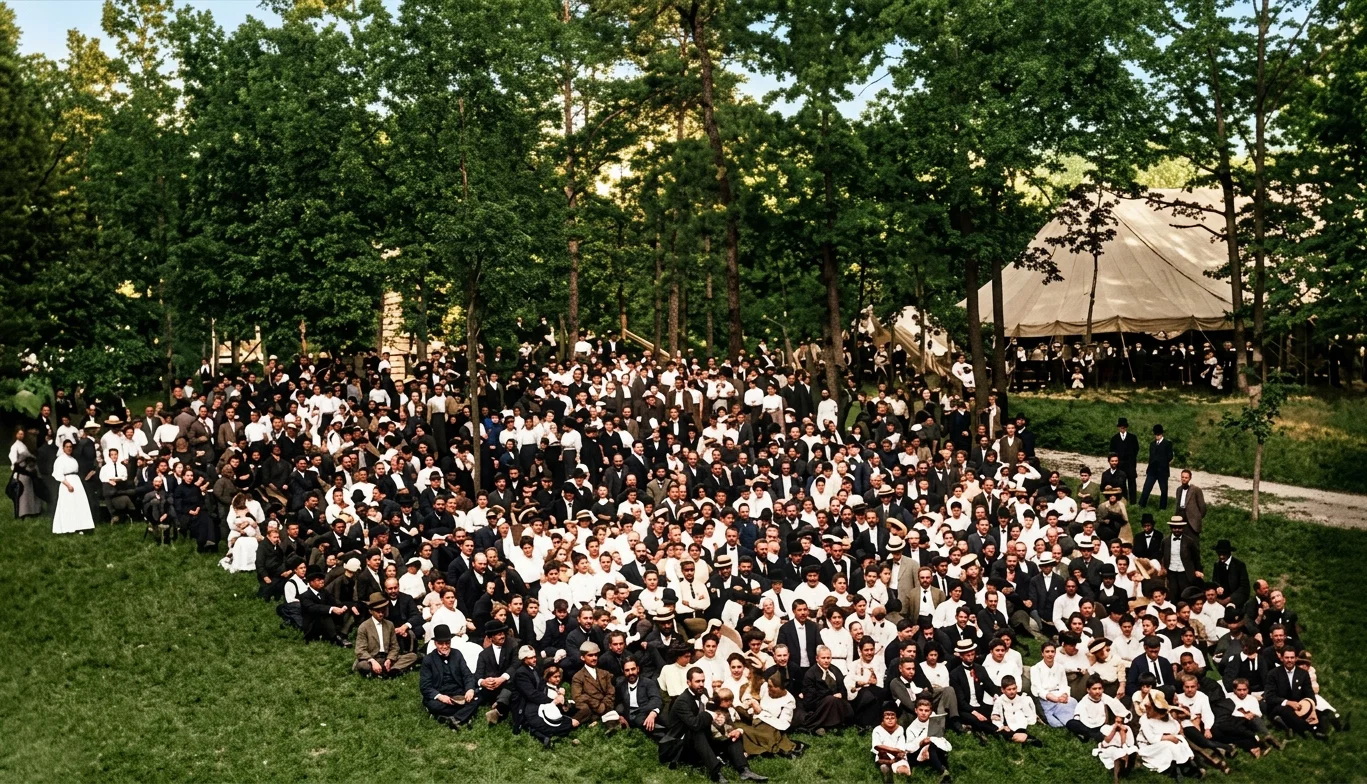
The General Conference assembled on the green, the big tent where the meetings were held in the upper right-hand corner.
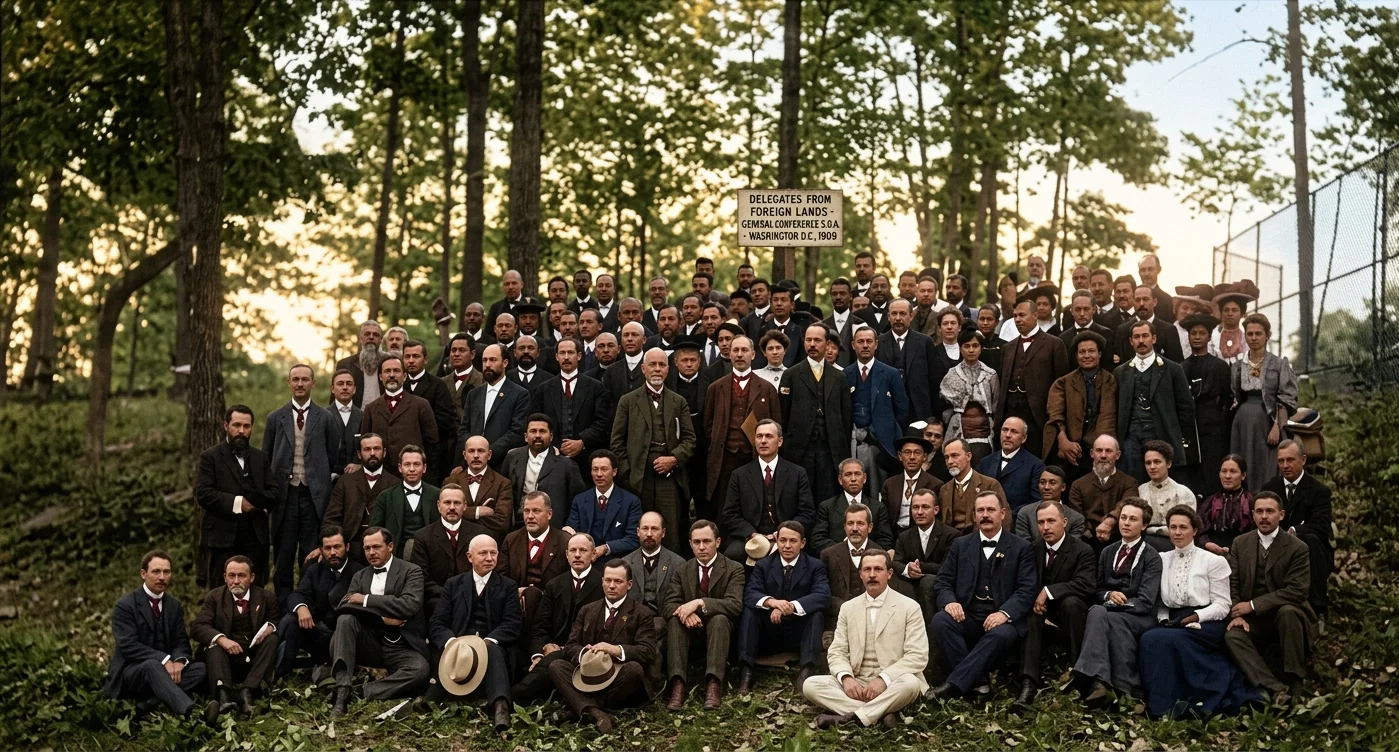
The delegates from foreign countries who attended the General Conference of Seventh-Day Adventists, Washington, D. C., May 13 to June 6, 1909.
The glad striking things of this conference, as we wrote of the one four years ago, is that it is a missionary conference. But far more than four years ago. The last conference was a missionary conference. This is a more missionary, a greater missionary conference.
Four years ago not a few local conference men came to secure help for their local field; but now one of the most important meetings on the ground is an early morning meeting in which conference presidents and leading men are coming together with leading workers from the great needy fields of earth to learn how they can help these fields in furnishing men and means from the home field.
Inspiring indeed are the reports from the great mission fields. But a few years ago the delegates and representatives from foreign lands were not many, and the most of these were Americans. Now they come one hundred strong from various fields, nearly every one a foreigner, to America, many not able to speak English at all, and the interpretation of thrillingly interesting reports have been before the conference again and again.
How good it sounded to hear that the everlasting good tidings were going to the world, published in sixty-one different languages, and to-morrow, so to speak, this statement will be out of date.
Our representatives had a glad story to bring from Russia, dark, tradition-bound, tyrannizing Russia. The old bonds are broken. The exiles are less frequent. Greater liberty of the Gospel has entered. Brother Perk told through an interpreter of his experience with Brother Conradi in a Russian prison, dark, dank, and filthy, with its horrible black bread. Now for the last four years 1,541 members had been received by baptism and 613 by vote, making the membership now 3,077. That these are faithful is shown in the tithe they pay for the support of the Gospel ministry. In 1905 it amounted to $5,587. Last year it had amounted to $11,431. In four years it had more than doubled. There are now 14 ministers in the field, and 67 other languages. Most of the gains were in the latter part of the period, for the first part was in a time of persecution. Literature now circulates quite freely with little trouble from the censor.
Thus the work has gone in Russia. Often baptisms have taken place at midnight. Men and women have been exiled to Siberia and the Caucasus. But wherever they have been driven, Christ and His truth have gone, so that from St. Petersburg in the west past the Ural Mountains, over into Siberia, far on even to Manchuria has gone God's everlasting Gospel. From the icy north to the Black Sea and to the Caucasus, even into Tartary, have little churches been raised up, and lights kindled of God are shining in the darkness. United in one are Great Russians, Little Russians, White Russians, Polanders, Lithuanians, Germans, Armenians, Jews, Kalmucks, Cossacks, etc., united in one in the Gospel of Christ. Out from Russia's multitude of nations God is gathering a people who are keeping the commandments of God and the faith of Jesus, and opening doors are meeting the heralds of truth everywhere.
In our next we will note other fields.

The Test.

DRAWING even a heavy load along the paved street is not a complete test of the strength of a horse. See how he leans into the collar when the steep place is reached! There is the test. So also with the Christian. The even tenor of life is not the testing time. Few will question our Christianity when nothing antagonistic to our own feelings and desires confronts us; but let a vexing incident occur, an accident, a misunderstanding, a rebuff—there is the test.
Human nature measures itself with a liberal rule; it measures others with a close standard. The world expects and demands righteousness of the Christian. The man who has no conscience in the matter of dishonesty in small dealings, Sabbath-breaking, mild profanity, questionable amusements, and scores of other such matters, will point a scornful finger at the professed Christian who does one of them. And can we blame him? If one makes a profession and fails to live up to it, he is dishonest. Before he made the profession, he was free; when he pledged his life to Christ, he put himself under obligation to live the Christ-life. He was a Christian when there was no special trial, if he endures the test; his failure to stand the test proves that he was not a Christian at all; his standing proves that he was. The trial is the test. Christianity is nothing whatever if it fails in the testing time. H.

Opportunity for Advancement

In every walk of life there is opportunity for advancement. The humblest task may be done better and better; improvements can be made. Granted that the implement we use is perfectly adapted to the work it does, then we who use it may make the improvement in ourselves. Whatever the burden or discouragement, let us not hesitate, but make the wise improvement. H.
Continue reading: The Chinese Mandarin Bible and Natural Immortality