God is very good to us in sending opportunities. It is true that they are not the same opportunities as earlier were given, and too frequently they are less and less rewarding than those that have passed us by unheeded. But still we may do something; perhaps, in God’s grace, we may do much with the things that remain. That is a good promise to remember, “They shall still bring forth fruit in old age.” It is not a matter of despair that a man is old or that a church is poor. God’s measure is of qualities. We may find and grasp great opportunities, though we ourselves seem small and weak. But we must buy them up, first by attention, then by faith and faithfulness. The work of the Christian is cooperative. We may be sure that while we are working, God works, too.—The Congregationalist.
Editorial
By Editor
The Columbus Unveiling
ON JUNE 8 there was unveiled in the city of Washington, in the great plaza between Union Station and the Capitol building, a beautiful statue to commemorate the discovery of America by Christopher Columbus. For this monument the national government had appropriated one hundred thousand dollars. It occupies the most conspicuous spot in the national capital, next to the Capitol building itself. Standing directly in front of the great Union Station, it occupies the gateway of the city.
ON March 9, 1882, there was established in the State of Connecticut an organization known as the Knights of Columbus, a Roman Catholic secret society, which has grown rapidly in membership until at the present time it claims 274,221 members. Whether or not the government appropriation for the Columbus monument was secured through the influence of this Catholic organization, it is certain that it was made an affair of the Roman Church as soon as the appropriation became available. An officer of the Knights of Columbus was placed on the committee in charge of the construction and location of the monument, and the details of the unveiling and the ceremonies in connection therewith were given entirely into the hands of this Roman Catholic secret society, and the members of this society marched at the head of all the civic organizations represented in the procession on the day of the unveiling. It was thus made a Roman Catholic Church affair, with the government of the United States paying for it to the amount of one hundred thousand dollars, and bearing all the expense incident to the joining of its soldiers and sailors in the great procession.
To make this Catholic celebration more spectacular and more impressive, the city of Washington was put to an expense of thousands of dollars for decorations, illuminations, fireworks, and all the necessary incidentals. In fact, the city took on an air of gaiety and excitement such as is manifest only on inaugural occasions. Forty thousand men marched in the procession, and at the close of the unveiling ceremonies this host filed in review before President Taft and the dignitaries of church and state at the reviewing stand near the Columbus monument. Besides this host, the city entertained many thousands of visitors (principally Catholic) from various parts of the country.
The papal flags everywhere in evidence, and the flags and banners of visiting and local Catholic organizations, gave to the whole proceeding the air of a monster Roman Catholic festival, the greater portion of it at the expense of the national government, and all for the glorification of Catholicism.
This demonstration was directly in line with the policy adopted at the national capital, in recent years, of advancing the interests of the Catholic Church by means of such spectacular public functions and the influence of public officials. This has been shown in the Thanksgiving “masses” in a Catholic church with the President and other federal officials in attendance, in “field masses” on federal property where the President must join in the Catholic ceremony, and in similar demonstrations, in all of which there is an effort made to twine and weave together again the functions of the state and the church, to unite in the New World what is being so ruthlessly severed in the Old.
It is expected that the placing of this monument of Columbus in the gateway of the national capital will give great impetus to the movement now well under way for making October 12 (Columbus day) a national, legal holiday. That day has been made a legal holiday already in twenty-three States; and congressmen and Catholic societies are urging, with ever-increasing influence, that the nation follow the example of the States, and make Columbus day a legal holiday for the nation. The arguments and the influence and the persistence are having their effect; and without doubt it will not be long until another Catholic holiday will be fastened upon the people of this country by legal enactment. Then more and more will be made of that day by the Catholic Church, and more and more will her influence and power be extended through that instrumentality. All signs indicate the ascendancy of Rome in the politics and the destiny of America, and such manifestations and occasions as these are but steps along that way which leads up to the pinnacle of her ambition—and to that great catastrophe which will shake the world, and shake her and all who cling to her out of the world.
C. M. S.
Notes on Important Eras of Fulfilling Prophecy
By W. A. S.
The Hand of God in History—No. 14
Notes on Important Eras of Fulfilling Prophecy
Beginning of the 1260 Years of Papal Supremacy
“And they shall be given into his hand until a time and times and the dividing of times.” Dan. 7: 25.
The spirit of apostasy was abroad in apostolic days. “The mystery of iniquity doth already work.” 2 Thess. 2: 7. It was seen in the perversion of truth, and in the spirit of self-exaltation that was to put man in the place of God, man’s way in the place of God’s way, man’s day in the place of God’s holy day, and to set human, mortal man as priest at an earthly altar, in place of the divine, ever-living High Priest in the heavenly sanctuary.
And this apostasy was to continue its work until the second coming of Christ. 2 Thess. 2: 8. “I beheld,” said Daniel, “and the same horn made war with the saints, and prevailed against them; until the Ancient of days came, and judgment was given to the saints of the Most High; and the time came that the saints possessed the kingdom.” Dan. 7: 21, 22.
But a period of years was assigned in the prophecy during which in a special sense this power was to assert supremacy over the saints and times and laws of the Most High. “They shall be given into his hand until a time and times and the dividing of time.”
The year is called a “time” in Scripture—“at the end of times, even years” (Dan. 11: 13, margin). According to the Jewish year, of 360 days, a time (one year), and times (two years), and a dividing of time (half-year), is 1260 prophetic days, or literal years. This period is repeated again and again in the prophecies concerning this apostasy—sometimes as forty-two months (1260 days, Jewish time), again as “a thousand and two hundred and threescore days.” See Dan. 12: 7; Rev. 11: 2, 3; 12: 6, 14; 13: 5.
The long 1260-year period, therefore, marks the time of the special papal supremacy. When did this period begin?
In the vision of Daniel 7, the prophet witnessed the division of the Roman empire into the ten kingdoms. Then up among these he saw the “little horn,” the Papacy, rising, with its stout look. And before it—in its presence—he saw “three of the first horns plucked up by the roots.”
These three horns were clearly the Heruli (overthrown by Theodoric, A. D. 493), the Vandals (subdued by Belisarius, A. D. 534), and the Ostrogoths (annihilated in the campaign under Narses, A. D. 552, 553). These were all heretical Arian kingdoms, followers of the teachings of Arius. The Papacy had appeared among the kingdoms, and three powers8had been literally “plucked up” in its presence.
The only questions are, At what period in the growth of the Papacy was it given power (over the saints and times and laws) answering to the prophecy? and, What vital events of well-established and incontrovertible history mark the beginning of the prophetic period of 1260 years? and, Do similarly vital events mark the close of that period? The answer of history is clear.
The pivotal stage between ancient and medieval history was the time of Justinian, who ruled the Roman empire from Constantinople. It was in the opening half of the sixth century. J. B. Bury says of Justinian:—
He may be likened to a colossal Janus bestriding the way of passage between the ancient and medieval worlds. . . . His military achievements decided the course of the history of Italy, and affected the development of western Europe; . . . and his ecclesiastical authority influenced the distant future of Christendom.—“History of the Later Roman Empire,” Vol. I, pages 351-353.
Of this world-shaping time, George Finlay says:—
The reign of Justinian is more remarkable as a portion of the history of mankind than as a chapter in the annals of the Roman empire or of the Greek nation. The changes of centuries passed in rapid succession before the eyes of one generation.—“Greece Under the Romans,” page 231.
And just here—in this epoch-making generation—we find the pivotal point in the history of the Papacy, the stage at which it passed from the days of strife for power to the period of acknowledged supremacy assigned in prophecy to the 1260 years.
In A. D. 533 Justinian issued his famous letter, imperially recognizing the bishop of Rome as the head of all the churches:—
Therefore we have been sedulous to subject and unite all the priests of the Orient throughout its whole extent to the see of Your Holiness. . . . For we do not suffer that anything which is mooted, however clear and unquestionable, pertaining to the state of the churches, should fail to be made known to Your Holiness, as being head of all the churches. For, as we have said before, we are zealous for the increase of the honor and authority of your see in all respects.—Cod. Justin., lib. 1, title 1, Baronii Annales Ecclesiastici, tom. 7, ann. 533, sec. 12. (The Latin text and translation given in “The Petrine Claims,” by R. F. Littledale.)
The emperor’s letter to the Pope had all the effect of a decree, and was later counted as such in the official acts. A later emperor, Phocas (A. D. 606), also recognized this headship of the Pope; but Dr. Croly says:—
The highest authorities among the civilians and annalists of Rome, spurn the idea that Phocas was the founder of the supremacy of Rome; they ascend to Justinian as the only legitimate source, and rightly date the title from the memorable year 533.—“Apocalypse of St. John.”
The critical period in the history and the prophecy was at hand. But when Justinian’s letter was issued, in 533, a heretical Arian and Gothic king ruled Italy from Ravenna, his capital. The Gothic kings claimed the right to interfere in papal elections at Rome. To restore Italy to the empire and drive out Arian heresy Justinian undertook his Italian campaigns. While in the sixteen years of these campaigns the city of Rome “changed masters five times, and suffered three severe sieges,” the real crisis of the contest was reached in 538, at the close of the first siege. The imperial army, under Belisarius, held the city of Rome; and the Goths, under King Witiges, had gathered practically their whole nation to take it. “If a single post had given way,” says Gibbon, “the Romans, and Rome itself, were irrecoverably lost.” The Goths were defeated, and this defeat, says Hodgkin, dug “the grave of the Gothic monarchy in Italy.” (“Italy and Her Invaders,” Vol. IV, book 5, chap. 9.) Though again and again they rallied, and twice afterward occupied Rome, this resistance of 538 against Witiges was the crucial hour in the history. Finlay says:—
With the conquest of Rome by Belisarius, the history of the ancient city may be considered as terminating; and with his defense against Witiges [538] commences the history of the middle ages.—“Greece Under the Romans,” page 295.
And the middle ages was, roughly speaking, the day of the Papacy. As Dr. Wm. Barry says,—
If the Papacy were blotted out from the world’s chronicle, the middle ages would vanish along with it.—“The Papal Monarchy,” page 4.
Not only was this stroke by the imperial sword at Rome, in 538, a decisive event in clearing the way for the assertion of the papal supremacy already recognized, but another deeply significant train of events begins with this year.
Pope Silverius had been made pope by the Gothic king. In November, 537, through intrigue, and on accusation that he had negotiated to betray the city to the besieging Goths, Silverius was stripped of his papal robes by Belisarius, and exiled, and Vigilius named in his stead. But the emperor intervened, and sent Silverius back to Rome, early in 538, with orders for a trial, and to be restored to the papal throne if found innocent. Belisarius delivered him to Vigilius, who quickly got him off to a desolate island, where he died, June 20, 538. Vigilius was thereafter recognized as pope. And of him Schaff says:—
Vigilius, a pliant creature of Theodora, ascended the papal chair under the military protection of Belisarius (538-554). —“History of the Christian Church,” Vol. III, page 327.
The arms of the empire put the Pope there; and though he was personally humiliated under Justinian’s arbitrary demands that he should approve and condemn according to imperial fancy, this use of the papal supremacy strengthened the idea that the Pope of Rome must be the one to speak and condemn for the universal church.
Next, Pelagius I (554-566) was made pope “by order of Justinian,” says Schaff, and this time again his elevation to the papal seat was secured “by the military aid of Narses.” Pelagius demanded frankly that the arms that had put a pope on the throne should enforce subjection to papal rule against bishops who failed to recognize his authority:—
Pelagius endeavored to enlist the civil power in his aid. He wrote several letters to Narses, who seems to have shrunk from using violence, urging him to have no scruples in the matter. These letters are an unqualified defense of the principle of persecution.—Smith and Wace, Dictionary of Christian Biography, article, “Pelagius” (Pope).
Thus the Papacy asserted its claim to wield the civil sword of persecution. The supremacy had been recognized imperially in Justinian’s decree of 533. The sword had struck a decisive blow to clear the way in 538, and the arms that there set the Pope on the throne continued to be used by the Papacy in its warfare against the saints and the laws of the Most High. In Bemont and Monod’s “Medieval Europe” we read:—
Down to the sixth century all popes are declared saints in the martyrologies. Vigilius (537-555) is the first of a series of popes who no longer bear this title, which is henceforth sparingly conferred. From this time on the popes, more and more involved in worldly events, no longer belong solely to the church; they are men of the state, and then rulers of the state.—Page 120 (revised by George Burton Adams, Henry Holt & Co., 1902).
However we may approach the subject, the history puts its finger on that crucial point. As stated in the quotation from Finlay, “the changes of centuries passed in rapid succession before the eyes of one generation.” The time of the prophecy had come, when the Papacy was to enter upon the 1260 years of supremacy.
In A. D. 533 came the memorable decree of Justinian recognizing the supremacy of the Pope, and in A. D. 538 came the stroke with the sword at Rome cleaving the way, and setting on the papal throne the first of the new order of popes—the kingly rulers of state.
The prophecy assigned a period of 1260 years to this supremacy. At the9end of that period came equally significant and epoch-marking events, advertising to the world the end of the prophetic period.
Just 1260 years from the decree of A. D. 533 in favor of the Papacy, came a decree, in 1793, aimed at the Papacy; and just 1260 years from that stroke with the sword at Rome for the Papacy, came a stroke with the sword at Rome against the Papacy.
W. A. S.
The Sabbath in Egypt
By F. M. W.
THE sojournings of Abraham, Isaac, and Jacob among the nations served to spread abroad in the earth a knowledge of the true God. While many had lost this knowledge and were bowing down to idols of their own making, there were doubtless many outside of the families of the chosen seed who were worshipers of the Creator of the heavens and the earth, and who remembered from week to week the regularly recurring memorial of his great work.
In the providence of God the seed of Abraham went down into Egypt. Joseph was sent before them to prepare the way for their reception. For his sake they were kindly received. After his death, however, there began the long years of bondage and servitude to which they were subjected until the exodus. They were afflicted for more than four hundred years. Their cries of anguish and distress ascended to heaven, and God in compassion remembered his covenant with Abraham, his promise unto Isaac and Jacob. For their deliverance he raised up Moses and Aaron, and sent them to Pharaoh with the request that he let his people Israel go. It is not unreasonable to suppose that during this Egyptian captivity the children of Israel in a large measure lost their living connection with the God of their fathers. In intermingling with the Egyptians, they imbibed their spirit, adopted their customs, and to a considerable extent lost the purity and simplicity of their religious faith.
When the time came for their deliverance, it was necessary for the Lord, through his chosen servants, to prepare them for emancipation not only from the physical bondage of Egypt, but from the spiritual bondage into which they had fallen. The efforts of Moses and Aaron were attended by a work of reformation. They sought to bring their brethren to that place in their experience where once more they could take hold of the mighty power of God, and through faith in his promises claim deliverance for themselves and for their children. Forgetting God in their idolatrous surroundings, they naturally forgot the memorial of his great power. Hence Moses and Aaron sought to bring the people back to Sabbath observance. This is very clearly indicated in the answer returned to them by Pharaoh when they requested that Israel might go into the wilderness to spend time in the worship of the God of heaven:—
“And the king of Egypt said unto them, Wherefore do ye, Moses and Aaron, let [hinder] the people from their works? get you unto your burdens. And Pharaoh said, Behold, the people of the land now are many, and ye make them rest from their burdens.”
Reference here could not surely be made by the king of Egypt to their resting during the customary rest hours of each day—the hours of the night. But here was some unusual rest to which the people had been called through the efforts of Moses. It is very natural to conclude that this was none other than the rest of the holy Sabbath.
That the children of Israel were well acquainted with the Sabbath before it was spoken from Sinai, or before their attention was called to it by the falling of the manna in the wilderness, is very evident from the record found in the sixteenth chapter of Exodus. When some of the Israelites went out to gather manna on the Sabbath, contrary to the command of the Lord, “the Lord said unto Moses, How long refuse ye to keep my commandments and my laws?” Verse 28.
This disobedience in their experience was not a new thing. Repeatedly had they violated God’s holy rest day, and by this question the Lord directly charges them with having long refused to obey him in the matter of Sabbath observance.
We are glad to note that other writers, even those who argue a change of the Sabbath from the seventh to the first day of the week, take this same position with reference to the knowledge and observance of the Sabbath during the Egyptian bondage. In “The Sabbath Viewed in the Light of Reason, Revelation, and History,” by Rev. James Gilfillan, published by the American Tract Society, page 284, we find this statement regarding Sabbath observance during this period:—
There are incidents in the history of Israel in Egypt which give indication of a preexisting Sabbatism. Moses and Aaron, by the direction and in the name of Jehovah, asked of Pharaoh to let the Hebrews go, that they might hold a feast unto God into the wilderness. What the feast was appears from the answer of the king of Egypt to their demand: “Wherefore do ye, Moses and Aaron, let the people from their works? get you unto your burdens. Behold, the people of the land now are many, and ye make them rest [Sabbatize] from their burdens;” and more decisively from the fact that no sooner had the people gained their liberty than they celebrated “the rest of the holy Sabbath unto the Lord,” feasting on the bread of heaven. Before this time, and on the very eve of the exode, the Passover was instituted, where the Sabbatic circumstances of “seven days,” resting from “all manner of work,” and “holy convocations,” are all mentioned as matters with which it is taken for granted that they were well acquainted. The doctrine of a paradisiacal and patriarchal Sabbath does not depend on the circumstances now reviewed, but however imperfectly they may have been stated, we venture to call for this verdict from our readers, that but for the antecedent institution and continued observance of a sacred seventh day, these circumstances could not have existed.
It is evident, as one closely studies the Bible record, that the children of Israel were required in a specified time to furnish a certain number of bricks. By strenuous labor they were doubtless able to meet the requirement in six days, thus obtaining the seventh day for holy rest. But later, when Moses demanded of Pharaoh that Israel be allowed to go, then, in order that the Israelites might be kept from what the king considered idleness, he ordered that the straw which had been supplied should be no longer furnished, but that they should be required to gather stubble from the fields, but the tale of bricks should in no wise be lessened. Regarding this the following statement in “Patriarchs and Prophets,” pages 257, 258, is to the point:—
Tidings of them and of the interest they were exciting among the people had already reached the king. His anger was kindled. “Wherefore do ye, Moses and Aaron, let [hinder] the people from their works?” he said. “Get you unto your burdens.” Already the kingdom had suffered loss by the interference of these strangers. At thought of this he added, “Behold, the people of the land now are many, and ye make them rest from their burdens.” In their bondage the Israelites had to some extent lost the knowledge of God’s law, and they had departed from its precepts. The Sabbath had been generally disregarded, and the exactions of their taskmasters made its observance apparently impossible. But Moses had shown his people that obedience to God was the first condition of deliverance; and the efforts made to restore the observance of the Sabbath had come to the notice of their oppressors. The king, thoroughly roused, suspected the Israelites of a design to revolt from his service. Disaffection was the result of idleness; he would see that no time was left them for dangerous scheming. And he at once adopted measures to tighten their bonds and crush out their independent spirit.
This oppressive order served greatly to increase the tribulations of the children of Israel. It seemed to them no doubt, as it often seems to us, that the Lord, instead of working for their deliverance, was binding upon them burdens heavier than they had borne before; but in all their trials God was seeking to draw his children nearer to himself. He was seeking to prepare them for a great deliverance from their oppressors, a fitting symbol of the soul liberty and of the escape10from the thralldom of sin which he was seeking to work out in their experience. May we to-day seek the same deliverance from the bondage of sin, and may the Sabbath of Jehovah in our observance represent not only a memorial of God’s mighty creative power, but as well a sign of his re-creative power in our sanctification. F. M. W.
The Price He Paid
By C. M. S.
It is very often asked, “Why does God permit these things that are filling the earth with sorrow?”
If men could but realize that God is with us in every sorrow that has ever been felt in the experiences of the human race, has actually suffered with those who suffered, they would be less prone to accuse God of responsibility therefor. Those things that have caused you sorrow for a few short years have caused him deeper sorrow for thousands of years. “In all their affliction he was afflicted,” says the sacred writer. “I have no pleasure in the death of him that dieth,” says Jehovah concerning his own attitude toward men. He is “long-suffering to you ward, not wishing that any should perish, but that all should come to repentance.” The declaration that he is “long-suffering” covers it all. It means that through all the ages of sin and sorrow and death, God has suffered with his people. The Word also indicates that in his patience in that suffering he is teaching us the grace of patience in the sorrows and afflictions that come to us.
While the goodness and mercy and patience of God are manifest in that fact, it is doubly manifest in this other fact that, at the same time, he was willingly carrying our griefs and sorrows as well as his own. “Surely he hath borne our griefs, and carried our sorrows.” And while he who was to bear our sins upon the cross was already carrying our afflictions, and bearing their marks upon him, the very men for whom he was suffering looked down upon him as the smitten object of God’s displeasure. Not only that, but while he was suffering for them, they refused to turn upon him a look of sympathy. “As one from whom men hide their face he was despised.”
Under this crushing burden Jesus Christ went up on Calvary’s cross that you and I “should not perish, but have everlasting life.” The wounds he received were the wounds we merited. His bruisings were the price that should have been paid by us—and he paid it. He was chastised that we might have peace. He suffered that our sufferings might cease. His wounds were received that ours might be healed; his death was welcomed by him that our life might be assured to us who believe on his name.
All this has been done for just such people as we are—for us. God counts it sufficient, and will count as his jewels all who will accept the conditions, and place their case in God’s hands on the basis of what God has done for them. Many will do this; for it is written, “He shall see of the travail of his soul, and shall be satisfied.” He will “justify many.” Their sins may have been written in red; but there is no color that can withstand the washing of the blood that was poured out upon Calvary. They may have been so filled with sin that their character is fitly represented by the color of scarlet. But there is no color that can put a permanent stain upon any soul that will submit to the cleansing of the blood of Jesus Christ.
God declares it sufficient for you and for me. Are we unwilling to take his word for it? He declares that price sufficient to purchase for every one of us eternal life. Ought we not to be willing—yea, glad—to accept eternal life in place of an eternal cessation of being? Do you say, as some are saying, “I will not receive it through the sufferings of an innocent person, but rather through my own purchasing power”? Your own purchasing power was long ago exercised, and you made your purchase; and it was death. Jesus Christ has made a purchase for you; and that is life. Now shall we adhere to our own purchase with all that it involves, and go down into eternal night when we might cast the worse than worthless thing aside, and have in its place the richest gift in the storehouse of God’s treasures? Let us call the price sufficient, as God does, and accept the gift of his measureless love.
C. M. S.
Note and Comment
Avoiding the Appearance of Evil
A CORRESPONDENT of the Sunday School Times inquires of the editor if she shall allow her sixteen-year-old daughter to dance with girls. To this question the editor replies in his issue of May 25, 1912, and offers the following sensible suggestions:—
Does dancing with girls make it easier not to dance with boys? If a girl becomes proficient in the various graceful dance steps, and finds great enjoyment in dancing with other girls, are these facts going to prove an additional safeguard to her as she grows up into young womanhood, and is urged to dance with her boy and young men friends? Or, when the invitations crowd in upon her, if she quietly answers that she does not know how to dance, has never learned, is she at a safer distance from the border-line? There would seem to be but one answer to these questions. The decision to leave dancing entirely out of life may seem very hard to a girl. She will be in a very small minority, for the present. And dancing with other girls is harmless enough, in itself. But it certainly exposes her to a temptation from which she may keep well away, if she will. No one's life is ever the poorer for being unable to dance. What is lost in the way of certain social opportunities may be a great deal more than made up in other ways which are not only far more important, but are more enjoyable as well. If this view be lovingly suggested as the parents' conviction and desire, not as a command, children may be led to see its wisdom and to adopt it as their own.
Puppy Love
THIS is the term applied by the superintendent of public schools in one of the California towns to the sentimentalism existing between boys and girls attending the public schools of that city. An appeal has been made to parents by this educator to assist him in stamping out this spirit, which is not only detrimental to the securing of good grades in school work, but is productive in a cheapening of the character and a lowering of the moral standard.
The dangers threatening this particular school may be seen working in some degree in almost every school in the land. As never before, parents need to unite with the teachers of their children in giving to the youth correct ideals of life, in impressing them with the sacredness of the marriage relationship, and instilling into their minds such principles of purity and self-control as will safeguard them against the tide of moral pollution that is sweeping in upon the world. And Seventh-day Adventist parents as well as others need to give careful regard to these questions. This spirit of sentimentalism sometimes finds a foothold in church-schools as well as in public schools, and if allowed to go unchecked, its evil effects will be quite as manifest.
Anti-Cigarette Sunday
JUNE 23 has been appointed as a day when special attention will be given throughout the country to a consideration of the evils of the cigarette. On that day Sunday-schools are expected to give a considerable portion of their time to a study of the cigarette and its effect upon those who smoke it. The anti-cigarette movement is well deserving of support. The use of the cigarette, by the growing boy especially, can not be too strongly condemned. The cigarette gets hold of the child earlier than liquor is able to. It quickly opens the way for indulgence in intoxicating beverages, and creates an appetite for them. No better work can be done for the boy than to set clearly before him the evil results of indulgence in that dangerous habit which dissipates the energies, wrecks the system, dulls and destroys the finer sensibilities of the child and youth, and wrecks the brightest prospects of young manhood.
Mexico
By H. L. Rawson
H. L. RAWSON
APPRECIATING as I do the good news which the dear old REVIEW brings me week by week, I shall contribute a little, in the hope that it may be of interest to others. After I had been in the republic of Mexico for some time, I answered a call for help which came from a few isolated believers in the city of Monterrey, state of Nuevo Leon. My first visit was in the month of July, last year. On that occasion I remained only about ten days. I held meetings each evening, and visited during the day. The few believers were confirmed in the truth they had already received, and four others began to keep the Sabbath. On my return in November, I found them all firm and alive in the work, with the addition of one family, who began to keep the Sabbath through the efforts of our German colporteur, Brother Schultz.
ANTONIO RODRIGUEZ
A helper in the gospel in Mexico.
The night I returned, I held a meeting with fifteen persons, assembled by prearrangement of the brethren, who were expecting me that day. Since then the evenings that have not been occupied with small meetings or family Bible studies have been few indeed, and the days are spent visiting among the people.
For a time our place of worship was a hired house near the outskirts of the city, where the greatest interest existed. Having gathered a few more believers, and the interest having become more general, we moved into the center of the city, opening a mission on one of the most frequented streets. Many pass the door every day, and as we have the show-window filled with an attractive display of our books and smaller literature, there is an almost continual opportunity to distribute tracts and papers to those who pause to look. This also gives opportunity to extend invitations to the meetings. Through what they read in the windows and the literature distributed, many who perhaps would not get the message in any other way receive at least a part of the precious truth we have to offer them. That the literature has effect is evidenced by the fact that those who have read some of it come to the services, and also by the strong opposition that soon arose from both Catholics and Protestants. But this only served to advertise us the more.
At present Brother Juan Robles and family, the pastor of three of our congregations that are located in the revolution-stricken district of afflicted Mexico, are giving me valuable help, as is also Brother Carlos S. Nicolas, who speaks in the services and helps in a general way. Brother Butka was also here for a time in the colporteur work.
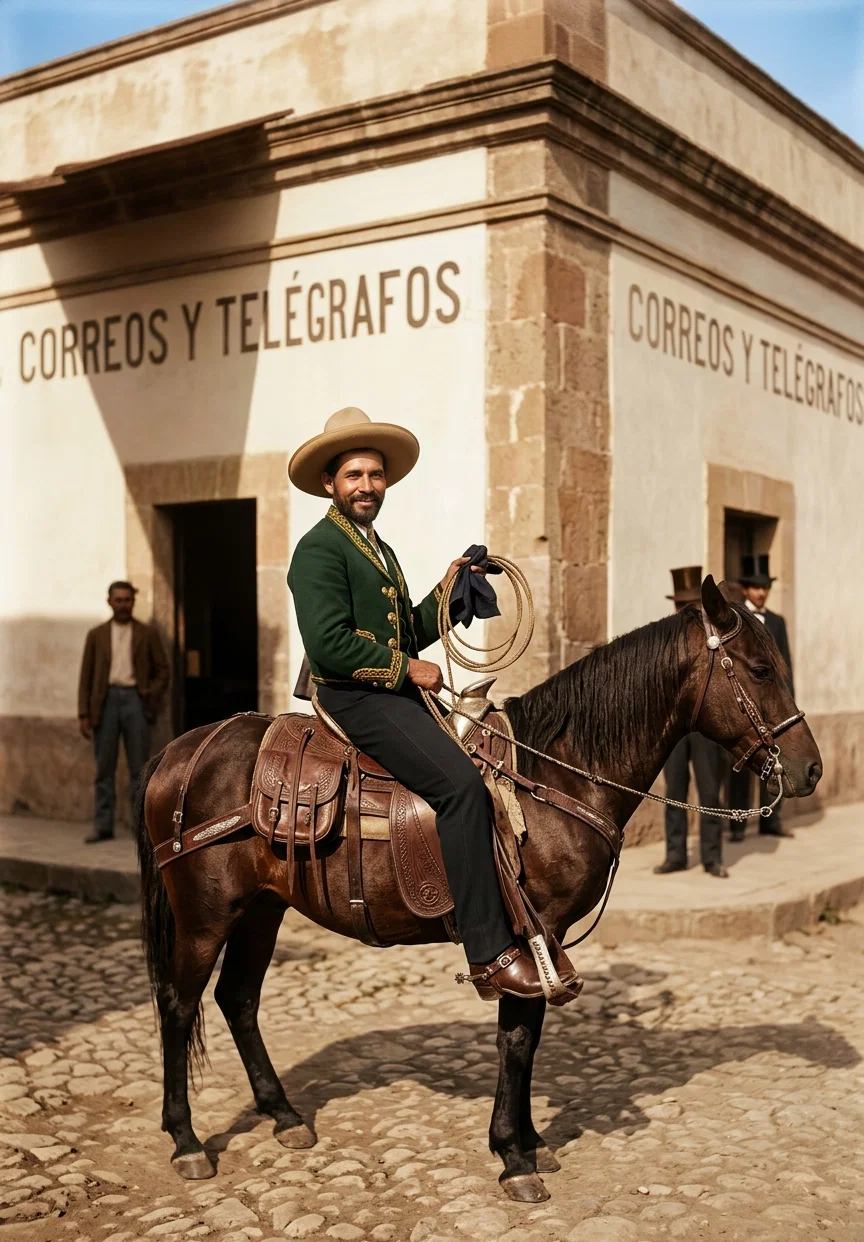
The mounted man in the accompanying illustration is Brother Antonio Rodriguez, the first man to accept the message in this city, and the man to whose activity much of the progress of the work here is to be credited. The trade by which he supports his family may be correctly guessed by what the picture shows in his hand (a shoe). I must not fail to state also that all the dear believers are true and active supporters of the work in the midst of strong opposition.
Since we opened our work in the present location, fifteen persons have signed a covenant to keep the commandments of God and the faith of Jesus, and by their influence and otherwise, to support the work of the message they have learned to love. There are several applicants for baptism, and a good prospect that the Lord will raise up a company of believers here to help proclaim the last message in this important center.
After speaking on the “Beast and Its Image” to an appreciative audience, an invitation was given for all those to arise who believed that the law as given on Mount Sinai was still obligatory on all, instead of the mutilated law as taught by the Papacy, and sixteen persons responded. Nearly the whole congregation arose to testify to their firm belief in the holy law.
The message is onward here, and the conviction that we have the sympathy and prayers of all the REVIEW family is a source of much comfort and strength.