The Youth’s Instructor, Vol. 33, No. 23.

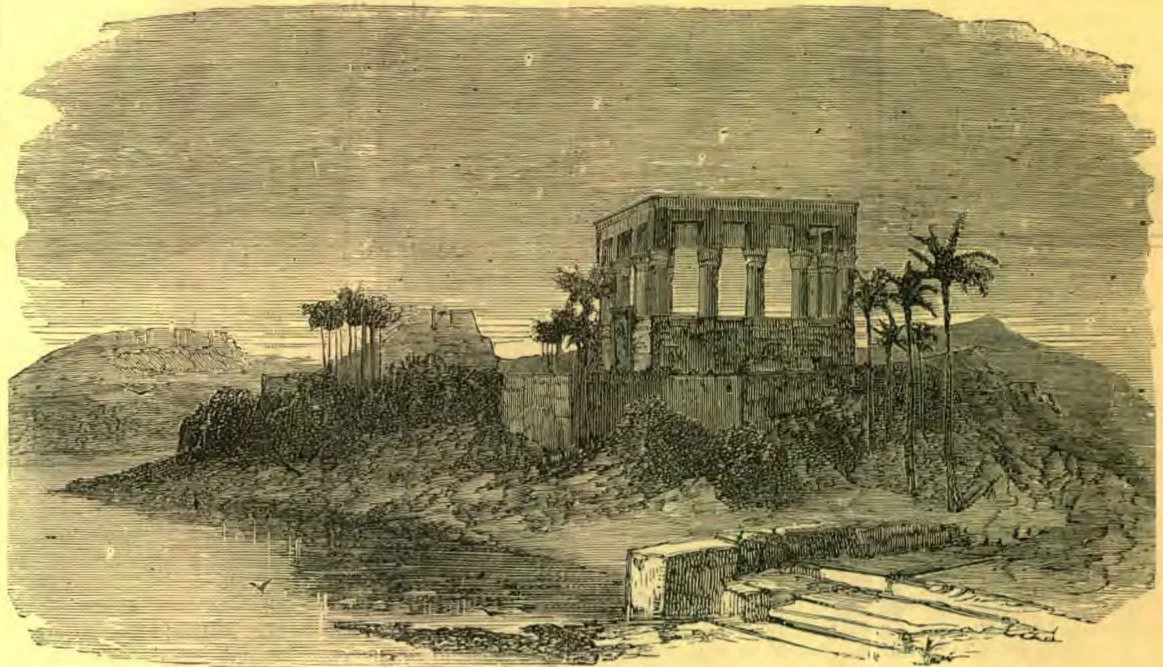
PHILÆ ON THE NILE

The Youth’s Instructor

Jun 24, 1885

S. D. A. Publishing Association · Battle Creek, Mich. · Jun 24, 1885

PHILÆ ON THE NILE.

The scenery along the Nile possesses a peculiar beauty, unlike that in any other country. The smooth river, flowing between brown banks, is bordered on either side by strips of green, and hemmed in by yellow sand hills. For mile after mile, the same view greets the eye, unbroken except by the mud huts of some little Egyptian village or the ruins of stately temples and tall monuments.
As one goes up the river, and approaches the southern confines of Egypt, the villages are farther and farther apart, and the desert sands creep closer to the water’s edge, leaving only a narrow strip of vegetation to break the monotony of the general brown. The scenery here grows wilder than any before seen in Egypt. The whole stream is choked with black rocks, bristling out in every direction, and over these the river eddies and foams.
A short distance above these rapids, called the First Cataract, lies the island of Philae, a quarter of a mile long and less than half as wide. Says a writer, “The approach to the island is very beautiful. On either hand, great, bare, shining rocks, black and gray, tower against the sky; while between them, through an opening, appears the little island, with palms in the foreground, and the well-preserved pylon of the Temple of Isis rising out of the green.” But it is only by contrast with the prevailing brown of the surrounding landscape that Philae assumes its fresh hue. The island is entirely deserted, and its scant vegetation suffers from the want of care. If the rubbish were cleared away, and the soil watered, as in other parts of Egypt, the spot would be lovely.
On the island are the ruins of two temples, one of which is shown in our picture. They were sacred to Isis and Athor, the two chief goddesses of the Egyptians. To the devout Egyptian, it formed no objection that the gods should be subject to the passions and woes that affect mankind. And so it will not seem strange when we learn that this island is the reputed burial place of Osiris, one of their chief gods. Philae was to the Egyptian what Mecca is to the Mahometan, or Palestine to the Jew. Its very soil was holy. None might approach it closely, or land upon it, without special permission. Happy indeed was the man who had the favor granted him of making a pilgrimage to this sacred place.
But all this is now changed. There came a day, when, as one traveler remarks, “for the last time the tomb of the gods was crowned with flowers, and the ‘Lamentations of Isis’ were recited on the threshold of the sanctuary. And there must have come another day when the cross was carried in triumph up those painted colonnades, and the first Christian mass was chanted in the precincts of the heathen.”
“A small basilica was built at the lower end of the island; the portico of the great temple was converted into a chapel, and dedicated to St. Stephen. . . . The little basilica, we may be sure, had a cluster of mud huts upon the roof, and I fancy the abbot and his monks installed themselves in that row of cells in the east side of the great colonnade, where the priests of Isis dwelt before them. As for the village, it must have been, like Luxor, swarming with dusky life, noisy with the babble of children, the cackling of poultry, and the barking of dogs; sending up thin pillars of blue smoke at noon, echoing to the measured chime of the prayer bell at morn and even, and sleeping at night as soundly as if no ghostlike, mutilated gods were looking on mournfully in the moonlight. The gods are avenged now—the creed that dethroned them is dethroned. . . . For the Church of Christ, which still languishes in Egypt, is extinct in Nubia. It was absorbed by Islam at last, and only a ruined convent perched here and there upon some solitary height, or a few crosses rudely carved upon the walls of a Ptolemic temple, remain to show that Christianity once passed that way.” W. E. L.

GOLDEN DEEDS.

WHAT is a golden deed? It is something which we do when we think more of others than of ourselves. And it is called golden because the rarest and most precious things in all the world are the acts of unselfish men.
What a golden deed is that which is told of Sir Philip Sydney! This brave English knight was fighting in Holland to help the Dutch keep their liberty against the tyrant Philip, of Spain. In a fierce battle he was struck by a musket-shot which broke his thigh-bone. Faint and thirsty from the loss of blood, he called for water.
He had just raised the cup to his lips, when his eye fell on a poor, dying soldier who was looking longingly at the cool drink. Without so much as tasting it, Sydney handed the cup to the poor fellow, with these words: “Thy need is greater than mine.”
Have you ever heard of the Swiss hero, Arnold of Winkelried? Once the Swiss were having a battle with a German army that had come to take away their land. The Germans stood very close together, each man with his sharp spear thrust forward; and this made a thick hedge of steel, which the Swiss, who had only short swords and battle-axes, could not break through.
Suddenly Arnold stepped forward and said, “My dear friends, take care of my wife and child, and I will open a road for you.” Then he seized as many German spear-points as he could reach with both arms, and throwing his weight on them, bore them down with him to the ground.
Over his dead body the Swiss sprang into the gap he had made; and before the day was over, they put the foe to flight.
Now let us hear of a glorious deed done more than two thousand years ago.
In Syracuse there was so hard a ruler that the people made a plan to drive him out of the city. The plot was found out, and the king commanded that the leaders should be put to death.
One of these, named Damon, lived at some distance from Syracuse. He asked that before he was put to death, he might be allowed to go home long enough to say good-by to his family, promising that he would then come back to die with the rest.
The king did not believe him. So he said, “I will not let you go unless you can find some friend who will come and stay in prison in your place. Then if you are not back on the day set, I shall put your friend to death in your stead.” The king thought, “Surely no one will ever take the place of a man who has got to die.”
Now Damon had a very dear friend named Pythias, who at once came forward, and offered to stay in prison while Damon was away. The king was very much surprised, but he had given his word; so Damon was permitted to start for home, while Pythias was shut up in prison.
Many days passed, and Damon did not come back. The king, curious to see how Pythias would behave now death was so near, went to prison. “Your friend will never return,” he said to Pythias. “You are wrong,” was the answer. “Damon will be here if he can possibly come. But he has to travel in a sailing vessel, and the winds have been blowing the wrong way for several days. However, it is much better that I should die than he. I have no wife and no little children; and I love my friend so well that it would be far easier to die for him than to live without him. So I am hoping and praying that he may be delayed until my head has fallen.” The king went away more puzzled than ever.
The last day arrived. Still Damon did not come, and Pythias was brought forth, and mounted the scaffold. “My prayers are heard,” he cried. “I can now die for my friend. But mark my words. Damon is faithful and true; you will yet have reason to know he has done his utmost to be here.”
Just at this moment a man came galloping at full speed, on a horse covered with foam! It was Damon. In an instant he was off his horse, on the scaffold, and had Pythias in his arms. “My beloved friend,” he cried, “the gods be praised that you are safe. What agony I have suffered in the fear that my delay was putting your life in danger!”
There was no joy in the face of Pythias; he did not care to live if his friend must die. But the king had heard all. At last he was forced to believe in the unselfish friendship of these two. His hard heart melted at the sight, and he set them both free, asking only that they would be his friends too.—Selected.

JUNE

MARCH is a trumpet-flower, and April a crocus wild; May is a harebell slender, with the clear blue eyes of a child; July is the cup of a tulip, where gold and crimson meet; And August a tiger-lily, tawny with passion and heat;— But thou art the rose of the world, precious and glowing and sweet!
Fair is the flush of the dawning over the face of the sky, Sweet is the tangle of music from wild birds fluttering by, Brilliant the glow of the sunset, and graceful the bound of the deer, Glad is the laugh of the children, ringing like joy-bells clear,— But what can compare with thy beauty, O red, red rose of the year?
—Wide-Awake.

The Value of Time

Those who understand the value of time, treat it as prudent people do their money: they make a little go a great way.—Hanway.

LITTLE MERCEDES.

It was evening in the old Spanish city of Cadiz. The hot sun had ceased to shine upon the white buildings, and the waters of the bay were tinged with the rose and violet reflection of the sunset.
Little Mercedes, a girl of eleven years, was seated upon the low steps of their humble dwelling, watching her mother, who was preparing the simple evening meal.
“O mia madre,” she exclaimed, “how I wish I could have a new dress! My old one is so shabby; not really fit to wear to the Cathedral service, and I am ashamed to be seen in it any more!”
“My child,” replied the mother, “I would gladly give you one if I could afford it, but you know we are poor, and it is with difficulty I can earn enough to procure food for us from day to day: I see no way for you to purchase the material for a dress, unless you can earn it for yourself.”
“That I will gladly do, my mother, if you will tell me how.”
“Perhaps you might gather chestnuts for old Silvio to roast for his stall in the market,” replied the mother.
“How much money would it take?” asked Mercedes.
“I think you would need five reals to buy the simplest material.”
“Five reals!” exclaimed the girl; “it would take a long while to earn that amount, for old Silvio could not pay much for the nuts, I know; he is so poor himself.”
However, Mercedes was determined to make the attempt, for the Spanish girls, like our own, are very fond of dress and finery, and like to look well on the Saints’ days and similar occasions.
The next morning, bright and early, little Mercedes was up and on her way to the market, where she speedily found old Silvio lighting his fire, and getting ready for his day’s sales. The old man readily agreed to her eager proposal; but, as she had feared, he could pay but a very small sum for the chestnuts, as his profits were very meager, and he had a hard struggle to make a livelihood. Nothing daunted, however, the little girl went off to gather the chestnuts, and day after day found her at this employment.
One Saturday her little friend Carita joined her, and while she helped her in her work, she told her of the new school recently opened by some good people, and to which she went every Sunday, ending by inviting Mercedes to accompany her the next day.
“What do you do there?” inquired Mercedes.
“We sing the most beautiful hymns,” replied Carita, “and learn words from a book they call the Bible. It is so nice,” the little girl added, “for they explain everything, and make it much more interesting than the dull catechism we say to Father Pedro.”
Mercedes was anxious to go to this wonderful school, and as her mother consented, Carita called for her the following day.
She found a pleasant room in which some thirty or forty children were gathered, with several ladies and gentlemen for teachers. She was greatly delighted with the sweet hymns in her own musical language, and listened attentively to the Scripture lesson. From that day, Mercedes was in her place each Sabbath, and soon learned to join in the hymns with the others.
Some of the children had Testaments of their own, and she longed to possess one, that she might read its precious words for herself. Upon inquiring the price of a Testament, she was told it was five reals, just the sum she had almost earned for her dress!
She went home very sober that day, for she had much to think of. Could she give up the dress for which she had worked and waited so long? For a time she felt as if she could not; but then she thought of the beautiful words she heard in Sunday-school, and how good it would be to read them for herself. She asked her mother, who told her to do as she chose, as the money was her own.
After awhile she decided in favor of the Testament; and as soon as she had earned the last real, she carried them to her teacher, and received a neat little copy of the New Testament in Spanish. Her joy was great, and she forgot all about her shabby dress as she hugged her treasure to her heart.
Dear children, this is a true story. Mercedes is a real little girl in that Spanish city, and the facts are all as related.
I wonder how many of our little readers would prefer buying a Testament with their earnings, to having a new dress, especially if they were as poor as Mercedes, and had no other means of getting the dress.—The Well-Spring.

LINCOLN'S MOTHER.

Though President Lincoln's mother died when he was only ten years of age, yet she lived long enough to inspire him with a noble ambition, to train him to love truth and justice, and to reverence God and goodness. Years after, when men were looking to him as one who might become a national leader, he said,—
“All that I am, or hope to be, I owe to my mother.”
The wife of a pioneer, she shared the privations and hardships of life in a wilderness. The struggle for existence familiarized her not only with the distaff and the spinning-wheel, but with the ax, the hoe, and the rifle. She helped her husband to clean and break up the soil, to kill wild turkeys, as well as deer and bears, whose flesh she cooked and whose skins she dressed and made into clothes.
When she married, her husband could neither read nor write, but she found time, toilsome as was her life, to teach both rudiments to him and to her son. She was unusually intelligent and refined for a pioneer's wife. Her taste and love of beauty made her log house an exceptional home in a wilderness, where the people were rugged, and lived so far apart that they could hardly see the smoke from each other's cabins.
When Abraham Lincoln had gained the people's ear, men noticed that he scarcely made a speech or wrote a State paper in which there was not an illustration or a quotation from the Bible. “Abe Lincoln,” his friends used to say, “is more familiar with the Bible than most ministers.”
He had been thoroughly instructed in it by his mother. It was the one book always found in the pioneer's cabin, and to it she, being a woman of deep religious feeling, turned for sympathy and refreshment. Out of it, she taught her boy to spell and read, and with its poetry, histories, and principles she so familiarized him that they always influenced his subsequent life.
She was fond of books, and read all she could beg or borrow from the pioneers far and near. Her boy early imbibed his mother's passion for books. Here and there could be found in the cabin Bunyan's “Pilgrim's Progress,” Weems' “Life of Washington,” and Burns' poems. Young Abe read these over and over again, until he knew them as he knew the alphabet.
When his mother died, the son had already received a good education—he told the truth, he loved justice, he reverenced God, he respected goodness, he was fond of reading, he could swing the ax, shoot the rifle, and take more than a boy's part in subduing the wilderness, and building up a home.
She selected the place for her burial. It was under a majestic sycamore, on the top of a forest-covered hill that stretched above her log-cabin home. No clergyman could be found to bury her, and neighbors took part in the simple, solemn rites. Months after, a preacher, who had been written to, traveled hundreds of miles through the forest to preach a funeral sermon under the great sycamore.
The boy of ten years never forgot those sad, plain services, nor the mother whose memory they honored. She ever remained to him the incarnation of tenderness, love, self-sacrifice, and devotion to duty. When he was President, he honored her training by the thought, “She placed me here!”—Selected.

UNDER THE TREES.

WHEN summer days are bright and long, And the little birds pipe a merry song, 'Tis sweet in the shady woods to lie, And gaze at the leaves and the twinkling sky, Drinking awhile the rare, cool breeze, Under the trees, under the trees.
When winter comes, and the days are dim, And the wind is singing a mournful hymn, 'Tis sweet in the faded woods to stray, And tread the dead leaves into the clay, Thinking of all life's mysteries, Under the trees, under the trees.
Summer or winter, day or night, The woods are an ever-new delight, They give us peace, they make us strong, Such wonderful balms to them belong; So, living or dying, I take mine ease, Under the trees, under the trees.
—R. H. Stoddard.

A DISOBEDIENT PROPHET.

Nearly twenty-six hundred years ago, there lived in Palestine a prophet named Jonah. The city of Nineveh was at this time a very wicked place,—so wicked that the Lord thought best to destroy it. So he told Jonah to go down there, and preach to the people. But Jonah thought that the Ninevites would repent, and the Lord would spare the city, so he tried to run away. Perhaps Jonah thought that if he could get away from the Holy Land, some one else would be sent to preach. So he ran down to Joppa, and took passage on a ship; but the Lord sent a storm, and the sailors, thinking Jonah was to blame for the storm, threw him overboard, and a great fish swallowed him up.
Jonah must have thought he would never see the land again; but the Lord kept him alive, and at the end of three days, he was cast out on the dry ground. You may be sure he was very glad to preach to the people of Nineveh now. He had found that the Lord was everywhere, and that it was useless to try to hide from him.
Nineveh was a very large city, some fifty or sixty miles around it. Some writers say it contained six hundred thousand inhabitants, and some say there were over two millions.
After Jonah had walked all day up and down the streets of the great city, crying, “Yet forty days, and Nineveh shall be overthrown,” he turned aside, and waited to see if the message would prove true. But forty days went by, and still the city stood; for the people repented when they heard Jonah, and fasted, and cried to God, and turned from their evil ways, and so God spared them.
You would suppose that Jonah would be glad when he saw so many people saved from death, but he was not. “He was very angry” when he saw that his preaching did not prove true. He said the reason why he ran away in the first place, was because he knew the Lord was merciful, and slow to anger. Then the Lord told him there were one hundred and twenty thousand innocent little children in the city.
How thankful Jonah should have been when the Lord was so merciful and forgiving. And how thankful we should be to have such a kind heavenly Father. Many Christians have some time in their lives been very wicked; and after they did profess to be followers of Christ, they were not always as good as they ought to be. But the Lord waits, and is very merciful and patient, and if we only turn to him with the whole heart, he will bless us and save us.
And we can learn another lesson from Jonah’s life. We should not be impatient if everything does not happen just as we think it ought to; but we should trust in the Lord, believing that everything will be for the best to those who love God.
JOHN R. CALKINS.

LOVE ALWAYS HERE.

LOVE is where the sunshine glows; Love is where the lily blows; Is with yonder little bird, Is with all the wildwood herd. If no human love be near, Love from God is always here. —Annie M. Starr.

“DO IT NOW.”

AMONG the mountains of Switzerland is a small hostelry, where tourists are accustomed to stop and refresh themselves before making the grand ascent. In the waiting-room of this inn is a placard suspended in plain sight, containing, in large type, these three words—Do It Now.
When the inn-keeper was asked the meaning of this, he explained that he was continually bothered by tourists asking him when they should go here, or when they should go there, or when they should do this, that, or the other thing, and so he had the placard put up that it might save him the trouble of answering so many questions.
Wise man! No doubt many a tourist has had occasion to thank him for opening his eyes to the danger of procrastination; for often the printed protest, the silent admonition, will have more effect than the spoken word.
We are all traveling up the mountain heights, and are more or less disturbed by anxious doubts and fears; and it would be well if we kept before our eyes this simple admonition: “Do it now.” And what a world of trouble it would save us to-morrow, if we were careful to do all that we ought to do to-day!
You have a difference with some member of the family, and sometime intend to say you are sorry, and ask forgiveness! Do it now! A friend has been bereaved, and it is in your heart to write a few comforting words. Do it now!
A poor family are in need of assistance; their case appeals strongly to your sympathy, and you suppose you ought to look after them. Do it now!
You have endeavoured to lead the life of a Christian, but have not yet entered into membership with any church. Do it now!
There was one sermon of the pastor’s which seemed to let in the light, and some day you mean to thank him for it. Do it now!
You were rather hasty in your temper yesterday, and must correct the tendency to answer back. Do it now!
You have a fashion of frowning when asked to do a favor; but some of these days you may be able to render more cheerful obedience. Do it now!
You know that your manners need polishing, and that you ought really to give up using slang words and phrases. Do it now!
Don’t delay doing whatever is necessary to the improvement of your character, or the benefit of your fellow-creatures. The habit of putting off, grows upon us; and if we accustom ourselves to act upon each good impulse, we shall be surprised to find how much we can accomplish, and how our own activity serves as a spur to those who are willing to do when they see others doing.
“The flighty purpose never is o’ertook, Unless the deed go with it.”
—S. S. Classmate.

THE BOY'S BARLEY-CAKES.

Little did that Jewish mother think, as she ground the grain, and mixed the dough, and heated the oven, and gave the five cakes to her little boy as he started for the great out-door meeting, that her little cakes, passing through the hands of the Prophet of Nazareth, were to feed the five thousand men who gathered to hear his words of grace. And little do we think, when we are doing some trifling service, how great a blessing God may pronounce upon the labor of our hands. What a story that boy had to tell his mother when he went home from the meeting; and what stories will be told to us when we reach the eternal home, and learn that our feeble service, our faintly spoken words, our little things done in the Master's name, have been crowned with a blessing that shall abide throughout eternity. Let us do our work heartily for God, and pray that he may accept the labor of our hands, and crown it with his eternal benediction.—Little Christian.

Honest Labor Versus the Easy Dollar

THE darkest day in a man's earthly career is that wherein he fancies there is some easier way of gaining a dollar than by squarely earning it.—Horace Greeley.

IMPORTANT BIBLE SUBJECTS.

LESSON 50.—INHERITANCE OF THE SAINTS. (Continued.)

SOJOURNING IN A STRANGE LAND.

[NOTE TO THE STUDENT.—Do not consider the lesson learned until you can give at least the substance of every text, with the correct reference for each. The references in black letters indicate those texts that should be committed to memory. A little diligent application each day will enable you to do this.]
1. What question did Abraham ask on one occasion when the Lord repeated the promise to him? Gen. 15:8.
2. What did the Lord say in reply? Gen. 15:9.
3. What did Abraham do? Gen. 15:10, 11.
4. What happened when the sun was going down? Gen. 15:12.
5. In this vision, what did the Lord say to Abraham? Gen. 15:13.
6. How long were his seed to be strangers in a strange land?
7. When the time was expired, what was to be done? Gen. 15:14.
8. What was the name of the land which they were to have as their own? Gen. 17:8.
9. Why could they not at once take possession of it? Gen. 15:16.
10. When the Lord did at last deliver the Israelites from bondage, what did he say to them? Ex. 19:3-6.
11. What did he say they should be? Ex. 19:6.
12. In making this promise, what was the Lord doing? Deut. 7:6-8.
13. Then with what is Ex. 19:3-6 parallel? Gen. 13:14, 15, etc.
14. What was the condition of the promise to Abraham, Isaac, and Jacob?
15. And what was the condition of this promise to the Jews? Ex. 19:5.

NOTES.

“Know of a surety that thy seed shall be a stranger in a land that is not theirs, and shall serve them; and they shall afflict them four hundred years.” Gen. 15:13. The student must not get the idea that this refers solely to the bondage in Egypt, for Paul tells us (Gal. 3:17) that from the announcement of the promise to Abraham until the giving of the law at Sinai, was but four hundred and thirty years. This four hundred and thirty years is thus computed: from the giving of the promise until the birth of Isaac, twenty-five years (Compare Gen. 12:1-4 with Gen. 21:5); from the birth of Isaac until the birth of Jacob, sixty years (Gen. 25:26); from the birth of Jacob until the going down into Egypt, one hundred and thirty years (Gen. 47:8, 9); making two hundred and fifteen years from the giving of the promise until the beginning of the sojourn in Egypt; and Josephus says (Antiquities, chap. 15, ¶ 2) that two hundred and fifteen years was the length of that sojourn. Thus the four hundred and thirty years of Gal. 3:17 and Ex. 12:40, 41 are accounted for.
The text under consideration (Gen. 15:13), however, is more difficult. It is evident from the text, and also its parallel in Acts 7:6, that the four hundred years’ sojourn ends at the same time as the four hundred and thirty years’ sojourn, viz., at the deliverance from Egypt. Then the four hundred years’ affliction (Gen. 15:13) must have begun thirty years after the giving of the promise. Dr. Clarke and others say that the mocking by Ishmael when Isaac was weaned (Gen. 21:1-10), called persecution by Paul in Gal. 4:29, marks the beginning of this four hundred years. Isaac was born twenty-five years after the promise, and the age of weaning is placed at about five years (see Clarke on Gen. 21:8), thus making the thirty years from the promise. This is certainly not inconsistent with Gen. 15:13, for if Abraham’s seed was to be afflicted four hundred years, we would expect that persecution to begin with Isaac. The only difficulty remaining is to show the harmony of these texts with Ex. 12:40, 41, which speaks of the children of Israel as sojourning four hundred and thirty years. But Dr. Horne (“Introduction to the Study of the Scriptures,” vol. 1, part 1, chap. III, sec. VI) says that the text, according to the ancient Samaritan Pentateuch, should read thus: “Now the sojourning of the children of Israel, and of their fathers, which sojourned in the land of Canaan, and in the land of Egypt, was four hundred and thirty years.” This rendering, which is confirmed by the Alexandrian manuscript of the Septuagint, makes perfect harmony.
From Deut. 7:6-8 we learn that when the Lord brought the Israelites out of Egypt, and made the promise recorded in Ex. 19:3-6, it was simply in keeping with the promise made to their fathers. The fact that the conditions of the two promises were the same (compare Gen. 26:5 with Ex. 19:5) harmonizes with this statement.

A LETTER AND ITS REPLY.

In the following letter and reply, clipped from an old paper, the Tribune’s instruction to the young man harmonizes well with Paul’s testimony in his epistle to Timothy: “All Scripture is given by inspiration of God, and is profitable for doctrine, for reproof, for correction, for instruction in righteousness,” etc. The Bible is a sure guide, as those most familiar with its teachings can testify. We quote:—
“Some persons, very ‘advanced’ in their notions, say that the Bible is an obsolete book, too old-fashioned for the present age. The New York Tribune is not so far ‘advanced.’ The following are copies of a letter once sent to that paper, and the Tribune’s reply:—
“I am a young man, just commencing business, and have some young men in my employ. How can I manage to prevent insubordination on the one hand, and to make a positive success as an employer on the other hand? Are there any books that will help me? What are some of the best books for a young business man?”
“The following pertinent suggestions were given in the answer:—
“The best single treatise is the New Testament; next to this is the book of Proverbs of Solomon. The best business man we have ever known, memorized the entire book of Proverbs at twenty-two,—carrying the American Tract Society’s ten-cent edition in his vest pocket, and committing a half dozen verses daily; and when he became an employer, gave a copy of the book to every employee, with a friendly inscription commending it as an admirable business guide.”

God's Provision for Those Who Go Forward

WHAT God has done for you in the past, marks no limit for what he will do for you in the future. You have only to go forward; and you will find that God never calls you into an untrodden path without first laying up in store for you those supplies which you will need, and which he will bring to your knowledge in his own best time.

BRIEF THOUGHTS.

ONE now is worth a hundred presents; One try a thousand can'ts. 'Tis try and now That make your laureled and world-famous men; Not can'ts and by-and-bys.
It is not singing psalms, but being one, Is music in God's ear. Not only lips, But also lives, must swell the hymn of praise, Or vain the song. To be true worshipers, We must ourselves be temples.

A FAMILY QUARREL.

Can our young friends point out Central America on the map? How many of them know that the inhabitants of that country have just been at war among themselves? Treasure-Trove gives some of the principal causes of the trouble, in the following paragraphs:—
“Central America has just had a fight. There is nothing very astonishing about this, for she has the reputation of being rather quarrelsome. It is seldom that each of her five republics is at peace with itself and its sisters; but this time things looked as if there was to be a general war in which all were to take part. The trouble was this:—
“Once all five of the sisters were united in one kingdom under the rule of Spain; but they revolted from the mother country, and each set up a government of its own, much like our republican government. All five then united in a confederation, something like our Union, but they quarreled and separated. Since then, the more intelligent of the people have been trying to restore the union, but the masses are so ignorant and contentious that they cannot agree.
“Not very long ago, Gen. Barrios, president of one of the republics, took it upon himself to force the other States to unite in one general government. Only Honduras consented to do this; the others said they would fight first. So they fought, and President Barrios was killed. Nobody else cared to carry out his design; and so the fighting ceased, and peace now reigns between the sisters.
“The whole of Central America is less than half as large as Texas, and the population is only one-half of that of New York State. Nicaragua, the largest of the republics, has the reputation of being the best behaved, i. e., having the best government. Don Adam Cardenas is the president; the country is prosperous, and has not had a quarrel since 1860. The much-talked-of Nicaragua Ship Canal would run through this country.
“Guatemala, the cause of this last disturbance, is the most northern of the countries, and since Gen. Barrios became its president, has made rapid progress.
“Honduras claims the honor of being the first land on the continent, that Columbus set his foot upon. It has also the dishonor of having more fights than any other.
“San Salvador has always been noted for its riches. Here some of those civilized Aztecs were found, when this country was explored by the Spaniards.
“Costa Rica, the smallest of the republics, has had less trouble among her own people than the others; but she has had her hands full in keeping her neighbors out of her territory. Nicaragua on the north, and Columbia on the south, have constantly been trying to rob her of the little land she has.”

SOME MODERN INVENTIONS.

The following are a few of the latest novel inventions of this wonderful age, for those who are interested in modern ideas:—
“Among the new applications of cotton is its use, in part, in the construction of houses, the material employed for this purpose being the refuse, which, when ground up with about an equal amount of straw and asbestos, is converted into a paste; and this is formed into large slabs or bricks, which acquire, it is said, the hardness of stone, and furnish a really valuable building stock.”
“Rain-band spectroscopes have been constructed by expert opticians, so small as to be carriable in the waistcoat pocket, but so powerful and true that a glance through one of them suffices to tell an experienced observer the general condition of the whole atmosphere, especially of the upper parts of it, where any changes take place earlier than below; thus enabling one to foretell rain.”
“A curious Japanese invention is that belonging to Otsuka Uinakichi, who, after extensive experiments, is said to have succeeded in making rifles of silk. They are described as ‘rigid’ as iron guns, while they are easy of carriage, and have a very long range.”
“A new method of driving horses by means of the feet, so as to keep the hands warm in cold, stormy weather, has been introduced recently. The feet rest on a firm board, and the horse is guided by raising or lowering the toes. The apparatus can be attached to any vehicle in a very few minutes, and can be used by a very young person.”
“It is proposed to anchor vessels at a distance of two hundred miles from each other in a straight line across the Atlantic Ocean, to be lighted by electricity and connected by an electric cable, thus lighting the path of ocean steamers and furnishing many other advantages.”

A NARROW ROAD.

One of the native explorers of the Himalayan regions of India beyond the British boundary, says Sir J. H. Lefroy, in his address to the British Association, describes a portion of his road on the back of Mount Everest as lying for a third of a mile along the side of a frightful precipice, at the dizzy height of fifteen hundred feet above the Bhotia-Kosi River. The track along the side of the mountain was made by inserting stout iron pegs into the perpendicular side of the rock, and upon these were laid iron bars and over them slabs of flat stones. This was the native highway; and although fifteen hundred feet above a yawning precipice, in no place was the road more than a foot and a half wide, and often not more than nine inches! And yet this narrow track, over such a frightful chasm, is constantly used by the natives in traveling and carrying their various burdens. G. W. A.

PACKING ORANGES.

When you unroll an orange from its tissue-paper covering, do you ever think how long it must take to wrap so many thousands separately? The work is usually done in the evening, all the help in the neighborhood coming in to assist. The large warehouses are lighted by candles along the walls, and at one end of the room are huge boxes filled with oranges. At the opposite end are long tables, behind which the wrappers are seated. By the side of each one is a bundle of tissue paper. The fruit is brought by boys, in large bread trays, and by a single movement the paper is wrapped tightly around, the ends twisted, and the oranges are dropped into another tray to be carried to the packers. These men place them in crates which hold from 120 to 140, and in Florida sell for about three dollars. The oranges are not brought direct from the grove to the packing house, but rest a day or two in the drying house. Sometimes the work is done to the music of a banjo.—Treasure-Trove.

CORSICAN WOMEN.

THE Corsicans are Italians by blood and language, Frenchmen by political accident, and idlers by nature. The women are the laborers, and also the beasts of burden. A French traveler says he has seen women and girls emerging from the woods, bending under the heavy loads of brush-wood for fuel, while their male companions rode behind them on ponies or mules.
Another traveler says that passing one evening through a Corsican village, he saw a troop of young girls carrying on their heads jars containing five or six gallons of water. Before them marched their male relatives, bearing flaming torches to light the burden-bearers on their way.
Water is brought into the cities by aqueducts. The women gather at the city-fountains to fill their jars, and to gossip. Resting the jar on one uplifted knee, and holding it by the ears, they fill it from the plashing jets. When it is filled, they raise it to their heads, square their shoulders, and march off without spilling a drop.
But the bearing of the jars on the head has this compensation: it gives the women an erect, robust, majestic carriage. They walk superbly, as do their sisters, the peasant women of Egypt, who also carry burdens on their heads.—Selected.
Continue reading: A RARE PLANT