The Youth’s Instructor, Vol. 33, No. 23.

PHILÆ ON THE NILE
Earlier text: PHILÆ ON THE NILE

A RARE PLANT.

THE following description of a rare and beautiful plant appeared in Golden Days a few months since:—
“The artillery fern, or flower, as it is sometimes called, is a curious and beautiful plant, which is not very generally known outside of rare collections or of florists’ greenhouses. It acquires its singular name from the military and explosive fashion with which it resists the action of water upon it. If a branch of the fern, covered with its small, red seed, be dipped in water, and then held up to the light, there soon commences a strange phenomenon.
“First one bud will explode with a sharp little crack, throwing into the air its pollen in the shape of a small cloud of yellow dust. This will be followed by another and another, until very soon the entire fern-like branch will be seen discharging these miniature volleys, with their tiny puffs of smoke.
“This occurs whenever the plant is watered, and the effect of the entire fern in this condition of rebellion is very curious as well as beautiful. As the buds thus open, they assume the shape of a miniature Geneva cross, too small to the naked eye to attract much attention, but under a magnifying glass they are seen to possess a rare and delicate beauty.”

USEFULNESS OF A TOY.

WHAT child has not amused itself with looking through a kaleidoscope and counting how many different pictures he could make by shifting the bits of bright glass at the end of the tube? This instrument, which was formerly sold as a toy, is used very much by architects and carpet designers to get plans for their work. But it is now used most extensively by men who manufacture round, stained window glass; for it supplies them with more beautiful patterns than they can make themselves.

FANNY’S LESSON.

Monday afternoon, Fanny went to a picnic, and lost her pocket handkerchief.
Tuesday she came home from school without her blue hair-ribbon.
Wednesday morning she laid her handkerchief on the sidewalk to hold the pretty stones she was gathering. Suddenly she heard a hand-organ just round the corner, by Paul Brown’s house, and away she ran to see if there was a monkey with it.
Paul and Wallace and Helen were standing by the gate, laughing at the pranks of a little creature with a face pitifully like that of a bad old man.
They all watched and listened awhile, and then Fanny wanted a penny to put in the monkey’s cap; so she started for home.
On the sidewalk, before the gate, lay the pebbles, but the little hem-stitched linen handkerchief was gone. Fanny looked very sober when she entered the house. She was ashamed to ask for the penny.
“It is almost time for school, my dear,” said mamma. “Are your hands clean? No. Where’s your handkerchief?”
trimmed with white embroidery, and that old brown rag was in the pocket.
Fanny had never been so ashamed in all her life. Papa hadn’t noticed the night before, but she was sure he would find out all about it now.
But she kept it out of sight pretty well all the morning at school. She didn’t lose it. Only one little girl asked her what she had in her pocket, and she pretended not to hear.
When she came home, she found company—Uncle Joe and Aunt Mary and her cousin Lu, just one year older than Fanny.
By the time dinner was ready, they were having a merry frolic, and were by no means ready to be quiet at the table. Suddenly Lu put on a funny look, and Fanny laughed, choked, strangled. Out came the calico rag. Fanny had quite forgotten it. She tried to hide her face while she used it, but papa said,—
“Why, my child, why do you put your head under the table?”
And Uncle Joe cried,—
“See here, Fanny, let’s have a peep at that handkerchief!”
Poor Fanny’s laughter changed suddenly to sobs.
“O mamma, please excuse me!” she whispered, and rushed up stairs to her own little room. Her heart was ready to burst, and when she heard mamma’s voice and Uncle Joe’s shouts of laughter, she knew they were talking of her carelessness, and it was very hard to bear.
But that one bitter lesson did help her to remember. Uncle Joe sent a box of handkerchiefs on her eighth birthday, with a brown calico one on top, to use for a day if she lost one. She put it out of sight in the bottom of the box, and hasn’t used it yet.—Youth’s Companion.

WEAVING SUNSHINE.

“You can't guess, mamma, what Grandma Davis said to me this morning, when I carried her the flowers and the basket of apples,” exclaimed little Mary Price, as she came running into the house, her cheeks as red as roses.
“I am quite sure, darling,” said mamma, “that I cannot; but I hope it was something pleasant.”
“Indeed it was, mamma,” said Mary. “She said, ‘Good morning, dear; you are weaving sunshine.’ I hardly knew what she meant, at first, but I think I do now; and I am going to try to weave sunshine every day.”
“Mother,” concluded Mary, “don't you remember the verses, ‘Four Little Sunbeams,’ you read to me one day? If those little sunbeams could do so much good, I think we all ought to be little sunbeams.”
After a few moments’ pause, a new thought came into Mary’s head; and she said, “O mamma! when Lizzie Patton was here, she told me that her Sabbath-school class was named ‘Little Gleaners.’ Now next Sabbath I mean to ask our teacher to call our class ‘Sunshine Weavers,’ and then we will all go weaving sunshine.”
It is a good plan to be sunshine weavers. They will be kindly remembered long after cross, hateful people have been forgotten.—Selected.

SOMETHING SURE.

WHAT a pity nothing ever Has a beauty that will stay!" Said our thoughtful little Nellie, Stepping briefly in her play. "All these velvet pansies withered,— And I picked them just to-day!"
"And there's nothing very certain," Answered Bess, with face demure; "When it rains, we can't go driving,— I wish promises were truer! I could rest, if I were certain Of a single thing that's sure!"
Grandma smiled from out her corner, Smoothing back a soft, gray tress; "Sixty seconds make a minute; Did you know it, little Bess?— Sixty minutes make an hour, Never more, and never less.
"For the seconds in a minute, Whether full of work or fun, Or the minutes in an hour, Never numbered sixty-one! That is one thing that is certain Ever since the world begun.
"Though the rose may lose its crimson, And the buttercup its gold, There is something, through all changes, You may always surely hold: Truth can never lose its beauty, Nor its strength, by growing old."
—Our Little Ones.

Fanny and the Lost Handkerchief

“O mamma,” cried Fanny, “somebody took it off the sidewalk!”
“Again?” said mamma, and shut her lips very tight.
You see, the trouble was that this dear little girl was a careless little girl. She wanted to be good, but she wanted fun first of all. So she always dropped her playthings where she was playing, tossed her hat into the first chair, and rarely knew where to find anything. Mamma had talked, coaxed, scolded; but Fanny seemed only to grow more thoughtless.
Thursday morning came. Mamma put a clean handkerchief in her little daughter’s pocket.
“Fanny,” she said, very soberly, “if you lose this, you must have a calico rag for a handkerchief all day to-morrow.”
“Mamma, I never will again! I promise you I never will; and a promise is a very special thing, you know, mamma.”
But she did! She and Helen Brown were coming down the hill toward home, talking about that funny monkey. Fanny was twisting her handkerchief into a rope as she walked.
Away flew the handkerchief into the gutter; away flew the little girls down the hill. Fanny did not think of it again till mamma said,—
“Well, my darling, did you keep the special promise?”
Fanny was really very sorry, but she had been sorry too many times. Mamma didn’t say one word. She only went to a drawer, took out some clean, old brown calico, tore off a square piece, and gave it to her little girl. Fanny needed it by that time to wipe away her tears.
The next morning, mamma put on her a new pink dress,

IN THE RAIN.

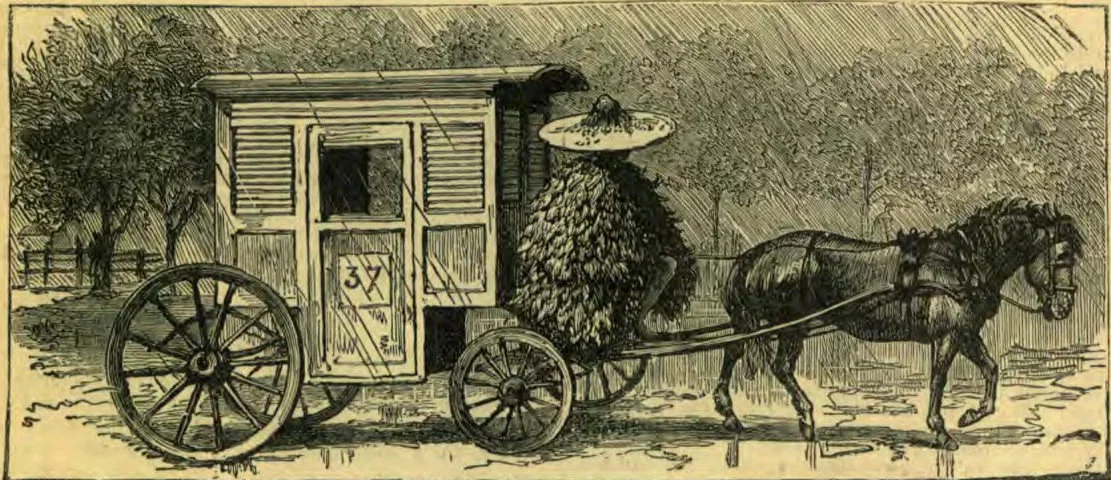
THIS horse and his master do not look as if they enjoyed their drive very much. How the rain pelts down on them! The pony trots along over this road in Chinatown, and tries not to mind the wet. The rain will not hurt him, for his Maker has given him a thick coat of hair, to protect him from the cold and wet. We hope that his master takes good care of him, and treats him kindly.
Behind him sits the driver. You know by his queer rain cloak and hat, that he does not live in America. He seems poor and degraded, and yet he is one of those for whom Christ died. What a pity it is that he does not know about God, and the way to heaven. No doubt he worships his little stone idol, and thinks that it can help him when he is in trouble. But his idol is no better than any stone. Perhaps some missionary, who has left his home, and sailed across the sea, will some day find him, and tell him about Jesus. I suppose there are millions of people who know nothing of the true God.
How glad we ought to be that we know about Christ; and how hard we ought to try to obey him in everything, because he loves us, and has done so much for us! Can you think of anything you do that grieves him? Will you not find out what he wants you to do, and try to please him every day?

Look on the Bright Side

Look on the bright side only, Leave care for by and by— Perhaps ’t will tire of waiting, And never more come nigh. The sun may shine to-morrow, Though to-night in clouds it set; So bravely face the future— "There’s blue sky somewhere yet."

Letter Budget.

LULU M. WOOD writes from Winnebago Co., Ill. She says: “I am a little adopted girl, ten years old. My parents are very good to me. I have always lived in Chicago until last spring. We have two horses and two cows, and they are all very gentle; and we have thirty chickens. I go to Sabbath-school, and learn my lessons in the INSTRUCTOR, which I think is a very nice paper for little folks. I want to be one of the Saviour’s little ones when he comes. This is my first letter, and I hope you will print it. I send my love to you all.”
In order to be one of the Saviour’s little ones when he comes, Lulu, you must be one of them here. Ask God every day to help you to do his will.
LEONA I. TOWLE, writing from Androscoggin Co., Me., to renew her subscription for the INSTRUCTOR, says: “We thank you very much for the nice paper, which has been a welcome friend and visitor at our home for more than two years. We read it and then send it to others.”
The practice of sending the INSTRUCTOR to others after reading it is commendable; for in this way it often falls into the hands of persons who become permanent subscribers.
Two little girls, BELLE JEWEL and CORA REEVES, have written letters and sent in one envelope from Barry Co., Mich. Belle says: “I have been going to the union school for two years, and have only missed five days in all that time.” They both attend the Sabbath-school, which has been held at a private house, but is now removed to the Red Ribbon Hall, because the school had grown so large. They mention the names of some who attend the school from Baltimore. Their last lesson, at the time the letter was written, was “Two Angels Visit Lot.”
We shall like to hear from these little girls again, and that they still like their Sabbath-school.
HERE is a letter from Clarke Co., Wis., written by JENNIE SUFFICool. She says: “I am twelve years old. I belong to a Sabbath-school of eighteen members, and we are all trying to get as many children to attend as possible. Some new ones have just come in. Pray that we may be the means of doing much good in this place.”
Such work as your school is engaged in, if faithfully done, will be accepted by the Master. We will remember you.
FELICIA SMITH writes from Ford Co., Kan., for the first time. She says: “I am eleven years old, and am trying to be a Christian. I was baptized last fall. My mamma, little brother and I keep the Sabbath; but my papa, and grandma, who lives with us, do not keep it. My papa is very good to us, and we hope he too will sometime become a Sabbath-keeper. I spent four days canvassing for the INSTRUCTOR, and got two subscribers. There are not many children about here. I learn lessons in Book No. 2, and my brother learns his in No. 1. My pony’s name is Nellie, and my brother calls his Billy. We have birds, and call them Charlie and Maud, for Eld. Boyd and his wife. I am going to have a ridge of missionary sweet potatoes. I want to be a good girl, and be saved with the INSTRUCTOR family.”
If all the INSTRUCTOR family missionary-gardens flourish this summer, we think there will be more than a mite contributed to the Lord’s treasury. We hope none of these many gardeners will have to report failure from any neglect of their own.

You have reached the end of this edition.

The Youth’s Instructor · Jun 24, 1885