LITERATURE is a collective body of literary productions, embracing the entire results of knowledge. If the entire results of knowledge may be obtained from an acquaintance with literature, shall we form an acquaintance with that which tends upward and heavenward, or shall we cultivate a taste for cheap reading? It is not the purpose of this article to speak of authors, but to contemplate the best methods and the best course of literature to be adopted by our children. The natural taste is for fictitious reading. Our youth need no encouragement in this direction. It is Satan’s work to present to them newspaper stories and story books that fascinate the senses, and this destroys all desire for that which is pure and wholesome. Will this fascinating reading develop firm, unspotted principles? “There are many of our youth endowed with great capabilities. God has given them the very best of talents, but their minds have been confused and enfeebled by the indulgence in inferior reading.”
If we would gaze for a moment upon the interior of our prisons, our hearts would quail within us. There our gaze is met by hundreds of young, sad faces. To what shall we attribute this state of affairs? Are these different creations than the more fortunate? Or are these some of our unfortunate youth, who have been allowed to indulge mind and body? Mothers, these were once babes cradled in their mothers’ bosom,—these were little flowers from heaven, gifts from the throne of God, sent to be nurtured by God’s own husbandmen. Fathers, mothers, have you toiled day and night? have you cultivated thoroughly, set the stakes, tied up the vines? Have you planted them in the sunshine, that rays from the Sun of righteousness may shine upon them? These are solemn questions, and require much meditation and prayer.
If it is as difficult to control the appetite for superficial reading as it is for the drunkard to control his appetite for intoxicating drink, radical changes must take place if we would give to the world practical men and women. God would have a people developed physically and mentally. We are living on the eve of a great crisis, and only those who are properly trained will be able to fight in the great conflict. Every parent should make a special effort to turn the attention of the youth from all exciting stories to the Word of God. The attention of every soul striving for eternal life must center upon the Bible. We must ourselves be drinking of the water of life freely. We must set a guard about our minds and the minds of our children, that they may not be allured by Satan’s temptations. The responsibility of proclaiming the message of salvation rests upon every parent. Shall we plead with our Heavenly Father that our eyes may be anointed with heavenly eyesalve, that we may be awakened to this great responsibility? It is Satan’s highest ambition to keep our minds upon the things of this world. He knows that the carnal mind is not subject to divine truths.
He has deluded many by advancing the idea that Bible knowledge as a foundation gives one an inferior learning. Martin Luther, the great Reformer, said that above all things he loved to draw wisdom from the pure source of the Word of God. While in the monastery, to which he resorted to obtain a spiritual training, he found a Bible fastened to the wall by a chain; to this he went continually for light and truth. It was said of him: “He was heard in the public discussions unraveling the most complicated trains of reasoning, and extricating himself from a labyrinth whence none but he could have found an outlet.” All his auditors were filled with astonishment. Whence did he obtain his wisdom? In Proverbs we read: “My son, if thou wilt receive my words, and hide my commandments with thee; so that thou incline thine ear unto wisdom, and apply thine heart to understanding; yea, if thou criest after knowledge, and liftest up thy voice for understanding; if thou seekest her as silver, and searchest for her as for hid treasures; then shalt thou understand the fear of the Lord, and find the knowledge of God. For the Lord giveth wisdom: out of his mouth cometh knowledge and understanding.” In these words we find the key that unlocks the treasure-house of knowledge.
Daniel was “skilful in all wisdom, and cunning in knowledge, and understanding science, and . . . had ability . . . to stand in the king’s palace.” He and his friends were educated in the school of the prophets. Was it an inferior learning? They were more wise than the magicians and astrologers. Were they deficient in science?—No, God is the true source of knowledge.
William Matthews, Professor of rhetoric and English literature in the University of Chicago, said: “Among the complaints made against the literature of our day, one of the commonest is that it lacks originality. Not only the poets are accused of stringing their lyres to the old times, and singing songs which have been sung substantially a thousand times before, but our philosophers and historians, our novelists, essayists, and theologians, are included in the same sweeping condemnation.” If every thought is traceable to some preceding writer, and thoughts result in action, shall our children gather seed thoughts from the Originator of all true science? or shall the truth which is placed before them be so mixed with error that no natural mind can decipher the original truth?
True knowledge is divine, and should be sought as for hidden treasure. It is that element which elevates to high, moral, spiritual, and intellectual development. Shall we as parents strive to lift the standard, that the darkness may pass away, and a new and heavenly light may shine in this darkened world?
Good Ventilation a Necessity to Health
By J. J. Bell, M. D.
J. J. BELL, M. D.
THE importance of an abundance of pure air for respiration is seen when we understand that the delicate mucous membrane of the lungs, through which we take in oxygen and give off carbon dioxide and other organic poisons, would cover an area of about two thousand square feet, or from one hundred to one hundred and thirty times the area of the skin covering the body.
Inspired air contains 79.15 per cent of nitrogen, 20.8 per cent of oxygen, and .04 per cent of carbon dioxide, moisture,12traces of ammonia and nitric acid, dust, and bacteria. Expired air contains 79.30 per cent of nitrogen, 16 per cent of oxygen, 4.38 per cent of carbon dioxide, an increase in moisture, also effete organic matter termed crowd-poison, some traces of hydrogen, marsh gas, etc.
We estimate the purity of the air by the percentage of carbon dioxide which it contains. Carbon dioxide, however, is not the only harmful ingredient present in expired air; but we know that when the percentage of carbon dioxide is high, other organic bodies, or crowd-poison, must be present in a correspondingly large proportion. It is not the lack of oxygen, nor is it the amount of carbon dioxide in the air of a moderately crowded room which makes it injurious to breathe; for the blood flowing in the lung tissue can obtain the necessary amount of oxygen from air containing as low as ten to fifteen per cent of oxygen, and breathing air containing one or two per cent carbon dioxide made by chemical methods is not harmful. But expired air containing one per cent of carbon dioxide is decidedly injurious because of the organic poisons present. The nose can detect very readily the impurity of the air of a crowded room, provided the individual enters directly from the fresh air outside. Those occupying the room may detect no unpleasantness because the olfactory nerves gradually become accustomed to the foul air as its impurities increase little by little.
Air containing two parts of carbon dioxide in five thousand we regard as pure. When carbon dioxide is present in the proportion of three parts in five thousand volumes, the air is impure and unfit to breathe. With every breath we exhale more than one cubic inch of carbon dioxide, which would thus render impure five thousand cubic inches of air, because five thousand cubic inches of pure or inspired air already contains two cubic inches of carbon dioxide. Five thousand cubic inches equal about three cubic feet. Thus we spoil three cubic feet of air at each expiration. Since we breathe about eighteen times a minute, we render impure three thousand cubic feet of air an hour. In a room having a capacity of one thousand cubic feet, with one inhabitant, in order to have the air pure the entire atmosphere would need to be changed at least three times an hour.
In order to ventilate a room without causing a draft, each inhabitant should have from seven hundred to one thousand cubic feet of space. Allowance should be made for furniture; and the area above fifteen feet high should not be reckoned.
Various methods have been in use for providing a means of ventilation. Two things, however, are a necessity, whatever system we adopt,—one or more fresh-air inlets, and a foul-air outlet. The latter must be equal in size to the combined area of all the inlets. The greater in number the inlets, and the fewer the outlets, the less will be the draft.
“No Place Like Home”
By Treasure Trove
“I HATE this little, low-roofed house,
This hill-bound valley home;
I long to see the glorious world,
And ’mid new scenes to roam!
“The sun just rises here, and sets,
The days are all the same;
There’s nothing grand to do or see,
And everything is tame.”
Years passed. The boy of restless heart
Had wandered far and wide,
Had tossed upon the ocean wave,
And climbed the Jungfrau’s side;
Had journeyed through the Golden Gate
To storied Eastern lands,
And pitched his tent where Afric’s streams
“Roll down their golden sands;”
Had glided through the Grand Canal,
’Neath soft Venetian skies,
And in strange northern lands had seen
The sun at midnight rise.
Through many cities grand and great
In wonder he had trod,
And on historic battle-fields
His feet had pressed the sod.
He roamed through galleries of art,
And palaces of kings,
And filled his memory with store
Of rare and wondrous things.
And then he came to that small vale,
Content no more to roam,
And said: “There’s not in all the world
So sweet a place as home!”
— Treasure Trove.
A New Danger
By L. A. Smith
L. A. SMITH
In an article contributed to the Chicago Tribune of January 10, Dr. William E. Gamble, of the College of Physicians and Surgeons, New York City, makes some statements which should cause any person inclined to the use of patent medicines to make a sudden halt in his experiments with such remedies. His statements refer to the extensive use which is being made of wood alcohol as a cheap substitute for common alcohol in patent medicines and other mixtures which require the presence of some preservative element. He says:—
“Within the last five years American physicians who limit their practise to diseases of the eye have recognized with increasing frequency cases of complete blindness resulting from the use of a cheap variety of alcohol known as wood alcohol. . . . Formerly its disagreeable odor deterred the debauchee from its use in all but unusual cases. Recently it has been deodorized, and placed upon the market under new and most innocent names. Frontier settlements, where supplies are apt to give out on account of lack of facilities for communication, have furnished more than their share of blind men from this cause. The drug in these cases has usually masqueraded under the form of essence of Jamaica ginger, lemon, peppermint, or cinnamon, wood alcohol having been used in their manufacture by unscrupulous firms, instead of the commonly used grain alcohol, for the reason that it costs but one third as much. Since it has been successfully deodorized, it has taken the place of the more expensive alcohol in the arts, and will more and more.
Under the name of Columbian spirits, varnishers use it almost exclusively to cut their shellac. During the last three years three cases of complete and permanent blindness have been observed in this city in varnishers, caused by inhaling the fumes of this drug in confined atmosphere. One man became completely and permanently blind within three days while varnishing the inside of a beer vat, while his partner became blind in two weeks. . . . Last year three fourths of a bottle of a widely advertised patent medicine, taken within a few hours in two or three doses by a man in this city, produced complete, permanent blindness. From the symptoms, wood alcohol was present in this mixture.
“I am informed by two of our best-known retail druggists that this variety of alcohol has within the last three or four years largely displaced grain alcohol in the manufacture of bay rum, witch hazel, and other barbers’ supplies. It is also used in the compounding of liniments. . . .
“The eyes of men blind from the use of either kind of alcohol have a normal appearance, no redness or swelling is seen, nor pain felt. This absence of any appearance of disease of the eyes lulls the victim into a false security, from which he may be aroused only when he is almost blind, and cure rendered impossible. The disease affects the nerve elements of the eye only, the retina and optic nerve.”
This knowledge of the terrible danger involved in the use, either internally or externally, of this deadly substance, says Dr. Gamble, is new, and has heretofore been published almost exclusively in special journals devoted to diseases of the eye.
Trusting the Lord's Leading in Perfect Rest
“I SOMETIMES wish that I could see
The way the Lord is leading me;
But hush, my soul, he knoweth best,
He’ll lead thee into perfect rest.
Sometime you will the reason know,
And then you’ll say, ’Twas better
so.”
Care of House Plants
A PLANT should not be watered every day, whether it needs it or not. More plants probably die from overwatering, than from any other cause. In order to find out whether a plant needs water, stir the soil with your finger, and if it is dark-colored and adheres to your finger, the plant needs no water; but if it is dusty and light-colored, it needs watering. A good vigorous plant growing in a warm room which shows these signs of dryness, should be saturated to the bottom when it is watered. A poor plant with little foliage should not be watered often; it is better to wait until it is quite dry.
Plants breathe through their leaves, and consequently require fresh air every day. If the leaves of the plant get covered with dust, its breathing pores are stopped up, and the plant can not live long. Therefore they should be frequently sprinkled, or in case they have large leaves, be wiped off with a wet sponge. This should be done every week, at least, and it will also prevent the eggs of insects, which may be on the plant, from hatching out.
Insects on House Plants
Should insects obtain a lodgment on your plants, the most effective remedy is fir-tree oil. One application will often show very good results. It should be applied only in the evening. Use only tin or earthenware vessels to hold the mixture in. To make a mixture suitable for washing or sprinkling, use a teaspoonful to a quart of water. If insects actually infest the plants, use two tablespoonfuls to a pint of water. Apply with a syringe, and wet it under the leaves as much as possible.
Frozen Plants
Sometimes it happens that through some mischance the plants in the window become frozen. In such a case, the best thing to do is to get the plants, as soon as possible, into a cool, dark room, a little above the freezing-point, and sprinkle them over with water; then bring them gradually to the heat, as sudden heat will completely destroy the plants. Very often plants that are frozen can be saved in this manner. A good plan to guard against frost is to cover the plants over with newspapers at night.
— Selected.
In an East African Village
By J. H. Watson
J. H. WATSON
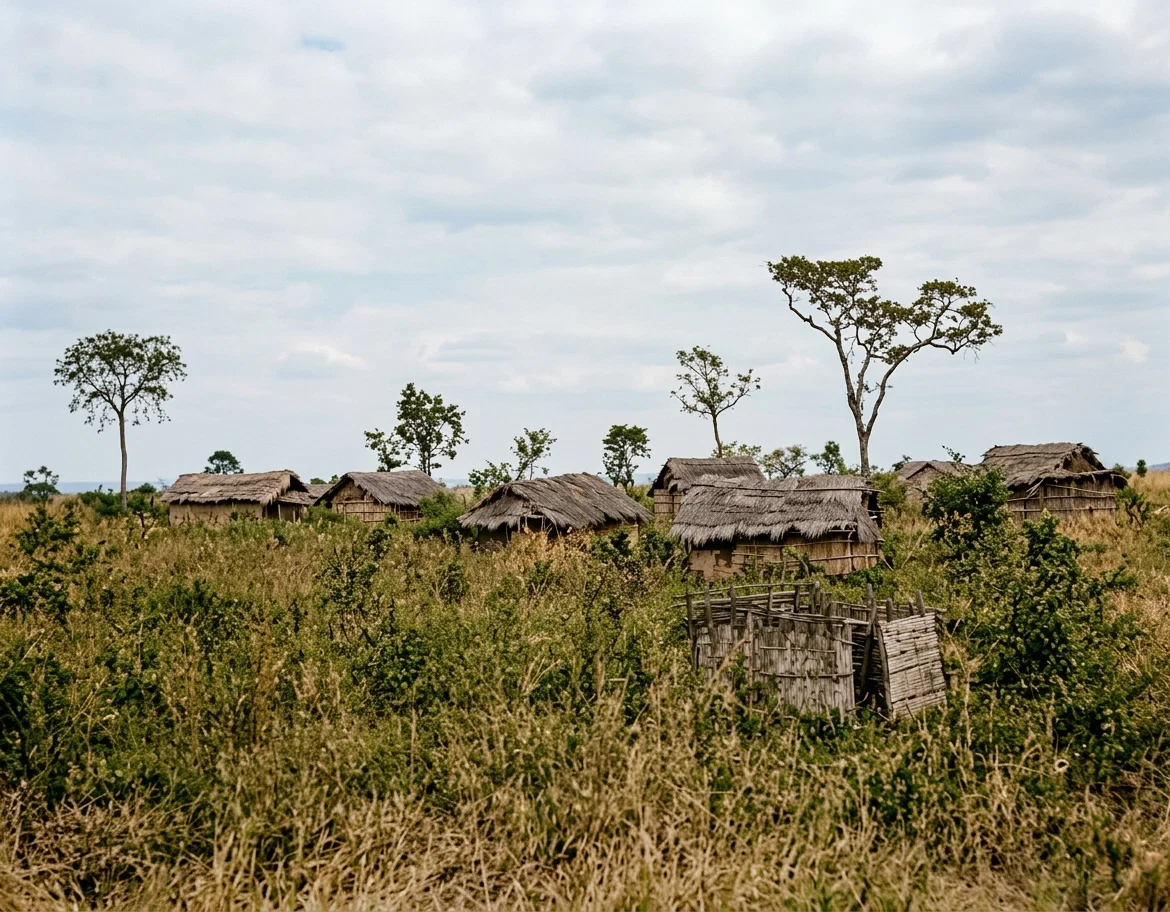
It would seem that the missionary efforts in past years in Nyassaland would have had more influence on the natives in the building of their huts. Many of them are satisfied with a mere hovel of grass held together with a few bamboos. Others have a better class of huts, the walls of which are made of bamboo poles set in the ground with some measure of order, and the roof is made of a network of bamboo rods, covered with a thatch of the long native grass. Some of them plaster the inside of the walls with mud, which in this country is used instead of mortar even in brick houses built by Europeans.
The huts are grouped together in villages, without any attempt at uniformity or orderly arrangement. Some villages are enclosed by a wall made of tall reeds for protection against wild beasts and marauders. The necessity for such protection is not so urgent now as in former years. Occasionally, however, we hear of some one being mauled by a lion or a leopard. We have been having some visits from leopards at our mission, causing considerable alarm among our boys. As they were quite bold in their attempts to get at our goats, we deemed it necessary to try to end their nightly visits. After watching in vain for several nights, we made an effort to outwit them, and in a specially prepared trap we caught a fine large leopard, fierce, but beautiful.
No provision is made for admitting light into the huts, or for allowing smoke to escape. The doorway serves both purposes. The houses are not much used during the day, but in the evening, whether the weather is warm or cool, a fire — their one luxury — is made on the floor, and the members of the household gather around, and seem to enjoy the smoke as they sit or lie on the ground, or perhaps on a mat made of reeds or rushes. This mat also does service as bed and bedding. When used to sleep on, the mat is folded, one half covering the sleeper, while he lies on the other half.
It is not safe for a European to live near a native village on account of the extremely unhealthful conditions. From an article giving a “Summary of Researches on Native Malaria and Malarial Prophylaxis” by two medical specialists, officially published in the British Central Africa Gazette, the official organ of the administration, I quote the following: “The condition of extreme unhealthfulness found in West Africa is not determined by the ‘climate.’ The reason is largely to be found in the conditions under which Europeans live in Africa. Even on general grounds, it would be well to avoid native huts and hovels with all their dirt and unsanitary surroundings, conditions which may be likened to the worst slums of our large towns. When, however, we realize that these huts are veritable hotbeds of malaria, it is evident that the very first sanitary law for Europeans in Africa is to avoid their neighborhood.”
NATIVE VILLAGE, BRITISH CENTRAL AFRICA
The reason for the European planter or trader avoiding the vicinity of the native villages is obvious, but the missionary can not wholly avoid coming into close contact with the people of the country. While taking all reasonable precautions, he must be willing to go where the people are, and even where the conditions are the worst, in order that he may seek out the souls that would perish in the darkness of heathen superstition unless he risked something to carry the gospel to them.
But perhaps worse than the unfavorable physical features in connection with the villages is the moral aspect. The natives have no regular work or work hours. Many of them do not work more than one month in the year; they are compelled by the government of the protectorate to work at least one month. The men expect their women and children to prepare the food, and to do most of the work in the garden, while they lie around day after day in a condition of listlessness. At any hour of the day one may find in the villages a group of men lying on the ground, perhaps listening to some one telling stories of questionable veracity, and passing around from one to another a peculiar sort of pipe, of which each one takes only one or two inhalations at a time. Usually a group of women may be found in another place, evidently occupied in about the same way, the pipe not excepted.
Dancing, accompanied by the drinking of native-made beer, is indulged in regularly. We frequently hear the beat of the weird-sounding drums begin late in the evening and continue through the night and the following day, and sometimes two nights and two days. The scenes in connection with this revelry are quite exciting, and require endurance worthy of a better cause.
The missions that have been established by the different denominations have done a good work in educating some of the young people to turn away from some of these corrupting influences.
Cholo, British Central Africa.
1904—The Mission Year
By W. A. Spicer
W. A. SPICER
“BUT when he saw the multitudes, he was moved with compassion on them, because they fainted, and were scattered abroad, as sheep having no shepherd. Then saith he unto his disciples, The harvest truly is plenteous, but the laborers are few; pray ye therefore the Lord of the harvest, that he will send forth laborers into his harvest.” Matt. 9: 36-38.
With the compassion of Jesus for the multitude filling our hearts, we must by his grace make 1904 a year of distinct missionary advance in the great regions still beyond. It is too soon to tell the results of the week-of-prayer offerings for missions; but the reports from various companies and lonely believers here and there show that the season was a blessed one with them. The prayer circle now girdles the earth with prayer and praise. In many languages the Lord of the harvest is being asked to send forth laborers. The cry of need from a perishing world is also a prayer to heaven for more laborers. What a cry, then, will ascend to the throne of mercy if now seventy-five thousand Seventh-day Adventists join their voices as one to swell the voicing of the world’s great need. Read again that thrilling bugle call given us in “Christ’s Object Lessons:” —
“From India, from Africa, from China, from the islands of the sea, from the down-trodden millions in so-called Christian lands, the cry of human woe is ascending to God. That cry will not long remain unanswered.”
So let us make 1904 a year of special prayer for missions. It is a tower of strength to our workers out in the fields to feel that believers at home are actually thinking of their work and its needs, and bearing the needs definitely upon the heart in prayer to God. Workers are often quite alone—far separated from the occasional associations and counsels with comrades that come in our conference work at home. Then it is14that the heart grips fast hold of the cable of prayer, and feels a joy in thinking that home friends are praying too, and that,—
“Though sundered far, by faith we meet
Around one common mercy seat.”
Let us press around that mercy seat, spreading out before it the needs of the world that God so loves. In order to do this we must watch the progress of the work in the great mission fields. Week by week in our papers our workers abroad among the nations tell of the open doors, and bring to our ears the echo of the Macedonian cry, “Come over and help us.” Fifteen or twenty year ago our hearts would have been mightily stirred by just a few of such reports as now are constantly spread before our eyes in the REVIEW and other papers. We must not become so accustomed to hearing from far-off lands that it seems a common thing to us. A study of these reports, with the map spread out before us so that we can see clearly the onward march of the truth, will show us that the pillar of fire and of cloud is indeed leading on to the finished work.
From land to land, and from tongue to tongue, the message is speeding on. The earth is surely being enlightened by the glory of God. If our eyes could be opened, we would see legions of angels pressing on still before us, preparing the way. From now on until Jesus comes, the consuming thought of our lives must be how most rapidly to enter the open doors in all nations. We must study the reports from week to week in our papers until we understand just the order of battle that Providence sets for the hosts of God to-day, and thus in our prayers be able to plead the needs that press most heavily. Definite prayer means something in God’s work. It is not enough to-day to pray for the work in general terms. It is our work, and we should know how to pray for it in a specific way. The Lord gives an instructive lesson in Isaiah 37. The Assyrian army surrounded Jerusalem. It was “a day of trouble, and of rebuke.” There was no might nor power of man to win the victory over the opposing forces. The Assyrian general sent in to Hezekiah a letter threatening utter destruction if Jerusalem refused to surrender. Then we read:—
“And Hezekiah received the letter from the hand of the messengers, and read it: and Hezekiah went up unto the house of the Lord, and spread it before the Lord. And Hezekiah prayed unto the Lord, saying, O Lord of hosts, God of Israel, that dwellest between the cherubims, thou art the God, even thou alone, of all the kingdoms of the earth: thou hast made heaven and earth. Incline thine ear, O Lord, and hear; open thine eyes, O Lord, and see: and hear all the words of Sennacherib, which hath sent to reproach the living God. Of a truth, Lord, the kings of Assyria have laid waste all the nations, and their countries, and have cast their gods into the fire: for they were no gods, but the work of men’s hands, wood and stone: therefore they have destroyed them. Now therefore, O Lord our God, save us from his hand, that all the kingdoms of the earth may know that thou art the Lord, even thou only.”
God heard that prayer. He said, “I will defend this city for mine own sake, and for my servant David’s sake.” And the angel of the Lord went forth and smote the camp of the Assyrians.
Thus it is that men pray in a time of crisis or distress. The heart clings to God for very definite and practical answers to the prayer of faith. It is a time of crisis in our own work. As truly as we live and are in the third angel’s message to-day, the hour has struck to actually do the work that we have known all along would be done sometime. This glorious message is to go with a loud cry to every nation, kindred, tongue, and people. John saw it flying in the midst of heaven until the blessed sound reached every ear. In our day, and without delay, this work is to be done. Now indeed “blessed is the people that know the joyful sound,” when God himself sounds the trumpet call for a missionary advance that shall finish the work.
“We have heard the joyful sound,
Jesus saves, Jesus saves;
Spread the gladness all around,
Jesus saves, Jesus saves;
Bear the news to every land,
Climb the steeps and cross the waves,
Onward, ’tis our Lord’s command,
Jesus saves, Jesus saves.”
So let us make the week of prayer recently passed but the introduction to a year of definite, persevering prayer to the Lord of the harvest to send forth laborers into the harvest field. As we become acquainted with the fields through the reports, we shall feel like mentioning them by name and pleading special needs, even as we do in our private devotions as we think of our own dear ones and special friends who are subjects of our prayers. It was the burden of the prayer of Knox, “Give me Scotland, or I die.” Hunt, who was so specially used of God in cannibal Fiji, cried out with his last breath, “O, let me pray once again for Fiji. God, bless Fiji!” And the Lord heard the prayer. When, in 1878, the China Inland Mission saw the need of opening up a work in the interior by women for women, it was felt that possibly Mrs. Hudson Taylor should lead the first effort. But could she leave her little ones to spend months in a new and hazardous endeavor?
“One thing was sure. If God wished it, he could provide for the children. Would he? At first it seemed not, but further prayer removed this obstacle completely. Still some thought it wrong. So they put God to the test. Mrs. Taylor asked the Lord one day to send her the money for her outfit, and to give her also two hundred and fifty dollars for a special purpose—just that, neither more nor less. If he gave her a sign, and did both, surely her way would be clear.”
“That very day a visitor called to see her, and inquired was she really going. On hearing that she expected to go, he handed her a check for the outfit, for that and nothing else—exactly the sum allotted to outgoing missionaries for that purpose. But that was only half her prayer. Yes; but three days later came a check for two hundred and fifty dollars, with express permission to use it for the purpose desired. Is not God more ready to answer than we are to pray?” And on the very day of her departure a gentleman who said he could ill spare it from his business sent five thousand dollars to defray the cost of the new effort.
With hearts warm with love for the souls for whom Christ died, let us keep step with progress in the mission fields, with earnest prayer unto God to send forth the laborers and to provide the means. Our missionary campaign requires a steady and continuous advance. It must not be the subject of a spasmodic effort one year and a dropping back the next. The ground gained must be held, and the line of battle pushed still further outward. The work can surely be done, for God commands it.
Early in this century, when as yet America was doing practically nothing for missions, six young men in Massachusetts met by a haystack in the fields, and prayed definitely that something might be done. They arose from their prayer season for missions with a clear conception of a program of effort that should reach the great regions beyond, and with the rallying cry, “We can do it if we will,” they began a work which was the foundation of all that American missionary societies have done toward the evangelization of the world. Now, with a great work to be done within a few years, and with hearts depending upon the great power of God, pledged to the fulfilment of his own word, let us take as our motto, “We can do it, and we will, by the grace of the Lord Jesus.” Everywhere there is a sound of a going in the tops of the mulberry trees. It is a time of good tidings, and we must hurry out to the wide world with the message.
Experiences on the Volga
By J. F. Huenergardt
J. F. HUENERGARDT
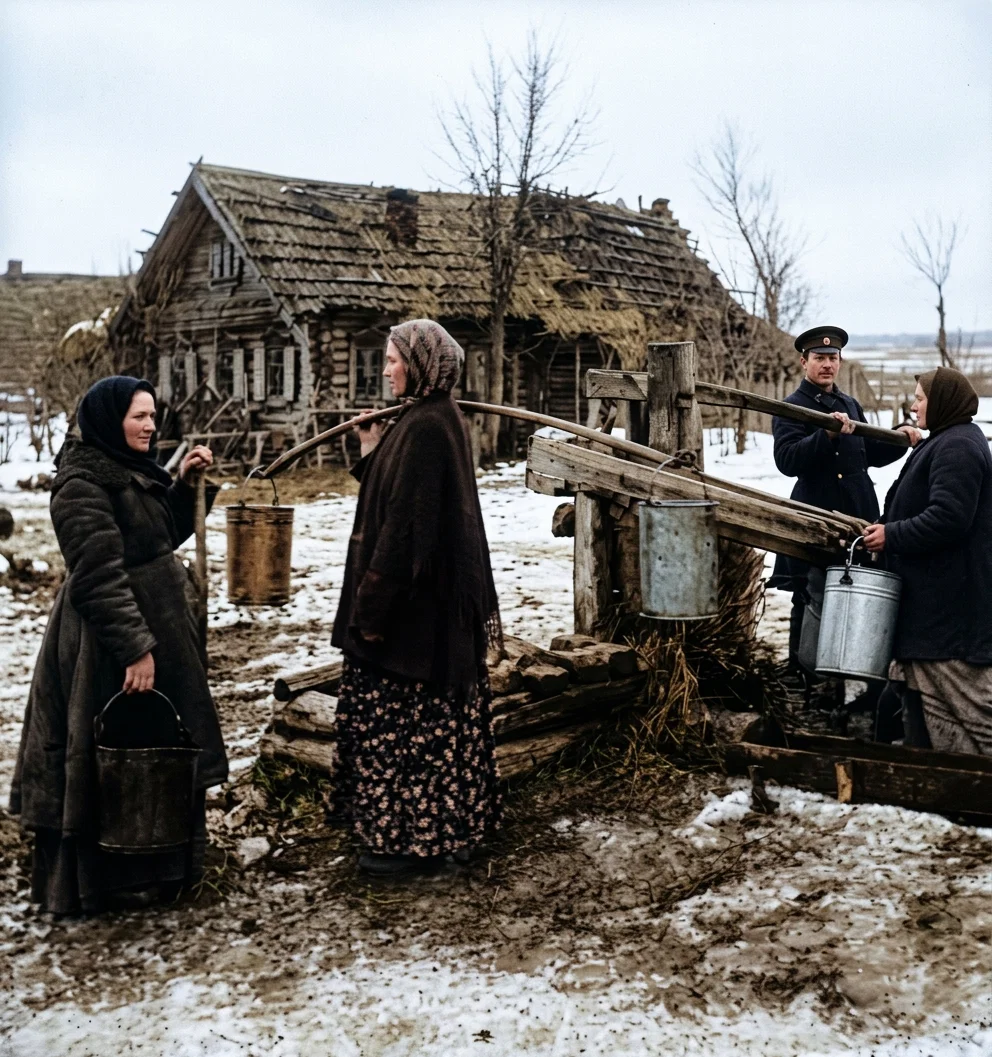
During the months of September and October, 1903, it was my privilege to visit my friends who live in the German colonies of Russia. I entered several places with very little difficulty, and as we had a district meeting appointed in the colony of Dobrianka on the Volga River, a good representation of our German brethren and friends came from the various colonies. The meeting was a profitable one, and we experienced the truth of the words in the twenty-third psalm. The Lord had indeed prepared a table for his people in the presence of their enemies; for nearly all our meetings were held without disturbance. On several occasions the enemies of the truth objected to our laboring in public, but the Lord so opened the way for us that we could speak freely.
I will mention one instance which shows how the Lord sometimes works15for his people. On arriving at a colony, my friend, who was an elder of the Lutheran church of that place, asked me to hold several public meetings. This I consented to do with the greatest pleasure. Many were invited. The pastor of the place, on learning of my presence, at once objected, and sent word to my host, the elder, not to allow any meetings of this sort, stating that if we persisted in continuing these gatherings, he would stop us by the police. I then concluded to speak to the gentleman myself. He received me in a friendly manner, and at once explained his situation, excusing himself for taking such a strong stand against us. He said that our teachings would only tend to confuse his communicants, and that after my departure he would have a very difficult task in restoring order. I assured him that I had come to present to the people the straight truth, which brings liberty and freedom to all who accept it, and that he should trust the result to the Lord. He then told me that he did not consider the Sabbath question of sufficient importance to make it a point of controversy and division. I told him that it is not the day only, but it is a matter of obedience to the Lord. I then had a long talk with him concerning the present truth, and our work as a people, and concluded with saying that I took him to be too much of a Christian and lover of religious liberty to interrupt our meetings. He smiled, and after thinking a little while, said, “I will not hinder your meeting to-night, on one condition, if you will also invite me to be present; I will thus take the responsibility of the meeting upon myself.” I at once took him at his word, and said, “I not only invite you to come to our meeting, but I expect you to feel at liberty to occupy some time in speaking to the people.” He gladly accepted the invitation. “Only,” he added, “promise me that you will say nothing on the Sabbath question.” I replied: “You, as a minister, know as well as do I that Paul says, ‘Quench not the Spirit,’ therefore, if the Spirit of the Lord impresses me to present that part of the truth to-night, neither you nor I would have a right to act contrary to the Spirit of God. I will, however,” I continued, “promise you to preach the straight gospel, and nothing but the gospel, even according to the statement of Luther, who said, ‘He who preaches the gospel without first presenting the holy law of God, does not preach the gospel right.’ On the other hand, he who preaches the law only, commits the same error. First preach the law of God in all its power and clearness, so that the sinner may be aroused by the thunders from Mt. Sinai, and see his lost condition, and then bring him to Calvary, that he may behold his Saviour in the beautiful story of the cross.”
We then found our way to the place of meeting, where a large company had gathered to await the results of the day. The meeting was given into my hands, and the free Spirit of the Lord came so near that we all felt his blessing and presence. At the close of the meeting our good friend, the Lutheran pastor, declared that he himself felt very thankful for the meeting, and he heartily wished that the Lord would unite the hearts of all Christian believers, and further assured our brethren that he would not hinder them hereafter.
A RUSSIAN HOME
In this and in other ways the Lord is wonderfully opening the doors for his work, even here in Russia. The people are rapidly being prepared by the Spirit of the Lord; but where are the workers? One thing is sure, our German American brethren can do a great deal for the work here among the Germans in Russia. If they come here to visit their friends, and at the same time spread the message, they will find thousands of ready listeners, and the police will not interfere with their work so readily, as they are only visitors, and their friends stand by them.
May the Lord bless our brethren in Russia, and bless the great Russian empire so that this precious truth may be known throughout all its bounds.