The Youth’s Instructor, Vol. 37, No. 12.

HOW MATCHES ARE MADE

The Youth’s Instructor

Mar 20, 1889

S. D. A. Publishing Association · Battle Creek, Mich. · Mar 20, 1889

HOW MATCHES ARE MADE.
We have learned in former articles of the difficulties under which people labored before the discovery of coal and the invention of the gas-light. We can, however, have little real idea of the difference between that time and ours, unless we can imagine all our modern improvements swept away, obliging us to do our work without them. Take the common match, for example. How many ever think how they would be obliged to get along if these had never been invented?
In primitive times, the only way known to “strike a light” was to rub briskly two pieces of dry wood together until the friction produced a fire. If any one wishes to know how tedious this process must have been, he has only to try it for himself.
Later, what was known as a tinder-box came into use. This was a small box in which was put very inflammable material, such as scorched linen. The box was then placed on a stand, or in some convenient position, and the person wishing a light held a piece of steel over it, and struck that with a slanting stroke, producing a spark of fire. This spark, dropping into the box, set fire to the tinder, from which a larger fire could be kindled.
But this was so much trouble that people sought a better way to start fires. In time there appeared “briquets phosphoriques,”—small metal bottles containing phosphorus and other chemicals. Into these were dipped little splints of wood tipped with sulphur, which, when withdrawn, slowly burned, because of the chemical action of air upon them. Although this was an advance over previous methods, it was expensive. Other inventions followed, but it was not till 1826 that a match was produced which would give instantaneous light.
It took a long time to bring these into public favor. Many objected to them on account of their strong smell, and also concluding that they must be very dangerous, they refused to use them. In England, especially, matches were not allowed to be made, unless the factory was removed at least fifty feet from all other buildings. The consequence was that other countries took the lead in manufacturing this useful article.
Sweden stood at the head of this industry, and for many years supplied all Europe with matches. It was the Swedes who first introduced what was called the patent safety match, which was warranted to “light only on the box,” and, as some wag suggested, “very seldom there.”
The match trade has now become an enormous industry in all countries, and matches of all kinds and descriptions are to be had everywhere for a mere trifle.
We will study the manufacture of matches for a few moments. First, a large pine log is sawn into lumber, the best and straightest of which will be made into matches, and the rest into boxes in which to pack them. That portion of the lumber designed for matches is planed and sawed into blocks a match-length long. These blocks are then placed in a machine in which are knives that split them into the thickness of a match. They are then returned through the machine, where they are again split, in the opposite direction, into the tiny square sticks that make the matches. These fall in a shower from the machine, and are gathered, by an ingenious machine, into rings of iron, where they are held separate from each other, yet fastened tightly in the frame, and the ends of them are dipped into a solution.
These frames, still containing the dipped pieces of wood, are then taken to the drying room. When dry, the matches are taken to the boxing room, where boys put them into the boxes in which we find them at the stores.
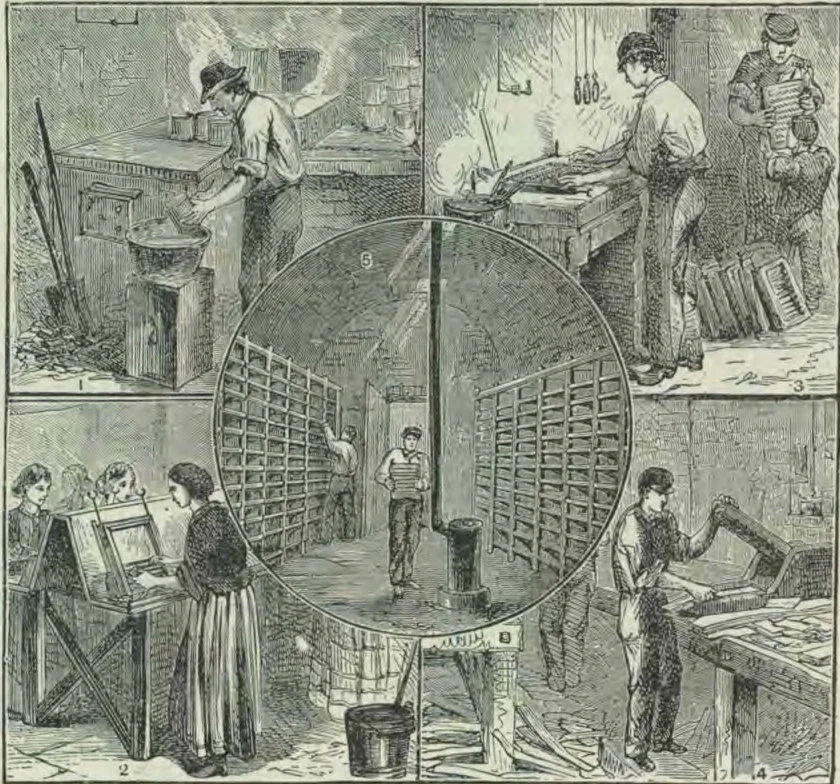
The accompanying picture shows how the work of making matches was carried on some years ago, before the perfected machinery of the present time was employed in their manufacture. That part of the cut marked 1 shows a man scorching the ends of the match sticks, before they are dipped in the solution; No. 2 represents a woman filling the frames with the sticks, preparatory to the dipping process; and No. 3 shows that process. No. 4 presents a man stamping the boxes, and No. 5 shows the drying-room, where the matches are dried after the dipping process.
It would seem to many that the manufacture of matches is rather small business; but when we stop to think of the millions upon millions of boxes that are used every year, we see that it must be a flourishing industry. In one year, Sweden alone sent out 134,616,448 boxes of matches, each box containing 100 matches. Considering that these are only a small part of the great number made every year, it shows that a large amount of timber must be worked up into these tiny fire-kindlers. J. O. C.

LET IT SHINE.

“Going in there?” said Thomas.
“Yes.”
“First rate lamp in that house.”
“What?”
“Lamp, you know, trimmed and burnin’.”
Sadie looked at the old man in some astonishment. He was the “odd job” man of the neighborhood; everybody knew him. He proceeded to prune his grape-vines with critical care, and turned a wrinkled, quizzical face toward her once or twice; but he made no further remark, and Sadie made her way to the front door of the little house beyond.
“Is Johnnie in?” she asked as the door opened. “I’m his Sabbath-school teacher.”
“No’m, not home from school; but won’t you come in and see mother.”
Sadie had glanced down the street as she knocked, thinking what a wearisome business this Sabbath-school visiting was.
“How do ministers live through their parish calls?” she wondered.
She looked up now, and saw a radiant face, not lighted for the occasion, but bright from within. She stepped through the door, to find herself at once in a small, clean, warm room. In a corner behind the stove was the mother, propped in an easy chair, helplessly paralytic.
Sadie’s quick sympathies were touched, and she at once approached the invalid. Her face, too, seemed full of quiet peace.
“You find these dark days very trying, I suppose?” said Sadie.
“O no; Anna reads to me when she gets through,” said the wavering, paralyzed voice.
“You have a nice, warm room.”
“O yes, Anna keeps a good fire.”
In rushed Johnny. “Say, Anna, where’s my ball? Can I have a cook—”
“S-h! Johnny, here’s your teacher.”
Johnny came forward with an awkward bow, and a restless glance at the door.
“I’m not going to keep you from your play, Johnny, and you can eat your cookie while I talk; but I want you to join a boys’ club from our Sabbath-school. They are going to meet Monday nights in our basement.”
“I may not get my lessons to go,” said Johnny.
“O yes, you will. You and I will learn them together Monday afternoons,” said Anna.
“Well, if Anna’ll learn the lessons with me,” said Johnny.
Sadie looked at Anna’s face, bright as ever, and wondered how many things she could do at one and the same time.
“First rate lamp in that house!” Thomas’s words came back to Sadie full of meaning. Yes, Anna’s light did shine, and Sadie went home illuminated.
“I’ve got a lamp, too, somewhere,” she meditated. “It was so dull and smoky, I set it away; but I’ll get it up and trim it and brighten it, and see if it will shine.” It did shine.—The Well-Spring.

GENTLENESS

SOMETIMES a gentle child, More simple, sensitive than the others, Comes to a family, and sisters, brothers, Drop their rude ways, grow courteous and mild.
So gentle souls are sent Into the tumult of this world's mad striving, To teach our coarser natures higher living, Sweeten asperity, calm our discontent.
Strength does not make the man. He is most noble, manly, who has dower Of gentleness controlling ruder power. The tender touch is always in God's plan.
—The Well-Spring.

AN OLD STORY OF A LION.

Androcles, the slave of a noble Roman, was doomed to die for a crime he had committed. The slave escaped to the deserts of Numidia, where he wandered among the sands, almost dead from heat and hunger. Suddenly he came upon a cave, and, creeping in, found a place at the farther end to sit down and rest.
But after a time a great lion came to the mouth of the cave, entered, and went straight to him. Androcles was sure his hour had come, but the lion came up to his side, laid his paw on his knee, and making a sort of cry, began to lick his hand.
Then Androcles saw that a sharp thorn was festering the lion's paw. The slave pulled out the thorn, and, squeezing the paw gently, relieved the fester.
The lion then left him, and soon returned with a fawn which he had just killed. For some days Androcles was kept from starving by the lion, but at last, in desperation, he gave himself up to his master.
His master was making a collection of large lions to send to Rome, and coolly ordered that Androcles be sent with the lions as soon as a certain number had been obtained; the slave was then to be exposed to fight with the lions in the amphitheater.
One day Androcles stood in the arena awaiting his fate. The gate was opened, and a huge lion leaped out. Suddenly the kingly beast fell to the ground, and crept to the slave's feet with gentle, caressing motions. The lion was Androcles's old friend.
The authorities, on learning the story, ordered Androcles to be pardoned, and gave him the lion. Cassius tells us that he himself saw the man leading the lion about the streets of Rome, crowds gathering about him, and repeating to one another: “This is the lion who was the man's guest; this is the man who was the lion's physician.”
Lions can be tamed, if taken young enough; but they may at any time break out with all their native fury, though seldom hurting their friends.—Forward.

SOME QUEER LITTLE FOLKS.

The world is filled with queer little people from the shores of the Arctic Sea to the vast plains of Patagonia. They live in all kinds of houses, from the igloos of the Esquimau to the palm dwellings of Lake Maracaibo. They are, for the most part, jolly little folks, with bright black eyes, and seem to enjoy life in spite of their sometimes unpleasant surroundings. Let us look at some of them at home; for child-life is interesting under any and all circumstances.
What queer cradles some of these little folks have! That of the baby within the polar circle is his mother's jumper-hood, and there the little one remains, with very few airings, until he is able to walk and take partial care of himself. It is a warm cradle, though; and travelers who have seen the wondering eyes and chubby face that appear at the opening, have been struck with the Esquimau baby's good nature. When he comes out of the jumper-hood, he is stuffed into a dress of soft fawn skin. Only the back part of this dress is open; and when the baby is once inside, a string draws the garment shut, like the string of a bag. There he is, shut in again; but he enjoys the change from the close jumper-hood to the fawn-skin suit. The little people of the Arctic Circle have odd names. They have no Toms, Dicks, Nellies, or Mabels there. In place of such names, we find Meteks, Accomodahs, Lipsus, and Marsumahs. When Elisha Kent Kane, the renowned Arctic explorer, went to take leave of a settlement on the shores of the cold sea, he was followed by a lot of little children of all ages, in tears; and one little girl named Aningnah cried bitterly behind a tent curtain, wiping her eyes on a bird skin. Thus we see that there are tender hearts among the children where the world seems a vast, bleak waste of ice and snow.
Another odd member of the large family of little people, is the Lapp baby. He, too, inhabits a land of cold, where wants are few and privations many. The usual cradle there is a piece of wood, shaped like a canoe, and hollowed out till it is very light. A quantity of soft grass is put in, and the tiny Laplander finds himself in a bed as soft as down. Here the baby laughs, or sleeps, or plays with the simple toys of the country till tired. The days are long in Lapland, and pleasures are limited. When Lapp mothers attend church, they sometimes leave their babies on the outside to keep them warm. To do this, they simply dig a hole in the snow, and put the little folks in, always taking care to leave on guard a faithful dog to protect them from the wolves. When half a dozen Lapp cradles are clustered together, the future gentlemen and ladies of the land keep up a chatter that sometimes interrupts the simple service going on in the chapel. A Lapp baby is good-natured; and when he begins to walk, he gets a dress of reindeer skins, and becomes, in his imagination, one of the chief personages of the country.
In India the wee folks are carried astride on the hip, as they were in oriental lands long ago. The Egyptian mother carries her baby on her shoulder—a custom which dates back to the days of the prophets, as in Isaiah we read: “I will lift up my hand to the Gentile, and set my standard to the people, and they shall bring up their sons in their arms, and thy daughters shall be carried on their shoulders.” It is curious, but a fact, that the cradles of antiquity in Bible lands have not changed, but are the same to-day as when the Pharaohs reigned, or as when the Saviour taught.—T. C. Harbaugh, in the Sunday-School Times.

MARCH

How stern is March, with blasts that warn or chide; Now, like some peevish grandame, fuming, sputtering; Now fierce to whirl the errant dust-clouds wide; Now bright with sunny gleams, though discord's muttering! Yet spirits of leaves, that in bare boughs abide, Mysterious happiness are mutely uttering, And under many a streamlet's barren side, The violets' hidden hearts are softly fluttering. —Edgar Fawcett.

BE SURE YOU HAVE YOUR TICKET.

If there were to be a concert in your town, and you wished very much to go, would you not be sure you had a ticket? You would not say, “It will make no difference; I guess they will let me in without one. I will try it any way.” No indeed! You would purchase your ticket, and be there early, so as to get a good seat.
When Mr. Moody came to San Francisco, thousands and thousands of people were very anxious to hear him,—many more than the great pavilion could hold. So tickets were given out for as many as could be accommodated. The tickets were free. Any one could get one provided he asked before all the tickets were given out. But, would you believe it! some foolish boys, yes, even some of our INSTRUCTOR readers, thought that they could get in without a ticket. So they rushed along; but the door was closed. They tried various entrances, but could not gain admittance. They had no tickets. If they had had to pay for their tickets, they would not have thought for an instant of trying to get in without one.
Now, the Lord is going to give out 144,000 tickets to those who are living on the earth, and the promise is, “They that seek me early, shall find me.” They will take us in to the heavenly city, the New Jerusalem.
Perhaps you will want to know what this ticket is. It is a “clean heart;” and you can get one by asking God in faith, believing that he will do just what he says,—“take away your stony heart,” and “give you a heart of flesh.” But first you must give him your old heart. Tell him to take it just as it is, all spotted with sins,—disobeying mother, putting off doing things you ought to do at once, being unkind to little brother or sister, speaking many idle and foolish words, wanting the best things yourself. Tell him to take it; for you do not want it any longer; you hate the things that are in it, and you cannot get them out unaided.
He will take it, if you will only be honest and tell him just what is in it, and he will give you a clean one,—one full of love and kind words, one that loves Jesus, one that loves to sing his praises, one that hates sin,—a heart that is always ready and willing to help, if the work is ever so disagreeable; a heart that is always happy, even when things do go wrong; a heart that forgets its own comfort in trying to comfort others, “In honor preferring one another.” This is the ticket that will admit you into heaven, and you cannot get in without one.
May none of the INSTRUCTOR readers be careless about getting their tickets in season. Ask God for a new heart to-day. LAURA E. CUSHING.

THE DRUMMER’S BIBLE.

This story is told of a little drummer boy in the Grand Army of the Potomac.
He lost his Bible, which he regarded as a letter from his beloved Saviour to himself, and was very fond of reading. He began to make a Bible for himself. He had formerly been a Sabbath-school boy, and his memory was well filled with choice Scripture texts.
These texts he began to write on his drum, one after another, until it was written all over. There had never been such a drum in the army before. Yet these texts did not hurt its sound, and I’m quite sure that the young drummer was none the less faithful to his duty for having the word of the Lord before him when he plied his drumsticks, and marched into the smoke of battle.—Ex.

“WEE LITTLE ME.”

“WELL?”
It was a sad, earnest, troubled little face into which Mr. Simmonds looked as he spoke; and to encourage the owner to put confidence in him, and speak, he laid a hand on her shoulder and smiled.
“I wish,” she began, then paused a moment before saying more. “I wish he would give wee little me something to do. I have no father and mother, and no one wants me. It wouldn’t be so hard, you know, if just there was some little thing he could trust me to do.”
Mr. Simmonds had been talking to a roomful of bright young people, trying to impress upon them the fact that they could not begin too soon to work for the Master. He had dwelt upon the idea that, if nothing else, they could be home brighteners. Here was a little one who literally had no home, and whom no one wanted. He knew something of how she had been left alone in the world, and that the time was soon coming when she must be taken to an orphan asylum, if no one could be found to interest themselves in her. Sitting down by her now, he asked,—
“Do you pray to God about it, Nellie?”
“Oh, yes,” she said, quickly. “I talk to him every day about it, and ask him to let some one want me sometime. I know he will answer me, but, you see, I can’t expect any one to want me until I’m older, and can do more; so I ask him to make me patient, and I try to talk to him often so I can keep him near me, and feel that he really is my Father. I’d like it very much if he’d give me something to do; but there are so many others to work for him that there can’t be much for me, whom nobody wants. Papa used to tell me that one thing to do for him was to learn to be patient, and I am trying.”
Without commenting on what she had said, Mr. Simmonds told Nellie that he was on his way to see a sick lady, and asked her if she would go with him. The lady, he said, had lately lost her husband and two dear little children, and had been very ill herself.
“I’m so sorry,” said Nellie, as the tears came into her eyes, and she prepared to go with Mr. Simmonds.
A very sweet face the sick lady had, but it was so sad and pale that Nellie could scarcely keep from crying when she saw it. She did not know what to say, but with one little hand brushed back a stray lock of hair that was falling over the pretty face, and then leaned over and kissed it.
Mr. Simmonds was watching them both very closely. He had kept Nellie in an outer room while he told Mrs. Earle something about her; and now when he saw Nellie’s actions, he felt that perhaps her prayer was to be answered sooner than she expected.
“Nellie,” said Mrs. Earle gently, trying to keep back the tears, “Mr. Simmonds tells me you are all alone in the world, and that you have prayed to God to—” but the tears and sobs came so fast now that she could not speak, and for a few moments Nellie wiped the tears away, and gently bathed the feverish face, speaking tenderly at times, as though she were the older of the two.
“Nellie,” said Mrs. Earle when she could speak, “do you think you could love me, dear?”
“Oh, yes!” said the child quickly. “I do. I can’t help it, you know.”
“Then, dear, God is going to answer your prayer; for if you can love me, I want you to live with me, and be my little girl.”
Starting up, and looking at her with wide open eyes, Nellie could only say,—
“Me! You want me!” Then turning to Mr. Simmonds, she looked at him appealingly.
“Yes, Nellie,” he said, reassuringly, “God has answered your prayer.”
“You have not told me if you will come,” said Mrs. Earle, tenderly.
In an instant Nellie was bending over her, saying, softly,— “You will let me talk to God, first, and thank him? It will seem more real then.”
While she was out of the room, Mrs. Earle said,— “It is strange how unexpectedly God answers prayer, and how our poor, feeble minds arrange the time and the means. I, too, have been praying for something I did not expect to get for a long time. I have wanted to feel that something somewhere was dependent on me in some way. It seemed to me it would help to make life worth living.”
“I knew,” said Nellie, when she had come back and curled herself on the bed by the side of Mrs. Earle, “that God would answer my prayer sometime, but I thought it would take him years and years to do it. Isn’t it beautiful to think he can do it at once if it is best for us? It makes him seem so much nearer. I ought not ever to think anything wrong.”—Children’s New Church Magazine.

THE TWO ROVERS.

The first Rover I will tell you about was a large Newfoundland dog. He belonged to a farmer whose children had grown up and left home. In their loneliness, the family made a great pet of their dog, treating him with as much love and respect as if he had been a child.
It seemed sometimes that if this dog could speak, he would talk very wisely. Of course one could judge of his thoughts only by his actions; but these were sometimes so wise that it was known far and near that Rover North was a very smart dog.
He learned to do many helpful things about the house and farm, finally becoming so useful that he was missed if absent only for a little while. He would bring wood into the house, carry notes and packages back and forth, drive the cows to and from the pasture, keep the chickens out of the yard and garden, carry the luncheon to the workmen in the field, and do many little chores that boys and girls are in the habit of doing for papa and mamma. I have seen him bring several dozen eggs at a time in a basket from the barn without breaking one. He always claimed this as one of his particular chores, and would make a great ado if any one tried to help him.
I haven't space to tell you all I would like you to know of this valuable dog. As proof of his intelligence, I will give you a little incident of his life.
At one time this farmer had a hired man who never began work after his meals until he had smoked his old clay pipe. He would seat himself on the back steps, and puff away, while Rover was trotting in and out, doing his little duties.
Starting up suddenly one day to go to the fields, the man accidentally left his pipe on the cistern pump. In the course of the forenoon the dog saw it, picked it up in his mouth, and carried it through several fields, to where the man was at work digging a ditch. As the man was stooping over to raise a shovelful of earth, he felt something nudge him on his shoulder. He looked around, when, to his surprise, there stood Rover holding out his pipe to him.
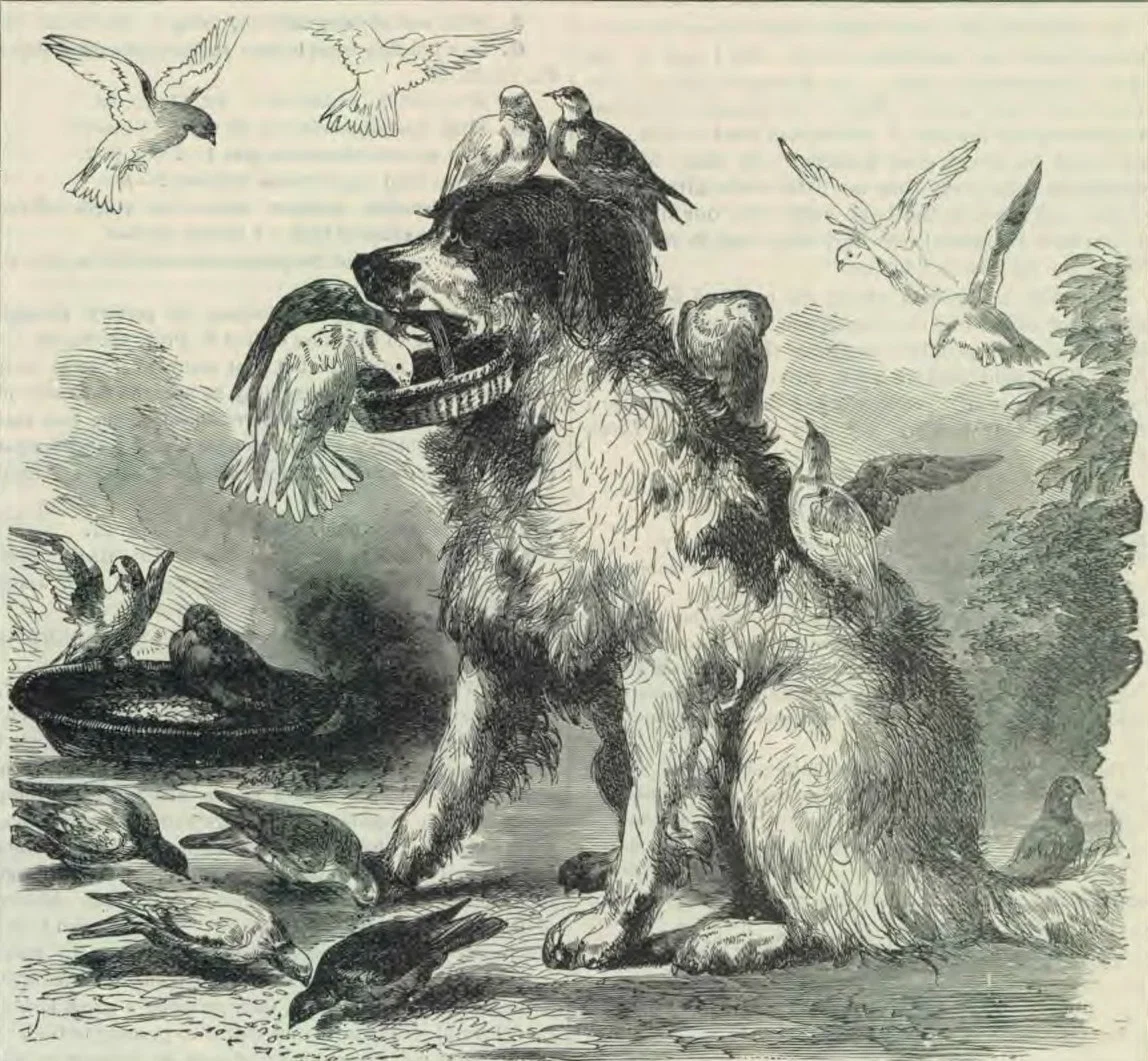
The second Rover was just as intelligent and helpful. He could even do some things that the first Rover could not; for he could feed the fowls as well as bring in their eggs. He would take a basket of grain between his teeth, and scatter it faster than you can.
The man who owned this dog had a flock of tame doves, which he kept in a park by themselves. Rover proved a faithful guardian over them. He would allow nothing to harm or frighten them, and he spent many happy hours watching them and playing with them.
See in the picture how the doves alight on his head, on his shaggy coat, even eating out of the dish in which he carries their grain. No fear of Rover have the doves. Why not? Don't you suppose that it is because he loves them?
In the story of “Mary had a little lamb,” the reason that the teacher gave the children for the lamb's loving Mary so, was because Mary loved the lamb. So I think it was with the doves; they loved Rover because he loved them, and treated them so tenderly. Whom we love, we shall treat lovingly; the more we love them, the harder we shall try to please them.
M. J. C.

A GOOD LESSON.

Alice Cook had one very disagreeable fault. Whenever she saw anything she wanted, she would ask for it. Her mamma felt very much ashamed of this fault in her little girl, and had often talked with her about it; but talking did not seem to do very much good, for somehow it was so easy for her to ask for things, that the words would slip out before she thought.
So Mamma Cook told Alice that she would have to carry back the very next thing she asked for away from home.
One day Mrs. Cook sent Alice to carry a pattern to Mrs. Rose, a lady who lived on the other side of the little village.
“Be careful to do nothing you would not do if I were with you,” said Mrs. Cook, as she tied the little white sunbonnet over the yellow hair.
Alice walked away feeling very important. It was so nice to be trusted to go all alone. And especially to Mrs. Rose’s, for they lived in such a pretty white house, with a green lawn in front.
“I wonder what makes mamma afraid I’m always going to do something naughty,” she said to herself, remembering her mother’s caution. “Of course I know how to behave.”
Mrs. Rose took her little caller into the sitting-room, where she and her little girl were making card-cases, letter receivers, and cornucopias, out of perforated card-board.
Alice admired them very much. She admired one little white cornucopia worked with green zephyr more than anything else. How nice it would be to have it for her very own!
She was sure Mary didn’t want it very much, not nearly as much as she did. She kept talking about it, and by and by, before she meant to at all, she asked for it. Mrs. Rose looked at Mary and smiled, and Mary gave it to Alice, for she was a polite little girl.
Alice did not feel very comfortable after that. She was in a hurry to go home, although mamma had said she might stay half an hour, and she had thought the time much too short.
After she was out of sight of Mrs. Rose’s window, she did not feel in nearly so much of a hurry. She walked back and forth on the long iron bridge very slowly. The cornucopia didn’t seem nearly so nice to her as it had before. Oh, how she wished it was back in Mrs. Rose’s parlor!
The way seemed very short, and she was at home long before she wanted to be.
Mrs. Cook knew that something was wrong when she saw the little girl coming slowly up the walk.
“Mary Rose gave me this,” Alice said, holding up the cornucopia.
“I hope you did not ask for it,” said Mrs. Cook, looking straight into the little girl’s face.
Alice had to tell the truth.
“I didn’t think I was going to,” she faltered, “and I am very sorry; truly I am, mamma.”
“Then don’t you think you had better take it back to Mrs. Rose, and tell her so?” asked Mrs. Cook.
This was a very hard thing for Alice to do, and at first she thought she could not; but finally she made up her mind that it was the only right way.
About half an hour after, Mrs. Rose opened the door to a very red-faced little girl, who held out the little white and green cornucopia that had made her so unhappy and sad.
“I have brought this back to Mary; will you please take it, and excuse me for asking for it?”
Mrs. Rose was very kind to the little girl, and urged her to keep the cornucopia; but Alice almost hated the sight of it; and was very glad when it was hanging between the curtains in Mrs. Rose’s parlor again.
Alice learned a good lesson that day, and one that she remembers still; for this is a true story, and I will let you think out the lesson for yourselves.—Our Sabbath Visitor.

A TRUE STORY OF LIONS.

DON'T you want me to tell you about the queer sight I saw the other day at the menagerie? Menageries are where you can see the funniest animals that ever lived anywhere. Some have horns on their noses, and there are others with humps on their backs. The creatures with humps are called camels.
The best of all the animals were the lions and tigers. They were just nice, though. I will tell you why. Papa bought me a lovely tin turtle, painted blue, red, and yellow, and there was a spring inside of him that would wind up a string. When you threw the turtle, if you held one end of the string in your hand, he would come back, just as if he were alive and liked to stay with small boys.
Hundreds of people went past me, but did not even say, “Oh! what a beautiful turtle your papa bought you for a dime!” But when I came to the cage of lions,—and papa says the lion is called the “King of beasts,”—I showed them my turtle. If they are kings, they can't talk a mite in real language, only lion-talk, which I, of course, can't understand. But they said just as plainly as a lion could, with his kind-looking eyes, “What a beautiful turtle your papa bought you for a dime!”
After this they raised their noses and smelt of my turtle; then I gave him a little toss, and the string wound up, and my turtle ran toward me. You never saw such surprised lions in all your life. I think they thought the turtle was alive. They sprang to their feet, and so did the Royal Bengal tigers that lived beside them.
Mr. and Mrs. Lion acted just like kittens, they wanted to play with my turtle so. I felt very proud, and I made my turtle run toward and unwind. A crowd of people formed around me to watch the lions and tigers play. Up and down the cages they ran, jumping over one another, and trying to get at my turtle.
It made me just love those lions to see them so pleased with my handsome turtle. So I said to the man that cared for them, “Mr. Menagerie Man, I love your lions very much. Won't you please sell me one to go with my turtle? I will be real kind to him, and see that he never goes hungry. He shall have a saucer of milk every time my little white kitten does, and he can sleep in the back yard with our dog Jip. I am sure Jip would not hurt him, and it would be very cozy for two in a kennel.”
Just then the crowd about me laughed so that I could not hear what the Menagerie Man said. I don't see any sense in people's laughing that way at nothing. Papa said that we must move on if we wanted to see the rest of the show that day; so you see I didn't get any lion for my own at all.—Our Little Ones.

THE WINTER FLY.

FROM the curtain's folds It crawls. What is it? Why, a last year's house-fly Come to visit. He says, with a buzz And a drowsy motion. “I have come because— I took a notion.”
The children find him, And as they watch him, Cry to each other, “Catch him! catch him!” And old Puss, too, Can see and hear him, And she creeps up softly To get near him.
Dear little house-fly, Hurry, hurry; Puss has claws, If her paws are furry! And if you dare On the pane to linger, You might be crushed By the baby's finger!
The sun is pale, And the winds are very Oh! very bitter Is February! And since cat and baby Are so uncertain, You'd better creep back Into your curtain.
—Clara Doty Bates, in Our Little Ones.
Continue reading: OLD TESTAMENT HISTORY