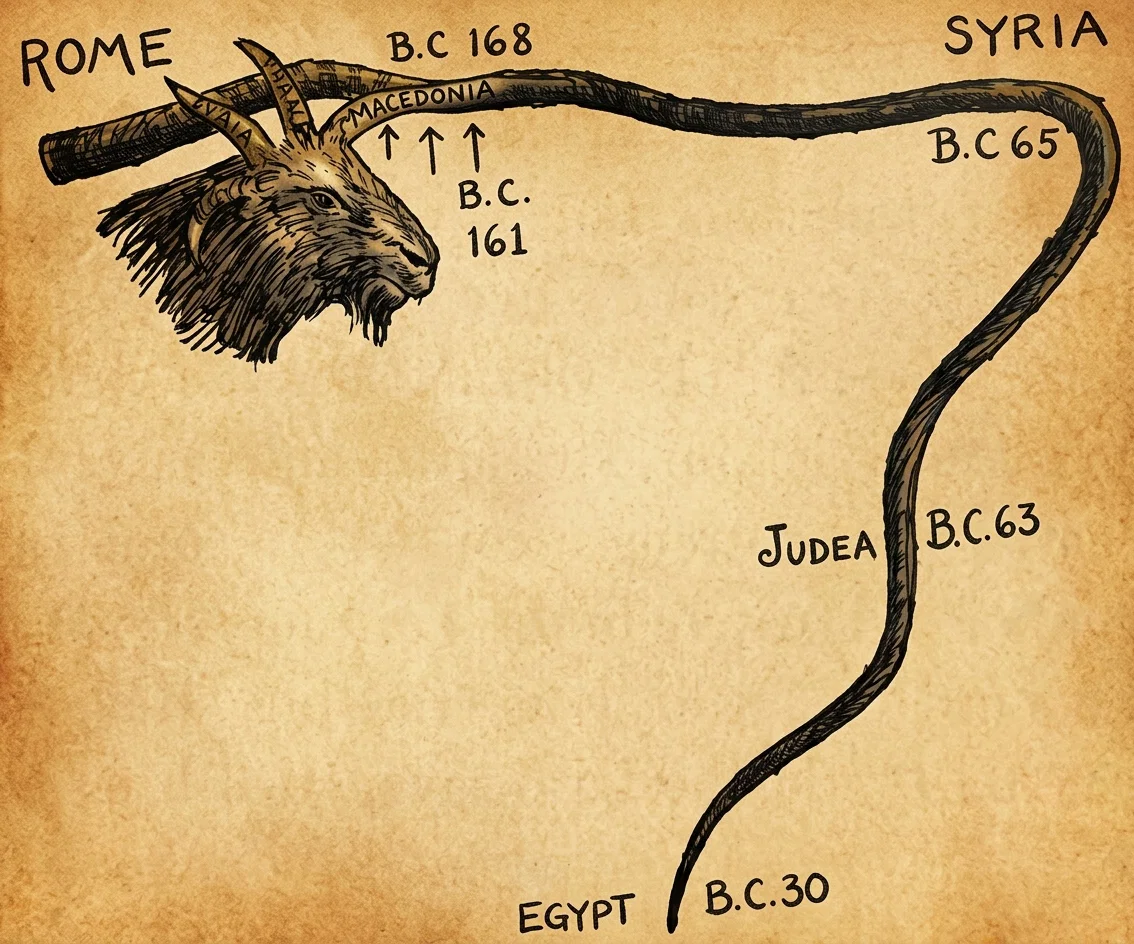
“Now that being broken, whereas four stood up for it, four kingdoms shall stand up out of the nation, but not in his [Alexander’s] power.” Verse 22.
After the death of Alexander, his four leading generals, Cassander, Lysimachus, Seleucus, and Ptolemy, divided the Grecian Empire between themselves. These divisions were known as Macedonia, Thrace, Syria, and Egypt.
The vision of Daniel continues: “And out of one of them [the horns, or kingdoms into which Grecia was divided] came forth a little horn, which waxed exceeding great, toward the south [Egypt], and toward the east [Syria], and toward the pleasant land [Palestine].” Verse 9.
Of the power represented by this symbol the angel says: “And in the latter time of their kingdom [the four divisions of Grecia], when the transgressors are come to the full, a king of fierce countenance [the little horn] and understanding dark sentences, shall stand up. And his power shall be mighty; . . . and he shall destroy the mighty and the holy people. . . . He shall also stand up against the Prince of princes [Christ].” Verse 23.
What power was it that conquered Egypt, Syria, and Palestine, and also stood up against Christ and destroyed his people? Rome alone will answer to the specifications. Rome has two aspects, and they are expressed in history as Pagan Rome and Papal Rome. Under the pagan rule, and previous to A.D. 538, the ecclesiastical power was under the domination of the civil power. After A.D. 538 under papal rule, the church dominated the civil power. These two phases of the Roman power are referred to in Dan. 8:13, 14.
The 2,300 Days.
“Then I heard one saint speaking, and another saint said unto that certain saint which spake, How long shall be the vision concerning the daily [‘desolation,’ understood, Pagan Rome; the supplied word ‘sacrifice’ is incorrectly used], and the transgression of desolation [Papal Rome], to give both the sanctuary and the host to be trodden underfoot? And he [the saint] said unto me [Daniel], Unto two thousand and three hundred days; then shall the sanctuary be cleansed.”
When Daniel heard the angel tell how this king of fierce countenance would stand up against the Prince of princes (Christ), and destroy his people, he fainted. In verse 27 Daniel says, “And I Daniel fainted, and was sick certain days; afterward I rose up, and did the king’s business; and I was astonished at the vision, but none understood it.” Gabriel5had been commanded to make Daniel understand the vision, but Daniel fainted, and became sick, so the explanation had to be postponed till he had recovered. The account of the angel’s return to complete the explanation of the vision, is resumed in chapter 9:21. Daniel says: “Yea, while I was speaking in prayer, even the man Gabriel, whom I had seen in the vision at the beginning, being caused to fly swiftly, touched me about the time of the evening oblation. . . . I am now come forth to give thee skill and understanding. . . . Therefore understand the matter, and consider the vision.”
The vision, so far as it related to the ram, goat, notable horn, the four horns which came up when it was broken, and the little horn, which destroyed the saints and stood up against the Prince of princes, had already been explained, so Gabriel resumes his explanation at that part of the vision left unexplained, that which related to time, or the 2,300 days mentioned. Thus he explains: “Seventy weeks are determined [cut off, or marked off] upon thy people and upon thy holy city, to finish the transgression [fill up the cup of their iniquity], and to make an end of sins [Christ makes the last offering for sins], and to make reconciliation for iniquity [we are reconciled to God by the death of Christ, Rom. 5:10], and to bring in everlasting righteousness [the life of Christ upon earth is everlasting righteousness; the everlasting law is exemplified in and through him], and to seal up [make sure] the vision and prophecy, and to anoint the most holy [the heavenly sanctuary].”
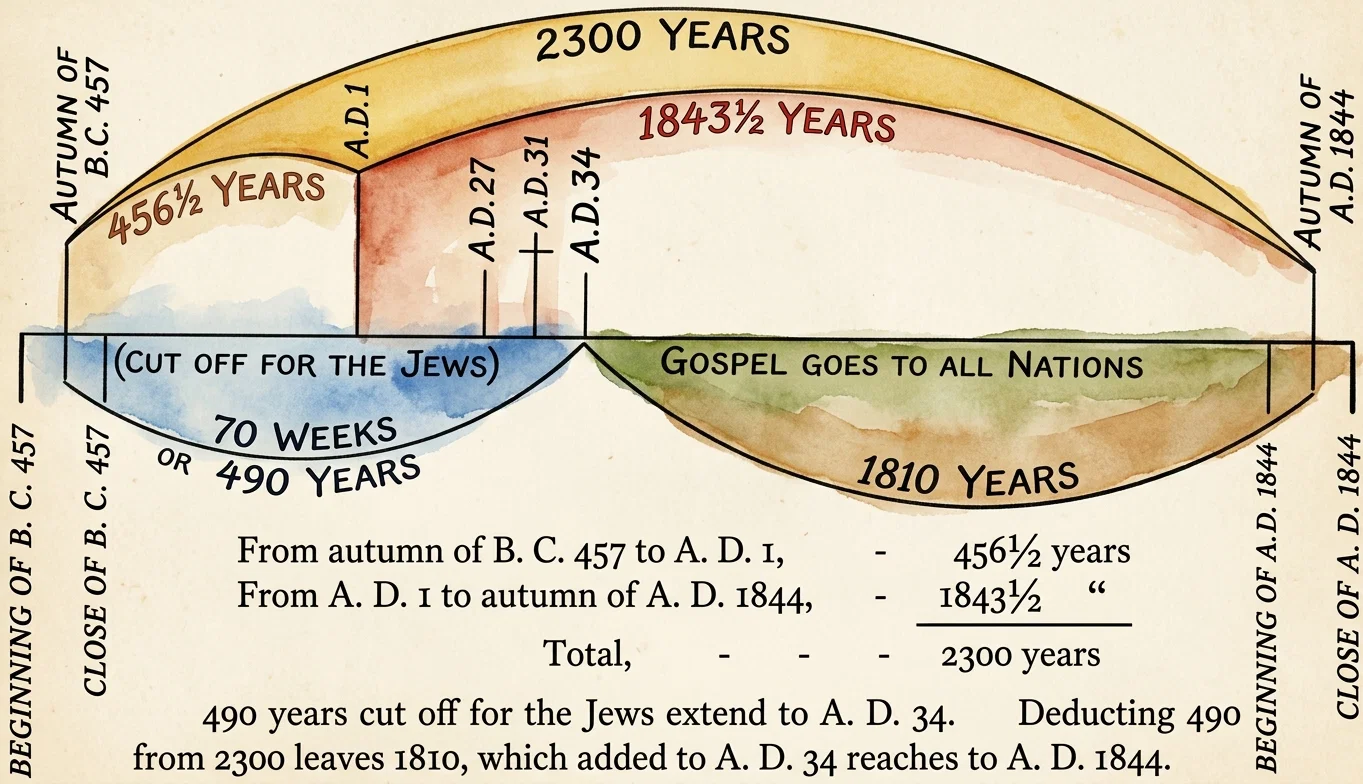
DIAGRAM OF THE 2300 DAYS. (Symbolic Time.)
All these events must take place during the first 70 weeks, or 490 days, of the 2,300 days. This was the time marked off upon the Jewish people.
The work of Christ is woven into this time vision, to seal it, or make it sure. We can plainly see that if the first 70 weeks, or 490 days, of the 2,300, reach down this side of Christ’s life and crucifixion, the greater portion of that long period is in the new dispensation. A day in symbolical prophecy always represents a year (Eze. 4: 6), and as the ram, the goat, and all the horns, are symbols, so the days are symbols, representing years, and the 2,300 days, instead of being literal days,—a little over six years,—represent 2,300 years.
The 70 weeks (the first 490 years of the 2,300 years) were to reach beyond the life and crucifixion of Christ, and the remaining 1,810 years extend on down into the new dispensation. Let Gabriel give us the starting point (verse 25):—
“Know therefore and understand, that from the going forth of the commandment to restore and to build Jerusalem, unto the Messiah the Prince, shall be seven weeks [49 years], and threescore and two weeks [434 years].” From the commandment to build Jerusalem until the Messiah must be 49 years plus 434 years, which equals 483 years. In the seventh chapter of Ezra we find the commandment or decree to restore and build Jerusalem, and the date given in the margin is B.C. 457. Coming down the stream of time 483 years from B.C. 457 brings us to A.D. 27. In A.D. 27 Christ was anointed with the Holy Spirit after his baptism, and became the Messiah, or Anointed. Seven weeks plus 62 weeks equal 69 weeks, which ended in A.D. 27. One week (7 years) more completed the 70 weeks allotted to the Jews, and brings us to A.D. 34, when they ceased to be God’s chosen people, and the Gospel went to the gentiles. In A.D. 34, the end of the 70 weeks (490 years), Jerusalem is doomed to destruction. The Jews have filled up the “cup of their iniquity,” the sin-offering is made, and everlasting righteousness has been brought in, in harmony with the declaration of the angel.
Seven weeks and threescore and two weeks, or 69 weeks, ended in A.D. 27, when Christ became the Messiah. Seventy weeks ended in A.D. 34. The angel still continues to explain what shall take place between the end of the sixty-ninth week (A.D. 27) and the end of the seventieth week (A.D. 34). “And he [Christ], shall confirm the covenant [new covenant] with many [of the Jews] for one week; and in the midst of the week [seven years] he shall cause the sacrifice and the oblation to cease.” Verse 27.
The week above referred to is between A.D. 27 and A.D. 34. The middle of this week would be A.D. 31, and then the sacrifice and oblation were to cease. In A.D. 31 Christ offered himself as a sacrifice, and when he died upon the cross, the veil of the temple was rent in twain, showing that the work in the Jewish temple had been completed, and that no more sacrifices were to be offered there.
If 70 weeks, or 490 years, of the 2,300 years reach to A.D. 34, the remainder of the 2,300 years—1,810 years—brings us to A.D. 1844. If we remove this date one year, it throws all the other dates connected with Christ out of their place, and thus destroys the strongest evidence of his Messiahship.
This prophecy is the foundation of the work of William Miller. Between the years 1837 and 1844 William Miller and his associates preached that Christ’s second advent would take place about 1844. They believed that “this earth was the sanctuary to be cleansed, and that its cleansing would be accomplished by fire at the second advent of Christ.” Miller’s mistake was in the event to transpire at the end of the 2,300 days, but not in the time when it ended.
What Is the Sanctuary?
We are not left in darkness and doubt about what the sanctuary is; for the Bible gives us clear and definite statements concerning this question. The subject of the sanctuary will be considered in the next article.
SO THOU ART MINE.
By Annie Smith
BY ANNIE SMITH.
What tho the way that I must tread
Be dark with sorrow's night;
So thou art with Me to the end,
I shall not want for light.
The earthly friends may, one by one,
Turn from my side away,
So thou, my Saviour, art my Friend,
I have a lasting stay.
If losing thee, I gain the world,
Yet am I still in need;
But if I lose the world for thee,
Then I am rich indeed.
There is a joy thy Spirit gives,
All other joys above;
And not earth's treasures, all combined,
Compare with thy great love.
So thou art mine, all else may fail,
Thy hand upholdeth me;
Amidst the ruins of a world
Safe I may lean on thee,
And feel secure upon thy breast;
For, knowing thou art near,
E'en thro death's shadow tho I pass,
No evil will I fear.
Richmond, Va.
Religion and Happiness
“IF you haven't enough religion to make any one else happy, it is not surprising that you are not happy yourself.”
CHRIST THE MEDIUM OF BLESSING.
By Ellen G. White
BY MRS. E. G. WHITE.
WHEN Christ came to the world, John says that “he came unto his own, and his own received him not.” The Jewish nation had set up a standard of character that they deemed righteous, and they did not realize their need of the righteousness of Christ. They were self-deceived, as was the man who presented himself at the wedding feast not having on the wedding garment. The Jews did not appreciate the incomprehensible love of God in giving Christ to be our Mediator, and to be the representative of God to man. They did not appreciate the fact that Christ was our intercessor, invested with the fulness of divine love. They did not realize the necessity of an Advocate at the right hand of the Deity. Satisfied with their own self-righteousness, they would none of Jesus.
Shall any of us be as unappreciative as were the Jews, or shall we look upon Christ as a perfect specimen of our perfected humanity, uniting in himself the attributes of Deity with our human nature? The only-begotten Son of God made manifest what humanity may become. In his sanctified human nature he revealed what man must be. Through him mercy was enabled to deal justly in punishing the transgressor of the law, and justice was enabled to forgive without losing its dignity or purity. At the cross mercy and truth embraced each other, righteousness and peace kissed each other. O, what a wonderful provision was made for man! How is it that we do not appreciate the heavenly gift? By the course that we individually pursue, we testify as to what value we place upon the golden privileges that are granted to us.
We should consider the fact that to Christ our nature was a robe of humiliation and suffering. He humbled himself to become a man, so that a body should be found, a Lamb without blemish should be provided as a sinless offering, that God might be just and the Justifier of him that believeth in Jesus. Humanity was in union with divinity. What was the exceeding sorrow he bore, when, the sinless, he took upon himself the mass of the guilt of the world? As we stand and view his cross and contemplate the amazing sacrifice of the only begotten of the Father, as we look upon the holy Sufferer, we realize something of the offensive character of sin, and at the same time have a feeble comprehension of the love of God for a fallen, apostate race.
God does not love us because he provided this great propitiation, but he so loved the6world that he made the propitiation from the foundation of the world. He has made every provision whereby his grace and favor may come to man. But was the great sacrifice made in order that Adam’s sin might be perpetuated, and the flood-gates of wo be ever left open upon our world?—No, it was to bring us back to our loyalty to God, to keep his commandments and live, and his law as the apple of our eye. Christ says, “Ye are my friends if ye do whatsoever I command you.” Perfect obedience to the law of God is the test by which it is known that our love is perfect toward Christ. The Father reveals his love to Christ by receiving and welcoming the friends of Christ as his friends. The Father is fully satisfied with the atonement that Christ has made. He suffered the penalty of the law in order that man might have an opportunity to exercise repentance towards God and faith toward our Lord Jesus Christ. In behalf of sinners Christ has borne hardships, insults, calumny, abuse, and misrepresentation. He was refused by those he came to save, rejected by his own nation. The Lord of glory was put to a most shameful death, and God himself was in Christ, suffering with his only-begotten Son, in order to reconcile the world unto himself. All this was done in order that fallen man might have another chance by which to redeem himself. Christ imputes his righteousness to the repentant, believing soul, and he who receives Christ becomes the friend of God. Humanity is glorified by the incarnation of Christ. Through the plan of salvation the divine government stands unimpeached, while salvation of penitent souls is secured.
In his prayer for his disciples Christ said: “I sanctify myself, that they also might be sanctified through the truth. Neither pray I for these alone, but for them also which shall believe on me through their word.” In his prayer Christ includes all those who shall hear the words of life and salvation through the messengers whom he sends. We are to look with respect upon God’s workmen, remembering that they are laborers together with God. The people of God through their union with Christ become one with each other. This is the object of their sanctification, “that they all may be one; as thou, Father, art in me, and I in thee, that they also may be one in us; that the world may believe that thou hast sent me. And the glory which thou gavest me I have given them; that they may be one, even as we are one: I in them, and thou in me, that they may be made perfect in one; and that the world may know that thou hast sent me, and hast loved them, as thou hast loved me.”
Can the human mind comprehend this statement? Can we by faith comprehend the fact that we are beloved by the Father even as the Son is beloved? Could we indeed lay hold of this and act up to it, we would indeed have the grace of Christ, the golden oil of heaven, poured into our poor, thirsty, parched souls. Our light would no longer be fitful and flickering, but would shine brightly amid the moral darkness that like a funeral pall is enveloping the world. We should by faith hear the prevailing intercession that Christ continually presents in our behalf, as he says: “Father, I will that they also, whom thou hast given me, be with me where I am; that they may behold my glory, which thou hast given me; for thou lovedst me before the foundation of the world. O righteous Father, the world hath not known thee; but I have known thee, and these have known that thou hast sent me. And I have declared unto them thy name, and will declare it; that the love wherewith thou hast loved me may be in them, and I in them.”
We have an advocate at the throne of God, which is encircled by the bow of promise, and we are invited to present our petitions in the name of Christ before the Father. Jesus says: Ask what ye will in my name, and it shall be done unto you. In presenting my name, you bear witness that you belong to me, that you are my sons and daughters, and the Father will treat you as his own, and love you as he loveth me. Your faith in me will lead you to exercise close, filial affection toward me and the Father. I am the golden chain by which your heart and soul are bound in love and obedience to my Father. Express to my Father the fact that my name is dear to you, that you respect and love me, and you may ask what you will. He will pardon your transgressions, and adopt you into his royal family,—make you a child of God, a joint heir with his only-begotten Son. Through faith in my name he will impart to you the sanctification and holiness which will fit you for his work in a world of sin, and qualify you for an immortal inheritance in his kingdom. The Father has thrown open, not only all heaven, but all his heart, to those who manifest faith in the sacrifice of Christ, and who through faith in the love of God, return unto their loyalty. Those who believe in Christ as the sin-bearer, the propitiation for their sins, the intercessor in their behalf, may through the riches of the grace of God, lay claim to the treasures of heaven. He that spared not his own Son, but delivered him up for us all, how shall he not with him also freely give us all things? Jesus says, “Ask, and ye shall receive, that your joy may be full.”
The summing up of the benefit of prayer is that devotion that leads to faith in God’s promises. This faith is the key that opens the divine treasury, is the hand by which we appropriate to our use the richest gifts of God. The prayer of the contrite heart unlocks the treasure house of supplies, and lays hold of omnipotent power. This kind of prayer enables the suppliant to understand what it means to lay hold of the strength of God, and to make peace with him. This kind of prayer causes us to have an influence over those with whom we associate. The prayer of faith is not listless, dry, and uninteresting. It wells up from perfect trust and assurance, and by its fervor makes manifest to the world, to angels, and to men, that you do believe in God, and have made Christ your personal Saviour. The Lord Jehovah accepts the argument that is presented in the name of his Son, and places the resources of his merit at your command. It is our privilege and duty to bring the efficacy of the name of Christ into our petitions, and use the very arguments that Christ has used in our behalf. Our prayers will then be in complete harmony with the will of God. Then it is that Christ clothes the contrite suppliant with his own priestly vestments, and the human petitioner approaches the altar holding the holy censer, from which ascends the incense of the fragrance of the merit of Christ’s righteousness. Our Redeemer encourages us to present the continual supplications. He makes to us most decided promises that we shall not plead in vain. He says: “Ask, and it shall be given you; seek, and ye shall find; knock, and it shall be opened unto you. For every one that asketh receiveth; and he that seeketh findeth; and to him that knocketh it shall be opened.” He then presents the picture of a child asking bread of its father, and shows how much more willing God is to grant our requests than a parent is to grant his child’s petition. He says: “If a son shall ask bread of any of you that is a father, will he give him a stone? or if he ask a fish, will he for a fish give him a serpent? or if he shall ask an egg, will he offer him a scorpion? If ye then, being evil, know how to give good gifts unto your children; how much more shall your heavenly Father give the Holy Spirit to them that ask him?”
Our precious Saviour is ours to-day. In him our hopes of eternal life are centered. He is the One who presents our petitions to the Father, and communicates to us the blessing for which we asked. He is the medium of prayer through which man speaks to God, and the medium through which God imparts blessing to humanity. He is the Intercessor and the Bestower. Herein is the love of God made manifest, “not that we loved God, but that he loved us, and sent his Son to be the propitiation for our sins.” God has given assurance upon assurance, heaped gift upon gift, multiplied grace upon grace, and imparted his divine treasures to humanity, in order that we may believe the love that God hath for us. Beholding this love, John exclaims, “Beloved, now are we the sons of God, and it doth not yet appear what we shall be; but we know that, when he shall appear, we shall be like him; for we shall see him as he is.”
THE FIRST SABBATH.
By S. N. H.
BY S. N. H.
As it was Christ who created the world (Col. 1:16), and performed the labor on each day of the six working days, so it was Christ who made the Sabbath. By three distinct acts the Sabbath was made,—by resting, blessing, and sanctifying. Gen. 2:1-3. But who was it that rested on that first seventh day that is measured off from eternity?—It was Christ the Father, angels—all who were engaged in the work of creation—and Adam and Eve. This was a wonderful Sabbath observance. It was a holy convocation. Lev. 23:2. In speaking of the Sabbath, Moses said: “Six days shall work be done; but the seventh day there shall be to you holiness [margin], a Sabbath of rest to the Lord.” It was holiness, because holiness was in the day. It was rest, because rest was in the day. It was a blessing, because God placed a blessing on the day. It was sanctification, because the day was sanctified. Each of these blessings come from Christ to man; “for Christ is Lord of the Sabbath day;” and “the Sabbath was made for man.”
Christ came to this earth to bring to fallen man what man had lost by sin, and therefore he said: “Come unto me, all ye that labor and are heavy-laden, and I will give you rest. Take my yoke upon you, and learn of me; for I am meek and lowly in heart; and ye shall find rest unto your souls.” But what rest is this?—It is the rest of Christ. It is the same rest that was placed in the Sabbath.7It was not physical rest which the Creator enjoyed—“for he fainteth not, neither is he weary”—but a refreshing rest of satisfaction. Men who find rest in Christ become physically weary. But they obtain the same rest that was first placed in the Sabbath; for it came from Christ. It was his rest. It partook of his nature. It is thus described by the prophet: “For thus saith the Lord God, the Holy One of Israel: In returning and rest shall ye be saved; in quietness and in confidence shall be your strength; and ye would not.” Isa. 30:15. Again, “To whom he said, This is the rest wherewith ye may cause the weary to rest; and this is the refreshing; yet they would not hear.” Isa. 28:12. Again: “The Spirit of the Lord caused him to rest.” Isa. 63:14. Again: “The Lord shall give thee rest from thy sorrow, and from thy fear, and from the hard bondage wherein thou wast made to serve.” Isa. 14:3. There is no hard labor of bondage like that of sin. Again: “For we which have believed do enter into rest, as he said, As I have sworn in my wrath, if they shall enter into my rest; altho the works were finished from the foundation of the world. For he spake in a certain place of the seventh day on this wise, And God did rest the seventh day from all his works. . . . There remaineth therefore a keeping of a Sabbath to the people of God.” Heb. 4:3-9, margin. Here it is very plainly stated the Sabbath contains the same rest that is found in Christ.
But man can not get this rest out of the Sabbath without Christ, because it was holiness in the Sabbath, and man had sinned and lost his holiness, the image and likeness of God. So every effort to become holy was a failure, because he had fallen, and there was no power, no holiness, no righteousness in man.
It became necessary, therefore, for a divine Being to bring down to man that rest, that holiness, that sanctification and blessing; and when through Christ it has been taken hold of, the Sabbath becomes a delight, the holy of the Lord, and honorable. But why can not I have Christ and the rest in him, and not take the Sabbath? The answer is very simple. It is the same rest and blessing in the Sabbath that is in Christ. If I get that which is in Christ, I have that which God placed in the Sabbath. They are both one in this respect. I might as well say, Why can not I have Christ and hate my brother?—Because Christ is love, and he that dwelleth in love, dwelleth in God; for God is love. He that hateth his brother is a murderer, and we know that no murderer hath eternal life abiding in him. It is an opposite spirit to Christ. He who has rest in Christ will observe the Sabbath.
The same rest of quietness, a refreshing of spirit, would have been found in the Sabbath, if man had never sinned, as God, Christ, angels, and man, who bore the image of God, had experienced in Eden. During the week then, as now, man would have experienced the favor of God; he would have known that he had the approbation of God; but at the return of the holy Sabbath, all labor would have been laid aside, and there would have been a quiet contemplation of the Creator’s works; and thus the blessing of Christ would have been especially revealed to the sinless race. When the moral image of the Creator is restored, and the new man is created in Christ Jesus unto good works, then, and then only, can the Sabbath be observed in all of its sweetness and soul refreshing.
It is because of God’s resting and being refreshed that constitutes the Sabbath a sign. “It is a sign between me and the children of Israel forever; for in six days the Lord made heaven and earth, and on the seventh day he rested, and was refreshed.” Ex. 31:17. Therefore God said, “Hallow my Sabbaths [this implies a preparation on the part of man], and they shall be a sign between me and you, that ye may know that I am the Lord your God.” Eze. 20:20. Or, again, we read, “And also my Sabbaths I have given to them, to be for a sign between me and them, to know that I am Jehovah their sanctifier.” Young’s translation. It is “Christ Jesus, who of God is made unto us wisdom, and righteousness, and sanctification, and redemption.” 1 Cor. 1:30. The blessing of Christ is what pardons our sins and covers our iniquity; for “David also describeth the blessedness of the man, unto whom God imputeth righteousness without works, saying, Blessed are they whose iniquities are forgiven, and whose sins are covered. Blessed is the man to whom the Lord will not impute sin.” Rom. 4:6-8.
Then in the Sabbatic institution, before man fell, were undeveloped the blessings revealed by the death of Christ on the cross, and thus made available to a lost race. Divinity took hold upon humanity, that humanity through divinity might obtain the blessings lost by sin. And when all is restored, man reinstated upon the earth made new, “it should come to pass that . . . from one Sabbath to another, shall all flesh come to worship before me, saith the Lord.” Isa. 66:22, 23. The Sabbath, then, in the fullest sense, becomes the everlasting memorial of Christ’s creating power in the creation of the world at the beginning, and the Redeemer, the Restorer, and Recreator of man, and of all that was lost by sin.