THE previous article on the law of God is both scriptural and Christian. Its propositions have been recognized by Christians generally.
Why, then, do we find the opposition to that law to-day, as it is given in the Scriptures of truth? The reasons may be stated under two heads:
Some Biblical "Reasons."
1. The first is thus stated by the apostle Paul: "Because the mind of the flesh is enmity against God; for it is not subject to the law of God, neither indeed can it be: and they that are in the flesh can not please God." Rom. 8:7, 8. The natural, unregenerate heart of man loves its own way. The lust of the flesh, the lust of the eyes, and the pride of life, hold him. He desires to eat, drink, and be merry, to please and gratify his tastes and appetites, to get and gather of the world's varied hoard to his heart's content, to make natural things, which perish with the using, his object in life. Such is the unregenerate sinner, ranging in all grades from the esthetic, refined ranks of what is sometimes called the better class, to the drunkard and libertine. They will often admit the perfection and grandeur of the law, but they do not, nor can they, observe it. They never will observe it or love it till they see the death which inevitably awaits its rejection, and will come to Jesus Christ, lay that carnal heart upon the altar for crucifixion, and let Christ come in with all His blessed righteousness of character, wrought out by faith in obedience to that law. He will then write that law upon the changed heart, and the erstwhile sinner will say, "O how love I Thy law! it is my meditation all the day."
Another class, while professing Christianity, not knowing the power of God, have opened their minds to the poison of "higher criticism," until faith in both the Bible and the law is gone. The foundation reason is found in the words of the apostle Paul quoted in the preceding paragraph.
2. Many sincere Christians, we believe, have found the whole "Christian" world keeping the first day of the week, contrary to the fourth precept of the Decalogue, and they have believed that somehow, somewhere, that commandment has been changed. "Multitudes, multitudes in the valley of decision" are wrestling with the question to-day.
Contradictory Positions.
That they have no satisfactory Bible proof is clearly evidenced by the contradictory positions their divided ranks take upon the question. "It is Jewish," say they, "and was not designed for the Gentiles." But every Bible truth of salvation came to us, as did the Sabbath, thru the Jews. Jesus our Lord and all His apostles were Jews. If we reject the Sabbath because it so came, why not also reject "the Lord of the Sabbath"—Jesus?
"A seventh part of time," they tell us, "is all that is necessary;" but the God who gave the PROPORTION of time gave us the very DAY of the seven, in order to test our faith, bring harmony in His universe, and bring to His people the double blessing of the day. It is a strange fact that so many who argue for the seventh part of time, with no part particularly holy, demand a definite day, Sunday, to be established by civil law, because harmony is necessary. Why not give to God the credit of as good sense as humans possess, and take His definite day, upon which He definitely rested, which He definitely blessed and sanctified? Gen. 2:2, 3.
"The world is round," they tell us; "and we can not keep a definite day on the round world." Yet they demand the keeping of the definite Sunday, on the same round world. Did not God know that the earth was round when He made the Sabbath for man; and did He not know that mankind would scatter over the earth, as He commanded them to do? The charge is not against man but God. The earth is round, but man can not be at one time in two places.
"The law was abolished at the cross," we are told. Why? It is just as good now as it ever was. And where is the proof to that effect?—There is none. At the cross all ceremonial and typical laws expired by limitation, but not God's moral law.
"Redemption is greater than creation," we are again told, and Sunday is the sign of redemption as the Sabbath is the memorial of creation. But, again, there is absolutely no proof that the first day of the week is a sign or memorial of redemption. Redemption, regeneration, IS creation (Eph. 2:10), and the Sabbath is God's memorial and sign of His creative and redemptive work, while HIS memorials of redemption and resurrection are the Lord's Supper and baptism, followed by a regenerate, godly life.
Sometimes all these self-devouring positions are taken by one and the same opponent of the Sabbath of the Lord. Like the false witnesses against our Lord, their witnesses agree not together.
Let us plead with all our Protestant brethren to cling to the old principles; stand by the eternal law of God; let His truth lead you. If there are revealed sins and mistakes, there will also be revealed the truth to take their place. If the idol Sunday be demolished with the hammer of the word, let it fall; truth will erect in its place God's own Sabbath temple, radiant with His glory and filled with the power of His endless life.
Our Catholic friends claim to hold to the unchangeable law, and then permit poor, erring, blind, fallible tradition to substitute for a day founded in a precept of that law, by which we must be judged, another day which as a holy day has no semblance of recognition in the truth of God, but bears every evidence of a usurper and counterfeit. Protestants who depend upon tradition for one single moral duty are on Catholic ground, and can give no reason why they should not yield all, and accept the Catholic rule for everything. We plead with both Protestants and Catholics to walk in the light of His word. That will reveal to us the whole truth, the change which God has not wrought but has permitted apostasy to make, and the great fact that His truth, hidden by apostasy, is yet to shine out in the last days in clearer light than ever before for acceptance or rejection. Why not accept it, and stand with Him?
The Results of Opposition.
It is seen in the rampant, increasing lawlessness in the world to-day; in the increase of crime among the criminal classes; in the increase of criminals from all the various grades of society; in the corruptions in municipal, state, and national organization; in the greed and graft of every phase of commercial enterprise; in the dishonesty confessedly existing in religious circles—all these are sadly yet mightily evident in declaring that lawlessness abounds, and the love of the many has waxed cold. The eighteen sins of Paul's declaration among those who have a form of godliness but deny its power, are everywhere in witness. "The law is slacked." Those who profess His name are joined with transgressors in breaking down God's barrier to open sin and shamelessness. "The priest's lips should keep knowledge, and they should seek the law at his mouth;" but what shall they do when those who should stand loyal to God, professed ambassadors for His government, standing nominally in the place of Christ, are themselves not only transgressing the law, but opposing and denouncing it? Let it be said, as true it is, that at the feet of the religious teachers of the time, who should be the salt of the earth, will be laid the greater part of the responsibility of the awful flood of wickedness which is sweeping over the world.
It is time to return and seek God; and we plead with our brethren in the ministry, by whatsoever name called, to preach the whole Gospel, the whole law of God, and so bring souls before the judgment-seat of God, where alone they can behold His love in Christ Jesus in saving them from the awful doom of sin.
The Peace of the World and Changing Sentiment.
THE theory that the world is coming to the place that will free us from the alarms of war has been a cherished one with many peace-loving people. In presenting the claim that the world has grown to an eminence of civilization that should preclude war, it has been urged that the equipping of armies and navies should be largely, if not wholly, discontinued. "The money that is being wasted in the building of great navies, and in the organization and equipment of great armies," it has been urged, "should be saved for the development of the occupations of peace."
But regardless of the good work of those who have been laboring to bring about peace among the nations, the spirit of war preparation is rising higher and higher. More powerful battle-ships and in greater numbers, are being built each succeeding year. More powerful guns, torpedoes, and other weapons of destruction are being designed and built. More and more of the revenues of the world are being turned into the insatiable demands that seem to be coming from somewhere that the armies and navies shall be kept up to the highest standard which the latest developments can suggest. Much more than half of the revenues of the great nations of earth are being eaten up by the war-gods.
Formerly it was the most popular to say that we should not prepare for war because the world was surely coming to an era of peace. But the facts of the awful preparations for war are before the world, and men can not close their eyes to them. And now the line of argument is shifting. The theory is being urged that we ought to make every preparation for war in order to insure peace. A characteristic statement along this line is the one made by Admiral Evans in a recent short speech in San Francisco. He said, "If you want to preserve the peace of the world, give us plenty of battle-ships and fewer statesmen."
There seems to be a feeling in the world that some great war is inevitable. Men do not seem to be able to shake off the conviction that it is11coming on with an irresistible power, and definitely sure. Many good people have talked against it, and have done, and are still doing, all they can to hold it back, yet they have the impression that it is coming. They have hoped that we could depend upon the humanity and the civilization of the age to stop it, but now the talk is beginning on every hand that we will have to have mighty fleets and well-trained armies if we are to secure and hold the peace of the world.
With such a sentiment as this coming in, and the sentiment is growing in every nation in the world, it is perfectly plain that war preparations will continue to increase in a most marked manner. And when these mighty navies and mighty armies are built up by all the nations, there will come some question that will lead them all into a most terrible war. Some nation will think that it can take its mighty facilities and win, and so it will precipitate the international conflict.
Good men and women have fought this awful war spirit, and they are still fighting it. They have hoped to win, and many of them are still heroically working with that end in view. There can be no doubt but that the Prince of Peace is using all such efforts to hold in check the demons of war. But if we will take the pains to study the prophecies of the Bible, we can see that all of this strong tide of sentiment that incites the preparation for war has been clearly pointed out for hundreds of years. The great war of Armageddon is one of the plain prophecies of the Scriptures, and that we are living just before the time for it is equally as plain.
But no one need be terrified by the thought of such a war. The ones who stand with God will be strongly protected. They will meet with no disaster, and they will be absolutely freed from all fear. We have the Lord's own promises for this protection, and His promises can not possibly fail.
Those who are working to keep the peace of the world should not slacken their efforts, and every one should hold up their hands in the noble work. They are agencies of the Lord in holding the strifes of the battle-field in check until all can have the privilege of learning the great truth of the Lord's soon coming. For all the prophecies make it very plain that the Lord will soon appear in the clouds of heaven; the second advent of Christ is right at hand. And this spirit of war is to grow stronger and stronger until the end. Indeed, it will become so strong that no power short of the second coming of the Lord Himself will be able to put an end to it.
We need to know the meaning of all the portentous events of this time, not merely in the field of war preparation, but in every other line as well so that we may stand in the security of the protecting power of God. He has issued the decree that none of His children shall be afraid before the stern perils that are incident to the closing conflict between truth and righteousness, between Christ and Satan. But to be His children we must study His word and learn to obey His will.
T.
Too Much Money
"Too Much Money."—Not long ago the son of one of the great Standard Oil magnates of the country was locked up in a felon's cell in a city in Pennsylvania. He stated the cause of it in three words: "Too much money." He had nothing to do but spend money and gratify selfish propensities. The end of it was prison. If he had had to earn his living or make his own way, he probably would have been a sober, industrious man. Millions are longing for wealth, and are seeking to obtain it by every get-rich-quick scheme possible, thinking that wealth will bring happiness. Happiness does not come in that way, as is evident from the sad record of the rich. Those who have had all the wealth which they could spend upon their own selfish ambitions and desires, are constant witnesses that money does not bring happiness. Better the prayer left us by the wise man than an inordinate desire for riches: "Give me neither poverty nor riches; feed me with the food that is needful for me, lest I be full and deny Thee and say, Who is Jehovah? or lest I be poor and steal, and use profanely the name of my God."
A Successful Air-ship.—A despatch from Manteo, N. C., states that the Wright Brothers of Ohio have perfected an aeroplane, or a war air-ship, which will fly, and is under the perfect control of those who manipulate it. On May 8 it flew out over the sea for a distance of eight miles; made many evolutions with the wind, against the wind, arose, descended, made sharp and decisive turns in all directions, and showed that the machinery was entirely under the control of its master. At one time it was said to be at least three thousand feet in the air. France has made an offer for it, it is said, of $250,000, but this has been refused. The Wright Brothers desire to sell it to the United States Government. Mr. Hiram Maxim, an inventor, tells us that the war-ship of the future will be the air-ship; and certainly, if it can be manipulated in this way, it will be one of the great determining factors.
April 29 the Japanese training cruiser "Matsushima" met with a terrible disaster off the Pescadores Islands. Only meager details have come of the catastrophe, so that it is not possible to tell how it occurred. This only we know, that the cruiser went down with about four hundred persons on board. Of these four hundred, only one hundred and seventy-five persons were saved. There seems to have been a fearful explosion which rent the cruiser asunder. Two sons of titled Japanese were among the dead. Her tonnage was five thousand.
Often Compared.—Joaquin Miller, the poet of the Sierras, writing of the marching of the marines at the reception of the men and fleet at Los Angeles, says:
"The boys, with their swords and guns, stepped quick and strong. The beauty of California was looking on, cheering, applauding, breaking their parasols and bursting their gloves. It was like the final great day of the carnival in the city of Rome."
Rome is frequently used as a striking simile of the United States. That great republic had many features of this great republic, and the dominant elements of greed and luxury and pleasure and corruption which carried that first great republic to destruction are operative now.
A Newport (Ore.) despatch of May 4 states that the "Minnie E. Kelton," a passenger steamer, met such terrific storms that twelve of her crew were swept from her decks to death, and others were greatly injured. The deck cargo, an immense quantity of lumber, shifted, a bulkhead was started in the fire room, fires were put out by the water under the boilers, and the ship was left to the mercy of the storm.
Despatches from New York, April 30, tell of one of the most terrific storms that ever occurred in the city, and all thru the Middle West there have been heavy falls of snow which have greatly injured crops and impeded traffic. May 4, Colorado was having the heaviest snowfall of the season. Trees have been broken down, and telegraph and telephone poles have fallen. Great damage has been done on account of frost.
Alcohol is not alone in its grip on humanity. Cocain victims are said to be constantly increasing, and its devotee becomes a veritable slave. A purveyor of the drug in Chicago recently had in his possession a baby's locket and twenty wedding rings which had been exchanged for the enslaving drug. Many of the French navy are said to be addicted to the drug.
A despatch from Butte, Mont., May 1, states that passenger train No. 6 was dynamited one mile west of there that night. It is supposed that the engineer is dead. One man riding on the blind baggage was rescued with both arms and legs broken. Who is responsible is not known. Desperation is one of the things which characterize the criminality of to-day.
Foreign Minister Pinchon has announced that France is supporting the proposals for Macedonian reform advanced by Russia, considering them preferable to those made by Great Britain. The minister further stated that France has joined Russia and Italy in supporting the Servian demand for a railroad concession from the Danube to the Adriatic.
The St. Louis express on the Pennsylvania Railway was held up near Pittsburg and $10,000 in gold taken from the messenger. Ten masked men were said to have accomplished the robbery. These train robberies were supposed, largely, to be confined to the West. This incident illustrates how bold and desperate and numerous criminals are becoming.
May 3, at the burning of a hotel at Fort Wayne, Ind., ten lives were lost, and many others were injured for life, some fatally. As a common thing, it was found that there were very few fire escapes, and the hotel itself was a regular fire-trap. The same day a large tenement house was burned in Brooklyn, N. Y. Six persons were consumed and four others seriously injured.
Storms in Texas.—A letter from Elder C. Santee of Fort Worth, Texas, informs us that the daily papers greatly exaggerated the reports of storms, and hence our statement, based on this news service, was also inaccurate. We are glad to make this correction, and glad also that there was no such destruction of property in the "Lone Star State" as was reported.
The "Crime Wave" Still Spreading.
THE Homiletic Review, always optimistic, is compelled by facts to say in its May issue:
"Since we commented on the 'crime wave' last summer, the situation has not improved. Bomb outrages have increased. Large districts of Kentucky have been terrorized by an oath-bound organization numbering thousands of men, whose head, says the governor of the state, has the power of life and death over the members, who freely employ the torch and bullet to gain their ends.
"On April 4 the president of the American Federation of Labor informed a Congressional committee that either Congress must enact the demands of the Federation into law, or 'there will spring up secret organizations bound by oath to the service of the cause of labor and to the fight we have already waged.'
"All this is disquieting enough; and besides, we have in consequence of a financial panic, a large army of the unemployed, many of them bitter and desperate. The social atmosphere is evidently full of electricity. The public peace is in a condition of unstable equilibrium, which, like dynamite, a sudden shock may upset destructively."
This is a mild and conservative view of the situation. God foresaw it and predicted it. "This know also, that in the last days perilous times shall come," "distress of nations with perplexity," "men's hearts failing them for fear, and for looking after those things which are coming on the earth," are all predictions of these times, and the conditions precursors of the "coming of the Just One."
Drifting
Drifting.—A writer in the London (England) Daily Chronicle avers that America is fast drifting toward monarchy. He notes, in proof of this, the changes that have been made in Washington society, especially that which revolves around the White House. Various rules have been evolved, and certain customs established, which serve to guide each successive occupant of the White House. Even the number of State dinners and receptions that the President has to give is now definitely fixed. It is also understood that an invitation to lunch or dinner at the White House is the equivalent of a command, as would be the invitation of a king. Then, too, if he has consented to dine at the house of one of his cabinet ministers, a list of the proposed guests should be submitted to him in advance. All these things show the tendency and drift of the present time. While some of the Old World governments are endeavoring to work toward a purer and sounder democracy, the United States, which was destined of Providence to lead them from the old, arbitrary governments of the Middle Ages, is becoming the pedagog to bring them back.
Porto Rico.
By B. E. Connerly
Its Religions.
PORTO RICO has always been a strictly Catholic country, and much of the time there has been a law prohibiting the entrance of non-Catholics. The first settlers came imbued with the Spanish idea of religion, advocating a union of church and state, and believing in persecuting dissenters; also that the church should support a large priesthood, and build churches in every city and hamlet. Morality has always been at a low ebb, for Rome has been slow in her protest against intemperance, profanity, theft, and adultery, as is shown by the practises of the people wherever she holds sway; but terrible are the punishments she has meted out to those who would presume to say aught against the dignity of the church or the founders of her doctrines.
Compound Locomotive of American Railroad Company Drawing Train Loaded with Sugar, Porto Rico.
There was a charge made of from ten to one hundred dollars for the marriage ceremony, and to force the people to pay these extortionate prices the civil marriage was condemned as illegal, and the children of such a union were called illegitimate. Very many of the poorest among the people could not pay, preferring to live in adultery; and so general had this practise become that it had lost its stigma, and the number of a man's wives was only limited by his ability to care for them.
Road in Porto Rico.
But Rome has not always had fair sailing, for the people, tired of confession and penance, of the multitudes of saints, and the endless round of ceremonies which only mocked the longings of the soul, have now and then revolted and turned away; but the church, equal to the emergency, would find a remedy. Some saint would appear in miraculous manner on some high hill or in some isolated place and, after working some miracle, would order the erection of a temple or shrine, and the people would again take courage and, as a penance for their doubting, would be willing to carry the stone and timber to the sacred spot for the erection of the edifice. Later the saint thus honored would come to heal the diseases of the faithful; and thus Rome, by multiplying her saints, her holy days, and by means of her visionary promises of absolution, has carried her unnumbered throng onward, they know not where.
About the year 1870 there began to be taught in Porto Rico a spiritual science similar to Christian Science, the doctrine of Allen Kardec, of Spain. It was neither political nor religious, but a sort of moral teaching which took fast hold of a large class of people tired of Catholicism, so that when the Americans came here, they found the people divided as regards religion about as follows: The men were about evenly divided between Catholics, Spiritualists, and free-thinkers; and the women were probably two-thirds Catholics and one-third Spiritualists, and there was a church of about forty members of the Anglican faith in Ponce.
As soon as the stars and stripes were fairly waving over the island, the Protestant missionaries came and began the work of distributing the Bible, which the people had never before been allowed to read, and selling religious books and tracts, and preaching the word to the few most common people who at first timidly gathered, doubtless led by their curiosity to know what the new teaching was like.
There are now representatives of all the greater Protestant denominations, such as the Baptists, Methodists, Presbyterians, United Brethren, Congregationalists, Episcopalians, Disciples, Lutherans, Christian Alliance, and the Christians. Catholics have also been sent down from the States, and in some parts these workers have reorganized the work, adopting the system of the American church, and have established large schools and hospitals.
The Protestant missionaries have done good work in the ten years that they have been in the island, and every city and almost every village has a place of worship, preaching, and Sunday-school. In some places there have been opened church schools, and there are three orphanages. The medical missionary work is receiving attention, and there is one well-equipped sanitarium and two or three good hospitals, and in the smaller towns dispensaries have been opened. Some of the larger denominations are each13spending more than one hundred dollars annually for the advancement of their work, and this is having a telling effect upon the people, so that everywhere in the island the Gospel is preached, the Bible is read, and to-day there are thousands of people in Porto Rico who are members of the Protestant churches.
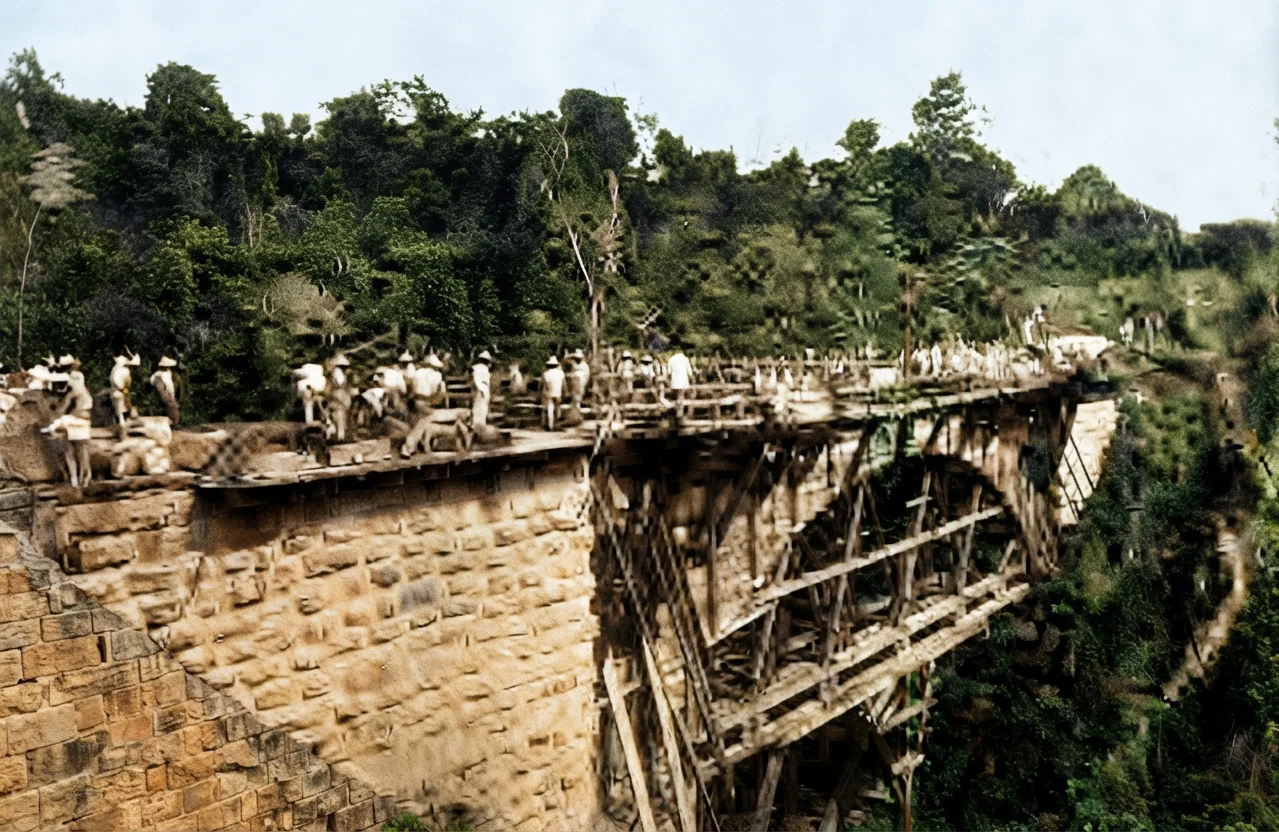
Constructing Bridge of Toa Alta-Corozal Road, Porto Rico.
The work of the Seventh-day Adventists began after the work of the other denominations was established, therefore we were not only unwelcome, but were told that there was no place for us. One of the leading ministers offered to use his influence to secure for me a place in a mining company that was beginning to operate here a little at that time; but we neither returned home nor accepted the proffered position, for we knew that the Lord had sent us with a message for the people and that the restrictions of man must not hinder our work of proclaiming to all the great message of the soon-coming Lord.
Thru the lack of stability on the part of the people we have raised up no strong churches, but, by the help of the Lord, we have gone to the remotest corners, and talked with the people, and carried them the printed page, until our doctrines are well known in every part of the island.
In concluding this article, let me say that I love Porto Rico, and I love her people. They have taught me many precious lessons, and the cry of my heart is that I may so live before them that they may seek the Saviour whom we in our weakness try to represent. B. E. CONNERLY.
Good News for You.
By Max Hill
A MESSAGE of wonderful beauty,
A message of truth and of light,
A message of love and of duty,
Has come and dispelled all my night.
The Saviour is coming in glory,—
He stands even now at the door;
I would that this wonderful story
Might gladden your heart evermore.
He's coming with glory supernal
To bring every man his reward,
A place in that kingdom eternal,
Be ready to welcome your Lord.
Read, ponder, the Saviour's own warning,
The signs He has given to men;
Tho many salvation are scorning,
These show He is coming again.
The signs in the heavens are telling,—
In sun, and in moon, and in stars;
Earth's armies to millions are swelling
For bloodshed, destruction, and wars;
Formality, creed, and profession;
Impurity, squalor, and grime;
Distress of the nations, oppression;
Unfaithfulness, hatred, and crime.—
Tho these fill the earth to o'erflowing,
Look up, for redemption is near;
To all the glad Gospel is going;
His footsteps e'en now we may hear.
MAX HILL.
An Experience in India.
[The following is an extract from a letter from Pastor W. A. Barlow, who is now in England on account of ill health, after serving for eighteen years as a missionary in India. It shows conditions that are all too prevalent in that sin-darkened land.]
I MUST tell you my last day's experience at Babolmohol. Having no pony, I walked over from Simultala to Babolmohol a few days before leaving for England. As I came thru a Hindu village not far from Babolmohol, I met a poor, half-starved woman and two children. The woman was suffering from hunger, and had had no proper food for fifteen days. One child was dying in her arms. The older child was suffering from some disease of the spleen. The poor woman pleaded for food and help. I asked her to send some one to our house for food as she could not go on account of weakness and dropsy, and with the dying child in her arms. No one came, but next day she with her two children came along in the afternoon. We gave her some milk, fruit, and rice, and they slept in the church-house for the night. Next morning we gave them more food and some clothing. I told them that we were leaving for England, and that they could go home slowly because no one was remaining to take my place. She with her two little ones started for their so-called home (only a hut made from a few branches and some straw to cover them). They had gone only as far as the Babolmohol River, when she lay down and died on the banks of the river. Her boy ran with his little dying brother to the village about two miles distant to tell the sad news of the poor famine-stricken mother's death. I believe her body was burned that day, and her husband is away from home seeking work, I suppose.
Does no one hear the voice of God to come over and help these poor people around Simultala and Babolmohol? Are there not some medical missionaries who have a real love for the poor villagers? Surely the harvest is great, but the laborers are few. I trust that some one will offer himself for this needy field. There are two mission stations vacant, waiting for workers who are filled with love for these poor native people, and who will live and work for their salvation. God will surely reward them.
Our Work and Workers.
By Editor
N. C. BERGERSEN reports the baptism of two at Newell and four at Sioux Rapids, Iowa.
SEVEN additions to the company at Corning, N. Y., are reported by T. B. Westbrook.
FOUR members were added to the Kansas City, (Kan.) church, Sabbath, April 18.
"LAST Sabbath I organized a Sabbath-school of thirty-eight members at Blackrock, Ore."—G. W. Pettit.
As a result of the labors of Sister Benn, four persons have taken their stand for the truth at St. Thomas, Ont.
REVIVAL services conducted by Brother B. L. Dieffenbacher at Greeley and Eaton, Colo., have resulted in the baptism of eight.
TEN or twelve are awaiting baptism at Chamberlain, S. D. Brother C. M. Clark is still laboring to advance the truth at that place.
AT Sharpsburg, Iowa, April 26, Brother M. W. Lewis baptized six children who had been taught the way of salvation by Brother R. E. Burke.
BROTHER W. R. FOGGIN recently had the pleasure of burying five precious souls in baptism at Walker, W. Va. Six more will be ready for baptism soon.
BRETHREN J. M. WILLOUGHBY and W. W. Steward recently closed a series of meetings at Ontario, Idaho, in which eight took their stand on the side of truth.
BROTHER and Sister G. R. Hawkins write from Muscatine, Iowa: "Since coming here, forty-five have united with the church, and the interest now is at its best."
NINE have accepted present truth at Corning, Cal., thru the labors of Brother and Sister Chas. Moler, C. N. Martin, and J. H. Behrens. The interest is still growing.
BROTHER CHAS. THOMPSON, president of Kansas Conference, writes of the organization of a little church at Essex, Kan., three of the members receiving baptism, April 26.
G. W. ANGLEBARGER, of Denver, Colo., writes: "We are glad to say that the work is still onward here. Since last September seventy-eight good souls have been added to the church."
TEN have taken their stand for the truth at Eddyville, Iowa, thru the labors of Brother E. W. Wolfe. Older believers were led to renew their consecration, and a Sabbath-school was organized.
"SABBATH, May 2, at a beautiful beach on the Long Island Sound, eight souls were baptized by the writer. Previous to the baptismal service, a church was organized, consisting of twenty-one members."—J. C. Stevens, Bridgeport, Conn.
THREE months of public effort at Bossburg, Wash., have borne good fruit. A Sabbath-school of forty-five members has been organized, and about fifteen have taken a definite stand to keep all the commandments of God. E. H. and Mrs. Huntley have sown the seed.
THE Toluca Industrial Advocate is a little paper published by Brother D. T. Shireman in the interests of the Toluca Industrial School, at Toluca, N. C. Those interested in the education of the poor of that district should correspond with Brother Shireman. Financial and other aid will be much appreciated.
IN November, 1907, the first Seventh-day Adventist church in Hayti was organized, with a membership of twenty-five. There are now nearly forty members in this church, which is located at Grande Riviere. Brother U. Bender reports a membership in the island of more than eighty, most of whom have been won thru the printed page.
FROM Somabula Mission, South Africa, come reports of progress. Brother W. C. Walston writes: "Our teachers and older boys at the mission go out every Sabbath afternoon and hold services at seven kraals near here, and on these occasions we have, at times, over three hundred natives who listen to the message. Several of our large family are awaiting baptism."
"LAST Sabbath was a day when God's presence could be felt; a Sabbath day when ten precious souls united with the church and celebrated the Lord's Supper; a day when the members came together in love for one another, and praised God for His blessings the past quarter. Sunday afternoon ten followed their Lord in baptism."—East Michigan Banner, reporting a meeting at Hazelton, Mich., May 2.
Wanted for Missionary Work.
Tracts and papers in German, French, and English. G. W. Baldwin, R. F. D. No. 1, Smith's Creek, Mich.
SIGNS OF THE TIMES and Watchman. Mrs. James Wood, 322 S. Detroit St., Warsaw, Ind.
Denominational literature of any kind. Mrs. C. Frasee, Homewood, Ill.
Bethel Industrial Academy, Bethel, Wis
Bethel Industrial Academy, Bethel, Wis.—Catalog for 1908-1909 has been issued, the school year having begun April 1. A full line of studies up to the eleventh grade is carried on in connection with the industrial work. Correspondence is solicited by the principal, A. W. Spaulding, Bethel, Wis.