The American Sentinel, Vol. 9, No. 30.

Combinations of Men Foretold in Isaiah Eight
Earlier text: Combinations of Men Foretold in Isaiah Eight

Strive to Merit It.

The Hon. James T. Ringgold, of the Baltimore bar, is well known to our readers, and by them held in high and grateful esteem for his noble defense of the principles of religious freedom and civil equality. Mr. Ringgold has written a book on the “Legal Sunday,” which will form a number of the Religious Liberty Library very soon to be issued. The author dedicates the forthcoming volume to Seventh-day Adventists in the following highly appreciative language:

TO MY FRIENDS,

The members of the Seventh-day Adventist Church throughout the world: Those true representatives of the martyrs of old, inheriting their spirit, tasting somewhat of their experiences; persecuted for religion’s sake in “free” and “Christian” America, as were their prototypes in despotic and pagan Rome; ‘like them hesitating not in the choice between “Diana and Christ;” yet, when reviled, reviling not again; may they yet, like them, make history; and by their firmness, their patience, above all by the example of their pure and beautiful lives, bring about the abandonment of pagan practices and pagan modes of thought in all Christian lands. To you, Seventh-day Adventists, this work is dedicated with the assurance that this world can offer no greater reward of endeavor, no higher honor for the writer, than the privilege of calling you, “My Friends.”
The expression of such sentiments, and their application to our people, imposes a sacred obligation to fulfill the position thus assigned to us. To appropriate unmerited praise is no credit to any one. To accept such lofty appreciation and make no effort to support the character ascribed to us would be a disgrace. God knows us better than Mr. Ringgold does. He in his providence has called us to stand in the very position outlined. Let us humbly strive with the help of divine grace to merit this eulogy, not only from those who know us among men, but from Him who sees not as man sees.—Review and Herald, S. D. Adventist Church paper.

“We Can Put Them in the Stocks.”

THE times smack of religious tumult. Two moderators of the Presbyterian Assembly—those of Sydney and Brisbane—have been publicly accused of doctrines hateful to the church. Nearer home a brutal and licentious soldiery have dared to perform “equestrian exercises” on the Lord’s day. Finally a judge of the Supreme Court has confessed without shame that he read up the Speight vs. Syme case on the Sunday afternoon. Well may Mr. James Balfour and Professor Rentoul, in the pauses of the Miss Sutherland controversy, find time to wonder how it is that earthquakes are smiting Athens when the real offenders are nearer at hand. However, no less pious a monarch than the second Charles has provided against the emergency, and already two Seventh-day Adventists have been sentenced to imprisonment in the stocks. These gentlemen insist on holding their Sabbath on the Saturday, and claim the right, having fulfilled their obligations to Providence, to follow their lawful calling on the Sunday. They must be taught the necessity of observing two Sabbaths in the week.
In the days when Charles the Second ruled the glorious British nation, It is said, from paths of virtue he habitually swerved; That he spent his whole existence in repulsive dissipation— But at least he took precaution that the Sabbath was observed. He was prone, perhaps, to covet the possessions of his neighbor, Or his neighbor’s wife or daughter, or his servant, or his ox; But he held decided views upon the point of Sunday labor, And he punished all transgressors by confinement in the stocks. Let us cherish the remembrance of a prince so truly pious, And condone his little pleasures as the follies of a king, Close our eyelids to his vices, let them pass unheeded by us, Though in ordinary mortals it would be a different thing. Let us recognize his claim to take a prominent position In the calendar devoted to the saintly orthodox, And insert a special heading in the Sunday school petition, “May God bless Charles the Second, and may Heaven preserve the stocks.” Let us all become detectives, down on Sabbath desecration, Let us catch the bold offenders in the very act of crime, That the stocks may never suffer from the lack of occupation, And the prison and the pillory be going all the time. And whence’er we find a citizen who tries the Sunday watering, Of his twenty feet of grass plot or his bed of hollyhocks— Well, we can’t resort to hanging, or to drawing, or to quartering, But all praise to Charles the Second, we can put him in the stocks.
—The Argus, Melbourne, Australia, May 12.

Will Congress Rest Under It?

THERE is upon the statute books what is known as the salary docking law, that is a law whereby a congressman absent from his seat without leave, unless on account of sickness, forfeits his salary for the time he is thus absent. July 11, Mr. Powers, of Vermont, reported to the House from the Judiciary Committee his bill repealing this salary docking law. The report ridicules the excuse for absence made by representatives in these words:—
It is apparent that the excuse of sickness is one easily made, and it is suspected that it is sometimes assigned as reason for absence without any diagnosis of ailments by medical experts. In other words, the enforcement of this section practically makes every member a pathologist on the subject of disease, which is not a qualification for service in Congress mentioned in the Constitution, and so for this reason the law is plainly unconstitutional. It is believed that each house of Congress can, by an appropriate rule, better enforce the attendance of members than by a statute operative as a penal statute and evaded by every subterfuge.
How seriously this is intended it is of course impossible to say. The idea that the law in question is unconstitutional on the ground alleged is utterly absurd. This certainly could not have been meant to be taken seriously. But is the idea that because the law is evaded it ought to be repealed any better? Scarcely. If congressmen ought to be paid for neglecting their business when they should be attending to it, then ought this law to be repealed, but not otherwise. If our lawmakers are so dishonest as to demand pay for work they do not do, and so utterly lost to all sense of decency as to falsify in order to get what does not in either justice or law belong to them, then indeed have we become one of the basest of nations and a hissing and a reproach to the world. Will Congress rest under the imputation thus put upon it by Mr. Powers, or will it show itself to be clear in this matter?

Why They Work on Sunday.

ADVENTISTS work on Sunday not from sheer willfulness nor merely to assert a right which they may or may not exercise at their pleasure, but because they regard it as a sacred duty to habitually devote Sunday to secular purposes; and this because they understand that the fourth commandment establishes a difference between the Sabbath and the six other days of the week, and requires men to respect that difference. To ignore this distinction between the Sabbath and the other days of the week is simply to defeat the object of the divine law, and to set up a counterfeit of the memorial which God has ordained to keep in remembrance the fact that he is the Creator of the heavens and the earth. It follows as inevitably as night follows day that W. B. Capps, now in the Weakley County, Tenn., jail, is there for conscience' sake.

Intolerant as National Reformers.

THE Ironclad Age, an atheistic paper, printed in Indianapolis, Ind., has upon its editorial page of its issue of the 14th inst., these two notes:—
At Wilmington, N. C., one man sued another. As the plaintiff arose to testify, objection was made on account of his disbelief in a god. After some consideration by the judge, the man was allowed to testify on condition that he declared his belief in a god. To the great surprise of all present he did so. But as his non-religious views were well known, he prejudiced his case to such an extent that no conviction can be had. And such is our boasted religious liberty.
We trust that the time will come when the cheerful doctrine of eternal torture will no longer be bellowed forth at camp-meetings and other godly assemblages by insane sensational rascals. We trust that the time will come when such work will be interdicted by law.
In view of the second paragraph quoted, what right has the Ironclad Age to find fault that a witness is required to avow his belief in God before being permitted to testify?—None whatever. Of course the North Carolina practice is wrong. Every man ought to be permitted to testify in a court of justice under the pains of perjury without any reference to his religious belief, and without any prejudice against him because of his faith or lack of faith; but the state of affairs that the Ironclad Age hopes to see would be much worse than the evil complained of. The National Reformers would overthrow the First Amendment to the Constitution in the interests of what they imagine is Christianity; the atheists of the Ironclad Age school would equally overthrow it in the interests of the blackest kind of infidelity, the very midnight of unbelief. There is small difference between the intolerance of atheism and the intolerance of so-called Christianity; both are utterly destructive to soul liberty, and both are from the enemy of all righteousness. That this is true is evident from the fact that the Ironclad Age takes its stand with the enemies of the Constitution which declares that “Congress shall make no law concerning an establishment of religion or prohibiting the free exercise thereof.”

Sunday Desecration Made Responsible for the Dagger of the Assassin.

THE Christian Statesman of July 7, attempts to place the responsibility of the work of the assassin, in the case of President Carnot, upon Sunday desecration in France. But in the attempt it has completely stultified its own position. The Statesman says: “For a hundred years the French nation has been in open defiance of the law of God, which commands ‘Remember the Sabbath day to keep it holy.’ . . . But the Sabbath is the one unfailing, open witness of the Almighty. It is a witness set in the heavens, and when observed, testifies to the authority of Jehovah with the clearness and constancy of the shining sun.
“The French people have been playing the anarchist toward the Almighty for one hundred years. They have stabbed righteousness to the heart every seventh day and defied God to avenge the dishonor of crime.” And then, with a wonderful amount of seeming modesty, the Statesman continues: We do not like to attempt to interpret Providence, but if the Almighty should desire to testify against this wickedness and defiance of his law and manifest his wrath was there a more opportune time than that in which the blow of the assassin fell?” But how is this? Does the reader see the relation between the fourth commandment and the blow of the assassin? Here it is: “There is one thing in connection with the time and circumstances of his death which deeply impressed us, but which we have not seen referred to, viz., that he was assassinated on the Sabbath [Sunday] at the close of a day of feasting and public demonstration, and while he was on his way to the theater to witness a performance.” All of which is to say that because the French people have not regarded Sunday—of course it means Sunday, although it says seventh day—with that Puritanical strictness that the Statesman thinks to be necessary; yet—(and the Statesman would be very modest in the interpretation of Providence)—yet Providence(?) directed the matter in such a way so that the blow of the assassin fell at that particular hour on Sunday!! Was ever absurdity more absurd? It is even worse;—it is open blasphemy to thus attribute the work of the assassin to Providence.
But with all due charity I will indulge the fond hope that the Christian Statesman did not mean all that the words imply. Yet it is a fact that men are driven in their blindness to a false cause, to make just such mistakes.
H. F. PHELPS.
St. Paul, Minn.

A Nebraska Paper Protests.

EVERY little while there is a threat of returning to the practical union of Church and State in this country. Any one who has even a superficial knowledge of religious history knows that wherever religion and politics have been united, wherever Church and State have been at one, there has been tyranny. There never has been a case in the history of the world where religion had the power to use the arm of the State that it did not use it, and use it against the rights and liberties of those who did not agree with them in their religious opinions. There never has been one single case. Only a little while ago a man in one of the Southern States was in prison. He was a Seventh-day Baptist. He believed in observing the Sabbath as he is ordered to in the Bible. His neighbors believed in keeping the first day; and there is a nefarious law on their statute book making it a crime for a man to work on the first day of the week. This man having kept the seventh day as his Bible told him to, and not feeling under any obligation to keep two days—the same Bible commanding him to labor six days—went about his business on the first day of the week, and was arrested and imprisoned. The only safety for liberty is the utter separation of Church and State. Yet every little while there is a bill introduced into Congress to attempt to put the name of God into the Constitution, and to declare officially in our fundamental law that we are a Christian people; and this right in the face of the fact that, were the orthodox God and the orthodox interpretation of Christianity to get into the Constitution of the United States, the rights of man would go out in the downfall of pure republican government and the establishment of an hierarchical government, and that it would then be necessary for the freemen to arise in their might, demolish the oligarchy and hurl the traitors into oblivion, at whatever cost.—The Sentinel, Oakdale, Nebraska.

Triumph of Faith.

COMMENTING on the fact that England is slowly but surely being converted to the true faith, the London correspondent of the Drogheda Argus says: “The truth is that at the present moment Catholicity in England, so far from being banned and scoffed at, is becoming fashionable, and to the Cardinal-Archbishop of Westminster is conceded a rank and a precedence, even in the presence of royalty, which are both striking and gratifying. Then, again, we have the convert Lord Ripon, a member of the queen’s cabinet and filling the office of one of the great secretaries of State; and my conviction is that only for the band of bigots at present in the two Houses of Parliament, an act opening the Lord Chancellorship of England to a Catholic would be passed without murmur; and furthermore, that the English people would be well content to see the English woolsack occupied by the eminent Catholic lawyer, Sir Charles Russell.”—The Monitor.

Romanism in Belgium.

THE religious statistics of Belgium for 1890, which were only published towards the close of last year, give the number of conventual institutions and their inmates in the kingdom—229 monasteries, with 4,775 monks, and 1,546 convents, with 25,323 sisters and nuns. These have grown during the decade preceding from 231 monasteries, with 4,120 monks, and 1,346 convents, with 21,242 sisters. The increase was not so great as in the period 1870–80, when many of the religious sects expelled from Prussia settled in Belgium. In the next decade many of these returned, owing to the relaxation of the church laws. But there are still over 30,000 men and women belonging to the various orders, and taking the population of Belgium in 1890 at 6,000,000, we find one “religious”—monk or sister—to every 200 persons.—American.

Sunday Omnibuses in Toronto.

AFTER the Sunday-car agitation in Toronto, Canada, last summer, a Mr. Kelly started Sunday ’buses. He has about eight at present. It grieves the Sunday people greatly, and it has been all Sunday preachers could endure to see such “desecration” continue. The law was not invoked until recently, but now the matter is in the courts, and the Sunday people are doing all in their power to restrict the movement of the people on the first day of the week. Those who do not own carriages, and are not able to hire them, can go to church or else stay at home.

Religious Societies and the Civil Government

ALL that religious societies have a right to ask of the civil government is the same privileges for transacting their own affairs which societies of every sort possess. This they have a right to demand, not because they are religious societies, but because the exercise of religion is an innocent mode of pursuing happiness. If it happens accidentally that others are benefited, it does not follow that they are obliged to pay for this benefit. It cannot be proved that the Christian religion needs the support of the civil government, since it has existed and flourished when entirely deprived of this support.—Rev. Dr. Wayland's Political Economy.

Equality Versus Toleration in Religious Liberty

A CONTEMPORARY remarks that toleration “is certainly a virtue whose spirit is embodied in the American Constitution.” Equality is a better word than toleration, and best expresses the real spirit of the Constitution. We do not “tolerate” Presbyterianism or Roman Catholicism in this country. Both have perfect equality before the law. We tolerate what we may disallow if we choose; so Spain tolerates Protestantism. But religious equality is a right not to be gainsaid; and that is the boast of America, as it is a fundamental principle of the Federal Constitution.— The Christian Work.

London Teachers Refuse School Board Religious Instruction Demand

“THE members of the London Teachers' Association,” says the London Correspondent of the New York Sun, “have refused to comply with the request of the tyrannical school board that they should individually explain why they wish to be excused from giving the form of religious instruction required by the famous circular. It remains to be seen what the board will do in face of the defiance of the teachers.”

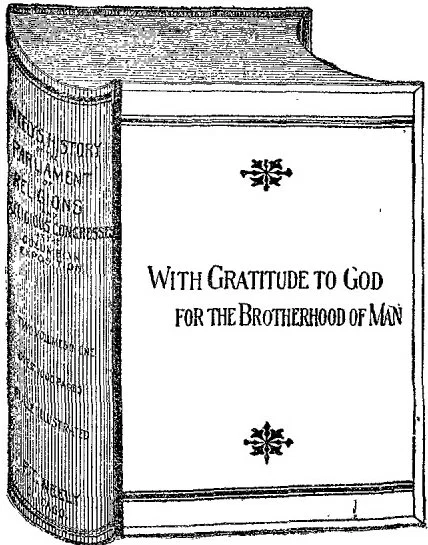
THE PARLIAMENT OF RELIGIONS.

This work is complete in one large octavo volume, and is a careful compilation of all of the proceedings—at once a fascinating story and a book of universal value. The book gives the origin of the Parliament of Religions; proceedings of every meeting of the Parliament; speeches delivered and papers read at every session of the noted gathering; the beliefs of the various religious denominations; opinions of eminent divines in regard to the Parliament; influence of the Parliament upon the religious thought of the world. Published by F. T. Neely, Chicago.
1000 pages. Price: Cloth, $2.50.
We have made arrangements with the publisher so that we can offer this book to our subscribers, together

WITH THE AMERICAN SENTINEL FOR $2.75,

only 25 cents more than the price of the book alone. This offer applies to either new subscriptions or to renewals. We will supply this book alone at the regular price, $2.50.
This book is not offered because we approve the Parliament of Religions, but because it is a history of one of the most remarkable and significant religious gatherings ever held.
Address, AMERICAN SENTINEL, 43 Bond Street, New York City.

Apples of Gold Library

ENVELOPE SERIES
THIS is the title of a little monthly publication recently started by the Pacific Press, and is designed especially for use in personal correspondence. It is printed on thin paper, and one or two numbers can be put in a No. 6 envelope, with an ordinary letter, without increasing the postage.
The following numbers have already been issued:—
No. 1. Looking unto Jesus. “ 2. The Christian’s Privilege. “ 3. The Sure Promises of God. “ 4. How to Get Knowledge. “ 5. The Church and the World. (Poetry.) “ 6. The Elect of God. “ 7. How Esther Read Her Bible. “ 8. The Thief on the Cross. “ 9. The Eleventh Hour. “ 10. Benefits of Bible Study. “ 11. Righteousness; Where Is It to be Found?
Five copies for one year, postpaid, 50 cents; or 12 copies for $1.00. Single subscriptions are not desirable, for two reasons: (1) The numbers being so small they are liable to be lost in the mails. (2) If they are used in correspondence, as recommended, more than one copy would be necessary.
Single or assorted numbers of the Library will be mailed in quantities at the following rates: 50 cents per hundred, or $4.00 per thousand copies. Always order by the NUMBER.

IS THE PAPACY IN PROPHECY?

BY THE Rev. Thomas W. Haskins, M. A., Rector Christ Church, Los Angeles, Cal.
The above is the title of a treatise written by the author, at the request of the Ministerial Union of Los Angeles, California. It grew out of a discussion upon the present aspect and aims of
The Roman Catholic Church in the United States,
the author taking the ground that the rise, progress, present and future condition of the temporal power known as the Papacy, or Vaticanism,
Is Outlined in the Prophecies of Holy Scriptures,
with sufficient accuracy to determine what the “Papacy” is, and what is to be its future development and ultimate end.
Paper Covers, - - - 25 Cents.
Cloth Covers, - - - 60 Cents.
Mailed, post-paid, on receipt of price.

The Law of God as Changed by the Papacy

Is the title of a large Chart just issued, which shows in a striking manner the blasphemous pretentions of the Papal power. The testimony of the Best Catholic Authorities is given, and shows, by quoting their own words, that Sunday is a child of the Catholic Church. These quotations, together with admissions from standard Catholic works, are arranged in parallel columns on either side of this Chart, while the center column contains the Ten Commandments as taught by the Catholic Church. The whole forms a collection of extracts of incalculable value for every Bible student.
The Charts are three by four feet in size, and are printed on heavy map cloth in bold type, easily read across the largest room.

Price, Post-paid, $1.00.

A fac-simile edition on thin paper, size 5½ x 7½ inches, suitable for missionary distribution, has been prepared, and will be sent post-paid at 50 cents per hundred, or $4.00 per thousand.
Address Pacific Press, 43 Bond Street, New York City. Kansas City, Mo. Oakland, Cal.

The Gospel in Creation.

_By E. J. WAGGONER._
What is the gospel? What is creation? What relation do they sustain to each other?
The title of this interesting and valuable book ought to be sufficient to recommend it to the earnest searcher after truth. The conception that there is an intimate relation between the gospel and the work of creation, makes this able little production at once of peculiar interest and profit, especially to those who have been accustomed to consider that the gospel did not exist in the old dispensation, but that it is confined in both application and promulgation to the new dispensation.
The spirit of the Old Testament is the Spirit of Christ, as witnessed by the ancient prophets. Christ was the Creator; and since the works of creation were the works of Christ, the story of creation contains the gospel, which, like creation, reveals the power of God. Hence, when Moses wrote of the works of creation—the works of Christ—he wrote the gospel.
The heavens and the earth and all contained therein—the works of creation—teach the power of God—the gospel—in a language that can be understood by all people, of whatever tongue. Since Christ the Creator is Christ the Redeemer, creative power is redemptive power; and in considering the power manifested in creation, we are contemplating the power of redemption.
These truths are all set forth in clear and concise language, and the author's deductions are logical, and substantiated in every case by the plain words of Scripture. And since there is no knowledge, science, or truth which the Bible does not unfold, no one can afford to be without this book, of which “the only design is to lead the reader to study the Word more closely for himself.”
Bound in Cloth, artistically designed and illustrated, 176 pp., 75 cents.
Address all orders to
INTERNATIONAL TRACT SOCIETY,
_271 West Main St., - - Battle Creek, Mich._

RELIGIOUS LIBERTY LIBRARY.

A monthly publication (with occasional extras) published by the International Religious Liberty Association. The following have been issued:—
No. 1. DUE PROCESS OF LAW AND THE DIVINE RIGHT OF DISSENT. An interesting and instructive work upon the “Process of Law,” “Christianity and the Common Law,” “Individual Right of Religious Belief,” “The Divine Right of Dissent,” etc., in review of Judge Hammond’s decision in the King case. By A. T. Jones. 120 pages. Price 15 cts.
No. 2. RELIGIOUS INTOLERANCE IN THE REPUBLIC. A lucid and vivid portrayal of recent persecutions in Tennessee, written by the editor of the Arena. 16 pages. Price 2 cts.
No. 3. CHURCH AND STATE. A timely document upon the origin of Church and State union with the arguments and excuses for Sunday laws, laws exempting Church property from taxation, laws against blasphemy, religious tests, etc., all well considered. By James T. Ringgold, of the Baltimore Bar. 60 pages. Price 10 cts.
No. 4. THE NATIONAL SUNDAY LAW. Arguments in behalf of the rights of American citizens, presented by A. T. Jones in opposition to the Blair Sunday-rest Bill. A thorough catechism upon the subject of Church and State. 192 pages. Price 25 cts.
No. 5. SUNDAY LAWS IN THE UNITED STATES. Their groundlessness and unconstitutionality exposed. By James T. Ringgold. 24 pages. Price 3 cts.
No. 6. THE CAPTIVITY OF THE REPUBLIC. A Report of the Hearing on the Sunday Closing of the World’s Fair, before the House Committee on Columbian Exposition, Jan. 10–13, 1893. 128 pages. Price 15 cts.
No. 7. APPEAL AND REMONSTRANCE. Resolutions adopted by the General Conference of the Seventh-Day Adventists, Feb. 24, 1893, with documentary evidence attached. 24 pages. Price 3 cts.
No. 8. APPEAL FROM THE U. S. SUPREME COURT DECISION MAKING THIS A “CHRISTIAN NATION.” A PROTEST. A review of the decision of the Supreme Court of the United States, declaring that “this is a Christian nation;” a powerful protest against the union of Church and State involved in this decision; also the subsequent act of Congress closing the World’s Fair on Sunday, and how it was secured. The work contains the text, in full, of this remarkable decision of the U. S. Supreme Court. By A. T. Jones, Editor American Sentinel, New York City. 86 pages. Price 15 cts.
No. 9. SHALL RELIGION BE TAUGHT IN THE PUBLIC SCHOOLS? A lucid exposition of both the unconstitutionality and impracticability of connecting religion with our public school educational system. 12 pages. Price 1½ cts.
No. 10. RELIGIOUS LIBERTY AND THE MORMON QUESTION. Is the Prohibition of Polygamy Religious Legislation? 20 pp. Price 2½ cts.
No. 11. THE “CIVIL SABBATH;” OR, DISGUISED RELIGIOUS LEGISLATION. Sabbath laws shown to be religious and only religious. 12 pages. Price 1½ cts.
No. 12. THE COLUMBIAN YEAR, AND THE MEANING OF THE FOUR CENTURIES. An address delivered by Alonzo T. Jones, on Columbus Day, 1892. Revised to date. 44 pages. Price 5½ cts.
No. 13. THE LIMITS OF CIVIL AUTHORITY, from the standpoint of natural rights and divine obligation. 12 pages. Price 1½ cts.
No. 14. CHRIST AND THE SABBATH. A study of the spiritual nature of the Sabbath and what Sabbath-keeping really is, showing the impossibility of its enforcement by civil law. 44 pages. Price 6 cts.
No. 15. ROME’S CHALLENGE: WHY DO PROTESTANTS KEEP SUNDAY? A reprint of a series of articles which appeared recently in the Catholic Mirror, the official organ of the papacy in the United States, in which Protestants are sharply arraigned on account of the absurdity of their position with reference to the Sunday institution; with copious notes, by A. T. Jones, Editor of the American Sentinel. 40 pages. Price 5 cts.
No. 16. OUR ANSWER: WHY DO SEVENTH-DAY ADVENTISTS SUFFER IMPRISONMENT RATHER THAN KEEP SUNDAY? A brief, historical, scriptural presentation of the Sabbath—the sign of loyalty to God—and Sunday—the sign of loyalty to the Roman Catholic Church. “It should be translated into every language, and placed in the hands of every person on the earth.”—A. T. Jones, Editor American Sentinel.
No. 17. SCRIPTURAL RELATION OF RELIGION AND THE STATE. A scriptural presentation of the principles upon which the proper relation of religion and the State is based, substantiated by facts of history. 80 pp. Price 10 cts.
No. 18. CHRIST AND THE PHARISEES; OR, CHRIST’S FAITHFULNESS IN SABBATH-KEEPING. A striking parallel between the time of Christ and our day, showing that as Christ was persecuted and even put to death for his faithfulness in keeping the Sabbath according to God’s idea, so in our day those who keep God’s Sabbath—the seventh day—are being and will continue to be persecuted for the same thing and for the same reasons. 40 pp. Price 5 cts.
No. 19. PROTESTANTISM, TRUE AND FALSE. This work, by A. F. Ballenger, after stating clearly the fundamental principles of true Protestantism, shows by incontrovertible evidence that modern Protestantism has fallen away from these principles. 32 pages. Price 4 cents.
Annual subscriptions to the Library, $1.00. Liberal discounts on any of the numbers in quantities and to the trade.
Order of PACIFIC PRESS, 43 Bond Street, New York City, Or Oakland, Cal.

Papal Stance on Cremation and Catholic Libraries

The pope has decided that burning of the dead “may be allowed under special conditions.” Upon this the Investigator remarks: “There was a time when popes of Rome decided that burning of the living was perfectly proper. Leo XIII. thinks cremation ‘heretical in principle.’ How tenderly Romanism handles dead men, but how roughly it has handled live ones.”
The Catholic Review of this city suggests that—
Wherever there is a public library, the Catholics of the neighborhood should combine to raise a fund to contribute, say, one hundred first-class Catholic books to it. If they don’t do this, they will lose a great chance to spread knowledge of the truth. Is there such an opportunity where you live?
Protestants ought to see to it that every library is likewise supplied with anti-Catholic literature.
Some of the people of Church Hill, Md., are still threatening violence against the Adventists. Elder Horton, the Adventist minister in charge of the work there, has again been threatened with personal violence; and one night recently a mob attacked the large tent in which meetings are held, and partly demolished it. They also did some damage to the new church building, now nearly ready for dedication. They declare that the building shall never be dedicated. The Adventists are very certain that it will be both dedicated and used after dedication.
One of the strangest things in human nature is the tendency to accept from government rights as favors, and to be devoutly thankful to government for them. Thus we find a Fourth of July orator near Lincoln, Neb., saying that notwithstanding the fact that our Government “is not as true to the Constitution as it once was,” “we should be thankful for what our country has done for us, and for the privileges still granted us.” The connection shows that the “privileges” have reference to rights of conscience, to believe and practice according to the dictates of conscience. The man who can be thankful for such privileges “granted” by government, could be thankful if he were about to be hung.
If we may believe the Declaration of Independence, there are such things as inalienable rights; rights not only not conferred by government, but rights of which government has no right to deprive a single man, however humble. Among these are rights of conscience. In 1829, Hon. Richard M. Johnson said, in a report to the United States Senate:—
What other nations call religious toleration, we call religious rights. They are exercised not in virtue of governmental indulgence, but as rights, of which government cannot deprive any portion of citizens.
This is true, but what then becomes of the idea of being thankful to government “for the privileges still granted us”? In 1827 Lord Stanhope said, in the British House of Lords:—
The time was when toleration was craved by dissenters as a boon; it is now demanded as a right; but the time will come when it will be spurned as an insult.
But that time can never come to people who are taught that religious liberty is a privilege granted by government. It is granted by God only, and the government that touches it is a tyranny, whatever its form or by whatever name it may be called.
The Boston Investigator has this to say about the failure of the National Reformers to interest Congress in their raid on the Constitution:—
The God-in-the-Constitution fanatics are waking up to the fact that they were sat down upon when the Judiciary Committees of both Houses refused to submit the proposed amendment to the Constitution to Congress. After all the flourish of Christian trumpets and grand boasts of the National Reform Association that the nation was to be made a Christian nation, Congress would not even listen to the petitions asking to have the preamble of the national Constitution amended to suit Joseph Cook, Wilbur F. Crafts, Rev. Dr. George, and a few other fossilized ministers. Good-bye, God-in-the-Constitution party.
As all are aware, we have not the slightest sympathy with the so-called National Reform movement; but it is bound to succeed. Whether they will yet secure the proposed amendment, we do not pretend to say; but the churches already dominate the Government; and according to the dictum of the supreme court, that “this is a Christian nation,” all that the National Reformers demand can be practically done without the amendment. We shall yet hear much more from the God-in-the-Constitution party, though in just what shape, time must reveal.
The case of W. B. Capps, the Seventh-day Adventist, now serving a sentence of fifteen months in a Tennessee jail, for doing ordinary labor on Sunday, has revived the question, Why do Adventists work on Sunday? The answer is, Believing the papacy to be antichrist, and holding the Sunday Sabbath to be the badge of its power, with Adventists the observance of Sunday would be equivalent to rendering homage to antichrist; hence their steady refusal to obey Sunday laws, and their willingness to suffer imprisonment, (as Mr. Capps is doing), the chain-gang, (as several Adventists have done), or even death itself, rather than to so much as appear to regard Sunday as other than a common working day. It is not therefore, as many seem to regard it, simply a matter of the choice of days, but is with the Adventists a vital question directly affecting their salvation.
The state of mind of the rulers, in at least a part of Europe, is thus described by a foreign correspondent of the Sun, in its issue of July 15:—
The French authorities are in a state of alarm approaching panic over the warnings of fresh anarchist plots. The information has been furnished principally by London and other foreign police, and extraordinary precautions have been taken to prevent the execution of the bloodthirsty designs. These measures are so stringent that all foreigners in France are likely to suffer inconvenience. Merely stopping to admire the architecture of the public buildings is likely to lead to arrest on suspicion, as an innocent Englishman found who gazed curiously for five minutes at the foreign office on Thursday. The customs inspectors have been instructed to investigate the contents of everything larger than a small orange. The bill for the suppression of anarchy, which is almost certain to pass the Chamber next week, is one of the most drastic pieces of legislation in history. It literally fulfills Macaulay’s prophecy that it might prove necessary to destroy liberty in order to preserve civilization. It almost forbids people to think anarchy. It certainly forbids them to mention it in a private letter. It tries offenders without a jury, and on conviction sends them to solitary confinement, and possibly to Cayenne.
Macaulay was by many regarded as a pessimist when he predicted such a condition as now exists; but his “pessimism” was simply the result of an intimate acquaintance with human nature. But even had he been less acute than he was he might have drawn his conclusions from the Scriptures of truth. Speaking by inspiration of God, the Apostle Paul wrote: “This know also, that in the last days perilous times shall come. For men shall be lovers of their own selves, covetous, boasters, proud, blasphemers, disobedient to parents, unthankful, unholy, without natural affection, truce-breakers, false accusers, incontinent, fierce, despisers of those that are good, traitors, heady, high-minded, lovers of pleasures more than lovers of God; having a form of godliness, but denying the power thereof: from such turn away.” 2 Tim. 3:1–5. And our Saviour foretold a time when men’s hearts should be “failing them for fear and for looking after those things which are coming on the earth.” Luke 21:26. That time of peril and of fear has come; and the next thing is the coming of the Lord.

You have reached the end of this edition.

The American Sentinel · Jul 26, 1894