S. D. A. Publishing Association · Battle Creek, Mich. · Jan 5, 1887
MY SON, GIVE ME THY HEART.
By Ellen G. White
The heart belongs to Jesus. He has paid an infinite price for the soul; and he intercedes before the Father as our Mediator, pleading not as a petitioner, but as a conqueror who would claim that which is his own. He is able to save to the uttermost, for he ever lives to make intercession for us. A young heart is a precious offering, the most valuable gift that can be presented to God. All that you are, all the ability you possess, comes from God a sacred trust, to be rendered back to him again in a willing, holy offering. You cannot give to God anything that he has not first given you. Therefore when the heart is given to God, it is giving to him a gift which he has purchased, and is his own.
There are many claimants to the time, the affections, and the strength, of youth. Satan claims the youth as his property, and a vast number render to him all the ability, all the talent, they possess. The world claims the heart; but that heart belongs to the one who redeemed it. If given to the world, it will be filled with care, sorrow, and disappointed hopes; it will become impure and corrupted. It would be the worst kind of robbery to give to the world your heart's affections and service, for they belong to God. You cannot with profit give your heart to pleasure-seeking. The enemy of righteousness has every kind of pleasure prepared for youth in all conditions of life; and they are not presented alone in crowded cities, but in every spot inhabited by human beings. Satan loves to secure the youth in his ranks as soldiers. The arch fiend well knows with what material he has to deal; and he has displayed his infernal wisdom in devising customs and pleasures for the youth which will separate their affections from Jesus Christ. The various amusements of society have been the ruin of thousands and tens of thousands who, had it not been for these attractions, would have been obedient children, respectful to their parents, upright, pure, and noble in their pursuits and in their character. In order to break away from the fascinations of pleasure, they will have to make a desperate effort. They will have to arise in all their strength, taking hold by faith of the Divine power in their efforts to be Christ's only.
The lesson of the prodigal is given for the instruction of youth. In his life of pleasure and sinful indulgence, he expends his portion of the inheritance in riotous living. He is friendless, and in a strange country; clad in rags, hungry, longing even for the refuse fed to the swine. His last hope is to return, penitent and humbled, to his father's house, where he is welcomed, forgiven, and taken back to a father's heart. Many youth are doing as he did, living a careless, pleasure-loving, spendthrift life, forsaking the fountain of living waters, the fountain of true pleasure, and hewing out to themselves broken cisterns, which can hold no water.
God's invitation comes to each youth, “My son, give me thine heart; I will keep it pure; I will satisfy its longings with true happiness.” God loves to make the youth happy, and that is why he would have them give their hearts into his keeping, that all the God-given faculties of the being may be kept in a vigorous, healthful condition. They are holding God's gift of life. He makes the heart beat; he gives strength to every faculty. Pure enjoyment will not debase one of God's gifts. We sin against our own bodies, and sin against God, when seeking pleasures which separate our affections from God. The youth are to consider that they are placed in the world on trial, to see whether they have characters that will fit them to live with angels.
When your associates urge you into paths of vice and folly, and all around you are tempting you to forget God, to destroy the capabilities God has intrusted to you, and to debase all that is noble in your nature, resist them. Remember that you are the Lord's property, bought with a price, the suffering and agony of the Son of God.
God says, “My son, give me thy heart.” Will you refuse him that which you cannot give with merit because it is his already,—that which you cannot refuse without ruin to your own soul? He asks your heart; give it to him, it is his own. He asks your intellect; give it to him, it is his own, lent you in trust. He asks your money; it is his own, give it to him. “Ye are not your own; ye are bought with a price.”
The Lord Jesus claims your service. He loves you. If you doubt his love, look to Calvary. The light reflected from the cross shows you the magnitude of that love which no tongue can tell. “He that keepeth my commandments, he it is that loveth me.” We are to become acquainted by diligent study with the commandments of God; and then show that we are his obedient sons and daughters.
The mercies of God surround you every moment; and it would be profitable for you to consider how and whence your blessings come every day. Let the precious blessings of God awaken gratitude in you. You cannot number the blessings of God, the constant loving-kindness expressed to you, for they are as numerous as the refreshing drops of rain. Clouds of mercy are hanging over you, and ready to drop upon you. If you will appreciate the valuable gift of salvation, you will be sensible of daily refreshment, of the protection and love of Jesus; you will be guided in the way of peace.
Look upon the glorious things of God in nature, and let your heart go out in gratitude to the Giver. There is in nature's book profitable study for the mind. Be not thankless and reckless. Open the eyes of your understanding; see the beautiful harmony in the laws of God in nature, and be awed, and reverence your Creator, the supreme Ruler of heaven and earth. See him, by the eye of faith, bending over you in love, saying with compassion, “My son, my daughter, give me thy heart.” Make the surrender to Jesus, and then with grateful hearts you can say, “I know that my Redeemer liveth.” Your faith in Jesus will give strength to every purpose, consistency to the character. All your happiness, peace, joy, and success in this life are dependent upon genuine, trusting faith in God. This faith will prompt true obedience to the commandments of God. Your knowledge and faith in God is the strongest restraint from every evil practice, and the motive to all good. Believe in Jesus as one who pardons your sins, one who wants you to be happy in the mansions he has gone to prepare for you. He wants you to live in his presence, to have eternal life and a crown of glory. MRS. E. G. WHITE.
WINTER NOON.
By Wm. Cowper
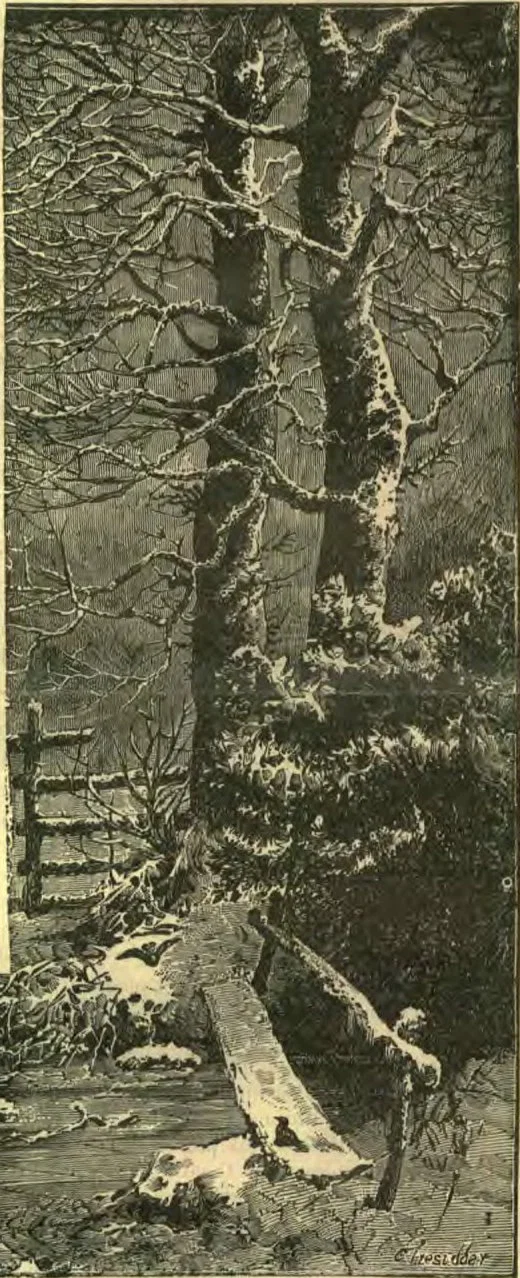
THE night was winter in his roughest mood,
The morning sharp and clear. But now at noon
Upon the southern side of the slant hills,
And where the woods fence off the northern blast,
The season smiles, resigning all its rage,
And has the warmth of May. The vault is blue
Without a cloud, and white without a speck
The dazzling splendor of the scene below.
Again the harmony comes o'er the vale;
And through the trees I view the embattled tower,
Whence all the music. I again perceive
The soothing influence of the wafted strains,
And settle in soft musings as I tread
The walk, still verdant, under oaks and elms,
Whose outspread branches overarch the glade.
No noise is here, or none that hinders thought.
The red breast warbles still, but is content
With slender notes, and more than half suppressed;
Pleased with his solitude, and flitting light
From spray to spray, where'er he rests he shakes
From many a twig the pendant drops of ice,
That tinkle in the withered leaves below.
Stillness accompanied with sounds so soft,
Charms more than silence. Meditation here
May think down hours to moments. Here the heart
May give a useful lesson to the head,
And learning wiser grow without his books.
—Wm. Cowper.
Who has deceived thee so often as thyself?
W. S. C
By W. S. C.
SEA TALES,—NO. 10.
We were scudding along at a distance of about four hundred miles from the boundary line of solid ice of the antarctic region. In the latitude in which we were then running, great caution had to be exercised, for at any moment we might encounter icebergs, which, at that season of the year, were to the south beginning to break loose and float northwards. When the wind blows from an iceberg, the chill may be felt, but when blowing towards the ice, and especially in the dense fogs that come frequently, we are liable at any moment to run upon one. The captain repeatedly cautioned both mates to keep a sharp lookout; but it is difficult to make a man realize the danger from such a cause, and I very much doubt if the lookout ever gave it a thought.
It seemed so strange to me that I should be sailing so near to the antarctic world. Less than half a day's good sailing would have placed us as far south as ever a vessel sailed in this longitude (155°). I remembered reading about the voyages of Dr. Kane and other arctic explorers, and of locating the arctic regions at some immensely indefinite distance from New York, with no more idea of an actual distance than I could have of that from the heavenly bodies, or of ever dreaming that I could possibly be induced to venture any closer than I then was to such a place; yet there I was sailing along on the very borders of the frozen world. The thought gave me a gloomy feeling. There we were out on that boundless expanse of water, solitary and alone. Not a sail had we seen, and every wind that blew (except from the west and south) drove us farther from aid, towards a region no human being attempts now to penetrate except from necessity. If there had been inhabitable land each side of us, I would have felt differently; but to know that every mile made to the south was so much towards meeting the thousands of miles of field ice and icebergs then moving, was anything but a pleasant reflection.
One afternoon two of the largest albatrosses yet seen kept us company. They must have been very, very old, as their feathers were rough and twisted, and they looked aged. I would not have been surprised had I been told that those birds were at least fifty years old. I am sorry that I can give no description of an albatross that will enable one to fully realize its size. I can think of nothing to compare it with except an eagle, yet that comparison does not suit. If either of the birds with us that day were laid across the parlor of an ordinary city dwelling (say 22 feet), with the wings extended, the tips of their wings would have touched the walls each side. Yet the body is not proportioned to the wings. One would suppose that a bird with such wings would have a body at least six feet in length, but the body of a large albatross is not larger than that of a good-sized goose.
Very few, I presume, understand how a captain at sea ascertains his position daily. It is quite puzzling, and it is impossible to give you a practical explanation; but I can present an idea of how it is accomplished, without stating the actual method pursued. In the first place, then, it must be understood that by the term “zenith” is meant a point directly over one's head, no matter where one may be, and that when the sun reaches the zenith, it is directly over one's head, or at an angle of just 90 degrees from the horizon.
Captains and first mates carry an instrument that is made to ascertain the distance the sun is above the horizon. At the top it has a small looking-glass, from which extends a long bar, having a slide attached, that runs over a graduated scale of degrees at the bottom of the instrument. In the center is a small telescope, in front of which is a frame, having in the lower half a piece of looking-glass, and in the upper a plain piece of glass, the edges of these glasses joining smoothly and perfectly. In using the instrument, the reflection of the sun is caught upon the small looking-glass at the top of the instrument; and looking through the telescope, the officer moves the slide to which the glass is attached until the sun's image is cast upon the half looking-glass in the center of the instrument, in such a way that the lower edge of the sun exactly touches the horizon (the top of the piece of looking-glass being on a line with the horizon). When this occurs, the scale on the instrument gives the height of the sun above the horizon, or its altitude. In this way the latitude for the day is ascertained. I am giving only a crude idea; to explain the whole method would be impracticable here. There are several calculations to be made, and tables of figures to consult, before the exact latitude is ascertained, but the result all hinges upon the “sight of the sun.” This sight should be taken early in the morning.
To learn the longitude, the officer takes the instrument on deck a few moments before the time he thinks it will be noon, and watches the sun, through the little telescope, as it rises. Precisely at noon it is directly overhead. There it seemingly remains an instant, then commences its descent on the west side of the globe. The instant while it is at rest is twelve o'clock. That instant the officer calls “eight bells,” which are struck on the bell forward of the forecastle; the mate alters the cabin clock to noon, and the steward starts out of the cabin and rings the bell for dinner. Now, supposing the ship's chronometer to be correct, when it was noon where we were, we found by the chronometer (which is Greenwich time) that it was 1:20 A. M. at Greenwich; we would have been exactly ten hours and twenty minutes ahead of Greenwich time, or of the meridian. As I have heretofore explained, if one sails east or west of Greenwich, every degree passed over makes a difference of four minutes, so that by reducing the above variation to minutes, and dividing by four, we would have 155, which would mean that we were in longitude 155°. But chronometers are never exactly correct, and, for other reasons I cannot explain here, there are a number of calculations to be made before the exact longitude is ascertained. I trust that the foregoing will give a general idea of how it is done.
W. S. C
A NEW YEAR AND A NEW LIFE.
By M. J. C.
A “HAPPY NEW YEAR” is our greeting to-day. It seems but a little while since we sent you one for 1886, and now, so soon, follows another. It is thus, one by one, that about six thousand years have gone by. A great multitude of people, too, who lived during this time, and perchance greeted each other in this old-time way, have passed off from the stage of action. But there is another act in the drama, to be ushered in by and by; for a careful record of their lives has been kept, which they must meet in the Judgment of the great day. So, too, each year that leaves us carries its record to God, and we must sometime meet it.
At first glance, the above may not seem very pleasing thoughts to begin a happy new year. But to a child of God who is earnestly trying to overcome, and has learned that his happiest year is one in which he lives nearest to God, a statement that he must die, and be judged, instead of making him gloomy and unhappy, has no terrors for him. Neither do his past failures discourage him; for there is a lesson in them which he cheerfully tries to learn.
If, in reviewing our past lives at this time, we discover mistakes, let us not become discouraged; but if we are permitted to begin the new year, let us begin new lives. If our paths have been crooked, let us make them straight. If we have neglected duties, let us pick them up. If we have shunned crosses, let us in future meekly bear them.
We can make straight paths only by taking each step in the right way. But so long as we can take only one step at a time, the task does not look so very difficult. Indeed it would not be so hard to walk in the narrow way if there was no enemy to draw us, magnet-like, into forbidden paths. Why so many fail is because they do not fortify themselves against this wily foe. We have the promise that if we resist the enemy, he will leave us. If we seek God earnestly for strength to do this, we shall have it.
The readers of the INSTRUCTOR have been taught so thoroughly how to live acceptable lives before God, that if they fail to obtain everlasting life they will be without excuse. What a terrible mistake any make who regard this matter lightly; for when the decision is made against them, it is forever too late to alter it.
Oh, the thought of being forever lost! Who can endure it? Who would sacrifice an unending life in the kingdom of God for all the kingdoms of this world? And yet many will sacrifice it for a paltry sum. Would that so foolish a bargain might not be made by any who read this paper.
Dear reader, the prize is before you. The way to obtain it is given in “line upon line.” Will you not begin the new year with your hand in that of your Heavenly Father, with an honest purpose to make his way your way? Thus you will fear him and keep his commandments, which will entitle you to a mansion in his kingdom. M. J. C.
—Christian Weekly
1886—1887.
'Tis midnight; throngs of angels hover near, Their white robes gleaming in the frosty air; They come to watch the last faint dying breath Of our loved Old Year—to us so dear. Ah! now he lies so still in death, cold death! For the year's that's dead go ring the knell, Sadly, slowly toll the bell: We, too, like you must die, Old Year, good-by, good-by!
An infant's hand takes up the sceptre now, Hail, radiant one, sweet babe, whence comest thou? Borne forth on fleecy clouds from time's mysterious shore? Thou art heaven-born; thy natal morn Earth greets with chime of bell and cannon's roar. We'll ring the bells for the glad New Year, Chime, bells, chime, bells, ring loud and clear; Merrily swing, joyfully ring, Welcome the New Year, Hail to the King!
—Christian Weekly
A FATHER'S LESSONS.
“If more fathers would take a course with their sons similar to the one my father took with me,” observed one of the leading business men of Boston, “the boys might think it hard at the time, but they'd thank them in after life.”
“What sort of a course?” we asked.
“Well, I was a young fellow of twenty-two, just out of college; and I felt myself of considerable importance. I knew my father was well off, and my head was full of foolish notions of having a pleasant time and spending lots of money. Later on, I expected father to start me in business, after I'd ‘swelled’ round a while at the clubs, and with fine horse-flesh.”
“Like a wise man, father saw through my folly, and resolved to prevent my self-destruction, if possible.”
“If the boy's got the right stuff in him, let him prove it,” I heard father say to mother one day. “I worked hard for my money, and I don't intend to let Ned squander it, and ruin himself, besides.”
“That very day father came along and handed me fifty dollars, remarking, ‘Ned, take that money, spend it as you choose, but understand this; it's the last dollar of my money you can have till you prove yourself capable of earning money and taking care of it on your own account.’”
“I took the money in a sort of dazed manner, and stammered out, ‘I—why—I—I want to go into business.’”
“‘Business!’ exclaimed father, contemptuously. ‘What do you know about managing the mercantile business? Get a clerkship, and learn the alphabet, before you talk to me of business.’ And father left me then to ponder on his words. And that fifty dollars was the last money my father ever gave me, till at his death I received my part of the property.”
“I became hard and bitter then, thought my father was a stingy old fogy, and resolved to prove to him that I could live without his money. He had roused my pride—just what he intended, I suppose.”
“For three days I looked about for a place to make lots of money. I found no such chance, and at length I accepted a clerkship in a large retail store, at four hundred dollars a year.”
“Another bit of father's ‘stinginess,’ at this time, was demanding two dollars a week for my board through that first year.”
“At the end of my first year I had laid aside two hundred dollars, and the next year, my salary being raised a hundred, I had five hundred laid by.”
“One hundred cents meant more to me in those days than one hundred dollars had previously.”
“At the end of four years' clerking I went to my father with fifteen hundred dollars of my own, and asked him if he was willing to help me enter business. Even then he would only let me hire the money, two thousand dollars, at six per cent interest.”
“To-day, I am called a successful business man. And I have my father to thank for it. Those lessons in self-denial, self-respect, and independence which he gave me, put the manhood into me.”
“Years afterwards, father told me it cost him the hardest struggle of his life to be so hard with his boy. But he felt it was the only course to make a man of me. Many a time we've laughed over that two-dollar board-bill.”—Youth's Companion.
“CARRY GENTLE PEACE.”
DEAN STANLEY recently addressed a crowd of children gathered in Westminster Abbey, and gave them this excellent rule for ordering their conduct:— “I knew once a very famous man, who lived to be very old—who lived to be eighty-eight. He was always the delight of those about him. He always stood up for what was right. His eye was like an eagle’s when it flashed fire at what was wrong. And how early do you think he began to do this? I have an old grammar which belonged to him, all tattered and torn, which he had when a little boy at school, and what do you think I found written in his own hand in the very first page? Why, these words, ‘Still in thy right hand carry gentle peace, to silence vicious tongues. Be just, and fear not.’ That was his rule all through life, and he was loved and honored down to the day when he was carried to his grave.”—Sel.
On the Folly of Rude Speech
It is easy to say a rude thing, but not wise.
INFLUENTIAL TRIFLES.
EVERY educator is a character-builder. This is emphatically so with a Sabbath-school teacher, because his scholars understand that his desire to see them disciples of Christ is the reason of his being in the teacher's chair. Hence they reasonably expect to see in him an illustration of the character he wishes them to attain. This expectation moves them to note his words, acts, and tempers. His gentleness, patience, kindness, sympathy, fidelity to his duties, etc., command their admiration, win their confidence, and predispose them to accept the truth and verity of the religion he teaches. But if he be given to lightsome speeches, to much laughter, to gossip with neighboring teachers, to pettishness, to sharp words, to impatience, or to angry words, their inward thoughts are unfavorable to him and prejudicial to their faith in the reality of religion, because they are quick to perceive their inconsistency with it. In the former case, the teacher puts elements of evil, in the latter, elements of good, into the characters of his pupils. He may question whether such trifles as his words, acts, and spirit can have such a weighty influence. Yet all history shows that they may and do, because in it we see that “trifles lighter than straws are levers in the building up of character.”—S.S. Journal.
UNCONSCIOUS COUNTING.
UNCONSCIOUS counting consists in being able to give the correct number of several objects at a glance without being conscious of counting them. If, as it is claimed, such knowledge may be acquired by practice, it might sometimes be valuable in making an estimate where haste is necessary. A trial of it would, at times, certainly afford pleasant pastime for the INSTRUCTOR boys and girls during their leisure moments; and should they not learn to distinguish so great a number of objects at a glance as some have done, they might in this way, after a little time, be able to count several numbers readily. The Pall Mall Gazette, in noticing an article upon this subject which appeared in the January number of the Gartenlaube, by Herr W. Preyer, says:—
“The writer points out that the ability possessed by every grown-up person of ordinary intelligence to distinguish three, four, or even five objects at a glance and without being conscious of counting them, may, by practice, be perfected to such a degree that it becomes quite as easy to count ten objects as it is to count three, and that it is possible to give the exact number up to thirty objects at a single glance. As an example of the latter attainment, the writer points to the well-known arithmetician, Dase, who died in 1861, and who declared that he could count thirty objects of the same kind as quickly and easily as other people could count three or four. The truth of this assertion was often proved when Dase, with lightning rapidity, gave the correct number of a herd of sheep, of the books in a library, or the window-panes in a large house. Apart from the utility of this branch of science, the method of teaching it is such that if it is only practised as a game, it may afford amusement in many a juvenile and family circle.
“The test of how far any one can count at a glance is easily made by putting several small objects, such as coins, pins, or matches, under a sheet of paper, then lifting the paper for a second and looking at the objects, and, after covering them again, give an estimate as to the number. At first it will be found difficult to fix the number if there are more than from three to five objects, but the eye becomes very soon accustomed to distinguish between larger numbers, so that after a short time, eight or nine objects will be counted by the eye with the same facility. Care should, however, be taken that the counting is not done consciously, for that would take far too much time; the number of objects should only be valued. The mistakes which are at first frequently made in this guessing game will become rarer and rarer, and almost anybody can become an expert in rapid counting up to ten objects. After that it becomes more difficult.
“To acquire this method of counting, black spots should be made on white square pieces of cardboard, first symmetrically, and in small numbers; afterward their number may be increased and their position altered. It will also be good practice to open a book, cover part of the page, rapidly look at the lines left uncovered, and to guess at the number. It is astonishing how soon the eye gets accustomed to the numbers.”
PARABLES OF CHRIST.
LESSON 17.—THE PUTTING FORTH OF THE FIG-TREE, ETC.
1. As Jesus went out of the temple at evening after giving his last discourse there, to what did some of the disciples call his attention? Mark 13:1; Matt. 24:1.
3. Later in the evening, as they sat upon the Mount of Olives looking down upon the temple and the city, what questions did they ask him? Verse 3.
4. What warning did he give them? Verse 4.
5. Why would such a warning be needed? Verse 5.
6. What great tribulation was to come before they could look for the second advent of Christ? Verses 21, 22.
7. To what special period do these verses apply? —To the 1260 years of papal persecution.
8. When did this period terminate? —Near the close of the eighteenth century.
9. What need was there to be of guarding against deception even after the close of this period? Verses 23-26.
10. By what figure did Jesus illustrate the manner of his second coming? Verse 27.
11. What did he give as the true signs of his second advent? Verse 29.
12. By what parable did he illustrate the certainty with which they might then look for his coming “in the clouds of heaven with power and great glory”? Repeat verses 32, 33.
13. In view of these things what admonition did he give to those who should be living at that time? Verse 42.
14. By what figure did he illustrate the importance of heeding this admonition? Verses 43, 44.
15. What question did Jesus then ask? Verse 45.
16. Who are represented by this wise servant? —The faithful ministers of Christ who truly feed the flock of the great Shepherd.
17. What does Jesus say of such a servant? V. 46.
18. What promise does he make? Verse 47.
19. Who are represented by the evil servant in verse 48? —Unfaithful ministers who do not feed the flock of God, but fatten upon it.
20. How is such a servant described? Verse 49.
21. How will such a one be disappointed? V. 50.
22. What will be his fate? Verse 51.
OF WRITING TO ABSENT SCHOLARS.
That teacher who wins a warm place for himself in the affections of his class seems “right of way” for his instructions to the consciences of its members. To win that place one must convince them that he cares about them, is in sympathy with their best interests. Among other innocent and judicious methods of doing this is the writing of letters to such of them as may happen to go from home for a time on long visits to relatives, on distant journeys, or perchance away to school for a term or two. To every youth, such going from home gives occasion to more or less of homesickness. At such times, says Cowper, “With what intense desire he wants his home!” And with what intense delight he then reads a letter from his friends at home, not excepting his Sabbath-school teacher! Could he speak his feelings, he would say, as the late Dr. J. B. Mozley did, when from home in his boyish days: “I don’t want to hear any news; it is not that I want, but there is something in a letter from home that would cheer me.” This confession of childish need may show a Sabbath-school teacher a simple means of linking a pupil’s heart to himself and thereby giving him an influence by which he may persuade him to enlist in the army of Christ. A grand result this, from a simple and by no means costly effort.—S.S. Journal.
TO WORKER SUBSCRIBERS.
By Editor
As the Worker has been merged into the INSTRUCTOR, all unexpired subscriptions to the Worker will be applied on the INSTRUCTOR, unless our subscribers notify us to the contrary. We will wait two weeks before making this change, so as to give a chance to hear from those who may wish their subscriptions disposed of in some other way.
S. S. PUBLISHING COMMITTEE.
“A MEADOW IN THE OCEAN.”
One would not naturally expect to find a meadow in mid-ocean, yet any who have read the life of Columbus may remember the fears he and his companions entertained as they, in their voyage to discover the Western continent, encountered a field of floating seaweed several thousand square miles in extent, so matted together as to hinder their progress. Their fears were based upon the idea that where there was so much vegetation there must be rocks or shoals beneath it, upon which their vessel might be wrecked. But investigation has proved that the water is of great depth in this locality, hence the weed has not been detached from anything beneath it. The following paragraphs from an exchange will throw some light upon this remarkable ‘meadow,’ as sailors sometimes call it:—
“This ‘meadow’ lies in the comparatively still water, between the southern branch of the great Gulf Stream and the return, or equatorial current, which comes back westward. The great mass of vegetation thus lies in a sort of ‘dead water’ or eddy of two great ocean currents.
“It is supposed these plants began life attached to rocks in the tropical seas, before being detached and carried on their long voyage by the Gulf Stream; and they are said by botanists only to produce their spores, as the seeds of flowerless plants are called, when so attached. Afterward they grow by sub-division, and multiply very rapidly. Sailors and geographers have named this ‘meadow,’ the Sargasso Sea. The Spanish name for seaweed is Sargazo, and from that is taken the botanical name Sargassum, which is the name of the genus to which the plant belongs.
“The bright chrome yellow color of the plant when alive contrasts beautifully with the intensely blue, clear water in which it floats,—the blueness being caused by the great depth of the water.
“But there are other Sargasso seas. One in the Pacific Ocean, lying, like the one in the Atlantic, between the great Japan current and the northern equatorial current. Then there is another not so large, to the southeast of New Zealand, and an immense field in the South Indian Ocean; but these last are of less importance to navigators, and consist mostly of different growth, the giant kelp, the stems of which are sometimes hundreds of feet long, and immensely thick and strong, so as to really stop a vessel.”
A NATURAL WONDER.
By Frank Hope
ONE of the most curious freaks of nature is found near a place called Tandil, in the Argentine Republic. It is an enormous cone-shaped rock standing solitary and erect in the pampas. The curious part of it is that it is not thrust out of the earth like most rock, neither is it attached in any way to the ground; but merely stands on the ground, looking like an immense deserted pear. The base of this rock is round, so that the colossus stands on a very small foundation, and it is so perfectly balanced that the action of the atmosphere or wind or something causes it to keep up a continual vacillating motion. Of course in such an immense mass this motion is hardly perceptible to the eye, but on a bottle's being placed under it, the rock can be seen to come slowly down and smash the bottle to pieces.
Standing on such a small foundation, the rock looks very strange, and seems as if it would topple over every minute; and any one looking at it would think that it might be pushed over by the hand. But this is not so. One of the presidents of that country got such an idea in his head and determined to pull it over. But after hitching to it all the horses that was possible, and levering it up behind with all the men that could work there, he had to give it up, for this had no effect on the old rock. So in spite of “all the king's horses and all the king's men” it still keeps peacefully vacillating in solitary grandeur. How it got there and why it acts as it does is a problem which may perhaps be solved by some scientific theorist.
FRANK HOPE.
SHOWERS OF GOLD.
Tradition has it that many thousands of years ago the Emperor of China, perceiving the wretchedness and destitution brought upon his people by the use of intoxicating beverages, issued a decree which closed every liquor shop in the empire. And the strangest thing about it was that for three days after the decree went into effect, the heavens rained gold. It came down like manna from the skies; and the people, being in possession of their senses, were able to gather enough to make them rich and happy for years thereafter. While the latter part of this story can hardly be accepted as literally true, we have no doubt the results of a general closing up of the dram-shops were better even than a shower of gold upon the land. An abundance of wealth is not so sure to bring peace, joy, and contentment to the homes of the people as virtuous and temperate living. If the $900,000,000 annually wasted on drink in this country could be saved to the people, the golden age would surely be upon us.—Sel.
LADIES' POWDERED COIFFURES.
Ladies' coiffures seem to have attained their greatest extravagance during the reign of Louis XVI., when the caricaturists of the day represented hair-dressers as mounted upon high steps whilst preparing ladies' coiffures. Leaders of fashion underwent trying ordeals in order to outvie one another in the magnificence of their head-dresses. When about to attend a court ball, it became necessary for them to sit up the whole of the night and the following day whilst their elaborate coiffures were being executed, so that they were sometimes twenty-four and even thirty-six hours under the hands of the coiffeur, who was piling tier upon tier of ornamentation on their devoted heads,