IT is very easy in any part of the country for society to be turned loose into a howling, violent mob. Increasing occurrences show that this is the case. To state it is simply to present an undisguised fact about which there should be no question in the mind of any one.
This condition of things is bringing the half suppressed suggestion from some of the leading editorial writers of the country that society is being so broken up that it will soon be a hopeless undertaking to maintain law and order. A very small minority make their inflammatory speeches, and a very small minority make open avowal for the vengeance of the mob. But the great majority seem to be powerless to hold the incendiary element in check. There seems to be a lack of firmness in government that allows the lawless element to break loose and do its dastardly work.
When the reason is sought for this condition of things it is not hard to find. Men are so intent in making money for themselves that they advance “business reasons” why they can not take a stand against the various wrongs that they know to be growing up right under them. The craze to get hold of money in the present is shutting the eyes of men so that they do not seem to realize the seriousness of the situation. An unhealthy and foolish optimism leads them to say, “O, it will all come out all right some way, and so we do not need to bother our heads; we must attend to business.”
And when riots and strikes are holding communities in terror, the thing that is talked most and made uppermost is the loss that is occasioned to “business.” “Our business is suffering, and we are losing thousands of dollars; and our community will be shunned by business enterprises,” is the great wail that is sent out.
The apostle exhorts Christians to be “diligent in business,” and we have that other scripture statement that the man who is diligent in his business shall stand before kings, but there are things sometimes that are more important than business. When the very fundamentals of organized society, expressed in just civil government, are not only being attacked but are being broken up, it is time for men to begin to study into the cause of this condition, and to act from a principle that has a much broader foundation than mere “business reasons.”
But the money-mad generation that would throw principle to the winds for “business reasons” has been very clearly sketched in the pages of sacred writ. One scripture reads:
“But know this, that in the last days grievous times shall come. For men shall be lovers of self, lovers of money, boastful, haughty, railers, disobedient to parents, unthankful, unholy, without natural affection, implacable, slanderers, without self-control, fierce, no lovers of good, traitors, headstrong, puffed up, lovers of pleasure rather than lovers of God; holding a form of godliness, but having denied the power thereof; from these also turn away.” 2 Tim. 3:1-5.
Self-love and also the love of money, together with a list of other evils that show an utter disregard for principle, make grievous times in the last days. Such is the statement of the apostle, and the apostle was bidden to write under the direction of Him who knows the end from the beginning. If this world is not plunging headlong into the condition described in the foregoing text, pray what kind of conditions would it take to mark its fulfilment!
The reckless disregard for the very principles that have made this one of the foremost nations of the world, and the turning away to the call of self-love and money-love are digging the foundation from under our national structure. And the conditions that prevail here are just as bad, when they are not worse, among all the other nations of the earth. The seed has been sown, and is rapidly growing to the harvest. We must do everything we can to enlighten our fellow men in regard to the final outcome. They must be shown that the only hope of permanently peaceable conditions in this world is for the armies of heaven, with the Lord Jesus at their head, to strike the decisive blow that will forever put an end to all this lawlessness and these violent conditions.
Every heart should be made to rejoice in the hope that the Master’s coming will be very soon and this reign of terror can not continue long. The evidence is incontestable, and the outlook is glorious. The Lord’s coming is right at hand.
The Bible of the Future
In a recent address at Ithaca, Prof. Nathaniel Schmidt, of Cornell University, speaking of the Bible of the future, goes on to state that the present Bible is only so many different books written by many different authors, and that as a standard of faith and practise it will fade away; that he could see the day when the present Bible, the King James Version, would only be read by scholars as they read Chaucer and Spencer, as an example of literary style. And then it will be a new Bible, containing all the books of the synagogue and the early Christian church which have been eliminated. It will contain every religious book that has been venerated. But its character, of course, will be simply that of a relic. There is no question but what Professor Schmidt’s words would come true if this old world went on at its present rate of “progress,” but before that time shall come, all the traditions of men and all opposers to God will have been brought to the test of His own presence and glory, and His words will be demonstrated true, “Every plant which My heavenly Father hath not planted shall be rooted up.”
Making Void the Word.
By Editor
The Catholic Mirror, referring recently to the death of John Alexander Dowie, and some of his vagaries, declares: "The end is not yet, nor will he while there are people who, casting away the word of God which is the bread of life, snatch greedily at the stones handed to them by designing men, who are richer in the wisdom of the children of this generation than in anything else." It would seem as if that were real good medicine for the Catholic Mirror itself to take. One of the great means by which Dowie deceived his dupes was the ornate ceremonialism which he borrowed from the Roman Catholic Church, his compulsory tithing system which he borrowed from the Mormons, and his own imperious personality and wonderfully persuasive voice by which he cowed and won the hearts of the impressive. But thereby he made void the word of God, just as truly as the Roman Catholic Church has made void the word of God that it may keep its traditions. If men had followed the word of God in the beginning of the Dark Ages we would have been spared all that intolerance and persecution, all the trouble between Church and State, all the differences in religious creed at the present time.
The Sabbath and Civil Law
By Editor
The Weekly Budget, of Ladysmith, Wis., has for its first article a sermon by the Rev. Thomas Barker on the Sabbath. He makes a splendid plea for the Sabbath as an institution and its need by humanity. This of course he draws from the word of God, but the latter part of his sermon shows that he does in no way understand the spiritual nature of the Sabbath, in demanding that it shall be enforced by law and that laws for its enforcement shall be upheld. No religious institution, call it Christian or otherwise as we will, is worthy to be perpetuated which must be upheld by civil law.
The Gospel Without Civil Power
By J. H. Merle D'Aubigne
Many thus imagined that the doctrine of the Gospel requires the support of the civil power. They know not that it advances without this power, and is often trammeled and enfeebled by it.—J. H. Merle D'Aubigne.
France
and the
Papacy
(From Our Own Correspondent)
Arch of Triumph, Paris.
Cathedral of Notre Dame (Our Mother), Paris.
A Historical Sketch.
Part First.
THE conflict between France and the Papacy is not an ordinary one; it is a family quarrel. We do not witness two enemies, but two spouses who have ceased to love each other, or rather who have never done so. As in every quarrel, it is difficult for unbiased spectators to decide between the parties, the complaints on either side seem so plausible, and it looks so probable that there are wrongs on both sides.
In this case of divorce, the difficulty is greater from the fact that the union to which it is proposed to put an end was a union against nature; the union of two beings which do not speak the same language and who belong to different species; one living for heaven and eternity, the other one belonging to this earth and the present time; the one representing the Spirit, faith, forgiveness, humility, the other one representing matter, force, the sword, and human glory.
Let us look back on this long and lamentable union of more than twelve centuries.
Pepin and Stephen II.
The occasion of the marriage between France and the Papacy was rather inglorious. Pepin, son of Charles Martel, while Duke of France, desirous of usurping the King Childeric III's place, asked Pope Stephen II to sanction his criminal intention. The pope bade him Godspeed, and Pepin gave him twenty-two cities taken from Astaulph, King of the Lombards, thus making a beginning of the temporal power of the pope.
It was no mean friendship which was thus being entered into between France and the Papacy. Stephen II wrote this to his partners: "According to the promise which has been made unto us by the Lord God, our Redeemer, I do take you, people of the Franks, from among all nations, for my special people." And at St. Denis, when the pope crowned Pepin, he proclaimed that his race was by the divine Providence elected as a protector of the Apostolic See until the end of the world.
From this time on we see the Papacy coming gradually to the idea of a universal dominion over kings and princes as well as over the churches. "There are two swords," said the popes, "the spiritual sword and the temporal sword; both belong to the church: the one is held by it thru the pope's hand; the other one is held for it by the hand of kings, so long as the pope desires or suffers it."
A Thousand Years' Quarrel Between the Church and France.
A new era opened in the history of the
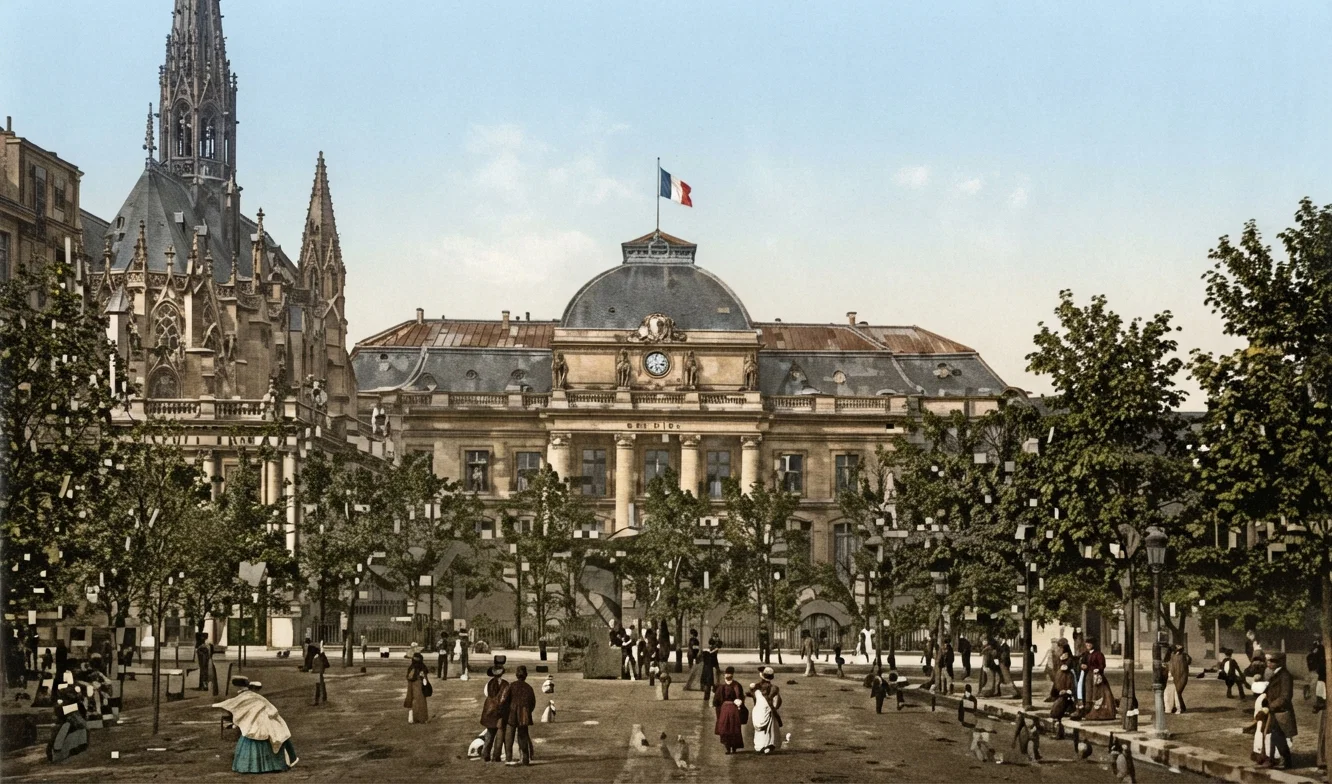
Hall of Justice and Church of St. Chapelle, Paris.
relations between the Papacy and the kings. What we now see is a continual struggle between two disparate powers, each of which is bound to encroach upon the realm of the other; the popes pretending to dominate upon temporal affairs, and the kings seeking to meddle with matters of religion. Each one knows how fiercely raged between the German emperors and Gregory VII the famous quarrel of investitures, made sadly dramatic by the trip of Henry IV to Canossa.
It is necessary here to remark that one of the leading elements of discord was the question of the income attached to lands owned by the church, or, in other words, money matters. The donations of the first Christian emperors and monastic life had made the church immensely rich. Hence the covetousness of kings who endeavored to profit by, or limit, the wealth of the bishops. The councils had decided that the revenues from church lands were to be entrusted to bishops and abbots. They were to divide these in four parts: one for themselves, the second for the poor, the third for the clergy of the diocese, and the fourth for repairs and needed buildings. It would have been strange if this privilege had not placed many bishops into luxury and covetousness. This result is abundantly confirmed by history. On the other hand, the kings claimed the right,—denied by the popes,—of nominations to bishoprics and to make money by selling sees and benefices. As a consequence, the highest positions among the clergy were occupied by grasping and unscrupulous men.
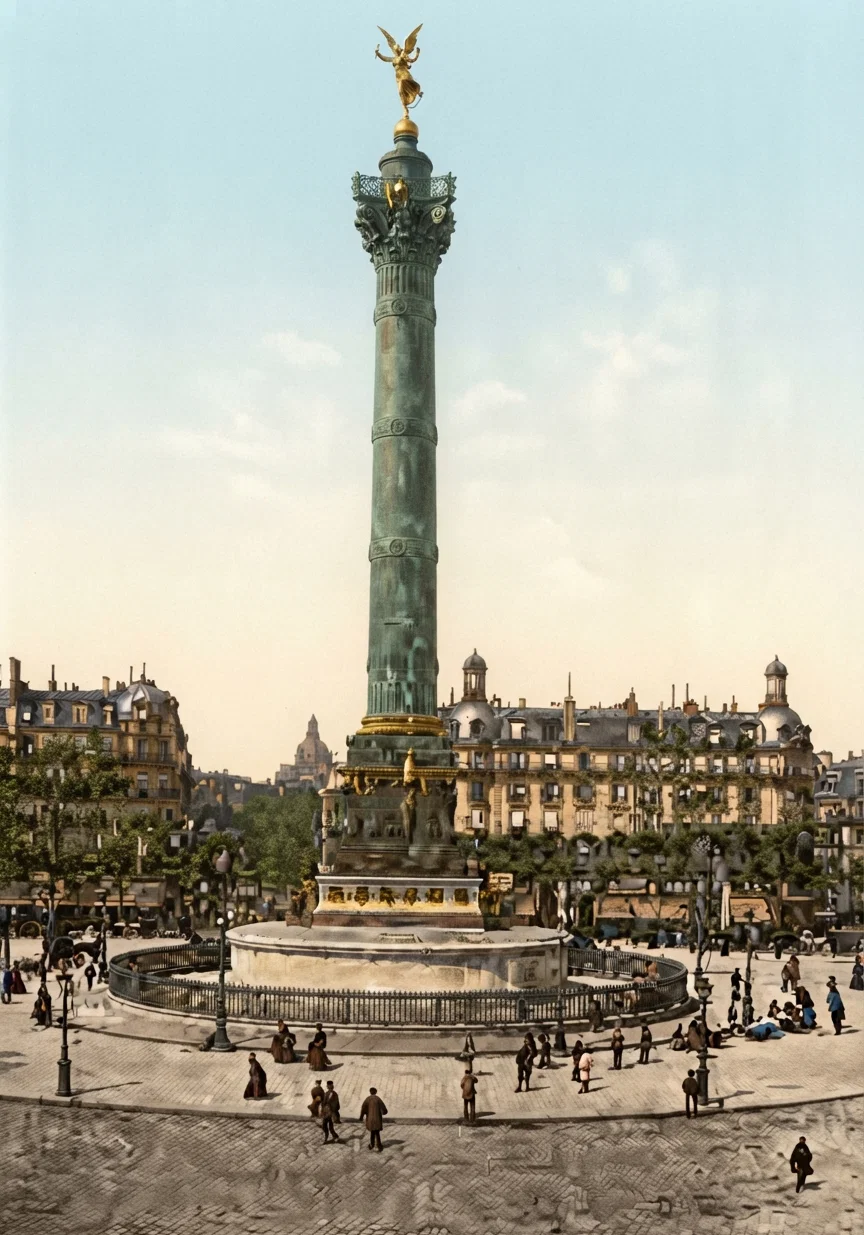
Column of July, 1830, Representing the overthrow of the Bastille.
In France, the quarrel raged between Philip I and Gregory VII; between Philip August and Innocent II; between Philip the Handsome on the one hand, and Innocent III and Boniface VIII on the other; between Charles VII and popes Martin V and Eugene IV; between Louis XIV and Innocent XI; between Napoleon and Pius VII; between the third Republic and Pius X.
The Question of Persecution.
A question which might reasonably have brought discord between the two allies, was the question of persecution. From the sixth century, the church possessed a judicial jurisdiction which included the judgment of crimes against religion, such as blasphemy, sorcery, heresy. Death was the final penalty of obstinate dissenters. But, claiming that Ecclesia abhorret a sanguine (the church recoils from blood), those sentenced to death or torture were given over to the secular arm. As a rule, the princes obeyed without scruple of hesitation the beckoning of the church.
In the thirteenth century, Innocent III had published a crusade against the Albigenses, readers of the Bible, and the princes of northern France had gone down south on a plundering and devastating tour. A similar situation offered itself in the sixteenth century when Protestantism appeared. While robbing the clergy without mercy, Francis I burned or hanged the Huguenots. In 1539 he published a general edict against the Lutherans. He was imitated by his successors, one of whom, Charles IX, authorized the horrible massacre of the Saint Bartholomew which was celebrated in Rome by glad Te Deums.
The Edict of Nantes and Its Revocation.
The progress of the Reformation, however, soon obliged the French Government to take a step toward toleration. April 13, 1598, Henry IV proclaimed the Edict of Nantes which allowed the Reformed people to exercise their worship where it already existed. But the first glimmer of freedom of conscience died out when Henry fell under the assassin's knife. Louis XIV was as humbly obedient to the church on the question of persecution as he was arrogantly independent and hostile on ecclesiastical and even theological grounds. We see him publishing drastic edicts against the Protestants, driving 200,000 of them out of his estates in 1685 by the revocation of the Edict of Nantes on the base claim that there were no more Protestants in France. It was not until 1787 that a toleration edict, inspired by Lafayette on his return from America, gave them the rights of citizenship.
The Revolution and the First Separation.
At the end of the eighteenth century, we meet with a fierce and bloody rupture between the Church and State. France was reaping the mistakes of several reigns, mistakes of which the two consorts were both responsible: luxury11of the court, great wars of ambition, persecution of non-Catholics. The poverty of the people was appalling. One of the first questions which came up before the convention was the confiscation of the church property which was marked at two billion francs, and a large share of which was represented by lands. The annual income from these lands was about seventy to eighty millions. The yearly revenue which came to each bishop from that source ranged from 7,000 to 600,000 francs. The 2nd of November, the National Assembly passed the following decree: "The church properties are placed at the disposal of the nation, on promise of providing in a proper manner for the support of ministers and for the care of the poor."
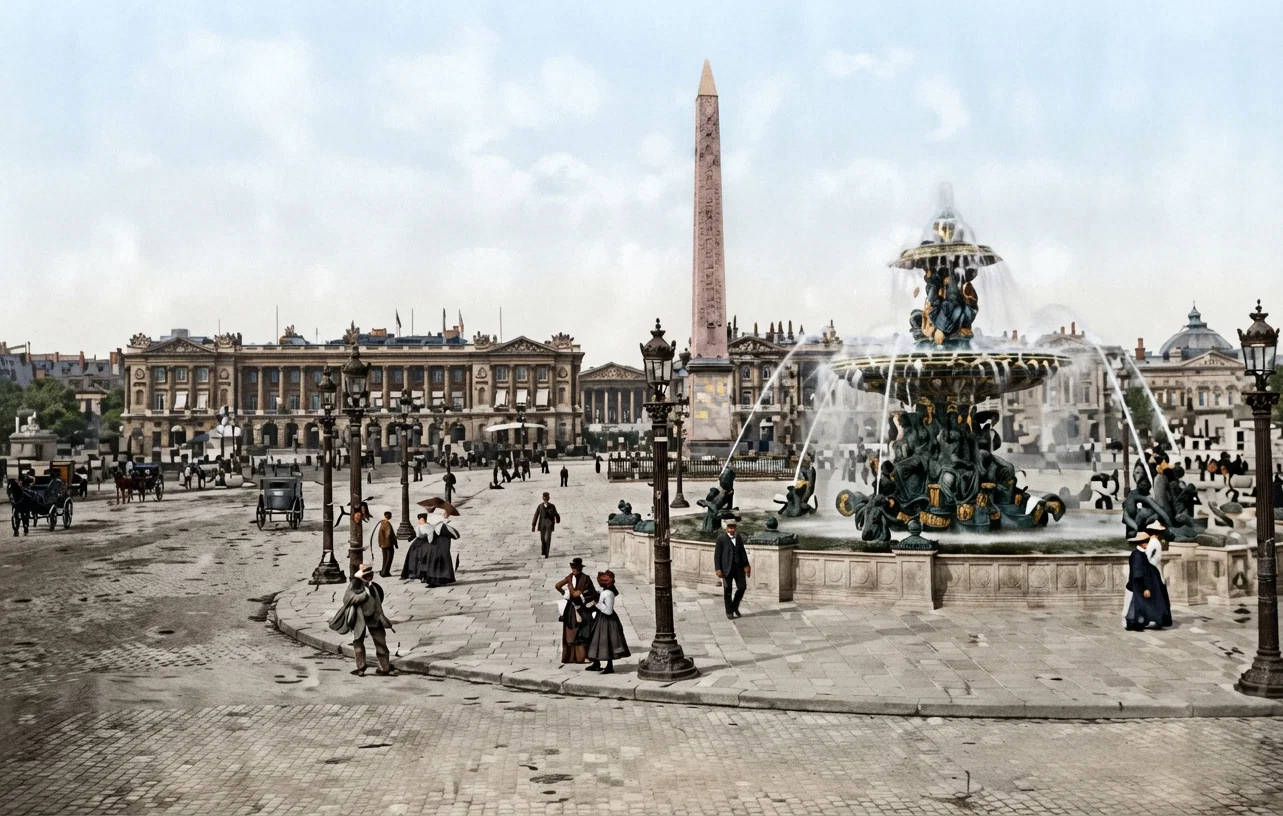
La Place de la Concorde (the Place of Assembly), Paris.
The Revolution soon became decidedly hostile to the church and to Christianity itself. Religious orders were abolished and the clergy was placed under a civil constitution which cut them off from the Papacy. The priests who refused to submit to it were banished, imprisoned, and put to death. In its turn, the church was outlawed, hated, and persecuted. At last, tired of its own excesses, France returned to the civil constitution of the clergy. Both sections of the Catholic clergy—those accepting and those rejecting the civil constitution—vied with each other in seeking to revive religion among the people. The churches were overflowing with worshipers, and a great religious revival took place.
Napoleon and the Concordat.
Then appeared Napoleon, seeking to turn everything to his own benefit and to the accomplishment of his dreams of universal dominion. In these dreams, the Catholic religion entered as an excellent moral police, as an instrument of domination. He immediately opened negotiations with Rome. Napoleon wanted the church in harmony with the pope, but submissive to, and controlled by, the government. The pope wanted it independent of State control and the only religion of the State. The Concordat was signed and broken time and again, each signer seeking to cheat his partner. Bonaparte got angry; he imprisoned 500 priests, and took the pope into France, but without avail. The struggle terminated only at the fall of Napoleon and his empire.
"The greatest mistake of my reign," said Napoleon one day, "was when I made the Concordat. I seek in vain to set proper limits between civil and religious authorities. The more I look into it, the more I see clouds, darkness, and difficulties." Napoleon failed to find out the true limits between the two spheres, for the good reason that he was unwilling to leave the church alone and to its own business.
From 1815 to 1905.
Thanks to a new Concordat concluded in 1817, a period of temporal success now opened before the church. Under Louis XVIII, Louis Philip, Napoleon III, and under the presidency of M. Thiers, Catholicism was enabled to reach an ascendancy which it had not known for a long time. Religious orders were reorganized and they multiplied rapidly. Mortmain became formidable. The clergy obtained the oversight of high and primary schools. It gained a foothold in the army, in the prisons, in public charities.
During this period, the church appropriations from State money rapidly grew as follows: In 1815, they were 11,000,000 francs; in 1819, 25,000,000; in 1830, they grew to 30,000,000; in 1848, to 40,000,000; in 1860, to 50,000,000; and from 1872 to 1882, to 53,000,000, to which were added 30,000,000 by the townships. In 1902, the fortune of the monastic orders was estimated at one billion francs.
But the tide of opposition was rising, and has kept growing with threatening strides ever since the disasters of 1870. Without interruption, the cabinets presided over by Gambetta, Jules Ferry, Paul Bert, Goblet, Waldeck-Rousseau, and Combes, steadily carried the country, step by step, toward the separation of State and Church. During a lapse of twenty-five years, a succession of laws was passed which aimed at, and accomplished, the following: The elimination of the clergy from the high-schools; members of unauthorized orders forbidden to teach; primary instruction made compulsory and gratuitous; certain teaching orders expelled, principally Jesuits; and finally, in 1904, all monastic orders forbidden to teach.
The expulsion of the religious orders in 1903 and 1904 created a great agitation in the Catholic centers. Many incidents showed that a crisis was at hand. It was brought about suddenly by M. Loubet's visit to the King of Italy and the protest of the pope against it. France recalled its ambassador, and the majority of the Chamber adopted an order of the day calling for the separation of the State from the churches. A bill to that effect was presented by the government in March 1905, and the 9th of December of the same year it received the signature of the president.
The White Man's Vices.
Dr. W. T. Grenfell, the well-known medical missionary and founder of the Labrador Mission, has stirred up the friends of Arctic exploration by the statement that wherever the white man has penetrated in the remote habitable north, the natives have suffered moral and physical deterioration. He even goes further and declares that before the explorers and traders came to Greenland, the people were peaceable and their lives were simple and healthful; but with the white man came the white man's vices, and these, in many localities, have so depraved the natives that the Eskimos are now disappearing more rapidly even than the North American Indians. Missionaries have done and are doing excellent work among them; but drunkenness, immorality, and disease increase at a rate that threatens their early extinction.
Dr. Grenfell's disclosures should not pass unheeded. Missionaries in other lands have told of the evil effects following the introduction among native races of the white man's vices, rum, opium, firearms, and immorality. Wherever these have been allowed to come in the wake of the explorer and trader, they have been a reproach to our own vaunted civilization, and a withering blight to the people we should have helped to save.—Christian Herald.
Men's Hearts Failing.
MR. STEAD told to a large audience in Boston how difficult he found it to get men of national standing to help forward the peace movement. One refused, saying, "No one has any faith any longer in this country, there is no use;" another refused, declaring, "I have not the courage to endure the sneers of the world at such an attempt—it is useless," while a third sadly uttered these words: "There is no use; nothing can be done; it was a great mistake that God made the world—if things keep on, the world will soon be too rotten to be worth damning." And thus men's hearts fail, and well they may, in the foolish attempt to reform and purify the world. That can never be done—God has never asked that it be done—that is not the end which the Lord seeks in this present dispensation. To undertake this is to depart from God's purpose and to secure defeat. This is the day of election—of securing a called-out people—an Ecclesia—and no man or devil can defeat that purpose of God. Ours is to preach the Gospel to all the world, and to every creature in the world, and to illustrate its principles while preaching. God will gather out those who believe and who become joined to the body of Christ by the reception of His life, in the power of the Holy Spirit.—Watchword and Truth.
From Fiesta to Death.
Thirty-nine, and possibly more, were killed in a wreck of a Southern Pacific train at Honda, Cal., May 11. The train was a special, carrying eastern visitors and delegates from the gay flower carnival of the Eastern Shriners in Los Angeles to their homes. It is not definitely known what caused the disaster, but engine, tender, baggage car, a diner, and three coaches were piled in hopeless confusion, burying many. Fire broke out, but was soon subdued. Many of the buried passengers were scalded to death by escaping steam. How many go down to death every day, snatched from pleasure and gaiety, without warning, without preparation. It is a sad picture, but so common that men look on unmoved.
A Russian on New York
A Russian on New York.—Maxim Gorki, the sensational Russian agitator who has described so vividly some of the evils of Russian life finds a field in New York City which seems to arouse within him equal abhorrence. He describes New York seen from afar as "a great maw with uneven, black teeth. On entering you feel that you have changed into a belly of stone and iron, into a stomach which has engulfed millions, and which crunches and digests them, and yearly waits for more and more." In its poorest quarters he finds horrors which eclipse all that he has seen in Russia. He says: "I have seen much beggardom: its green, bloodless, bone-stretched face I am acquainted with. Its eyes, dim with hunger and burning with avidity, cunning and revengeful, or slavishly submissive, and always inhuman, everywhere I have seen, yet the horrors of the East Side are blacker than anything known to me. In these streets, packed with people as a sack with grain, children seek eagerly in the garbage-pails which stand upon the footway for rotten vegetables, and devour them, mildew and all, on the spot, amid the acrid dust and exhalations. When they discover a crust of rotten bread it arouses fierce enmity among them; seized by the wish to devour it, they fight like small dogs."
An Impossible Thing.
By Editor
Mr. Rudolph W. Benkert sends us a call for the "Christian Party Conference," at Rock Island, Ill., May 1, 1907. The postal card on which the call was printed reached here April 29, 1907, altogether too late. Mr. Benkert has a great ambition; and we are sure the best of motives. He wishes to make this nation a Christian nation by law, but he will be sadly, sadly disappointed. His party has adopted as the basis of the platform "Jehovah's Ten Commandments and Jesus' Golden Rule," and it includes in its constituency all who can endorse this platform as a measure of just law and rule for righteous government from God, thru Christ, by and for the people." Now if Mr. Benkert knew how only one can adopt the Ten Commandments and the Golden Rule he would never seek to debase them by putting them in the platform of any political party whatsoever. They can only be wrought into the heart and life by the Spirit of Jesus Christ, and any attempt to do otherwise is ever sure to result in hypocrisy and tyranny.
Human Selfishness.
As illustrating the selfishness of so-called Christian shop-keepers in the "most Christian City" in the world, a writer in the World's Work presents some information from his investigations of conditions of shop-girls; that is, of manufacturing houses who employ much help, and where the assistants live on premises furnished by employers. Sometimes there is one bath for a hundred people, sometimes no bath is provided at all. The lavatories are used by men and women alike, and they sleep four to fourteen in a room, sometimes two in a bed, with blocked fireplaces and closed windows. England allows six hundred cubic feet of air space for each criminal, but these shop assistants are compelled to live in a space of less than three hundred cubic feet. In many cases they are lodged in old, tumble-down private house properties, the sanitary conditions of which are unspeakably bad. That they do exist, shows the essential selfishness of the natural heart of man unless restrained or controlled by civil law.