Pacific Press Publishing Company · New York · May 14, 1896
“CIVIL” REASONS FOR RELIGIOUS INTOLERANCE IN ROME.
The contest between Christianity and the Roman Empire, which began with the proclamation of the gospel and ended only when Rome acknowledged the inalienable right of every man to worship God according to the dictates of his own conscience, affords one of the most impressive object lessons that the world has ever seen.
The measure of religious liberty which we enjoy to-day is largely due under God to the self-sacrifice and heroic endurance of those men and women, yea, and even children, who fearlessly offered themselves upon the altar of principle, scorning to save their lives by a denial of Him who has said: “If the world hate you, ye know that it hated me before it hated you.”
A Contest Between Principles.
The controversy between the Christians and the Romans was not a dispute between individuals, or a contention between sects or parties. It was a contest between antagonistic principles—between Christianity and Rome, rather than between Christians and Romans.
On the part of Christianity this contest was the assertion of the principle of the rights of conscience and of the individual; on the part of Rome it was the assertion of the principle of the absolute absorption of the individual, and his total enslavement to the State in all things, divine as well as human, religious as well as civil.
Jesus Christ came into the world to set men free, and to plant in their souls the genuine principle of liberty—liberty actuated by love,—liberty too honorable to allow itself to be used as an occasion to the flesh, or for a cloak of maliciousness,—liberty led by a conscience enlightened by the Spirit of God,—liberty in which man may be free from all men, yet made so gentle by love that he would willingly become the servant of all, in order to bring them to the enjoyment of this same freedom.
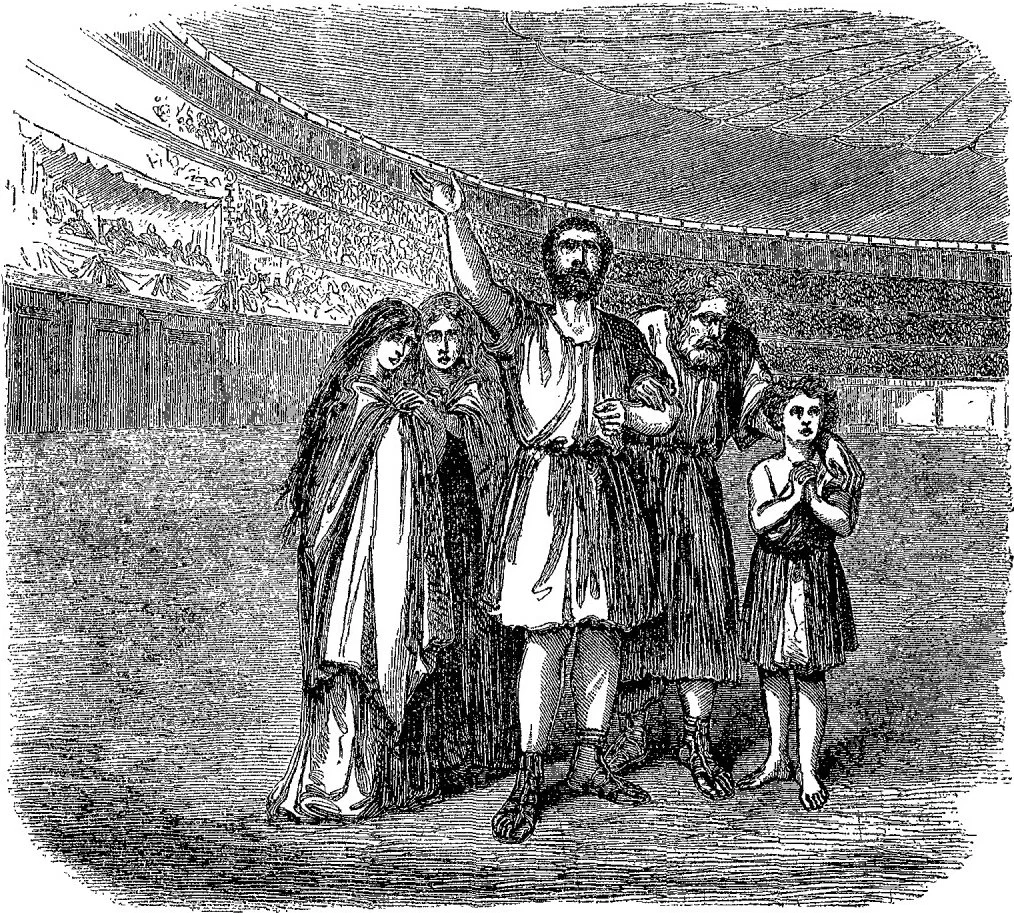
‘CHRISTIAN MARTYRS IN THE CIRCUS’ AT ALEXANDRIA.
What Rome Claimed.
The Roman Empire then filled the world,—“the sublimest incarnation of power, and a monument the mightiest of greatness built by human hands, which has upon this planet been suffered to appear.” That empire, proud of its conquests, and exceedingly jealous of its claims, asserted its right to rule in all things, human and divine.
Man with all that he had was subordinated to the State; he must have no higher aim than to be a servant of the State; he must seek no higher good than that which the State could bestow. Thus every Roman citizen was a subject, and every Roman subject was a slave. “The more distinguished a Roman became,” says Mommsen, “the less was he a free man. The omnipotence of the law, the despotism of the rule, drove him into a narrow circle of thought and action, and his credit and influence depended on the sad austerity of his life. The whole duty of man, with the humblest and greatest of the Romans, was to keep his house in order, and be the obedient servant of the State.”
To Acknowledge Christ Was to Deny Rome.
It will be seen at once that for any man to profess the principles and the name of Christ, was virtually to set himself against the Roman Empire; for him to recognize God as revealed in Jesus Christ as the highest good, was looked upon by Rome as nothing else than high treason; because as the Roman State represented to the Roman the highest idea of good, for any man to assert that there was a higher good, was to make Rome itself subordinate. And this would not be regarded in any other light by Roman pride than as a direct blow at the dignity of Rome, and subversive of the Roman State. Consequently the Christians were not only called “atheists,” because they denied the gods, but the charge against them before the tribunals was of the crime of “high treason,” because they denied the right of the State to interfere with men’s relations to God. It was held that in this they were “irreverent to the Cæsars, and enemies of the Cæsars and of the Roman people.”
The Roman idea of the State was not merely the State as a civil institution, but as divinity154itself. Rome was the supreme deity. Thus the idea of the State as the highest good was the religious idea, and consequently religion was inseparable from the State.
The Roman State being the chief deity, the gods of Rome derived their dignity from the State rather than the State deriving any honor from them. And though Rome allowed conquered nations to maintain the worship of their national gods, these as well as the conquered people were considered only as servants of the Roman State. Every religion was held subordinate to the religion of Rome, and though “all forms of religion might come to Rome and take their places in its pantheon, they must come as the servants of the State.”
A fundamental maxim of Roman legislation was,—
No man shall have for himself particular gods of his own; no man shall worship by himself any new or foreign gods, unless they are recognized by the public laws.
“What the Law Says is Right.”
The Roman State being the supreme deity, the Senate and people were but the organs through which its ideas were expressed; hence the maxim, Vox populi, vox Dei—the voice of the people is the voice of God. As this voice gave expression to the will of the supreme deity, and consequently of the highest good; and as this will was expressed in the form of laws; hence again the Roman maxim, “What the law says is right.”
It is very evident that in such a system there was no place for individuality. The State was everything, and the majority was in fact the State. What the majority said should be, that was the voice of the State, that was the voice of God, that was the expression of the highest good, that was the expression of the highest conception of right;—and everybody must assent to that or be considered a traitor to the State. The individual was but a part of the State. There was therefore no such thing as the rights of the people; the right of the State only was to be considered, and that was held to be absolute.
Christianity was directly opposed to this. It proclaimed the right of the individual to worship according to the dictates of his own conscience, while Rome asserted the duty of every man to worship according to the dictates of the State. Christianity asserted the supremacy of God; Rome asserted the supremacy of the State. This was the contest, and these were the reasons of it, between Christianity and the Roman Empire.
Christianity Not Anarchistic.
Yet in all this Christianity did not deny to Cæsar a place; it did not propose to undo the State. It only taught the State its proper place; and proposed to have the State take that place and keep it. Christianity did not dispute the right of the Roman State to be; but it did deny the right of that State to be in the place of God.
In the emperor was merged the State. He alone represented the divinity of the Roman Empire. The Christians’ refusal to recognize in him that divinity or to pay respect to it in any way, was held to be open disrespect to the State. The Christians’ denial of the right of the State to make or enforce any laws touching religion or men’s relationship to God, was counted as an undermining of the authority of government. As it was held that religion was essential to the very existence of the State, and that the State for its own sake, for its own self-preservation, must maintain proper respect for religion; when Christianity denied the right of the State to exercise any authority or jurisdiction whatever in religious things, it was held to be but a denial of the right of the State to preserve itself.
They Sought to Preserve the State.
Therefore when Christianity had become quite generally spread throughout the empire, it seemed to such emperors as Marcus Aurelius, Decius, Valerian, and Diocletian—emperors who most respected Roman institutions—that the very existence of the empire was at stake. Consequently their opposition to Christianity was but an effort to save the State, and was considered by them as the most reasonable and laudable thing in the world. And it was only as a matter of State policy that they issued edicts or emphasized those already issued for the suppression of Christianity. In making or enforcing laws against the Christians it was invariably the purpose of these emperors to restore and to preserve the ancient dignity and glory of Rome.
“The immortal gods,” said Diocletian, “have, by their providence, arranged and established what is right. Many wise and good men are agreed that this should be maintained unaltered. They ought not to be opposed. . . . It is the greatest of crimes to overturn what has been once established by our ancestors, and what has supremacy in the State.”
The Conscience above the Magistrate.
As before remarked, Christianity and the Roman theory of the nature and sphere of the State were antagonistic. The State assumed to be supreme in all things; Christianity set the Creator above the State, and the individual conscience above the civil magistrate.
Every means known to the Romans for the punishment of crime was invoked against the Christians. The emperors, governors, and magistrates felt it to be their duty to maintain the dignity of the empire by enforcing the “law” because it was “law.” They felt that the very existence of civil society was at stake, and unflinchingly did they discharge their “sworn duty.”
They Gave Their Lives for a Principle.
Imprisonment, banishment, torture and death were invoked against the Christians, but without avail. Whole families were condemned and executed, or given to the wild beasts in the arena; but the followers of Christ faltered not. The hoary-headed grandsire, the middle-aged father, the loving wife and mother, the affectionate daughter just merging into womanhood, and even the innocent child, strengthened by that mysterious power given by God in answer to humble faith, alike unflinchingly awaited the onslaught of the fierce Numidian lions about to be let loose upon them, and which they knew would presently feast upon their flesh and drink their life blood.
Two hundred and fifty years this contest continued, and then as the outcome of the longest, the most wide-spread, and the most terrible persecution that ever was inflicted by the Roman State, that empire was forced officially to recognize the right of every man to worship as he pleased. Thus was Christianity acknowledged to be victorious over all the power of Rome. The rights of conscience were established, and the separation of religion and the State was virtually complete.
But how brief was the triumph. No sooner had the cloud of intolerance lifted than it again settled upon the world, and even to-day in our own “free” land men suffer fines, imprisonment and chain-gangs for daring to worship God according to the dictates of their own consciences, and for denying the right of the State to exact from them a service due only to God and to be rendered only to him.
What shall the end be?
CHAFF IN THE PLACE OF BREAD.
FROM many of the “sermons” preached nowadays from our orthodox pulpits, one would receive the impression that we have reached a time when the simple gospel of salvation through faith in Christ had become secondary in importance to themes of city politics and government. The great question to be considered from the pulpit, if we may judge from appearances, is not the establishment of the law of God in the heart of the individual, but the enforcement of some human law—and particularly the Sunday “law”—in view of a manifest tendency on the part of some to disregard it.
The question of Sunday observance was the theme of discourse with two prominent clergymen of Jersey City on Sunday, May 3. These were the Rev. C. Raboteau, Baptist, and Rev. L. W. Hathaway, Presbyterian. The former, as reported by the New York Tribune, of May 4, gave a scathing denunciation of official inaction in enforcing the Sunday law, concluding with the words, “More pressure, brethren! More pressure until it touches the sore spot. A little less soft soap and more pressure.” It is possible that some in his audience who had come hungering for spiritual food, may have felt a simultaneous wish for a little less husks and chaff, and a little more of the bread of life.
The Rev. Mr. Hathaway’s discourse dealt more with the nature and obligation of the Sabbath institution, but was not lacking in admonitions concerning the duty of Christian men to see that the Sunday law was strictly enforced. Concerning the Sabbath instituted at creation, he said: “It was given to man in the very beginning of time, and so is universal law. It was given to man for his moral and spiritual life. A ceremonial or a civil law may be made and repealed, may serve its time and cease to be; but a moral law is a part of the essential nature of man and of God, and is just as essential to man’s moral and spiritual being as the air for his lungs or food for his body. We must remember that this law is found in the Decalogue, the eternal moral law, which can no more be annihilated than can God himself cease to be.”
This is true, and worthy of being continually borne in mind by every individual on the earth. But the trouble is that so many people, even in the churches, are, like the speaker, entirely at variance with this truth in their religious practice; observing not the seventh day, which God blessed and set apart for mankind, but the first day, which as a sabbath day is solely an institution of “the church.”
But following this statement of truth, the speaker made the amazing assertion that “in this wicked world the moral law must be enforced by civil enactment.” How can anyone suppose for a moment that such a thing could be! Can the divine be upheld by the human, or the infinite be grasped by the finite, or holiness be enforced by that which is of the earth? The law of God “is holy, and just, and good;” it is as holy, and as broad, and as high, as God himself. The fountain of civil law is, at its best, defiled by the taint of worldliness and sin. As well155might it be expected that a fountain could send forth at once both sweet and bitter water, as that the moral law can be enforced by civil enactments. If the moral law were left to be enforced by such means, it would fall infinitely short of being enforced at all.
No less incredible is the statement which immediately followed this utterance, that “without civil law there would be no sabbath worth the name.” The person who inclines to such a view should turn to Genesis and read the account of the institution of the Sabbath at creation. He will find that it was in no way related to or dependent upon the “civil law.” It was—and is—the rest of God, by him hallowed and blessed, and by him made to-day a blessing to everyone who will observe it. The Sabbath is essentially spiritual, and as such is independent of all civil enactments. No man can be prevented by civil enactments from enjoying communion with God, which is the essence of true Sabbath-keeping, as set forth in Isa. 58:13, 14.
It is well, of course, that under proper circumstances the people should be urged to do all in their power to maintain honesty, decency, and justice in the affairs of the government with which they are identified. But let this not be done by clergymen acting professedly in their capacity of ministers of the gospel of Christ. Let not the flock of God be fed upon the chaff of the “beggarly elements” of the world. Let not the people be taught that the gospel of God is a scheme for the regeneration of earthly governments through the power which they themselves must exercise; but that it is “the power of God unto salvation to everyone that believeth” (Rom. 1:16); that its salvation is salvation from sin and death, and its government and kingdom not such as can be evolved from amidst the sin and selfishness of this world, but the glorious government and kingdom of God, which will be set up on the new earth, after this world with all its earthly kingdoms shall have passed away, and will endure forever and ever.
NO PRINCIPLE VIOLATED IN RELIGIOUS MARRIAGES.
A CORRESPONDENT writes us as follows from Watertown, Wis.:—
Please give light on the following points:
The position is taken by some, that the principle of total separation of Church and State is encroached upon in the marriage ceremony as performed by the clergy. The reasons given are these:
It is a civil duty because authority is given by the State.
It becomes a religious duty if the clergyman performs the ceremony; and because preaching and praying as well as sacred hymns form a part of the ceremony.
Therefore it becomes a union of Church and State, say they. Please explain.
A SUBSCRIBER.
So far as the State is concerned, marriage is simply a civil contract to be regulated by civil statute in accordance with the laws of our being, in such a way as to guard the rights of the contracting parties, their offspring, and the community.
But while marriage is a natural, civil, social relation revealed in the great Book of nature, written in the very constitution of the human family, so that they naturally enter into it; it is also the subject of divine revelation. God has seen fit to throw around it the sanctions and safeguards of his revealed will. It is the duty and privilege of Christians to recognize the divine institution of the marriage relation by connecting with the marriage contract such religious services as seem to them fitting; and for the State to forbid this would be despotism.
In some countries the Roman Catholic Church has secured the enactment of laws forbidding all civil marriages and requiring that all marriages be solemnized by the church. This is one extreme; the other would be to forbid religious marriages and require all marriages to be performed by a civil magistrate.
THE FUNCTION OF CONSCIENCE.
The moral monitor of every man is his conscience. This monitor is implanted in man's very nature, and the importance of its office cannot be overestimated. It should at all times exercise the fullest control over the individual life. Whatever tends to interfere with its action, by depriving it of its power, lessens the individual's moral worth, and in the same degree his capacity for usefulness in society. An individual with no conscience is mere personified selfishness, a menace to every right of his fellow-beings, and isolated from every ordained purpose of human existence.
Conscience cannot constitute a moral standard of right and wrong; but its monitions are nevertheless to be always heeded. The moral standard is the word of God; and by this word conscience must be directed and enlightened. Whatever the individual knows of that word, or of right and justice from whatever source, conscience seeks to enforce in his life. Conscience is always fully abreast of the individual's knowledge of moral truth. The one who is obedient to all the dictates of conscience, is living up to all the light he has.
Conscience, however, does not respond to every force that seeks to govern the individual, but only to that which can bring conviction to the mind; and to seek to govern men by any other means, is to do that which must result in harm. Man was given a conscience and endowed with reason in order that he might be governed through his own free will. Mere force is not the proper means of government for reasoning beings. It is true that civil government operates by force and not by persuasion; but civil government is based upon reason, and its machinery and laws are such as reason sanctions. And conscience dictates obedience to all that which reason requires. It is the right of men everywhere to require that all legislation should be reasonable; it is their right to live under a government by the principles of which reason and conscience are not sought to be fettered. It is their right to secure such government, even at the cost of revolution.
When any individual is forced to do that which is contrary to reason and the dictates of his conscience, an injury is done to his moral nature. When conscience is violated, its vitality is impaired; and from unwillingly violating his conscience under pressure put upon him by others, the individual erelong descends to the point of voluntary disregard of its dictates, in which condition he is entirely unfitted for usefulness as a citizen, and becomes a menace instead of a blessing to society and to the State.
The State wants citizens who are conscientious,—whose actions in all things are governed by regard for the rights of their fellows, and a sense of accountability to the final Judge of all the earth. To this end it is necessary that its laws shall be reasonable and just. “Law” must not be set above reason and justice, even though its repeal be speedily anticipated. Conscientious regard for the right is the best guarantee of the individual's worth as a citizen; and in order that this regard may be as deep and as widespread as possible, the government must be careful that its forces work in harmony with those reasonable and intelligent convictions of right with which conscience is inseparably connected. Otherwise there will speedily spring up in the minds of the people a contempt for law and a distrust of the machinery of government to secure the rights and blessings to which they feel themselves to be entitled.
He who surrenders his own rights, cannot be expected to defend the rights of others; and he who violates his own conscience cannot be expected to regard the consciences of others. “Laws” to compel the conscience—such for example as “sabbath laws”—cannot but operate detrimentally to the State. Law must be based upon the principle of the protection of rights; based upon any other principle, a “law” will invade rights instead of protecting them.
A nation will wax or wane in the scale of true prosperity in proportion as its government approximates to that perfect form under which the minds and consciences of men are left without restraint in the exercise of their natural and proper functions.
THE BARBERS’ SUNDAY LAW OF CALIFORNIA DECLARED UNCONSTITUTIONAL.
By Editor
THE cause of religious legislation has received a backset in California by the recent decision of the State Supreme Court, declaring the “Barbers’ [Sunday] Law” to be unconstitutional. This “law” was enacted not long since in response, ostensibly, to a demand from the barbers, based upon the hardship of being compelled to carry on their business seven days in the week. In the endeavor to create sentiment in favor of Sunday legislation, much is made of the alleged involuntary servitude of the working men to the exactions of employers and of the public, which demand the continuance of labor throughout the entire week; but the view taken by the court was evidently different from that held up before the people by the word-painters who are agitating for Sunday enforcement. Among other things the court said:—
This law was made to protect the laborer from the capitalist; but it is not easy to see how it does so. It deprives a man of the right to labor and to enjoy the fruits of his toil. It is a curious law for the protection of labor which punishes the laborer for working; yet that is precisely what the law considered does.
Certainly, any person who wishes to labor upon the first day or any other day of the week, should be allowed the privilege of doing so by a law the purpose of which is to protect labor. There is no protection of labor in a law which compels a person to be idle when he wishes to work, or punishes him for honest, manly toil.
It is not clear how, in a country where all involuntary servitude is illegal except in the case of criminals, there can be any real need of protection for labor. What is wanted in this country, as in most other countries, is a more general opportunity to engage in honest, remunerative toil, and not the curtailment of such opportunities as there are. Not more idle men, but more employed men, is what the country needs. Its idle men constitute already one of the chiefest menaces to its welfare.
Sunday legislation is class legislation of the156most pronounced type. It is legislation in favor of a particular class, who believe in Sunday as a day of rest; and it is legislation which forbids a certain kind of business upon grounds which would include all kinds, thus making an unjust discrimination. Upon this point the court said:—
In a law such as this no reason has been shown why the followers of one useful and unobjectionable employment should be debarred from the right to labor upon certain days and not on others. When any such class is singled out and put under the criminal ban of such a law as this the law not only is special, unjust, and unreasonable in its operation, but it works an invasion of individual liberty—the liberty of free labor which it pretends to protect.
The fact that the distinguishing feature of the “law” was that it gave prominence to the first day of the week as a day of rest, clearly shows that the real protection aimed at was protection for a religious institution; and the same is true of every Sunday “law” in existence to-day.
We trust that this decision will do something to stay the rising tide of religious legislation which threatens to sweep away the liberties of the American people.
ANOTHER VICTIM OF SUNDAY-LAW INJUSTICE.
By D. W. Reavis
BY D. W. REAVIS.
The law as to the case of State of Alabama vs. W. J. Hasty, “for Sunday breaking,” is as follows:—
Any person, who compels his child, apprentice, or servant to perform any labor on Sunday, except the customary domestic duties of daily necessity or comfort, or works of charity must, for the first offense, be fined not less than ten, nor more than twenty dollars, and for the second, or any subsequent offense, must be fined not less than twenty nor more than one hundred dollars and may also be imprisoned in the county jail or sentenced to hard labor for the county, for not more than three months.”
The indictment:—
State of Alabama. Henry Co. Circuit Court at Columbia. Fall Term, 1895.
The grand jury of said county charge that before the finding of this indictment William J. Hasty did compel his child to perform labor on Sunday which was not the customary domestic duties of daily necessity or comfort or works of charity, against the peace and dignity of the State of Alabama.
On April 30 this case was called before Judge Foster, and the defendant was tried and convicted for compelling his child to perform labor on the first Sunday in June, 1895.
The State brought three witnesses to prove that the child did work on that Sunday. These witnesses testified that they saw the child in the field plowing with the defendant, but did not know whether the father compelled him to plow or not. They simply saw him plowing; did not know how old he was. They knew he was a member of the Seventh-day Adventist Church, and that he kept Saturday for the Sabbath. They had been up the river and were on their way home, looking over the crop, when they saw the defendant forcing his child to plow.
The State then put the child on the stand as a witness. He said he did plow on the Sunday in question, but that he did it of his own free will—that his father had never asked him to work on Sunday—that he was a Seventh-day Adventist by profession and a member of that church, and that he worked every Sunday, having kept the day before as he believed the Bible enjoined upon him to do—he claimed a right to work on Sunday in compliance with the command, “Six days shalt thou labor”—that he was in his eighteenth year, and that he was accustomed to suggesting and planning the work on the farm, and that he himself proposed to plow a certain field of peas on the day in question.
The attorney-general asked the witness if the defendant would allow him to work on his farm on Saturday. Witness did not know as to that, but he did know that the defendant could not compel him to work on Saturday. The defendant did not testify, and had no witnesses, only those of the State.
The State’s Attorney, Richard H. Parks, entered enthusiastically upon his argument for the prosecution, using the well-known theory that Sunday laws have no part in religion, and that in this country all can believe and worship as they please, but they must obey the civil laws. He argued on the presumption of the law in that when the minor did an act jointly with the parent the law presumed that it was done by the authority and the direction of the parent; and that in this case it was the duty of the defendant, in the face of the law, to compel the child to refrain from labor on Sunday.
Hon. R. H. Walker, of Columbia, who volunteered his services in the defense of the defendant, took up the religious nature of the Sunday law, contradicting Mr. Parks as to its being only civil law, and tracing it back to the time of Constantine in A. D. 321, proved it to be a leading means of the union of Church and State at that time, and to be still upon the statutes of most every State as a relic of the Dark Ages. Mr. Walker took the position that the Sabbath and its observance belong alone to God; that in the command to “Render to Caesar the things that are Caesar’s, and to God the things that are God’s,” we are forbidden to render it to the State, to whom belongs neither the institution nor the right to command its observance, even to minors; and that for the State to force, by law, the observance of a day that God did not set apart for worship, was to force its subjects to disobey God; that God set apart the seventh day of the week (Saturday) for the Sabbath, and commanded its observance, and as that was the most ancient law on this subject and given by God himself, whose right it was to establish it, and as this law has never been repealed it is binding upon all to this day, and that legislation upon the Sabbath question was not only religious legislation, but was unconstitutional and therefore void.
Mr. Walker then explained that the intent of the Alabama Sunday law was merely to protect the rights of minors and servants who desired to observe Sunday when employed by those who were not under the restraints of said law themselves. That if a minor or servant did the work of their own free will the law could not hold that they had been compelled to do it. The following extracts from the judge’s charge to the jury will bear out this interpretation of the law:—
It is not whether the boy of the defendant worked on Sunday, but whether the defendant compelled him to do so, that is, did he force him to do such work. Before the jury can reach a conviction of the defendant in the case, they must believe, from the evidence beyond all reasonable doubt and to a moral certainty, that the defendant compelled his son to work on the first Sunday in June, 1895; and unless this has been proven by evidence to the exclusion of every reasonable doubt, the jury should acquit the defendant. If the jury should believe, from the evidence, that the minor son of the defendant worked at the time, as said by the State, of his own volition, and not compelled to do so by the father, then the defendant could not be guilty, and it would be the duty of the jury to acquit the defendant.
Notwithstanding this charge and the above testimony in the case, the jury was only out a few minutes before they gave a verdict of “guilty,” placing the fine at $20, the limit of the law. To this is added the cost of $31.70.
The defendant refused to give bond for cost and fine, and was placed in jail until he can be taken to the mines, where he will be forced to work it out at 30 cents per day. As the sheriff turned the key on the defendant, there was an exciting scene just outside the enclosure of the little old wooden jail. Some burst into tears as they exclaimed: “My God, I hate to see that!” Others offered to pay $5 to get him out, pronouncing such treatment to a good and honest man a shame and disgrace. Old comrades, who had served in the confederate army with the defendant, shed tears freely and swore that they would kick the jail down, while others gloated that the defendant was where he was, they being to a large degree the means of his imprisonment. Altogether there was a lively discussion of the principles involved, with various conceptions of justice and law being enthusiastically expressed.
NOTE: A telegram received just before going to press says: “Friends paid Hasty out. He was held only two days.”
All lovers of justice and liberty will breathe a little freer to know that this innocent man is not to be compelled to labor in the mines under the nefarious contract system in vogue in Alabama; but this fact does not lessen the injustice of the verdict.—EDITOR SENTINEL.
PREACHERS OBJECT TO SUNDAY CYCLING.
The people shall not work on Sunday, neither shall they play, is the sentiment of the so-called Sabbath Protection League of Boston, as is witnessed by the following from the Boston Herald, of April 28:—
Sunday cycling was under consideration as the principal topic of interest before the meeting of the directors of the New England Sabbath Protective League at Wesleyan Hall yesterday afternoon, and, although no definite action was taken on the subject, an effort to reduce it will be made in the near future.
The officers of the league do not object to the exercise itself any more than they do to walking or to riding in a carriage, but they propose to use all the influence they possess to discourage “club runs” on the Lord’s day. These runs they regard as dangerous influences. They think they attract many, not merely from divine service, but from any observation of the day which is not more secular in its result than the manner in which they observe any other day of the week.
The opinions of the members of the league on this subject are reinforced by letters from persons who are not members of the league, and some of whom are not even church members, protesting against the manner in which many of these cycling organizations conduct themselves on the sabbath. They claim that the bicyclers not only rob the day of all its sacredness, but transform it into a huge holiday.
The league officers have not yet formed any plan by which to counteract this evil, as they consider it, but they will probably issue a circular appeal to the several clubs, asking them to refrain from these runs, and if this is not successful, they may attempt to obtain some legislation to control it.
The secretary of the league, Rev. M. D. Kneeland, reported that interest in the work of the league is157spreading, and that he has received requests to advocate its ideas in various cities throughout New England. He is now speaking from three to six times a week in the interests of the league, and expects to have a heavy moral backing in this as well as in several other projects which are in contemplation.
It is evident that nothing short of a complete code of Blue Laws will satisfy the advocates of a civilly-enforced religious Sunday.
BIBLICAL INSTRUCTION IN COLLEGES.
To a series of questions which were sent out last fall to seventy-two leading colleges of the country for the purpose of ascertaining to what extent biblical instruction is given, forty-one replies were received, which gave the information that in almost all of these the Bible is used to a greater or less extent as a text-book, and the interest in Bible study, as a rule, seems to be on the increase.