The pressure of the air is the active principle in barometers. Otto Guericke (ga-rick-eh), of Magdeburg, Germany, a philosopher wiser than his generation, made the first barometer, not taking into consideration Torricelli's and Pascal's experiments. Guericke constructed in his own home a cistern which opened on the roof of his house. He floated on the water a wooden figure of a man. As the atmosphere decreased in pressure on the top of the water in the cistern, the old wooden fellow, which usually overlooked the roofs of the buildings, would go out of sight; and as the atmospheric pressure increased, the old man would be lifted up higher, so he could be seen from the street. Usually before a storm there is a decrease of pressure, so the old fellow would draw his head out of sight before a shower; but on pleasant days he would be quite sure to be out looking about. The people, being superstitious and ignorant, thought the owner of the curious figure was in league with the devil, so threatened his life. The philosopher, rather than further risk his safety, removed the old barometric gentleman to less conspicuous quarters.
Our present-day barometers are based upon the same principle as Guericke's; but mercury is substituted for water. Since it is more than thirteen times as heavy as water, a tube only one thirteenth as high is required. While the air at ordinary pressure will sustain a column of water about thirty-four feet high, it will sustain a column of mercury only thirty inches, as Torricelli showed.
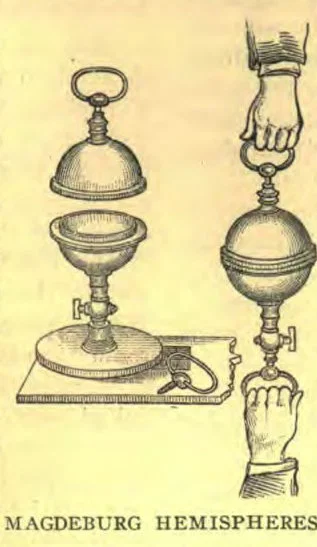
Otto Guericke made another interesting piece of apparatus that illustrated admirably the pressure of the air. This consisted of two large metal hemispheres that could be fitted tightly together. After putting them together and exhausting the air from them by means of the air-pump which he himself invented, eight strong horses, four at each end, were unable to pull them apart.
The air-brake used on trolley and steam cars is a very important invention, and depends upon compressed air for its utility. A powerful condenser worked by steam is attached to a locomotive. It is connected by pipes with a reservoir under each car, and fills these reservoirs with highly compressed air. When the engineer wishes to stop the train, he moves a lever, which allows the compressed air to rush into a cylinder, also under the car, and, by driving a piston along this cylinder, it presses the brake strongly against the wheels.
Winds are due to differences in the atmospheric pressure. Warm air is lighter than cold air; so wherever the earth for any cause becomes especially heated, the air over that place is thinner and lighter, so the cold air rushes in and lifts the warm air up and out. If the air everywhere was of equal temperature, there would be no winds. Cyclones are accompanied by a whirling, or rotation, of the wind around a heated area, or an area of low barometer, together with an onward movement of the storm over the country. The great weight, or pressure, of the air at such times is very apparent from the immense damage and curious freaks wrought by the cyclone. One storm that “started from the Barbados sunk an English fleet that anchored at St. Lucia, and then ravaged the entire island, blowing down houses and burying over six thousand persons in the ruins. Then, moving on to Martinique, it overtook a French transport fleet, sinking forty ships, with four hundred people, all of whom perished. Farther on to the north, the islands of San Domingo, St. Vincent, and St. Eustatius were devastated, and nearly all the vessels in the track of the cyclone were lost, with all on board.”
While winds at times prove very destructive to life and property, their work is usually of a beneficent character, purifying the air, equalizing temperatures, so modifying climate and distributing moisture.
To the air in its quiescent state we also owe much. It diffuses light, so that we can see all about us in the daytime. Were it not for the particles of the air reflecting and re-reflecting the light, we should need a lantern at noon even to find anything on the side of the house opposite the sun. The beautiful sunset colors are made possible by the air and the vapor it holds. So the northern lights, among the most impressive of atmospheric phenomena, are caused by discharges of electricity through the rarified air of the upper regions. Beauty and utility are wonderfully combined in the services our atmosphere renders us. Let us not forget that our Father's thought toward us when he said, “Let there be a firmament in the midst of the waters,” was a very generous one.
Liquid Air
It may be interesting, before leaving the study of the air in its natural or gaseous form, to study it in its liquid8state. Liquid air, according to one writer, is air so cold that it assumes the liquid form. The first ounce ever produced cost three thousand dollars, and the next pint, eighty dollars. With improved methods it may now be prepared for a few cents a gallon. A Mr. Trippler, of New York, has a private plant for liquefying air, and so economical are his methods that his prodigal use of the liquid is astonishing to all observers. He pours it out upon the floor by gallons, that visitors to his plant may see how rapidly it evaporates.
Mr. Trippler makes use of both pressure and cold in his plant. He subjects the air to a pressure of two thousand or two thousand five hundred pounds per square inch. The liquefied air occupies only about one eight hundredth of its former volume. It evaporates readily, drawing heat from whatever is in contact with it. Rubber, beefsteak, and eggs are made brittle like glass by being immersed in it, and will give forth a musical tone when struck. This is due to the intense cold, and not to any chemical action. Lead is made elastic, and mercury, the quicksilver of our thermometers, is frozen to a solid by it. Nails may be driven into wood by mercury hammers thus formed. If liquid air is poured into a glass of alcohol, the alcohol will quickly freeze solid. If a tin cup is immersed in liquid air, it becomes so brittle that when struck it breaks as does glass.
Owing to the rapid evaporation of liquid air, it will, in a few seconds, if confined in a tube closed with a wooden plug, drive out the plug with an explosive force and a loud report. Paper, or even the asbestos felt used in wrapping pipes, will, if saturated with it, burn brilliantly. The older the liquid air, the more brilliant the burning, since the nitrogen escapes more readily than does the oxygen, and leaves the residue richer in oxygen than the newly formed liquid.
Because of the concentrated oxygen in the liquefied air, steel pens, watch-springs, electric-light carbons, if heated to a red heat, burn rapidly when plunged beneath the liquid. The carbon dioxide gas formed by the combustion freezes at once, and drops to the bottom of the vessel as a white solid.
If a kettle of liquid air is placed on a cake of ice, the air boils vigorously, since the ice is very hot compared with the liquid air.
The suggested uses of liquefied air exceed its practical uses. While liquid air may have to wait long, as did electricity before coming fully into its own, it has already rendered service in purifying liquids by freezing them. For instance, as chloroform crystallizes, by subjection to great cold, into solid crystals, these can be removed and melted, and a pure product obtained. The cold of liquefied air in some instances may be used to produce chemical reactions, the same as heat. It has also served as an explosive in blasting, thirty tons of coal being loosened at times by one shot. It is also used as an energy producer, a refrigerant, a cauterizer in surgery, a smoke consumer, and for burning garbage in cities.
F. D. C.
MAGDEBURG HEMISPHERES
X-Ray Apparatus for Dentists
When making a diagnosis, dentists heretofore have depended only upon inspection and palpation, and the description furnished by the patient, which in many cases is grossly exaggerated. About the spread and nature of the ailment, the dentist could draw conclusions only from the symptoms, and to find out the real condition of the teeth and the jawbone was often exceedingly difficult and sometimes impossible.
A Berlin electric company has now placed on the market an X-ray apparatus especially constructed for dentists, with which the old difficulties are overcome, as it allows a most exacting diagnosis to be made. The apparatus is very simple, and can be handled by the dentist without any assistance. It is on wheels, so that it can be pulled to the operating chair, and the X-ray tube is attached to a long metal frame in such a manner that it will stay in any desired position. The apparatus is set in operation by pressing a foot lever, which allows the dentist to have both hands free properly to adjust the film.—Technical World Magazine.
Watch Screws and Jewels
PROBABLY the smallest screws are those turned out in a watch factory. They are cut from steel wire by a machine, but, as the chips fall from the knife, one is tempted to observe that the operator is amusing himself, inasmuch as no screws can be seen. Yet, at every third operation of the machine, a screw is duly completed.
The fourth jewel-wheel screw is next to invisible, and to the naked eye it resembles a speck of dust. With a glass, it may be seen to be a small screw, and some calculation reveals the fact that it has two hundred sixty threads to the inch. It takes a very powerful glass to observe these threads.
These screws are said to be but four thousandths of an inch in diameter, and the heads are double in size. It has been estimated that an ordinary thimble could contain one hundred thousand of them.
Quite a number of new jewel settings have been added to the movements of first-class watches during the last ten years. These new jewels have created an added demand for expert jewel setters.
The term jewel in a watch movement is to be taken literally. The small precious stones are drilled to receive the pinions or axles of the wheels, the object being to provide a bearing that will not corrode and will not wear away easily.
The garnet is the least valuable of these jewel settings, but some of the minute sapphires and rubies employed in the bearings of a watch are quite good enough for the setting of a ring.
For the most part, however, these fragments of precious stones are off color, the sapphire especially pale to insignificance, but at the same time harder and better for watch jewels because of this light color. Occasionally a ruby jewel burns red in one of the neat little envelopes in which they come from Switzerland, five hundred or one thousand in a lot.
Each stone is shaped to a circle and bored through9the center, each boring being just a little less than the diameter of the pinion used in the factory where it is finally to be placed in the upper or the lower plate of a watch.
The immediate setting for the watch jewel is a minute cylinder, brassy in appearance, but really of soft gold composition. Before the jewel gets to the setter, it has been put into a lathe, and by means of a minute steel point covered with diamond-dust and oil, the center has been enlarged to fit the steel pinion which shall be housed in it. In the hands of the setter the cylinder is put into a lathe. With a moistened finger the jewel is picked up and placed inside the cylinder as it rests on the tip of the revolving lathe shaft. With a pointed tool the setter presses against the revolving cylinder edge, forcing the soft metal to overlap and close upon the sapphire or ruby till it is embedded firmly in the metal cushion; then a pressure upon a follower at the other end of the lathe brings a cutter to bear upon the metal circumference, turning it to the exact size of the jewel hole in the plate of the watch, with the hole in the center of the jewel exactly in the center of the metal setting.—Harper's Weekly.
The Ability to Forget
A RETENTIVE memory may be a good thing, but the ability to forget is the true token of greatness.—The Philistine.
Faithfulness in Daily Duty as Preparation
“FAITHFULNESS and loyalty to the duties of every day is the best preparation for the faithfulness and loyalty required of the soldier.”
The Strength of Insects
ANTS will carry loads forty or fifty times as heavy as themselves. The beetle can move a weight one hundred twelve times his own weight. The house-fly gives six hundred strokes of its wings in one second, and this enables it to go a distance of thirty-five feet. The dragon-fly can speed through the air at the rate of sixty miles an hour, and, more wonderful still, can stop instantaneously in its flight, or move backward, or sidewise, without changing the position of its body.
Hundreds of bees can hang one to another without tearing away the feet of the upper one.
It has been estimated that if an elephant were as strong in proportion to its weight as a male beetle, it would be able to overturn a “sky-scraper.”
In leaping great distances, this strength is shown in another phase. If a horse could jump as far in proportion to its weight as a flea can to his, the horse would jump about two thousand miles.—Harper’s Weekly.
Volunteers to the Front
VOLUNTEERS are wanted! hear the stirring call.
O, be swift to answer, comrades, one and all;
Girding on your armor, haste to march away;
For the Lord is calling, “To the front to-day!”
Volunteers are wanted! valiant men and true.
In the ranks, my brother, there is room for you.
Christ is the Commander; let us all obey,
When he gives the order, “To the front to-day!”
Volunteers are wanted! for on land and sea
Satan’s starving bondmen clamor to be free;
Hasten to their rescue; if you still delay,
Blood-bought souls must perish. “To the front to-day!”
Volunteers are wanted! on the battle plain
Soldiers brave are falling, ne’er to fight again;
Who will take their places in the deadly fray?
Who will march with Jesus “to the front to-day”?
Volunteers are wanted! let the ranks be filled;
Soon the din of battle will in peace be stilled.
See! the clouds are lifting, soon they’ll clear away;
Glory gilds the heights along the front to-day.
CHORUS:
Away to the battle-field, away, away!
The King calls for soldiers in his ranks to-day;
Hear the bugle calling, into line be falling,
Forth to the battle-field, away, away!
—Pentecostal Hymn-book.
Devotion to the Bible
MATTHEW HALE SMITH, in his book “Marvels of Prayer,” tells of a shipwreck, and of the rescue by Captain Judkins and the crew of the “Scotia.” Among the rescued was a lad, about twelve years old, who had lost everything.
“Who are you, my boy?” said Captain Judkins.
“I am a Scotch boy; my father and mother are dead, and I am going to America to find my uncle, who lives in Illinois.”
“What is this?” said the captain, as he took hold of a rope that was tied around the boy’s breast.
“It is a piece of cord, sir.”
“What is that tied under your arm?”
“My mother’s Bible; she told me never to lose it.”
“Is that all you saved?”
“Yes, sir.”
“Couldn’t you have saved something else?”
“Not and save that.”
“Didn’t you expect to be lost?”
“I meant, if I went down, to take my mother’s Bible down with me.”
“All right,” said the captain, “I’ll take care of you.”
Having reached the port of New York, Captain Judkins took the boy to a Christian merchant, to whom he told this story. “I’ll take the lad,” said the merchant. “I want no other recommendation; the boy that holds on to his mother’s Bible in such perils will give a good account of himself.”—Selected.
The Salvation of Rover
By J. W. Foley
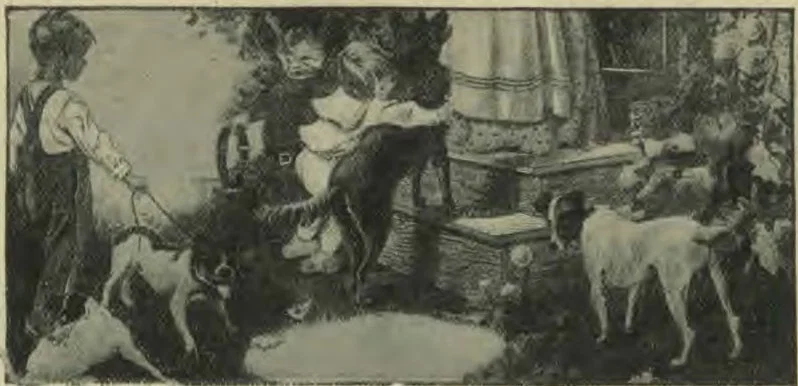
“THE SALVATION OF ROVER”
Ma said we had too many dogs—we never had but four,
And Tommy Brink let us have his, which only made one more.
We just had Rover, Spot and Tige and Fido of our own,
But Tommy Brink had gone away and left his dog alone,
Which almost broke its heart, and so we let it come and play
With all our dogs till after while it seemed to want to stay;
But ma said three dogs were enough for three small boys, and so
We'd have to pick out three to keep and let the other go.
We thought it over quite a while, and looked at them to find
Which one to give away, and couldn't quite make up our mind.
You see, they were such splendid dogs, and we all nearly cried
When we looked at them in the yard, while trying to decide.
Nobody knows how hard it was; they were such friends, you know,
And each one liked us so we couldn't bear to let him go.
But, after talking all forenoon, John told us, me and Jim,
To lead up Rover to the house—we'd have to part with him.
My, he was such a handsome dog, and had such big brown eyes,
That looked at us so friendly like, and O, so smart and wise!
But we all led him to the porch, and John called ma to come,
And tried to tell her how it was; but he was choked and dumb.
So then I told her Rover was the dog that jumped for Jim
One day when he fell in the creek, and was too small to swim,
And Rover pulled him to the bank; but he is old, and so
We told our mother he's the one we guessed we would let go.
And Rover wagged his tail at her, and barked as if to say
He'd just as soon jump in the creek for us most any day.
And we all waited, hoping she would change her mind; and then
She shook her finger right at me, and then said, “O you Ben!
You picked him out on purpose, sir!” And she pulled Rover's ears,
And petted him; and John he smiled; and we all gave three cheers,
Till mama said she guessed, perhaps, she really didn't know
As much about a dog as boys, and not to let him go.
—J. W. Foley, in Youth's Companion.
Some Customs of India
By Daisy Stanford
I ARRIVED in India in November, and the evenings were then beginning to be chilly. The first thing which amused me very much was to see the men looking around and picking up bits of stick and straw, and making a tiny fire, then sitting with their backs to it. So long as their backs were warm, they seemed to be perfectly happy, no matter whether their feet were cold or not.
The men do not take off their hats or turbans in the houses, but take off their shoes and leave them outside as they go into the houses.
They all wear sandals, and they slip into them and out of them and walk on and leave them just when they wish. The little Brahman girl's dress has a frill to the skirt, but it is always around the waist, and never at the bottom of the skirt.
The day I arrived was the day for marrying the plum and the sugar-cane. They have a ceremony for this, and after that ceremony the wedding season commences. In our part of India some of the low-caste widows marry, then they have music for three years; but if it is a little girl who has never been married before, they have what they call music for seven years,—and, O, don't we know it! Usually the music begins about eleven o'clock at night and goes on until about three o'clock in the morning, and the most we can hear are the drums and the tom-tom, tom-tom. They have something that looks a little like a bagpipe, only it is much worse. Then they have little stringed instruments that they play at the same time. It seems as if the more noise they can make, the more music they think they have.
Their manner of treating those who are ill is strange and cruel. In one place, the medicine used for a burn is a mixture of coal dust and goat manure, which is spread thickly over the burn.
I was passing through a village one day, and a baby was crying; it had pain, and the mother had no soothing sirups, or anything like that, or fomentations. I stopped to see what was being done. The mother had this little naked baby on her knee, and was holding its hands and feet. Every house has a little scythe which the cook holds between her feet and slices the vegetables over the blade. A neighbor woman got the scythe, put it into the fire, and made it red-hot; and then to get rid of the pain, this red-hot scythe was applied all the way around the child's abdomen so as to irritate the outside, I suppose, and draw away the irritation from the inside. I had often seen little fellows running around with many little scars around the abdomen, but I did not know what caused them.
I was standing on a platform before getting into the train, when I saw a big umbrella, made of striped material, with a curtain all around, right down to the ground, coming to the train. At the back was a man walking, I suppose it was the husband, and his hand was passed through the curtain, holding the stick of the umbrella. In front was another man walking, holding the two curtains together. There was a woman11on either side. They went up to the carriage, and the two low-caste women darted forward, pulled the curtain aside and close up to the side of the train, so no one could see who was getting out, and the woman inside walked into the carriage, the door was shut, and they carried the umbrella away. I was standing quite close to her, but I could not see her because this man was very careful not to let her be seen. And the carriage window was shut so that the woman inside could not see out, and no one could see in.
Not very long ago a purdah woman whom a Bible woman had gone to see, became very much interested, and asked to be taught because she so much wanted to know about Jesus. The teachers went; but one day she said: “You must not come here any more. I can not go on reading and hearing about Christ and not become a Christian. If I become a Christian, I can not possibly live here.” She was the fourth and a favorite wife of a Mohammedan. Later one went again, and she said, “I can not live here; I am a Christian; I do love Jesus for all he has done for me, and I must get away somehow.” We could not help her to get away; otherwise they would say we had kidnapped her, so we had to be very careful. At last, one night the missionaries heard a cough outside, and going out found there the Bible woman who was interested in this Mohammedan woman, and she said, “She has arrived.” This poor woman who had come away from home to live a Christian life was trembling from head to foot. It meant leaving husband, leaving parents; it meant leaving children. People say to us sometimes, “You don't seem to get many converts.” O, if you people at home knew and realized what it means to the people out there to become Christians! There were only about twenty minutes left to get her into the train to send her to the conference home.
I went into a zenana once, where was a woman in whom I was very much interested. Suddenly she came across to me, and the first thing she said was, “Have you a husband?” I said, “No.” She said, “Alas, alas, and when did he die?” I said, “I have never had one.” “Never had one?” She thought it was strange, and at last she said, “I know why it is; it is because you are a Christian, and you Christians can not marry.” I said, “Certainly we may.” Then she went on to tell me about her husband and son, and her jewels, and then asked where I was going. I told her I was going home to England for a little while, then to America, and then coming back to India. She looked at me, and an altogether different look came into her face. Just by my side in a little coop was a big, fat goose, and the poor thing could not move. She looked at that goose, then looked up at me and said, “Memsahib, I am just like the goose in that coop; I am in the zenana, and I can not get out; but you, because you are a Christian, are like a bird flying about in the sky; you can go out and see everything God has made.” She had never before seen a bit of nature. The difference in the life of the Christian woman and the life of the woman who knows nothing whatever about Christ, came to her at once.
I have often seen the people of India by the hundreds bathing in the filthiest of water to get rid of their sins. I saw one man sitting with his toes in the river Ganges, and with one hand holding a silver rosary, counting his beads; with the other hand he was holding his nose, and the more prayers he said with one breath, the more holy he was, and the greater his reward.—Daisy Stanford.
Salads: Pea, Lima Bean, Egg, and Vegetarian Chicken Recipes
Salads — No. 15
In our last lesson we were told how to make the dressings for salad. Several recipes for combining the various salad ingredients follow:—
PEA AND ONION SALAD.—Green peas, canned or stewed, one pint; onion, one; salt; mayonnaise.
Drain all liquid from the peas, and add to them the salt and finely minced onion. Allow to stand for an hour or two, and then mix in enough mayonnaise to make the salad of the right consistency. Serve a spoonful of this on a leaf of crisp, clean lettuce as an individual portion.
GREEN PEA AND NUTTOLENE SALAD.—Proceed as for pea and onion salad, adding one cup of finely diced nuttolene to the ingredients called for in that recipe. Minced celery may be added if desired.
LIMA BEAN SALAD.—The beans for this salad should be cold and not have been boiled long enough to make them mushy. Add grated onion or minced celery or both if desired, and enough mayonnaise or favorite salad dressing to make them of the desired consistency.
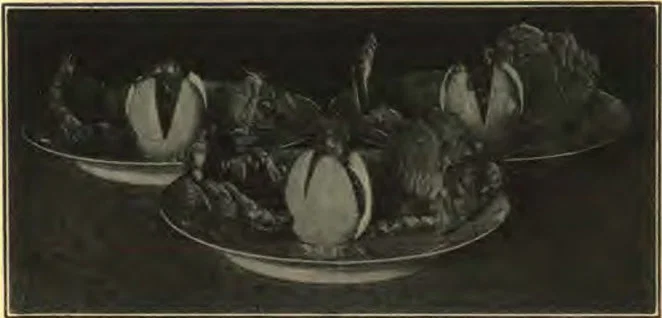
EGG SALAD.—Hard boil as many eggs as you have persons to serve. Upon removing the eggs from the boiling water, drop them at once into cold water, so that the shell will come off more readily. When the eggs are cold, cut them in quarters lengthwise, place them with their points together on a leaf of lettuce, and drop in the center a spoonful of the nut salad dressing, and serve.
VEGETARIAN CHICKEN SALAD.—Protose, one-half pound; nuttolene, one-fourth pound; celery, one cup; juice of two lemons; onion, one; salt. Mince the celery, onion, protose, and nuttolene, and mix together. Add the salt and lemon juice, and allow to stand for an hour or so, stirring occasionally to bring the lemon juice up from the bottom into the mixture. Then drain off any liquid that may remain, and add either mayonnaise or favorite salad dressing. Serve on leaves of lettuce, with a small spoonful of dressing on top of each portion.
TOMATO SALAD.—This salad is easily prepared. All that is necessary is to pare and slice chilled tomatoes and serve them on leaves of crisp lettuce dressed with nut salad dressing.
FRUIT SALAD.—This is the queen of all salads. Take equal proportions of sliced bananas, diced apples, oranges, and seeded cherries, and mix them with golden salad dressing. Other fruits, such as pineapples, currants, peaches, grapes, and fresh figs, may be used, if preferred.
EGG SALAD
Books Young People Should Read
“Miracles of Missions,” a Four-Volume Series, by Arthur T. Pierson
CLOSELY linked to the great commission, “Go, teach all nations,” is the promise of our Saviour, “And, lo, I am with you alway, even unto the end of the world.” It is said that history is the interpreter of Scripture, and truly the story of Christian missions is in itself a proof of the actual presence of our Commander-in-chief on the field of conflict. The13incidents given in these volumes are forceful demonstrations of this truth, yet they are only the gleanings from a world-wide harvest-field “gathered behind reapers who have, in more abundant sheaves, already given their testimony.” The sketches are brief, and for this reason will be of especial interest to those who can not command time or means to explore more bulky volumes. The variety of fields from which these stories of missionary heroism and reward are gathered, will serve to show how wide and also how varied is the Saviour’s working. “They mutually illustrate each other’s central lesson, that the Lord God of Elijah still lives, and that he who can use the mantle of faith, to smite the waters, will still find that they part before the more than magic charm of that all-powerful name, Jehovah, God!” Cloth, $1 per volume; paper, thirty-five cents. Order from Review and Herald Publishing Association.
Missionary Volunteer Reading Courses
Senior No. 4 — Lesson 13: “Story of John G. Paton,” Chapters 1-7
Test Questions
1. Of what parentage was John G. Paton?
2. Describe his early home, telling something of the religious atmosphere there.
3. What trade did Paton learn? Of what practical value was this knowledge to him?
4. Relate an incident showing his firmness of character.
5. What definite purpose did he have in life?
6. Why did he go to Glasgow? Tell something of his early struggles there.
7. Describe the home-leaving.
8. After he gave up teaching, into what work did the providence of God lead him? How marked was his success?
9. Do you see any indications of the future foreign missionary?
10. What helpful suggestions do you find in this lesson on methods used in city mission work?
Note
“After a considerable term of service as a city missionary, Paton was about to be removed to some other field, because of the apparent unfertility of his work. A few who had enjoyed his ministry determined that they would try what individual invitations could do to increase the number of his congregation. Astonishing were the results! The largest available place speedily became too small for the crowds that were brought together by this simple form of individual effort.”
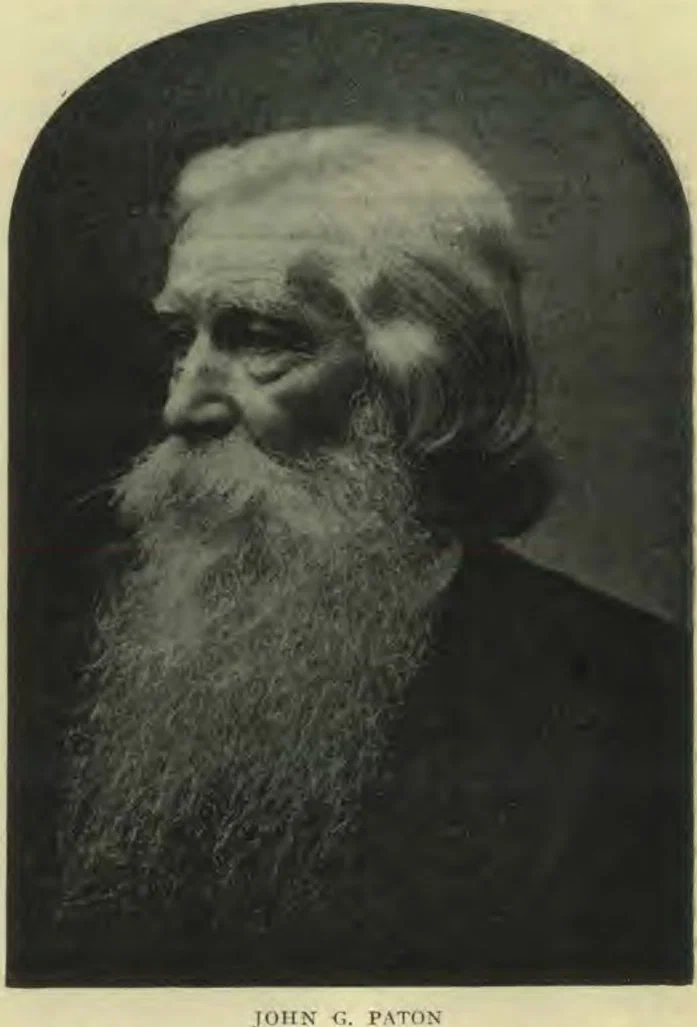
JOHN G. PATON
Junior No. 3 — Lesson 12: “How the World Is Clothed,” Pages 316-335
Test Questions
1. WHAT did some people use for pins during the Revolution? What did pins cost in 1812? Why?
2. When did England first make pins? When did this country? How many does the United States make every year?
3. How are pins headed, sharpened, polished, and put in paper?
4. What pins are still partly made by hand? How many glass-headed pins can a man head in a day?
5. Tell how a piece of wire is made into a needle.
6. Who invented the sewing-machine? What two kinds are now common?
7. In what different industries are sewing-machines essential?
8. What first created a demand for the large clothing factories?
9. How is the work divided among those employed in these factories?
10. Describe the cutting of garments.
11. What is meant by “sweating,” as applied to the making of clothing?
12. At what time of year are summer suits manufactured? winter suits?