The Youth’s Instructor, Vol. 47, No. 37.

THE KINGDOM OF JOHORE

The Youth’s Instructor

Sep 21, 1899

Review and Herald Publishing Company · Battle Creek, Mich. · Sep 21, 1899

THE KINGDOM OF JOHORE.
During the early months of 1893 the newspapers of the country were full of matter pertaining to the World's Fair; and among the interesting announcements was one to the effect that the sultan of Johore, an Oriental potentate of great wealth and power, would visit the Columbian Exposition. The American consul, who was responsible for this glowing announcement, left the impression upon the public mind that golden coin, and it might be even precious gems, would be sown broadcast by this royal spendthrift, who had more treasure than he knew what to do with, and who was coming to this country to furnish Yankees with a specimen of the Simon pure article in the line of Oriental sovereigns. The whole land was interested; and many were induced to visit the World's Fair in the hope of seeing this Malay sultan.
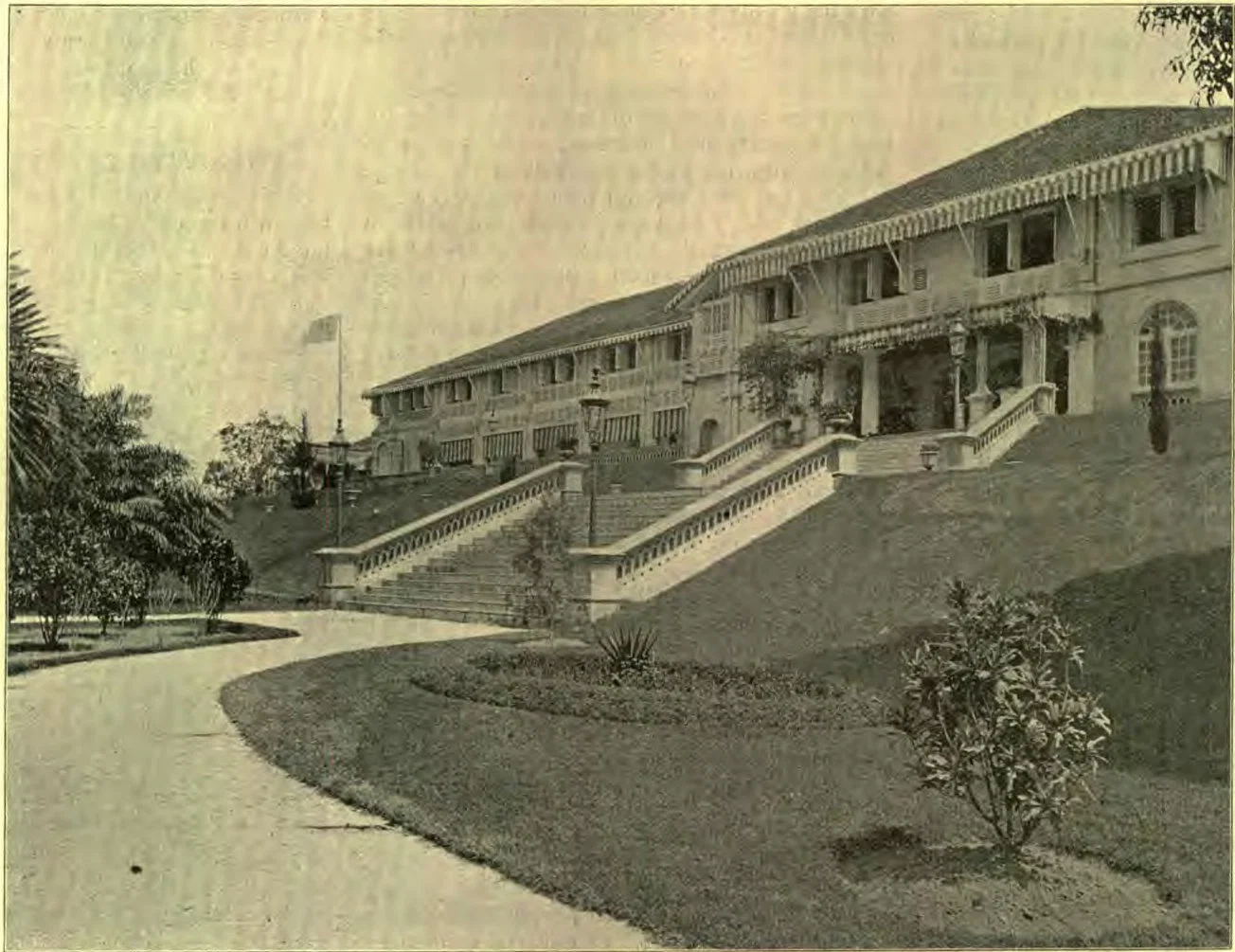
THE PALACE OF THE SULTAN OF JOHORE.
The sultan of Johore, Aboubaker, when he saw a report of these highly colored representations, was so incensed that he peremptorily canceled all instructions to his ministers of state for the preparations that had been carried on for this contemplated visit to America. The facts in the case are these: His territory includes about nine thousand square miles of the southern point of the Malay Peninsula. He is nominally independent, but pays tribute to the British crown. His kingdom is heavily mortgaged, and is very insignificant when compared with even so feeble a country as Siam.
The sultan himself died some years ago, and was succeeded by his son. Aboubaker was educated in a missionary school at Singapore, which was established by Sir Stamford Raffles, the founder of the colony. In those early days the Raffles Institution, as the school was called, was a mission school, and Aboubaker received a Christian education. His contact with Englishmen, together with the education he received, had the effect of broadening his character. He was intelligent, had a high appreciation of the advantages that exist in Western civilization, and as far as he was able, made use of them when he came to the throne. He constructed thoroughfares, built bridges, and in various ways sought to better the conditions of the state. He encouraged planters and gave concessions to miners; and, after the example of his European preceptors, he also licensed gambling, the sale of opium, etc. The entire population of his kingdom would not reach half a million, the most important part of which, from an economic point of view, were the Chinese; for from them he derived the greater part of his revenue.
The capital of the kingdom of Johore is situated on the southern shore of the peninsula, opposite the little Island of Singapore, which is separated from the mainland by a narrow strait, less than two miles wide. The capital, Johore Baru, consists of a few hundred Chinese and Malay houses besides the sultan's palace, the harem, the barracks for the state forces, and the government offices. In the picture we have a fine view of the palace, or a portion of it. The right wing does not appear, but can easily be supplied by the imagination. The palace is a two-story bungalow of royal dimensions. There is nothing kingly in its appearance, so far as its exterior is concerned, except its unusual size. Like all Oriental dwellings, a wide veranda extends around the entire building, both above and below. In this building the verandas are enclosed above by Venetian shutters and below by rattan screens. The body of the house is constructed of brick, plastered over with mortar, and is lime-washed. It receives a new coat of calcimine every year, and is thus kept new and attractive in appearance. A tropical luxuriance of vegetation assists the landscape-gardener in harmonizing the surroundings with the appearance of the building itself, and a beautiful and attractive picture is the result.
The interior of the palace is expensively furnished, and is more in keeping with the idea of a royal residence. Priceless rugs cover the floors, and beautiful furniture, tastefully arranged fills all the rooms. I had the pleasure of visiting the palace on several occasions, and found it a very elegant establishment indeed, considering the scanty dimensions and resources of the state. This very elegance partly accounts for the heavy mortgage held by the British government upon the property of the kingdom.
There lived in the town of Johore Baru an enterprising Scotchman, who was engaged in the sawmill and lumber business. At the time of my residence in Singapore, James Meldrum was a man of nearly threescore and ten. He was a trusted counselor of the sultan, and exerted a great influence over him, so much so, indeed, as to excite the jealousy of the ministers of state; but he continued to enjoy the confidence of Aboubaker to the day of his death. By his counsel and advice, many improvements were undertaken, one of the most important of which was the construction of a system of water-works, by which the town is supplied with wholesome drinking-water. The sultan's estimate of the old Scotchman was expressed in his conferring upon him the rank of dato, or prince.
Mr. Meldrum was an earnest Christian, and used his influence and wealth to a considerable extent in helping promote the work of the missions in the state. He kept open house for all missionaries and Christian workers; and no more delightful or quiet retreat could be found than his spacious bungalow, standing on the crest of a cliff that commands a view of the straits for miles in both directions. It was always cool, and an abundance of excellent reading-matter furnished the toiler with the best possible means of rest and quiet recreation. I can never forget the delightful hours spent in this truly Christian nobleman's hospitable home.
The sultan of Johore was abreast of the times in more respects than in having a sumptuous palace. He commanded a small fleet of tiny warships, which were a trifle too large to be called steam launches, and a trifle too small to be dignified with the name of gunboats. They were of modern pattern and construction, and chiefly designed as a means of recreation for his royal highness. He drove fine horses, played billiards well, and enjoyed a hearty repast; but, whatever virtues he lacked, he possessed one that would do credit to a vast number of Americans who consider themselves better men than this petty rajah,—he was a stanch total abstainer, as is every good Mohammedan. While visiting the courts of Europe, he was often rallied on his abstemious habits by different members of the various royal households where he was entertained; but he had sense enough not only to refuse intoxicating beverages, but also to inculcate some homely precepts on the rich rewards of a strictly temperate life. In fact, he regarded himself as superior in character to most of the men that he met, who were not above indulgence to the extent of intoxication. Another of the sultan's favorite pastimes was the bicycle; not that he rode it himself, but he had others ride it in ways that contributed to his amusement. He would organize holiday sports, and offer tempting prizes to the men who could make the fastest or the slowest time, or who could perform strange or novel feats.
The sultan encouraged missionary work among the Chinese; but while he may have been inclined to extend the same privilege to missionaries to the Malays, popular sentiment, together with the influence of the priesthood, rendered such a course impossible. The only missions in the state are those conducted by the English Presbyterian Missionary Society and the Plymouth Baptist body. Thus far the accessions to Christianity from among the Chinese have reached only one or two hundred, but no doubt larger results will be seen in the future. The work is thoroughly and conscientiously conducted, and its good effects are seen in the restraint that it puts upon crime.
The present sultan is on the best of terms with the British government, and spends much of his time in a palace built by his father in the town of Singapore. This is really the residence of the sultan; for but a small part of his time is spent within the boundary of his own state. It was with the old sultan of Johore that Sir Stamford Raffles in 1819 signed a compact securing to the British the Island of Singapore, whereon is now situated the capital of the Straits Settlements.
If any of our readers should ever visit these Eastern lands, and find themselves in Singapore, it will well repay them to engage a carriage or jinrikisha, and enjoy the delightful fifteen-mile ride across the island to visit this little kingdom, which forms the southernmost point of the continent of Asia. R. W. Munson.

AN ALL-POWERFUL SAVIOUR.

I.

CHRIST took upon him the form of sinful man, clothing his divinity with humanity. But he was holy, even as God is holy. He was the sin-bearer, needing no atonement. Had he not been without spot or stain of sin, he could not have been the Saviour of mankind. One with God in purity and holiness, he was able to make a propitiation for the sins of the world.
Christ has declared our position. “He that followeth me,” he says, “shall not walk in darkness, but shall have the light of life.” He is the light of the world. Through him light shines amid moral darkness. He is the bright and morning star. He is the Sun of Righteousness, the brightness of the Father’s glory. He is “the true Light, which lighteth every man that cometh into the world.”
A physician, a healer, Christ came to restore the moral image of God. This is the covenant, the pledge, that if we come to him, renouncing our own ways and works, we shall receive the imputed righteousness of Christ. As man works out his own salvation, God works with him, to will and to do of his good pleasure. Those in whose hearts he abides are made all light in the Lord. The presence of the Saviour is apparent. Good and pleasant words reveal the Holy Spirit’s influence. Sweetness of temper is manifested. There is no angry passion, no obstinacy, no evil-surmising. There is no hatred in the heart.
Faith is genuine only when it works by love and purifies the soul. Self must be crucified, else sin will remain to defile the whole being. The Cain-spirit must not be allowed to enter the heart; for the hatred it brings is next of kin to murder. Man can not enjoy divine blessings unless he shows love to God and to his neighbor. He has lost God’s favor by sin, and can not be saved unless Christ takes away his sin. The moral image of God can not be restored in him while he cherishes his own image; for this means defilement. He must work diligently for the right, if he desires to see the restoration of the divine image.
Christ is a complete Saviour. It was a perfect sacrifice that he offered on Calvary’s cross, that man might have a full and complete sanctification. Wonderful is the provision that he has made, yet many who claim to believe have only a nominal faith. Their profession does not convert them. They have not surrendered all to Christ. They have not opened the door of the heart to welcome him as a heavenly guest. They love themselves and their own ways, failing to realize that their ways, their words, and their characters are opposed to God. Such can never reach perfection unless they see themselves as they are. If the natural disposition is not changed, if it remains as it was before Christ spoke to them, they are lukewarm, neither cold nor hot. Christ says to them, “Because thou art lukewarm, and neither cold nor hot, I will spew thee out of my mouth.” I can not plead in your behalf; for you have no desire for my glory.
Many professed Christians have never seen the Way, the Truth, and the Life. This is why there is so little genuine sanctification. One safeguard after another is removed from the sanctuary of the conscience. The failure to overcome leaves the soul unguarded. Evil habits, unresisted, strengthen into chains of steel, binding the whole man.
Slipshod religion is a dangerous thing, in the home or in the church; and to educate the mind to look for defects in others unfits the soul for communion with God. This is the leaven of evil. The very act of looking for evil in others develops defects in those who look. These would be alarmed could they see the facts that are registered against them in the books of heaven. The man with the beam in his own eye thinks he has discovered a mote in his brother’s eye. But the very discovery of the mote is the sign of the beam. Christ says to us: “Judge not, that ye be not judged. For with what judgment ye judge, ye shall be judged: and with what measure ye mete, it shall be measured to you again. And why beholdest thou the mote that is in thy brother’s eye, but considerest not the beam that is in thine own eye? Or how wilt thou say to thy brother, Let me pull out the mote out of thine eye, and, behold, a beam is in thine own eye? Thou hypocrite, first cast out the beam out of thine own eye, and then shalt thou see clearly to cast out the mote out of thy brother’s eye.”
MRS. E. G. WHITE.

Little Things Make Character, Great Things Test It

“THE little things of life make character, and the great things of life test it.”

THE FAITH OF A LITTLE CHILD.

EVERY one smiled when his father carried him into the car—this little lad of three, who taught me so sweet a lesson in faith. The car was crowded; but there was a corner between door and window where the child could stand, and there his father put him down.
“You stay still there, Herbie; papa is going to stand near you. You won’t be afraid?”
The wee man shook his head very decidedly, and catching hold of a brass rail with his chubby fist, stood contentedly watching his father with trustful, happy eyes. At every corner new passengers came on, and crowded between father and child. Herbie was much more comfortable in the sheltered nook where his father had put him than he would have been even in his father’s arms on the crowded, jolting platform. Little by little, the newcomers hid the father from Herbie’s sight. He did not look like a child who was accustomed to being alone, and I watched him closely, ready to comfort if need be. I saw his lips moving, and bent toward him. This was what he said: “I can see my papa’s foot, and I can see my papa’s hand.”
Precious little heart, comforting itself!
The crowd jostled back and forth. I heard another whisper: “I can see my papa’s foot. I—can—see—my—papa’s—foot!”
Then the foot was no longer visible to the patient watcher. Trouble clouded his serious eyes for a minute, followed by a happy smile
“I can hear my papa talk!”
Sure enough, the father was talking to some one. But the conversation was not long. The blue eyes were growing shadowy again.
“Herbie,” I whispered, “I can see your papa. I am taller than you. I can see your papa’s face, dear.”
For a brief space my face was subjected to a searching glance. Then the content came back to the boy’s face. He watched me, and I watched that other face, nodding assurance to my little friend. In a few moments the passengers began to leave the car, and the father sat down, and took his child on his knee.
“Were you afraid, Herbie?”
“No; I knew you were there all the whole time!”
Oh, for the faith of a little child, that whatever comes, the heart may say, “I was not afraid; for I knew that, all the time, Thou wert there!”—Selected.

MINISTRY

The memory of a kindly word, Long, long gone by; The fragrance of a fading flower, Sent lovingly; The gleaming of a sudden smile, Or sudden tear; The warmer pressure of the hand, The tone of cheer; The hush that means, “I can not speak, But I have heard;” The note that only bears a verse From God’s own word,— Such tiny things we hardly count As ministry, The givers deeming they have shown Scant sympathy; But when the heart is overwrought, Oh, who can tell, The power of such tiny things To make it well? — Christian Herald.

BELLS

BELLS are of ancient origin, having been used on the holy garments of the Israelitish priest when he entered the sanctuary of the Lord. They are still used in some of the religious services of the Catholic Church.
It has long been a custom among the Catholics to consecrate and name a bell before using it, those who have presented it to the church, or who have contributed most liberally toward buying it, generally acting as its sponsors. The first bell to receive a name was the one hung in the Lateran Church in 968 A. D., by Pope John XIII, who named it after himself.
The bell is more intimately associated with the feelings and emotions of mankind than any other instrument.
A fanciful old writer aptly describes its threefold use in the following manner:—
“To call the fold to church in time, we chime; When joy and mirth are on the wing, we ring; When we lament a departed soul, we toll.”
The reason bells are tolled at burials is that it was once customary to ring a “passing” bell while a person was dying, in order that all who heard might pray for his soul, which, it was thought, was leaving this world, and needed a safe-conduct into the other country.
A beautiful custom is the ringing of the curfew. The word sounds rather poetical to our ears, perhaps from having seen it in connection with some romance; but it means simply “cover the fire;” and was used formerly to tell the people to go to bed. Nowadays the curfew is rung in many cities and towns as a signal that children under a certain age must return to their homes.
The bell has been used from time immemorial to call persons together for a special work or purpose. The feasts of Osiris, a god of ancient Egypt, were announced by the ringing of bells; the Romans rang bells when it was time to bathe; and the Christian worshipers rang them at the hour of prayer. Thousands and thousands of weary men and boys at work in the field welcome the sound of the dinner-bell; and troops of children follow with willing feet the call of the school-bell.
Bells are often arranged in chimes, and placed in church towers as musical instruments. A traveling company, which went through the country several years ago, carried, and used in a single performance, no fewer than one hundred and fifty bells. These varied in size from those two or three feet in circumference down to the tiniest dinner-bell.
Moscow is famous for its great number of bells. It is said to have contained at one time nearly two thousand. One of these bells alone weighs more than fifty-seven tons; and as it suffered an accident which precluded its suspension, it is made to serve as a chapel. The room is twenty-two feet in diameter, and over twenty-one feet in height.
The bell that is most interesting to us, however, is dear old Independence bell. It was cast in England, in 1752, but was broken in a trial examination before its suspension, and was recast in Philadelphia. It now rests in the Hall of Independence, Philadelphia, with a great fissure in its side.
Bells are made of different metals,— brass, steel, silver, zinc, etc.,— but the best are said to be composed of copper and tin, combined with an admixture of silver. There are bell-foundries in Troy, New York, Philadelphia, Boston, and several other places in our own country, to say nothing of those in other lands.
MRS. A. G. BODWELL.

THE OLDEST OBELISK.

The oldest of all the obelisks is the beautiful one of rosy granite that stands alone among the green fields on the banks of the Nile, not far from Cairo. It is the gravestone of a great, ancient city, which has vanished, and left only this relic behind. That city was the Bethshemesh of the Scriptures, the famous On, which is memorable to all Bible readers as the residence of the priest of Potipherah, whose daughter, Asenath, Joseph married. The Greeks called it Heliopolis, the city of the sun, because there the worship of the sun had its chief center and its most sacred shrines. It was the seat of the most ancient university in the world, to which youthful students came from all parts of the world to learn the occult wisdom which the priests of On alone could teach. Thales, Solon, Eudoxus, Pythagoras, and Plato all studied there, perhaps Moses too. It was also the birthplace of the sacred literature of Egypt, where were written on papyrus leaves the original chapters of the oldest book in the world, generally known as the “Book of the Dead;” a whole copy or fragment of which every Egyptian, rich or poor, wished to have buried with him in his coffin, and portions of which are found inscribed on every mummy-case, and on the walls of every tomb and monument.
In front of one of the principal temples of the sun, in this magnificent city, stood, along with a companion, long since destroyed, the solitary obelisk that we now behold on the spot. It alone, as I have said, has survived the wreck of all the glory of the place, as if to assure us that what is given to God, however ignorantly and superstitiously, endures, while all the other works of man perish. It was constructed by Usirtesen I, who is supposed to have reigned two thousand eight hundred years before Christ, and has outlasted all the dynastic changes of the land, and still stands where it originally stood nearly forty-seven centuries ago. What appears of its shaft above ground is sixty-eight feet in height, but its base is buried in the mud of the Nile; and year after year the inundation of the river deposits its film of soil around its foot, and buries it still deeper.—Christian Union.

English Language Word Count Compared With Other Tongues

“THERE are 250,000 words in the English language — 70,000 more than in the French, German, and Spanish languages combined.”

HOW JOHNNY BURNED HIMSELF.

Johnny saw the pretty, soft steam puffing out of the kettle. His mother said: “Johnny, take care, or you’ll burn your fingers, dear!”
“Thteam can’t burn!” cried wise Johnny. “Only fire burnth.”
“You must not try it. It will burn you.”
“Oh, dear,” cried Johnny, “why can’t I have my own way thometimeth? When I’m a big man, I mean to thtand and poke my finger in the teakettle all day, thometime, and have my own way, and—”
Poor Johnny did not wait until he was a big man. A scream of pain told that he had had his own way already. The little white fingers were sadly burned, and Johnny screamed and jumped so that his mother could hardly hold him.
Take care, young folks, how you take your own way. There are worse foes in the world than Johnny’s steam.—Selected.

THE SHOWER.

How the rain came down In the dusty town! The sick and suffering, rich and poor, In the drizzly dawn Of the summer morn, Glad greetings called from door to door.
How the torrent poured! Every stone and board, Every roof and wall, was sweet and clean! Every thirsty blade Upreared its head, And glowed with a fresh and lively green.
How the birds rejoiced, And their gladness voiced Till the wildwood rang with the shrill refrain; And the colt and calf Both tried to laugh, With the goose and the duck, at the falling rain.
How the mother mild And the father smiled At the shower that would make the corn and hay; But a boy there was— He sulked, because The rain interfered with his outdoor play!!
MRS. ELIZABETH L. ROSSER.
“HOW THE RAIN CAME DOWN!”

Chapter XIV.

“I SEE; yes, I understand,” said Officer Mc Farlan. “And you haven’t given me your confidence for nothing,” he added. “It shall be made just as easy for you and her as possible, even if I lose my uniform. You will need to get a good sight at her, though, to be sure that she is the right one. She needn’t see you. I will fix that.”
“Tell you what!” cried Seth, as a new thought struck him. “Where’s the telegraph office? I’ll send for Will. He’s the kind to come into this about now. He can get here by noon, and just happen on her track somewhere, you know,—but anyhow, just so ’t she gets into Will’s hands, it’ll be all right. If there is any money wanted, Officer, to get this all straight, here ’tis.”
“Not for me,” and the policeman put his hands behind him.
“No, no! I don’t mean that; I’m not quite a fool, if I am from the country. But she may need some—somebody may for her, you know, and here ’tis. I’d know better’n that, old fellow. But my, what a godsend you have been to me—how you’ve taken the sting out of the lash! Maybe I never would have found her but for you. I’ll never forget it, never!”
They walked on, Seth’s face showing a little less ghastly, although he might yet have passed for a frightened culprit being taken in tow by the emissary of the law, only that in this case the face of the emissary did not wear its judicial mask, and his hands had a way of getting to Seth’s shoulder that was scarcely official.
The telegram was sent, and the two hastened on to the police station. Seth was given a position in the crowded court-room, favorable for an unobserved view, where he sat, growing more white and limp every moment, while the officer went to look after his prisoner.
At the Goss’s, affairs were in sorry shape. Mrs. Goss, never vigorous, always doing her daily work “on her nerve,” had no “grit” left, with which to meet the awful lonesomeness of the house, and the nameless fears concerning Shirley.
The post-office had been diligently watched by Aunt Nell, but nothing had come to relieve the tense strain of anxiety. Seth had sent his address, but nothing more had come from him; and at last the poor mother, who had sat every mail-time bolstered up in a chair by the window, watching for the letter that did not come, sank to the floor “all in a heap,” and was taken up as one dead. A man and horse were snatched from the field, and despatched for the doctor; and during the long, breathless time that followed, Benjamin Goss seemed gradually to come to his senses.
Aunt Nell had not been going home at all any more. She had left her children with Mrs. Adams; one of the “hands” went over at night to do the chores and sleep in the house; and she took care of things for Benjamin, and nursed her sister. This willing helpfulness on her part, added to the peculiar influence that she had always exerted over the strong-willed man, gave her at this time new power, which she was not slow to use in her own quiet, wise way.
“What are we going to do, Nell?” Benjamin Goss gasped, looking helplessly at her as they worked together over the cold, rigid body of his wife.
“I’m doing all I can now, and intend to keep on,” was the reply. Goss did not say anything for a while, and then he said, “Well, what do you think I can do?”
“For what? whom? when?”
“Nell, you know perfectly well what I mean. Of course it’s all on Shirley’s account that we are in such a fix.”
“Oh, Shirley?—Well, yes, I think she has something to do with it, although she is not responsible for it all, by any means. Let’s see,—it’s nearly a week since she made the plunge. Almost anything could happen in a week. Your work has been going on pretty well, though, hasn’t it?”
“Nell, you are enough to drive a man wild. What makes you say such dreadful things?”
“Because I am talking about dreadful things. I never was mixed up in anything more dreadful. A young girl, pretty, dainty, ignorant as a child, with almost no money, and not one acquaintance there that we know of, starts into a great, wicked city, when it’s as much as a good, strong man can do to withstand its snares and bewilderments. Her father will not run after her, not he! She may learn her own lesson, and find her way back when she gets ready, in the best shape morally and physically that she can. Her mother breaks her heart over the child’s absence, exposure, and the father’s stern coldness, and lies at the verge of death—can one make a pleasant story over a situation like that?”
“Nell, you—you—what do you mean?”
“I think you understand me. Sometimes a man had better sacrifice his own way: he has to, many times, if he would get the result he desires from a seed or field. I remember that you had to give up and try again before you got your potato as you wanted it.”
“Well, then, what would you have me do in this case?”
“I?—Oh, nothing. If you don’t see what to do, I can’t show it to you. If the God in whom you profess to believe does not show you, how can I? If you will not listen when he speaks, you will not listen to me. Shirley may just as well go to ruin now, without prolonging the agony, as to struggle on with her father’s way any longer, and come to grief at last. If you can’t put yourself in her place, and make up your mind to do what you would have had to have done to give you a fair chance; if you can’t remember that bit of your own history that has been told so often,—how your father found out that you were not a baby to be strapped any longer, and decided to give you elbow-room,—and if you are not man enough to treat your daughter as fairly at least as you would if she were your son, then the case is hopeless. Sister had better die right here, and Shirley go on to the bitter end.”
Aunt Nell’s voice was breaking into a sob, when the door opened, and the doctor came in with Will. She gave a little cry, and threw herself, sob and all, into her husband’s arms.
“Tut, tut,” said Will, hugging her close, and kissing her heartily. “Save that until we can afford it; no time to cry when everything is down at the heel. Chirk up; it’ll all come out right. Never cry unless you’re so happy you can’t help it.”
“May be that is it, now that you’ve come,” she said, turning again to the bedside.
The old family doctor heard the story, examined the patient, and gave the verdict.
“Shirley must be brought home at once, or her mother will die. No two ways about that. She has no vitality to stand a strain like this. Queer, what creatures women are! A man can go through anything heart-whole, but a wisp of a girl or boy can break a woman’s heart as easy. Sometimes a man can do it, if he is bull-headed enough,—has a ‘way’ of his own, and sticks to it, you know.”
Poor Benjamin Goss felt that he was getting more than his share; so he left the room, and went to the barn.
He sat down in the midst of the hay, and thought it all over. He was not a bad man, his heart was tender when you got down to it. His was simply a strong, independent, masterful nature, which carried things along in its own way by sheer force. He loved his wife and daughter deeply. It was this very love that had made him so hard for them to endure. It was a love that would insist on carrying them when they wished to walk; in which he could see only sacrifice on his own part, and unappreciated blessings on theirs.
Benjamin Goss was not a bad man. He had thought he was a Christian once, in his youth; for he had been brought up in the love of the truth. When he had married, and settled down on this large farm that his wife had brought to him, he had even kept the Sabbath until he found it difficult to avoid transacting business with men who could see no reason for being put off if the Sabbath chanced to be the most convenient day for them; and hence from slight concessions, rather than to make people trouble and provoke discussion, he gradually came to be known as the one man in the community to whom all days were alike.
This was not true, however. The Sabbath was still to him the one day of the Lord; and the sting of its conscious violation had been one cause of the growing hardness of his nature and the irritability of his temper. His heart was naturally tender,—so tender that he did not dare allow it an opportunity to speak unless he intended to obey its impulses, so he usually kept the heel of his iron will upon it, and no one ever suspected the possibilities of affection that were hidden away in his heart.
As he sat on the hay-mow that afternoon, his heart came to the surface for a little while; and he was almost on the point of conceding the fact that he had made a miserable mistake, had sinned. He was almost ready to fall upon his knees, and confess to God. He saw himself even confessing to his wife and Shirley; and perhaps he would have done it but for the appearance of the telegraph messenger from the station, who came whirling up on his wheel.
It was not a new thing for the telegraph boy to wheel up to the Goss farm, but his coming had never before created quite such a feeling of dread and expectancy. Mr. Goss from the barn, and Will from the house, met him at the gate. The despatch was for Mrs. Nellie Burns, however, and when opened, read:— “Wire Will to come. Everything looking up. Expect us all soon. Seth.”
“O my darling!” sobbed Aunt Nell. “I was so afraid we would never hear from her again. And just to think—” then hastening into the room where Mrs. Goss lay, she said, joyfully, “Sister, Shirley is found, and is coming home! Do you hear? Now you are as good as well, aren’t you?”
“Thank God!” was the feeble response.
“Yes, indeed. It was God and our good Seth. We have reason to be thankful to both. And Will is going right away to catch the next train. Aren’t you, Will?”
“Sure! Mother,”—he always called Mrs. Goss mother,—“you must get your strength back quick; for I’m going to canvass you for my new book when I get back. I can’t come home, and go to the city to boot, for nothing; and you’ll have to get courage to subscribe for that book, and make Ben pay for it.”
“What do you mean by such talk as that, Will?” asked Mr. Goss, angrily. “Did I ever leave my wife to ask me for any new book that she needed? You can put me down for a dozen right now, if they are such as we have use for; and you know it. Seems to me you are all rather overstepping, or stepping on, a man in his own house to-day, with a vengeance. And as for your going to the city at the call of Seth Adams, to bring my daughter home, I think you might be in better business.”
“Will you go?” asked Will, gently.
“Not a step. She knows the way back, and is perfectly capable of coming, without anybody. She took herself away, and she can come back when she gets ready; and I have the satisfaction of knowing that she will not come for you or Seth Adams until she does get ready,” and he smiled grimly, and turned away with a hardness and bitterness in his heart such as he had never known before.
Aunt Nell was at first alarmed at the prospect of an altercation, in the weak condition of her sister; but the glad tidings that Shirley was found and coming home had so filled the brain and heart of the mother that she had neither thought nor feeling for anything so trivial and common as angry words from her husband.
MRS. S. M. I. HENRY.
(To be continued.)

The Christ-Spirit Brings Regard for Others' Rights

“A HIGH sense of the rights of others, with a charitable regard for their claims upon us, is one fruit of the Christ-spirit in our heart.”
Continue reading: WATCHING THE PRIMROSES BLOOM