LITTLE GERTRUDE had seen many flowers all her life in the city; but until she went to visit her grandmother in the country, she had never seen an old-fashioned garden.
As she was very careful not to step on the flower beds, or pick the flowers without permission, grandmother let her play and walk in the garden just as much as she wished; and little Gertrude was very happy, and stayed with the pretty flowers each day.
“I wish, grandmother,” she said, one day, “I could see some flowers bloom. Somehow they are always just buds, or else all bloomed out. I have watched them lots of times, but I never saw them really blooming. Did you ever see a flower come right out?”
“Yes, dear,” said grandmother, “many times, and you can, too. The evening primroses are just ready to blossom, and I am sure we can see some really bursting into bloom to-night.”
So that night, toward seven o’clock, when it was still light, but the sun had set, Gertrude went with her grandmother to the garden. They went to the bed where the giant evening primroses grew. The plants were almost as tall as Gertrude, and were covered with tall, pointed buds, each shut up closely in a reddish cover. This cover is called the calyx.
Here and there a little point of yellow was sticking out of the top of a calyx. “Watch these very closely,” said grandmother. Suddenly a tall plant gave a little shiver. “Look sharp!” cried grandmother; and the first thing Gertrude knew, to her great surprise a calyx split open, and a yellow flower began to untwist; then with a quick movement the pointed parts of the calyx fell backward, and the flower spread out into full bloom, being a lovely lemon yellow, and larger than a silver dollar.
All over the bed the flowers were coming out. “There’s another! There’s another!” cried Gertrude, in great excitement.
It was not long before seventy flowers were in bloom on the primrose plants. Gertrude, with grandmother’s help, counted them.
“There, that is all for to-night; there are no more large buds,” said grandmother, “and it is time for little girls to go to bed.”
“They are almost too pretty to leave,” said Gertrude, gazing at the tall, flower-filled plants, and sniffing their delicate perfume. “Will they stay in bloom all night?”
“Yes, and they will keep in bloom a little while to-morrow morning; but as soon as the sun gets hot, they will all droop and soon fall off, but to-morrow night just as many more will be ready to blossom.”
After this for many evenings Gertrude went to watch the blooming of the primroses. One night when grandmother thought it too damp to stay out, she brought some of the buds into the house, and placed them in water; and she and Gertrude watched them bloom there.—
Selected.
At Grandma's.
By A. B. C.
Out in the country at grandma's!
Beautiful, care-free days!
Romping from daylight till sunset,
Trying a dozen new plays!
Running wild races with Rover,
Hide-and-go-seek in the barn,
Bringing the cows from the pasture,—
Oh, it is fun on the farm!
Up in the gray light of morning,
Dancing feet never at rest;
Hunting for eggs in the hay-loft,
Finding a hen's stolen nest;
Feeding the frolicking lambkins,
All the pet calves in the lane,—
Many bright days may come after;
None bring our childhood again.
In the cool edge of the evening,
Wading with bare, brown feet,
Down where a gay little brooklet
Gurgles its clear waters sweet;
Then, when the glow of the sunset
Fades from the bright shining west,
Low sound the songs of the twilight,
Lulling the children to rest.
A. B. C.
THE DAY OF SMALL THINGS.
By W. S. Sadler
THE boy or girl who neglects small opportunities will probably never be entrusted with the responsibility of great things; for to those who despise the day of small things, the day of great opportunities never dawns. Cultured and refined characters are made so by attention to the small courtesies and duties of every-day life. The seemingly unimportant acts of every-day life will determine habit, and habit molds the character. It is the daily living out of truth that makes its principles a part of us, and contributes to the development of a symmetrical character.
The smallest act, the passing thought, every word,—all have their influence in the formation of character. The boy or girl who is unfaithful in his household duties would be unfaithful in the greater things if they were entrusted to him. Some persons do not consider faithfulness in these so-called little things essential to the service of God. They long to do or be something great, and are led to neglect the every-day duties of the present, in their imaginary plans for doing some great thing in the future.
God does not require us to be successful; he merely asks us to be faithful. If we are faithful, we may be sure that he will be successful. In the grand final review, when all the world shall stand before the Judge, he will say, to the unfaithful stewards,—those who have passed by the small things, in their effort to do some great thing,—“I never knew you.” But, they urge, have we not done many wonderful things in your name? Have we not prophesied and cast out devils in your name? Then shall he declare, “I know not whence ye are; depart from me, all ye workers of iniquity.” Those who are bidden to enter into the joy of their Lord are those who have been faithful in such small things as giving a cup of cold water to the traveler, visiting the prisoner in prison, comforting the sorrowful, and giving a morsel of food to the hungry.
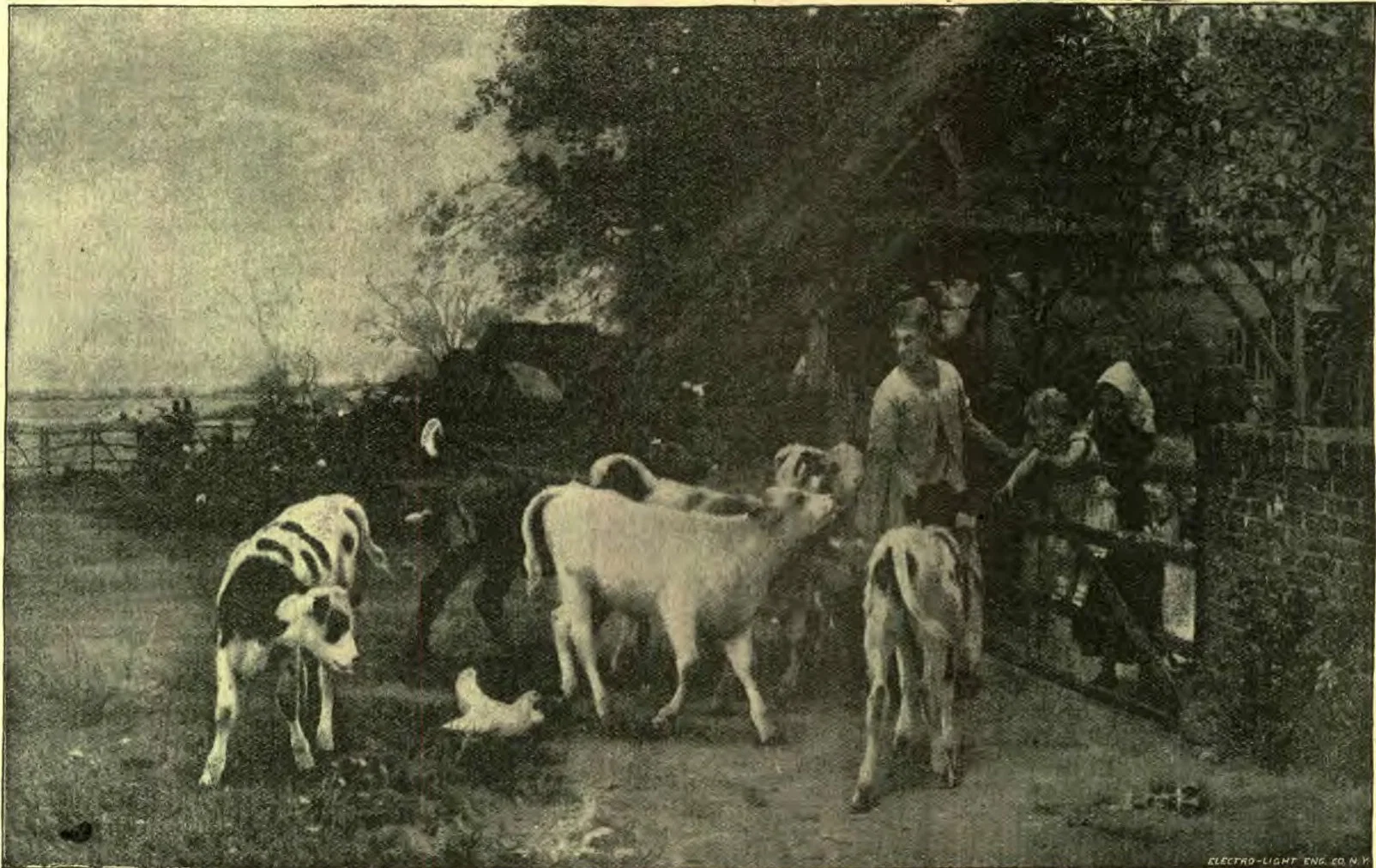
“ALL THE PET CALVES IN THE LANE.”
In faithfully performing the work of to-day we shall gain both the experience and the education that will qualify us to do the greater work of to-morrow. Despise not the day of small things.
W. S. SADLER.
Courtesy as a Christian Grace
“COURTESY is a Christian grace. The very best manners are not too good for a Christian to use every day. We do our Master no credit when, under a false plea of ‘sincerity,’ we are brusk or uncouth.”
From Clam-Shell to Button.
By Mary E. Wheaton
During the last three or four years, quite an industry in clam-digging has sprung up along the banks of the Mississippi. As many as fifty button factories are situated in various places on the Mississippi, from Clinton, Iowa, to points north of Quincy, Ill. At intervals, on either shore, may be seen the tents and other paraphernalia of the clammer, or sheller, as he prefers being called. Many of the workers come from inland towns, and camp out on the water’s edge during the summer months. Perhaps one hundred persons will be living thus in one camp, to the village proper this settlement being known as Clamtown.
The first work of the sheller is to secure a fairly wide flat-bottomed boat. Two or three bars, usually iron, are then fitted out with hooks. The latter are attached to the bars by means of short ropes. As many as one hundred hooks, each with several prongs, are often suspended from one bar, the latter being about ten feet in length. These bars are placed upon upright sticks, which are fastened to the boat, and made with a fork in the upright end, into which the bar fits. One man, often more, rows the boat out into the clam-bed, where the bars are lowered. Stout ropes pull the bar along as the boat is slowly rowed about. It takes some time for the hooks to fill. As the hooks touch the shell lying on the river-bed, it partly opens; and as the hook enters, it closes tightly again. If a good haul is made, it requires a strong man to pull the shells safely into the boat. They are jerked from the hooks, and thrown into the bottom of the boat, while the bars are lowered again, the operation being repeated until several hundred shells are taken.
On reaching shore with his cargo, the sheller empties his load into wooden vats, and the “boiling-out” process begins. When the shells have been thoroughly heated, they open of themselves. Then comes the most tedious part of the work, also to some the most fascinating. The clam itself must be removed. The meat is considered unfit to eat, but careful attention is given to each clam, especially to certain kinds, as valuable pearls are sometimes found therein. Occasionally a pearl is found that will bring from fifty to ninety dollars. Usually, however, only “slugs”—pearls of an inferior quality—are found. As a rule, the shellers find it much safer to depend upon their day’s work for a living than to hunt for pearls.
The shells are sold to the button factories for about four dollars a ton in the summer season. If a man can afford to hold his shells until winter, he will receive almost double that amount. When the shells are exhausted, or the season ends, the tents are folded, and the sheller moves either to new fields or to warmer quarters for the winter.
The Mississippi River shells have proved to be a good product, and pearl buttons cut from them find a ready sale in the markets of the world. MRS. MARY E. WHEATON.
DULUTH, MINNESOTA.
By C. H. Harper
At the western extremity of Lake Superior, and at the head of navigation on the Great Lakes, is the picturesque city of Duluth, “The Zenith City,” with one of the finest harbors in the world. A strip of land from forty to sixty rods in width and over six miles long, called Minnesota Point, separates the Bay of Superior from the lake. Outside the point the storms may lash the waters of Lake Superior into fury, but within the harbor the water is undisturbed.
The city was named after Daniel Greysolon du Lhut, a French explorer and trader who came to the Lake Superior country over two hundred years ago, and visited the spot upon which now stands the city bearing his name. Duluth is rapidly rising into prominence; and it is the opinion of thinking men that it is destined to become the great commercial center of the Northwest. So rapid has been the advancement in recent years at the head of the Lakes, that travelers are astonished to see the development made. St. Louis County, of which Duluth is the seat, has an area of nearly eight thousand square miles; and within its borders is the largest body of uncut white pine timber east of the Rocky Mountains. The amount of timber cut last year in the Duluth district was over five million feet. A few miles north of the city is the largest and richest Bessemer iron region known to exist. One thousand carloads of iron ore are brought down daily during the summer, and unloaded at the two largest ore-docks in the world, whence it is shipped to the lower lake ports. The iron-ore output at the head of the lakes for 1898 was nearly six million tons. The capacity of the flour-mills of Duluth, Superior, and West Superior is twenty-two thousand barrels a day. The Imperial mill at Duluth has made more flour, exclusive of bran, in one day than any other mill in the world. Including warehouses now going up, these three towns have probably the largest grain-storage capacity in the world.
The public-school buildings of Duluth are said to be as fine as any in the United States, the school property being valued at nearly two million dollars. Four hospitals, thirty-eight churches, a library of twenty-six thousand volumes, and a government fish-hatchery are among the public buildings.
All this development seems the more marvelous when we remember that in 1860 the total population of St. Louis County was only four hundred and six; and at the close of the Civil War, in 1865, there were not over half a dozen families at Duluth. The present population is about sixty thousand. It is hard to believe that until 1870, when the city was first reached by railroad, the United States mail was carried on a trail, by a packer and dog-train, yet such is the fact.
The wonderful beauty of the scenery around Duluth compels the admiration of every lover of the beautiful. Along the crest of the bluff, six hundred feet above the level of the lake, a boulevard has been made, which is easily accessible from the streets of the city at various places. From this boulevard one obtains a view of the Bay of Superior, the St. Louis River and bay, the cities of Superior, West Superior, and Duluth, and as far off on Lake Superior as the eye can reach. It is truly a scene of unsurpassed beauty. By taking a car on the Seventh Avenue incline, the visitor can reach the summit in five minutes, where all this magnificent scenery is spread out before him. During the last few years, under improved sanitary conditions, the death-rate has fallen until at present it is but 10.1.
C. H. HARPER.
Dangers of Probing the Ear with Objects
It is a dangerous practice to introduce ear-spoons, ear-sponges, pins, hairpins, tooth-picks, etc., into the ear to remove the wax. There is as much wisdom as humor in the old adage, “Put nothing into your ear smaller than your elbow.” If an insect gets into the auditory canal, drop in a little sweet-oil, which will either drown it or cause it to crawl out. The ear should never be probed to remove a foreign body.— Good Health.
THE THOUGHTS OF OTHER DAYS.
By William Archer Wright
SOMETIMES in the summer evening,
When the sun's last golden light
Lingers on the distant steeple,
Ere it bids the town good-night,
And the heavens with the glory
Of the sunset are ablaze,
Through the mists and shades, unmeaning,
Of the long years intervening,
Come the thoughts of other days.
Other thoughts of other sunsets,
When the mind knew naught of care,
Come on fairy wings of fancy;
Some are gloomy, some are fair,
Some are peaceful, sober, silent,
Others gay and blithe as spring;
And the griefs and cares that bound me
Vanish as they, hovering round me,
To my soul a message bring.
As it were, a light from heaven
Seems to shine upon my way,
Showing how the Lord has guided
All my life from day to day.
And my faith in God grows stronger,
And my grief is turned to praise;
And while twilight shadows gather,
In a prayer I thank my Father
For the thoughts of other days.
WILLIAM ARCHER WRIGHT.
Organs of Digestion.
By Mrs. M. D. Mc Kee
The largest gland in the body is the liver. Lying on the right side, just above the lower edge of the ribs, it overlaps the stomach. Underneath the liver is a sac, or pouch, called the “gall-bladder,” which contains bile, a fluid secreted by the liver. The gall-bladder and the liver are connected with the small intestine a few inches below the stomach. Bile is alkaline, and of a golden-brown color when fresh; but if turned out of its course, and ejected through the mouth, it is green or yellow, from contact with the acid gastric juice.
Just behind the stomach is the pancreas,—a long, peculiarly shaped gland, which secretes the pancreatic juice. This is much like saliva, and is formed during digestion, emptying into the small intestine, four or five inches below the stomach, through a duct which joins it from the liver. In summarizing, we see that there are five digestive fluids: (1) saliva, formed in the mouth; (2) gastric juice, formed in the stomach; (3) bile, formed in the liver; (4) pancreatic juice, formed in the pancreas; (5) the intestinal juice, formed in the intestines. Gastric juice and bile are good “antiseptics;” that is, they preserve food from fermentation while it is being digested.
The liver changes a large share of the grape-sugar and half-digested starch into glycogen, which it stores up in its tissues. In the interval between meals the liver redigests the glycogen, or liver-starch, reconverting it into sugar, and sending it into the blood in small amounts, instead of permitting the whole amount formed during digestion to enter the circulation at once. If too much sugar should enter the blood at one time, the system would have trouble to take care of it; and unless the eliminative organs were in health, or relief came in some way, the system would be poisoned, and death would result.
We should therefore be careful not to take into the system more, even of good food, than it can use. Especially should we avoid dropping into the stomach little titbits now and then, thus imposing a constant tax upon the digestive organs. If you desire to have them give you the best service, leave them alone during the interval of from five to seven hours between your regular meals.
Medical men claim that the liver suffers more from pressure, and is more often displaced, than any other organ. Especially is this true of women who wear tight clothing, and of men who support their clothing with tight belts. Think how sensitive a beef-liver is,—how easily crushed between your fingers,—and remember how closely, in texture and appearance, the human liver resembles it.
The liver is the great strainer of the human system. All the blood in the body passes through it, and all impurities or poisons are retained (that is, if the liver is acting naturally), and then thrown off from the system. If poison, such as arsenic, mercury, or lead, enters the stomach, whatever portion is absorbed goes into the liver, which retains and expels it, thus protecting the rest of the body. Were it not for this wonderful gland, that acts as a sentinel to guard the entire body, we should not live very long. Care in regard to our clothing and diet, with abundance of exercise in the open air every day, are necessary if the liver shall be enabled to do its best work.
MRS. M. D. Mc KEE.
NOTES AND COMMENTS
By H. E. Simkin
A Large Steamship.—The “Oceanic,” of the White Star Line, which started on her first voyage from Liverpool to New York, September 6, is the largest ship in the world. Not only is she the largest ship now existing, but she is larger than any other boat ever built, not excepting the “Great Eastern” and Noah’s ark. Her length is seven hundred and four feet; beam, seventy-two feet; draft, twenty-six feet; and she is registered to carry seventeen thousand tons. She was built in that great ship-building city, Belfast, Ireland. The “Great Eastern” was one eighth of a mile long; but seven and one-half times the length of the “Oceanic” equals a mile.
Significance of the Names of Ships.—How many readers of the INSTRUCTOR know that the names of ships many times indicate to what line they belong? Perhaps you have never thought of it, but it is true of all the larger lines crossing the Atlantic, and in many other cases as well. The boats of the American Line are the “St. Louis,” “St. Paul,” “New York,” “Paris,” “Berlin,” and several others,—all names of cities, you will notice. The names of the White Star Line’s boats all end with “ic.” The “Majestic,” “Teutonic,” “Germanic,” and “Oceanic” are samples. The boats of the Cunard Line have names with Roman endings, such as “Campania” and “Lucania.” A notice of these facts enables sea-going persons to tell what line a boat represents with a readiness that is quite a puzzle to those who are unaware that her name signifies the line to which she belongs.
The Transvaal Crisis.—England and the Dutch Republic, in South Africa, are on the verge of war. At least it so appears at present, and it is quite likely that before this paper reaches its readers, hostilities may have begun. About four weeks ago British troops were sent to the scene from Gibraltar, and since that time several regiments in India have been told to prepare for travel. Boer artillery has also been prepared for action, and both parties seem to be ready to settle by means of war what the world said, in the Peace Conference, should be settled by arbitration. It may be that diplomatic skirmishing may put the difficulties off again, but it seems that some settlement must soon be made; for, like the goat and the donkey, they have started across the narrow plank bridge on which they can not pass, and they must soon meet.
The Cleveland Strike.—This effort on the part of a labor organization to carry out its designs surpasses all precedents in the boldness of its plans, and the utter disregard of the rights of those who are not connected with the dispute at all. The men struck because some non-union men were employed. The company then transferred all these men to one line, and agreed to hire only union men on the other lines. This line was then boycotted, and several of its cars have been destroyed in one way or another by the strikers or their sympathizers. Several times it has been thought the difficulty was over, but renewed outrages still occur. A short time ago a minister of the gospel was severely assaulted at a late hour of the evening for no other reason than that he had just alighted from one of the boycotted cars.
Public Extravagance.—It is to be expected that unusual demonstrations will be made to welcome Admiral Dewey on his return to this country, but it seems out of place to expend such immense sums of money in honor of one man, even if he did successfully sink a lot of old Spanish ships. A respect for his cool nerve and a suitable reward for his services are right, but the lavish way in which money is being expended in his reception must of necessity tend to stir up the baser elements of socialism and anarchy. When thousands in New York City go to bed (or to sleep, many of them have no beds) hungry every night, they can not help to some extent resenting the making of a single gold cup, costing five thousand dollars, which is to be presented to the admiral at the hands of New York’s mayor. On this cup four sets of artisans are working day and night, in order to finish it in time for Dewey’s arrival. This is only a sample of the expenditures. The common people notice these things. H. E. SIMKIN.
(September 30, 1899.)
SABBATH-SCHOOL LESSON.—NO. 14.
(September 30, 1899.)
HEALING OF BLIND BARTIMÆUS: VISIT TO THE HOUSE OF ZACCHÆUS.
Time: A. D. 31. Persons: Jesus and disciples, multitude, two blind men, Zacchæus. Place: Jericho.
QUESTIONS.
1. Toward what place did Jesus journey? Matt. 20:17. On the way what instruction did he give his disciples? Vs. 18, 19.
2. During the journey who came to Jesus, and with what request? Vs. 20, 21. What reply did Jesus make? V. 22. What question did he then address to James and John? What was their answer? Id. What did Jesus say would be their portion? V. 23.
3. Because of the request made, how did the ten disciples feel? V. 24. As a reproof to their worldly ambitions, what did Jesus say to the twelve? Vs. 25–28; note .
4. As Jesus passed through Jericho, who appealed to him for help? V. 30. How were the suppliants treated by the multitude that followed Jesus? Mark 10:46–48; note . What was the result? Matt. 20:31. How did Jesus reward their faith? Vs. 32, 34. What was the effect of the miracle upon the people? Luke 18:43.
5. What is said of Zacchæus? Where did he reside? Luke 19:1, 2; note . What effort did he put forth in order to see Jesus? V. 4. Why was it necessary for him to do so? V. 3.
6. When Jesus beheld his interest, what did he say to him? V. 5. What complaint was made when Jesus accepted his hospitality? V. 7. What evidences of genuine conversion did Zacchæus give? V. 8. What did Jesus say in response to his confession? Vs. 9, 10.
7. What circumstances led Jesus to give the parable of the nobleman? V. 11. Relate the main points of the parable. Vs. 12–27.
8. Who is represented by the nobleman? What and where is the kingdom? Who are the servants? What are the “pounds” delivered them? Who are the citizens who say, “We will not have this man to reign over us”? When will the reckoning time be? See note .
NOTES.
To Reach BATTLE CREEK
—FROM—
CHICAGO, BUFFALO, DETROIT, OR TOLEDO,
Purchase Tickets Reading over the MICHIGAN CENTRAL
“The Niagara Falls Route.”
A First-class Line for First-class Travel between Chicago and New York and Boston. Elegantly equipped through trains pass Battle Creek in each direction daily.
R. N. R. WHEELER, O. W. RUGGLES,
Ticket Agent, Battle Creek. Gen’l P. and T. Agt., Chicago, Ill.
TAKE THE Canadian Pacific Railway
for . . . CHATHAM, OTTAWA, MONTREAL, LONDON, GALT, QUEBEC, WOODSTOCK, TORONTO, BOSTON, PORTLAND, and
All points in New England, the Maritime Provinces, Great Britain, and the Continent.
Illustrated literature, time-tables, and full particulars, upon application to—
J. FRANCIS LEE, GEN. AGENT,
Passenger Dept. 228 SOUTH CLARK ST., CHICAGO.
Branch Offices: 76 Ottawa St., Grand Rapids, Mich. Room D, Chamber of Commerce, Cincinnati, Ohio. 315 Chestnut St., St. Louis, Mo.
Grand Trunk Railway System
Time Card in Effect February 5, 1899.
C. & G. T. DIVISION.
WEST-BOUND FROM BATTLE CREEK.
LEAVE.
No. 11, Mail and Express, to Chicago — 12.00 M.
No. 1, Chicago Express, to Chicago — 9.00 A. M.
No. 3, Lehigh Valley Express, to Chicago — 3.40 P. M.
No. 5, Pacific Express, to Chicago, with sleeper — 12.55 A. M.
No. 75, Mixed, to South Bend — 7.30 A. M.
Nos. 11 and 75, daily, except Sunday. Nos. 1, 3, and 5, daily.
EAST-BOUND FROM BATTLE CREEK.
No. 10, Mail and Express, to Pt. Huron, East, and Detroit — 3.45 P. M.
No. 4, Lehigh Express, to Pt. Huron and East — 8.27 P. M.
No. 6, Atlantic Express, to Pt. Huron, East, and Detroit — 2.25 A. M.
No. 8, Lehigh Exp. to Saginaw, Bay City, Pt. Huron, and East — 6.50 A. M.
No. 74, Mixed, to Durand (Starts at Nichols) — 7.35 A. M.
Nos. 10 and 74, daily, except Sunday. Nos. 4, 6, and 8, daily.
E. H. HUGHES,
A. G. P. & T. Agt. Chicago, Ill.
A. S. PARKER,
Ticket Agent, Battle Creek.
Christian Volunteers
By W. S. Chapman
FROM THE WORK IN OHIO.
Christian Volunteers.
For some time Elder Albert Carey, M. D., of the Ohio Conference, has had a burden to arouse the youth among us to a more active participation in the work connected with the third angel’s message, and has labored earnestly and faithfully to create an interest in the matter. At the last State meeting, he presented a plan that was so favorably received that at the recent camp-meeting in August, a resolution was introduced and adopted, to the effect that steps be taken at once to organize the youth of the State in accordance with the plan suggested by him. The management of the work was placed in his hands, the association, when perfected, to labor in harmony with the conference, but to perfect its own organization, and to select and elect its own officers. The young people on the grounds responded heartily, and speedily effected an organization, over sixty names being obtained to the membership list. The name adopted was “Christian Volunteers,” and two forms of membership certificates were issued for signature; the first for the use of those who should determine to consecrate themselves wholly to the Lord and his service, the other for those who are not ready to yield completely to God’s will, but who feel their need of a closer walk with him.
The Volunteers’ certificate contains, in addition to the signature, address, and date, the following motto and text: “The gospel of present truth ‘to every nation, kindred, and tongue, and people’ as quickly as possible.” “And this gospel of the kingdom shall be preached in all the world for a witness unto all nations; and then shall the end come.”
The Seekers’ certificate opens with the words: “Recognizing my need of a Saviour, and of leading a life more in harmony with his, I hereby enlist myself as a seeker after a life of full volunteer service for him.” The name, address, and date are followed by the invitation of Isa. 55:6, 7: “Seek ye the Lord while he may be found, call ye upon him while he is near: let the wicked forsake his way, and the unrighteous man his thoughts: and let him return unto the Lord, and he will have mercy upon him; and to our God, for he will abundantly pardon.”
From a manuscript copy of a forthcoming leaflet, written by Dr. Carey, the following items are selected as showing the trend, the object aimed at, and the character of the work hoped for:—
“MOTTO, Always the Lord’s. To have a knowledge of the gospel; a knowledge of the needs of the world, and of every crying heart, which can be learned only by an actual experience in the things of God, and by dealing with souls. To labor to hasten the coming of the Lord.
“PLAN OF WORK.—Companies to be organized in every church, in obedience to the Testimony: ‘Let young men, and young women, and children go to work in the name of Jesus. Let them unite together on some plan of action. Can not you form bands of workers, and have set times to work together, and ask the Lord to give you his grace, and put forth united action? You should consult with men who love and fear God, and who have an experience in the work, that, under the movings of the Spirit of God, you may form plans and develop methods by which you may work in concert, and for certain results.’—Mrs. E. G. White, in the Instructor for Aug. 9, 1894.
“ORGANIZATION.—To be simple, with a chairman and secretary, allowing the members alternately to take charge of prayer-meetings, Bible study, or readings, all laboring in harmony with the Spirit of God.
“MISSIONARY READING-CIRCLE, as provided for by the Foreign Missionary Board and the Berean Reading-Circle, combined, and to engage, as the way may open, in every other line of gospel work.
“CORRESPONDENCE.—A regular system to be adopted, so that every talent may be utilized, and lonely, isolated, or backslidden youth may be brought into sympathetic touch with the work, and with spiritually stronger helpers, more favorably situated, and more courageous. Correspondence with workers in the field, both domestic and foreign, to be encouraged.
“DANGERS.—To be guarded against by adherence to simple rules: (1) to take no step without prayer, and counseling with older and more experienced workers; (2) to let the Holy Spirit be the superintendent of my service, inditer of my letters, and author of my actions. ‘To encourage any unbecoming familiarity in the association of men and women, boys or girls, under pretext of seeking conversion or sanctification, is to foster an evil whose influence is of the worst character.’—‘Gospel Workers,’ page 274.”
On Sabbath, August 26, Dr. Carey occupied the pulpit of the Cleveland church, and presented the plan outlined here, and it was decided to meet the following evening, and perfect an organization.
Certificates, or samples of them, can be had, and further information obtained, by addressing the State secretary, Miss Jeannette Haskell, Geneva, Ohio.
W. S. CHAPMAN.
TO SAVE THE DOCTORS’ BILLS
Use “Garland” Stoves and Ranges.
Self-Pronouncing S. S. Teachers’ Reference Bible.
Specimen Page of the S. S. Teachers’ Bible. Size, 5 x 7¾ inches.
They that sealed the covenant. NEHEMIAH, X. The points of the covenant.
gavest before them, neither turned they from their wicked works.
36 Behold, we are servants this day, and for the land that thou gavest unto our fathers to eat the fruit thereof and the good thereof, behold, we are servants in it:
37 And it yieldeth much increase unto the kings whom thou hast set over us because of our sins: also they have dominion over our bodies, and over our cattle, at their pleasure, and we are in great distress.
25 Re’hum, Hā-shāb’nah, Mā-a-sē’iah,
26 And Ā-hi’jah, Hā’nan, Ā’nan,
27 Mal’luch, Hā’rim, Bā’a-nah.
28 ¶ And the rest of the people, the priests, the Lē’vites, the porters, the singers, the Neth’i-nims, and all they that had separated themselves from the people of the lands unto the law of God, their wives, their sons, and their daughters, every one having knowledge, and having understanding;
Contains the celebrated Teachers’ Helps, comprising nearly 400 pages. Also a complete series of fifteen new maps.
Description.—Imperial Seal Binding, Tuck Edges, known as “Divinity Circuit,” Rounded Corners, Full Red under Gilt Edges.
We offer this Bible, post-paid, for only SIX NEW YEARLY SUBSCRIPTIONS at 75 cents; or TWELVE NEW SIX MONTHS’ SUBSCRIPTIONS at 40 cents.
We will also send it, post-paid, with the INSTRUCTOR one year for $2.25.
For 20c extra we will stamp your name in gold upon the cover.
ONE LIFE.
By Horatius Bonar
Not many lives, but only one, have we—
One, only one!
How sacred should that one life ever be,
That narrow span,
Day after day filled up with blessed toil,
Hour after hour still bringing in new spoil.
— Horatius Bonar.
A Place for Each in the World's Work
THERE is a place for us all in the world’s many-sided work. This thought need not cause us to think more highly of ourselves than we ought to think. Rightly considered, it will serve to give directness of aim and faithfulness of purpose. It adds strength to our effort to know that we are doing the work that has been appointed to us, and doing it well.