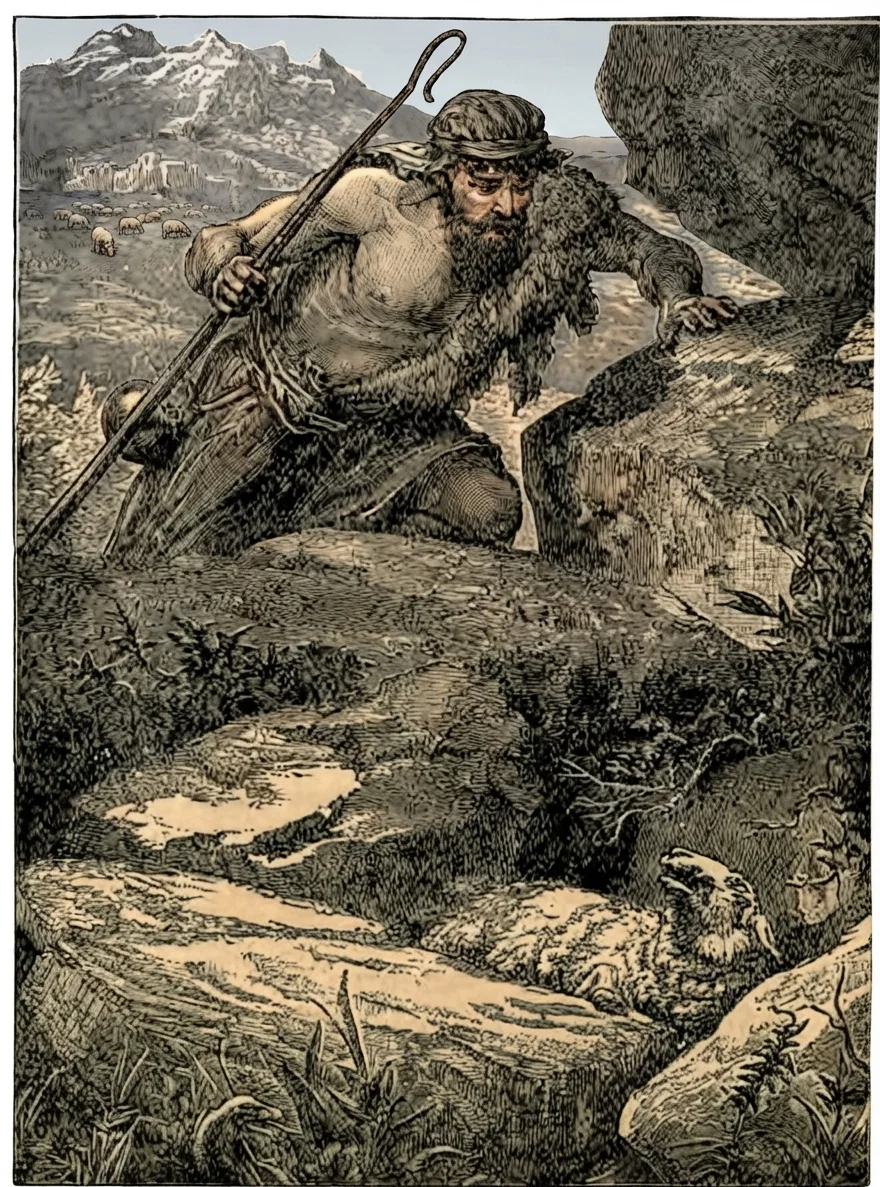
THE relation which God sustains to his people is often represented by the well-known figure of the shepherd and the sheep. Said the sweet psalmist of Israel, "We are the people of his pasture and the sheep of his hand." Ps. 95:7. He beautifies this thought by sweet assurance: "The Lord is my shepherd; I shall not want. He maketh me to lie down in green pastures; he leadeth me beside the still waters. He restoreth my soul; he leadeth me in the paths of righteousness for his name's sake." Ps. 23:1-3. The Lord himself recognized this tender relationship; for he says, "My sheep wandered through all the mountains, and upon every high hill; yea, my flock was scattered upon all the face of the earth, and none did search or seek after them." Eze. 34:6. Behold the defenseless sheep scattered upon the bleak mountains, pursued by hungry wolves, driven by the merciless storm, seeking shelter and finding none; hear their piteous cry.
THE LOST SHEEP.
But is God's flock in such deadly peril? The under shepherds have proved false; through selfishness and greed they have betrayed their trust. As said our Saviour, "The hireling fleeth, because he is an hireling, and careth not for the sheep." John 10:13. The false shepherds, or pastors of Israel, had feasted on the fat sacrifices laid upon God's altar, but they had not fed the people with spiritual food, for they were not connected with God, or consecrated to the duties of their sacred office. They were leading lives of carnal self-indulgence. The prophet Isaiah called them "blind watchmen;" "dumb dogs, they can not bark; sleeping, lying down, loving to slumber," "greedy dogs which can never have enough;" "shepherds that can not understand; they all look to their own way, every one for his gain, from his quarter." Isa. 56:10. God reproves thus these false shepherds: "Wo be to the shepherds of Israel that do feed themselves! should not the shepherds
feed the flocks? Ye eat the fat, and ye clothe you with the wool, ye kill them that are fed; but ye feed not the flock. The diseased have ye not strengthened, neither have ye healed that which was sick, neither have ye bound up that which was broken, neither have ye brought again that which was driven away, neither have ye sought that which was lost; but with force and with cruelty have ye ruled them." Eze. 34:2-4.
Was unfaithfulness in those set over the flock of God peculiar to ancient Israel, or does it abound in these later times? Men without the aid of revelation might not be able to answer this question with authority, but the sure word of prophecy expressly affirms that "there shall be false teachers among you, who privily shall bring in damnable heresies, even denying the Lord that bought them" (2 Peter 2:1), and that "in the latter times some shall depart from the faith" (2 Tim. 4:1). The Saviour said, "Beware of false prophets, which come to you in sheep's clothing, but inwardly they are ravening wolves." Matt. 7:15. To all these false pastors and prophets of both ancient and modern times, the great Shepherd says that because of their unfaithfulness he is against them, he will require his flock at their hand, and will cause them to cease from feeding the flock. "Neither shall the shepherds feed themselves any more; for I will deliver my flock from their mouth, that they may not be meat for them."
Then how tenderly God speaks to his wandering ones: "As a shepherd seeketh out his flock, . . . so will I seek out my sheep, and will deliver them out of all places where they have been scattered in the cloudy and dark day. And I will bring them out from the people, and gather them, . . . and will bring them to their own land." "I will seek that which was lost, and bring again that which was driven away, and will bind up that which was broken, and will strengthen that which was sick." "I will feed them in good pasture, and upon the high mountains of Israel shall their fold be." Eze. 34:12, 13, 16, 14.
The remainder of this beautiful chapter contains a prophecy of Christ as the true Shepherd: "And I will set up one shepherd over them, and he shall feed them, even my servant David; he shall feed them, and he shall be their shepherd." Eze. 34:23. It is not uncommon for the prophets to designate Christ as David, since the Saviour was to come in David's royal line, thus, "My servant David shall be their Prince forever." Eze. 37:25.
As the complement to the chapter we have just contemplated, we turn to the tenth chapter of John. How many believers have found sweet comfort and consolation here! Yet it is only by comparing the prophecy with the Gospel that the true depth of meaning can be discovered. Here the Lord Jesus reveals himself as fulfilling the promise of the Father. He says: "I am the good Shepherd, and know my sheep, and am known of mine." "And I give unto them eternal life; and they shall never perish, neither shall any man pluck them out of my hand." "I and my Father are one." John 10:14, 28, 30.
How tenderly did the good Shepherd seek out the lost sheep of the house of Israel! How faithfully did he feed them with the bread of life! But an infinite sacrifice was required, that the gift of eternal life might be transmitted to man. It was no less than the life of the tender Shepherd, and this he freely gave. "The6good Shepherd giveth his life for the sheep." John 10:11. "For Christ also hath once suffered for sins, the just for the unjust, that he might bring us to God, being put to death in the flesh, but quickened by the Spirit." 1 Peter 3:18.
Poor sinner or trembling believer, have you stumbled on the dark mountains of unbelief and sin? The tender Shepherd gave his life to save you. Has he sought you out and brought you home to the shelter of the fold? Have you received a crumb of the heavenly manna? Is he leading you beside the still waters of his love? Then the good Shepherd says to you, as to the repentant Peter, "Feed my sheep," "Feed my lambs." John 21:16, 17. "And when thou art converted, strengthen thy brethren."
You say that you are not learned; you are, it may be, a suffering invalid, a child, one of Christ's "little ones," yet you may seek for wanderers from the fold of God; you may find and bring home a lost sheep to the loving Shepherd's care. You may gather with him, and, O, the joy of rescuing a perishing soul! It is the joy which Christ and angels know. "And when the chief Shepherd shall appear, ye shall receive a crown of glory that fadeth not away." 1 Peter 5:4. And every soul you have won will be as a star in your crown of rejoicing.
Our Lord said, "Other sheep I have which are not of this fold; them also I must bring." Mortal man can not fathom the mysterious realms of God's universe, whence he will call his scattered ones, but we are assured that in the fulness of time he will "gather together in one all things in Christ, both which are in the heavens [margin], and which are on earth; even in him," and "there shall be one fold and one Shepherd."
"Tenderly the Shepherd, o'er the mountains cold,
Goes to bring His lost one back to the fold,
Seeking to save, seeking to save,
Lost one, 'tis Jesus seeking to save."
"THE MOST HIGH RULETH." NO. 2.
By W. N. G.
PEOPLE who deem it the province of the church to reform the government, and the duty of the government to patronize the church, are wont to cite the government of Israel as proof of the doctrine. They would fain imitate Israel in the Government of the United States, in their zeal to honor the Lord by formal statute, with themselves as lawgivers and executives. The various factions of National Reformers point to Israel as the notable example of a nation honoring God in its laws, and therefore God directing its prosperity. They seem to forget that no nation ever suffered a more ignominious fall than did Israel.
God chose the people of Israel because they were the seed of Abraham (Deut. 7:8), that through them he might fulfil the promise to Abraham that in his Seed (Christ, Gal. 3:16) all the nations of the earth should be blessed. It was necessary that they be set apart from other nations in order that the Messiah might be identified as the son of Abraham; and the first thing in the New Testament is the genealogical record showing this fact. Israel was also a typical nation; its sanctuary was a typical sanctuary, the service of which was a typical service. The yearly round was typical of the work of salvation, including that of the High Priest in heaven. Therefore there could not be another such nation.
The old covenant, which was made especially with that people, was a national covenant. The people as a whole were formally included. See Ex. 19:5-8; 24:3-8; Deut. 26:16-19. But they broke that covenant by disobeying the law of God, which they promised to keep. The new covenant is not national; it is an individual covenant. Like the law of God, it is universal; it is in force wherever there is an individual that will receive the law of God in the heart. Christ had the law of God in his heart as an individual (Ps. 40:7, 8), and "if ye be Christ's, then are ye Abraham's seed, and heirs according to the promise." Gal. 3:29. Then the service of God is an individual matter, and not national. The Lord has not given temporal laws direct to any other nation, nor has any man or set of men been commissioned to do so for him. If they feel that they have been so commissioned, they ought to be able to show their credentials.
Of Israel and its laws Moses said: "For what nation is there so great, who hath God so nigh unto them, as the Lord our God is in all things that we call upon him for? And what nation is there so great, that hath statutes and judgments so righteous as all this law, which I set before you this day?" Deut. 4:7, 8. Yet all this did not keep them from idolatry. Under all these advantages they many times turned away from the Lord. God would have cut them off entirely but for his promise to Abraham. Ex. 32:1-14. He also spared Judah, at the time of the division of the kingdom, because of his servant David, to whom he had made a like promise. 2 Kings 11:29-36; Acts 2:29-31. Those good laws did not keep even Solomon from gross idolatry, although in addition to them he was endowed with special wisdom from heaven. No law can be given, either human or divine, that will make men righteous. Rom. 3:20. If the universal law of God, or the righteous statutes given by him to his own chosen people, fail to make men religious at heart, how can it be expected that political statutes will do so? The most that any law to compel men to observe religious rites can do is to make them hypocrites. Even under "statutes and judgments so righteous" as those given to Israel, that people went so low into sin that in the days of Manasseh, they became "worse than the heathen, whom the Lord had destroyed before the children of Israel." 2 Chron. 33:9.
Because of the sins of Solomon, the kingdom was divided by Him who ruleth, and was afterward known as the kingdoms of Israel and Judah. From this time on not one of the kings of Israel, and but few of the kings of Judah, were loyal to the God of heaven. But in his own time and manner he ruled; nor did he rule by compelling them to serve him. His long-suffering mercy was extended in marked degree. Prophet after prophet was sent to warn, to entreat, to plead with them to turn unto God; but the people, with individual exceptions, were deaf to these appeals. So the Lord ruled in Israel's case by allowing them to be taken captive by the Assyrians. 2 Kings 17.
Although there were some partial reformations in Judah, her downfall as an independent nation also came. The warning voice of the prophets was unheeded. See Jeremiah 7. Of the people Christ declared with weeping, "O Jerusalem, Jerusalem, thou that killest the prophets, and stones them which are sent unto thee, how often would I have gathered thy children together, even as a hen gathereth her chickens under her wings, and ye would not!" Matt. 23:37. All this, too, notwithstanding the good statutes which God had given them. They thought their own statutes better than the law of God, and so it is with humanity to-day.
Toward the close of Manasseh's wicked reign, the Lord brought upon Jerusalem the hosts of Assyria, and Manasseh was carried away to Babylon. Then he repented and turned to the Lord, and, as a consequence of his humility, he was again restored to his kingdom, and did what he could to undo his former evil deeds. So the Most High was able to rule both against and for King Manasseh; he did not lack the power to bring a heathen nation against his wayward people, nor to deliver them when due repentance was manifested. But when Manasseh's son Amon came to the throne, he returned to the former wicked course of his father. He reigned two years, and was then assassinated by his servants. For the records of these two kings see 2 Chronicles 33.
Next came Josiah's good reign (chapter 34); but "after all this" he came to an inglorious end by meddling in other people's affairs. He interfered in a war between Egypt and Assyria, and was killed in battle. The people made his son Jehoahaz king, but the king of Egypt, in retaliation for Josiah's interference, deposed him and placed Eliakim on the throne. The king of Egypt also placed the land of Judah under tribute of "an hundred talents of silver and a talent of gold" (chap. 36:3), and changed Eliakim's name to Jehoiakim. But Jehoiakim did evil in the sight of the Lord, so the king of Babylon was permitted to come against him and carry him away captive. Some of the vessels of the house of the Lord were also carried to Babylon.
Then came Jehoiakim with a short evil reign, and King Nebuchadnezzar took him also to Babylon, with more of the goodly vessels of the temple, and made Zedekiah king. The record says that Zedekiah also "did that which was evil in the sight of the Lord his God," and rebelled against King Nebuchadnezzar, into whose hand the Lord had given the kingdom. "And all the chief of the priests, and the people, transgressed very much after all the abominations of the heathen; and polluted the house of the Lord which he had hallowed in Jerusalem. . . . They mocked the messengers of God, and despised his words, and misused his prophets, until the wrath of the Lord arose against his people, till there was no remedy." Verses 14-16.
Zedekiah was the last king of that chosen people. Nebuchadnezzar put out his eyes and took him to Babylon, where he died in captivity. The story of his downfall is more fully told in 2 Kings, chapters 24 and 25. Whatever measure of independent government Judah afterward enjoyed was as a province subservient to the great kingdoms that ruled the world. The prophet Ezekiel said of Zedekiah: "And thou, profane wicked prince of Israel, whose day is come, when iniquity shall have an end, thus saith the Lord God: Remove the diadem, and take off the crown; this shall not be the same; exalt him that is low, and abase him that is high. I will overturn, overturn, overturn, it; and it shall be no more, until he come whose right it is; and I will give it him." Eze. 21:25-27.
Thus we see there can be no more genuine theocratic government on earth till Christ shall come, whose right it is, and whose subjects will all have his law in their hearts, doing his will in the spirit, and therefore from free will. Then "he shall reign over the house of Jacob7[the spiritual seed] forever; and of his kingdom there shall be no end." Luke 1:33. This does not mean his first advent, for he declined a kingly position then (John 5:41; 6:15; 18:36); his purpose at that time was to "bear witness to the truth" (verse 17). But "when the Son of man shall come in his glory, and all the holy angels with him, then shall he sit on the throne of his glory; . . . then shall the King say unto them on his right hand, Come, ye blessed of my Father, inherit the kingdom prepared for you from the foundation of the world." Matt. 25:31-34.
NOTABLE NIGHTS.
By Bessie Cooper
THE night has been eloquently eulogized by the pen of the poet:—
“How beautiful the night! The balmiest sigh,
Which vernal zephyrs breathe the evening’s ear,
Were discord to the speaking quietude
That wraps the moveless scene.
. . . Seems like a canopy which love hath spread
To curtain her sleeping world.”
It was God the Creator who made the night so beautiful in its adornments,—the bright stars that shed their light from the heavens, and the pale-faced moon as it hangs above the silver clouds. But the most elevating and interesting thoughts come in connection with the notable nights mentioned in the Bible.
Just before the destruction of Sodom and Gomorrah, two angels tarried all night at Lot’s house. Their mission that night was to warn Lot of the coming destruction of the doomed city. The fate of Sodom and Gomorrah are held forth as a warning to the people of our time; will we heed the warning?
In after years Jacob, for fear that he might be slain by his brother Esau, fled to the house of his Uncle Laban. He had hundreds of miles to travel alone, and his heart was burdened with the wrong that he had committed. At night he lay down to rest. The earth was his bed, a stone was his pillow, and “the heavens above studded with stars unutterably bright, through which the moon’s unchanged grandeur rolls,” was the roof that covered him when he lay down to sleep. In his dreams he saw a ladder reaching from earth to heaven, upon which angels were ascending and descending. What a grand sight to behold those lovely forms, going up and down, arrayed in garments of purest white! The Lord spoke words of comfort and promise to Jacob that night. The dreary desert became a house of God, and the pillow of stone the gate of heaven.
Twenty years later, Jacob, with a large family, a numerous company of servants, and large flocks and herds, was returning to Canaan. It was a lonely, mountainous region, the haunt of wild beasts, and robbers and murderers were lurking around the place where Jacob, lonely and sorrowful, prayed to his God most earnestly, while his company went on before. It was at midnight. Unexpectedly a hand was laid upon him. He thought it was an enemy trying to take his life, and he attempted to loose himself from the grip of his opponent. Amid the darkness each struggled to gain the victory over the other. While in this terrible conflict, lasting almost till daybreak, Jacob’s thigh, by a touch from his supposed antagonist, was put out of joint. Then he knew that he was combating a heavenly being, and he sought and obtained the overcomer’s blessing.
Pharaoh’s heart was not deeply touched by the first six plagues that were sent upon him and his people. It must have been a hardened heart that could resist the seventh and last plague. In the night the angel of death touched the first-born in every household, where the blood, representing faith in God, was not found on the door-posts. It was heart-rending to hear the moans and cries of the people as they saw their dear ones stricken down so suddenly. Think for a moment how solemn and sad that night must have been! Yet in it was salvation for all.
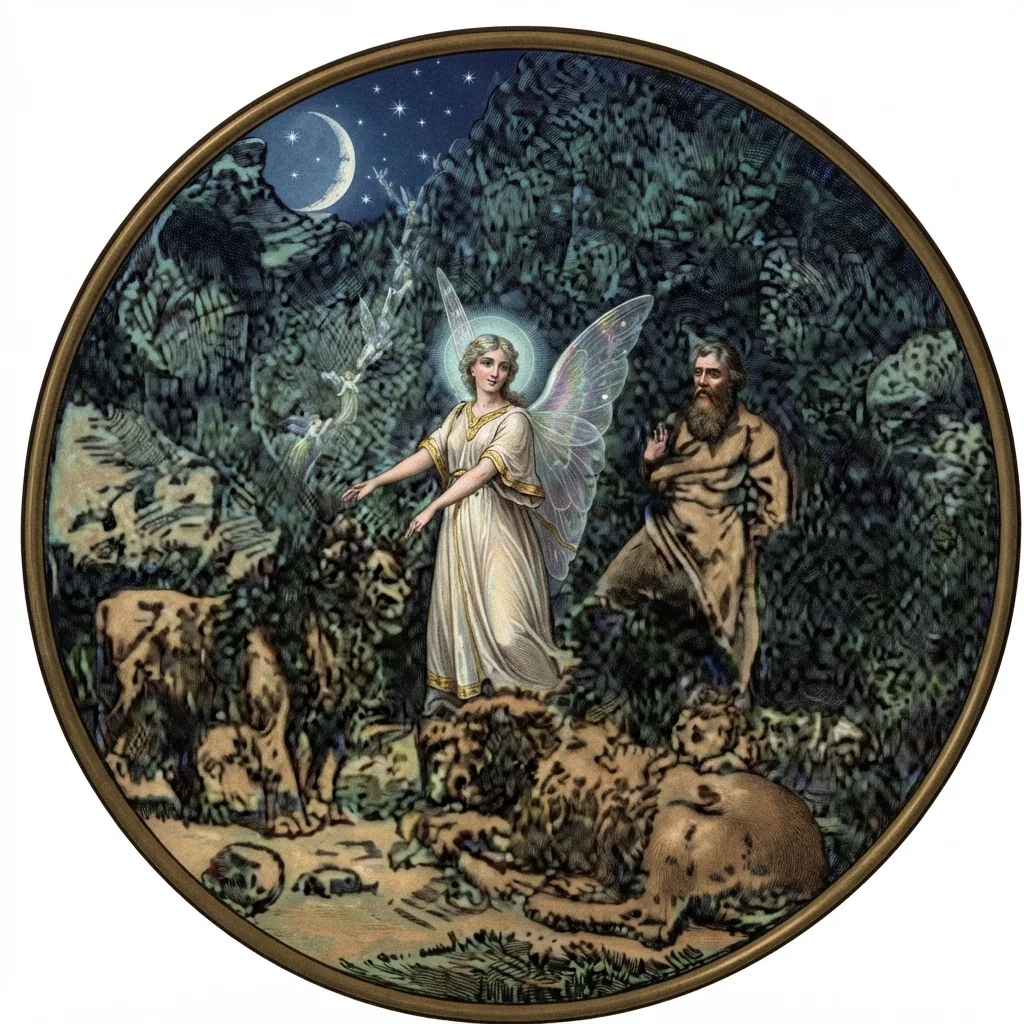
Who of us, like the prophet Daniel of old, ever spent a night in a den, surrounded by wild beasts? No doubt that was the strangest night he ever experienced. He had no human companion, yet he was not alone; the God of heaven watched over him. How that night was spent, we are not told, but Daniel’s great faith, of which we are informed, would indicate that it was spent in prayer and communion with God.
Many years ago, in the city of Bethlehem, there was born a Babe. The night was beautiful, the heavens were illuminated by the stars, and the moon sent forth its silver rays. All nature seemed to smile, as it, with the people, looked at that innocent Babe in the manger. As the shepherds were caring for their flocks that night, no doubt they were talking about the prophecies relating to the Messiah, or singing a psalm as the still hours of the night were passing away. Presently their attention was attracted by the appearance of a lovely star in the heavens, the brightest of all the stars. The Bible says, “The glory of the Lord shone round about,” and an angel declared unto the shepherds the birth of the Saviour. Then the stillness of the night was broken, for “suddenly there was with the angel a multitude of the heavenly host, praising God.”
Soon after this the same Child was taken to Egypt. They must travel in the night, so that they would not be seen by King Herod’s spies, who sought to kill the infant Jesus. They were guarded by angels of God as they journeyed in the still hours of the night.
Other great events worthy of note took place in the night, such as our Lord’s meeting with Nicodemus, his eating the Passover and Lord’s supper, and his instruction to his disciples and prayer for them, as recorded in John, chapters 13 to 17. That same night also he went to the Garden of Gethsemane, where he prayed to his Father to give him strength to resist the awful trial just before him. How terrible was his agony, as he prayed, “O my Father, if this cup may not pass from me, except I drink it, thy will be done!” He had not yet left the garden when Judas came with a mob, and the Saviour of the world was delivered into the hands of his enemies, to be mocked and crucified. Surely such a betrayal was a deed fitted only to be done in the darkness of night.
Other notable nights were those when Jesus met with his disciples after his resurrection, when Peter was delivered from prison by an angel, when Paul escaped from Damascus, when he and Silas sang hymns in the Philippian jail and an earthquake shook open the prison doors, and when Paul was carried by Roman guards from Jerusalem to Cæsarea to deliver him from the fury of the Jews.
These are a part of God’s wonderful dealings with his children in the night. Not all the poetry ascribed to the night is so grand or instructive as the simple accounts of notable nights in the history of God’s work for the salvation of souls.
Bessie Cooper.
Oakland, Cal.
THE TWO GOVERNMENTS AND THE LAW OF GOD.
By W. L. Iles
THE two governments referred to are the universal government of God and the theocracy of Israel. The law referred to is the Ten Commandments. Governments can not exist without law, and law can not exist without governments. We will first consider the universal government.
The Universal Government.
First Proposition.—The eternal God, the great Jehovah, is the supreme Ruler of the universe, and his authority extends as far as his creation.
“The Lord hath prepared his throne in the heavens; and his kingdom ruleth over all.” Ps. 103:19. God has therefore a “throne” and a “kingdom.” A kingdom must have a king. If this King “ruleth over all,” then he must have a law by which his subjects are governed. And here are other proofs: “The Lord is in his holy temple, the Lord’s throne is in heaven; his eyes behold, his eyelids try, the children of men.” Ps. 11:4. “The Lord reigneth, he is clothed with majesty. . . . Thy throne is established of old; thou art from everlasting.” Ps. 93:1, 2.
God has a temple in heaven, and in the temple is his throne. The Lord sits upon the throne and rules the universe. When Christ ascended on high, he sat down upon the throne of God, or the throne of universal dominion. “Her child was caught up unto God, and to his throne.” Rev. 12:5. “To him that overcometh will I grant to sit with me in my throne, even as I also overcame, and am set down with my Father in his throne.” Rev. 3:21. “We have such an high priest, who is set on the right hand of the throne of the majesty in the heavens.” Heb. 8:1.
This world has been out of harmony with God and his government. Christ will reign upon his Father’s throne until all power opposed to God is subdued. If we are brought in harmony with God’s government by conversion, through the wooings of God’s Spirit, the power of sin is subdued. Those who refuse to yield to the pleadings of the Spirit of God, never become subject to God and to his government, and will be destroyed from his kingdom. When all the universe is in harmony with God’s government, there will be no more sin, or transgression of his law. If we can determine what law is the foundation of God’s government, to which all must be subdued, before he leaves the throne, then we may know we have found the law to which our lives must be brought in harmony.
The Theocracy of Israel.
In the government of Israel God was ruler. Israel was his chosen people.
Second Proposition.—The government of Israel was a government within a government, and the Son of God was King.
It was Christ that led the children of Israel8out of Egypt. “And did all drink of the same spiritual drink; for they drank of that spiritual Rock that followed [went with] them; and that Rock was Christ.” 1 Cor. 10:4. But the Jewish nation rejected their King, and chose a man to rule over them instead of God. “And the Lord said unto Samuel, Hearken unto the voice of the people in all that they say unto thee; for they have not rejected thee, but they have rejected me, that I should not reign over them.” “And ye have this day rejected your God, who himself saved you out of all your adversities and your tribulations.” 1 Sam. 8:7; 10:19. “O Israel, thou hast destroyed thyself; but in me is thy help. I will be thy King; . . . I gave thee a king in mine anger, and took him away in my wrath.” Hosea 13:9-11.
God was the “King of Israel,” and when they rejected him, and chose man to rule over them, the natural consequence of their course would be for them to cry, “We have no king but Cæsar.”
We know God has a universal government. We know that Christ is now Priest-king in that government. We know that the theocracy of Israel was a government of God. Therefore the theocracy of Israel was a government within a government.
The object of the work of Christ in the government of Israel was to bring them in harmony with God and his government. If they had obeyed God and his law, they would have been in harmony. Therefore the righteousness required by the law is the righteousness required in God’s universal government. The righteousness required by the law is the righteousness of God, and when we have the righteousness of God we are in harmony with his government.
The State of California is a government within a government. The man who obeys the laws of California is in harmony with the United States Government, for the laws of California do not conflict with the laws of the general government. If California enacts a law that conflicts with some law of the general government, it is unconstitutional, because the Constitution of the federal government is a part of the organic law of California. So also the law of morals in the general government was the law of morals in the theocracy, in order that the character of those in the theocracy might be in harmony with God. W. L. ILES.
(To be continued.)
Bible Readings.
By G. W. Rogers
"Seek ye out of the Book of the Lord, and read."—Isaiah.
"Whoso readeth, let him understand."—Jesus.
EVENTS CONNECTED WITH THE MILLENNIUM.
1. THE Lord comes, raises the righteous dead, changes the righteous living, and both classes are caught up to meet the Lord in the air.
"For the Lord himself shall descend from heaven with a shout, with the voice of the archangel, and with the trump of God; and the dead in Christ shall rise first; then we which are alive and remain shall be caught up together with them in the clouds, to meet the Lord in the air; and so shall we ever be with the Lord." 1 Thess. 4:16, 17.
2. Jesus comes to fulfil the following promise:—
"In my Father's house are many mansions; if it were not so, I would have told you. I go to prepare a place for you. And if I go and prepare a place for you, I will come again, and receive you unto myself; that where I am, there ye may be also." John 14:2, 3.
3. The earth is reduced to a chaotic condition.
"I beheld the earth, and, lo, it was without form, and void; and the heavens, and they had no light." Jer. 4:23.
4. It is desolate of inhabitants.
"I will cut off man from off the land, saith the Lord." Zeph. 1:3.
"I beheld, and, lo, there was no man, and all the birds of the heavens were fled. I beheld, and, lo, the fruitful place was a wilderness, and all the cities thereof were broken down at the presence of the Lord, and by his fierce anger." See Jer. 4:23-26.
"Then shall that Wicked be revealed, whom the Lord shall consume with the Spirit of his mouth, and shall destroy with the brightness of his coming [Greek, "presence"]." 2 Thess. 2:8.
5. The saints during the thousand years shall reign in judgment with Christ in heaven.
"And they lived and reigned with Christ a thousand years." Rev. 20:4.
"Do ye not know that the saints shall judge the world? . . . Know ye not that we shall judge angels?" 1 Cor. 6:2, 3.
6. During the thousand years (the millennium), Satan is bound.
"And he laid hold on the dragon, that old serpent, which is the devil, and Satan, and bound him a thousand years, and cast him into the bottomless pit." Rev. 20:2, 3.
7. The wicked do not live again till the end of the thousand years.
"The rest of the dead lived not again until the thousand years were finished." Rev. 20:5.
8. At the end of the thousand years will be fulfilled what is written in Rev. 20:7-15.
G. W. ROGERS.
Question Corner
"Enquire, and make search, and ask diligently."
No. 654. Cain's Sin.
In what did the sin of Cain's offering consist? Was it in offering the fruits of the ground instead of offering a lamb as did Abel?
It consisted in disobedience and unbelief. He slew Abel "because his own works were evil, and his brother's righteous." 1 John 3:12. He who is obedient to God, of course is a doer of righteousness. He who is disobedient does evil works. The one believes God's way is best, and yields to do it. The other in unbelief chooses his own way of disobedience. Abel's lamb showed faith in the coming Sacrifice. Cain's offering, proper, no doubt, as a thank-offering, showed no faith in a Saviour from sin.
The text reads: "Let no man therefore judge you in meat, or in drink, or in respect of a feast day, or a new moon, or a sabbath day; which are a shadow of the things to come; but the body is Christ's." R. V. In the first no man has a right to judge, or condemn, his brother anyway. "Who art thou that judgest another man's servant?" "Judge not lest ye be judged." "Therefore judge nothing before the time until the Lord come." Rom. 14:4; Matt. 7:1; 1 Cor. 4:5.
"But others may condemn us." Yes, but it will amount to nothing; for only One can truly condemn us, Jesus Christ. Rom. 8:34. Therefore pay no attention to their condemnation. If we walk aright, we need not fear what man can do. But in the special things the apostle names, there is no condemnation of any kind if we do not observe them. For the yearly feasts and new moons, annual sabbaths (of which there were several [Leviticus 23]), "besides the Sabbaths of the Lord" (verse 38), and the meats and drinks connected with the sacrifices, all of which stood for sin, were "shadows," which pointed forward to Christ. When Christ came, all those types expired by limitation, even as the shadow ceases when we reach the substance. But this has no reference to the Sabbath of the Lord, which is eternal. See Isa. 66:22, 23.
ROBBER MONOPOLIES; WORLD TRUSTS.
ONE man and the syndicates he represents,—J. Pierpont Morgan,—is said to control twenty-six lines of railway. All the lines between Chicago and New York except the Baltimore and Ohio and the Pennsylvania are controlled by him, and it is said that the former of these two will soon succumb, while the latter will offer no opposition. The same trust controls the Northern Pacific, the Oregon Short Line, and it is predicted will soon control the Union Pacific.
In addition to its railway interests, it is stated that the same great octopus controls the output of all the anthracite coal of Pennsylvania, thus controlling under one head the heat and warmth of thousands of homes.
At a recent meeting of the conservative Massachusetts Reform Club, Mr Byron W. Holt, an expert in tariff matters, made an address on the Sugar Trust. His remarks were strong and radical. Gamaliel Bradford and Hon. John E. Russell were equally strong in what they said against the political power of corporations, and their alleged robbery of the people. Here are some utterances from Mr. Holt's address, taken from the Boston Globe of October 9:—
“Of the $18 which the average family will spend this year for sugar in various forms, $10 will go for sugar, $4.50 to the government, $3.00 to the Sugar
The Outlook
By Editor
"I will stand upon my watch, and set me upon the tower, and will look forth to see what He will speak with me."
Bowing to the Papacy.—A despatch dated Washington, D. C., October 13, to the Examiner, of San Francisco, says: "Never in the history of this city was such a reception tendered a prelate of any church as the farewell banquet given to Archbishop Keane by citizens of Washington at the Shoreham Hotel to-night. It was a representative gathering, and the high estimation in which this noted Catholic divine is held was evidenced by the fact that a goodly portion of the guests were not of his religious faith. Nearly every member of the Cabinet, senators, representatives, high officials of the army and navy, judges, and many of the leading citizens and officials of the District of Columbia, were present. President McKinley . . . assured them [a committee of invitation] that there was no man in the country whom he held in higher esteem than Archbishop Keane, but that he had made it an iron-clad rule to refuse all invitations to dinners except those from his Cabinet officers. . . . The cleverest speech of the evening was made by Webster Davis, Assistant Secretary of the Interior, who in a most witty manner denounced sectionalism of all sorts as well as religious prejudice. He designated Archbishop Keane as one of the most thoroughly American citizens this country has ever produced, and this sentiment, coming from a man who is strongly Protestant in his religious belief, was heartily applauded. There were over 200 guests present, and but for the fact that no more could be accommodated, there would have been a much larger attendance. . . . Among the guests were many men who never attend events of this character, but who made an exception in the case of the distinguished prelate who is to leave here in a few days to resume his post of duty at Rome. Other prominent persons present, besides the members of the Cabinet, were National Committeeman Kerens, of Missouri; Senator Roach, of North Dakota; Dr. Conaty, rector of the Catholic University; General Vincent, of the army; ex-Chairman Harrity, of the Democratic National Committee; Commissioner of Immigration Powderly, Admiral Ramsey, and several Protestant clergymen."
In a letter from the Vatican to the New York Sun, July 11, 1892, it was said: "What the church has done in the past for others, she will now do for the United States." The "church" is certainly succeeding. She deceives that she may bind. She ensnares in the deceiving. In all this the Catholic Church is acting consistently. But wo be to that land that crowns her mistress. Its fate may be read in Spain and Italy.