The Scriptures teach most explicitly that Christ existed prior to all created intelligences. They declare that he was “the First-born of every creature!” The apostle Paul says to the faithful brethren at Colosse, in speaking of Christ, “And he is before all things, and by him all things consist.” Col. 1 : 17. That he existed before this world was created is apparent from the wording of his prayer to his Father while here among men. Said he, “And now, O Father, glorify thou me with thine own self with the glory which I had with thee before the world was.” John 17 : 5. He was the only begotten of God, partaking of his Father’s nature and name by inheritance. By this inherent nature he became equal with God, thus possessing ability to create and give life. He naturally possessed all the attributes of God, not only while he dwelt in heaven, but also in his sojourn on earth; for saith the apostle, in Col. 2 : 9, “For in him dwelleth all the fulness of the Godhead bodily.”
Christ having a nature superior to that of the angels, he received a more excellent name than they. Heb. 1 : 3, 4. An angel has not the power to create or give life, consequently can not redeem (re-create) the earth or man. The angels, it is true, have existed through the ages, i. e., the period of time that relates to the existence of this world, at least. They can not impart life, for they are dependent on the Godhead for a continuation of their own existence, the same as man. The crucifixion of an angel would have resulted only in the loss of the angel’s life, without any benefit to the death-doomed race of this fallen world. Disobedience to the Life Giver placed men beyond the power of angels to restore. This shows what a terrible thing sin is, and the nature of the law of God, of which sin is the transgression.
Christ being the first-born of every creature, and an equal associate of the Father, he has witnessed the development of the universe through the ages. He was with the Father in the beginning of this world, and counseled with him in its formation. It was then and there that God said to Christ, his Son, “Let us make man in our image.” Gen. 1 : 26. This certainly5was not said to an angel; for an angel could not create man. The beloved apostle John says in the first chapter of his Gospel: “In the beginning was the Word, and the Word was with God, and the Word was God. The same was in the beginning with God. All things were made by him,” etc. This Word that was in the beginning with God and was God, was none other than Christ: for says the fourteenth verse, “The Word was made flesh, and dwelt among us.”
Gospel Ordinances of the Past.
We are aware that it is a mystery how he who was equal with God, could humble himself to that extent as to change his majestic form, and become the infant of the manger; but when we consider that the Word of God declares it thus, we are satisfied, and accept the declaration, with its only inspired explanation, “Great is the mystery of godliness: God was made manifest in the flesh.” 1 Tim. 3 : 16.
Christ and the Father are equal in power, wisdom, and glory. They were one in creation, and are also one in re-creation, or redemption. He who undertakes to hold one above the other, or in any way represent one as acting alone, will find his task exceedingly difficult, and will also find it impossible to sustain such a view by the Scriptures.
Having now learned that Christ was the first-born of every creature, that he was in the beginning with God, and co-operated with him in the work of creation, let us now trace his work with his Father in the redemption of man.
The Lamb Slain.
The Word of God declares that Christ was the Lamb slain from the foundation of the world. It says, “All that dwell upon the earth shall worship him, whose names are not written in the book of life of the Lamb slain from the foundation of the world.” Rev. 13 : 8. This scripture also furnishes proof that Christ existed at the foundation of the world, and it was then that he, in counsel with his Father, consented to be slain for the redemption of man. It was then that “God so loved the world, that he gave his only-begotten Son, that whosoever believeth in him should not perish, but have everlasting life.” John 3 : 16. About 4,000 years after this, “when the fulness of the time was come, God sent forth his Son, made of a woman, made under the law, to redeem them that were under the law, that we might receive the adoption of sons.” Gal. 4 : 4, 5. The struggle of giving up his Son was at the foundation of the world, when he gave him for sinful men, that they might become brothers to Christ, and God’s adopted sons. This love on the part of God for those who were in rebellion against him, was more fully realized by angels and men when the Son of God was in the agonies of death on Calvary’s cross. As soon as man sinned, the plan of salvation was laid, and the promised Lamb of God was appointed man’s intercessor, and through each generation that was to people the earth he was to carry out the mind of his Father.
With His People of Old.
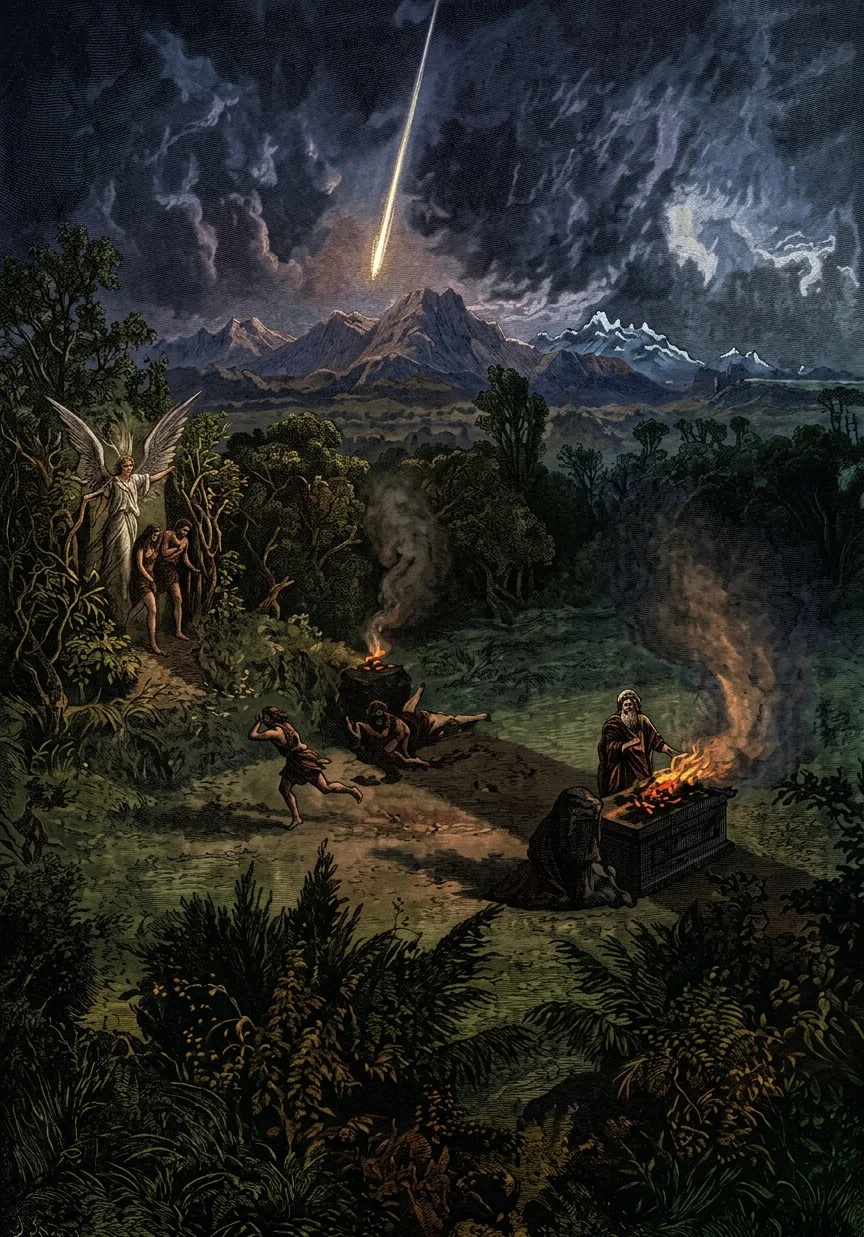
The first forms of worship that were instituted pointed directly to Calvary. The bleeding lamb in the hands of Adam was a type of the Lamb of God, which was promised at the foundation of the world to be slain, as we have already noticed. Christ’s tender watchcare was over Adam and his family. His Spirit moved on the hearts of his posterity, and one after another in each succeeding generation was led into the path of truth and holiness. He translated Enoch and Elijah, preserved Noah and his family during the flood, while he executed the penalty of his Father’s law upon those who rejected his long-offered mercy. He led Abraham, cared for Jacob, preserved Joseph, and was a faithful shepherd to all who trusted in him. He walled the waters of the Red Sea for Israel to pass through, and by word of command rolled them down on their enemies. Christ gave the law on Sinai. He was the pillar of cloud by day and fire by night. It was he who gave the laws to govern the affairs in civil matters of the Jewish commonwealth. He also gave instructions concerning the sacrificial offerings. Many became so used to seeing the offering writhing in its blood, which was poured forth as an acknowledgment that the sinner was worthy of death, and also as an expression of faith in the coming Saviour, that they took the life of the animal as carelessly as if preparing it for the shambles. They little realized that Jesus was near and beheld the flowing blood. As he looked upon the innocent lamb struggling in the agonies of death, he knew that it was a type of his own bloody struggle which was to take place in Gethsemane and on Mount Calvary.
Christ was with his chosen people at all times. Sometimes he saw them fleeing before their enemies, as at Ai, because of their unrepented sins, and sometimes following them in hot pursuit, because of their faith and obedience in him as their leader. It was Jesus that met Joshua on the field of Jericho, and declared himself to be the prince of the Lord’s hosts. His presence sanctified the ground, and Joshua was commanded to remove his shoes from off his feet.
Christ was the spiritual meat and drink of his wilderness people. Says the Word of God: “Moreover, brethren, I would not that ye should be ignorant, how that all our fathers were under the cloud, and all passed through the sea; and were all baptized unto Moses in the cloud and in the sea; and did all eat the same spiritual meat; and did all drink the same spiritual drink; for they drank of that spiritual rock that went with them [margin]; and that rock was Christ.” This scripture plainly states that Christ went with them, and was their spiritual food and drink.
When Israel murmured, they murmured against Christ and tempted him; for saith the Scriptures, “Neither let us tempt Christ, as some of them also tempted, and were destroyed of serpents. Neither murmur ye, as some of them also murmured, and were destroyed of the destroyer.” 1 Cor. 10 : 9, 10. The murmuring, rebellious, impenitent ones were destroyed in their sins, and the penitent, humble ones were pardoned of their sins. Not one sin has ever been pardoned by heaven, except through the intercession of Christ. As surely then as the Israelites were sinners, and received pardon, so surely they received it through Christ; for saith the Word speaking of Christ, “Neither is there salvation in any other; for there is none other name under heaven given among men, whereby we must be saved.” Acts 4 : 12.
The Saviour of the Ages.
A great deal is said about this being the Christian dispensation and the former the Mosaic dispensation. These terms may be permissible to designate these two great epochs of time; but the idea has largely obtained that the plan of salvation was very different and inferior in the Mosaic dispensation than in the Christian. The opinion prevails with many that God did not save men through Christ in the former dispensation, but does in the latter. The people of the Mosaic dispensation were sinners. They committed the same sins that the people do to-day. Even the best of them deceived, falsified, and sinned in other ways. Cain killed; Abraham and Jacob deceived; Achan stole, and David committed murder and adultery. Some of these repented, and were pardoned through Christ, and some did not repent, and were not forgiven. People kill, lie, steal, and commit adultery in the Christian dispensation. Some repent and are forgiven through the same compassionate Saviour; others prefer to settle their sinful account at the judgment.
Gospel Ordinances of the Present.
It is true that the people of the Christian dispensation have greater light, for there has been an unfolding of the plan of salvation in the sufferings and crucifixion of the Son of God. But the minds of men have degenerated in a corresponding ratio, so that the opportunity for the exercise of faith is about the same. A murderer, liar, or thief can be pardoned only through divine blood, and as the blood of Christ is the only divine blood that was ever shed in this world, it follows that there can be but one Saviour for all men, no matter whether he lived in the Mosaic or Christian dispensation.
Types and Symbols.
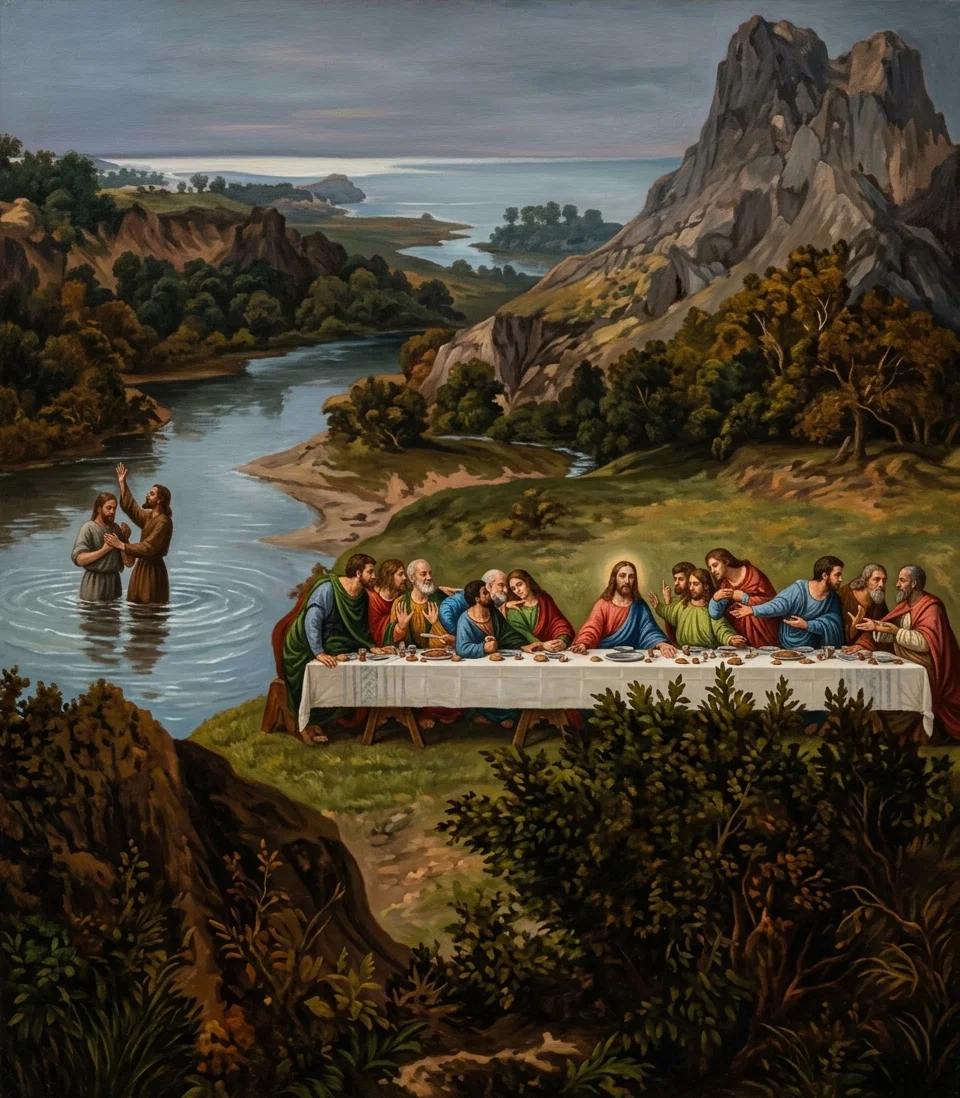
The ceremonies enjoined by God, in the Mosaic dispensation, that kept the coming Saviour in mind, were changed at the cross, and new ceremonies instituted to keep in mind that the Saviour had come and shed his blood for the remission of sin. One of these rites is the Lord’s supper, the bread representing the mangled flesh, and the wine, the precious6blood of the Lamb of God, which takes away the sin of the world.
All of the patriarchs and prophets of the former dispensation received pardon through Christ, and as they beheld the blood of the guiltless lamb flowing from the victim, struggling in the agonies of death, they looked forward to Calvary by faith and saw the blood of Christ flowing from the pierced veins. They knew much better than some of our modern expositors of these times, that through it only could they be pardoned and become reconciled to God. They knew that the blood of sheep and bullocks, or any animal used in the sacrificial system, could not atone for sin. Says the apostle Paul, “For it is not possible that the blood of bulls and of goats should take away sins.” Heb. 10 : 4.
No one who believes the Bible will claim for a moment that Abraham, Isaac, Jacob, and Moses were not pardoned of their sins. Now, as the above scripture says that it is impossible for the blood of bulls and goats to take away sin, it follows that they received forgiveness through him (Christ) to whom their offerings pointed. These offerings were not needed after type met its antitype in the crucifixion of Christ, and God saw proper to abolish them and institute new ones. Among these newly-instituted ceremonies, in addition to the eucharist (which we have already noticed), is the rite of baptism, enjoined by Christ himself (Mark 16 : 16), and which so forcibly illustrates his burial and resurrection (Rom. 6 : 4, 5).
(Concluded next week.)
THE PLEASURES OF THE WORLD.
By Clyde Scott Chase
“If any man will come after Me, let him deny himself, and take up his cross daily, and follow Me.”
THE Saviour spake; and from His lips
Came forth the great and potent word:
“The bitter of the cross He sips
Whose heart by love of God is stirred.”
And we, amid earth’s sins enrolled,
Attest His counsel true and wise;
God’s face no one can e’er behold
Through sinful-pleasure-blotted eyes.
Self must be crucified if we
The peace of Heaven truly feel;
At all times we must hear and see
The poet Cowper’s words of steel:
The joy that vain amusements give,
O, sad conclusion that it brings!
The honey of a crowded hive,
Defended by a thousand stings.
’Tis thus the world rewards the fools
Who live upon her treacherous smiles,
She leads them blindfold by her rules,
And ruins all whom she beguiles.
CLYDE SCOTT CHASE.
CHRIST THE LIFE GIVER.
By Ellen G. White
“In the beginning was the Word, and the Word was with God, and the Word was God. The same was in the beginning with God. All things were made by him; and without him was not anything made that was made. In him was life; and the life was the light of men. And the light shineth in darkness; and the darkness comprehended it not.” The world did not see divinity in the humble Man of Nazareth. The only-begotten Son of the infinite God was in the world, and men knew him not in his true character.
“In him was life; and the life was the light of men.” It is not physical life that is here specified, but immortality, the life which is exclusively the property of God. The Word, who was with God, and who was God, had this life. Physical life is something which each individual receives. It is not eternal or immortal; for God, the life giver, takes it again. Man has no control over his life. But the life of Christ was unborrowed. No one can take this life from him. “I lay it down of myself,” he said. In him was life, original, unborrowed, underived. This life is not inherent in man. He can possess it only through Christ. He can not earn it; it is given him as a free gift if he will believe in Christ as his personal Saviour. “This is life eternal, that they might know thee, the only true God, and Jesus Christ whom thou hast sent.” This is the open fountain of life for the world.
Giving his charge to Timothy, Paul says: “But thou, O man of God, flee these things; and follow after righteousness, godliness, faith, love, patience, meekness. Fight the good fight of faith, lay hold on eternal life, whereunto thou art also called, and hast professed a good profession before many witnesses. I give thee charge in the sight of God, who quickeneth all things, and before Christ Jesus, who before Pontius Pilate witnessed a good confession; that thou keep this commandment without spot, unrebukable, until the appearing of our Lord Jesus Christ; which in his times he shall show, who is the blessed and only Potentate, the King of kings, the Lord of lords; who only hath immortality, dwelling in the light which no man can approach unto; whom no man hath seen, nor can see; to whom be glory and power everlasting.”
Writing again, Paul says: “This is a faithful saying, and worthy of all acceptation, that Christ Jesus came into the world to save sinners; of whom I am chief. Howbeit for this cause I obtained mercy, that in me first Jesus Christ might show forth all long-suffering, for a pattern to them which should hereafter believe on him to life everlasting. Now unto the King eternal, immortal, invisible, the only wise God, be honor and glory forever and ever.”
Christ “brought life and immortality to light through the Gospel.” No man can have an independent spiritual life apart from him. The sinner is not immortal; for God has said, “The soul that sinneth, it shall die.” This means all that it expresses. It reaches farther than the death which is common to all; it means the second death. Men start back at this, saying, Would you make man no more than a beast? This is thought to be degrading. But what is it that elevates man in the sight of God? Is it his accumulation of money?—No; for God declares, “The gold and the silver are mine.” If man abuses his intrusted treasures, God can scatter faster than man can gather. Man may have brilliant intellect; he may be rich in the possession of natural endowments. But these are all given him by God, his Maker. God can remove the gift of reason, and in a moment man will become as Nebuchadnezzar, degraded to the level of the beasts of the field. This God does because man acts as tho his wisdom and power had been gotten independently of him.
Man is only mortal, and while he feels himself too wise to accept Jesus, he will remain only mortal. Men have done wonderful things in the intellectual world, but who gave them power to do this?—The Lord God of hosts. If in their fancied efficiency men triumph because of their own power, and glorify themselves, following the example of the antediluvian world, they will perish. The imagination of that long-lived race was only evil, and that continually. They were wise to do evil, and the earth was corrupted under the inhabitants thereof. Had they connected themselves with the One who is infinite in wisdom, they could have done marvelous things with their God-given ability and talents. But, turning from God, they chose to follow Satan’s lead, as many to-day are doing; and the Lord swept them from the earth, with all their boasted knowledge.
Humanity may be exalted by the world for what it has done. But man can lower himself very fast in God’s sight by misapplying and misappropriating his intrusted talents, which, if rightly used, would elevate him. While the Lord is long-suffering and not willing that any shall perish, he will by no means clear the guilty. Let all take heed to the words of the Lord: “Wherefore kick ye at my sacrifice and at mine offering, which I have commanded in my habitation; and honorest thy sons above me, to make yourselves fat with the chiefest of all the offerings of Israel my people? Wherefore the Lord God of Israel saith, I said indeed that thy house, and the house of thy father, should walk before me forever; but now the Lord saith, Be it far from me; for them that honor me I will honor, and they that despise me shall be lightly esteemed.”
God honors those who obey him. “The Lord rewarded me according to my righteousness,” said David; “according to the cleanness of my hands hath he recompensed me. For I have kept the ways of the Lord, and have not wickedly departed from my God. For all his judgments were before me; and as for his statutes, I did not depart from them.”
Only the believer in Christ can receive life everlasting. Only by continually feeding on Christ’s flesh and blood can we have the assurance that we are partakers of the divine nature. No one should be indifferent on this subject, saying, If we are honest, it is no matter what we believe. You can not with safety surrender any seed of vital truth in order to please yourself or anybody else. Do not seek to avoid the cross. If we receive no light from the Sun of Righteousness, we have no connection7with the Source of all light; and if this life and light do not abide in us, we can never be saved.
God has made every provision that his purpose in the creation of man shall not be frustrated by Satan. After Adam and Eve brought death into the world by their disobedience, a costly sacrifice was provided for the human race. A higher value than that they originally possessed was placed upon them. By giving Christ, his only-begotten Son, as a ransom for the world, God gave all heaven.
The acceptance of Christ gives value to the human being. His sacrifice carries life and light to all who take Christ as their personal Saviour. The love of God through Jesus Christ is shed abroad in the heart of every member of his body, carrying with it the vitality of the law of God the Father. Thus God may dwell with man, and man may dwell with God. Paul declared, “I am crucified with Christ; nevertheless I live; yet not I, but Christ liveth in me; and the life which I now live in the flesh I live by the faith of the Son of God, who loved me, and gave himself for me.”
If through faith man becomes one with Christ, he can win life everlasting. God loves those who are redeemed through Christ, even as he loves his Son. What a thought! Can God love the sinner as he loves his own Son?—Yes; Christ has said it, and he means just what he says. He will honor all our drafts if we will grasp his promise by living faith, and put our trust in him. Look to him, and live. All who obey God are embraced in the prayer which Christ offered to his Father, “I have declared unto them thy name, and will declare it; that the love wherewith thou hast loved me may be in them, and I in them.” Wonderful truth, too difficult for humanity to comprehend!
Christ declares: “I am the bread of life; he that cometh to me shall never hunger; and he that believeth on me shall never thirst.” “And this is the will of him that sent me, that every one which seeth the Son, and believeth on him, may have everlasting life; and I will raise him up at the last day.” “Verily, verily, I say unto you, He that believeth on me hath everlasting life.” “Except ye eat the flesh of the Son of man, and drink his blood, ye have no life in you. Whoso eateth my flesh, and drinketh my blood, hath eternal life, and I will raise him up at the last day. For my flesh is meat indeed, and my blood is drink indeed. He that eateth my flesh, and drinketh my blood, dwelleth in me, and I in him. As the living Father hath sent me, and I live by the Father, so he that eateth me, even he shall live by me. This is that bread which came down from heaven; not as your fathers did eat manna, and are dead; he that eateth of this bread shall live forever.” “It is the Spirit that quickeneth; the flesh profiteth nothing; the words that I speak unto you, they are spirit, and they are life.” MRS. E. G. WHITE.
MAN'S EDEN HOME.
By Augusta W. Heald
“In the beginning.” These words of inspiration transport us back through the ages of this world’s history to that far-distant time when “the earth was without form, and void” (Gen. 1:2), a confused mass of elements, and darkness covered the abyss. But the Spirit of God brooded upon the face of the waters, and the “Word,” by whom all things were made, acting in union with God the Father, created the light and the firmament. The waters were gathered together, and the dry land appeared; then at God’s command appeared also the tender grass, the herb yielding seed, and the tree yielding fruit, each after its kind, and, hanging in the blue firmament, the sun shone forth to rule the day, and the moon and stars, the night.
Then appeared, by the will of the great Creator, the marvelous production of animal life, the fish of the sea, the fowl of the air, the beasts, “and the cattle upon a thousand hills.” Ps. 50:10. Lastly, as God’s masterpiece, framed in his own image, man stands forth with powers and capabilities fitting him to become the companion and friend of the divine Creator. “And God saw everything that he had made, and, behold, it was very good.” Gen. 1:31.
Thus have passed the six days of creation’s week, and on the seventh day God rested from his work. He ceased from creating; “and God blessed the seventh day, and sanctified it; because that in it he had rested from all his work.” Gen. 2:3.
We next read that God planted a garden, and there placed the man whom he had created; this garden was called Eden, or “Delight,” and here, amid bowers of beauty, dwelt our first parents; their office was to dress the garden and keep it. Here grew every tree pleasant to the sight; every leaf and bud was perfection, fresh from the Master’s hand, while man, in the image of the Creator, had God’s law written in his heart, and was by nature inclined to that love of God and his creatures which “is the fulfilling of the law.”
Here, amid his handiwork, God was accustomed to manifest to his children the tokens of his divine presence; their hearts had known no sin; they had no conception of pain, or sorrow, or death. O, blessed estate of man in his innocence! Our present fallen nature can not comprehend its fulness, but our thoughts love to linger with our first parents in the “garden of delight.”
“The spacious firmament on high,
With all the blue, eternal sky,
And spangled heavens, a shining frame,
The great Original proclaim.”
AUGUSTA W. HEALD.
JEWISH CUSTOMS AND TRADITIONS.
By F. C. Gilbert
(By an Israelite.)
The Sanctuary and Its Services.—Continued.
The Laver of Brass.
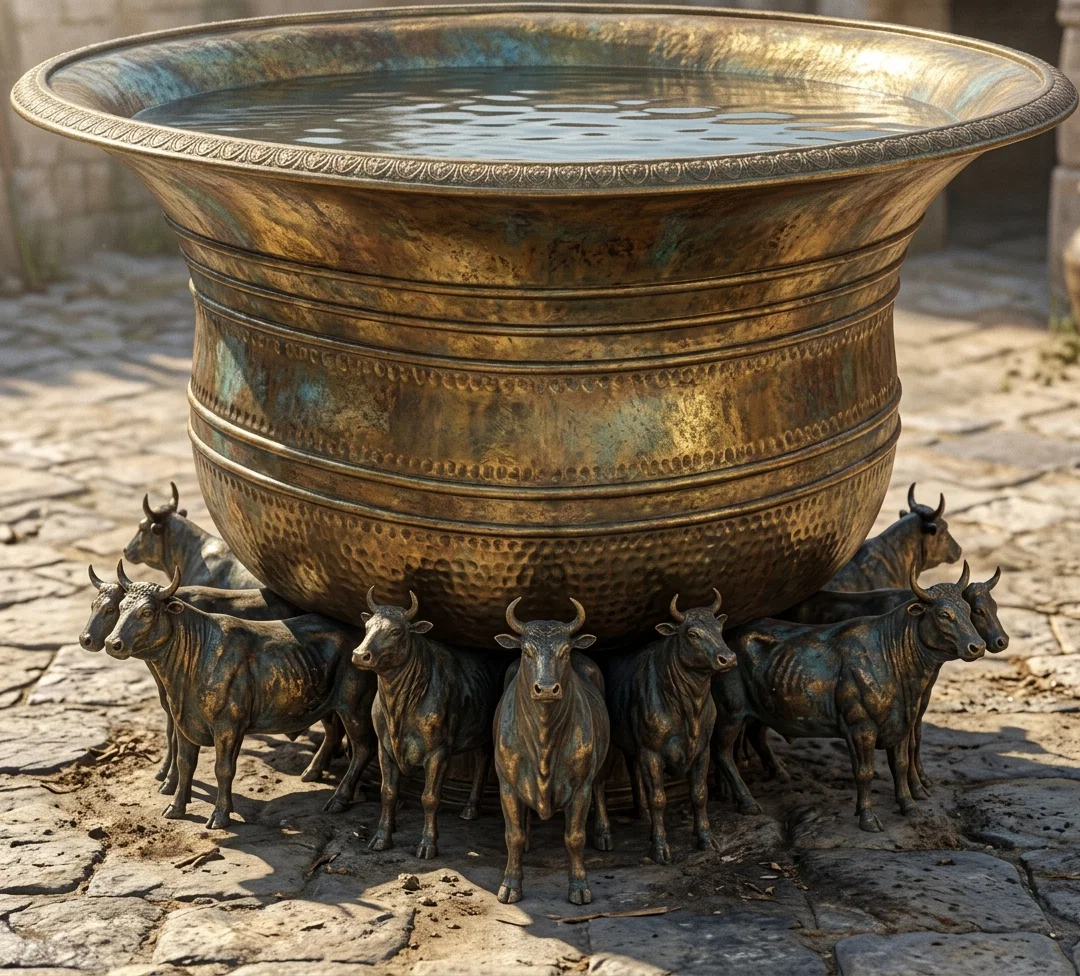
The next article of furniture we find in the court, between the altar and the door of the tabernacle, is the laver, which was designed for the priests alone to wash in. In this laver, water was constantly to be kept, that every time the priests performed any service for the Lord in the sanctuary, the water must first be used. The following is the explicit language the Lord uses regarding the use of the laver: “For Aaron and his sons shall wash their hands and their feet thereat; when they go into the tabernacle of the congregation, they shall wash with water, that they die not; or when they come near to the altar to minister, to burn offering made by fire unto the Lord; so they shall wash their hands and their feet, that they die not; and it shall be a statute forever to them, even to him and to his seed throughout their generations.” Ex. 30:19–21. Two things are very noticeable and impressive in connection with this article of furniture,—it was always to be used before doing any of the service of God, and death resulted if it was not used. Hence great importance must be attached to it.
Laver of Solomon's Temple.
We have already seen that the altar had connected with it the shedding of the blood, and the forgiveness of sins; but while this is absolutely necessary for the sinner to receive, it is not sufficient to carry him all along the way in his Christian life. It was not sufficient for the priest to offer simply one offering for himself; he had to offer them always. But in addition to this he was obliged to use the laver all the time when he wished to do any service for the Master. So the Christian must ever be washing himself in the water of the Word.
Water is used much in the Bible as significant of cleansing and purifying. Hence we read, “Then will I sprinkle clean water upon you, and ye shall be clean; from all your filthiness, and from all your idols, will I cleanse you.” Eze. 36:25. And concerning the Lord’s church we read, “Husbands, love your wives, even as Christ loved the church, and gave himself for it; that he might sanctify and cleanse it with the washing of water by the Word, that he might present it to himself a glorious church, not having spot, or wrinkle, or any such thing; but that it should be holy and without blemish.” Eph. 5:25–27. Unless we are born by water and the Spirit we can not see or enter the kingdom of God. Hence how important that once having been washed in the blood of the Lamb, we continually wash ourselves in the water of the Word, that our lives may be truly cleansed and purified, and prepared for the life which the Master has in store for us.
And we should remember that the water of those days in which the priests washed was typical of Christ, as the water they used came from the rock which was smitten; and the apostle Paul plainly tells us that they all drank of that spiritual Rock that followed them, and that Rock was Christ. 1 Cor. 10:1–4. And we know that unless a man constantly drink from the Fountain of Life he can not live, but will surely die. Christ is the Word. John 1:1, 14. Christians are all priests, for they are “a kingdom of priests.” Hence how important that we always imbibe that Word into our souls, that the soul temple may be cleansed from all defilements, that when we do any ministering for the Master, it may be done acceptable to him, that we die not.
We are exhorted as Christians to be clean. “Be ye clean, that bear the vessels of the Lord.” Isa. 52:11. Long ago the psalmist said that only those should ascend into the hill of the Lord that had clean hands and a pure heart; and the way that cleansing could be reached was by taking heed according to the Word of God. He also said that after he had washed his hands in innocency, he could compass the altar of the Lord. Ps. 24:4; 119:9; 26:6.
It is by this Word we are begotten again to that living hope which makes us not ashamed because the love of God is shed abroad in our hearts. It is by this Word we are sanctified; for it is the truth that sets us wholly apart. It is by this Word that we receive the new life, for it is both spirit and life. It is by this Word that we talk to the blessed Master, and learn his wishes concerning us. It is with this Word we make our requests known to the Father, who so gladly delights to grant what his children need. O, what a blessed Word it is, and yet how much neglected! How much more precious Christ would become to us if we studied that Word more, and heeded its precepts! We should then want to come to him more, and learn to love him better. We should then be kept from committing many sins we do to-day because of the neglect of that Word. It was the Word which David hid in his heart that kept him from sinning against God. Ps. 119:11.
May God help us all to realize that, as priests of God and Christ, we are always to minister unto him; but unless the washing of the Word does its share in the service, we may have spiritual death, and the worship not be acceptable. But if we carry out his wishes, he will accept the offering from our hands, and we shall be wholly sanctified, soul, spirit, and body.