WHAT is the evidence from the Bible that the first day of the week, or Sunday, is the Sabbath? Nearly all the Christian world keeps Sunday, and can it be true that there is no divine command or authority for it?
The word “Sunday” does not occur in the Bible at all. But the day we call Sunday is spoken of in the good Book a number of times as the first day of the week, but in no one of these instances is it called the Sabbath; nor is there any occasion for drawing even an inference that there is any sacredness attached to the day. It is merely spoken of as the first of the working-days of the week, and no more.
In his article on “The Perpetuity of the Sabbath,” found in other columns of this issue, Pastor R. C. Porter gives all the texts in which the first day of the week is mentioned in the New Testament. No one claims that the Sabbath was changed during Old Testament times, and hence if there is to be found any authority for Sunday observance, it must be found in some one of the texts where the first day of the week is mentioned. Surely it could not be claimed that the Lord would establish Sunday as a day of rest and not say anything about it.
Now, if the reader is candidly seeking for the truth on this Sabbath question, let him read carefully all the texts that speak of the first day of the week. He will find the list in the concluding portion of Pastor Porter’s article on the next page. Some of these texts will show that the first day of the week was the day on which Christ rose from the dead, but they will also show that the Sabbath according to the commandment was still kept by the disciples. Another one of the texts will show that Paul held a meeting on that day, and if you read the context, you will learn that while Paul was preaching, two of his disciples were hard at work sailing around a cape in the Mediterranean from Troas to meet him at Assos. And still another of the texts will show that the church at Corinth was exhorted to lay by for the collection, “according as the Lord had prospered him.” To be able to lay aside for the contribution as the Lord had prospered, would necessitate looking over the business in order to see how much had been made.
Thus in all these scriptures do we see that only secular work is prescribed for Sunday, or the first day of the week. The original Sabbath commandment shows us plainly that the seventh day is, and ever has been, the Sabbath. In view of these plain facts, what will we do about it? Will we continue to keep Sunday when the Lord has plainly showed us that He requires the observance of another day? T.
"Scientific Basis of Sabbath and Sunday."
THERE has come to our table a book with the above title, by the Rev. Robert John Floody. Introduction by G. Stanley Hall, LL.D., President of Clark University. Second and revised edition. 360 pages. It is published by Herbert B. Turner & Co., Boston.
We confess that we looked for something better. We are told on the title-page that it is "a new investigation after the manner and methods of modern science, revealing the true origin and evolution of the Jewish Sabbath and the Lord's Day, for the purpose of ascertaining their real significance and proper observance." The author is Master of Science, Bachelor of Sacred Theology, etc.
We wonder that he did not say in the very beginning that he did not believe the Bible. It would have saved him many words. Why in the world he should speak of it as "inspired," and as the "Sacred Record," we can not see. The evidences he brings show that the early Sabbath of the seventh day as a sacred day was very wide-spread, but it does not seem even to occur to the author that this common knowledge had its source in the origin of the Sabbath at creation. No, all these great nations were moon-worshippers, and the week and the Sabbath came from the phases of the moon! It does not seem to occur to him that all the "holy" days connected with moon-worship might be perversions of the true. The reason why these obvious explanations do not occur to the author is quite patent. He has adopted the conclusions of "higher criticism," which sets aside the Bible as a mass of traditions and legends written at a very late date, and unworthy of credence. Yet the vague, fragmentary record of archeology, often uncertain in meaning, is taken as confirmed truth. The Biblical feast of the new10moon is counted idolatrous, and because the monthly festival and weekly holy day are mentioned together, the Sabbath must have originated in moon-worship! The moon, he declares, was the chief object of worship, when the testimony is to the effect that the sun was the chief god because of his blazing, terrific splendor.
Because the Hebrews in idolatry patterned after other nations and chose a king like other nations, therefore they got their Sabbath from other nations!
He tells us that there are two Decalogues, entirely different, the one in Exodus 20, the other in Exodus 34; that Moses wrote very little of the Pentateuch; that the earliest law of the Sabbath (Ex. 34:21) was after 850 B.C.; that Ex. 20:22 to 23:33 was written about B.C. 750; that Deuteronomy was written about B.C. 622; the creation story of Gen. 1:1 to 2:3 was written about B.C. 450, and that not till then did people have the Sabbath as a memorial of creation. It would puzzle one to find a decalogue in Exodus 34, but Mr. Floody tries to tells us what it is. It would be easier to find one in Genesis 1.
In his "scientific" study he declares that Mr. Gamble's sliding position on the adjustable sabbaths "is not borne out by facts" (page 87), which is true. The theories devour each other—a case of Kilkenny cats.
His New Testament argument is deplorably weak. Other first-day apologists have done much better. He tells us what things should not be allowed and what things are permissible on Sunday, just as the men of other minds have no rights in the matter, and then argues the right of the State to make Sunday laws, and makes an appeal for concerted action.
He gives a little thought to the advocates of the Bible Sabbath, calls them Saturdarians, a strictly "scientific" term, we suppose, in the vocabulary of higher criticism, inasmuch as the seventh-day Sabbath people do not advocate Saturday nor keep it, as the seventh day is not identical with it.
Another of his many examples of "scientific" inquiry is shown in the following from page 321:
"Why should the Saturdarians commence the day at sundown? No doubt it is to have the identical time of Palestine where the commandment was given."
The truly scientific mind will inquire. If Mr. Floody had asked a single intelligent advocate of the seventh-day Sabbath, he would have learned to speak with less confidence.
We have not space nor time nor disposition to point out all or half or one-fourth of the defects in this book, which makes such high claims and weak performances. Shall we accept as a "scientific basis," on which to build the hopes of eternal life, the conclusions of one who denies the Biblical record concerning man and the Sabbath; who prefers the questionable conclusions of men that pile their hypotheses against God's word on the sandy foundation of uncertain data; whose suppositions ever lie against the Bible when it would be the easier, truer way to favor the moral Record; who will quote as authoritative testimony to "the will of God" the spurious epistles of Ignatius, long ago repudiated by scholarship; who sets aside with a wave of the "scientific" hand all divine law for the Sabbath, but urges that Sunday be established by human law? We beg to demure. The book is neither scientific nor Scriptural, and is worthy of the higher criticism, the exponent of which it is.
A Great and Purposeful Movement
By Charles M. Snow
By Charles M. Snow
THE sixth annual convention of the American Federation of Catholic Societies was held in Indianapolis, Ind., July 14 to 17, inclusive. The convention was opened by solemn pontifical high mass in the church of Saints Peter and Paul, and a sermon by Most Rev. James H. Blenk, Archbishop of New Orleans. The other meeting of the day was a mass meeting in Tomlinson Hall, where an audience of about 3,000 was gathered. The hall was beautifully decorated with the American and papal colors, and everything was done that could be done to impress the beholder with the magnificence, the pageantry, and the power of the Catholic Church.
This first mass meeting of the convention was attended by the highest dignitaries of the Catholic Church in the United States, and was presided over by Rt. Rev. F. S. Chatard, bishop of Indianapolis, who was clad in the vestments of his rank, and seated at his right hand was the Rt. Rev. Diomede Falconio, apostolic delegate of Pope Pius X to the United States, clad in a gorgeous robe of silk.
At the entrance of these dignitaries, leading a procession of Fathers, Right Reverends, and Most Reverends, the whole audience arose to do them honor, and remained standing until the apostolic delegate from Rome gave the signal to be seated.
After the opening preliminaries, Mayor Bookwalter of Indianapolis gave the welcoming address, in which he, tho professing himself a non-believer, paid the highest praise to the great religious organization known as the Catholic Church and to the great federation of Catholic societies under its auspices. Loud applause interrupted the mayor as he declared the Catholic Church in this country to be second to none, and denounced as know-nothings and infidels those who took any other view. He was vociferously applauded.
The president of the federation replied to the address of welcome, following which the pope's special delegate to the convention, Diomede Falconio, pronounced upon the federation and its aims and purposes the blessing which the pope had sent him to Indianapolis to give in person. It was plain, from the words of blessing and praise spoken by the papal delegate, that the work of federating the Catholic societies of the whole world will be one of the chief purposes of that church from now on. Last year the papal blessing was sent by telegraph. This year so important had the work grown in the eyes of the Vatican that it seemed expedient to send a personal representative of the pope over sea and land to speak that blessing.
A Significant Address.
The principal address of the evening was delivered by Mgr. Joseph Shrembs, Vicar General of Grand Rapids, Mich. The subject of the address was “Christ and the Twentieth Century.” There was no question from the beginning of the long address that the speaker was pleasing his audience. It was a powerful address from a Catholic standpoint, and well calculated to win to the Catholic faith many a man and woman uncertain in their belief or the foundation of their faith.
The bishop set forth in strong light the work that the Gospel of Jesus Christ had done in changing the hearts of men, in putting civilization in the place of barbarism, Christianity in the place of heathenism; but the agency to which he attributed all this was the Catholic Church. He showed clearly what the world would be without Christ; but the Catholic Church was His only legitimate representative on earth, and to that church he gave the glory for all that had been accomplished in the betterment of the world during the Christian era. In conclusion the bishop said: “Friends, we are the children of that blessed Catholic Church which has not surrendered the faith, and to which the longing eyes and weary hearts of the earnest believers of disintegrating Protestantism are turning.”
Catholics have not been slow to see the downward trend in Protestant belief that has come about thru a lack of devotion to the sacred word, and a spirit to criticize that word out of the field of belief and practise. It is true that because of this tendency among so many professed Protestant churches, Catholicism is winning many recruits.
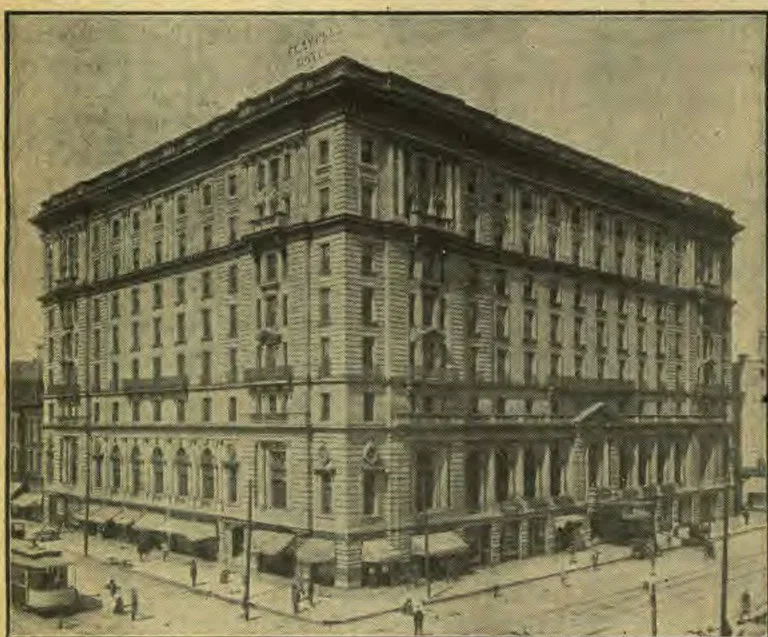
The first business session of the federation was held at the headquarters of the convention, Claypool Hotel, at 10:30 A. M., Monday, July 15. The two most interesting features of this meeting11were the annual report of the president of the federation and the annual report of the national secretary.
The president of the federation declared in his report that federation had passed out of the experimental stage, and must now be recognized as one of the great forces of the nation, and that the unity of the whole Catholic body in this country would soon be realized. They were planning to take up energetically the work of forming new federations and of strengthening those already organized that they might make themselves a power in the land. He stated that as a result of the banding together of Catholic societies in this country to stand for their rights, there was only the remotest possibility that religion (by which he meant the Catholic Church) would ever be interfered with. This was, of course, an allusion to the experience thru which the church has been passing in France. The federation of Catholic societies would be able to wield such an influence in this country and be able to bring such pressure to bear in its organized capacity that no such condition could ever be brought about here. “We ask,” said he, “no favors of any man, but only that our rights before the law in equity be recognized;” and the federation is that power which is to make the demand for “rights” so powerful as to insure the obtaining of those “rights.” “Federation,” he said, “is bigger than any Catholic society. It is working hand in hand with the clergy for the advancement of the Catholic Church.”
Protestants have long been bidding for Catholic support along various lines, and an assurance that they have not been bidding in vain was given in these words of the federation’s president:
“We propose to cooperate with our separated brethren in advancing any cause that is for the good of the people. We have already done so in more than one instance. Our friends who differ with us in religion have appreciated the grand work in which we are engaged, and welcome our cooperation in improving the moral tone of our citizens.”
Here is the forecast of the federation of the world under one head; for be it known that when Protestant and Catholic join, the Catholic will take no second place. Thus we see clearly the welding of the first links in that chain which is to bind the people of this world to the throne of St. Peter; for the federation idea is not confined to this country. It is actively going on in all the principal nations. Thru that arrangement a power is developed which will be able to say “to them that dwell on the earth, that they should make an image to the beast that hath the stroke of the sword and lived.” See Rev. 13:11-18.
Claypool Hotel, Headquarters of the Convention.
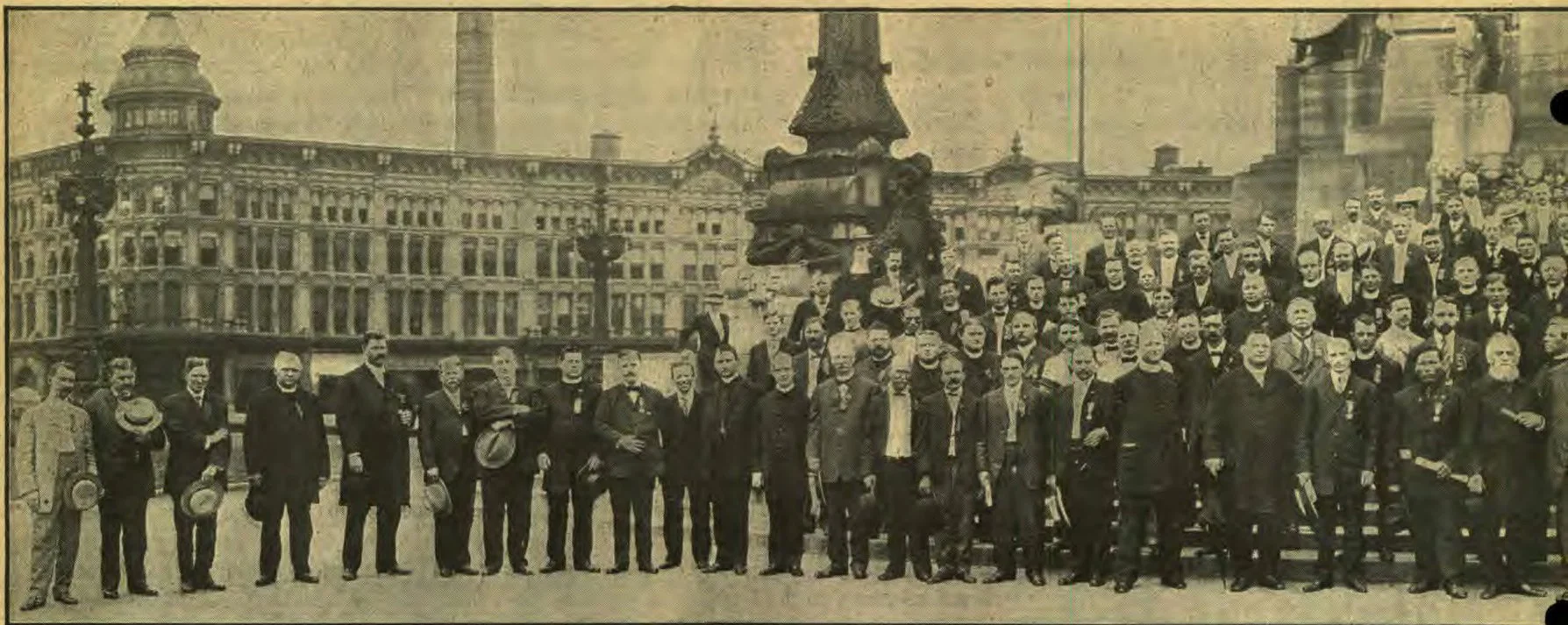
Official Delegates to the Sixth Annual Convention of the American
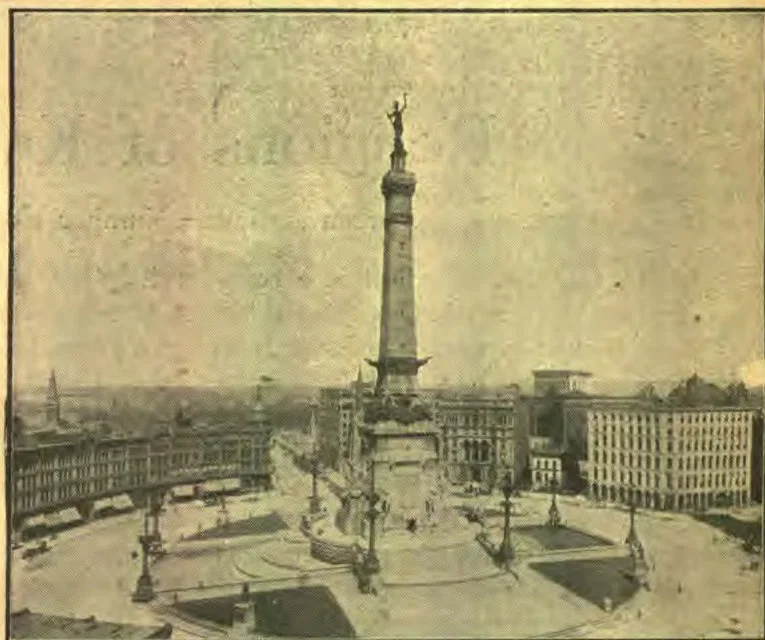
War Monument Circle, Near Headquarters, Where Picture of Delegates Was Taken
AFTER the night of wrestling,
Struggling with habits strong,
After the rain of teardrops,
After the conflict long,
The day breaketh.
After the dire disaster,
Crushing thru heart and brain,
After the grief and sorrow,
After the cutting pain,
The day breaketh.
After the pit and dungeon,
After the heavy cross,
After the fire and scourging,
Failure, distress, and loss,
The day breaketh.
After the time of waiting,
Glimmers the morning star,
Gates of the East swing open,
Glory from land afar,
The day breaketh.
Religions of Korea
By F. W. Field
Korean Articles—Number Four
KOREA has been described as a country without a religion. Confucianism and Buddhism were introduced from China, but at present have very little influence. The former is rather a system of ethics, quite lacking in the restraints and incentives essential to a religion. The latter at one time became quite prevalent and influential in Korea; but about three hundred years ago it fell into disrepute for political reasons, and was disestablished. So at the present time, Buddhism in Korea must be sought for to be found. The principal monasteries and temples are situated in remote places. Perhaps the most famous are those among the Diamond Mountains, in the east-central part of the country.
Airy Spirits.
With the people generally, the only substitute for a religion which they possess is a superstitious form of spirit worship. The popular imagination peoples every conceivable place with hosts of airy spirits, good, bad, and indifferent; but the great majority are malevolent. The people live in constant dread of being injured by these evil spirits; or of offending the good spirits, and so losing their favor and protection.
This gross superstition is without priests or temples, without any regular form of worship or of religious ceremony, without sacred writings to which even a form of reverence is paid. Two classes of exorcists or sorcerers, the Pan-su and the Mu-tang, tho not forming an order, nor being united into an organization, are practically recognized as the priesthood of the cult; for it is thru them that the spirits are approached and propitiated.
Seeking the Sorcerers.
The services of these sorcerers are sought under a variety of circumstances. In time of sickness or other trouble, the incantations of the sorcerers are believed to exorcise the evil spirits. On the occasion of some important transaction, as a marriage, the location of a grave, or of a dwelling, the purchase of land, a sorcerer is employed to make a favorable forecast for the event. It will be seen that the services of these sorcerers are frequently required; and as their fees are high, the aggregate of these makes a heavy burden for the people already impoverished by official rapacity. It has been estimated that at the lowest calculation Demonism costs Korea two million five hundred thousand dollars annually.
The Pan-su are a class of blind sorcerers; and fortunate are the parents who have a blind son, for he will be able to support them from the profits of his divinations. The Pan-su form a guild, or society; and the chief officers of this guild in Seoul hold certain official titles from the government, which serves to give prestige to the whole body. The Pan-su are employed in time of sickness to exorcise the evil spirit that is believed to cause the disease. Their services are also sought for the purpose of divination. The late queen is said to have frequently consulted these blind sorcerers in behalf of her son, the crown prince, whose health has always been somewhat precarious.
The Mu-tang Deserts Everything.
Of the other class of sorcerers, the Mu-tang, the great majority are women. The position of these women is peculiar. While their employment is lucrative and their services are freely sought, socially they are looked upon as outcasts from society. A Mu-tang is believed to be possessed by some spirit; and any woman is liable to receive this "supernatural call." The spirit is supposed to seize upon the woman, and impose his personality upon her. From this time she severs every home tie, deserts parents, husband, and children, and obeys only the "call" of her familiar spirit. Judging from the experiences of these women upon receiving the "call," it seems more than probable that these are real cases of possession by evil spirits, like those recorded in the Bible.
The functions of the Mu-tang are similar to those of the Pan-su, but more varied. While the Pan-su seeks by his incantations to expel, bottle up, or bury the troublesome evil spirit, the efforts of the Mu-tang are rather to propitiate the spirit, and so secure relief from his malevolent influence. The Mu-tang are also consulted for purposes of divination; and their influence in this direction extends even to the court of the king. It is related that on one occasion when the king was planning to give an entertainment to the corps diplomatique, sorcerers were consulted as to the most propitious building or room in which to hold the function. A number of sorcerers were consulted in turn; and as their advice did not agree one with another, the place of the entertainment was several times changed within an hour. No serious consequences might follow so simple a matter as this. But as these sorcerers are also consulted in matters of State, the resulting uncertainty and confusion can readily be imagined; and the removal of their influence from government circles is one of the political reforms that has been attempted within recent years.
Much more might be written on this topic of Demonism in Korea; but enough has already been presented to give some idea of the burden of superstitious fear which rests upon this people. And it is with a sense of relief that we turn to consider what the Gospel of peace and of love that casts out fear has done for them.
The First Protestant Missionary.
Korea was opened to foreign residents and foreign intercourse in the year 1884; and in the same year the first Protestant missionaries entered the country. But the Roman Catholics had preceded them by exactly a century. The first efforts of the Protestant missionaries met with very scant success.13After five years of labor, the number of believers in both the Presbyterian and Methodist missions was only about one hundred. As late as 1897 a well-known traveler and writer described the people as being practically devoid of religious sentiment, and the outlook for the success of the Gospel among them as very unpromising.
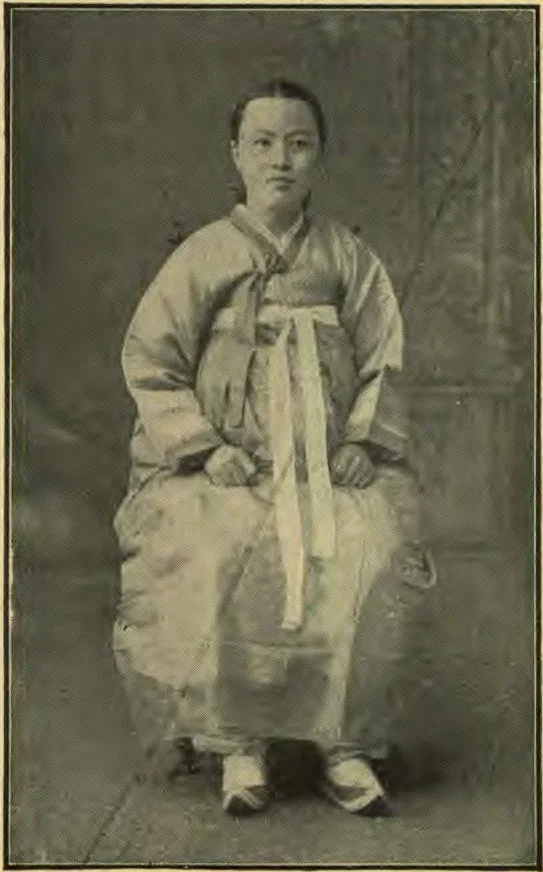
A Korean Lady.
But since that time the work has gone forward by leaps and bounds. Hyeng Yang, the old capital, was one of the first places occupied by mission workers; and after six years of labor, the Presbyterians had twenty-eight converts in that city. But at the present time the whole number of Christian converts in the city is said to be over five thousand. This remarkable increase in this particular locality will serve as an example of the progress made in other places. The missionaries who have been connected with the work from the beginning speak of the results as a marvel of God's grace. From a few isolated localities, the work has been extended from the south far toward the north, and from the western to the eastern shores.
Korean Liberality.
The Korean Christians are often spoken of in terms of praise for their missionary zeal, and for their liberality in the support of Gospel work. It seems to be the rule that the little companies of believers in country districts build their own meeting-houses. They have very little money, but only a small outlay of cash is required. The materials for the walls, roof, and floors, are readily supplied from their own fields; so that the timbers of the frame would be the principal expense in money. Donations of work reduce the carpenter's bill to a minimum. They are also liberal in their support of their native evangelists. In addition to this, it is a common practise for believers to devote a certain number of days or weeks, as they may be able, to active evangelical labor among their neighbors who have not yet heard the Gospel. These graces of liberality and zeal, it would appear, have been carefully cultivated by the missionaries, who have taught the Koreans to bear their share of the work.
All the various lines of missionary effort are being systematically developed in Korea, including evangelical, educational, publishing, and medical missionary work. Korea presents great opportunities to consecrated workers along all these lines. The lack of a regular system of public schools leaves a large place for Christian schools for the education of the youth and children. The practical results of the rational treatment of disease are the best refutation of the superstitious claims of the sorcerers. Native laborers, trained in mission schools, are seconding the efforts of missionaries from abroad.
We rejoice in what has been done and, is being done for the evangelization of Korea; for we recognize this as a part of the great work of evangelizing the world. But as a preparation for the Saviour's coming, the people of Korea must hear the closing message of the Gospel as proclaimed by the three angels of John's prophecy. The whole truth concerning the commandments of God and the faith of Jesus is to be preached in Korea, as in all the world. The claims of the true Sabbath are to be presented; every error in faith and practise is to be laid bare, and the "faith once delivered to the saints" is to be heralded thru all the land. And we rejoice also that this closing message has found an entrance into Korea, and that it is making substantial progress. But the particular account of this remarkable work of the Lord must be reserved for a later article.
Tokyo, Japan. F. W. FIELD.
July Receipts for India Mountain Mission Home.
Curtis Shingler .................................................... $ .25
M. Mary Schon .................................................... .25
Arley M. Allen .................................................... .50
John Schick .................................................... 1.00
Blanche Kalin .................................................... 1.00
Fredy R. Allen .................................................... 1.50
Carrie Allen .................................................... 2.50
Mrs. George Fritz .................................................... 3.00
F. A. Allen .................................................... 12.50
Ellelin Ferris .................................................... 1.00
Cath. E. Ferris .................................................... 2.00
Eugene Roe .................................................... 1.00
J. H. Fritts .................................................... 4.00
Gertrude Barron .................................................... 1.00
Mrs. Jared Wilson .................................................... 3.00
M. M. Fry and family .................................................... 15.00
Mrs. A. C. Campbell .................................................... 5.00
C. D. Reaser .................................................... 5.00
Mrs. M. A. Seaton .................................................... .25
M. M. Minier .................................................... 1.00
Mrs. E. Snyder .................................................... 5.00
Mrs. S. E. Mills .................................................... 1.00
Mrs. L. O. McFarland .................................................... 1.00
A. A. Weseman .................................................... 5.00
Alfred Karlson .................................................... 1.50
C. M. Crane .................................................... 1.00
Mrs. L. S. Shear .................................................... 5.00
Robt. S. McLain .................................................... 5.00
Mrs. A. T. Stickney .................................................... 10.00
Mrs. Florence Carr .................................................... 1.00
A Friend .................................................... 5.00
Mrs. Sarah Eldridge .................................................... 1.00
Edna Kendall .................................................... 1.00
Peter Jensen .................................................... 1.00
D. B. Richards .................................................... 2.00
Mrs. Maggie Phillips .................................................... 1.00
Mrs. D. McKeen .................................................... 1.00
Maggie McCulloch .................................................... 1.00
H. C. Balsbaugh .................................................... 1.00
C. M. McIlwain .................................................... 1.00
Stanley Swisher .................................................... 1.00
Mrs. F. A. Fleck .................................................... 1.00
J. F. Lamond .................................................... 5.00
Mrs. M. A. Hollister .................................................... 5.30
H. E. Svendsen .................................................... 5.00
Mrs. V. Liter .................................................... 5.00
Anna Frazier .................................................... 5.00
Miss E. Batterson .................................................... 2.00
Mrs. Lillie Nelson .................................................... 2.00
Johnson Buckley .................................................... 3.50
Mrs. E. W. Hurlbutt .................................................... 10.00
A. J. Burns .................................................... 2.00
Frank Banks .................................................... 1.52
J. H. Sylvester .................................................... 2.00
B. B. Johnson .................................................... 2.00
Mrs. J. S. Leacock .................................................... .50
C. Christensen .................................................... 1.00
Idaho Friends .................................................... 10.00
Mrs. M. R. Towers .................................................... 4.00
P. Gomez .................................................... 1.00
E. L. Morrow .................................................... 1.00
Mrs. E. C. Pearson .................................................... 2.00
O. J. S. Kemmerer .................................................... 5.00
P. M. P. .................................................... 30.00
Geo. E. Henton .................................................... 10.00
Jas. A. Dye .................................................... 2.00
Josephine Gotzian .................................................... 50.00
Sallie Cain .................................................... 2.00
A Friend .................................................... 1.00
J. B. Reid .................................................... 5.00
Mrs. Papworth .................................................... 1.00
The late Mrs. A. N. Loughborough .................................................... 20.00
A Friend, Idaho .................................................... 2.50
Total .................................................... $311.57
Previously reported .................................................... 116.75
Total to August 1 .................................................... $428.32
Health and Disease
"Health and Disease." By Dr. C. G. R. Montoux, Surgeon of Lyon Post No. 8, G. A. R., Oakland, Cal. Author's portrait as a frontispiece. Published by the doctor himself, at Oakland, Cal.
The design of this work is to give a popular exposition on the essentials of health, the causes of disease, the care of the sick and convalescent. The book contains much information on hygiene, physical culture, diet and digestion, clothing, occupation, recreation, etc., etc. One may not always agree with him. He takes little stock in the germ theory of disease, advocates little medicine. Among the causes of disease he includes alcohol, and other intoxicants and tobacco. Like many other physicians, he thinks hypnotism may be used to advantage in the treatment of the sick, a thing to be deplored. An appendix contains an essay on the "Physical Degeneration of the Human Race," another on the "Increasing Occurrence of Childlessness," and a third on "Principles of Sexual Physiology." It is a thought-suggesting book.