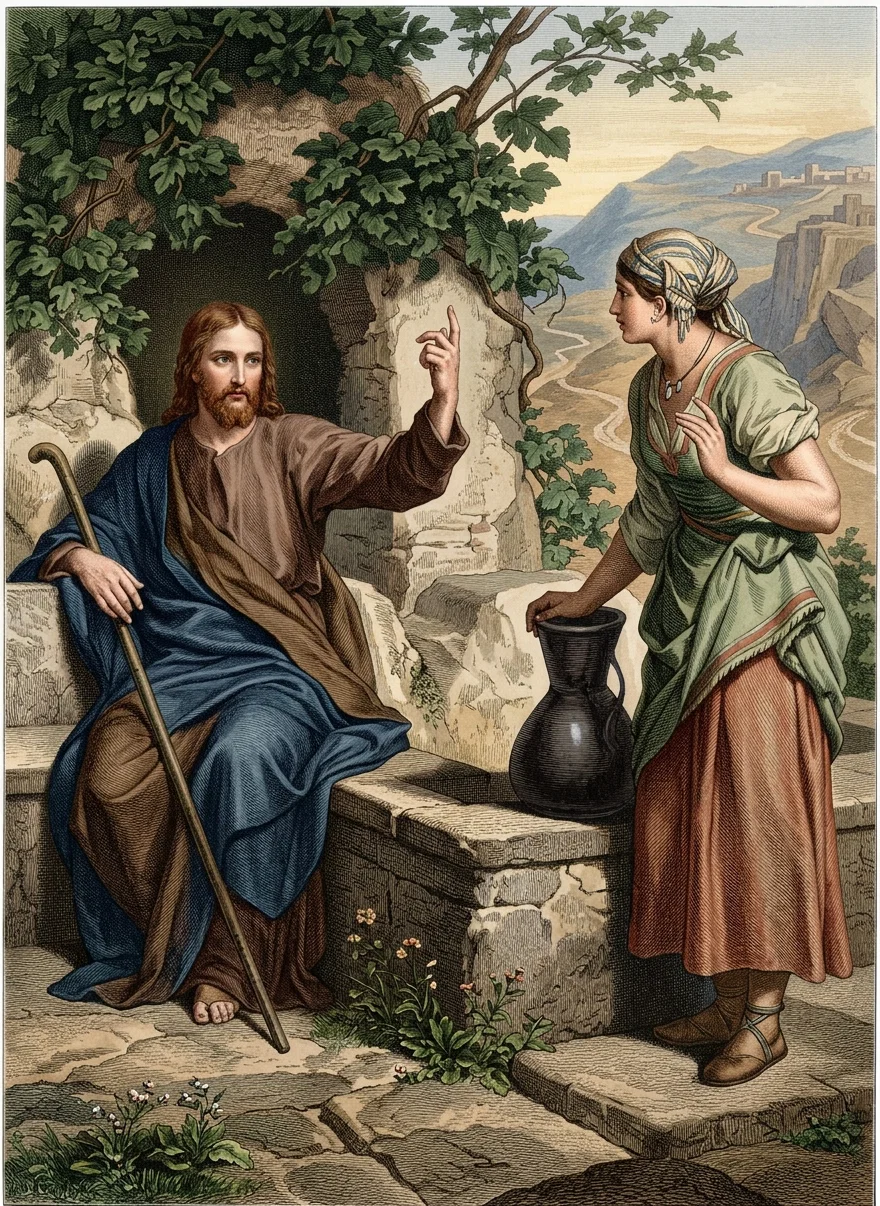
AS the world's Redeemer, the Son of God took upon him our human nature. He humiliated himself, vailing his divinity with humanity, that he might in his life upon earth share in the experiences of the poor, the oppressed, and suffering of the human race. He was subject to the frailties of humanity, and as he journeyed from Judea to Galilee, he was weary with labor and travel. Hungry and thirsty, he tarried to rest at Jacob's well, near the city of Sychar, while his disciples went to buy food in the city. He who had subjected himself to humanity was the Majesty of heaven, the Creator of every good and perfect gift. In giving himself to redeem our world, Christ gave himself a living sacrifice. He emptied himself of his high prerogatives, left his mansions of glory, his throne and high command, and became poor, that we through his poverty might be made rich.
As Jesus sat by the well side, the cool, refreshing water, so near and yet so inaccessible to him, only increased his thirst. He had neither rope nor bucket with which to draw, and he waited until some one should come to the well. He might have performed a miracle, and thus have obtained a draught from the well, had he wished; but this was not God's plan. Nothing must be allowed to separate him from the lot of humanity, which he had voluntarily assumed.
"There cometh a woman of Samaria to draw water; Jesus saith unto her, Give me to drink." The woman answered, "How is it that thou, being a Jew, askest drink of me, which am a woman of Samaria? for the Jews have no dealings with the Samaritans." Christ was near to the woman of Samaria, and she knew him not. She was thirsting for the truth, yet knew not that He, the Truth, was beside her, and was able to enlighten her. And to-day there are thirsting souls sitting close by the living fountain. But they are looking far away from the well that contains the refreshing water, and, though told that the water is close by, they will not believe.
Jesus answered the woman, saying, "If thou knewest the gift of God, and who it is that saith to thee, Give me to drink; thou wouldest have asked of him, and he would have given thee living water. The woman saith unto him, Sir, thou hast nothing to draw with, and the well is deep; from whence then hast thou that living water? Art thou greater than our father Jacob, which gave us the well, and drank thereof himself, and his children, and his cattle?" Yes, Jesus could have answered, The one who is speaking to you is the only begotten Son of God; I am greater than your father Jacob, for before Abraham was, I am. But he made answer, "Whosoever drinketh of this water shall thirst again; but whosoever drinketh of the water that I shall give him shall never thirst; but the water that I shall give him shall be in him a well of water springing up into everlasting life."
The woman was so astonished at his words that she rested her pitcher on the well, and, forgetting the thirst of the stranger and his request to give him to drink, forgetting her errand to the well, she was lost in her earnest desire to hear every word. "Sir," she said, "give me this water, that I thirst not, neither come hither to draw."
Jesus now abruptly changed the subject of conversation, and bade the woman call her husband. She frankly replied, "I have no husband. Jesus said unto her, Thou hast well said, I have no husband; for thou hast had five husbands; and he whom thou now hast is not thy husband; in that saidst thou truly."
As the past of her life was spread out before her, the listener trembled. Conviction of sin was awakened. She said, "Sir, I perceive that thou art a prophet." And then, in order to change the conversation to some other subject, she endeavored to lead Christ into a controversy upon their religious differences. "Our fathers worshiped in this mountain," she said, "and ye say, that in Jerusalem is the place where men ought to worship. Jesus saith unto her, Woman, believe me, the hour cometh, when ye shall neither in this mountain, nor yet at Jerusalem, worship the Father. Ye worship ye know not what; we know what we worship, for salvation is of the Jews. But the hour cometh, and now is, when the true worshipers shall worship the Father in spirit and in truth; for the Father seeketh such to worship him. God is a Spirit; and they that worship him must worship him in spirit and in truth. The woman saith unto him, I know that Messiah cometh, which is called Christ; when he is come, he will tell us all things." But what was her astonishment when Jesus said, "I that speak unto thee am he."
The conviction of the Spirit of God had come to the heart of the5Samaritan woman. She believed that the words of Christ were the truth. No teaching that she had hitherto heard had aroused her moral nature, and awakened her to a sense of her higher need.
Christ reads beneath the surface, and he revealed to the woman of Samaria her soul thirst, which the water from the well of Sychar could never satisfy. He himself lost all sense of hunger, and thirst, and weariness. His thirst was satisfied in seeing her drink of the water of life. He was rejoicing in spirit that his words had aroused her slumbering conscience, and quickened her spiritual perceptions.
Christ understands the needs of the world, and through him alone can the Father supply them. He is thirsting to give the needy souls the water of life freely. Christ is thirsting for the recognition of those for whom he left the courts of heaven, his honor, his glory, his royal throne, his high command. He is thirsting for the love, the coöperation that must be given him as their personal Saviour. He would have them come unto him, taking hold of his grace by faith, partaking of him, the Living Water.
The natural thirst of the woman of Samaria had led her to a thirst of soul for the water of life. Altho she had made no request of him to satisfy her spiritual wants, Christ offered her an abundant supply for her soul's great need. And through the words spoken to her, the water of life was to flow forth to many thirsting souls.
Forgetting the errand that had brought her to the well, the woman left her water pot, and went into the city, saying to all whom she met, "Come, see a man, which told me all things that ever I did; is not this the Christ?"
As yet Christ had not taken the refreshing draught that he desired, nor tasted the food that his disciples had brought. They saw that their Master was intently absorbed in meditation, his face beaming with divine light, and they scarcely dared to interrupt his communion with heaven. But they knew that he had been a long time without food, and, placing some before him, they prayed him to refresh himself. Turning lovingly to them, he said, "I have meat to eat that ye know not of."
The disciples, thinking that he was speaking of temporal food, inquired among themselves, "Hath any man brought him aught to eat?" But Jesus explained: "My meat is to do the will of him that sent me, and to finish his work. Say not ye, There are yet four months, and then cometh harvest? behold, I say unto you, Lift up your eyes, and look on the fields; for they are white already to harvest. And he that reapeth receiveth wages, and gathereth fruit unto life eternal; that both he that soweth and he that reapeth may rejoice together. And herein is that saying true, One soweth, and another reapeth. I sent you to reap that whereon ye bestowed no labor; other men labored, and ye are entered into their labors."
Christ looked forward to the day of Pentecost, when the Holy Ghost should descend upon his disciples. He would teach them that they were not to look upon this as the result of their own labor. They were not to lose sight of the fact that patriarchs, prophets, and holy men had been sowing the seeds of truth. God's ancient chosen people had been enriched with precious truth, which was to them as the river of God. Christ had been their invisible leader through all their travels in the wilderness. Gracious illustrations of his love were given them in the covenant signed by God in the rainbow of promise, which was ever to be an assurance that seed-time and harvest time should remain, and that the world should never again be destroyed by a flood. Christ was just as truly the water of life to Abel, Seth, Enoch, Noah, and all who received his instruction then, as he is at the present time to those who ask of him the refreshing draught. God has given his Word to his chosen ones, and made known his way. Through his Son he has been supplying them with the dews and showers of his grace. But his blessings are often overlooked, and men take the glory to themselves.
The rain is not seen until it begins to fall, and it often comes wholly unexpectedly. So the Lord's precious gift of grace is often nearer than we think. If we will only have faith, and wait patiently for a little while, his help will come, and will surprise us as he surprised the woman of Samaria. He shall come down like showers upon the fruitful6earth.
When the Lord gave his message to the Laodiceans, who thought themselves rich and increased in goods, and in need of nothing, he did not conceal from them their true condition. He said: "He that hath an ear, let him hear what the Spirit saith unto the churches. And unto the angel of the church of the Laodiceans write: These things saith the Amen, the faithful and true witness, the beginning of the creation of God: I know thy works, that thou art neither cold nor hot; I would thou wert cold or hot. So then because thou art lukewarm, and neither cold nor hot, I will spue thee out of my mouth. Because thou sayest, I am rich, and increased with goods, and have need of nothing; and knowest not that thou art wretched, and miserable, and poor, and blind, and naked." This was the message of truth that Christ opened before them. They needed everything. But he did not present to them their great necessity without also providing a remedy. He opens before them a fountain of supply for every need: "I counsel thee to buy of me," he says, "gold tried in the fire, that thou mayest be rich; and white raiment, that thou mayest be clothed, and that the shame of thy nakedness do not appear; and anoint thine eyes with eyesalve, that thou mayest see." It is necessary for us to know our soul's need in order to receive the heavenly treasure provided for us in Christ.
In Eden the Lord gave the promise that the Seed of the woman should bruise the serpent's head. And the work which Christ carried forward at Jacob's well, in proffering the water of life to the woman of Samaria, is a fulfilment of that promise. And he will continue this work until every soul shall have been tested and tried.
The woman, in apparently withholding from Christ the water he asked of her, represents many who are withholding from him the recognition, the sympathy and love, that he is hungering and thirsting for in response to his great love for us. Christ has not withheld his grace and love from any member of the human family. For each he has an inexhaustible supply. And yet how little acknowledgment he receives, how little thanksgiving, how little fruit in good works. He is hungering for the sympathy and love of those whom he has purchased with his own blood. He is watching and waiting for that love which we can not withhold from him with any safety.
The world's Redeemer knows the necessities of every soul. When we are oppressed and languid, he knows it, and he it is that supplies the spiritual refreshment. Ask ye of him; watch unto prayer, and it will come. Jesus is the bread of life, to be eaten every day; he is the water of life to the parched and fainting soul, and all may partake of his grace.
Earth's cisterns will often be emptied, its pools become dry; but in Christ there is a living spring from which we may continually draw. However much we draw and give to others, an abundance will remain. There is no danger of exhausting the supply; for Christ is the inexhaustible well-spring of truth. He has been the fountain of living water ever since the fall of Adam. He says, "If any man thirst, let him come unto me and drink." And "whosoever drinketh of the water that I shall give him shall never thirst, but the water that I shall give him shall be in him a well of water springing up into everlasting life."
MRS. E. G. WHITE.
THE FOURTH COMMANDMENT.
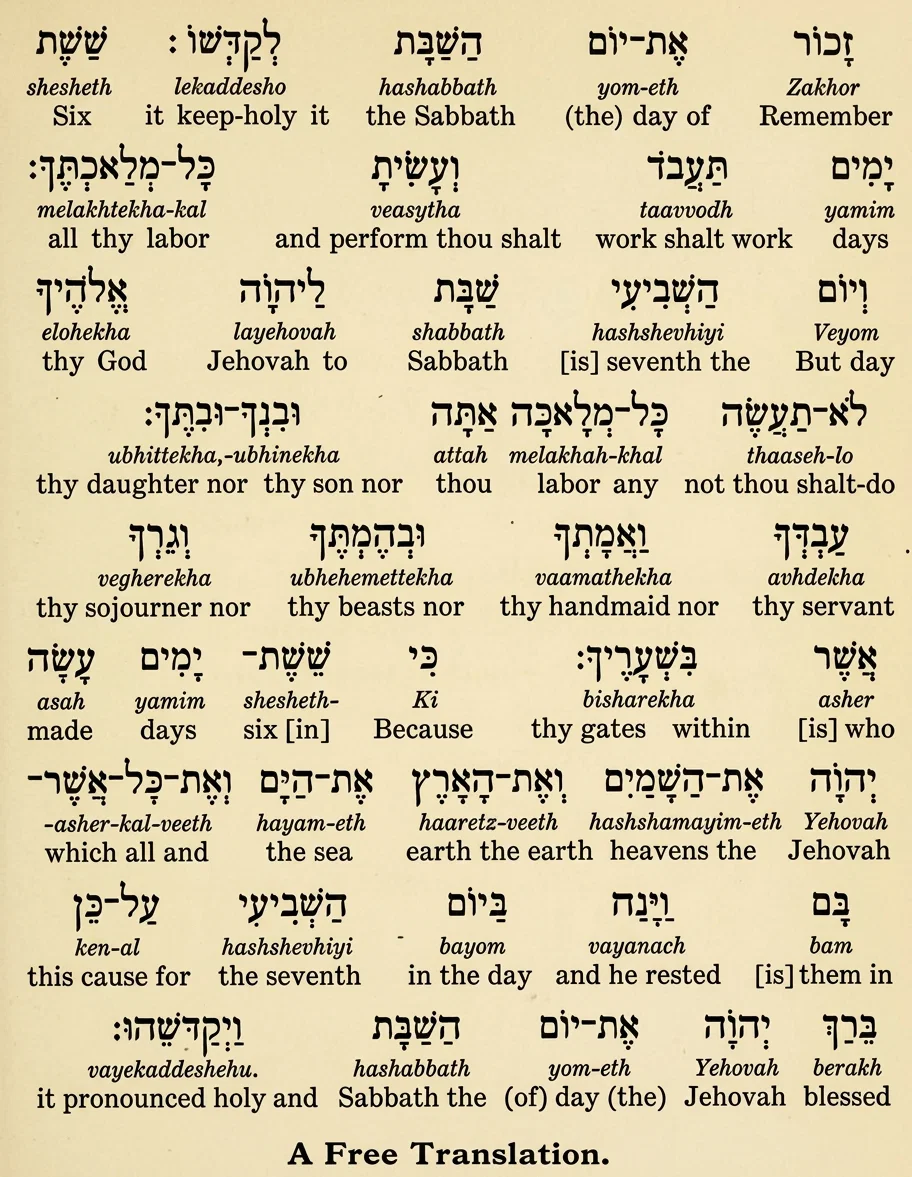
A Literal Word-for-Word Translation.
THE following word-for-word translation was made some years ago by Prof. A. Kunz, A.M., of Battle Creek, Mich. The Hebrew, like many other oriental languages, reads from right to left. The lines in Italics are a transliteration of the original, that is, putting into Roman letters the Hebrew words.
A Free Translation.
"Remember the day of the Sabbath [the rest] to keep it holy. Six days thou shalt work, and thou shalt perform all thy labor. But day the seventh is Sabbath to Jehovah thy God; [in it] thou shalt not do any labor; thou, nor thy son, nor thy daughter, thy servant, nor thy handmaid, nor thy beasts, nor thy sojourner, who is within thy gates. Because in six days Jehovah made the heavens and the earth, the sea, and all which in them is; and he rested in the day the seventh; for this cause Jehovah blessed the day of the Sabbath and holy pronounced it."
Keeping Christ’s Commandments
“If ye love Me, keep My commandments.”
General Articles
By Ada D. Wellman
"Christ Jesus, who of God is made unto us wisdom, and righteousness, and sanctification, and redemption."
"AND HE DIED."
"DEAD!" Such is the news that the press tells, to-day, of a person
But yesterday deemed the most honored and happy of men;
One who'd attained the fulfilment of highest ambitions,
His life a success, and new prospects still beckoning—then;
Now—dead? Ah! the loftiest heights of our poor aspirations
For influence, luxury, learning, for power or fame,
But lead to the low-lying valley to which we all hasten,
Where highest and humblest, all stations and ranks, are the same.
Ada D. Wellman.
TWO BOOKS.
By M. E. K.
A NEW book of a very remarkable character, both as to its matter, price, and the way it is to be distributed, is soon to be issued. The writer, or rather compiler, of the book, for he will draw material for it from many sources, is Mr. Hubert Howe Bancroft, popularly known as the "historian of the Pacific Coast." He was the author and publisher of a very remarkable book issued the year of the World's Fair in Chicago, known as the "Book of the Fair." His success in that enterprise has encouraged him to undertake another similar enterprise. The new book is to be called the "Book of Wealth." It is to be a history of wealth from the earliest times unto the present. The great nations of antiquity, their most stupendous works, and the traffic and trade of the greatest kings and merchant princes, will be fully described. All lands are to be searched for information; artists will prepare by original designs such pictures that the book will afford the best possible representation of wealth, and the elegance and luxury which have ever accompanied it during all past times.
Modern wealth will also be described. Sketches of the lives of the representatives of wealth now living will be given, whether crowned and titled Europeans and Asiatics, or the uncrowned, untitled kings of American commerce and trade. Photographs of the wealthy will embellish the book; even a group of the guests at the Bradley-Martin ball was photographed for that purpose.
It is perhaps needless to say that this book is not designed for general circulation. It is sold only to those who subscribe for it beforehand, and if the reader has not been asked to subscribe, he may be sure that he will be unable to obtain a copy. The smallest price for which one of these books can be obtained is $1,000, and $2,500 is the highest price. More than that, the line is very carefully drawn as to who can have them even at that price. Only about four hundred copies will be printed. A man worth less than $10,000,000 has little chance to get one. Even the king of Italy feels too poor to subscribe! Thousands would be glad to get their names in it, were they not barred by the lack of the millions necessary to gain their desire. Thousands of those who are comparatively wealthy will envy those who, by reason of their greater wealth, are given a place in this book, which they can not secure.
As I was reading of this book, and learning the facts which I have briefly stated here, there came to my mind this passage of Holy Writ: "And another book was opened, which is the Book of Life." Rev. 20:12. This book is not a new book; it is coeval with man's history. It is a book of wealth—of true wealth—for it is a book of character; and there is no wealth like the wealth of a righteous character. Those whose names are written and retained there (Phil. 4:3; Rev. 3:5) are the wealthiest persons of the world; yea, of the universe; for they are the children of God, "and if children, then heirs; heirs of God, and joint heirs with Christ; if so be that we suffer with him, that we may be also glorified together." Rom. 8:17.
How poor the fleeting treasures of this world look compared to the wealth possessed by every child of God! In his Word a new earth of surpassing loveliness is described, and a city whose walls are of jasper, whose streets are of gold, and whose gates are of pearl, is set before us as our future home, throughout the unending ages. Better than all, we are to have God's character of perfect holiness received by our faith in Jesus Christ, and the happiness that can only come by perfect freedom from sin. All this, and much that is beyond our understanding, is comprehended by the fact that one's name is in the "Lamb's Book of Life."
Who can have their names there?—All who repent of their sins, and accept the Saviour. The king can have it, and so can the humblest and poorest man in all his kingdom. No money is necessary to secure it. God is equally rich toward all his children. Here is the invitation: "Ho, every one that thirsteth, come ye to the waters, and he that hath no money; come ye, buy, and eat; yea, come, buy wine and milk without money and without price." Isa. 55:1.
But few can have their names placed in the "Book of Wealth," but all can have their names in the "Book of Life." There is no exclusiveness in our God. All are invited; all may come; all may share in the richest blessings both here and hereafter. "And the Spirit and the bride say, Come. And let him that heareth say, Come. And let him that is athirst come. And whosoever will, let him take the water of life freely." Rev. 22:17.
Reader, in which of these two books would you prefer to have your name? Probably you can not get it into the "Book of Wealth," even should you try; the wealthy will not permit it there; but all the wealth of the world, and all the power of the world, can not prevent the angel of God from tracing your name in the "Book of Life." Shall not each one who reads these words, seeing the goodness and mercy of God in stooping to save, and the glorious heights to which he will raise the repentant sinner, say, "Lord, I give up all for thee, to be thine and thine alone, both now and forevermore"? Then your name will be entered in the "Book of Life," and you in perfect confidence can say:—
"Jesus, my Lord, I know His name;
His name is all my trust;
Nor will He put my soul to shame,
Nor let my hope be lost.
"Firm as His throne His promise stands,
And He can well secure
What I've committed to His hands
Till the decisive hour.
"Then will He own my worthless name
Before His Father's face,
And in the New Jerusalem
Appoint my soul a place."
M. E. K.
THE GROWING LIFE.
Both natural and spiritual life are progressive. The body grows to manhood's prime, the soul grows in grace or grows in sin. As natural life never reaches a stationary point, neither does the development of character. Naturally, we grow in years; morally, we grow better or worse. Let us learn from nature's analogies. There are two forces operative in every life, one constructive, the other destructive. We live or die, as one or the other is triumphant. Whenever the plant reaches the limit of development, that moment it begins to decay, the destructive force is master. Whenever the Christian reaches the point that he ceases to7"grow in grace," to bring forth the "fruits of the Spirit," that moment he confronts the death line of the soul; spiritual death has laid hold upon him. But, while the grass withereth, and the flower thereof fadeth, because natural life is temporal, the gift of God to the soul is "life eternal;" and he who is the "resurrection and the life," declareth, "Whosoever liveth and believeth in me shall never die."—Selected.
THE NAME OF JESUS.
By Cyrus Simmons
THE meaning of the name Jesus is Saviour. The Hebrew form of Jesus is Joshua. The angel informed Joseph, "Thou shalt call his name Jesus; for he shall save his people from their sins." Matt. 1:21. Many have been called Jesus or Joshua before and since the incarnation of the Son of God, but none have been able to so perfectly manifest the salvable power of God.
A name given by man is to designate the individual; a name conferred by God is to indicate the character. The manifestation of God in sinful flesh in the person of Christ is to show the world by an unanswerable object lesson how divinity can and will fellowship with man and save him from his sins. The salvation from sinning is active and present; it lives with and confers everlasting life on the believer, because it is wrought through "the power and wisdom of God."
Christ, when referring to the spiritual condition of the living, says, "He that believeth not is condemned already, because he hath not believed in the name of the only-begotten Son of God." The converse he gives in the beginning of the verse, "He that believeth on him is not condemned. John 3:18. The tense in both instances is present, and the believing is active; the condemnation is likewise present, as it is evidenced by the works of the unbeliever. What is the nature of the works of an unbeliever?—Evidently it is carnal. The faith of the uncondemned is made known by his works, which are the fruits of the Spirit. Who can do the works of the Spirit save he who has the power of the Spirit by reason of Christ dwelling within him? Then to believe on Jesus is to believe in his name; and to believe in his name is to believe in his power to save us, not in our sins, but from our sins.
The Holy Spirit when interpreting the name of God says: "Behold, God is my salvation; I will trust, and not be afraid; for the Lord Jehovah is my strength and my song; he also is become my salvation. Therefore with joy shall ye draw water out of the wells of salvation. And in that day shall ye say, Praise the Lord, proclaim his name [margin], declare his doings among the people, make mention that his name is exalted." Isa. 12:2-4. Jehovah is our strength when the Spirit helpeth our infirmities. Rom. 8:26. The water that we shall draw with joy out of the wells of salvation is the same Spirit. John 7:38, 39. When Jehovah has become our strength through his Spirit, then it is by faith we draw this spiritual water out of the wells of salvation; then is the day when we shall praise the Lord, when we shall proclaim his name by our works through the power of his Holy Spirit; then is the day when we shall declare his doings and not our doings among the people, when we shall make mention that his name is exalted by the power of Jesus to save us from our sins.
This newness of life can only be had by a new birth, and by the companionship of an indwelling God; for the prophet concludes, "Cry out and shout, thou inhabitant of Zion; for great is the Holy One of Israel in the midst of thee."
From the foregoing how do we understand the following text, "For God so loved the world, that he gave his only-begotten Son, that whosoever believeth in him should not perish, but have everlasting life"? Simply to believe that nearly 1,900 years ago the Son of God became manifest in sinful flesh and lived a perfect life, can and will do one no good, without further believing that the same Jesus by a new birth through faith can become manifest in our sinful flesh and work out a sinless life; "then greater will be he that is in us, than he that is in the world." This is practical godliness; this is a living faith in Jesus, and a belief that he can save us from our sins; then it is we perish not; then it is we have that everlasting life, for we have the Son. CYRUS SIMMONS.
Knoxville, Tenn.
JEWISH CUSTOMS AND TRADITIONS.
By F. C. Gilbert
(By an Israelite.)
The Sanctuary and Its Services.—Continued.
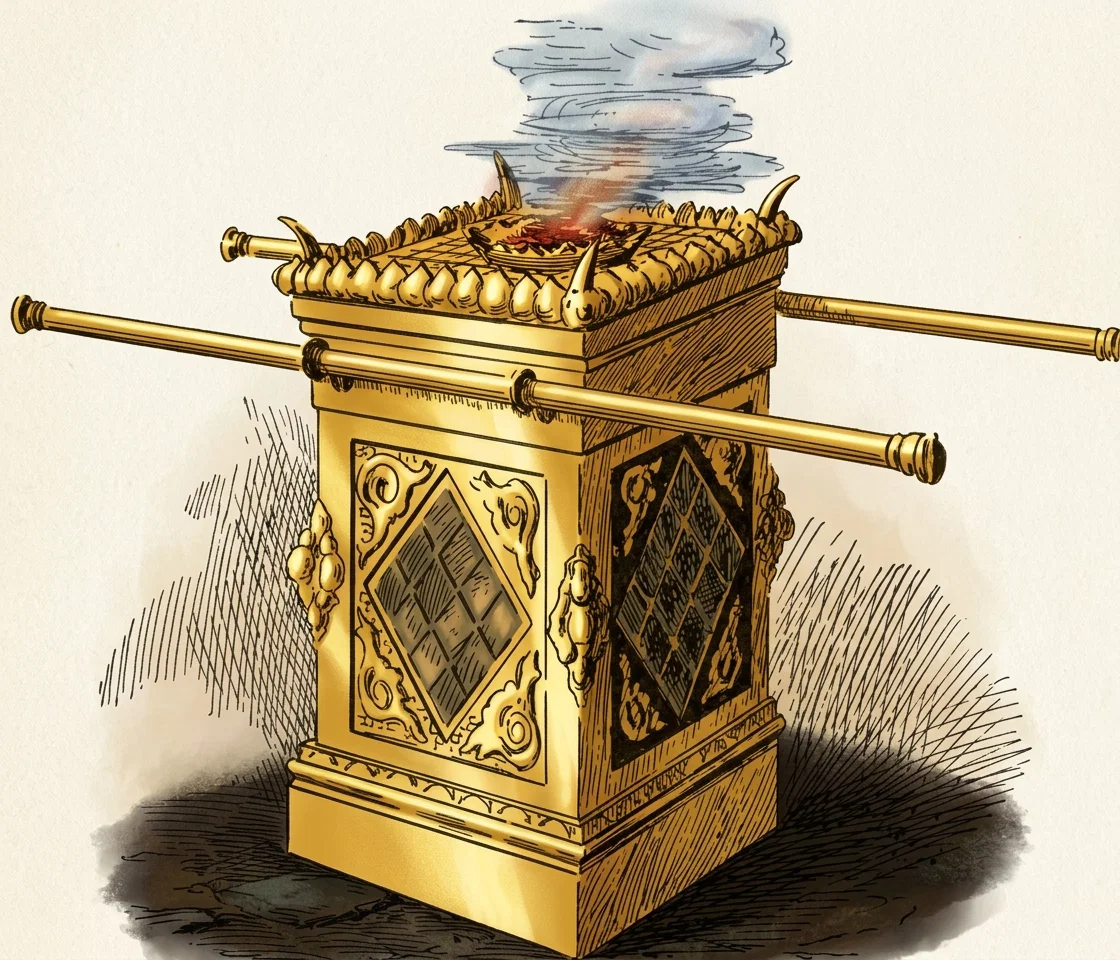
The Golden Altar.
WE will now take leave of the outer part of the tabernacle, and enter into the first apartment of the holy places. What beauty and grandeur do we behold, as we get a glimpse of the articles of furniture therein! The first thing we meet is the golden altar, or the altar of incense. A description of it is found in Exodus, as follows:—
"And thou shalt make an altar to burn incense upon; of shittim wood shalt thou make it. A cubit shall be the length thereof, and a cubit the breadth thereof; foursquare shall it be; and two cubits shall be the height thereof; the horns thereof shall be of the same. And thou shalt overlay it with pure gold, the top thereof, and the sides thereof roundabout, and the horns thereof; and thou shalt make unto it a crown of gold roundabout. And two golden rings shalt thou make to it under the crown of it, by the two corners thereof, upon the two sides of it shalt thou make it; and they shall be for places for the staves to bear it withal." "And thou shalt put it before the vail that is by the ark of the testimony; before the mercy-seat that is over the testimony, where I will meet with thee."
And the use of the altar is thus described:—
"And Aaron shall burn thereon sweet incense every morning; when he dresseth the lamps, he shall burn incense upon it. And when Aaron lighteth the lamps at even, he shall burn incense upon it, a perpetual incense before the Lord throughout your generations. Ye shall offer no strange incense thereon, nor burnt sacrifice, nor meat offering; neither shall ye pour drink offering thereon." "And thou shalt set the altar of gold for the incense before the ark of the testimony." Chapter 30:1-4, 40:5.
The composition for the incense is found in chapter 30:34-38, directions for its use in chapter 30:6-9.
Thus in brief has the Lord given us a description of the altar, and the purpose it served. It was especially designed for use morning and evening; but the effect of the incense lasted the remaining interval. What a beautiful odor must have emanated from that altar as the incense ascended to God, and how fragrant must it have been before him! It not only filled the holy place, but affected the most holy also, as it filled all the space where it had opportunity to expand.
How fittingly does the incense offered upon the altar represent the prayers of God's people! David says, "Let my prayer be set forth before thee as incense; and the lifting up of my hands as the evening sacrifice." Ps. 141:2. The true prayer kindled by the fire of God's own love ascends to the throne of grace as the sweet odors from the altar. And how fragrant are the prayers of a Christian to God! His anxiety to have us pray to him is greater than our own. He loves to have us pray, and delights to send answers of peace.
What a calm and holy joy the priest must have had when he lit the lamps morning and evening! And how pleased he must have been when that time came, that he might offer the sweet incense unto the Lord.
It must be no strange fire to offer that incense; that would not be acceptable to the Lord. Aaron's sons did offer foreign fire upon the altar of incense, and the result was they lost their lives. See Lev. 10:1, 2. Prayers which arise to God, to be accepted in his sight must be inspired by his own flame of love; any other inspiration is false fire, which is not acceptable to God, and the result will be spiritual death. That is why there is so little spiritual life in Judaism to-day, and also in apostate Christianity. The prayers which are offered are either written out or else a dead formality, consequently there is no life to the soul.
The spiritual people in the days of Christ understood that this was the meaning of the offering up of the incense morning and evening,—the ascension of true prayer to the Lord. "And it came to pass, that, while he [Zacharias, the priest] executed the priest's office before God in the order of his course, according to the custom of the priest's office, his lot was to burn incense when he went into the temple of the Lord. And the whole multitude of the people were praying without at the time of incense." Luke 1:8-10.
Christ himself delighted often to pray, and we can see probably why he enjoyed so much to commune with his Father. He was a sweet savor unto the Lord, offering his prayers to God, which were always acceptable to the ears of his Father. What a privilege the Saviour thought prayer was, and how he delighted to spend whole nights in this way! And it was prayer which gave him so much strength to perform his work, and carry on his mission for which he came to the world. And as in days of old when that incense arose to the Lord there was much pleasure brought to the heart of God, so the Father took delight in having his Son approach him, regarding the prayer fragrant as incense. The incense filled all the sanctuary with its rich odor; prayer filled all the life of Christ with the fragrance of kind deeds and ministrations of mercy. God accepted the incense; he accepted also the prayers.
And, dear reader, what was true of the offering of the incense in the days of the priests in the sanctuary, and also the offering of the prayers of Jesus while on earth, is equally true of the prayers of the Christian of to-day who serves God in deed and in truth. The real ministration is carried on in heaven to-day and the Lord accepts us and our prayers. "And another angel came and stood at the altar, having a golden censer; and there was given unto him much incense, that he should offer it with the prayers of all saints upon the8golden altar which was before the throne. And the smoke of the incense, which came with the prayers of the saints, ascended up before God out of the angel's hand." "And when he had taken the book, the four beasts [living creatures] and four and twenty elders fell down before the Lamb, having every one of them harps, and golden vials full of odors [margin, incense], which are the prayers of saints." Rev. 8:3, 4; 5:8.
What a blessed thought! Jesus Christ, our great high priest, stands to-day before the throne of God, and through his precious merits, makes our prayers as acceptable to God as was the incense in days of yore. And too, they are equally as fragrant to him. Not because we offer them, but because he makes them acceptable through Jesus. And the Saviour told us he would pray for us after he went away. And we know that he never offered a prayer but what was always pleasant to the sight of God. "And Jesus lifted up his eyes, and said, Father, I thank thee that thou hast heard me. And I knew that thou hearest me always." John 11:41, 42. And if those prayers were heard while on earth, surely they will be heard for us while he is in heaven. "Let us therefore come boldly unto the throne of grace, that we may obtain mercy, and find grace to help in time of need." Heb. 4:16. Let us pray much and often; and let our petitions be inspired by the sparks of his own love; then they will be accepted before him, and he will delight to receive us. What blessings we lose because we do not come, when he is so anxiously waiting to bestow his love upon us, and make our lives fragrant with his own good works, which he has wrought for us through Jesus!
"Prayer is the breath of God in man,
Returning whence it came;
Love is the sacred fire within,
And prayer the rising flame."
F. C. GILBERT.