Your ShelfYour Projects

Signs of the Times, Vol. 20, No. 35.

Pennsylvania Sunday Observance Laws
Earlier text: MANNERS AND MANNER

SUGGESTIVE THOUGHTS.

SOME revivals are "got up." Others come down. Revivals where the evangelist is the chief attraction are those that come up—from the pit.
Let us have the kind of revivals that make the Zaccheuses pay back what they have taken by fraud.
There is a wide difference between church loyalty and church bigotry.
In nine cases out of ten, apologies are made before preaching for the purpose of leading the people to believe the opposite of what the preacher is saying. Long introductions spoil sermons. Too much soup takes away the appetite for dinner.
Fretting babies do not disturb the preacher, but inquisitive people do, who turn around to look.
Don't tell your pastor that you "enjoyed" the sermon. If you cannot say it helped you, say nothing about it.
People who serve God only when they feel like it, never do a full day's work.
If some preachers would not try to do so much, God would do more for their congregations.
The word "ought," thoroughly learned, is a boy's best equipment.
Two half Christians do not make one whole one. They make zero.
The church of God is not a house of "attractions." The lust of entertainment and the teaching of the cross do not go together.
What is there funny about the ten commandments or the sermon on the mount? Let those who are clamoring for "spicy preaching" answer.—Selected.

CAMP MEETINGS FOR 1894.

DISTRICT NUMBER ONE.

New York..........................................July 26 to Aug. 6 Virginia..................................................Aug. 7-14 West Virginia.........................................Aug. 16-27 Vermont, Morrisville..........................Aug. 23 to Sept. 3 New England.....................................Aug. 30 to Sept. 10 Maine, Bath............................................Sept. 6-17

DISTRICT NUMBER TWO.

Tennessee River, Bowling Green..................................................Aug. 27 to Sept. 7 Florida, Seffner........................................Nov. 8-18

DISTRICT NUMBER THREE.

Ohio, Newark........................................Aug. 10-20
  • Indiana, Indianapolis..............................Aug. 7-13
Michigan (northern) Frankfort.................Aug. 20-27
  • Illinois....................................................Aug. 22-28
Michigan (State) Lansing.....................Sept. 19 to Oct. 1

DISTRICT NUMBER FOUR.

Nebraska, Lincoln (Peck's Grove) Aug. 21-28

DISTRICT NUMBER FIVE.

Texas, Cleburne......................................Aug. 9-20 Arkansas, Fayetteville............................Aug. 16-27 Oklahoma T'y,..................................Aug. 23 to Sept. 3 Colorado, Denver..............................Aug. 30 to Sept. 10 Kansas, Emporia......................................Sept. 6-17 Missouri, Warrensburg (Pertle Springs) ..........................................................Sept. 19 to Oct. 1

DISTRICT NUMBER EIGHT.

Central Europe, Neuchâtel...................July 12-22
Appointments marked by a star will be preceded by a workers' meeting. GEN. CONF. COM.

International S. S. Lessons.

"So they read in the book in the law of God distinctly, and gave the sense, and caused them to understand the reading." —Neh. 8:8

LESSON IV.—SUNDAY, JULY 22, 1894.

FLIGHT INTO EGYPT.

[NOTE.—The questions which follow are merely suggestive for the student on the leading points of the lesson; it is presumed that the thorough student will think of many more as he studies the subject. References, where verses alone are given, always refer to the lesson scripture printed above. All other references are given in book, chapter, and verse. The text printed is that of the Revised Version, not because it is especially preferred, but because it is not found in every family, as is the common version.]

Lesson Scripture, Matt. 2:13-23.

13. Now when they were departed, behold, an angel of the Lord appeareth to Joseph in a dream, saying, Arise and take the young child and his mother, and flee into Egypt, and be thou there until I tell thee; for Herod will seek the young child to destroy him.
14. And he arose and took the young child and his mother by night, and departed into Egypt; and was there until the death of Herod;
15. That it might be fulfilled which was spoken by the Lord through the prophet, saying, Out of Egypt did I call my son.
16. Then Herod, when he saw that he was mocked of the wise men, was exceeding wroth, and sent forth, and slew all the male children that were in Bethlehem, and in all the borders thereof, from two years old and under, according to the time which he had carefully learned of the wise men.
17. Then was fulfilled that which was spoken by Jeremiah the prophet, saying,
18. A voice was heard in Ramah, weeping and great mourning, Rachel weeping for her children; and she would not be comforted, because they are not.
19. But when Herod was dead, behold, an angel of the Lord appeareth in a dream to Joseph in Egypt, saying,
20. Arise and take the young child and his mother, and go into the land of Israel; for they are dead that sought the young child's life.
21. And he arose and took the young child and his mother, and came into the land of Israel.
22. But when he heard that Archelaus was reigning over Judea in the room of his father Herod, he was afraid to go thither; and being warned of God in a dream, he withdrew into the parts of Galilee.
23. And came and dwelt in a city called Nazareth; that it might be fulfilled which was spoken by the prophets, that he should be called a Nazarene.
Golden Text: "The Lord shall preserve thy going out and thy coming in." Ps. 121:8.
NOTE.—Chronologically, this lesson follows immediately after the last. Joseph and Mary evidently started for Egypt immediately after the departure of the wise men. This account is found only in Matthew. The places mentioned are Bethlehem of Judea, spoken of in our last lesson, Nazareth, a little city in Galilee west of the Sea of Galilee, and the country of Egypt. The place there is supposed to be Matareeh, a few miles northeast of Cairo. The rulers, general and special, at this time were, Augustus Caesar, emperor of Rome, and Herod the Great, his thirty-fourth and last year as king of Judea. His successor was Herod Archelaus, this being his first year.

SUGGESTIVE QUESTIONS.

  1. When the wise men had departed, how did the Lord speak to Joseph? Verse 13.
  2. What did he tell him to do? and why? Note 1.
  3. How promptly did he obey? Verse 14.
  4. How long was he in Egypt? Verse 14. Note 2.
  5. What prophecy was thus fulfilled by Joseph's going into Egypt? Verse 15.
  6. When Herod saw that the wise men did not return, how did it affect him? Verse 16.
  7. What did he do?
  8. What prophecy was thus fulfilled? Verses 17, 18. Note 3.
  9. When Herod died, how did the Lord again instruct Joseph? Verse 19.
  10. What message did he send him? Verse 20.
  11. How did Joseph regard the message? Verse 21.
  12. When he heard that Archelaus was reigning in the room of Herod, how did he feel? Verse 22.
  13. What did the Lord warn him to do? and how?
  14. Where did he dwell? Verse 23.
  15. What was thus fulfilled? Note 4.

NOTES.

1. THE child Jesus was in danger, not because of any hatred which was possessed toward Joseph, but because of the hatred which Satan possessed toward Christ. Herod was not stirred up against the holy family because of any prejudice which he had against them, but because Satan had stirred him up against the promised Ruler of the people of God. In his birth, his care, and his training, he was under the divine instruction. The Lord says, Go to Egypt and stay there till I bring thee word. "It was not necessary for Joseph to know the times nor the seasons;" as it has been well remarked, only that he should commit his ways unto God, who did know. The cruelty of Herod is well known. Farrar says: "Deaths by strangulation, deaths by burning, deaths by being cleft asunder, deaths by secret assassination, confessions forced by unutterable torture based on insolent and inhuman lust, marked the annals of a reign which was so cruel that it is said the survivors during his lifetime were more miserable than the sufferers." "And, as in the reign of Henry VIII., every dark and brutal instinct of his character seemed to acquire fresh intensity as his life drew to its close." This lesson also shows God's special goodness as manifested through the ministration of angels.
2. Until the death of Herod.—How long they remained after this is uncertain. Immediately after the reign of Herod began the reign of Herod Archelaus. He also was of a cruel disposition. Consequently when Joseph returned, he did not dwell longer in Judea.
3. In this act of Herod is shown the fearful cruelty of his character. His rage was vented entirely upon those who were innocent of any wrong. Even granting that there was to be a king from some of those children who would take the throne which Herod occupied, he probably would not have come to the throne during Herod's lifetime. But Herod's foolish ambition and mad jealousy brooked no restraint. In this prophecy in Jeremiah is also brought to view God's promise of the resurrection. This is not mentioned in Matthew; but the Lord says in Jer. 31: 16, "Thy children shall come again to their own border." God will bring back from the enemy's land, the land of death, all those who have died for his sake and in him. That is especially true of those children who were slain for his sake, not in the same sense in which others have suffered for his sake, but they were innocent sufferers because he was in the world.
4. He shall be called a Nazarene.—Not "Nazarite," which is a different word in the original Scriptures. The word Nazareth seems to have come from Nezer, denoting a feeble branch in contrast with a noble tree, and the city itself seems never to have risen out of its original insignificance. The Jews seem to regard it in that light. "Can any good come out of Nazareth?" had become with them a proverb. So it is said of the Messiah by the prophet Isaiah that "he is a root out of a dry ground." He is called the "Branch." He had no external sign of nobility or excellence or power, and the family of David at this time was sunken in lowliness. By living in Nazareth Jesus came to be known as a Nazarene; and this name precisely fulfilled the idea, says Peloubet, expressed by the prophets as belonging to the Messiah. Jesus was a branch (Isa. 11: 1), and by his Nazareth (branch) name fulfilled this prediction. But if we take the meaning of Nazareth to be one who saves or protects, the name Nazarene would have reference to his work as a Saviour. In either case it fitly applies to the Lord's Messiah. One practical lesson that we may learn from this is God's divine guidance and special care over all his children. He will guide us and minister to us just as truly as he did to our Lord Jesus Christ if we trust him. We may also learn that however much men may plot or plan against God's purposes their schemes will come to naught. God's decrees, the purpose of the ages, will be fulfilled. The kings of the earth may take counsel against his Anointed, but the Lord that sitteth in the heavens will laugh and will have them in derision. Everyone who embraces Him in whom all God's purposes center will triumph with Him in that day when He shall take His kingdom.

SCHOOL CATALOGUES.

We have received from two of our Eastern schools neat catalogues for 1894-95.
The calendar of Battle Creek College gives us the board of trustees; the officers; the beginning and ending of the terms of school; the faculty; a description of the college, its location, founding, object, character, etc.; departments of instruction, in which the Bible is made prominent; general outline of the various courses (Biblical, Scientific, and Classical); expenses; regulations; summary of students; list of graduates; text-books, etc. Very full information is given to the readers as to the kind and character of the school. The officers of the board are: President, U. Smith; Secretary, W. W. Prescott; Treasurer, A. R. Henry. Catalogues and information may be obtained, we suppose, by addressing the secretary, at Battle Creek, Mich.
Calendar of Mount Vernon Academy, Mount Vernon, O. This is a neatly gotten-up pamphlet, with three cuts of the buildings and grounds. It contains information respecting the academy similar to that given above of Battle Creek College. The officers are as follows: President G. A. Irwin; Secretary, H. M. Mitchell; Treasurer, W. T. Bland. Copies may be obtained we suppose by addressing the secretary at Mount Vernon, O. May God greatly prosper these schools in the year to come.

LITERATURE WANTED.

Seventh-day Adventist literature is desired for distribution by the missionary society at Pendleton, Oregon. Address, postpaid, Elder G. W. Davis.

IN THE HEART OF THE SIERRAS

YOSEMITE VALLEY, BIG TREES ETC.

By Col. J. M. HUTCHINGS.
Fine English Cloth, embossed in jet and gold, - - $3 25 Fine English Cloth, embossed jet and gold, gold edges, 3 75 Full Sheep (library style), marbled edges, - - - - 4 25 Half Morocco, gold edges, - - - - - - - 5 00 Full Morocco, gold edges, - - - - - - - 6 00
The most authentic and intensely interesting description of the Yosemite Valley and Big Tree Groves of California ever written. It contains nearly 500 pages of text, with more than 150 illustrations, 28 of which are beautiful full-page artotypes. It portrays, by aid of the artist's genius and the author's facile pen, the lofty mountains and charming valleys, the placid lakes and thundering cataracts, of the world-renowned Yosemite. The mission of this work is to make the best possible representation of the marvelous scenery and sublime natural wonders of this unique region.
TOURISTS' EDITION.—We have just issued a TOURISTS' EDITION of this grand book. It is the same size page and contains everything that our elegant Subscription Edition does, except the artotype plates. It is printed on a fine quality of thinner paper, bound in flexible binding, and makes a beautiful book. Paper covers, $1.25. Flexible cloth, $1.50. Address, PACIFIC PRESS PUBLISHING CO., Oakland, Cal.

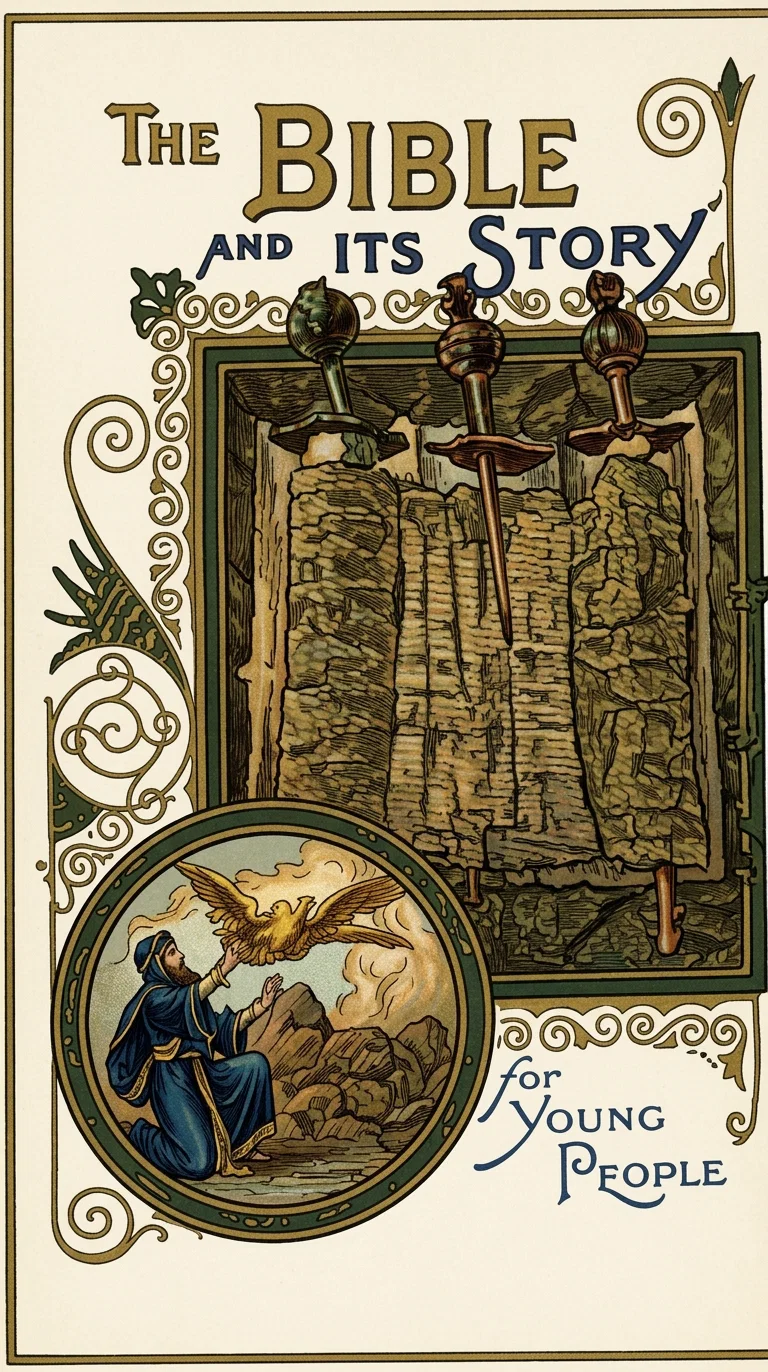
THE BIBLE

AND ITS STORY

BY JOSEPHINE POLLARD Author of "The History of the New Testament in Words of One Syllable;" "History of the Old Testament;" "Battles of America."
This volume has been published to assist parents, guardians, and teachers in the religious instruction of those under their charge by enabling them to place in the hands of children a book which would reverently tell the Biblical story without sectarian bias. The one object that has been kept steadily in view throughout its preparation has been to present a connected narrative of the sacred events, consecutively arranged in the order of their occurrence, and describe in such clear and simple language as could be easily understood by youthful readers. It is believed that no more complete and accurate recital of Scriptural history has ever before been made for the use of the young.
The book comprises 576 pages. There are 280 illustrations (many of them full-page), of which a complete list is prefixed to the volume. Especial attention is called to the Index, which occupies twenty-two double-columned pages and contains upwards of two thousand analytical references to the text. The great fullness of this Index will of itself render the volume invaluable to all who believe that a familiar knowledge of the incidents of the Bible cannot be acquired at too early an age.
Price, postpaid, $1.00. Address, PACIFIC PRESS PUBLISHING CO. Oakland, California.

"FATHERS OF THE CATHOLIC CHURCH."

By ELD. E. J. WAGGONER.

HISTORY REPEATS ITSELF,

Because human nature is the same in all ages of the world. Hence he who would know how to avoid error in the future must know how errors have developed in the past. The "FATHERS OF THE CATHOLIC CHURCH" shows the condition of the heathen world at the time of Christ, briefly states the principles of ancient heathen philosophy, which was largely responsible for the immorality of that time, and shows how the adoption of these principles by prominent men in the church, and the incautious lowering of the standard of pure Christianity to accommodate the heathen element, developed the Papacy, which was simply a new phase of Paganism. It shows that by the time of Constantine every phase of the Papacy was fully developed, and was only waiting for supreme power. The chapter on

SUN-WORSHIP AND SUNDAY

Is alone worth the price of the book. The chapter on "The Apostolic Church" consists largely of quotations from Scripture, showing that grave errors both of faith and practice existed in the church even in the days of the apostles, so that the early existence of a practice proves nothing as to its correctness. Then a chapter is devoted to each of the Fathers, and to his writings. The Sunday argument, so far as it is drawn from the Fathers, is completely demolished by the citation of other testimony from them in favor of some of the grossest evils of the Catholic Church. Lastly, several chapters are devoted to "The Great Apostasy," in which are traced the logical results of the teachings of the Fathers.

EVERYBODY SHOULD HAVE THIS BOOK

As all are constantly meeting quotations from the Fathers in behalf of Sunday. In these cases it is only necessary to show that the same Fathers believed in purgatory and prayers for the dead, to nullify their testimony.
The book is printed on fine tinted paper, neatly bound in cloth, with gilt side stamp, and contains 392 pages.

PRICE, POSTPAID, $1.00.

Address all orders to

PACIFIC PRESS PUBLISHING CO.,

Or, 43 Bond Street, New York. OAKLAND, CAL.

BIBLE SANCTIFICATION:

A CONTRAST OF TRUE AND FALSE THEORIES. BY MRS. E. G. WHITE.
This is a pamphlet of only 84 pages, but its value is not to be judged by its size. It is just what its title indicates: a faithful presentation of Bible truth on this important subject, and an exposure of the false theories prevailing in regard to it. Every believer in Bible truth should read it. Buy it, read it, and lend it to your neighbor. Price, 10 cents.
Address, PACIFIC PRESS, Oakland, Cal.

LESSON III.—SABBATH, JULY 21, 1894.

PREPARING FOR HIS COMING.

Lesson Scripture, Luke 12: 41-59; 13: 1-5.
41. And Peter said, Lord, speakest thou this parable unto us, or even unto all,
42. And the Lord said, Who then is the faithful and wise steward, whom the Lord shall set over his household; to give them their portion of food in due season?
43. Blessed is that servant, whom his lord when he cometh shall find so doing.
44. Of a truth I say unto you, that he will set him over all that he hath.
45. But if that servant shall say in his heart, My lord delayeth his coming; and shall begin to beat the menservants and the maidservants, and to eat and drink, and to be drunken;
46. The lord of that servant shall come in a day when he expecteth not, and in an hour when he knoweth not, and shall cut him asunder, and appoint his portion with the unfaithful.
47. And that servant, which knew his lord's will, and made not ready, nor did according to his will, shall be beaten with many stripes;
48. But he that knew not, and did things worthy of stripes, shall be beaten with few stripes. And to whomsoever much is given, of him shall much be required; and to whom they commit much, of him will they ask the more.
49. I came to cast fire upon the earth; and what will I, if it is already kindled?
50. But I have a baptism to be baptized with; and how am I straitened till it be accomplished!
51. Think ye that I am come to give peace in the earth? I tell you, Nay; but rather division!
52. For there shall be from henceforth five in one house divided, three against two, and two against three.
53. They shall be divided, father against son, and son against father; mother against daughter, and daughter against her mother; and mother-in-law against her daughter-in-law, and daughter-in-law against her mother-in-law.
54. And he said to the multitudes also, When ye see a cloud rising in the west, straightway ye say, There cometh a shower; and so it cometh to pass.
55. And when ye see a south wind blowing, ye say, There will be a scorching heat; and it cometh to pass.
56. Ye hypocrites, ye know how to interpret the face of the earth and the heaven; but how is it that ye know not how to interpret this time?
57. And why even of yourselves judge ye not what is right?
58. For as thou art going with thine adversary before the magistrate, on the way give diligence to be quit of him; lest haply he hale thee unto the judge, and the judge shall deliver thee to the officer, and the officer shall cast thee into prison.
59. I say unto thee, Thou shalt by no means come out thence, till thou hast paid the very last mite.
1. Now there were some present at that very season which told him of the Galileans, whose blood Pilate had mingled with their sacrifices.
2. And he answered and said unto them, Think ye that these Galileans were sinners above all the Galileans, because they have suffered these things?
3. I tell you, Nay; but except ye repent, ye shall all in like manner perish.
4. Or those eighteen, upon whom the tower in Siloam fell, and killed them, think ye they were offenders above all men that dwell in Jerusalem?
5. I tell you, Nay; but, except ye repent, ye shall all likewise perish.
IN studying this lesson, do not forget to review the whole chapter until you can "think through" the whole of it. This lesson is rather difficult of close analysis, and perhaps the heading of the lesson may be sufficient to indicate that portion of it which is in the twelfth chapter. Close study will enable you to master the details. The necessity for repentance may serve to keep in mind the subject of the first five verses of the thirteenth chapter, although it does not indicate all the lesson that is to be learned from them.
  1. With what illustration did the last lesson close?
  2. What question did Peter ask?
  3. How did the Lord answer him?
  4. What will be done by the faithful servant? Compare Rev. 21: 7.
  5. What other class of servants is mentioned?
  6. How does he say, "My Lord delayeth his coming"?
  7. What is the outward evidence of what he is saying in his heart?
  8. What will be done to such a servant?
  9. What is said about the degrees of punishment?
  10. What did Christ say he had come to send on the earth?
  11. What will the gospel of Christ cause?
  12. How do people judge of the weather?
  13. When people can so readily read the face of the sky and of the earth, what else ought they to be able to do?
  14. With what exhortation and lesson does the chapter close?
  15. Of what did some who were present tell Jesus?
  16. What did Jesus say of them?
  17. What did he say of those upon whom the tower in Siloam fell?
  18. What did he say of all who should not repent?

NOTES.

1. THE gospel of Christ is the "gospel of peace" (Eph. 6: 15), yet it causes division and strife, because of the hardness of men's hearts. The Lord, through the Psalmist, says, "I am for peace; but when I speak, they are for war." Ps. 120: 7.
2. Do NOT make the mistake of trying to make an application of all the details of the illustration in the close of chapter twelve. Remember that we are not told what the adversary, the officer, the magistrate, and the judge signify, or that they are designed to have any particular significance. Consequently, any attempt to apply them in detail, as to God, the law, Satan, etc., can be nothing but idle speculation. In the absence of any application of the terms in the Scripture, it is sufficient to be admonished by the illustration to give diligence to be at peace with God, and to be delivered from the bondage of sin.
3. CHRIST teaches that it is a mistake to suppose that every calamity is a punishment for some specific sin. This is shown, not only in the present lesson, but in John 9: 1-3. The entire book of Job shows the same thing. Jesus does not say that these Galileans and the others were not sinners, but that they were no greater sinners than others who had received no injury. Read the seventy-third psalm, and learn that God does not settle accounts in this life, and read also the book of Job, to learn that affliction is not necessarily a sign of God's displeasure. See also James 5: 11.
WORD THOUGHTS.—Fire (v. 49). "God is a consuming fire." He will consume the sin and leave us pure if we desire. He will consume us at last with the sin if we choose that instead of God.—Straitened (v. 50), constrained, pressed.—Division (v. 51). Christ's gospel is healing. It causes division by calling men out of death into life, and many will not come.—A cloud (v. 54), literally, the cloud, the particular kind of cloud which indicated rain.—Discern (v. 55), to test or prove. The R. V. has "interpret," with the margin "prove."—Hale (v. 58), haul or drag.—Officer, from the verb prassō, to effect or accomplish, to bring things to an issue, to exact. See R. V., margin.—Mite (v. 59) from leptos, peeled, husked, and hence thin or fine. Therefore of a very small or thin coin. Vincent.—Sinners (v. 4) literally "debtors," referring perhaps to reference in last chapter.

Steps to Christ; Christ and the Sabbath

STEPS TO CHRIST. The Pacific Press Publishing Co., Oakland, Cal., have received an entirely new stock of the latest edition of that excellent book entitled "Steps to Christ," by Mrs. E. G. White. The price, postpaid, is only 75 cents. Address as above.
CHRIST AND THE SABBATH: Or Christ in the Old Testament and the Sabbath in the New, by Elder James White. Paper covers, fifty-six pages, sent post-paid for ten cents. Address, PACIFIC PRESS, Oakland, Cal.

CHRIST IN THE GOSPELS,

—OR—

The Life of our Lord in the Words of the Evangelists,

BY JAMES P. CADMAN, A. M.
Is, as its Name Indicates, a Compilation in which the four Narratives of # THE LIFE OF CHRIST ARE WOVEN INTO ONE CONNECTED STORY, MAKING A COMPLETE HARMONY OF THE GOSPELS IN THE EXACT LANGUAGE OF THE SCRIPTURES.
THE text is that of the Revised Version, and while every word in the four Gospels appears, the work is so arranged that the reader can tell at a glance the words used in each Gospel. Those who have tried to gather all the facts concerning some miracle, or other event, and at the same time properly locate and credit the various parts of the narrative, will appreciate this book, which is the very best of its kind and gives evidence of an immense amount of careful and painstaking labor.
The book is fully indexed so that any text or subject can be readily found; and the maps, notes, and diagrams which it contains are alone well worth the price of the volume. The following partial (less than half) TABLE OF CONTENTS will give an idea of the scope of the work:—
Index to chapter and verses; Life of Our Lord (333 pages); Index of persons, places, and subjects, with dictionary of proper names; Explanation of maps and diagrams; Map of the pathway of Jesus; Diagrams illustrating the principal events of crucifixion week.
This work is invaluable, and all who love the Bible should have a copy. It contains 394 pages, is well printed on good paper, and is neatly and substantially bound in cloth.
Price, post-paid, - - - - - - - - - - $1.50 With gilt edges, - - - - - - - - - - - 2.00 Address, PACIFIC PRESS, Oakland, Cal.
BIBLE ELECTION. By M. C. Wilcox. A brief presentation of God's plan and purpose concerning man, showing that the doctrine of election, or predestination, according to the Bible, is full of comfort and instruction. It throws new light on old controversies. Bible Students' Library, No. 67; 24 pp.; price 3 cents. Address Pacific Press Pub. Co., Oakland, Cal.
THE TALENTS. By M. C. Wilcox. A brief essay on "The Parable of the Talents," showing that the talents represent the various gifts of the Spirit which God bestows as he will upon those who are consecrated to him, with the duties and blessed privileges involved therein. Bible Students' Library, No. 77; 16 pp.; price 2 cents.
Continue reading: News and Notes