The Youth’s Instructor, Vol. 27, No. 40.

Samuel's Call

The Youth’s Instructor

Oct 4, 1879

S. D. A. Publishing Association · Battle Creek, Mich. · Oct 4, 1879

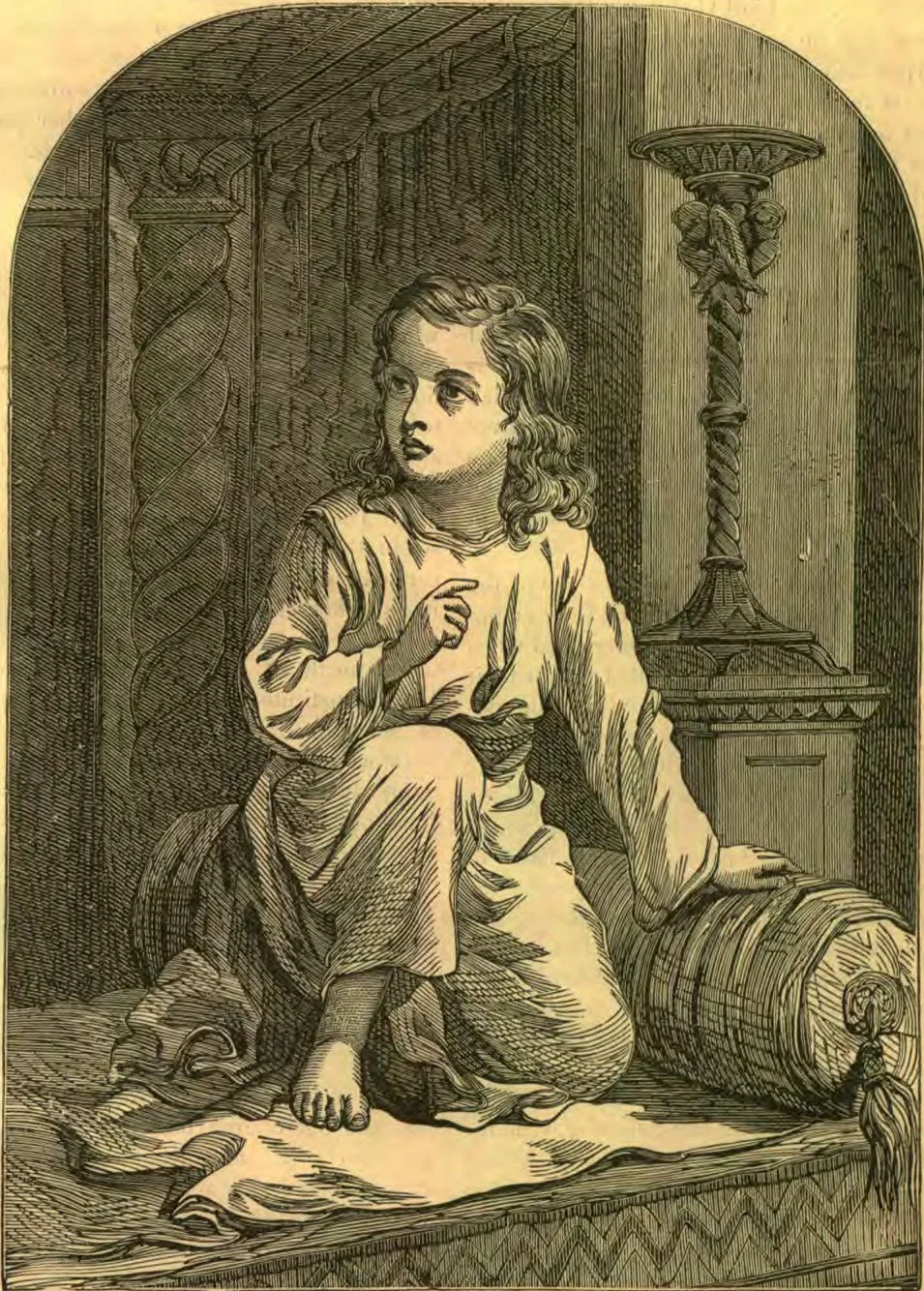
Samuel's Call.

JUST as you are going to sleep at night, if a voice from Heaven should call you by name, it would startle you so that you would not be able to go to sleep again. Do you remember the story of Samuel the prophet, how he was called of God when he was a little boy? His mother had brought him to the temple, and left him there to live with the good priest, Eli. Samuel's mother used to come and see him once a year, and always brought him a new coat when she came.
One night, as the little boy was going to bed, he heard some one calling to him, Samuel! Samuel! He thought it was Eli the priest who spoke, and running into the next room, where the good man was sleeping, he said, “Here am I.” Eli told him that he had not called him, and bade him lie down again. He went back to his little room, and lay down. How sweet and childlike this was! He was not afraid, for Eli had told him to go; and though he could not tell who had called him, he lay down again to sleep.
And again the same voice called to him, Samuel! Samuel! Now he thought, surely that must be Eli, the good old priest, who has called me; and getting up, he went into Eli's room again, but he had not called him. Eli sent him back, and once more he lay down on his pillow. The third time the same voice was heard: Samuel! Samuel!
Was it Eli? It must have been, for no one else was there. So he went to Eli again and asked him if he had called him. Samuel did not suppose the Lord would speak to a child; but Eli thought it must be he, and told Samuel to go and lie down, and if he heard the voice again, to say, “Speak, Lord, for thy servant heareth.”
The little boy did as he was told. Once more he went to his bed, and the Lord called again, Samuel! Samuel! You would think that a child would be afraid to speak to the great God. But he was not afraid. He said, as Eli had told him, “Speak, Lord, for thy servant heareth.” Then the Lord told him what he would have him do; and afterward trained him up to be a prophet, a preacher, and a very good and useful man.
The God of Heaven has never called you as he did Samuel, and asked you to become his child, and grow up in his fear and love, and serve him. But he has called you in many other ways, and very often. Did you ever hear his voice?
He speaks to you in his holy word. When you read the Bible, it is God speaking to you. Every word is his voice. And you should heed what it says, just as you would if you heard him calling to you by name, and saying, “My son, my daughter, give me thy heart.”
God speaks to you when your conscience reproves you. When you have done wrong and feel it, the Lord God is calling you to repent and do so no more.
How many of these calls have you had? God is speaking to you now. He sent these lines to you, in this Sabbath-school paper, that you might read them on his holy day, and while you are reading heed his voice.—S. S. Visitor.

LITTLE CHILDREN.

“Except ye become as little children.”
EXCEPT your Father lead you, You cannot find the way Among the snares and pitfalls, The lures that lead astray; Except you be like children And hold the skirts of love, You’ll miss the narrow pathway That leads from earth above.
No other gift of Heaven So much as this I crave; No other gift so potent To surely guide and save. Oh! in this world of dangers, Of passions fierce and wild, Give me the perfect wisdom Of a confiding child.
—Advocate and Guardian.

From Sea to Sea: Battle Creek and Its Origins

FROM SEA TO SEA.—NO. 16.

BATTLE CREEK is a thriving little city of about seven thousand inhabitants. It is named after the stream, Battle Creek, which forms a junction with the Kalamazoo River not far from the center of the city. The stream itself received its name from the following circumstance, which occurred in the winter of 1823-4:—
The Indians had become jealous of the encroachments of the whites on their sugar-camps, and this feeling was increased when a party of surveyors proceeded to run their lines through the maple groves. The surveyors encamped on the point of land where the Battle Creek unites with the Kalamazoo, and while the party were absent in the woods, two men who had been left at the camp were attacked by two Indians of great size and strength, evidently with the intention of securing their provisions, and thus hindering the survey. After a sharp skirmish the Indians were defeated. But the surveyors, on returning to camp, decided that it would be no longer safe for them to remain in the neighborhood, and accordingly they returned to Detroit. In the following spring the difficulty with the Indians was peaceably settled, and the surveyors resumed their work. From this skirmish, the savages gave to the stream the name Wawpokisco, which is translated into English as “Battle Creek.”
As we are to remain for some time in the city, we have opportunity to look about and note the progress made during my absence of more than ten years.
There are two lines of railroad running through Battle Creek: the Michigan Central, extending from Detroit to Chicago; and the Chicago and Lake Huron, designed to connect Port Huron with Chicago. [This road is now called the Northwestern Grand Trunk R. R. It has been constructed to a point within twenty-seven miles of Chicago, and will soon be finished.] At the point where these two railroads cross each other, in the eastern part of the city, is the great manufactory for the famous Nichols and Shepard Vibrator threshing machines. This establishment turned out last year one thousand machines. The buildings of the firm, with the houses occupied by their workmen, constitute no small part of the city of Battle Creek. The C. & L. H. railroad and this great threshing machine manufactory have both been constructed during my absence from the place.
I observe evidences of thrift all over the city. In the northern part, humble cottages have been replaced by many fine residences. No. 1, of the graded schools of Battle Creek, has changed its old-style building for an imposing, college-like edifice. On Main St. the Presbyterians and the Baptists have erected handsome church buildings, and all the old tumble-down places on the “race” and at other points have given way to large brick stores.
In the western part of the city I notice many signs of improvement. This part is to a large extent occupied by the Seventh-day Adventists. Here is their great central publishing house for the world. Ten years ago it consisted of one building, with about six thousand feet of floor room; and its business was confined to printing. Now I find one massive four-story building, and beside it another building of the same size as the original structure. The floors now furnish about twenty-seven thousand feet of room. Here are carried on not only printing, but stereotyping and first-class book-binding.
Ten years ago there stood, a short distance north of the publishing house, a Health Institute, capable, with its cottages, of accommodating some sixty patients. Now we see, near the same spot, the great Sanitarium, in which are accommodations for about three hundred patients. Ten years ago, a denominational school had been opened in a room some twenty feet square. This has grown to a bona fide college, with its professors and teachers. It occupies a beautiful three-story building just across the street from the Sanitarium.
With the growth of these institutions, the numbers of the S. D. A. church and congregation have increased to such an extent that the old church building, 40x65 feet, was too small for their accommodation. It was accordingly removed, and its place is now occupied by a Tabernacle capable of seating thirty-two hundred persons.
Truly, Battle Creek, with its fine buildings, clean streets, and abundance of shade trees, is a delightful place. J. N. L.

BLINDNESS

How frequently we see people who are deprived of their natural sight,—blind,—and how we pity their condition. The loss of, or a defect in, any of the organs of our senses is truly lamentable, but the loss of sight seems most so. To be unable to look upon the beauties of nature, the faces of those we love and with whom we converse, unable to read or study, or to perform manual labor, must detract much from what makes life desirable. Truly, the blind need our most tender sympathies; and of all people they most need the sustaining grace of the gospel, for it is when its purpose shall have been accomplished that the glad day will be ushered in when deaf ears shall be unstopped, and the blind shall receive their sight.
But the condition of a true Christian whose natural vision is wholly darkened is enviable compared with his whose moral vision is blinded. Indeed, to be living at ease, self-satisfied, blind to our faults, is the worst condition that can befall a human being. Probably most of the INSTRUCTOR family have good natural sight, which is one of God’s rich gifts, and should be used to his glory; but can they detect the corruptions of the heart? do they see the faults which separate them from God? If not, there is a film of blindness over their eyes, and although it may hide their sins now, the day is fast approaching when every fault will be revealed in its true light.
Dear children and youth, we are treading upon the last sands of time, upon the very verge of eternity, and we know that many of you are walking blindly, self-deceived, and that unless you can see your true condition the great day of God will overtake you as a thief. We urge each of you to anoint your eyes with the Revelator’s eye-salve, which is a never-failing remedy for blindness of heart, making you feel your need of the white raiment which must clothe all who are saved. Don’t wait till to-morrow, but know to-day, and each succeeding day of your lives, that you are clothed with the wedding garment, and then whether you fall asleep in death, or are alive when Christ comes, it will be well with you.
M. J. C.

Conscience as the Compass of Duty

CONSCIENCE is the magnetic needle which is given to us to direct our course. Worldly wisdom, like a spy-glass, may show breakers ahead, but cannot guide across the ocean.

LIFE'S CHANGES.

TO-DAY we may stand in the sunshine bright, The dark clouds of sorrow be vailed from our sight; We can mingle our songs with the birds in the grove, While nature seems breathing of gladness and love; Our hearts are uplifted in reverent praise To Him, our Creator, who knoweth our ways.
To-morrow, dark clouds the sky may o'erspread, The God-given light from our spirits be fled; Our songs be all hushed, the wild birds all flown, And nature frown on us, bereft and alone; In anguish our hearts feel the chastening rod, Yet we'll bow to the will of our Father and God.
E. W. C.

BIBLE LESSONS FOR YOUTH.

LESSON LXVI.—REVIEW ON LESSONS LXIII–LXV.

1. What reason did the people give for wanting Samuel to anoint a king to reign over them? 1 Sam. 8:1–5.
2. What did the Lord instruct Samuel to tell the people?
3. When they refused to receive counsel, who was anointed to be their king?
4. Tell what was done at Mizpeh. Chap. 10:17–27.
5. By what act did Saul silence the opposition to his being king? Chap. 11.
6. Where did Samuel gather the people after the battle?
7. For what purpose?
8. What did he afterward compel them to acknowledge? Chap. 12:1–5.
9. How did he make it appear that the Lord had always been their king?
10. How were Samuel’s words confirmed? Verses 16–18.
11. How did this miracle affect the people?
12. What caused the Philistines to make war against Israel about two years after this time? Chap. 13.
13. Describe the cowardly conduct of the men of Israel.
14. By what rash act did Saul displease the Lord?
15. What did he lose by his disobedience?
16. How were the Philistines finally defeated? Chap. 14.
17. With whom did Saul make war after this? Verses 47, 48.
18. On what errand did the Lord then send him? Chap. 15:1–3.
19. What instructions did he give him?
20. How did he carry out these instructions?
21. In reproving Saul, what did Samuel say about obedience? Verse 22.
22. What of rebellion? Verse 23.
23. What did Samuel say when Saul asked him to return with him and worship the Lord? Verse 26.
24. What did he say when Saul laid hold on his garment and rent it? Verses 28, 29.
25. Why did not Samuel visit Saul any more?
26. How many years passed before the Lord sent Samuel to anoint a king to reign in Saul’s stead?
27. Tell what took place on that occasion. Chap. 16.
28. For what purpose was David brought before Saul?
29. What brought him into the camp when Goliath defied the armies of Israel?
30. Describe his encounter with the giant.
31. How did Saul regard David at first?
32. What caused a change in his feelings? Chap. 18:6–8.
33. Describe the persecutions which David suffered at the hand of Saul.
34. Relate circumstances showing David’s generosity toward Saul.
35. How did Saul finally come to his end? Chap. 31. G. H. BELL.

A REPORT FROM TEXAS.

Brn. R. M. and J. S. Kilgore held an arbor meeting near our home in Hill County, beginning August 27, and as a result a few more of our neighbors are keeping the Sabbath.
On Sabbath, August 30, we had a Sabbath-school under the arbor, Eld. R. M. Kilgore acting as superintendent. The Peoria and Cleburne schools were well represented, and a few from Denison, Plano, and Dallas, were present, with many spectators. The report of the Peoria school for the preceding Sabbath was read, and the roll called by the secretary, many answering to their names with texts of Scripture. Classes were then arranged, and lessons recited. As a general exercise, the superintendent asked questions in review. The synopsis of the Bible lesson was well recited, and some were very prompt in answering review questions. A few timely remarks were made by Bro. King, of Dallas, and the school closed, many of us feeling much encouraged.
Perhaps I should wait for those who are older to exhort and advise, but I feel like saying to the brethren and sisters of our State, Let us work for the interest of the Sabbath-school. We can do much good if we only have a will to work, and a desire to advance the cause. Every one can do something; and it is far better to do a little than to be an idler. Christ has paid an infinite price to redeem us, and we can certainly afford to put forth some effort and make some sacrifice ourselves. We need not expect to drift quietly to Heaven with no exertion on our part; could we thus gain Heaven, we could not enjoy its blessedness.
Brethren and sisters, shall we not arouse, and try to make our schools interesting? Try to have good music, and sing with energy and feeling. All can recite the lesson better after a thrilling song. Let us not be satisfied with the same old pieces we have been singing all our lives. We have a good music book, the Song Anchor; let us all try to provide ourselves with one, and then learn its new and stirring songs. The books cost something, it is true, but so does everything that is worth having. If necessary, let us deny ourselves of some article of dress. Many spend as much for a yard of ribbon as a book would cost. Leave off some of the ribbons and flounces, and put more time and energy into the Sabbath-school work. I would rather wear the same old hat for several seasons than do without books and lesson sheets.
Sabbath-school secretaries can do much toward making the schools interesting. In the reports given from week to week everything of interest should be noted. If the lessons are well recited, or if there is any other encouraging feature, it will be well to mention the fact in the report.
Let us keep humble. If our schools are flourishing, we should not take the praise to ourselves, but give God all the glory, that he may continue to bless. Help is very near; let us seek to “hold the fort,” and be among the number who can
“Wave the answer back to Heaven, By Thy grace, we will!”
Rosa Chrisman.
Sec. Texas S. S. Association.

LESSONS FOR CHILDREN.

LESSON XL.—REVIEW ON LESSONS XXXVII-XXXIX.

1. How long did Saul and his servants hunt David among mountains, and in caves, and in every place where he could flee?
2. What was David finally obliged to do to save his life?
3. Tell how David at times had it in his power to kill Saul.
4. Why would not David harm the king? 1 Sam. 26:7-11.
5. Why did Saul kill the priests?
6. What trouble finally came upon this wicked man?
7. Of whom did he seek counsel?
8. What success did he have?
9. How did he perish?
10. When David heard of the death of Saul and Jonathan, what did he do?
11. What quality of character did he show in this?
12. Between what two kings was the government of God’s people divided after the death of Saul?
13. Over what tribes did each of them rule?
14. To what family did Ish-bosheth belong?
15. Who had command of his army?
16. Did the tribe of Judah and the other tribes live peaceably together?
17. Who was captain of David’s army?
18. In the wars that followed, which prevailed, Judah or the other tribes?
19. How did all the tribes finally come under the rule of David?
20. Who made war with David, as soon as he was anointed king over Israel?
21. In these wars, how did David show that his successes had not made him forget God?
22. How had the ark of God fallen into the hands of the Philistines?
23. What did they do with it?
24. Why could they not keep it?
25. How did they return it?
26. What happened at Beth-shemesh?
27. Who came and took the ark away from Beth-shemesh?
28. How long did it remain in Kirjath-jearim?
29. How was it removed from that place?
30. Why did David turn aside, and leave the ark in the house of Obed-edom?
31. How long did it remain there?
32. How was it then taken to Jerusalem?
33. After David had built himself a palace of cedar, what did he want to do for the Lord?
34. Why was he not allowed to do this?
35. How was David comforted for not being allowed to build the house? 1 Chron. 22:9, 10.
36. What did the Lord make known to David by writing with his hand upon him? 1 Chron. 28:11-13, 19.
37. In what way was David allowed to help in this work? 1 Chron. 22:14, 15.

HINTS ON QUESTIONING.

THE following hints are from a lecture by J. G. Fitch, M. A., on the Art of Questioning. We think they will be appreciated by Sabbath-school teachers.
Cultivate great simplicity of language. Use as few words as possible, and let them be such as are adapted to the age and capacity of the class you are teaching. Remember that questions are not meant to display your own learning or acquirements, but to bring out those of the children. It is a great point in questioning to say as little as possible, and so to say that little as to cause the children to say as much as possible. Conduct your lesson in such a way that if a visitor or superintendent be standing by, his attention will be directed, not to you, but to your pupils; and his admiration excited, not by your skill and keenness, but by the amount of mental activity displayed on their part.
Do not tell much in your questions. Never, if you can help it, communicate a fact in your question. Contrive to educe every fact from the class. It is better to pause for a moment, and to put one or two subordinate questions, with a view to bring out the truth you are seeking, than to tell anything which the children could tell you. A good teacher never conveys information in the form of a question. If he tells his class something, it is not long before he makes his class tell him the same thing; but his question never assumes the same form, or employs the same phraseology as his previous statement; for if it does, the form of the question really suggests the answer, and the exercise fails to challenge the judgment and memory of the children as it ought to do.

Great Works Grow From Faithful Small Beginnings

Says The Christian at Work: Moreover, it is not to be forgotten that the great things which individuals have accomplished have never been the results of isolated efforts. They have been the achievements of those who commenced with that which was “in their hands,” and who were led forward and upward, step by step, often in a way that they knew not, to the crowning labor of their lives. Had they waited for the opportunity for doing the great thing before they did anything, no great thing would ever have been performed by them. But their work grew under their hands as they went on; the horizon widened as they climbed the hill; and, having proved their faithfulness in that which was least, they were prompted to do that which is greater.

MAKING SUNSHINE.

“H, dear, it always does rain when I want to go anywhere!” cried Jennie Moore. “It’s too bad! Now I’ve got to stay indoors, and I know I shall have a wretched day.”
“Perhaps so,” said Uncle Jack; but you need not have a wretched day unless you choose.”
“How can I help it? I wanted to go to the woods and gather nuts, and now there is not going to be any sunshine at all, and I shall have to stand here and see it rain all day long.”
“Well, let’s make a little sunshine,” said Uncle Jack. This made Jennie smile through her tears, showing that Uncle Jack had manufactured a few rays already. So Jennie agreed to be his partner in this new business, and went to work according to these three rules:—
First. Don’t think of what might have been if the day had been better.
Second. See how many things there are left to enjoy.
And, lastly, do all you can to make other people happy.
Jennie began by amusing her little brother, who was crying. By the time she had him riding in a chair and laughing, she was laughing, too. After that she found many a pleasant amusement, and when bed-time came she kissed her uncle good-night, and was even more happy than if she had spent the day in playing in the woods, and gathering nuts. But that was not all. She dreamed that night that Uncle Jack had built a great house, and put a great sign over the door, which read,
SUNSHINE FACTORY.
She made her uncle laugh when she told her dream; but she never forgot what you must remember: A cheerful heart makes its own sunshine. A cheerful heart is one in which the Saviour dwells. If you follow him, you will not walk in darkness; all days and all duties will be bright and beautiful.—Sel.

LETTER BUDGET.

SEWARD, NEB.
Dear Editors: For the first time I write to the INSTRUCTOR. I keep the Sabbath with my parents, brothers, and sister. I get the weekly INSTRUCTOR. I like to go to Sabbath-school and learn my lessons. My father is a minister, trying to bring the people to keep the commandments of God and the faith of Jesus. I hope to meet all the INSTRUCTOR family in the kingdom of God. Clara R. Hackworth.
RIO, KY.
Dear Instructor: I prize your good teachings very highly. I love to study the Bible lessons given in your pages from week to week, which mamma says will be of lasting value to us. We have Sabbath-school every Sabbath, and sing from the Song Anchor, which we like well. I often think of the great class that will meet in the new earth from Sabbath to Sabbath.
I am twelve years old. I have much to overcome, but I want to be a useful worker in God’s cause. I want to meet all of the INSTRUCTOR family on Mount Zion. I have never had a sister, and my only brother now sleeps in the grave. In the morning of the first resurrection, I shall, if faithful, meet him, with the Saviour, who says, “Suffer little children, and forbid them not, to come unto me; for of such is the kingdom of Heaven.” Mamma sends love with me to all the INSTRUCTOR family. Pray for me, that I may form a character that will stand the test at the coming of the Lord. Yours in hope of eternal life,
Flora A. Ross.

A PLEASANT OCCASION.

An old gentleman of this place, who loves children, has for a few years past raised a large quantity of water-melons, and when they were ripe he has invited the school-children to come and enjoy the fruit with him. This year my husband and myself were asked to attend this little festival and address the children. When we arrived at the home of our friend we found there, with our own little daughter who joined them, sixty-four boys and girls, from two adjoining districts.
After the children had all feasted on the delicious fruit, they gathered under the trees, and spent some time in singing. We then talked to them a few moments upon the importance of improving their time, and of forming good habits while young, and invited them to sign a pledge to abstain from alcoholic beverages and from tobacco. The teachers, two noble young men, also made a few remarks, encouraging the children to sign the pledge, and then headed the list with their own names. In a short time we obtained forty-seven names.
The joy of the old gentleman who gave the entertainment was very great. He told the children that he had a thousand times regretted the bad habit formed in boyhood, of using that filthy weed, tobacco, and he hoped they would avoid it. He also exhorted them always to deal with one another in love; for as they measured to others, the same would finally be meted out to them.
A daughter of our friend read a short and very interesting essay on tobacco, after which the children gave the old gentleman a standing vote of thanks for the pleasure he had given them. They then formed into line, and with three hearty cheers, started on the march back to the school-room.
I hope to meet many of these dear children and youth in the kingdom of God. Oh, what a beautiful sight it will be to behold a vast throng of little ones who have loved obedience and righteousness, partaking of the fruit of life's fair tree!
E. S. LANE.
Fremont Center, Mich.
Continue reading: UNDER THE SEA