We have just returned from a trip to Peking, Tien-tsin, and other places in the north of China, and I will endeavor to acquaint you with the situation, as far as we were able to learn it in the time we were there.
Peking is a little over six hundred miles from our work here in Honan, and two days are required to reach it by rail (the train does not run at night).
Even to one acquainted somewhat with China's war preparations, the most striking thing in the capital and large cities is the military display. We happened to be in Peking at a good time to see this at its best. May 21 the emperor went out to the Temple of Heaven, to sacrifice. This is over two miles from the palace, and the road on either side was lined with soldiers, and there were some on every housetop along the way. Greater precautions are taken now than formerly, because it has been but a few years since a bomb was thrown at the emperor's chair as he was being carried out. These soldiers are not the old-fashioned ones that were a laughing-stock, but they are well-armed and well-drilled, and for endurance will excel any army in the world, with the possible exception of Japan.
The students in all the schools are being drilled, and even the very children on the streets seem to have the fever; for they can be seen in little companies here and there, practising a drill. Not only this, but what surprised me somewhat was to see the students in the professedly Christian mission schools armed with wooden guns, and going through a regular military drill. I spoke to one of the professors about it, and he said it was required of all their students. To see the spirit manifested, made one feel that it was a travesty on Christianity to call such an institution a Christian school.
The leading denominations all have schools and colleges in some one or other of the cities of north China. They have large buildings; in fact, they are not inferior to most of the colleges in the States. The course is also quite thorough. For example, Chinese students who have been graduated from the Methodist Episcopal mission school can take post-graduate work in the University of Michigan. Practically all the schools take in the heathen, as well as believers, and some of them draw nearly half their attendance from the heathen students. Of course this can but have its influence upon the spirit of the school.
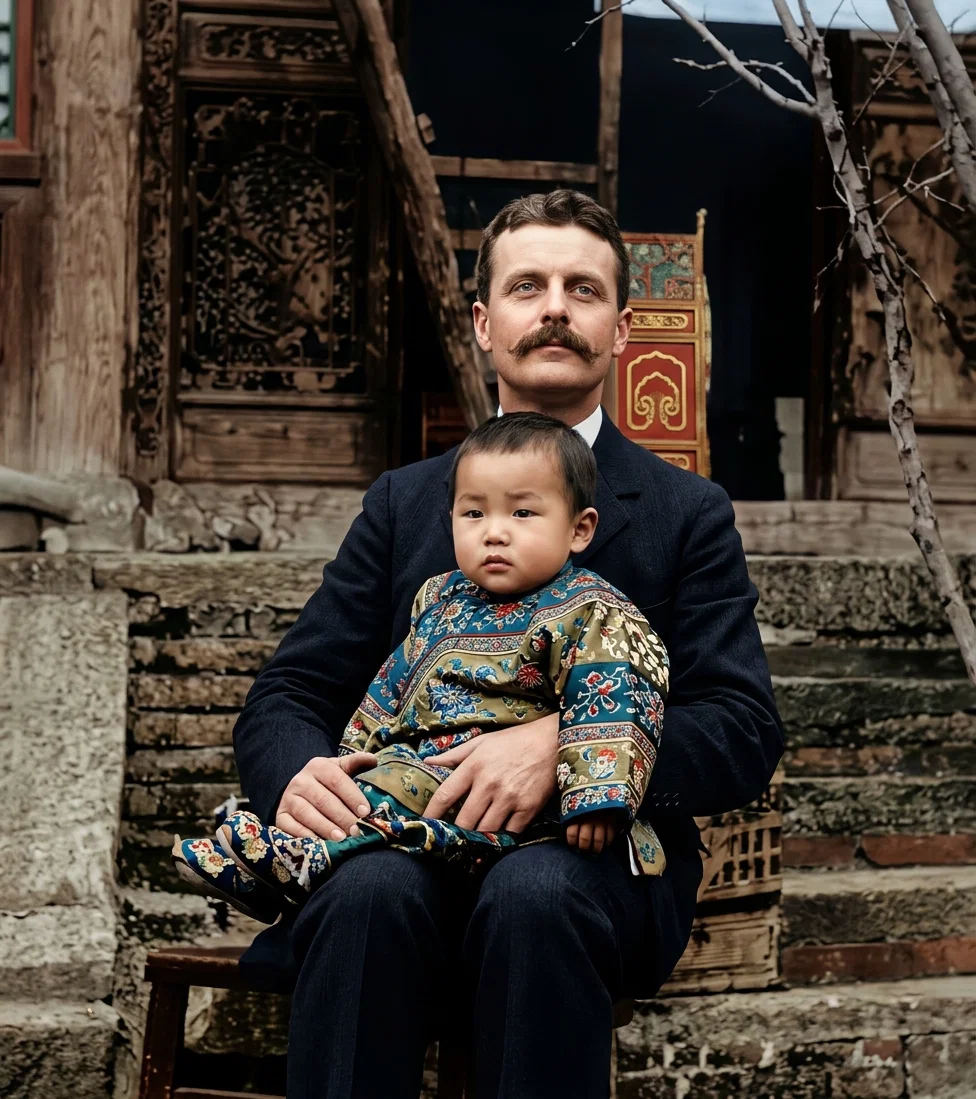
Dr. Selmon and Baby Ruth in Native Costume
To the students who are believers, some of the schools furnish room, board, and clothes. In other cases the student pays, if he feels able to do so. The Methodist school, called the Peking University, has an attendance of five hundred, and over two hundred more in the girls' school.
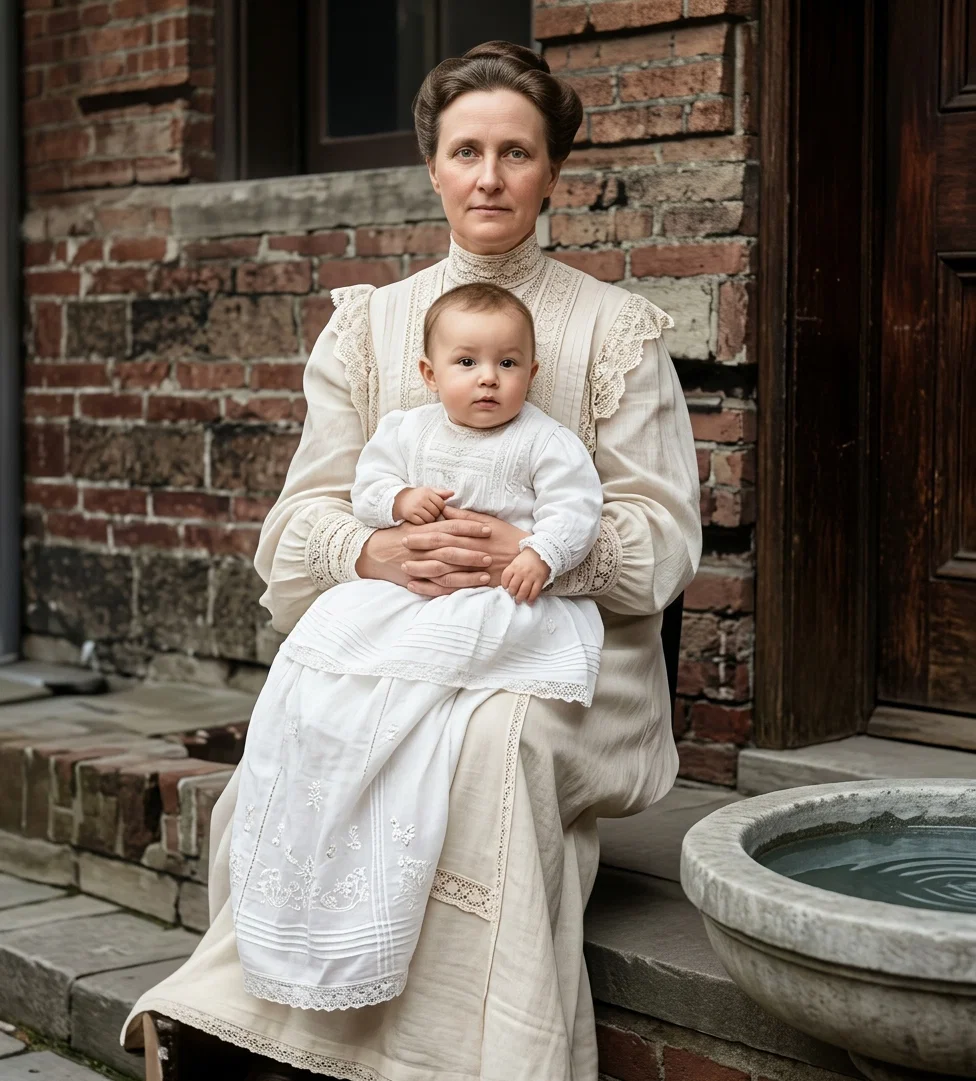
Dr. Mrs. Selmon and Baby Ruth
in American Dress
The anti-foreign feeling is very strong, especially in the capital, and the people are more distrustful of the foreigners than even the people here in the interior. Mission work has been so mixed up with politics that it could not be otherwise. Medical work has been the great drawing-factor so far, but this is so no longer. The Chinese are opening up free medical dispensaries and hospitals in Peking and Tien-tsin. Men have charge of them who have secured their training at the mission medical schools or in the government medical college at Tien-tsin. The medical workers in Peking told us that this was making a marked difference in their medical work. Fewer patients are coming to them; in fact, there is coming to be a sort of competition between the mission dispensaries and the Chinese free dispensaries.
We had a long conversation with the pastor of one of the native churches in Tien-tsin. I was told that he is one of the ablest Chinese preachers in north China. He said his church was self-supporting now, and paid him a good salary. Of all the converts, not one was from the city itself. All were people who had come in from other places, and had some work or business in Tien-tsin. The country work about that city is very prosperous.
On Sunday we attended services in the native church. The congregation was made up in large part of the students from their schools, very few middle-aged men and women being present. The services were very brief, the minister preaching from the words, “I will have arise.” Luke 15:18. A marked difference between this and the ordinary congregation of Chinese converts seen in the country was that no one carried a Bible, as far as I saw. In the country every Christian carries his Bible.
All the foreigners in Peking live in palatial residences, and have numerous servants and livery. We found here that supplies, both native and foreign, were very high. This is due to the fact that the internal tax on everything entering this city is very high. Also, the region about is mountainous and sandy, and wherever there is a plot of land that might have been cultivated, it is encumbered with some kind of temple.
After looking around both in Peking and in Tien-tsin, we sought the Lord as to where the work should be first opened up. Finding that Peking was the place in which he wanted it, we remained there several days longer, and made more careful inquiries. One could not look over the situation here without being impressed that it is high time that the work was begun. I was surprised to find that this city has eight daily papers, and a great many others not issued daily. This is a strategic point. The transient population is very large. There is constantly a stream of people from all the provinces, and from Manchuria and the north. It would mean much to us to get a foothold here; for while the work for the people of the city itself might not be of any more importance than that in many other large cities, yet we would reach the whole of China by being located in the capital; and so be able to reach the people from all provinces.
At present there are four missions in Peking. These were all there before the Boxer trouble, and have very large tracts of land and buildings in the city. To secure land now is a difficult problem. It is expensive, and hard to get. The Y. M. C. A. have just succeeded in securing a place, after trying for about five months.16
For us to open up the work there means that we would have to secure a piece of land at the very outset, and put up a house in which to live. It will not be possible for us to rent a place where we can carry on our work; for the native houses are all low, one-story, and unhealthful. It is doubly important for the new workers that they should have a sanitary home while studying the language and getting acclimated. So the starting of the work means an outlay of several thousand dollars gold.
I was pleased to find that we had no difficulty with the language. It is the pure Mandarin. There is a variation in the pronunciation of a few classes of characters, but these are very readily learned.
I hope that the workers who are sent out for this place will be those of good education, and also with experience in meeting people; for we shall constantly be brought into contact with the other mission workers. They are nearly all university people, and there are some sincere Christians among them. Many of them treated us well. We pray that some may get hold of this truth. There are many substantial Christians among the native converts, also. We were told of some who are working for the missions, in the school, and preaching, getting fifteen dollars a month, who have been offered three hundred dollars a month by the Chinese government. As I spoke with some of them, I was impressed that they were sincere, and were following all the light they had received. When the truth is presented, it will be sure to reap some fruit among this class.
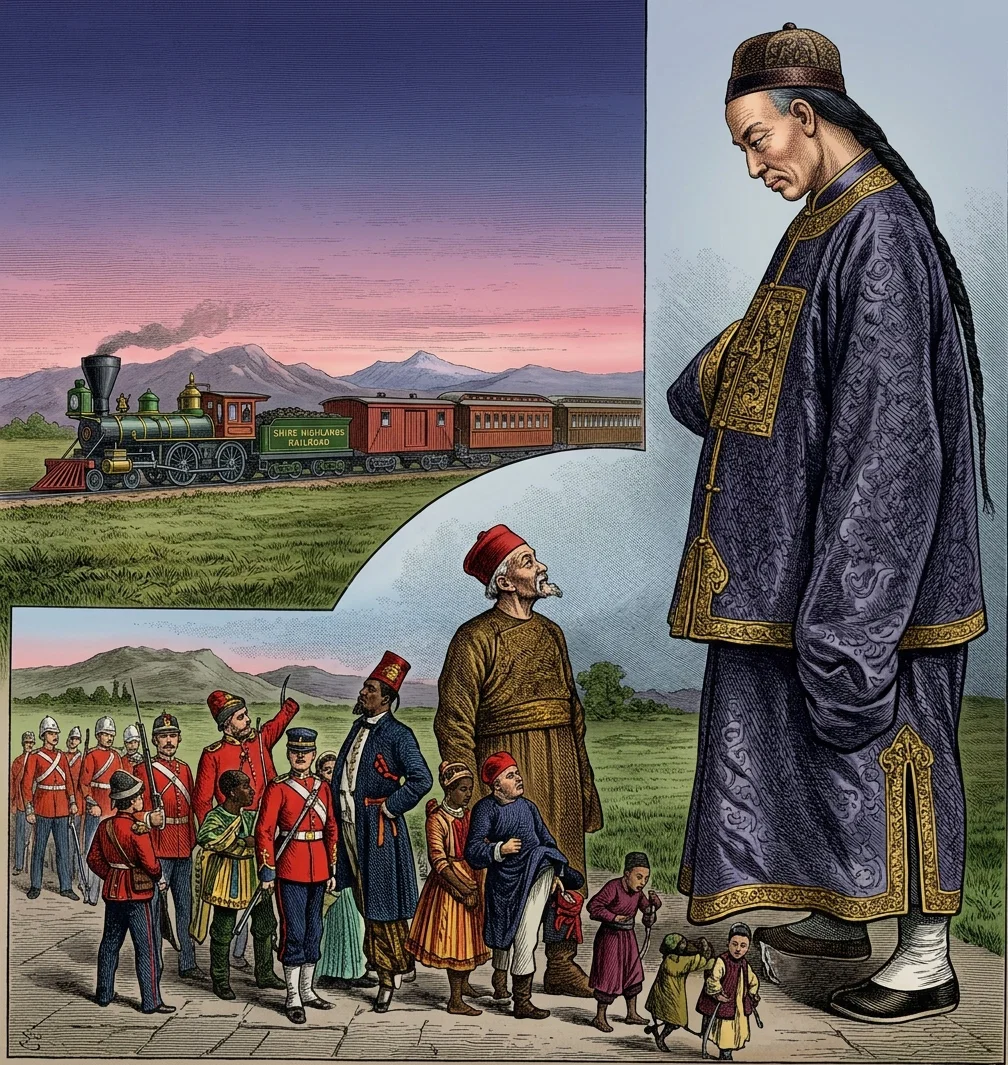
Courtesy of the Strand Magazine
THE SIZE OF CHINA IN COMPARISON WITH OTHER NATIONS
British Central Africa
By Joel C. Rogers
JOEL C. ROGERS
We have at last reached Cholo, Nyassaland, the end of our long journey. As we came up the Zambesi River and the Shire, and as we climbed the big mountain last night at midnight on the road from Chiromo to the mission, we felt that we had been well advised in regard to the best season for entering Nyassaland. This is the dry season, and the rivers are falling rapidly, but the country seems very beautiful.
It is rather exciting, in the middle of the “mighty Zambesi,” to see our boys plunge into the water, one by one, with a long rope fastened to the prow, to pull our little flat-bottomed steamer off the sand. This operation is varied by twenty or more of these native boys, with long bamboo poles, shoving with all their might to help the boat along, or to swing it from a sticking place. I suppose by the end of this month it will be almost impossible for any boat to reach the terminus of the railway at Port Herald. Midway up the Shire River we were obliged to transfer to a smaller boat. The river became very narrow as we ascended, so that with the two barges, conveyed by most of the boats, the little flotilla reached almost from one bank to the other. It seemed almost impossible for the wheelman to keep the boat in the channel. The river is very winding. We passed several extensive sugar plantations on the Zambesi. The factories make the product into crude sugar, and ship it to Lisbon for refining.
From Port Herald to Chiromo—thirty miles—we had as comfortable a ride on the Shire Highlands Railroad as one could expect on the New York Central. This road is being extended to Blantyre, which place I believe they hope to reach this year. As you know, the Cape to Cairo Railroad is pushing up through northern Rhodesia, and I am hoping that within a few years we shall have a railway connection across from Blantyre. The journey from Cape Town to British Central Africa is very tedious. It took us two full weeks to reach Cholo from Gwelo.
Brother Branch met us at Chiromo, with about forty boys to carry us and our goods. Each machila requires a relay, so they assign about ten boys to one machila. For a long journey this mode of travel seems necessary here; but to strong, healthy people, like ourselves, walking would be preferable. Every bone in my body aches to-night, from the excessive shaking up which I got in the machila.
LATER.—As there was no mail for a few days, I have waited to see more of the mission before sending this letter. This has given me time to visit the school, and to take a good look about the place. The buildings are in good condition, as a rule. I like the location and surroundings quite well. Mount Cholo is about seven miles away to the west, and to the north we have a number of higher mountains. We find quite a nice variety of fruit growing on the place, such as lemons, pineapples, bananas, and guavas. Of course we shall miss our American fruits, but I am told that some raspberries and other things grow wild.
As near as I can learn, there are about one hundred and fifty persons living on the station. This includes men, women, and children—possibly there may be more. It seems that among the older missions in this country, the custom has been established of paying boys a certain wage monthly to attend school. Of course they do some work. It seems that in order to get a school together, Brother Branch has been obliged to follow this custom. Of course the wage is very small—three shillings a month, and their food, to the unmarried men, and three shillings a month and ground for a garden, to the married men. It may be that this is the only way to keep a school together. They do some farming on the place, but in a very primitive way, and on a limited scale. I am told that cattle raising pays better than anything else here. At present there are only nineteen head of cattle on the place. These are the increase from four head which Brother Watson bought four years ago.
I find a school numbering about sixty, which is made up of some married men and their wives, who live here on the place; a few young men; and boys and girls. It is now time for their annual vacation, which lasts a month or more. Mrs. Branch and the three children intend to leave to-day, for a vacation at Cape Town. This will give us time with Brother Branch to look about the country, and we hope to find a suitable place for a mission training-school. The plan of work which I have in mind is, briefly, this: to let the school go on about as it is; then as soon as we find a suitable place for our school, we will take the young men who we think are capable of receiving training for teachers and evangelists, and try to gather in more.
Within a few days we shall go to Blantyre, and shall also visit Shiloh, which is now offered us for one hundred pounds. There is also another place offered for sale near Blantyre, which we shall visit. Of course I can not say anything as to how things will turn; but we trust that the Lord will open the way, and give us some young men who can be trained to carry the message to the people of Central Africa.
The Harvest Is Great
“THEREFORE said He unto them, The harvest truly is great, but the laborers are few.” Luke 10:2.
MATTIE HAMILTON WELCH
By Mattie Hamilton Welch
From the Southland
JACKSONVILLE.—The message is just as precious down here as in the Northland. Jacksonville, “the Gateway to Florida,” is one of the most important cities of the South. Situated on the picturesque St. Johns River, it is a charming place, with its colonial homes, paved streets, and tropical vegetation. Thousands of tourists pass through here going to southern Florida and the West Indies, in the early winter, then again on their return to their homes in the North, in late spring. This, therefore, is a very important missionary center.
We have a pretty little church building here, and a small, but faithful congregation. We have an organized Home and Foreign Missionary Society, which does effective work in distributing our literature, especially among the sailors, this being quite an important marine port.
The young members of the church here are also organized into a Missionary Band, and have been active in giving the message to the world. They held their picnic in Riverside Park, a few weeks ago, but the only leisure hour they had was when eating their lunch. Not one moment was wasted in sport, but the time was spent in assorting, wrapping, and stamping copies of the REVIEW, Signs of the Times, Youth’s Instructor, and Bible Training School. These were then addressed to missionaries of the different denominations who were in foreign fields, or at their homes on furlough. The money in the children’s treasury was used to buy the paste, wrapping-paper, and postage-stamps, instead of ice-cream, watermelon, or some other picnic treat. Surely after this self-denial, and the dedicating of all the prepared literature with prayer, God will bless his message as it speeds on its way to earth’s remotest bounds. Truly those children had a picnic that could be an auxiliary to a camp-meeting. We would be very glad if literature would continue to come, for the supply which was so liberally sent in reply to Brother Parmele’s request through the REVIEW, two months ago, has been exhausted. If any of the readers have extra Bibles, we would be glad to receive them, to distribute among the sailors who are not supplied.
We have been trying to find a building here suitable for a school for the colored young people. There are many things that have hindered an advance move, for work must be done very quietly in the South, as there is considerable prejudice against educating the negro; but Jesus died for them, and I do not forget how ardently my dear husband desired to come South and preach the message after he accepted it. Now he has fallen asleep, we feel that even under great obstacles we must carry out his wishes for these people. We desire the prayers of our people for the success of this work, and would be glad to receive donations toward its support.
MATTIE HAMILTON WELCH
Educational Work on the Part of Catholic Orders
By Chas. T. Everson
While the Jesuits are the foremost educators in the Roman Church, they are not by any means the sole occupants of the Catholic educational field. There are, for example, the Barnabites, Somaschians, Salesians, and other orders that dedicate a large part of their activity to the department of didactics. There are also many convents of nuns which are centers of educational effort.
In their educational efforts the Jesuits generally aim to reach the better classes, and, as a consequence, have richly furnished schools. For the middle and poorer classes there are other orders that offer educational advantages for a small tuition, and in many instances their teaching is entirely gratuitous. There are quite a large number of free Catholic schools in Rome; and often these schools not only furnish instruction free, but provide books and clothing for those that are too poor to procure them for themselves. Also in the schools for girls the nuns will help the students to provide a dowry when they wish to get married, as even the poorest of the girls are expected to bring their husbands something if possible. Then when they reach the age of confirmation, often these free schools will provide the candidate for confirmation with an entirely new outfit of wearing apparel. By these means they work to tie the children and their families to the church.
Among the extremely poor, we find the Salesians showing a tremendous activity. This order, which was founded about the year 1846 by Don Bosco, derives its name from St. Francis de Sales, its patron saint. It confines its work to educating orphans, outcasts, and those children whom the parents are no longer able to care for.
Don Bosco was an ordinary priest of Turin, who conceived the idea of educating abandoned children. The uppermost thought in his mind in their education was to instruct them well in the Catholic catechism. He therefore began his work by holding classes among abandoned children, with the aim of instructing them in the Catholic doctrines. These classes showed him the need of providing some place of refuge for these outcasts. By a gigantic effort he succeeded in building up a mighty institution for these abandoned children in Turin. Beginning with a few rented rooms, he gradually, through gifts, offerings, and endowments, succeeded in building up an immense institution that at present provides educational advantages for thousands of these poor children.
A paper was founded early in the history of the movement, and it was widely circulated, telling of the progress of the work, and what was contemplated by it. As a result, rich gifts and offerings soon began to flow into the coffers of the institution. With the surplus funds other institutions of the same nature were founded in different cities of Italy, France, Spain, South America, England, etc. Thus we see that the small beginning made a little over half a century ago has developed into a mighty educational movement.
The Salesian method of education has largely an industrial basis. In their institutions they teach the youth the ordinary trades, besides the common branches of education. However, the religious instruction occupies a prominent part in the education of the youth, even to the neglect of other things at times, as is true with all Catholic educational institutions; for Catholic schools are first and foremost centers of propaganda, and then educational institutions. However, in these Salesian schools they study their young people, and when they see a boy who has a special aptitude in a certain direction, they develop that talent to its utmost capacity. As a consequence, among those that have issued from their schools they number men of real talent, and some that have made a high mark in their profession. Among other profitable industries they occupy themselves in getting out popular editions of standard works, and by this means have made great gains.
The institutions help one another. If one institution has a surplus of funds, it sends the money to the mother institution at Turin, which in turn aids any school that may be in need. This educational work among the extremely poor has done wonders for the advancement of Catholicism among that class.
We can plainly see, therefore, that the Catholic educational system leaves no loopholes, but extends its influence to every walk of life. It has its luxuriously furnished institutes for the rich, its modestly equipped schools for the middle classes, and its extensive institutions that provide for the education of the poor.
Catholicism is not a combination of chance, but a well-organized system, with certain definite ends to gain. It uses those means which are calculated to obtain the results at which it aims. By long experience of calculating and reckoning from cause to effect, it has learned what means are necessary to obtain certain results. And amid all its appearance of luxury and love of ease, Catholicism is energetic, and keeps all its forces at work.
An intense activity, born of the power of the Holy Spirit, is necessary to cope successfully with this power, especially in its own stronghold.
CHAS. T. EVERSON.
Louisville (Ky.) Camp-Meeting
By J. F. Poole
THE good camp-meeting held at Louisville, Ky., July 18-28, is now past. The meeting was held in a beautiful grove in the suburbs of the city. The attendance of our people was not so large as expected, owing to the fact that the season had been backward, and there had been so much rain that when the dry spell came, many had to remain at home to care for their crops. Nevertheless, the promise that God’s blessings are not confined to large numbers was verified to us, and all who attended were richly repaid.
Elder Spicer spent the first Sabbath with us, and his good words of instruction and timely counsel were much appreciated by all. We had expected to have Prof. J. E. Tenney with us during the entire meeting, but after two days18he was called to another field. His stay, though short, was beneficial to all. The other laborers present were Brethren Harrison and Melendy, representing the canvassing work; Sisters Harrison and Lenker, of the Sabbath-school and young people’s work; Brother Milo Emmerson, and the writer. Brother S. M. Jacobs and wife had charge of the dining tent, in connection with which practical instruction was given in healthful cookery. This was highly appreciated by our own people and those from the outside who were in attendance.
During the day, the thoughts presented were such as to lead to self-examination. The evening services were a series of sermons on the points of our faith, calculated to be of benefit to the outside attendance.
Parents’ meetings were held, which we believe will be the means of helping us to better train our children for the kingdom of God. Meetings for the children were also held each day.
The entire camp consecrated themselves to God and his service. This season was one of spiritual refreshing to the Louisville church, and all expressed themselves as having received rich blessings from the storehouse of God. Sixteen precious souls were added to this church. Six received baptism, and others were prevented because of sickness.
We believe the time has fully come for our people to receive the latter rain, and make haste to enter the kingdom of God. J. F. POOLE.
Canadian Union Conference
By W. H. Thurston
For some time we have been endeavoring to revive the missionary work by getting all to do something, thus enlisting many in active, continuous efforts. Early in the year Brother I. S. Jones began to work in this field as general canvassing agent. In the spring we held three canvassers' institutes, one in each local conference, and these were well attended. Twenty-four young men and women went into the field with books, and their reports during the summer have been good. Some are canvassing to earn a scholarship, and others are following the usual plan of book work. Many have related very interesting experiences in connection with their work, and we believe these earnest efforts will result in much good. Some of these workers have been connected with tent companies, enjoying the benefit of the meetings, and rendering some assistance in the services. The majority of these colporteurs expect to return to our schools this fall, and fit themselves for better work.
A new building is being erected at Lornedale Academy, and will probably be ready for occupancy early in the fall. This building was much needed, and will be a great blessing to the work in Ontario. The Williamsdale Academy is well provided with rooms and facilities, and an increased attendance is expected this year. These schools should be heartily supported, and earnest efforts should be made to induce our young people to attend and prepare for service.
After many months, a physician has been secured for the Knowlton Sanitarium, and ample help is in training there now for that department of work. On account of the long delay in placing proper workers there, the work has been much hindered, but we hope for the best now.
There are five tent companies in the field this summer, and with one exception good reports have come from these efforts. The Lord will bless every faithful effort put forth in his name. Aside from these tent-meetings some meetings have been held in other sections with good interest and some immediate results.
Elder S. A. Farnsworth, of the Quebec Conference, has been transferred to Vermont, and will make that his field of labor. We are now arranging for a man and his wife to locate in Montreal to do Bible work. Montreal is a large city, greatly in need of help, and we believe a good work can be done there for both French- and English.
Elder O. F. Butcher, of Detroit, Mich., located in Ottawa last fall, and held cottage meetings during the winter, with good attendance. The people were interested in the studies; and he and his wife have been following up the work this summer with the Family Bible Teacher, tracts, and Bible readings. On account of Sister Butcher's condition of health and Elder Butcher's throat trouble, they will close their work here in August, and go to Washington, D. C., and take up other work. We regret very much that it becomes necessary for them to leave Canada, but the work is the Lord's, and he will supply all our needs. We shall hope to arrange for other help for Ottawa in the near future.
Brother and Sister W. J. Hurdon are having all they can do in their treatment rooms in Ottawa, and are meeting with excellent success. The treatment rooms in Lindsay, Ontario, conducted by Brother and Sister Henderson, we understand, are receiving good patronage now. There are several nurses out in the field, doing private nursing with good results. We are glad for these training centers which we have in operation, and the outlook is promising for scores of workers in the near future to go forth to the harvest.
Elder Keslake gives favorable report of the work in St. John's, Newfoundland. The outside attendance at the meetings continues good, and several have been baptized there this summer. Miss Lucinda Iler, a graduate nurse, went to St. John's in June under the direction of the conference, and after getting located and acquainted with some of the doctors and people, is having frequent calls for nursing. She will do Bible work and nursing as the situation seems to demand.
The Dominion Sunday law is being enforced in a few places, but is meeting with considerable opposition from its supposed friends. A Rational Sunday League has been organized, it is said, to oppose the Lord's Day Alliance in their effort to enforce the Sunday law. We are now coming up to our camp-meetings and annual gatherings, and these will be important occasions. It is hoped that there will be a general rally to these meetings, and that they will be all that the Lord would have them be to the entire people. Some of the ministers from abroad will come in and assist us in these gatherings, and we shall appreciate their help. We are living in very important times, and much depends upon our attitude and loyalty to the work just now. The cause is in need of men and means to carry on the work in all parts of the earth. Let all work and pray to this end. This union has raised a nice little sum toward the $150,000 fund, and if every believer could lay down another dollar to this fund, it would help substantially in closing the fund. Let us examine our pockets once more and see if we can not give again. It is pleasing to note that our tithes and offerings are increasing; and by the cheering words we get from the different parts of the field, we know the Lord is blessing his people. Let all come to the annual feast with a prayer of faith, and all will receive a blessing. Come one, come all. W. H. THURSTON.
A Word from Brazil
By F. W. Spies
In these Catholic countries one meets with strange incongruities. Observing the people, he sees on one hand a superstitious reverence for some things supposed to be sacred, while on the other hand really sacred things are utterly prostituted. For instance, people will be seen who, when passing a church, a graveyard, a crucifix, or a funeral procession, lift their hats, and make great demonstrations of reverence.
But as the stranger who is just beginning to understand the language begins to comprehend the meaning of some of the business signs he meets, he wonders not a little at the professed reverence for some things, while others more sacred are treated as if they merited no consideration whatever.
In one of our Rio suburbs a person is edified with the following signboard: “Açougue de Sao Salvador” (Butcher shop of the Holy Saviour). In one of our northern coast cities they sweep the garbage and dirt together into the streets, then place it into a lighter (a kind of boat), taking it out onto the ocean, and dumping it overboard. This garbage conveyance bears the dignified name of Espirito Santo (Holy Ghost). The steamer on which I am now embarked bears the same name; the province to which I am going likewise. The entire name of the city of Bahia is Bahia de Sao Salvador (Bay of the Holy Saviour). About two years ago I baptized a brother whose name was Raphael Archangio dos Santos (Raphael, Archangel of the Saints). The name Salvador (Saviour) is met daily. But after becoming converted, many of our brethren drop these names.
I might multiply these examples indefinitely, but these suffice to show that the Church of Rome is nothing more than paganism. Outward ceremonies are multiplied, and the “faithful” suppose that religion consists in a close observance of these rites, while the real meaning of the Scriptural terms are not to the faintest degree comprehended or experienced. Brazil has twenty-two million souls chained to this pagan superstition. but, thanks be to God, the third angel’s message is bringing light to some of them.
May the Lord of the harvest send more reapers to speedily gather many other sheaves for the heavenly garner. Since writing a week or so ago, I have received another letter, in which those who for some time have been keeping the Sabbath in Bahia ask to be baptized.
I am now on my way to the province of Espirito Santo, to make a brief visit19to the churches and companies in that field, who have not had a visit since a year ago; while Mucury, a section in the northern part of the province of Minas Geraes, has not had the pleasure and benefit of a minister’s visit for two years, and Bahia is waiting. Then here in Rio we have sufficient work for six laborers.
But we are of good courage in the Lord, for he is blessing us; and in the name of Israel’s God, we go forward unto certain and final victory.