The Youth’s Instructor, Vol. I, No. 14

A Quick-Tempered Kinglet

The Youth’s Instructor

April 3, 1902

Review and Herald Publishing Company · Battle Creek, Mich. · April 3, 1902

A Quick-Tempered Kinglet
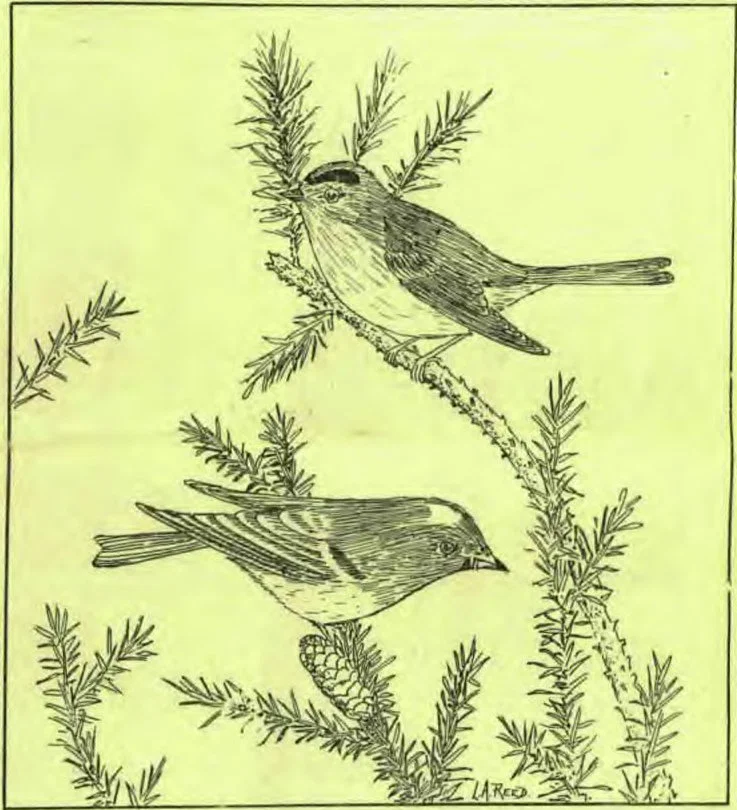
RUBY-CROWNED KINGLET; GOLDEN-CROWNED KINGLET
BRAVERY and bigness do not always go together. Those who are familiar with our door-yard birds know how effectually the house-wren persecutes the prowling cat, and drives it away from the neighborhood of the bird’s nest. Kingbirds drive off the crow, and even greatly annoy the fish-hawk; while even the diminutive humming-bird is absolutely fearless at times, and successfully defends its nest if its antagonist is but a single bird of another species.
These instances refer to birds in spring and summer, when the nest and eggs or the young are the immediate object of a bird’s solicitude. In winter we do not expect to witness such instances of courage on the part of the smaller of our birds. In fact, sparrows flee when a sparrow-hawk appears. But recently I saw a golden-crowned kinglet question the right of an Acadian owl to take his ease in an evergreen. Never was there a more inoffensive bird than this little owl at the time. It was cuddled up in a heap, and half asleep. But the kinglet found the bird, and immediately set up a shout, and darted into the tree, snapped its beak, and, I think, twitched the owl’s feathers. At any rate, there was no more sleep for the bird in the tree. But it was not moved to vacate at the mere bluster of a little kinglet. It sat still, slowly opened its beak now and then, and moved its head to and fro. This was kept up until the sharp chirping of the kinglet attracted other birds, and a more serious attack was made. The owl then took flight; and while the rejoicing was general, not one of the sparrows, nuthatches, and chickadees made more clatter, for a brief moment, than the kinglet.
There was a sequel to the incident. The little bird that started the affair did too much. It was overcome by excess of exertion, and was so limp and listless when I saw it last, that it seemed to me it was thinking whether it had not made a goose of itself. It is possible that some little birds, like some small children, never take time to consider if the gain derived is worth the effort it calls for.—Charles C. Abbott, M. D., in St. Nicholas.

Birds of Early Spring

THERE are a number of birds you will not be likely to see after March and April; therefore you should be on the lookout now, to see them before they are gone for another year. Last spring I told you about them; but perhaps you have forgotten; so I will call your attention to them again.
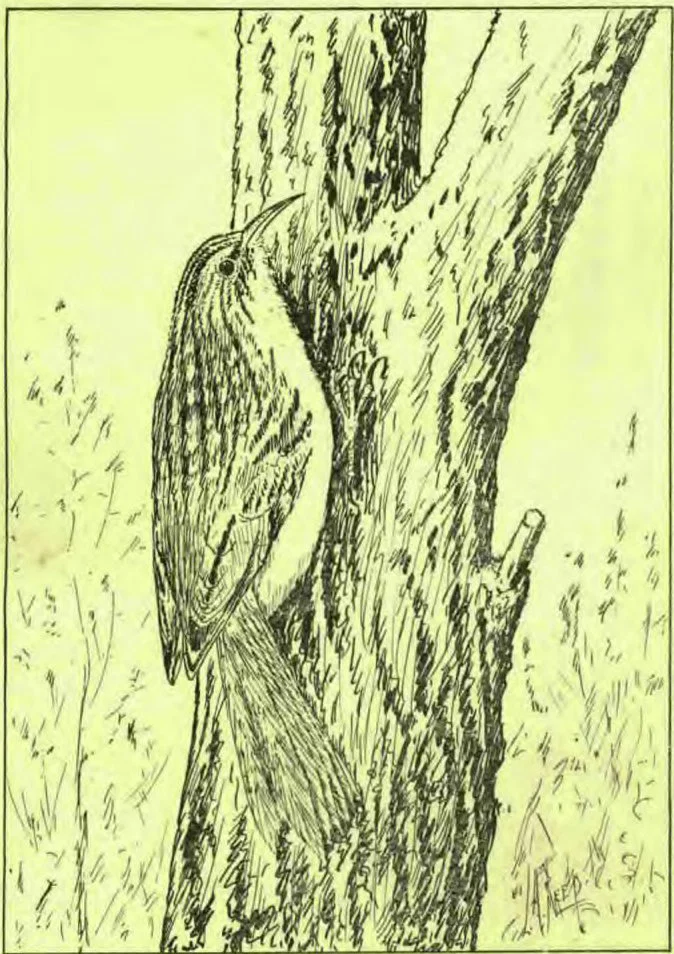
THE BROWN CREEPER
THE BROWN CREEPER
First, there is the white-breasted Nuthatch. This bird has a peculiar note; and if you fail to see him, you ought surely to hear him. Only a few days ago I passed a tree where there were two Nuthatches, seeing neither of them. But just as I had passed, I heard them call to each other, Yank, yank, yank! and looking about, discovered them on the trunk of a maple, walking, head downward, like flies on a wall.
The Red-breasted Nuthatch is a more northern bird than his white-breasted cousin. He is also smaller, and may be easily distinguished by the stripes on his head and the red on his breast. This bird is said to be quite common in the Adirondacks.
At the same time that I saw the two White-breasted Nuthatches of which I have just spoken, I saw on another tree only a few feet away, that other interesting winter bird, the Brown Creeper. It also walks on the side of tree trunks, in its search for insects and larvae, but I have never seen it walk downward on the trunk, as the Nuthatch frequently does. True, it will now and then turn with its head downward toward the foot of the tree; but it quickly turns back again, and moves upward in its peculiar jerking way. When it has gone high enough, it flies to the foot of another tree trunk, and works its way up that; and so on continually as long as you choose to watch it.
Then there are the Kinglets. You have only a little time left in which to become acquainted with these charming birds. The kinglets are olive-green above, whitish beneath, and about four inches long. The Ruby-crowned Kinglet has a scarlet patch on the top of the head, which can be seen only when the bird lifts its crest. The Orange-crowned Kinglet has a reddish-orange crown, bordered with black and yellow. In fall, winter, and spring these little birds travel in flocks.
Be on the lookout this month for the Kingfishers; they arrive the first week in April. And here is a list of other birds that will come North the latter part of March and in April. Surely you will be kept busy if you study them all. I name only a part of the host: Whippoorwills; Chimney-swifts; Humming-birds; Kingbirds; Least Flycatcher, or Chebec; Crows; Rusty Blackbirds; Purple Grackles; Vesper-sparrows; Grasshopper Sparrows; Tree-sparrows; Chipping Sparrows; Field-sparrows; Swamp- and Fox-sparrows; Chewinks, or Towhees; Martins and Swallows; many of the Vireos and Warblers; Catbirds; Brown Thrashers; House-wrens; Wood-thrushes; Veeries; Hermit-thrushes; Robins; Bluebirds. At this time, also, the Juncos, Northern Shrikes, and Winter Wrens leave us on their way North.
Of course a late, backward spring will keep the birds from arriving as early as when the season is more open. But during April the arrival of birds will be constant. L. A. REED.

A Swamp Bird

I AM a swamp bird, that is all,— But O, the secrets that I know Of little brook and waterfall, Of hidden flowers that bloom and grow! For me no field nor orchard wall: I am a swamp bird, that is all.
None follow where I dare to go, And where I hide my nest away. The fiercest winds of all may blow, The heartless spoiler seek his prey; But through the swampland, dusk and low, None follow where I dare to go.
FRANK WALCOTT HUTT

Little in His Own Eyes

“WHEN thou wast little in thine own sight, wast thou not made the head of the tribes of Israel, and the Lord anointed thee king over Israel?” So said Samuel to the proud-spirited, self-reliant Saul. We are not to suppose that the Lord was deceived in Saul; but his case serves a far greater purpose in illustrating the folly of the tendency of human nature than all he ever accomplished during his life.
Saul was chosen king, as we believe, for two special reasons. One was his admirable bearing and impressive appearance. From his shoulders upward he stood above his fellows. The people all had to look up when they spoke to him. His words seemed to come from above them. He did not need to stand on a box or a chair to see. He could see when others were only being smothered in the crowd, and he could tell his less fortunate companions what was going on. We sometimes envy such giants.
But it generally hurts tall people to go under a barbed-wire fence. They can not stoop to trials. They have to bend low to see a child. Many tall people can do that easily enough, if, like the youthful Saul, they are little in their own estimation. It is a grand sight to see a great man who does not know he is great, but thinks, on the contrary, that he is very small.
Such was young Saul, and God chose him for this reason. When Samuel told the astonished youth that he was to be Israel’s first king, it came like an earthquake shock to him. “Am not I a Benjaminite, of the smallest of the tribes of Israel? and my family the least of all the families of the tribe of Benjamin? wherefore then speakest thou so to me?” No doubt he felt as if he were the smallest member of that smallest family of the smallest tribe of Israel. Surely such a one should not be king.
But as Saul went on, the evidences that a great future was before him thickened. He was even anointed with the holy oil at the hand of the man of God. When he reached home, he did not so much as speak of what had occurred. But a public test was called. By lot the tribe was chosen, then the family, and finally the individual. Each step brought the choice to Saul. But when his name was reached—where was the man? The Lord only knew; for he alone had seen Saul hide himself “among the stuff.” O, he could not bear the thought! The weight of it crushed his heart, and took the strength out of his very bones. He could not even face the people. But he was found. Pale and trembling, he was brought out of his hiding-place. How the people shouted over such a little big man! He was nearly eight feet tall; but he was the smallest man in that company. God loved him, and stilled his throbbing heart. I believe that the heavenly angels were at that moment looking upon the young man with admiration. He gathered some good men about him; and when the sons of Belial derided him, saying, “How shall this man save us? and . . . despised him, and brought him no presents,” “he held his peace.”
What a pity he did not remain thus humble and childlike! How much he might then have accomplished for God and man, none can tell. Prosperity and the blessing of God soon built him up in his own estimation. Rebellion, stubbornness, and apostasy followed. Then came rejection of God, trouble, defeat, and a terrible death. David, the innocent object of Saul’s insane rage, lamented his death in these touching words: “The beauty of Israel is slain upon thy high places: how are the mighty fallen! Tell it not in Gath, publish it not in the streets of Askelon; lest the daughters of the Philistines rejoice, lest the daughters of the uncircumcised triumph. Ye mountains of Gilboa, let there be no dew, neither let there be rain, upon you, nor fields of offerings: for there the shield of the mighty is vilely cast away, the shield of Saul, as though he had not been anointed with oil.”
The path over which Saul passed to ruin is wide open to-day. It awaits every youth whom God chooses for his service. If you are not small in your own sight, he can not choose you. If he chooses you for a great work, as you value success and life, keep little in your own sight.
G. C. TENNEY.

She Always Made Friends

It was a blustering day in February—just the day to “sit by the fire and spin.” In the midst of my enjoyment Christina tells me that I am wanted down-stairs. Who now? Not the umbrella-mender, the scissors-grinder, the Dutch-cheese man, “the butcher, the baker, the candlestick maker”?—No; I found none of these when I entered the kitchen; but there, close to the range, was a wee bit of a woman, holding out to the heat two wrinkled hands that looked like gnarled and crooked twigs.
She at once displayed her wares,—“Holders; three cents apiece, or two for five cents!” As she bent over her basket, I noticed something wonderfully sweet in her old face, and her voice had in it a note that told of a contented heart.
“Isn’t it rather a cold day to be journeying about on foot?” I asked.
“O, I don’t mind it. See what a warm shawl I’ve got on, and it takes more of a wind than this to blow through this hood of mine. I used to go out by the day house-cleaning, but you see I’ve got the rheumatism in my hands now so I can’t do that. But I can sit at home, and make these holders, and it’s astonishing how many of them I sell. Why, I make enough selling these holders to pay my rent. I have one room, and that makes me a comfortable home.”
“When will you come again?”
“Generally I go round once a month, but I sha’n’t be here next month, because I’m going up to Phillipsville a-visiting. I went up there last summer to see some old friends of mine; and before I was through visiting them, some new friends asked me to come and see them; and so between them they kept me there a whole month. Somehow I always make friends wherever I go.”
By this time my purchase was made, and she had reached the door. She stepped out bravely into the fast-gathering snowdrifts; and as she turned to give me a parting word, her old face shone with a light that “the daughter of a thousand earls” might envy.
I returned to my sitting-room with these words running through my mind: “I always make friends wherever I go.” Brave old heart! What wonder? She never asks folks to listen to her whining; instead, she goes about singing the song we are always glad to listen to; for—
“All the world doth love the song That happy people sing.”
— Epworth Herald.

Fighting the Avalanche

THE avalanche plays a terrible part in the annals of the Alps. Almost every mountain village has its traditions of tragic happenings from these mighty and fatal snowslides, which, like a sudden bursting flood, give no warning, and have no mercy upon anything in their track. Gathering strength with every foot of ground they pass, they descend upon house, hut, field, and valley, killing and burying their victims at one stroke. They are the terror of all; and, until lately, no way of averting them has proved possible, though such a way has long been sought.
Nowadays, however, the Austrian government has undertaken to govern the avalanche, and has actually succeeded in many places in doing so. Those who know the mountains know that there are some places more favorable to snowslides than others. At certain points, an avalanche may be expected almost every year, and the Austrian railway that runs from Innspruck to Zurich found it necessary to run through some of these dangerous spots, and so had to fight the obstinate and terrible force of the snowslides year after year. Tracks were carried away, trains were in danger, stations were swept to destruction, and the railroad managers were at their wits’ end. A signalman, his wife, and three children, at one of the danger-points, were sacrificed to the avalanche, and still no remedy appeared.
Finally, ten years ago, the Austrian government took up the fight in earnest, and sent its engineers into the Alps to spend all winter and spring, year by year, in the mountains, until some plan of campaign could be found that would be victorious against the silent might of the snow torrent.
At first, like anybody else, the engineers fought the avalanche as an avalanche. Wherever they thought it might come, they built great defenses for the railroad, of stone and wood. But the snow flood, as it rushed down, either carried these away, or, burying them deep, went on downward over them resistlessly. In vain the barriers were built higher; they were swept away, and their mass only added to the momentum of the avalanche. After several years the engineers, one and all, were obliged to confess that they found it absolutely impossible to stop a snowslide.

A New Thought

Then came a new thought. Once started, the avalanche was unconquerable. But suppose it were kept from starting, and conquered before it began. To work again went the engineers. Instead of one high barrier at the bottom of the hills and ravines, they put up low walls, rows of stout stakes, and mounds of earth, at short intervals from the top downward. Perhaps forty of these insignificant-looking affairs would be dotted here and there upon a mountain-side, none running all across it, but each guarding the sliding of the snow from some small slope. All summer long these walls were worked upon; and when winter came, the engineers waited, eagerly, for the next avalanche to start. But it never started,—at least, on the points where the little fences and barriers had been built. You see, a few square feet of snow might move downward, but it would reach the nearest wall long before it was large enough to do any damage, and pile up in a little, helpless heap, and be stopped right there. It couldn’t be an avalanche, for it wasn’t let alone in its beginning. The battle was won in this simple, easy way; and now the railroad runs all winter, the signalmen are perfectly safe, and the passengers look up at the aimless-looking, insignificant little walls dotted far up the mountain-sides, and know that as long as they keep guard up there, travel is protected, no matter how long and hard the snow-storm may be.
It is a simple secret,—the secret of fighting the avalanche,—and it holds just as good in the moral world as in the Alps. All temptation is like an avalanche,—sudden, disastrous, sweeping away resistance. We can fight it, if we choose, as the engineers did the snowslide at first. We can determine that, no matter how tremendous the temptation becomes, we will resist it in the end; and we can build a strong barrier at the point where thought and desire pass into act. But we shall soon find that when thought and desire are overwhelmed in a mighty rush of temptation, the barrier goes down like matchwood. So true is this, and so well known, that some will say, “Such and such a temptation can not be resisted; it is impossible for a saint to resist.”
The secret of resistance that the saint learns, and that we all can learn, is the secret of not letting the temptation get a good start. A little wall of self-denial, a little barrier of prayer, a little fence of firm resolve, in the very beginning of thought and desire,—and lo! the temptation will never reach the line of act at all, but die, harmless, before it has power to sway the slightest deed. The youngest lad can conquer the biggest of temptations in its beginning; yet the same temptation, allowed to take its course, will sweep the strongest soul away in utter and eternal ruin. That is the lesson of fighting the avalanche; and our only safety lies in knowing and practicing it. Let us build the barriers in youth, and build them wisely; then no sudden, overwhelming, deadly rush of evil can ever dash us down to anguish and destruction.—Mary Whiting Adams, in S. S. Visitor.

“He Is Not Here”

He is not here! He is not here! For the grave defeated lies, And the death of death is the theme of songs In the heights of the holy skies.
He is not here! Ah, blessed word! Let angels’ songs resound! For a happier day in the far away The ages have never found.
Sound the happy song in a voice so strong That the echoes shall float away To the farthest shore; for dismay no more Shall close life’s setting day.
He is not here in the grave so drear Where the worm and corruption lie; In immortal life he has closed the strife, And mounted the beaming sky.
He is not here! let resound the cheer Of the joy that never dies; For with him above on the wings of love We’ll mount his eternal skies.
B. F. M. Sours.

The Crowfoot Family

19. THIS is one of the largest and most important families of the vegetable kingdom. The scientific name, Ranunculaceae (ra-nun'ku-la'-se-e), is derived from the Latin word rana, meaning a “frog,” from the fact that many of these plants grow in the water. By most botanists the plants belonging to this family, or natural order, are regarded as the most highly developed of all plants.
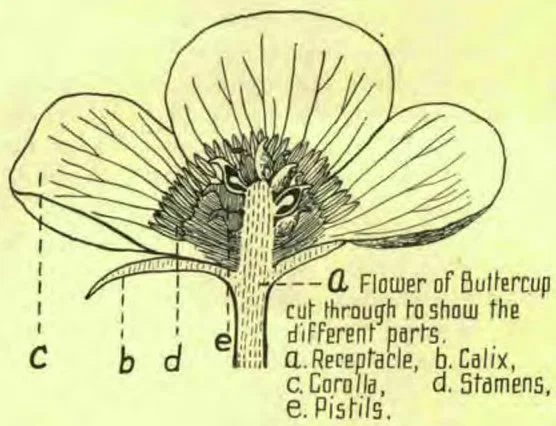
A Flower of Buttercup cut through to show the different parts. a. Receptacle, b. Calix, c. Corolla, d. Stamens, e. Pistils.
20. There is no one characteristic by which it may be determined positively that certain plants belong to this group; but, as is usually the case with brothers and sisters, or others who are nearly related, there is a general family likeness by which they may, in most cases, be easily recognized.
21. They all agree in having colorless, acrid juice; but this of itself is no certain evidence that they belong to this family, for there are other plants that have juice of the same kind. If you break the stem of any one of these plants and taste its juice, you will find that it has a sharp, hot, or biting, taste. In some species the juice is so strong that it will cause blisters if applied to the skin. This acridity is the prevailing characteristic of the family.
22. Doubtless you will say that it is a very unpleasant characteristic to possess, but let us learn a lesson from it. Often boys and girls, and men and women, manifest this same bitter, stinging property, by speaking unkind, and even cruel, words of others.
23. These plants do not show their disagreeable nature until they are broken or crushed. It is much the same with us. So long as no one crosses our path, or does anything to displease us, we can keep good-natured; but if something is done to irritate us, we very soon show our unpleasant dispositions. Would it not be much better, and make life sweeter and happier, if we should meet the trials of life in the long-suffering spirit of the meek and lowly Jesus, and, like the rose when bruised and crushed, only shed forth the more fragrance?
24. If the plants of the Crowfoot family are dried, or subjected to a high temperature, this property disappears. We sometimes find those among the human family who are ever discontented and complaining about one thing or another, until the fires of affliction drive off their unpleasant qualities. When the blessings of life cease to fall as freely as before, and they are hard pressed by care, grief, and perplexity, or sickness lays them low upon beds of pain, then they learn patience and charity for others, and are divested of that irritating, stinging property which they previously carried about with them.
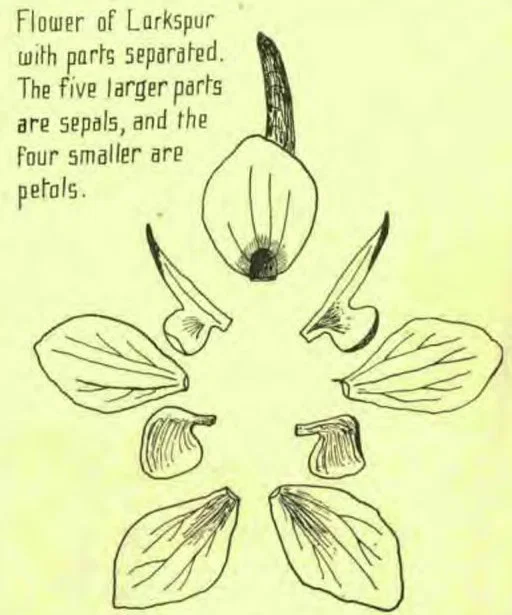
25. All the plants of this family have the parts of the flower separate, and inserted on the receptacle. The calyx is formed of from three to fifteen sepals, and the corolla is formed of from three to fifteen petals, varying in the different species. The corolla is sometimes absent, in which case the calyx is colored like a corolla. The numerous stamens are also a help in recognizing this group.
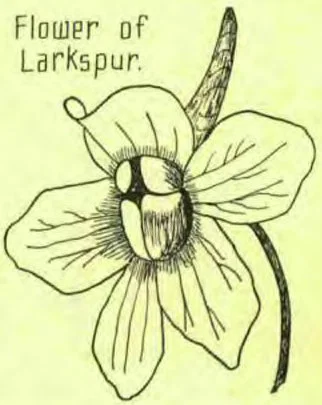
Flower of Larkspur.
Flower of Larkspur.
26. Among these plants are some that are narcotic and poisonous; and some are used in medicine, such as aconite and hellebore.
27. Most of the species are herbs, but a few are shrubs. In general they are natives of cold, damp climates. Some grow in the tropics, but almost exclusively upon the mountains. While the different members of the family are most abundant in Europe, one or more representatives occur in nearly all parts of the world.
28. To this group belong the clematis, or virgin’s bower, the anemones, hepaticas, marsh-marigolds, columbines, larkspurs, and peonies. Among these are many of our cultivated ornamental plants. The different varieties of clematis, with their profusion of snowy flowers of various sizes and colors, are becoming the favorites of all climbing plants. The anemone, with its red, white, blue, or variegated flowers, is another favorite. The peony has luxuriant foliage and magnificent double flowers of enormous size and rich colorings, which make it a favorite to-day, as it has been for many years.
Flower of Larkspur with parts separated. The five larger parts are sepals, and the four smaller are petals.
29. While it is true that plants of the Crowfoot family have a disagreeable acrid juice, many of them produce large and showy flowers of great beauty, which we delight to gather from the woods and fields, or to cultivate in our gardens.
B. E. CRAWFORD.

Guarding Our Capital

WE start out in life with a definite amount of possible energy. We can spend it as we please; but even with the best intentions, many people use up a large part of their capital in worry, anxiety, or by fretting over non-essentials,—trifles which have nothing whatever to do with their success.
If we would only learn to control our thought-force, and to expend it where it is needed, instead of allowing it to ooze out, or leak away in driblets, on unimportant matters, what marvels we would accomplish!
In an average lifetime, just think how much real energy, which might be turned into success-capital, has been wasted in useless expenditures and leakages! Some people spend half the power they generate in vain worry, anxiety, bickering, splitting hairs over irrelevancies.
Much of our possible success-energy is wasted through fear, which, in all its phases, is the greatest enemy of the human race,—fear of failure, fear that we shall come to want, fear of imaginary happenings which have no foundation in fact, dread of criticism, forebodings about the future, fear of misfortunes that may come to our friends, ourselves, or our business. How many promising lives have been wrecked by this gloomy phantom — fear!— Success.

The Glory of Grass

SPLENDID and fair as a vision that passes, Folded in beauty so rare and strange, Stately and grave, how the lithe young grasses Shadow the glories that wither and change!
Orchard and timothy, swinging and swaying, Heavy and bent with the bloom and dew, Rifled by honey-bees humming and straying Meadows of clover and daisies through.
Splendor of blades in the rich meadow masses, Ripple of light where the green billows run, Waving of plumes as the summer wind passes, Only to fall in the harvest sun.
Graces of grasses so fair in your glory, Fitly ye measure the shadows that pass, Ages and ages repeating the story Tangled and old in the glory of grass. —Benjamin F. Leggett.

Mission Arrows Gathered at the Toronto Convention

The missionary is the man with a message.
Where there is responsibility, there is opportunity.
God calls for a world-wide interest in his world-wide work.
The messenger largely affects, if he does not determine, the effect of his message.
The missionary is not effective because of what he knows, but because of what he is.
How can you expect to evangelize the heathen in China, if you are not evangelizing the heathen at home?
Africa is in the form of a great question-point that opens westward. She is asking why she is still in darkness.
The greatest gift that can be given to man is inspired enthusiasm. An enthusiastic man is a God-inspired man.
The more your heart goes out in love for souls, the less you will care for yourself, your position, your reputation.
The work of winning souls to Christ is incomparably the greatest work we have to do. It is the most enduring work.
Africa stands like a gigantic ear, waiting to listen to the only message that can transform her desert into the garden of love.
Mighty changes are taking place in the Eastern nations with marvelous rapidity. If we allow these opportunities to pass, we shall be the losers.
The gift of Christians last year to missions represents one twelfth of a tithe of what was saved out of their income after necessities and even luxuries had been provided.
The rescue of the world will be brought about when the young people arise with the energy of the Crusaders, and go forth to awaken and arouse an interest in this world-wide work.
The bank deposits of Great Britain, Germany, Spain, and the United States last year were equal to the missionary gifts of these four countries for eleven and one-half centuries.
If there is one thing in which we have failed in the past, it is the small place in public and private that we have given missions in our prayers. Our prayers ought to be more brief, more definite, involving some knowledge of all missions and all knowledge of some missions.
Whatever scholastic occupation you may give your minds to, above all things study the word. It is the armor in which you are clad, the food upon which your soul lives. Learn a portion of the Scriptures every day, and go over it again and again, that it may be fresh in your mind.

Kansas Tract Societies and Membership Reports

Kansas reports six Societies, as follows: Topeka, twelve members; Ottawa, nineteen members; Atchison, twenty members; Thayer, twelve members; Galena, ten members.

Young People's Society Formed at Alameda, California

A YOUNG PEOPLE'S SOCIETY has been formed at Alameda, California. The membership is small, but the members are alive to the work to be done, and are taking it up with enthusiasm.

Young People's Society Work at Springdale, Arkansas

J. C. ANDERSON writes as follows concerning the work at Springdale, Arkansas: “We have a Young People’s Society here of about twenty-five members. We endeavor to do something for the Master by scattering literature, visiting, etc. Twenty-two copies of the midwinter number of Good Health have been sold. We have three departments; namely, caretakers,—those who care for the aged, sick, needy, etc.; distributors,—those who give away or sell books, papers, tracts, etc.; and reserves, or those who are ready for any work.”

Young People's Work at Bethel, Wisconsin

Miss Edith Cowles writes thus of the work at Bethel, Wisconsin: “Our young people's organization still continues, and seems to take on new life as the ‘Christ's-Object-Lessons’ campaign is being pushed. Several of our members have been out to adjoining cities, and spent several days in canvassing for our books. The experiences which they have had to relate encourage us all. I am convinced that our life as a Society finds its secret in prayer. We have appointed eleven o'clock on Thursdays as a special prayer hour for our Society. God has a wonderful work to perform through the young people of this denomination.”

Another Suggestion

Miss A. Helen Wilcox, the Iowa State Sabbath-school Secretary, in writing of the work in that State, gives an excellent testimony to the value that a regular missionary enterprise is to a Young People’s Society. She says: “The reason some Young People’s Societies have been so devoid of interest is because they have failed to realize the necessity for systematic, continuous missionary effort on the part of each individual member of the organization. Branch Sabbath-school work is an ideal work for young people. They may organize schools, with older ones to direct their efforts, and gain a wonderful experience for themselves, and lead children to Jesus.”
“The branch Sabbath-school work has proved a panacea for the many perplexities of the Des Moines Young People’s Society. A number of the members have been engaged in this work all winter, the largest school having a membership of between thirty and forty; and another school is about to be organized, that all who desire to do so may gain an experience in the work. The Consecration Meetings are no longer a dread to the young people, but the testimonies given inspire one with a desire to labor for souls.”
Why should not our young people generally engage in this work? In nearly every locality there are children who could be gathered together for such a school. For further suggestions concerning this work, address your State Sabbath-school Secretary. If you have not her name and address, write to Mrs. L. Flora Plummer, 705 Northwestern Building, Minneapolis, Minn.

April Study of the Field

Suggestive Program for Young People's Meeting

(April 6–12)
1. OPENING EXERCISES.—Scripture reading: Isa. 44: 1–22. Five minutes.
2. Talk by the Leader: The Inspiration of the Student Volunteer Movement to Seventh-day Adventist Young People. Ten minutes.
3. Field Study:—
(a) Continue Elder Conrad’s trip to Palestine, noting facts that show that the Lord is preparing the way for his last message. Five minutes.
(b) A trip from Australia to the East Indies, mentioning especially unentered fields. Five minutes.
(c) A summary of the encouraging items which have appeared during the month. Five minutes.
(d) A summary of the appeals, pointing out upon the map the different fields from which these come. Five minutes.
(e) The letter from our African boy. Five minutes.
4. What We Can Do. Ten minutes:—
(a) Pray intelligently.
(b) Give systematically. (Ten-cent-a-week plan.)
(c) Prepare to go.
5. Closing Exercises, in which a few minutes may be spent in prayer that the young people may have a broader appreciation of the great work intrusted to this last generation, and a deeper, more compassionate passion for souls. Ten minutes.

Note

As usual, the material upon which the field study is based, will be found in the current number of the Missionary Magazine. Besides the article in the Magazine on the Student Volunteer Movement, suggestions may be gleaned from the reports which have recently appeared in the Review, and the Instructor of March 20 and 27. Ten minutes might be profitably spent by the leader on the inspiration Seventh-day Adventist young people should derive from this movement for foreign missions among the young people of other denominations.
Under the fourth item, a stirring address or paper may be presented by some one whose heart is aglow with our great privileges in connection with this work.
To pray intelligently means to study the great field and its needs.
To give systematically means to keep this work in mind constantly.
To prepare to go means to lay our life plans with but one object in mind,—the giving of this gospel speedily to all the world. Every other plan will be made subservient to this. E. H.
Continue reading: How We Get the “Life Boat” into the Prison Cell