WHILE you are reading this, some of our Chicago workers will probably be mailing fifty thousand copies of the April Life Boat. These will go to every State prison in the land. You may be interested to know how we manage to place these actually in the hands of the men behind the bars.
The first step was to write to the secretary of each State for the name and address of the prison wardens of each general prison in that State. Then a personal letter was written to each of these prison officials, more than a hundred in all, calling their attention to this issue, and asking how many copies of the Life Boat they could judiciously use, so that one might be placed into the hands of all who would care to read it.
We are glad to say that these men have been so generally pleased with the special Prisoners’ Number of the Life Boat previously issued that nearly all have already written us favorable replies. As soon as this number is read, we shall begin to receive a host of grateful letters from the prisoners themselves, assuring us that our efforts in their behalf are not thrown away. Some will tell us of reading and rereading this issue until it is fairly worn out.
In our various penitentiaries there are plenty of men who possess tender hearts, and who deeply appreciate this effort on our part. It will cost several hundred dollars to send this number of the Life Boat to all these prisons, but it is worth many times that amount to reach so many of these men whom the Christian church have almost entirely overlooked in their missionary efforts.
If you feel impressed to send a small gift to assist in defraying the expenses of publishing this number, we feel sure you will never regret it. If you are not already a subscriber to the Life Boat, do not fail to send twenty-five cents for a year’s subscription, to begin with this special Prisoners’ Number. We are confident that if you do this, you will feel, at the end of the year, that you have received good returns for your investment, especially if you lend the Life Boat to your friends after you have read it.
Address the Life Boat, 28 Thirty-third Place, Chicago, Ill. DAVID PAULSON.
Black Brownie
By Aunt Betty
The True Tale of a Rooster
WHEN he was young, he was just a little fluff of brown down; but his feathers came out nearly black, so the children, who named every creature on the ranch, called him Black Brownie. He wasn’t pretty; he was from a late brood, and did not grow very well, so he was “small for his age,” and if he had never learned any tricks, I think he would never have won any distinction.
But one summer morning he began to take lessons. Lizzie opened the little door of the chicken-house, and out poured Old Brigham, the Black Spanish rooster, and all his household. Last of all came Black Brownie; for he always acted on the principle that “discretion is the better part of valor,” and kept as far as possible from Old Brigham.
Just as the little fellow came through the door, Lizzie caught him, and setting him on a bench, told him he could not go until he should crow. I suppose it must have been just his time to crow, and he could not help himself; for crow he did, and was at once released. Morning after morning the lesson was repeated, until he had learned the meaning of the word “crow,” and would obey immediately. Then he was taken to the house and shown off, to the delight and astonishment of the family. He soon learned to crow for a crumb, just as a dog will “speak” for a piece of food; and after a little he would not pick up a morsel from the floor without first crowing, whether he had been told or not.
Black Brownie was very tame, and willing to be picked up at any time. Indeed, he would much rather be carried than walk; if the family went walking, he always went, too,—only he wouldn’t walk. He would get right before one of us, look up in our faces, and cackle until he was picked up. He wouldn’t be ignored; did we turn aside, he hurried around in front again, and was right under our feet. Nothing could exceed his satisfaction on being taken up, and he showed an air of great sagacity, nodding his head at every step.
There was a picket fence about the house, which professed to keep the chickens out; but in the course of the day a large proportion of them found their way in, Black Brownie always among them. At evening all the others found their way out again; but he always paraded up and down the path from the house to the gate, cackling loudly, until some one opened the gate for him.
Old Brigham was the terror of his life; and when he saw his enemy coming, Black Brownie fled swiftly toward any one who might be in sight. On being taken up, he would turn his head toward the big rooster and crow, over and over again.
Often have I seen him come into the house, followed by an anxious-looking hen, seeking a nest. Going behind the kitchen door, he would seat himself on the bare floor, assuring her in persuasive tones that a more desirable place for a nest could not be found. But in spite of him, the hens were never deceived into trying it, always walking out again with great dignity.
At the end of his second summer, Black Brownie’s brief life ended; but short as it was, it shows what kindness may do even for a rooster. AUNT BETTY.
Window Pictures
DOLLY was cross because it rained, and she could not take a ride on her new tricycle. She pouted and scolded till mama had to tell her to sit down in her little rocking-chair, and not stir until the baby was hushed to sleep.
So Dolly sat there, watching the merry rain-drops roll down the window. Presently she became interested in them.
First one little shining fellow would hang on the upper ledge in some mysterious fashion, then he would tumble and roll down; another followed him swiftly; then two more would chase him, and a fifth bravely join the race. Sometimes a pair of drops would run together and meet, “just like two sisters hugging and kissing each other,” Dolly thought.
Sometimes, too, there would be a whole row strung out like shining beads on a silver thread.
After a while there was a puddle of them on the broad window-ledge. Suddenly there was a whirring of wings, and a sparrow flew down. He drank daintily, then took a little bath, splashing the water lustily.
Presently he caught sight of the reflection of himself in the pane, and began to ruffle up his feathers and strut pompously up and down. Then he gave an angry little peck at the glass.
Dolly laughed, and with a good-by chirp the bird flew away.
A leaf from the woodbine blew against the pane. It looked very pretty, just as if it were cut out of brown and purple satin. A red-and-black ladybug crawled over it, keeping on its outer edges away from the wet.
There was a spider-web in one corner. Its silken threads were broken down by the shower,110and the spider hurried back into his den, dragging a dead, slim-waisted, blue-black wasp.
From the window Dolly caught a glimpse of a bit of the road where Mrs. O’Brien’s ducks were paddling about in the puddles. The grocer’s boy rattled by in his red cart, and after him Dr. Pillsbury all muffled up in a mackintosh. Then little Billy Dodge trotted by, his face as red as a peony, his fat legs in new rubber boots, holding a big umbrella that wabbled in the wind. Now a western breeze came rushing along, plucking the yellow leaves from the hickory-tree—away they flew like a flock of canaries! The sun peeped out from behind a cloud, and the drops on the window-sill were changed into rainbow tints. The storm was over.
“What makes you so quiet, dearie?” said mama, gently.
Dolly drew a long breath, and turned a smiling face toward mama. “I have been having a good time,” she said, “watching pictures in the window-frame!”—Companion.
A Small Boy's Ambition
By Emma F. Bailey
My brother Fred's the nicest man, so big an' straight an' tall.
Why, he can do all kinds of things that I can't do at all!
An' you always hear him whistlin' while he's a-workin' round.
Sometimes he doubles up his arm, an' says to me, "Now, pound!"
An' when I pound him (awful hard), he only laughs at me.
When I am big, that's just the kind of man I'm goin' to be.
Sometimes when I've been hammerin', and the nails won't go in straight,
My brother Fred, he comes along, an' says, "Why, that's first rate!"
An' then he takes my hammer, an' he taps just once or twice,
An' all those crooked, bent-up nails go in as straight an' nice!
An' then he laughs an' picks me up, till I am taller'n he.
An' when I'm big, that's just the kind of man I'm goin' to be.
Sometimes when I'm a-playin' round, I break things, an' feel bad;
But Fred, he comes whistlin' along, an' says, "Don't look so sad."
Then off he goes, an' pretty soon I hear him comin' back;
An' what I broke's all mended up so ma can't find the crack!
I don't cry then, but laugh, an' mama laughs, an' so does he.
An' when I'm big, that's just the kind of man I'm goin' to be.
Once I was sick a-visitin', I guess I was 'most dead.
But mama, she knew what to do—she sent for brother Fred.
An' Fred, he picked me right straight up, an' carried me off home
So easy in his big, strong arms. An' wa'n't I glad to come!
An' I was thinkin' all along, as he was bringin' me,
"When I am big, Fred's just the kind of man I'm goin' to be!"
—Emma F. Bailey, in St. Nicholas.
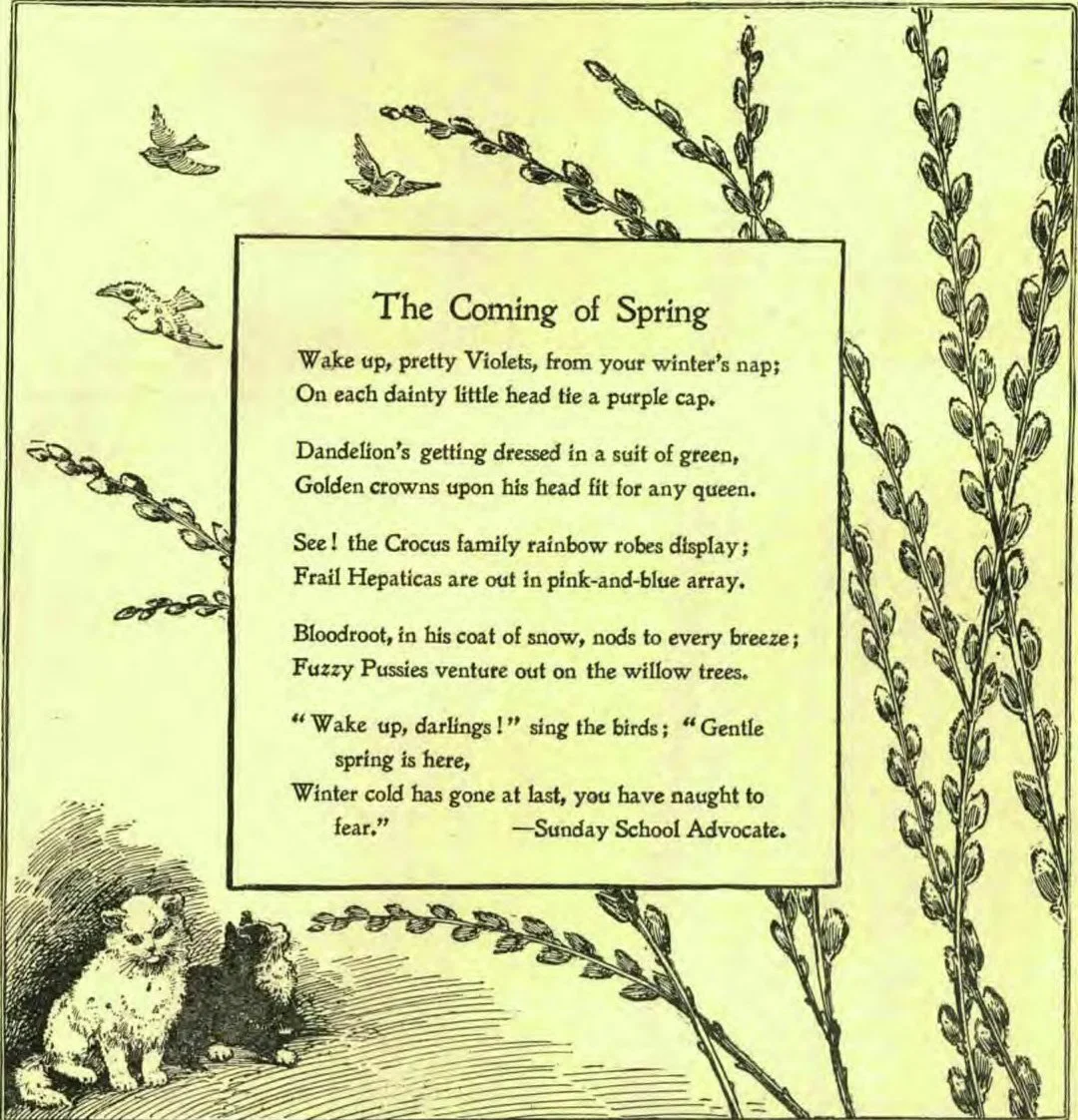
The Coming of Spring
Wake up, pretty Violets, from your winter’s nap;
On each dainty little head tie a purple cap.
Dandelion’s getting dressed in a suit of green,
Golden crowns upon his head fit for any queen.
See! the Crocus family rainbow robes display;
Frail Hepaticas are out in pink-and-blue array.
Bloodroot, in his coat of snow, nods to every breeze;
Fuzzy Pussies venture out on the willow trees.
“Wake up, darlings!” sing the birds; “Gentle spring is here,
Winter cold has gone at last, you have naught to fear.” —Sunday School Advocate.
Star Study for April
By Dr. O. C. Godsmark
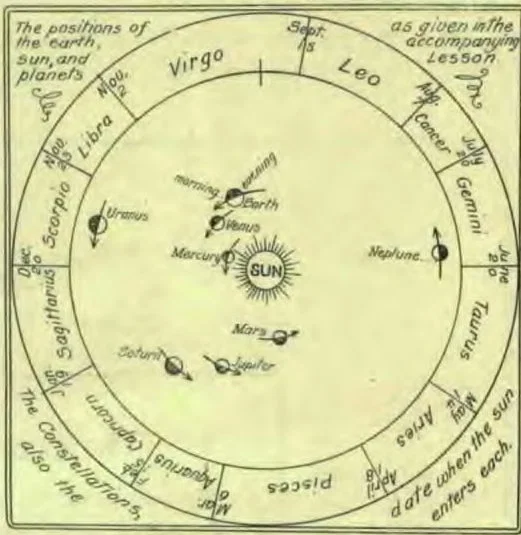
In our study for March, we learned that those planets lying nearer the sun than we, travel more rapidly than the earth; also that those lying farther from the sun travel more slowly. By comparing this diagram with the one in the INSTRUCTOR of February 27, this may be readily seen.
During March the earth made one twelfth of its yearly journey around the sun. Venus has outrun us, and is now nearly out from between us and the sun; while Mercury, the fleet, has outdone all the others, and completed about one fourth of his annual journey. Mars has made noticeable progress; but with the others so small a fraction of their yearly circle has been passed as to be scarcely noticeable on so small a diagram. Jupiter, the most rapid of this class, has gone only one one-hundred-and-forty-fourth part of his journey around the sun. These planets, therefore, appear stationary.
How many of our readers were up the mornings of March 15, 16, and 17, on the sharp lookout for Mercury? Those who were had no trouble in locating Venus, which reached her brightest point as morning star about March 20. If you saw Mercury at all, you caught him much nearer the point of sun-rising than was Venus.
As far as our solar system is concerned, all our work during the coming spring and early summer will have to be done in the early morning; for six of our planets are now morning stars. Can you tell by the diagram which they are? Let me help you a little. In imagination place yourself on the dark part of the earth, marked “morning,” just at the point where the earth is rotating out of darkness into the light of day; and then see how many planets are above your horizon.
Mercury and Mars will both be morning stars; but so nearly in line with the sun as to be invisible. Jupiter and Saturn may be seen; but will appear small, owing to their great distance from us, being nearly on the opposite side of the sun. Uranus, also, is so far distant that we shall not be able to detect him with the unaided eye; but Venus will be beautifully clear among the stars that deck our morning skies, though constantly growing dimmer as the season advances.
The three planets, Venus, Jupiter, and Saturn, may be easily distinguished from the other stars by their more ruddy color. They will be not far from the point of the sun-rising. Venus will be the brightest star of the east, and will be quite low; a little higher up will appear Jupiter; and the next higher will be Saturn. Fix these in mind, and then watch them during the coming season.
In view of what we have already learned in these studies, how many can tell why Venus will constantly grow less brilliant, while Jupiter and Saturn will continually grow brighter, during the coming months? Why is it so difficult to see Mercury? Will Mars continue to be a morning star? or will he shift to the evening sky?
DR. O. C. GODSMARK.
THE INTERMEDIATE LESSON
II — The Spirit
(April 12)
“AND the earth was without form, and void; and darkness was upon the face of the deep. And the Spirit of God moved upon the face of the waters.” Gen. 1:2.
“Whither shall I go from thy Spirit? or whither shall I flee from thy presence? If I ascend up into heaven, thou art there: if I make my bed in hell, behold, thou art there. If I take the wings of the morning, and dwell in the uttermost parts of the sea; even there shall thy hand lead me, and thy right hand shall hold me.” Ps. 139:7–10.
“The Spirit of God hath made me.” Job 33:4. “In him we live, and move, and have our being.” Acts 17:28.
(The Scripture texts are the lesson to be studied. Go over these carefully every day, until you know just what each one teaches. Then the following notes will help to a fuller understanding of the lesson. Read them carefully several times. Lastly go over all the questions, and be sure you can answer each one in the words of Scripture.)
The Holy Spirit, which in the beginning moved upon the face of the waters, is the life and presence of God himself. By his Spirit, Jesus Christ fills heaven and earth, and does what he wants done in all his universe.
It is not possible for us to get away from God’s Spirit, and out of his presence; for he is everywhere.111There is no place where God is not; in the depths of the earth, in the depths of the sea, in the highest heaven,—he is there.
The Spirit knows all that is in the mind of God, and does what is his will, making everything just as he would have it.
The earth was without form, and void. “And the Spirit of God moved upon the face of the waters.” The word “moved” here means the waving, fluttering movement of the wings of a bird when it hovers over its nest. The Lord uses this beautiful figure to teach us of the creative work of his Holy Spirit, which moved over the lifeless, formless earth, and filled it with the life and power of God. You will remember that it was in the form of a dove that the same Spirit afterward rested upon the Saviour at his baptism.
It was the moving of the Spirit upon the earth, which gave shape and life to all things. The earth produces nothing of itself, but everything is brought forth by the power of the Spirit. This is what made the earth in the beginning bring forth grass, trees, animals, and man; and that life-giving Spirit of power has never left the world. It was the moving of the Spirit of God that formed you, and everything that you see in the earth to-day, and it is this that holds you in shape, and fills you with life.
If God should take away his Spirit from the earth, all things would turn again to the dust from which they were formed, and it would again be without form, and empty and dark, as it was in the beginning.
The Spirit of God is the cause of all movement. Nothing has ever moved except by his power. “The Spirit is life,” and alone can give life; and there can be no movement without life. It is in him that “we live, and move, and have our being.” It is the Spirit of God that gives you the power to move. Will you not let him move you always in just the way that he wants you to go?
“Take my hands, and let them move
At the impulse of thy love.
Take my feet, and let them be
Swift and beautiful for thee.”
Questions
What was the condition of the earth in the beginning?
With what was it covered?
How was it brought into order?
Where is the Spirit of God?
Where can we go to get away from the Spirit?
Could we be alone if we were in the heart of the earth?
If we were far off upon the sea, what would God still be doing for us?
What is it that has made us?
What is he still doing for us?
Where do our life and breath come from?
What would take place if God should withdraw his Spirit from the earth?
How do we live?
What power is it that enables us to move?
What is he able to do for us if we will let him?
Miracles
“An egg a chicken! don't tell me!
For didn't I break an egg to see?
There was nothing inside but a yellow ball,
With a bit of mucilage round it all—
Neither beak nor bill,
Nor toe nor quill,
Not even a feather
To hold it together;
Not a sign of life could any one see.
An egg a chicken? You can't fool me.
“An egg a chicken! Didn't I pick
Up the very shell that had held the chick
(So they said)? Didn't I work half a day
To pack him in where he couldn't stay?
Let me try as I please,
With squeeze upon squeeze,
There is scarce room to meet
His head and his feet.
No room for any of the rest of him; so
That egg never held that chicken, I know.”
Mama heard the logic of her little man,
Felt his trouble, and helped him as mothers can.
Took an egg from the nest—it was smooth and round;
“Now, my boy, can you tell me what makes this sound?”
Faint and low, tap, tap;
Sharp and quick,
Like a prisoner's pick.
“Hear it peep, inside there!” cried Tom, with a shout.
“How did it get in? and how can it get out?”
Tom was eager to help—he could break the shell;
Mama smiled, and said, “All’s well that ends well.
Be patient a while yet, my boy.” Click, click!
And out popped the bill of a dear little chick.
No room had it lacked,
Though snug it was packed;
There it was, all complete,
From its head to its feet,
The softest of down, and the brightest of eyes,
And so big—why, the shell wasn't half of its size!
Tom gave a long whistle. “Mama, now I see
That egg is a chicken, though the how beats me;
An egg isn't a chicken, that I know and declare;
Yet an egg is a chicken—see the proof of it there.
Nobody can tell
How it came in that shell;
Once out, all in vain
Would I pack it again.
I think ’tis a miracle, dear mama mine.”
Mama kissed her boy. “It may be that we try
Too much reasoning about things, sometimes, you and I.
There are miracles wrought every day for our eyes
That we see without seeing or feeling surprise;
And often we must
Even take on trust
What we can not explain
Very well again.
From the flower to the seed, from the seed to the flower,
’Tis a world of miracles every hour.”
—Selected.
Beecher and His Teacher
HENRY WARD BEECHER certainly owed a debt of gratitude to his teacher in mathematics, says an exchange, not only for the knowledge acquired through his tuition, but for lessons tending to produce strength of character. He tells this story to illustrate the teacher’s method:—
“I was sent to the blackboard, and went, uncertain, soft, full of whimpering.
“‘That lesson must be learned,’ said the teacher in a very quiet tone, but with terrible intensity. All explanations and excuses he trod underfoot with utter scornfulness. ‘I want that problem; I don’t want any reasons why I don’t get it,’ he would say.
“‘I did study it two hours.’
“‘That’s nothing to me. I want the lesson. You need not study it at all, or you may study it ten hours; suit yourself. I want the lesson.’
“‘It was tough for a green boy,’ says Beecher, ‘but it seasoned me. In less than a month I had the most intense sense of intellectual independence and courage to defend my recitations. His cold and calm voice would fall upon me in the midst of a demonstration, ‘No!’”
“‘I hesitated, and then went back to the beginning, and on reaching the same spot again, ‘No!’ uttered with a tone of conviction, barred my progress.
“‘The next,’ and I sat down in red confusion.
“‘He, too, was stopped with ‘No!’ but went right on, finished, and sat down, and was rewarded with, ‘Very well.’
“‘Why,’ whimpered I, ‘I recited just as well as he did, and you said, ‘No!’”
“‘Why don’t you say, “Yes!” and stick to it? It is not enough to know your lesson. You must know that you know it. You have learned nothing till you are sure. If all the world says, “No!” your business is to say, “Yes,” and prove it.’”
“New York’s Most Useful Citizen”
By David Paulson
It has been well said that “some men are born great, some achieve greatness, and some have greatness thrust upon them.” But there is one great man in this nation, born in a lowly home in far-away Denmark, of whom it certainly can not be said that he had greatness thrust upon him. I refer to Jacob Riis, the author of that well-known book, “How the Other Half Lives,” and also of a more recent book, which is an account of his interesting life, under the title, “The Making of an American,” published by the Macmillan Company.
Mr. Riis accomplished so much for the betterment of the wretched tenement district of New York City that President Roosevelt has termed him “New York’s most useful citizen.” Mr. Riis devoutly recognizes divine guidance throughout his eventful career.
We may never have an opportunity to institute reforms which will add as much to the happiness of thousands of people as Mr. Riis has brought to pass; but each one of us may add sunshine to the lives of our immediate associates, making them brighter and more cheerful because we have lived. If we have done no more than this, although our fellow men may not inscribe our names high on the roll of fame, yet at the bar of God our Master will pronounce upon us a blessed benediction; for, as he himself declares, “Inasmuch as ye have done it unto one of the least of these my brethren, ye have done it unto me.”
Mr. Riis did not enjoy very elaborate educational opportunities in his early life. Disappointments at home, and a desire to see something more of the great, wide world than there was for him to observe in his little island home, led young Jacob to embark for America.
His first glimpse of New York City was in the very portion where he afterward accomplished such epoch-making reforms. How meager and incomplete was his notion of America can be imagined when he states that he expected to see buffaloes and red Indians charging up and down Broadway.
His money was soon gone, and he began to cast about for something to do. His first employment was in building huts for miners. In his book he relates a number of his experiences in mining, which are evidently more amusing to read about than they must have been to experience.
In course of time, he drifted back to New York City, but being unable to obtain a position, the pangs of hunger drove him again into the country. Having had no experience in farming, he could secure only “odd jobs,” thereby earning a meal or two at a time; then wander on, vainly attempting to find something else to do. Thus, almost unconsciously and certainly unwillingly, he was fast drifting into a tramp’s career. Possibly the Lord’s hand was in it all; for some of the rebuffs and cruel things he had to meet during those dark days made such an impression upon his mind that they no doubt had much to do in inspiring him in later years to strike such telling blows in behalf of the poor and down-trodden that thinking people all over the nation were aroused to action.
One cold, dismal night he found himself again in New York City, without money, food, or a place to sleep. He sat down on a North River pier; and such a feeling of despair swept over him that he contemplated throwing himself into the water, when his forlorn little black-and-tan dog, which had shared his troubles, crept up and licked his face. Even so slight an exhibition of affection was sufficient to save him in that awful hour.
At midnight he arrived at the police station, and begged for lodging. The hard-hearted officer refused him admittance unless he left his dog behind; and rather than perish on the street, he left his small companion on the outer doorstep. During the night he was robbed of a small gold trinket, which he carried with him as a memento of home. He reported his loss to an officer, who, instead of helping the lad, accused him of lying, intimating that if he had had such a trinket, he had probably stolen it. Young Jacob resented the accusation, and was promptly thrown out of the door, one of the men following after to kick him down the steps. At that moment his faithful dog fastened his teeth deep in the officer’s leg, upon which he seized the poor brute by the hind legs, and beat its brains out against the stone step. Mr. Riis, already goaded to desperation, became furious at this cruel treatment of his only friend, and laying hold of paving-stones, would probably have cleared out the entire police station had he not been overpowered.
I mention this incident because it had such an influence in determining his future work. Quoting his own words: “The outrage of that night became, in the providence of God, the means of putting an end to one of the foulest abuses that ever disgraced a Christian city, and a mainspring in the battle with the slum as far as my share in it is concerned. My dog did not die unavenged.”
In order to show that the death of this dog had to do with the doing away of the police-lodging evil, we will pass over twenty years of Mr. Riis’s experience. He had been for years one of New York’s most successful reporters. With his flash-light camera, in the dark hours of night, knowing no fear, he had silently gone in and out of the most wretched portions of New York City; and, often at the risk of his own life, succeeded in obtaining those startling pictures which told their own story in the book that afterward made his name known all over the nation. He had endeavored in vain to correct some of the terrible conditions that were in existence in that city, one of them being the huddling together of unfortunate men in an inhuman manner in the police stations.
In 1896 the tide had begun to set in for reform. Theodore Roosevelt had been appointed president of the police board, and Mr. Riis had been conducting him around, showing him something of the lodging-house evils, when, at two o’clock in the morning, they arrived at the very police station where Mr. Riis’s dog had been cruelly killed twenty years before. The incident is best told in his own words: “It was raining outside. The light flickered, cold and cheerless, in the green lamps as we went up the stone steps. Involuntarily I looked in the corner for my little dog; but it was not there, nor any one who remembered it. The sergeant glanced over his blotter grimly; I had almost to pinch myself to make sure I was not shivering in a linen duster, wet to the skin. Down the cellar steps to the men’s lodging-room I led the president of the police board. It was unchanged—just as it was the day I slept there. Three men lay stretched at full length on the dirty planks, two of them young lads from the country. Standing there, I told Mr. Roosevelt my own story. He turned alternately red and white with anger as he heard it.
“‘Did they do that to you?’ he asked, when I had ended. For an answer I pointed to the young lads then asleep before him.
“‘I was like this one,’ I said.
“He struck his clenched fists together. ‘I will smash them to-morrow.’
“He was as good as his word. The very next day the police board took the matter up. Provision was made for the homeless on a barge in the East River until plans could be perfected for sifting the tramps from the unfortunate; and within a week, on recommendation of the chief of police, orders were issued to close the doors of the police lodging-rooms on Feb. 15, 1896, never again to be unbarred.
“The battle was won. The murder of my dog was avenged and forgiven, after twenty-five years.”
Mr. Riis believes that every successful worker for humanity must conceive the fact that no matter how unfortunate the circumstances under which a man may be placed, human nature is not wholly lost; that “there is still the spark of His image, however overlaid by the slum. . . . Only tramps! It had been dinned into my ears until I said it myself, God forgive me! Aye, that was what we had made of them with our infernal machinery of rumshop, tenement, and dives. With Christian charity instead, what might they not have been?”
When you are tempted to ignore, or perhaps despise, some poor wreck of humanity, stop and consider what the difference might have been if he had enjoyed your opportunities, and you had been compelled to grow up groaning under the burden of his heredity and his surroundings. After you have carefully thought over this matter for a few minutes, if you will breathe a prayer to God, you will be likely to experience such a feeling of thankfulness for your lot, and at the same time such a feeling of pity for your unfortunate brother, that you will long at least to hold out an encouraging hand to him.
DAVID PAULSON, M. D.
II — Who Shall Be Worshiped?
(April 12)
MEMORY VERSE: “If the Lord be God, follow him: but if Baal, then follow him.” 1 Kings 18:21.
LESSON HELP: “Patriarchs and Prophets,” Chapter I.
Synopsis
In Revelation 14 is given a threefold message to all the world just before the coming of Christ. Matthew 24 calls this message the “gospel of the kingdom,” and very appropriately so; for its work is to restore the kingdom of God in the heart, in direct opposition to the worship of the beast and his image by the whole earth. This beast gets its power from Satan, and therefore the real question to be settled is, Who shall be worshiped, God or Satan?
Long ago, even before the earth was made, Lucifer raised this question in heaven; and he fell because of his effort to take God’s throne. He then influenced our first parents to try the same thing,—“Ye shall be as God” (R. V.), said Satan, and they believed him. They did indeed become as God in knowing good and evil (note ), but in so doing they lost the likeness of God in their hearts. To Adam and Eve the gospel of the kingdom was first preached in the promise given in Gen. 3:15. Every time the gospel message wins a single soul, or makes its way to a single heart, Satan’s head is bruised, and God’s throne is set up in that heart. Thus the image of God is restored, and we become like him.
Now is the time for this question to be settled; and when each one shall have settled it for himself, Christ will come, and with gladness “it shall be said in that day, Lo, this is our God; we have waited for him, and he will save us.”
Questions
1. Where do we find the full text of the gospel message which shall prepare the people for the coming of the Lord?
2. At this time concerning whom does the question of worship come to its climax?
3. What shows that this beast is the same as that mentioned in Rev. 13:14, 15? Note .
4. How is this beast spoken of in verse 14; that is, what beast is it?
5. To whom is the beast with the wound indebted for all his power? V. 2.
15. In getting knowledge that belongs to God alone, what did Adam and Eve lose?
16. How was the gospel first preached to them?
17. What change will this work in all who accept it? 1 John 3:2.
18. When this question of worship is settled, what event will take place?
19. What can the people of God then say?
Notes
Cultivating a Good Memory
MEMORY is an essential that can be cultivated. There is no acceptable apology possible for a poor memory, and it is one thing a public will not forgive. A great deal of time is not required to cultivate memory, since, when on a train, in the street, or anywhere else, in fact, one may be memorizing; and every line or bar intelligently committed to memory is an advance.—Success.
Finish Each Day and Be Done With It
FINISH every day, and be done with it. You have done what you could. Some blunders and absurdities no doubt crept in; forget them as soon as you can. To-morrow is a new day; begin it well and serenely, and with too high a spirit to be cumbered with your old nonsense. This day is all that is good and fair. It is too dear, with its hopes and invitations, to waste a moment on the yesterdays.—Emerson.
Boy’s Watch, Free
To introduce E-Z Washing Tablets, we will give to every boy who will sell 32 bars at 10 cents a bar a guaranteed nickle-plated watch and chain; value, $1.50. Send your name and address, and we will send the Tablets prepaid; and when you have sold them, send us the $3.20, and you shall receive the watch and chain by return mail. E-Z Washing Tablets wash clothes without rubbing. Ladies, send for circular. Three samples, 10 cents. Write to-day to Mallett Novelty Co., 710 East 171st Street, New York City.
Shorthand by Mail
YOUR spare time can be well improved by studying shorthand, and this can be done at small expense to you by taking a mail course at your home. We are using “The Rogers Compendium of the Graham System of Shorthand,” a method arranged especially for home study, and giving an epitome of a system of shorthand acknowledged to be the best, the briefest, and the most complete. The only presentation of Standard Phonography in which all shorthand outlines are written as first learned, thus greatly abbreviating the work on the part of the student. A complete course in thirty lessons, illustrated by facsimile notes, with key. The correction of all students’ papers given special attention by experts. Reasonable tuition rates. If interested, write for full particulars. Practicing stenographers wishing to prepare for rapid reporting work should secure the last twenty lessons.
FIRESIDE CORRESPONDENCE SCHOOL,
Battle Creek, Mich.