The Youth’s Instructor, Vol. 37, No. 3.

THE FIRE BY THE SEA

The Youth’s Instructor

Jan 16, 1889

S. D. A. Publishing Association · Battle Creek, Mich. · Jan 16, 1889

THE FIRE BY THE SEA.
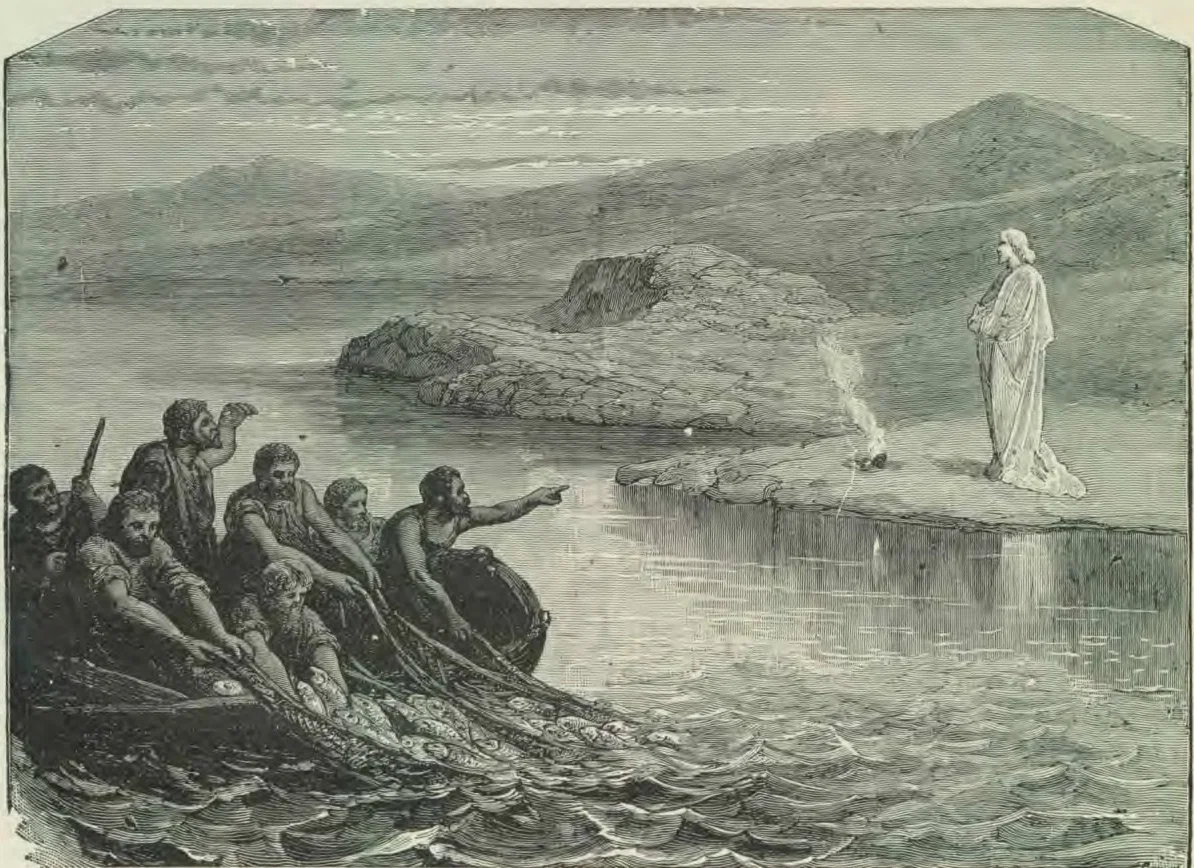
There were seven fishers with nets in their hands, And they walked and talked by the sea-side sands; Yet sweet as the sweet dew-fall The words they spake, though they spake so low, Across the long, dim centuries, flow, And we know them one and all,— Ay! know them and love them all.
Seven sad men in the days of old, And one was gentle, and one was bold, And they walked with downward eyes; The bold was Peter, the gentle was John, And they all were sad, for the Lord was gone, And they knew not if he would rise,— Knew not if the dead would rise.
The livelong night, till the moon went out, In the drowning waters they beat about; Beat slow through the fog their way; And the sails drooped down with wringing wet, And no man drew but an empty net; And now 't was the break of the day,— The great, glad break of the day.
“Cast your nets on the other side!” ('T was Jesus speaking across the tide;) And they cast and were dragging hard; But that disciple whom Jesus loved Cried straightway out, for his heart was moved,— “It is our risen Lord,— Our Master, and our Lord!”
Then Simon, girding his father's coat, Went over the nets and out of the boat,— Ay! first of them all was he; Repeating sore the denial past, He feared no longer his heart to cast Like an anchor into the sea,— Down deep in the hungry sea.
And the others, through the mists so dim, In a little ship came after him, Dragging their net through the tide; And when they had gotten close to the land, They saw a fire of coals on the sand, And with arms of love so wide, Jesus, the crucified!
'Tis long, and long, and long ago, Since the rosy lights began to flow Over the hills of Galilee; And with eager eyes and lifted hands, The seven fishers saw on the sands The fire of coals by the sea,— On the wet, wild sands by the sea.
'Tis long ago, yet faith in our souls Is kindled just by that fire of coals That streamed o'er the mists of the sea; Where Peter, girding his father's coat, Went over the nets and out of the boat, To answer, “Lovest thou me?” Thrice over, “Lovest thou me?”
—Alice Cary.

ELSIE'S BIRTHDAY GIFT.

“A WHOLE day to do just as I like!” said Elsie Dean, “and I've got this beautiful new Bible for a birthday present. I don't know how to thank you, mamma; it is just what I wanted most.
“I promised Cora I would spend a part of the day with her, and I've so many other things to do, that I really don't know where to begin!”
“Why not learn a verse from your new Bible?” said her mother. “That would be a good beginning.”
“So I will, mamma. I am going to do that every day; and if I should live to be as old as you, and learn three hundred and sixty-five verses every year, how many I shall have laid up in my mind!”
“And if you hide them in your heart, and make them the guide of your life, you will have nothing to fear in the future,” said Mrs. Dean.
Elsie took up her pretty brown Bible with a thoughtful face, and this was the verse that met her eyes as she opened it:—
“Beloved, if God so loved us, we ought also to love one another.”
“I am sure that is easy to do,” said Elsie. “I love everybody—except Joe Wood, and nobody can love him, he is so hateful. I can't forgive him, either, for drowning my kitten, and he is always calling me names besides. No; I am sure I can't love him, and there is no use in trying.”
Then Elsie put away her Bible, and went over to see her dearest friend, Cora Allen.
“I am so glad you have come early,” said Cora.
“I've just got a lovely new tea-set that Aunt Hattie sent me, and Angeline, my Paris doll, is going to have a grand party. Mamma let me make some little cakes and tarts, and I've got everything arranged in the summer-house, and we will have a splendid time.”
These two little girls were always happy together, and this was an unusually happy day; but it came to an end at last, as happy days always do, and when Elsie was ready to go home, Cora asked, suddenly,—
“Did you know Joe Wood had got hurt? He cut his leg when he was chopping wood, and his mother has to go out washing every day, so he has to lie in bed all day alone. They are so poor, you know; and now he can't work, they have a hard time of it. Miss Prince told mother she really pitied Joe, if he was such a bad boy.”
“He can't expect to have many friends,” said Elsie. “He never tried to make any.”
“And he will have time to think about how bad he has been,” said Cora. “I hope he will behave a little better when he gets well.”
All the way home Elsie thought of Joe.
“May be I shouldn't be any better than he is,” she said to herself, “if I hadn't any father, and we were so poor and everything. I have half a mind—yes, I will do it if mamma is willing, and I know she will be.”
Half an hour after, Joe heard a low knock at the door, and then it was pushed open, and Elsie walked in.
“I am so sorry you have got hurt,” she said, “and I thought you must be lonesome all alone. Mamma sent you this big basket of things,—oranges and grapes and everything nice,—and I've brought you my Christmas book; it is just full of pictures and stories, and I thought it might help you to forget the pain in your leg.”
“You'd better take 'em all back,” said Joe, in a husky voice. “I ain't fit to have 'em. I thought everybody hated me, so I didn't care how I acted. I'm awful sorry I drowned your kitten.”
“You must not feel bad about that any more,” said Elsie. “I am sure you would not do it again.”
“I know where there's a kitten,—a regular beauty,—and I'll get it for you as soon as ever I get on my feet again, see if I don't,” said Joe. “You won't ever catch me acting so mean again—not if I know it.”
“May be we haven't been very kind to you, Joe,” said Elsie, with a queer choking in her throat. “But I'll be good and try to help you after this, and I am sure Cora and the others will, when I tell them. I must go home now, but I'll come and see you again soon.”
Then Elsie hurried home with a very happy heart.
“I think now I've got my verse for to-day perfect,” she said to her mother, “so I'm all ready for another to-morrow.”—The Well-Spring.

ONE PENNY LOST.

A LITTLE rosy-cheeked working girl in a street-car the other evening, on examining her pocket-book, found that she had lost one penny, so that she had only four cents with which to pay her five-cent car fare. On discovering her loss, she exclaimed, “I must get out; I have lost a penny!” and then blushed when she found she had given expression to it aloud.
The loss of a penny in this case involved much to her. It probably meant a walk of many miles. Fortunately, a kindly-disposed gentleman sitting beside her, handed her a nickle and received her four pennies in return. A smile and “Thank you” from that innocent little face amply repaid his kindness, and the transaction made both borrower and lender pleased.
The loan was a little thing, yet the cheer it gave to one who was just beginning to provide for her own support by honest labor, will probably leave a lasting impression for good. This want of a penny and its supply, in the busy whirl of life, simply illustrates that our pleasure and gratitude are oftener evoked by little things than otherwise.
It is the little things that enter into our life which make it bright and cheery, or sad and disappointing. A little act of kindness, a little smile, a little word of cheer,—what hope and joy they bring to those needing them; and who does not need them? This simple act to the child, the loaning of one penny, probably gave her a more exalted opinion and a better impression of humanity than thousands of larger or more momentous acts will likely do when her life is rounding up.—Dry Goods Chronicle.

THE FIJI ISLANDERS.

“You have just come in from school, haven't you, Genie?”
“Yes, mamma; and what do you think Julia Gregory said when we were studying our geography lesson to-day?”
“I don't know, dear; but if it was something to help you remember your lesson, I suspect it made you glad.”
“It wasn't about the lesson we had to-day; but she says it will be in our lesson very soon, though, and I suppose I shall have to learn it, if it is ever so wicked.”
“What do you mean, child?”
“Why, Julia says it is true that the natives in the Fijian Islands catch and eat people who go there. It isn't so, is it, mamma?”
“It is true, daughter, that the natives of those islands were guilty of that wicked and cruel practice. Fifty years ago there wasn't a Christian in all Fiji. The natives were savage cannibals; but now, it is claimed, there are no heathen. Other savage tribes, too, from an early period of the world's history, have been guilty of this barbarous sin.”
“The people who eat human flesh are called cannibals; and cannibalism is a part of the religion of some savage tribes. The Fijians thought the gods delighted in human flesh.”
“Some tribes partake of human flesh only when there is a scarcity of other meat; others feed upon it thinking it will make them ferocious and blood-thirsty. But the worst form of cannibalism is practised by those who use human flesh as an article of food, the same as they do other meat. In trying to give the gospel to these tribes, many missionaries have lost their lives.”
“Then, mamma, I don't think it is a very nice thing to go as a missionary to the heathen. Why, how can the Lord expect we will go and teach people who will, likely as any way, eat us all up?”
“Well, Genie, Christ gave his life for our sakes, so he expects we will risk our lives for his sake. When a person is truly converted, he wants everybody else to have the peace, the joy, and the blessedness that comes through the Saviour. Christ dwells in his heart, and it makes him do as Christ did, even to laying down his life, if necessary.”
“We know, Genie, that human life has been sacrificed in the attempt to introduce the gospel to the people of cannibal countries; but the efforts put forth have resulted in the conversion of many natives, who are now devoted and courageous Christians. Miss Gordon Cumming, in her book ‘At Home in Fiji,’ says the native Christians have a spirit of consecration, zeal, and self-denial that but few possess, even in Christian lands. Some of them come right forward and offer themselves as missionaries, even going to strange islands, where, to human appearance, there would be no escape from either the cannibals or the damaging influence of an unhealthful climate.”
“At one time a number of native Fijian teachers, with their wives, offered themselves to go and open a mission in New Britain, a cannibal island a little way east from New Guinea, in the Pacific Ocean. The English Consul, seeing the dangers imminent to such an undertaking, tried to discourage them.”
“Did they give it up, mamma?”
“No, indeed. They said decidedly, ‘We know those islands. We know the danger. If we get killed, well; if we live, well. We are willing to go.’ The wife of one teacher being asked if she intended to accompany her husband, said, ‘I am like the outrigger of a canoe; where the canoe goes, there you will surely find the outrigger.’”
“These teachers gave up their salaries, and without knowing where their food would come from, they went, relying upon God's promises, to carry the gospel to those blood-thirsty savages. And though some of these teachers lost their lives by cannibals, the ranks were at once filled by others equally devoted and courageous.”
“Do the Fijians keep the Sabbath, mamma?”
“They have not yet had light upon the Sabbath, but they are very strict in the observance of the day they think God set apart as the rest-day. We would do well to imitate their devotion. Miss Cumming says that not a canoe will put to sea upon Sunday unless it be to carry a teacher to a place of worship. As proof of their loyalty to God, Miss Cumming relates an interesting circumstance that happened when she was on the islands. It was occasioned by one of their most pleasing festivals happening upon Sunday, and was nearly as follows:—”
“It was the feast of Bololo—the Bololo being a small sea worm, long and thin as ordinary vermicelli, which lives in the deep sea, and is greatly prized by the natives as an article of food. Only on two days of the whole year do these creatures come to the surface of the water. The first day is in October, which is hence called Little Bololo, when only few appear. After this no more are seen till the high tide of the full moon, which occurs between the 20th and 25th of November, which takes the name of Great Bololo. Then the worms rise to the surface in countless myriads, always before day-break. The natives know exactly when to expect them, and their appearance makes the merriest day of the year.”
“About midnight the people go out in their canoes, carrying wicker baskets, in which to dip up the dainties of the sea. When the Bololo appear, all is sport and laughter, every one bailing them up, and trying who can most quickly fill his canoe, either by fair sport or stealing from his neighbor. As the day dawns, the mysterious creatures with one accord sink once more to their native depths, and by the moment of sunrise, not one remains on the surface; nor will another be seen for nearly a twelve month. All the canoes then return to land; the Bololo is wrapped in bread-fruit leaves, and cooked in ovens on the beach, and there is a great feast—a regular white-bait dinner. The supply generally lasts several days, and basketsful are sent to friends at a distance.”
“The full-moon tide in November of that year happened upon Sunday. Don't you think it was a great temptation to Fijian Christians?”
“Did any of them go out to gather the Bololo, mamma?”
“Not a native Christian went out to secure this esteemed treasure of the sea. God's promises were more precious to them than any treasure gotten by dishonoring him.”
“If there had not been some who had the spirit of Christ urging them to seek and save that which was lost, in the face of every danger, what would now be the condition of the inhabitants of those sea-girt isles? One cannot always tell where God's treasures lie until he has searched for them; it is his duty to hunt them wherever there is a possibility of finding any. Should he lose his life in the attempt, as the Fijian missionary said, ‘It is well.’ He that loseth his life for Christ's sake secures eternal life.”
M. J. C.

ANIMAL TRADES AND PROFESSIONS.

Did you ever read about the different kinds of trades the many outside dwellers are plying? They get about their work by day-break, when most of the children are sleeping sweetly and soundly on their snowy pillows. Wilson Flagg, in his book of birds, speaks of them as musicians. He calls the robin the clarionet player, the blue-bird the flageolet, the hair-bird the octave-flute, and the golden-robin the bugle. He says the serious part of the music begins very early—as if the musicians began the morning with their “Praise God, from whom all blessings flow.” At sunrise the bobolink begins his comic melody. He is the merriest of the birds, and there is never a plaintive strain in his music. He is a very jolly sort of musician. Wilson Flagg also tells us that if a discordant sound occurs in the musical performance, it disturbs the equanimity of the singers, and they all suddenly stop, and some minutes elapse before they start again. You might listen to their morning concerts, and find out for yourself about this statement he has made.
The birds are the musical characters. What are the wasps? They are paper-makers. They make paper out of material the paper mills could not use at all. Their nests are made of paper. If you examine one, you will see how curiously they are made; but look out for the wasps inside. The caterpillar is a silk-spinner. The mole is an engineer; he can form a tunnel quite as well as if he had taken an engineering course in one of our colleges. The bee, we are told, is a professor of geometry. He constructs his cells scientifically; all the great mathematicians in the world could not make them as the bee does. The nautilus is a navigator, hoisting and taking in his sails as he floats along the water, and casting anchor at pleasure. The kingfisher and the heron are fishermen. When you go to the ocean beach, watch them, and see how skillfully they fish. They do not often go away without fish, as I have many times seen the boys and girls go, with disappointed faces. One secret of their success may be that they keep very still and do not chatter to each other.
The beetle is a grave-digger. He goes about his work very solemnly, and it would be well worth while for you to watch him at his work. In the evening the lamp-lighters come out and light up the woods and gardens. They are the fire-fly and the glow-worm. The beavers are carpenters and masons. We might keep on enumerating the different trades of these busy little workers, but every boy and girl who has an opportunity of watching the busy life in the outside world of nature, will be surprised to find how much there is of importance going on, how much these little creatures God has made are capable of doing.—S. T. Perry, in Evangelist.

THE BIBLE.—NO. 1.

I WANT to talk with the INSTRUCTOR family about the Bible. I will try not to talk long at a time, and I will also try to talk in a plain, easy manner, using words we can all understand, because I want you to get well fixed in your minds the facts about God's book and what he says to us in it.
The Bible is a very common book, that is, it is found all over the world. There is no other book, unless it be the dictionary used in all our day schools, that is so scattered up and down the earth. Go to England, France, Germany, India, China, Japan, or to the islands of the sea, and you will find the Bible there the same as in America. People own more Bibles than any other one book.
Bible societies print millions of copies of it, amounting to tons in weight. The Bible is for this reason sold very cheap. You can buy a nice, good one for twenty-five cents, and a New Testament for five cents. If a person wants a Bible, and is too poor to buy it, the Bible society will give him one, so none need be without a Bible. This is a good plan, and we ought to be glad that very poor people can have it. The societies have Bibles of different styles and prices for sale in the cities and towns of this country. The places where these Bibles are kept are called depositories. In the city of London, eighty-four years ago, the large Bible society of England was formed. It is called “The British and Foreign Bible Society.” Seventy-two years ago, in New York City, the “American Bible society” came into existence. Since then, these two societies have printed in several languages enough Bibles to fill many trains of cars.
Now where did this book, that has found a home everywhere, come from? We will let the Bible itself tell. It says: “All Scripture is given by inspiration of God.” 2 Tim. 3:16. Also in the last verse of the first chapter of second Peter, we read, “Holy men of God spake as they were moved by the Holy Ghost.” Then God by his Spirit inspired good men to give the Scriptures. They spoke the Lord's will,—what he would have them speak. He put it into their minds what to say, and they wrote it down, and it was kept and taught to the people. He also told these men to write what he had revealed to them. Thus Moses wrote in a book what the Lord told him. Deut. 31: 9, 24.
The Lord told the prophet Habakkuk (pronounced ha'-bak-ook) to write what he had said to him, and had caused him to see. He told him to “write the vision and make it plain.” Hab. 2:2. The reason was “that he may run that readeth it.” That is, that whoever reads the words of the Lord that were written, might make haste to let others know of them.
A wicked ruler drove that good man, the Apostle John, to a wild and lonely island because he was a Christian and stood up for Jesus. While there, the Lord by his Spirit showed him many wonderful things, and told him to write them in a book for the different churches. Read Rev. 1:11, 19.
Thus we see that the Lord not only spoke to good men in the days of old, and caused them to see certain things, but told them to write them out for the people. In this way the Bible came from God.
N. J. BOWERS.

A LARGE CAT.

Did you ever watch Mistress Pussy catch a bird? How quietly she waits, and how stealthily she creeps along until she gets near enough to be sure she will not make a mistake. Then she gives a spring, and the little songster's life is ended.
Mistress Pussy has a great many relatives. Some of them have unpleasant dispositions. We should not like to live with them; for they would do us harm.
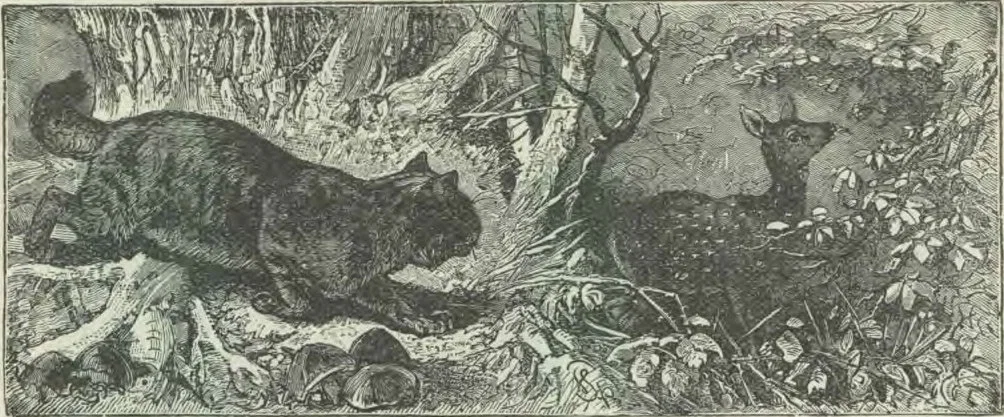
In the picture is a very large cat. It has so many names that I hardly know what to call it by. It is the American Lion, the Panther, the Catamount, or as the hunters sometimes call it, the Painter. In your Natural History it is called the Puma. Its body is four feet and a half long, and its tail measures nearly two feet more. It has a tawny fur, without any of the stripes and blotches that you see on a leopard's skin.
Do you not see how quietly the puma is creeping around the roots of that old tree? He is so still that the timid deer does not hear him. Soon he will make a spring, and the pretty little creature will lie dying at his feet. When the lion springs on his prey, he gives a terrific roar; but when the puma springs, there is no sound except the crashing of the bushes. The puma can imitate the bleating of the forest deer so well that hunters, and even the deer themselves, are deceived by it.
The puma lives in both North and South America. It lives in Northern California, where the grizzly bear lives. The grizzly bear and the puma hate each other. When they fall to fighting, the puma usually conquers. Old grizzly does not like to be beaten, so he pays the puma back by killing all the puma kittens he can find.
If captured when young, the puma grows so tame that he will follow his master around like a dog.
W. E. L.

DRATHERING

MRS. PUTNAM stood looking out of the back window. The kitchen stove, which was heated to bake bread, made the air uncomfortably hot, while the pile of unwashed dishes gave a rather forlorn look to the usually tidy room, quite in contrast to the scene without.
Under the maple trees in the yard, two little girls were playing croquet. Dressed in their cool afternoon lawn dresses, they made a pleasant picture. The mother smiled, in spite of her aching head, to see them so happy. But nevertheless the game must be spoiled; for there was some brushing up and dusting to be done elsewhere, and the children must “do the dishes.”
“Millie!”
The older little girl dropped her mallet, and ran at once to see what was wanted.
“Can you and Helen do the dishes for poor, tired mamma?”
“O mamma!” exclaimed Millie; for she knew that this was mamma’s polite way of saying, “You and Helen must do the dishes,” and a very decided frown puckered her forehead.
Sometimes it was almost more of a trouble for mamma to get any work out of Millie than to do it herself, and she was afraid it was going to be so this afternoon.
The checked gingham aprons were soon buttoned on, and a few minutes later two sweet voices were heard singing over their work. The song was made up for the occasion, and ran thus:—
“Only a dishwiper, proudly I stand, Wiping the dishes at mamma’s command; Watching if ‘Rinse them’ shall the order be, Standing by the table, serving faithfully.”
And then came the chorus,—
“Surely my mamma may depend on me, Though but a dishwiper I may be.”
“Bless their dear little hearts!” said mamma to herself.
A little later, mamma was resting in a darkened room, and the game of croquet was resumed.
That night, after the children were in bed, and little Helen was asleep, mamma sat on the side of Millie’s bed to have the usual good-night talk. That night-talk gave the mother a stronger hold on her child’s confidence than anything else could.
“You were a real help and comfort to me to-day, dear; but you know sometimes you do what I ask you to in such an ungracious way that I would rather do almost any amount of work than to ask you to help. What made you do it so nicely to-day?”
“Well, mamma, I’ll just tell you. You looked so tired, and I remembered what you had told me about doing things to help other people, and all at once I just felt as if I’d drather do it than not.”
And then she added, with a burst of thought: “And, mamma, isn’t it funny how much difference drathering makes?”
“Yes, dear, it does make all the difference in the world. None of us can choose what we will do from day to day, but we can choose to do what is given us to do cheerfully and well; and, as you say, ‘drathering’ makes all the difference. Give me my kiss. Good-night.”—Selected.

A BAD HABIT.

LITTLE Mattie was always getting into mischief because she would not heed what older and wiser people told her. She always wanted to see for herself if things were just as they were said to be.
One day she told her sister Amy, who was much younger, that she was going to get some honey out of the beehives.
“The bees will sting you,” said Amy.
“I am going to see if they will,” said Mattie; and she ran to the hive and overturned it.
Out swarmed the bees in great numbers. They were very angry at being disturbed, and lighted on Mattie’s face, neck, and hands, stinging her so badly that she fell to the ground, screaming with pain.
The cook ran out of the kitchen and picked her up. She was sick in bed for several days, and you may be sure she never went near the beehives again.
But she was not cured of meddling. One day she leaned over the well-curb to see how deep the well was.
“Take care! you’ll fall in,” said Amy.
“No, I won’t fall in,” said Mattie; but just as she spoke, over she went.
The well was not very deep, and Mattie did not get hurt at all; but she had time to get very wet and to shed a great many tears before her papa came and drew her up in the well-basket. She caught cold, too, and had to stay in the house for a week, and take very bitter medicine.
But she was just as meddlesome as ever, and it took a very severe lesson to cure her of her bad habit.
One day her brother Joe left his gun in the hall, while he went into the kitchen for a drink of water.
“Don’t touch that gun, Mattie,” he said; “it is loaded.”
Mattie was playing with her dolls by the hall door; but as soon as Joe went away, she ran to the gun and stroked it with her hands.
She took hold of the gun, and tried to lift it, but it was too heavy. It fell to the floor, and went off with a loud noise. And Mattie fell, too, shot through the knee.
It was many weeks before she could play out-doors again, and then she had to walk with a crutch. But she had learned to let things alone. She was cured of her bad habit.—Our Little Ones.

HOW SILK IS MADE.

Do you ever think, children, when your pretty ribbons are tied on, that the glossy, beautiful silk is made by a worm? Some of you may have seen silk-worms, but many do not know what an interesting story their little life makes.
Last winter there was sent me a tiny package of what looked like little gray seeds, or beads. I had to keep them very cold until the mulberry leaves were well grown. Then I put the seeds in a warm place. In a day or two there were myriads of tiny little creatures crawling out from the seeds or eggs. At once they began to eat the leaves of the mulberry. Day after day they ate, and grew, until they were as large as my little finger, and longer. They ate so much that we were all kept busy feeding them. They would seize a leaf, and leave nothing but the veins in a few moments. If you ever saw a skeleton bouquet, you can imagine how they left the leaves.
But one morning they did not seem so hungry. They wandered about, and climbed up the bundles of straw I had set for them. In a little while many of them began to spin the most beautiful silken threads, very much as a spider does. Back and forth, over and over, in loops like a figure 8, went their queer “hooded” heads. By and by each one could be seen inside a beautiful silken veil, or shell, about the size of a large peanut. The worm continued to spin until the veil was too thick for us to see through; but we could hear his little “click, click, click,” as he worked. The worms have to be killed in the case. If they are allowed to live, they will break the delicate threads.
We did not kill them all, however. I wish you could have seen the room when we gathered the cocoons, which is the proper name for the peanut-shaped home of the silk-worm. All along the ceiling, behind the window-curtain, on papa’s desk, in baby’s rubber,—which she forgot to put away,—behind the pictures, on the cord, under the broom, on the floor, around the door-knobs—cocoons, cocoons, everywhere; countless numbers were also hung, like pretty birds’ eggs, in the straws. From these, after a few days, came beautiful white moths, not at all like the ugly worms.
From the cocoons in which we killed the worms, we reeled the delicate threads from which all our silk is made. Is it not indeed a curious story?—Mrs. E. C. Smith.

PLAYING BROWNIE.

It was a very dismal, rainy day; and a very dismal little girl, with something that looked very much like a raindrop running over each cheek, stood at the sitting-room window, drumming drearily on the pane, through which there was nothing to be seen but a rubber-coated grocery boy, with a basket on his arm.
“What a horrid, horrid day!” pouted Alice Kent.
“What a little Miss Grumblekin!” exclaimed busy Aunt Julia, as she hurried through the room, clad in her gossamer waterproof, en route for market.
“But, auntie, I haven't anything to play with.”
Aunt Julia stopped a moment. “I know a nice game that you can play all by yourself,” she said.
“What is it?” asked Alice.
“Play you are a good brownie,” replied her aunt. “Your mother has a great deal to attend to this morning.”
“What do good brownies do, Aunt Julia?”
“Things to help people when nobody sees,” was the reply,—“surprises, you know.” Then she was gone.
Alice stood and watched the umbrella turn the corner; then her face brightened as she ran upstairs as fast as her feet would carry her.
As the family sat at the cozy tea-table that evening, mamma remarked, “I believe there has been a good fairy around to-day. Somebody dusted my room, and put my work-basket to rights, and arranged my top drawer beautifully.”
“Why, that is strange, Ellen,” said grandma; “I had a similar experience. Somebody found my spectacles, and saved me the trouble of coming down after the morning paper.”
“I wish you would notice the hall closet,” interjected Aunt Julia. “You know it’s a catch-all for the family.”
“Yes,” sighed mamma; “when everything else is in order, that closet rises up before me like a nightmare. I must straighten it out this evening.”
“But it looks very nice to-night,” continued Aunt Julia,—“shawls all folded on the shelves, hoods and hats and gloves and rubbers in their proper places. I could hardly believe my eyes.”
“There is a certain little girl,” said papa, “who often forgets to put my gown and slippers by the fire, but my fairy must have done it to-night. Have you had a dull day, Puss?”
“The pleasantest day I can remember,” replied Alice.
No one thought her to be the child who had pouted at the rain that morning.—S. S. Classmate.

CONTENTMENT

Tell me, little bird, why You stay when the snow is here? Have you not wings to fly To some happier atmosphere?
“I love the wild dance of the snow, And the berries, frosty and red; Why should I hasten to go, When here is my daily bread?
“And if my notes are but few, When you think of the thrush and the jay, What can a little bird do But sing on through the storm as he may?
“Chickadee-dee-dee-dee: Perhaps some one is glad to hear Just this frolic whistle from me In the songless time of the year.”
—St. Nicholas.
Continue reading: SHELLS OF AFRICA