The Youth’s Instructor, Vol. 33, No. 8.

CAPTAIN COOK

The Youth’s Instructor

Mar 11, 1885

S. D. A. Publishing Association · Battle Creek, Mich. · Mar 11, 1885

CAPTAIN COOK.
It was in a very humble home that Captain James Cook first saw the light of day. In a little mud house in the village of Marton, Yorkshire, he was born, October 27, 1728. His father was a poor farm-laborer. But you must not imagine that he led so free and independent a life as do the farmers in our country. There all the land is owned by the lords, who hire the poor people to till it for them. Mr. Cook was an industrious and upright man, who did faithfully the work assigned him. He so well pleased his employer, that he was appointed overseer on the farm where he worked.
The owner of the farm sent James to a day-school, where he was taught to read and write and cipher. He did not stay in school a great while. Before he was thirteen, he was apprenticed to a shopkeeper at Straits, a good-sized fishing town. James had always wanted to go to sea, and it did not lessen his desire any to live among fishermen. Undoubtedly he found it very irksome to sell ribbons and lace, and pins and thread. I imagine he found it easy to quarrel with his master, who soon gave him his discharge papers.
As soon as he was free, he bound himself out for seven years to some Quaker ship owners. Most of this time he spent on board a coal ship. Shortly after his time was out, he was appointed mate of one of these ships.
In the year 1755, when England was at war with France, young Cook happened one time to be in the Thames River, with the ship to which he belonged. His Majesty compelled every seaman on whom he could lay hands to enter his service in the navy. Young Cook at first thought he would hide, and so escape being pressed into service; but he finally concluded to go to war, and voluntarily offered himself to the royal navy.
There is not space to tell of all the good service he did his country and the world. He made two voyages to the Southern seas, and discovered many things. When he came home from his second voyage, he was made a post-captain; he was also appointed captain of the Greenwich hospital, and was made a member of the Royal Society.
This was quite a high position for a humble farm-laborer's boy to have risen to. Yet no man was more deserving of such honors than he. And he gained it all by his sagacity, firmness, and perseverance. No one would have thought, when he was a common sailor on the coal ships, that he would have risen above that position. Yet he was “diligent in business,” anxious to learn, and quick to improve every opportunity as soon as it presented itself; and success in some way or other was sure to come. His humanity and sympathy made him a great favorite with his crews.
When we read of a man who has so heroically given up all home comforts, endured every hardship, and faced great danger, all that he might help people to know more of the great world in which they live, we at least hope that he may be allowed to live a good old age, and die surrounded by the familiar faces of friends. But Providence seems to have ordered otherwise for Captain Cook.
In his last voyage he sailed into the Pacific Ocean up to Behring’s Straits to discover a passage from the Pacific through the Northern seas to the Atlantic. But he found the straits so blocked with ice that it was impossible to proceed; so he turned back to winter in the Sandwich Islands. These islands he had discovered and named while on his way north. He now explored the coast line more carefully, and discovered two more islands in this group.
The natives treated him with the greatest kindness, furnishing him with an abundance of fresh provisions, and in every way showing him tokens of great respect. Everything passed along smoothly, until one night the natives stole one of the ship’s long boats. In a voyage of discovery, in unknown seas, such a loss was irreparable.
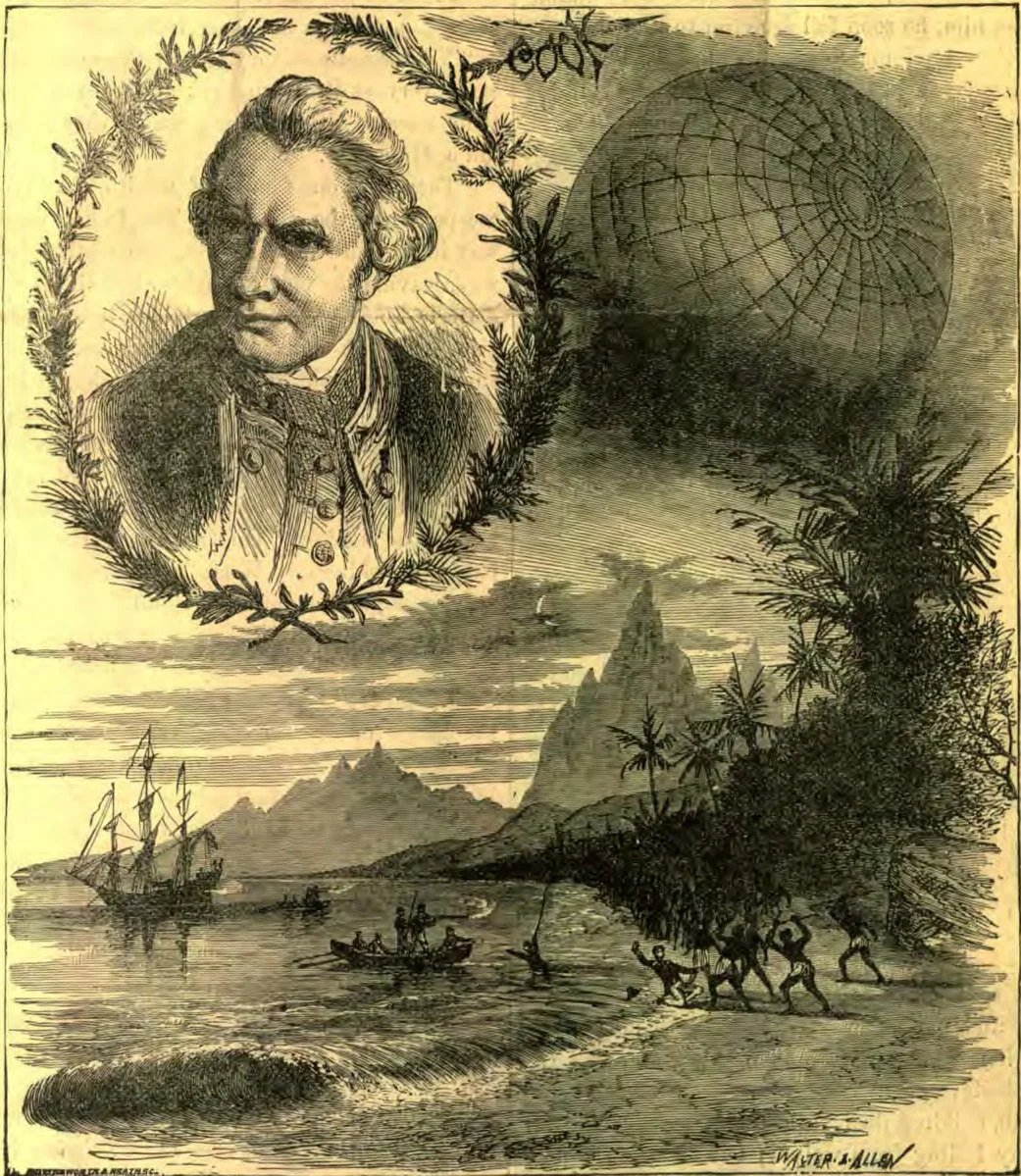
Captain Cook determined to have his boat back; but he had no way to get it except by seizing the king and keeping him until the stolen property was returned. When he went on shore with a small company of marines, to get the king, the natives surrounded them, and with horrid yells, drove the sailors back into the water with long spears and great stones. The Captain, always looking out for the safety of his men before he did for his own, was the last one to leave the beach. The natives surrounded him; but as the boat’s crew were unable to assist him, he soon fell a victim to their barbarity. Thus he found a grave February 14, 1779, in this savage land, far from home, and all his heart held dear.
W. E. L.

ROCK OF AGES.

It is said that in the ocean, Far from land on either side, Stands a rock of vast dimensions, With foundation deep and wide;
And that high above the water, Where the waves in fury foam, In a cleft secure and sheltered, There a dove prepared her home.
There she'd sit and croon her nestlings, Though the waves might rage without, Fearing not the surging breakers, Or the storm-king's angry shout.
Darksome clouds might gather o'er her, Thunders rage, and lightnings play, Still within that cleft she rested, Peaceful as on sunny day.
Thus it is on life's wild ocean, When the surging billows roll, And the storm-clouds thickly gather, Brooding terror to the soul; When the thunders rage above us, And the night bodes but despair, In the Rock that's cleft before us, Rest is found, and shelter there.
Rock eternal! Strong foundation In the Lord's unchanging love! Here we rest in peace and quiet, Fearless as the ocean dove.
Fiercer sweeps the tempest o'er us— Sweeter seems this blest retreat; Sings the soul in softer cadence, Songs of trust, and praises meet.
Rock of Ages! Christ our Saviour, Let us hide ourselves in thee Till the storms of earth are over, And we rise to dwell with thee.
J. M. Hopkins.

HUNTING FOR HUGUENOTS.

It had been a long, sultry, busy day in the field of a French peasant-farmer. Jean was glad at length to miss the children’s voices, which had mingled in the hurry of the harvesting since early morning. “They have seen the storm-cloud,” he said to himself, “and sped home to the mother!” But they had done no such thing; they had never thought of it! When the big drops began to fall, and the thunder rattled in the mountains, they crept into the shelter of a shock of wheat, and played that they were hiding from roaring wolves.
In the evening, Jean told his wife how soon the youngsters disappeared from the work-field when the dark cloud came. “But, Jean, they never reached home till the cows came in to the milking; where were they?” So the children were called to give an account of themselves, and both father and mother laughed heartily to hear of the safe, dry hiding-place under the grain, and the make-believe play.
“Ah, children dear,” said the mother, “it’s easy to play hiding from wolves; but many’s the poor mother who has searched these same fields and yonder mountain-side to find a spot where her little ones could be safe.”
“From wolves, mother? from real wolves?” cried the children in one breath.
“From wicked men, I mean; and they had the cruelty and cunning of brute beasts, and were worse than wolves; oh, yes, a thousand times more bad.”
“What did they want little children for? Maybe they ate them up,” sighed little Marguerite.
“No, no!” said the mother; “I have heard my old grandmother tell the tale many times, though it is not as plain in my head as it was in hers, the dear old mother.”
“This peaceful valley was the home of hundreds of Protestants, or Huguenots, as they were called. Sometimes the French king would favor them, and then they were so happy and prosperous. They could weave silk, and carry their goods to the rich merchants of Lyons; or they could till their little farms, and cut their harvests, and take care of their cows and sheep. But often the king and his great men would differ from these simple and good people in religious matters, and they would make, oh, such hard laws; and then if the people could not obey them, soldiers were sent out to roam up and down this lovely vale to compel obedience. Sometimes it was to pay heavy taxes: then the soldiers drove away the pretty, gentle cows, who would go bellowing and moaning with affright and pain, off into the mountain pass, pricked on by the soldiers’ bayonets. Once the decree was that all children over ten years of age must be taken away to be educated in the schools of the nuns and priests. Ah! that was a dark year, my grandmother said. The people hid their little ones in all sorts of hiding-places. In the fields, just as you hid to-day for play; in caves out in the mountain-sides, everywhere were the dear children hid; and saved, too, many of them.”
“But, mother,” said Henri, “couldn’t the soldiers look in the harvest-fields? I should go right there if my sisters hid away from me.”
“Yes, sometimes they looked there, for they became very skillful hunters; and they would run their spears into anything which they suspected hid a Huguenot.”
“There was one family of wealth, that tried to escape from the country. The father went one way in disguise of a laborer, the mother another way, leaving the eldest daughter to follow with two little brothers. She dressed herself as a peasant-girl, loaded a donkey with panniers, or baskets slung on each side, and filled the baskets with vegetables. In the bottom of each basket was a child hidden! The strict command to them was silence; no matter what happened, they must not move nor speak. So they started, the sister walking gayly beside the donkey. On the way she met a company of soldiers. ‘What is in your baskets?’ they cried, and before she could reply, one of the men thrust his bayonet into one of the baskets. Not a sound was heard; so they suffered the pretty market-girl to go her way. As soon as it was safe, she threw off the covering, expecting to find her brother dead. He was wounded, and covered with blood, but he knew that all their lives hung on his keeping silence, and not a groan or a sigh had escaped his lips! The sister tried to nurse the little hero, and keep him alive till they could reach the sea-coast, and join their mother, which she did in safety, and they crossed the sea to England. The poor father was never heard from.”
“That’s all my story for to-night, children. You’ve had a busy day in the harvest-field. So now to bed, and sleep sweetly. Dream not of wolves, little ones. No dangers are now near us in this dear home-vale!”—The Christian Weekly.

A VALUABLE ACCOMPLISHMENT.

A certain lady has a rare accomplishment, which has secured to her many friends and charmed many acquaintances. It is the art of sympathetic listening. Is there any one who may not indulge in it? Coleridge was a wonderful talker; people listened eagerly to him, but he lost this means of learning. He listened to nobody, but wherever he might be, he made all the talk. Madame de Staël was another whose conversational powers were much celebrated, but who also lacked the ability to listen. Each had heard of the great fame of the other as a talker, and they were both anxious to meet. They met, but without pleasure or satisfaction, for each wished to talk, and neither to listen. No wonder that disgust filled the minds of the two gifted ones, who, had they been willing to exercise for a while the gift of listening, might have derived wonderful pleasure instead.
We are told that Emerson was in the habit of drawing out expressions of opinions from others by his habit of questioning, and of deferential listening, and it was his own opinion that he rarely engaged in such a conversation without deriving benefit from it. No matter how ignorant may have been the one to whom he thus listened, it was almost certain that in his own line of life, he knew some one thing about which his more learned questioner was ignorant.—S. S. Classmate.

Highest Aim and True Endeavor

HIGHEST aim and true endeavor; Earnest work, with patient might; Hoping, trusting, singing ever; Battling bravely for the right; Loving God, all men forgiving; Helping weaker feet to stand;— This will make a life worth living, Make it noble, make it grand.

POOR RICHARD

Written for the INSTRUCTOR.

“POOR RICHARD.”

BENJAMIN FRANKLIN, whom every school-boy knows as the inventor of the lightning rod, was a good statesman and philosopher. He manifested much sagacity and practical common sense; he displayed industry, tact, and firmness in all affairs, both great and small.
About one hundred and fifty years ago he printed an almanac, into which he put many wise sayings. He called it “Poor Richard’s Almanac,” and published it for twenty-five years. Afterward he printed these sayings in a book. In this book he represented himself as stopping at a place where an auction was soon to be held. As the hour for holding the auction had not come, the men fell to talking about the hard times. At length one of them called to a clean, plain old man with white hair, “Pray, Father Abraham, what do you think of the times? Won’t these heavy taxes quite ruin the country? How shall we ever be able to pay them? What would you advise us to do?”
The old gentleman then gave them very good advice, telling them that the taxes were indeed heavy, but that they should not allow idleness, pride, and folly to increase them; they should improve all the time, and use judiciously what money they had. “What maintains one vice,” continued the old man, “would bring up two children. You may think, perhaps, that a little tea, or a little more costly diet, clothes a little finer, and a little entertainment now and then, can be no great matter; but ‘many a little makes a mickle.’ ‘Beware of little expenses; a small leak will sink a great ship.’ Here you are, all got together at this vender of fineries and knicknacks. Remember what Poor Richard says, ‘Buy what thou hast no need of, and ere long thou shalt sell thy necessities.’”
The people heard the old man’s talk, approved of the doctrine, and practiced to the contrary; for the sale opened, they began to buy extravagantly, notwithstanding all Father Abraham’s cautions and their own fear of heavy taxes. Many other sayings of Poor Richard’s were woven into the old man’s harangue.
As Franklin lay on his death bed, his eye happened to rest on a picture of the Saviour hanging on the cross. Turning to his old nurse, he said, “Aye, Sarah, there’s a picture worth looking at! That’s the picture of Him who came into the world to teach men to love one another.”
J. R. CALKINS.

The Peril of Telling Untruths

TELLING an untruth is like leaving the highway and going into a tangled forest. You know not how long it will take you to get back, or how much you will suffer from the thorns and briars in the wildwoods. How much better it is to tell the truth at all times.

CHEAP ENOUGH.

“I guess I’ll back out of it somehow,” muttered Arthur Swain, drawing his new sled into the stable, and stowing it away under the stairs.
“Back out of what?” asked his brother, entering in time to hear Arthur’s low words.
“Zakie Cole offers for my old sled ten cents more than Oscar Blake, and I think I shall let it go to the highest bidder,” exclaimed Arthur, in quite a business-like tone.
“But didn’t you agree to let Oscar have it?” asked Dennis, quite surprised at his brother’s sharpness.
“Yes; I told him I thought twenty-five cents all the sled was worth,” replied Arthur, somewhat disconcerted; “but I suppose now it is worth more, if Zakie will give more.”
“But you know Oscar expects to have it for twenty-five cents,” returned Dennis. “You set your own price when he asked what he should give you for it. I wouldn’t sell another boy’s sled,” he added somewhat scornfully.
“I’ll sell my sled to the one who will give the most for it,” exclaimed Arthur angrily. “Thirty-five cents is cheap enough.”
“Cheap enough!” echoed a voice from the gloomy depths of a room beyond.
“Who is in there!” and Arthur bolted through the open door to learn from whom the voice came.
“Oh, Uncle Dana, then you think my sled cheap enough at thirty-five cents?” asked the boy, drawing him into the open air.
“I was not thinking of your sled at all,” was the quiet reply. “I was thinking of something else that was cheap enough.”
“What else, uncle? What is cheap enough?”
“A boy’s honor, Arthur. Don’t you think ten cents cheap enough for that?” asked Uncle Dana, looking keenly at the lad.
Arthur colored, but said nothing.
“Tell me truly, Arthur, if no other offer had been made to you, would you not have expected Oscar to take the sled and pay twenty-five cents for it?”
“Yes, uncle, I should,” was the unhesitating reply.
“Honor is honor, my lad, whether it be in your hands or in Oscar Blake’s, and it demands the same usage from you that would be expected from another. Whenever you fail to do this, you sell your honor cheap, whether you get ten cents or ten thousand dollars.”
Arthur put the old sled beside the new one, and when Zakie Cole called, hoping to overreach Oscar Blake, who was unable to buy a new sled, he found Arthur firm in his resolution to abide by his first bargain.
“I thought I would keep Oscar Blake from coasting on Carlton Hill,” exclaimed Zakie in a vexed tone, “but now I suppose we must have him, patches and all.”
“Oscar isn’t to blame for his patched clothes,” returned Arthur warmly; “and I am sure the patches are always neatly put on,” thinking of the delicate hands which did this service of love for the poor boy.
“I don’t care. All the rest of the boys dress well, and we don’t want this ragamuffin with us. If you will help him to a sled, you may take him with you somewhere else to coast;” and with this Zakie was off. Arthur watched his retreating form through the dusky twilight, and thought that honor was sold sometimes even cheaper than for dollars and cents.—Well-Spring.

QUEER CONVEYANCES.

Some birds are known to fly long distances, carrying their young on their backs. Small birds take passage across the Mediterranean Sea on the backs of larger and stronger ones. They could not fly so far. Their strength would give out, and they would drop into the water.
Along the northern shore of the sea in autumn these little birds assemble to wait the coming of cranes from the north, as people wait for the train at a railroad station. With the first cold blast the cranes arrive, flock after flock. They utter a peculiar cry, as of warning or calling. It answers the same purpose as the ringing of the bell when the train is about to start. The small birds understand it. They get excited. They hasten aboard, scrambling for places. The first to come get the best seats. If the passengers are too many, some will have to flit back to the hedges until the next train. How they chatter good-byes—those who go and those who stay!
No tickets have they, but they are conveyed safely. Doubtless the great birds like this warm covering for their backs. In this way the small birds pay their fare. And it is these last who must be out in the wet, if it storms. The little passengers are of different species, like Americans, Irish, Germans, and Chinese, traveling together in cars or steam-ships. Their journey takes them through the air, high above the wide sweep of waters. They are close companions on the way. By and by they reach the beautiful south country. There they build nests and sing sweetly, as they build here and sing for us in our happy summer time. Indeed, God cares for the sparrows.—Selected.

TRUST

Patter, patter on the old porch roof, Like the sound of summer rain, Slyly keeping just aloof From watching eyes near window-pane, The little feet of sparrows come, And, over every friendly crumb, Let fall by some bird-loving hand, The tiny saints make feasting grand. One crumb apiece for hungry throats, To summon forth such merry notes Of cheerful gratitude—it shames me quite, That I do not receive my daily mite With equal joy—and let my crumb a day Send me contented to my work away.

LITTLE THINGS.

More depends upon little things than we think. It is said that Voltaire, when five years old, learned an infidel poem, and he was never able to free himself from its effect. Scott, the commentator, when despairing, read a hymn of Dr. Watts', and was turned from a life of idleness to one of usefulness. Cowper, about to drown himself, was carried the wrong way by his driver, and went home to write, “God moves in a mysterious way.”
The rebuke of a teacher aroused Dr. Clarke to great action, who had up to that time been slow in acquiring knowledge. Ole Bull, the great violinist, rescued from suicide by drowning and taken to the near residence of a wealthy lady, became her protege and soon acquired fame. Robert Moffatt, the distinguished missionary, attended a missionary meeting, and was led to devote himself to work for the heathen. One step downward often leads men into greatest guilt. It is the little words and actions that mar our lives.—Selected.

Commit Fully to God and Persevere

You said you tried to find the Saviour, but how?—making an attempt to-day, dropping it tomorrow? When a ship starts for Europe, does it keep leaving and returning to port? No; it goes, its prow pointed eastward, and it keeps on in sunshine and storm. In just that way fully and finally commit yourself to God, and hoist sail, not in a new venture, but a new life. Begin to-day, and persevere.

IMPORTANT BIBLE SUBJECTS.

LESSON 35.—INHERITANCE OF THE SAINTS.

(Continued.)

THE FIRST DOMINION.

[NOTE TO THE STUDENT.—Do not consider the lesson learned until you can give at least the substance of every text, with the correct reference for each. The references in black letters indicate those texts that should be committed to memory. A little diligent application each day will enable you to do this.]
1. What has God promised to them that love him? James 2:5.
2. What was a special characteristic of Christ? 1 Peter 2:22, 23.
3. What will all the followers of Christ do? 1 John 2:6.
4. Then what will characterize all the followers of Jesus?
5. And what is promised to the meek? Matt. 5:5.
6. To whom does the earth belong? Ps. 24:1.
7. Since, by virtue of his creative power, the earth belongs to the Lord, what has he a right to do with it? Jer. 27:4, 5.
8. To whom was the earth given in the beginning? Gen. 1:26-28.
9. How extensive was man's dominion? Ib.
10. Over what creatures did his dominion extend Ib.
11. In what form was Adam created? Gen. 1:27.
12. Did his likeness to God consist in anything more than outward form? Eccl. 7:29.
13. When the dominion was given to man, in what condition was everything? Gen. 1:31.
14. When the dominion of the earth is again given to men, how will they stand related to God? Dan. 7:27.
15. How perfect will be the service which they will render to God? Matt. 6:10.
16. In order to have a sinless dominion, what must be done? Matt. 13:40-42; Ps. 37:10.
17. When the wicked are destroyed from the earth, what will take place? Matt. 13:43; Ps. 37:11.

WHAT THE TEACHER NEEDS.

We hear much of the qualifications of Sunday-school teachers. Sometimes these are represented in a manner to discourage and repel many who are conscious of their deficiencies. There are teachers who succeed without some of the qualifications thought by others necessary to success. Though deficient in many desirable qualifications, they evidently have something in their character which brings results.
One thing is certain. No teacher can succeed who does not have communion with the Great Teacher. Whatever other qualifications he may have, he needs those which come from a spiritual knowledge of the Lord Jesus Christ. This will intensify his teaching power, giving him a hold on his scholars which can be obtained no other way.
The suggestion offered to preachers on a certain occasion may be serviceable for Sunday-school teachers. We trust it will be none the less acceptable because it comes from a converted heathen. At a meeting of preachers in China, several years ago, one of the native converts who was preaching before them said: “Ask the Master for Peter’s hook, to bring up the fish; for David’s crook, to guide the sheep aright; for Gideon’s torch, to light up the dark places; for Gospel seed, without any tares in it; for Moses’ guiding rod; for the brazen serpent, to cure the bites of the world’s snakes; for David’s sling, to prostrate your giant foe; for the armor inventoried by Paul in the last chapter of Ephesians; but, above all, for the wonderful Holy Spirit to help at all times. If we have all these, it is no matter where we go.”
This is to the point. If the teachers in our Sunday-schools follow this wholesome advice, they will have no cause to complain of want of success.—Sunday-School Journal.

The Earnest Teacher Is a Growing Christian

THE earnest teacher is always a growing Christian. No one can take others' farther than he has gone himself.

“WILL IT RAIN?”

WELL, yes, it is cloudy, perhaps it may rain, But it cannot be sunshine forever, you know; There's always an equal division, you'll find, Of shadow and sunshine as through life we go.
But one thing is certain, though clouds may hang low, The sun is behind them, all ready to shine; And to keep a brave heart when vexations are near Is to lighten the woes that would make us repine.
If the tear-drops must fall, let us try if we can A rainbow to make as we smile through our tears, And in thinking of paths that were sunny and bright We forget to be peopling unknown ones with fears.
Even clouds have their blessings; they help us to know The joy and the beauty of each sunny day; For the blessings and joys that are many and free We learn not to value till taken away.
Now here is your sermon, my dear little girl, As you stand on the threshold and ask, “Will it rain?” Go bravely ahead, with a sunshiny heart, And your way will seem golden with sunbeams again.
—M. D. Brine.

THE ARGUS PHEASANT.

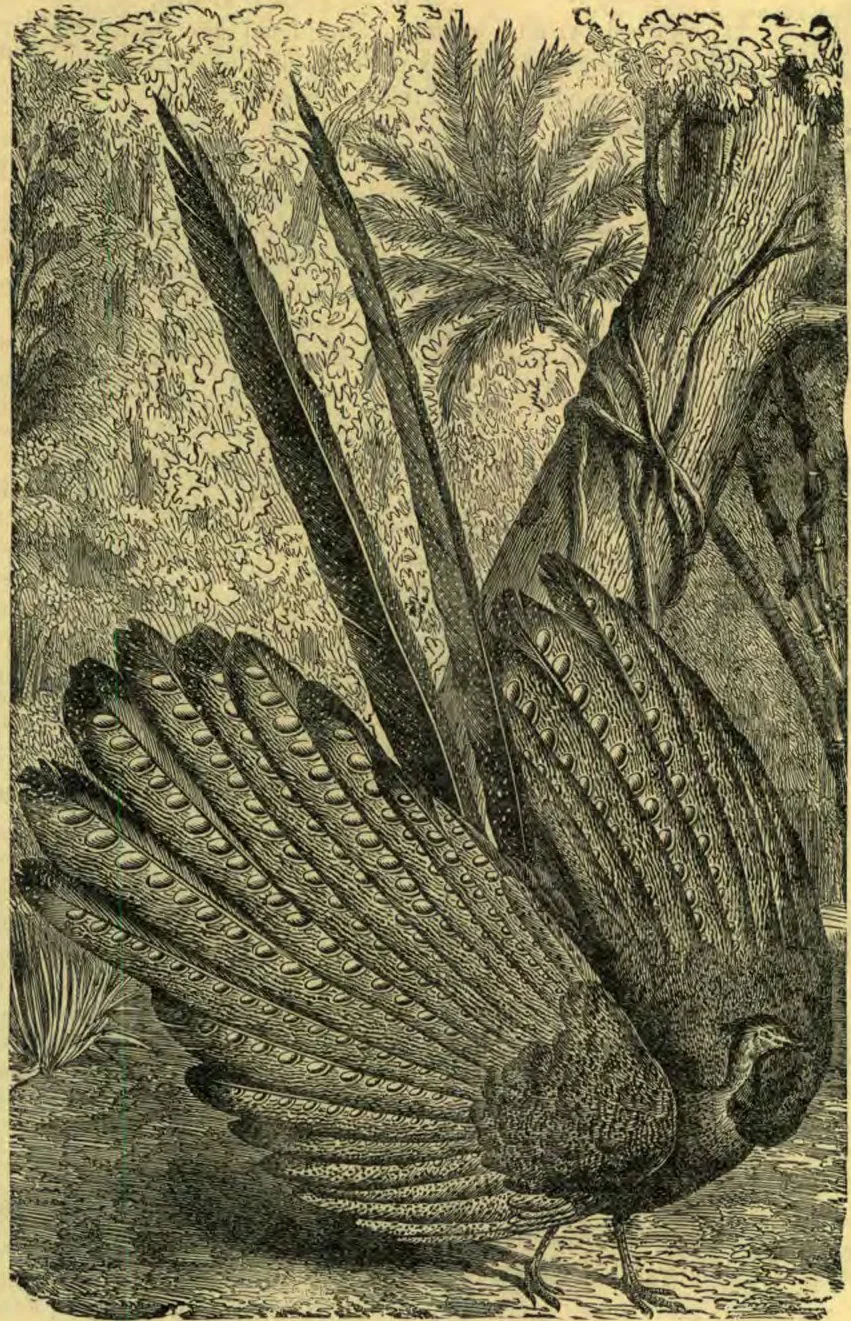
Have you ever seen a peacock, with its gaudy tail spread wide, strutting about as though he was king of the birds? Well, this is not the picture of a peacock, but of one of its cousins. And see how nearly like the peacock he tries to show off his fine feathers, which are covered with spots very like those on the peacock’s tail.
There is a large family of birds called the pheasant family. It includes the peacock, the turkey, the Guinea fowls, and ever so many kinds of real pheasants, more than we can tell you about now. The most beautiful of the pheasants are the Reeves, the golden, the silver, and the Argus. It is the Argus pheasant which is shown in the picture.
Any little boy or girl who has seen the golden robin that sings so sweetly, knows that it is its color that gives it the name of golden robin. The golden pheasant is named for its color, too; and so is the silver pheasant. These birds have other very bright colors besides the silver and gold, which make them very showy; but the most grand, the most stately of the pheasants is the Argus.
This bird’s body is about the size of a common fowl, but its two middle tail feathers are between three and four feet long, so that the bird measures about five feet. Some of its wing feathers are three feet long, so long that the bird cannot fly very well; but its wings, when spread, act as sails do to a boat, and help it to run very fast.
The under side of the bird is a reddish brown, spotted with black; the back is pale yellow, with black and brown spots. The two long tail feathers are a dark chestnut, and are covered with white spots inside a black ring.
We haven’t room to tell you all about its pretty wings. Some of the feathers are so curiously marked with jetty black; deep rich brown, orange, fawn, olive and white, that one cannot describe them. In some feathers there will be as many as seventeen large eyes, surrounded by rings of jetty black.
Probably you have never seen the Argus pheasant; for its home is very far away, and but few persons take the trouble to raise it here. When you travel around the world, if you will call at the East India Islands, south of Asia, you may see this bird in all its glory. How many of you can tell whether these islands are in a hot or a cold climate? Is there anything in the picture by which you can tell?
You don’t know why this bird is called the Argus pheasant, do you? Well, the heathen, who don’t know the true God, do not understand his wonderful works, and so they imagine a great many strange things. One of their imaginary stories is something as follows:—
There was once a very wonderful man, whose name was Argus. He had a hundred eyes, and only two of them slept at one time. His eyes were all over his body, and so the goddess Juno set him to watch over a certain priestess called Io. The god Mercury put Argus to sleep with the songs he played to him on his harp, and then slew him. Afterward Juno took the eyes of Argus to adorn the peacock’s tail.
Now this is only a fable, a heathen imagination; but the Argus pheasant was named from it.
M. J. C.

MAKING UP WITH GOD.

A little boy came to his father one day, and said, “O papa, I have made up with God!”
“Why, my son,” said his father, “I hope you had not fallen out with God, had you?”
“Yes, papa, I had. I was very bad, and grieved him. But I felt real sorry, and asked him to forgive me, and he did; and now I’m so happy because I’ve made up with him!”
I wonder if any dear child who reads these words has fallen out with God?
It is a sad thing for a child to disobey his father or mother, and to know that they are displeased with him; but it is much worse to offend the One who is mighty to save or to destroy.
The Lord wants every one to “make up” with him. He says, “Come, now, let us reason together,” and, “If we confess our sins, he is faithful and just to forgive us our sins, and to cleanse us from all unrighteousness.” Let us come to him, and tell him all our hearts, and he will never turn us away without a blessing.—Selected.

Letter Budget.

Lulu May Cleary writes from Kossuth Co., Iowa. She says: “I cannot write; but I thought if mamma wrote for me, perhaps it would be printed in the Budget. I am six years old. Two years ago, when papa was first a Sabbath-keeper, I used to say I was a ‘Sunday-school;’ but now I know better. Papa and mamma have taught me that Saturday is the Lord’s Sabbath. I was sick with scarlet fever from the middle of September till the last of October, and it left my lungs so weak that the doctor thought I would have quick consumption; but I am almost well now. Papa read in the Budget about a little girl by the name of Lulu who was going to camp-meeting. That is my name. Last summer I went with papa and mamma to three camp-meetings,—one in Marshall, Minn., one in Marshalltown, Iowa, and one in Algona, Iowa. I want to be a good girl, so I can live with Jesus when he comes.”
Lulu ought to be a pretty good little girl after attending so many camp-meetings; and she is probably a very thankful little girl, because she has her health again. How glad it makes us to feel well after having been sick; and how it should make us love the Giver of all our blessings!
Willie H. Whybark, of California, sends twenty-five cents for an outfit, and says he is going to canvass for the INSTRUCTOR, and get all the subscribers he can. Says he wants to work for the paper, and he wants some of the nice, new books to read. He lives in a small town, which he will canvass; also the country around it. There are over a hundred scholars in their school, and he hopes to get some of them to subscribe. He is ten years old. He keeps the Sabbath, and learns lessons in Book No. 2.
We like Willie’s spirit, and hope he may succeed, not only in getting subscribers, but in earning some good books.

You have reached the end of this edition.

The Youth’s Instructor · Mar 11, 1885