Tokyo.—In sending in her February report, Sister Bessie M. Young wrote me quite an interesting letter about her work and experiences. She is still living with Sister Fukazawa. The latter has a pleasant home by herself, furnished by her adopted father. She supports herself by teaching, and their plan is to do quiet missionary work with those who attend the language classes. Sister Fukazawa has a good knowledge of English, and so has no trouble in securing students for that language. Sister Young is still devoting a good share of her time to the study of Japanese; but she also assists in the teaching. They are now planning to begin classes in Bible study, using at first some simple Bible story book, like “Gospel Primer.” Sister Young writes that they have a good class of well-to-do people among their students. One is the wife of a sea-captain sailing on the Nippon Yusen Kaisha European line of steamers. Another is the married daughter of a count. While this sort of work requires much time and patience to develop fruit, yet a class of people can be reached in this way that could hardly be approached by other methods.
I have already referred to the classes that the brethren have been holding during the winter for the benefit of our young men. Two Bible classes are held every forenoon, and one in the evening for those who wish to study English. In the afternoon the young men assist in the printing-office, where we are now printing our semi-monthly paper and the Sabbath-school lessons. When spring comes, several of these young men will be ready to go out into active work in the field. Brother Okado will probably go out into the canvassing work again. Brother Seino, who comes from the new company near Fukushima, will also be ready to enter the work in the field, perhaps in company with Brother Watanabe. Brother Hamana, who accepted the truth in Nagasaki last summer, is planning to return to his family in Hokkaido, the northern island, very soon. It is his desire to open up the work in that part of the country. So far we have had no work and no believers in those parts. We rejoice that there is this prospect of entering this part of our field with the message. Some one of the our committee will probably visit Hokkaido, and advise with Brother Hamana for the opening of the work. We are informed that among the other churches there is a well-established understanding as to the division of territory in this island; so they may not make our work and workers very welcome. We need wisdom and grace in beginning the work in this field, that no mistakes shall be made, and that opposition be not unnecessarily stirred up. But the truth must go in spite of opposition.
Brother Kobayashi in Nagasaki reports one believer ready for baptism. There are also interested persons in several localities in the neighborhood of Saga, where he used to live. It is probable that Brother Kuniya will make a trip to Kiushu, to visit him and assist him in the work for a time. Brother Minami, who accepted the truth last year and came to Tokyo in the fall, is proving to be quite a help in translating for our Japanese paper. It is thought, therefore, that Brother Kuniya may now be spared from this part of the work, and so be free again to devote his time entirely to field labor. Brother Minami is also acting as my teacher in the Japanese, and I am putting in quite regular time now. At present I am holding Bible classes in English three evenings a week, for the students in this part of the city, with an attendance of ten or twelve. We also hold evening service every Sunday in my class-room, and several young men have been attending of late. The brethren over at Sendagaya have been holding Sunday-evening meetings in Brother Burden’s house, in the room where we conduct our Sabbath services. By this means, and by Bible readings they have been holding with persons in that neighborhood, some are becoming interested, and several have attended our regular Sabbath services. Brother Kuniya has had some interesting experiences this winter with several persons with whom he has held readings. Especially a young doctor has seemed much interested, and has been studying some topic with Brother Kuniya every Saturday evening. We hope to see some of these accept the truth.
While we have perplexities to meet, yet we are of good courage to press ahead to gain greater victories for the truth during the present year.
F. W. FIELD.
The Lake Union Conference
By I. H. EVANS
The Lake Union Conference convened in the South Side Church, Chicago, Ill., March 15-29, 1908. The conference was preceded by a three-days' publishers' institute, which considered the circulation of our denominational literature.
At the opening of the conference there was present nearly a full delegation from the respective conferences. Elder Allen Moon, president of the union conference, presided; and all were glad to know that his health is greatly improved. The meetings passed off harmoniously, and there was a marked unanimity of sentiment throughout the entire conference in most of the business matters.
The Lake Union Conference pledged itself to raise a sum of money equal to ten cents a week per member for foreign missions, and the local conferences were generous in voting tent companies for the work in the South.17
Elders A. G. Daniells, G. A. Irwin, G. F. Haffner, Prof. M. E. Kern, and the writer, of the General Conference, men were present during a part or the whole of the session. S. N. Curtiss, D. W. Reavis, and Morris Lukens, representing the Review and Herald Publishing Association, of Washington, D. C., were also present, and rendered valuable assistance.
During this session of the conference, the Review and Herald Publishing Association held its annual meeting in connection with the Lake Union Conference, and elected four members of its board of trustees for the two succeeding years.
One day of the session was given to the study of the educational work, and another day to the medical work. These days were interesting features of the meeting; and the papers submitted, and the discussions that followed, were educational and helpful in their nature.
Elder Allen Moon was re-elected president of the union conference, and W. H. Edwards chosen secretary and treasurer. There was a free discussion on the numerous resolutions that were adopted, and all who took part seemed to desire to see the work advance, and to send the message to all parts of the world.
Reports from the various conferences, rendered by the presidents, indicated that earnest work is being put forth in the local conferences to advance the message along all lines.
The report concerning the circulation of our denominational literature was encouraging, and all seemed to feel that the past was only an earnest of what we might expect in the future.
In membership the Lake Union Conference is the strongest union in the United States, and the various conferences comprising it have been so generous in the supplying of men for foreign fields that they find themselves crippled in handling the work in their territory. Scores of workers have gone out from this union conference to the foreign fields during the last few years, and the conferences have contributed liberally from their tithes for the support of the work in other lands. Many young men have been encouraged to enter the ministry, who are making rapid growth, and will soon be able to do efficient work in the Master's vineyard.
We trust that the past is only a beginning of the good work which this strong union conference will do in behalf of other lands. The officers of the union need the sympathy and hearty co-operation of all the brethren in the field, that the work may prosper and grow.
We trust that the next two years will be the most encouraging in the history of the Lake Union Conference.
This closes the sessions of the Union Conferences in the United States for this biennial term, and the meetings have been most encouraging. There never has been a time in the history of our denominational work when there was such a united and sympathetic co-operation as at the present time. There has never been a time when our people were more united in the carrying forward of the third angel's message than at present. The tithes have greatly increased, until they have reached nearly a million dollars a year. The annual offerings were larger than at any time in the history of our work. There are more workers in the foreign fields than ever before; and more men in our schools and conferences who are seeking a preparation to enter the foreign service than at any time in our denominational history. The local and union conferences are contributing more liberally from their surplus tithes than ever before. Many conferences are limiting themselves to a minimum of expense, that more funds may be saved for the foreign work. In all the meetings there has not been a note of discord or lack of harmony. We believe these are signs of the rapid prosecution of the third angel's message, and indicate a quick work in the future.
We trust that God's people everywhere will unite in carrying out the great and broad plans that have been laid for the prosecution of the work, that with one heart and one mind this work may go to all the earth as a witness to every nation. I. H. EVANS.
In the Silesian Conference
By Guy Dail
ONE year ago this field was organized out of the territory of the East German Conference, and at that time it had a membership of 381. The first twelve months of its separate existence witnessed 118 accessions, and a net increase of ninety-two, so that its present membership is 473. Last year its tithe was 21,121 marks, or an average of 44.65 marks per capita. Its Sabbath-school, weekly, and annual offerings amounted to 4,300 marks. The book sales were 18,321 marks, against 13,322 marks in 1906.
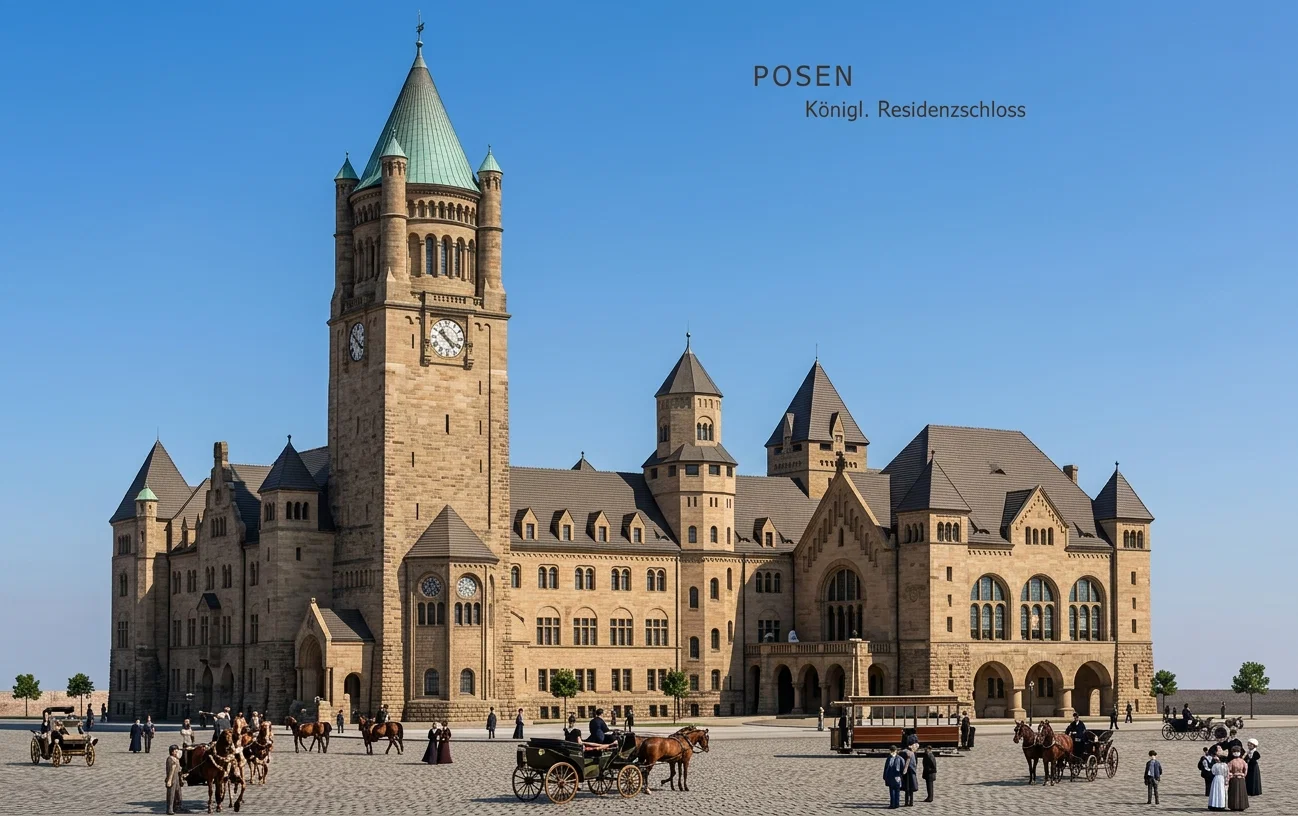
NEW CASTLE OF THE GERMAN CROWN PRINCE
Posen and Silesia are the two provinces that make up the territory of this field, and their population amounts to 6,929,250, a large number of whom are Poles. We were much pleased to hear some of them bear testimony in their mother tongue during the social meeting Sabbath afternoon.
The city of Posen, where the second annual Silesian conference was held February 7-11, was the capital of the kingdom of Poland until the close of the thirteenth century. It now contains about 141,000 inhabitants; it is a growing town, with a number of fine modern public buildings, among which is the new castle of the German Crown Prince. Of the old structures, one of the most interesting is the Rathaus, or city hall erected as a Gothic edifice, but rebuilt in the Renaissance style (1550-1552) after a fire in 1536.
There were about one hundred twenty-five of our own people at the meeting. The lectures for strangers were held in four or five large halls in different parts of the city, and they were visited by three hundred or four hundred fifty each evening. The truth was presented in a straightforward, simple manner. One of the signs of the times has been the bitter spirit that is shown our work and workers in this place. One of the public Christian homes which provides accommodations for passing strangers, refused us lodging because of our religious belief. One evening during the conference there was a lecture against us and our work. Several of the brethren attended, and they report that only the greatest ignorance or the most wilful misrepresentations could be responsible for such untruths as the speaker uttered about the third angel's message. However, there were not more than about a fifth as many present as attended our own meeting that night. In our meeting two evenings later, the conference president replied to the charges made against us.
One of the most emphatic points made at this conference is the need of more literature in the Polish language. Thus far we have in that tongue “Christian Temperance,” “The Sufferings of Christ,” “Two Thrones,” “Full Assurance of Faith,” “Is the End Near?” and “God’s Prophetic World Clock.” “Glorious Appearing” is in process of preparation. Other works will soon be out in this language, for it is felt that we must do more to get the truth before the Polish-speaking nationality. These publications are issued by the Hamburg House.
Aside from the assistance of the local workers, Brethren L. R. Conradi, J. Erzberger, J. H. Schilling, and A. W. Petersohn were able to help in the work of the meeting.
There was the greatest harmony in the business sessions of the Silesian Conference. Elder J. Pieper was unanimously chosen president. The resolutions were of the same general character as in the other German meetings that have been reported in the REVIEW recently. There was a slight deficit after the auditing was done, for the annual income did not quite cover the expenses; but plans are laid to prevent such an18event in 1908. One of the workers, Sister Goldkuehler, who had but recently come from the Friedensau school, and was engaged for a short time in the Bible work here, was laid to rest during the latter part of the year. A resolution was passed in which the delegates fittingly expressed their sympathy to the parents and relatives of this sister. It was also voted to strengthen the poor fund of the conference, and a good collection for this purpose was taken on the spot; while the Sabbath-school and weekly offerings were liberal.
Four were baptized at Posen. One man was ordained to the gospel ministry—Brother C. Dangschat. The field begins its new year with three ordained ministers and ten Bible workers. There are twenty-six regular canvassers at work here.
We wish the brethren and sisters in Silesia and Posen well, the coming year, and trust they may be remembered in the prayers of our people. GUY DAIL.
Portugal
By C. E. Rentfro
Four times a week I go to Lisbon for meetings, and often on other days, to visit and give Bible readings. I was obliged to leave a fair interest, to go to Oporto to help Elder E. Schwantes, and this interest must be picked up again. Elder Schwantes has a good attendance now.
A year ago I went up to Oporto, and one day, while out helping the colporteur we called at a place where a man manifested a desire to buy a Bible. We sold him a sixty-cent Bible. I took his address, and wrote him a letter about the Bible, how to study it, etc. He replied, and we kept up correspondence for a time. Now he has bought all our books in Portuguese, and a prophetic chart, which hangs on his wall, a wonder to his visitors. He is a mail-carrier, but, on account of rheumatism, is on the sick list, yet receives his wages. Two weeks ago we organized a Sabbath-school in his home. His wife keeps the Sabbath, and he will do so, at least until he may be called to service again. We pray that he may be strengthened to stand fully for the truth.
A friend here in Lisbon told me he had heard of the Sabbath question about fifteen years ago. He said a Spaniard was here selling tracts on Sunday. This man asked him why he did so. The reply was that the others were wrong, in keeping Sunday, and he kept the right day. This gave my friend a shock, and now he affirms that the Sabbath is the true day to be kept. Whether or not he will keep it, remains to be seen.
We are earnestly endeavoring to win ten to the standard of the truth before camp-meeting. In the past we prayed, “O, Lord give us at least one soul, or one more soul.” But now we have decided to eliminate the words “at least,” and are praying for a certain number. This appears a big thing to us, but to those a long way off it may seem small.
We thank all who had a part in getting us the money to pay for the organ.
We have had stirring times here. For a number of days I carried my passport and means for identifying myself in case of being stopped by the police for an examination of my person. It is against the law to carry knives. I usually carry my pocket-knife; but while doing so, if I had been examined, for some days no one would have heard of me. Nothing unpleasant happened to us, while hundreds were imprisoned for very trifling things. The news that passes the frontier is often far from true. We are in troublous times, in the days when unheard-of things are occurring. Men are waxing worse and worse. Yet a remnant will be saved. Surely some will enter the kingdom of God from this country.
C. E. RENTFRO.
_Received on the $150,000 Fund up to April 14, 1908_
By I. H. EVANS
**_Atlantic Union Conference_**
Central New England ........$ 2,773.18
Greater New York ............ 1,501.31
Maine ....................... 852.89
New York .................. 2,326.50
Southern New England ...... 1,210.50
Vermont ................... 1,344.74
Western New York .......... 2,073.09
Total ....................... 12,082.21
_Canadian Union Conference_
Maritime .................... 566.49
Quebec ...................... 169.94
Ontario ..................... 807.28
Newfoundland ................ 20.80
Total ....................... 1,564.51
**_Columbia Union Conference_**
Chesapeake .................. 624.53
Eastern Pennsylvania ..... 2,548.91
New Jersey ................ 1,202.45
Ohio ...................... 6,302.43
Virginia .................. 1,034.77
West Pennsylvania ......... 1,969.46
West Virginia ............. 558.86
Total ....................... 14,241.41
**_District of Columbia_**
Washington Churches ....... 1,384.54
_Lake Union Conference_
East Michigan ............... 3,158.46
Indiana ................... 5,247.02
North Michigan .............. 1,705.22
Northern Illinois ......... 2,913.36
Southern Illinois ........... 1,457.71
West Michigan ............. 8,733.70
Wisconsin ................... 5,044.25
Total ....................... 28,259.72
**_North Pacific Union Conference_**
Montana ..................... 691.64
Upper Columbia ............ 3,036.43
Western Washington ........ 3,308.13
Idaho ....................... 1,022.65
Western Oregon .............. 2,956.15
Hawaii ...................... 21.05
Alaska ...................... 20.00
Total ....................... 11,056.05
**_Southern Union Conference_**
Conference not specified .... 97.41
South Carolina ............ 266.09
Alabama ..................... 613.14
Tennessee River ........... 1,405.31
Florida ................... 951.48
North Carolina ............ 954.70
Cumberland ................ 1,360.99
Louisiana ................. 572.54
Georgia .................... 457.97
Total ....................... 7,092.71
_Northern Union Conference_
Iowa ........................ 7,777.58
Minnesota ................ 5,752.78
South Dakota .............. 2,666.47
North Dakota .............. 2,134.93
Conference not specified .... 73.82
Total ....................... 18,405.58
**_Pacific Union Conference_**
Southern California ....... 4,584.90
Arizona ................... 466.79
California-Nevada ......... 10,249.03
Utah ...................... 440.58
Total ....................... 15,741.30
_Southwestern Union Conference_
Not specified ............... 22.82
Arkansas .................. 938.93
Oklahoma .................... 3,938.79
Texas ....................... 2,488.90
Total ....................... 7,389.44
_Western Canadian Union Conference_Alberta ................... 1,211.35
British Columbia ............ 224.50
Manitoba .................... 349.76
Saskatchewan Mission Field .. 59.60
Total ....................... 1,845.21
_Unknown_
Unknown ..................... 161.70
_Foreign_Algeria .................. 13.33
Australia ................... 178.71
Bermuda ..................... 36.00
China ....................... 165.60
South Africa ................ 439.02
Jamaica ..................... 66.01
Yukon Territory ............. 20.00
England ..................... 281.55
West Africa ............... 50.00
Mexico ...................... 65.97
Costa Rica .................. 6.25
India ....................... 190.25
South America ............... 76.43
Switzerland ................. 9.69
Panama ...................... 27.11
Nicaragua ................... 9.00
Central American Mission .... 26.00
Trinidad .................... 28.69
Norway ...................... 25.00
Japan ....................... 12.50
Haiti ....................... 5.00
Egypt ..................... 51.55
Palestine ................... 2.00
Tobago, W. I. ............... 1.22
Cuba ........................ 8.00
Hungary ..................... 3.00
Tahiti ...................... 14.88
France ...................... 6.80
Philippine Islands .......... 1.00
Samoa ....................... 8.00
Barbados .................... 5.00
Portugal .................... 1.00
Straits Settlements ......... 10.08
Pitcairn Island .............. 20.00
New Zealand ................. 1.52
Fiji ........................ 4.87
St. Kitts ................... 7.51
Ireland ..................... 1.21
Russia ...................... 5.00
Denmark ..................... 14.59
Santa Domingo ............... 2.50
Total ....................... 1,901.84
Grand Total ................. $137,994.77
I. H. EVANS, Treasurer.
A Sunday Law Hearing
By W. W. P.
A HEARING on the Sunday observance bills introduced into the Senate by Senator Johnston of Alabama was given last Wednesday afternoon by a sub-committee of the committee on the District of Columbia, consisting of Senators Johnson, and Gamble of South Dakota. The hearing occupied an hour and a half, and the time was equally divided between those who favored either or both of the bills, and those who opposed them.
The first speaker was Mr. F. B. Sands, representing the butchers’ clerks, who spoke for the passage of Senate Bill No. 3940 “requiring certain places of business in the District of Columbia to be closed on Sunday.” Mr. Sands said that this bill was desired by his clients in order that they might have one day in the week when they would not be compelled to attend to business. He argued that this bill was for the benefit of a certain limited class, and thought that those not directly affected by the bill ought not to oppose it.
Mr. Charles F. Diggs spoke briefly in behalf of the Retail Grocers’ Protective Association, using practically the same line of argument as that employed by Mr. Sands.
The leading argument in opposition to these bills was made by the editor of the Review, who had been requested to represent the views of Seventh-day Adventists upon this question. A summary of the argument presented is as follows:—
The bill is religious in its character, and is aimed to secure the observance of a day held as sacred by a part of the community rather than to protect all citizens in their equal rights. This is shown in the title, which states that it is “a bill for the proper observance of Sunday as a day of rest in the District of Columbia;” and the body of the bill further emphasizes this claim by restraining all persons from engaging on that day in the ordinary pursuits which are followed freely upon the other days of the week. Inasmuch as no such restraint is deemed necessary in order to secure the proper observance of such civil holidays as the fourth of July, the twenty-second of February, etc., it is plain that by this bill Sunday is to be distinguished from civil holidays; and the only basis for such a distinction is the supposedly religious character of the day.
The exception made in favor “of household work or other work of necessity or charity” is in the usual language dealing with the religious observance of a day.
As by this bill sports and amusements freely permitted on other days are forbidden, it is evident that the framer of the bill intended to secure the religious observance of the day. Such prohibition of amusements is an infringement on religious liberty, as is plainly stated by Tiedemann in his work on “Limitations of the Police Power,” as follows:—
“The indulgence in quiet, orderly amusements, since they involve no violation of private rights, can not be prohibited by law without infringing upon the religious liberty of those who are prevented, and such regulations would therefore be unconstitutional.”
The bill permits the performance of works of necessity on the first day of the week, but expressly states that such work must be so performed “as not to interfere with the repose and religious liberty of the community.” It is evident that the “religious liberty of the community” would not be disturbed on the first day of the week more than on other days, were it not that the first day of the week is regarded as different in its character from the other days, and the pursuit of the ordinary avocations of life would be a desecration of the day. The fact that religious services are held on other days of the week and that the worshipers find sufficient legislation in the acts protecting peaceable assemblies on all days of the week, shows that no further legislation is required merely for the protection of religious gatherings on Sunday.
This is not a mere theory, but is found practical by the more than two million citizens of the United States who observe the seventh day of the week as the Sabbath, but do not deem it necessary to compel others to refrain from labor on that day in order that they may have religious liberty and not be disturbed in their religious assemblies.
The history of the fourth and fifth centuries shows that the real purpose of Sunday legislation in forbidding labor and sports is to secure attendance on public worship.
A bill so plainly religious as this one, is contrary to the first amendment to the Constitution, which provides “that Congress shall make no law respecting an establishment of religion or prohibiting the free exercise thereof.” This is clearly shown in the well-known mail report prepared by Hon. Richard M. Johnson, of Kentucky, in 1830, who said: “Congress acts under a Constitution of delegated and limited powers. The committee look in vain to that instrument for a delegation of power to inquire and determine what part of time, or whether any, has been set apart by the Almighty for religious exercises. On the contrary, among the few prohibitions which it contains, is one that prohibits a religious test, and another that Congress shall pass no law respecting the establishment of religion or prohibiting the free exercise thereof.”
This bill violates the true principle of religious liberty as well in the case of those who voluntarily observe the first day of the week as the Sabbath, as in the case of those who observe the seventh day of the week, or of those who do not wish to observe any day. The principle is the same whether one is compelled to do what he wishes to do, or what he wishes not to do.
Sunday laws would not be justified even if an exemption clause were inserted in favor of those who observe another day. The right to enact such a law with an exemption clause involves the right to enact a law without an exemption clause.
At the close of the argument, the following conclusions were drawn:—
1. All legislation requiring cessation of labor or amusements or both, on the first day of the week, is religious legislation.
2. All such legislation, being religious legislation, is contrary both in spirit and in letter to the first amendment to the Constitution.
3. All such legislation infringes upon the religious liberty of all classes of men, not only of those who observe another day and those who observe no day whatever, but as well of those whose present religious sentiments lead them to the voluntary observance of the first day of the week as a day of rest and worship.
4. All such legislation is outside the proper sphere of civil government, whose duty it is to protect all its citizens in the exercise of their religious beliefs, so long as in so doing they do not interfere with the equal rights of others, or in their refusal to exercise a religious belief, and not to favor any religion or any sect of any religion.
5. All such legislation constitutes a decision of a religious controversy, and if enforced, leads to religious persecution.
6. All such legislation is based upon religious considerations, and can not be justified upon civil grounds.
7. All such legislation is in effect a union of church and state, and is therefore both un-American and unchristian.
W. A. Colcord, secretary of the Religious Liberty Bureau, followed with a brief paper, in which he traced the history of the Sunday bills now before Congress, and showed that they originated in an interdenominational committee representing the churches of the District, thus making it clear that the real purpose of this legislation is of a religious character. He also adduced various arguments relating to the provisions of the bill and the principles involved therein, which further emphasized the fact that the legislation is religious in its character, and an infringement upon religious liberty and a violation of constitutional rights.
K. C. Russell, the chairman of the Religious Liberty Bureau, also read a paper in which he dwelt further upon the nature of the proposed legislation and emphasized its religious character.
Mr. David Eccles, representing the Secular League of Washington, then made a brief address before the committee, in which he declared that if the request for this legislation was granted, it would be but the beginning of legislation infringing upon the rights of citizens, and that it was better to leave the question of the hours of labor to be adjusted by the various labor organizations.
Mr. James L. Feeney, chairman of the Legislation Committee of the Central Labor Union, of Washington, then spoke briefly in favor of the bills under consideration, and the chairman declared the hearing adjourned.
W. W. P.
Progress at Port Jervis
Brother R. H. Martin, who is laboring at Port Jervis, N. Y., sends this encouraging word: “On January 25, 1908, Elder C. H. Edwards organized a Seventh-day Adventist church in this city, with ten members. On a recent Sabbath our hearts were rejoiced when five united with us, making a total of seven during the month of March, with one awaiting baptism. There are four other Sabbath-keepers who have not yet united with the church, and the prospect looks bright for the future, as the interest is still good. We ask an earnest interest in your prayers that the Spirit of the Lord will continue to work.”