The Youth’s Instructor, Vol. 47, No. 19.

WATER-CARRIERS OF MEXICO

The Youth’s Instructor

May 11, 1899

Review and Herald Publishing Company · Battle Creek, Mich. · May 11, 1899

WATER-CARRIERS OF MEXICO.
Mexico has but two seasons, the rainy and the dry. The rainy season begins in June, and ends with September; so the months from October to June are without rain. During this time everything becomes dry, and the water-supply in some places is almost exhausted. Often water must be carried long distances.
WATER-CARRIERS.
WATER-CARRIERS.
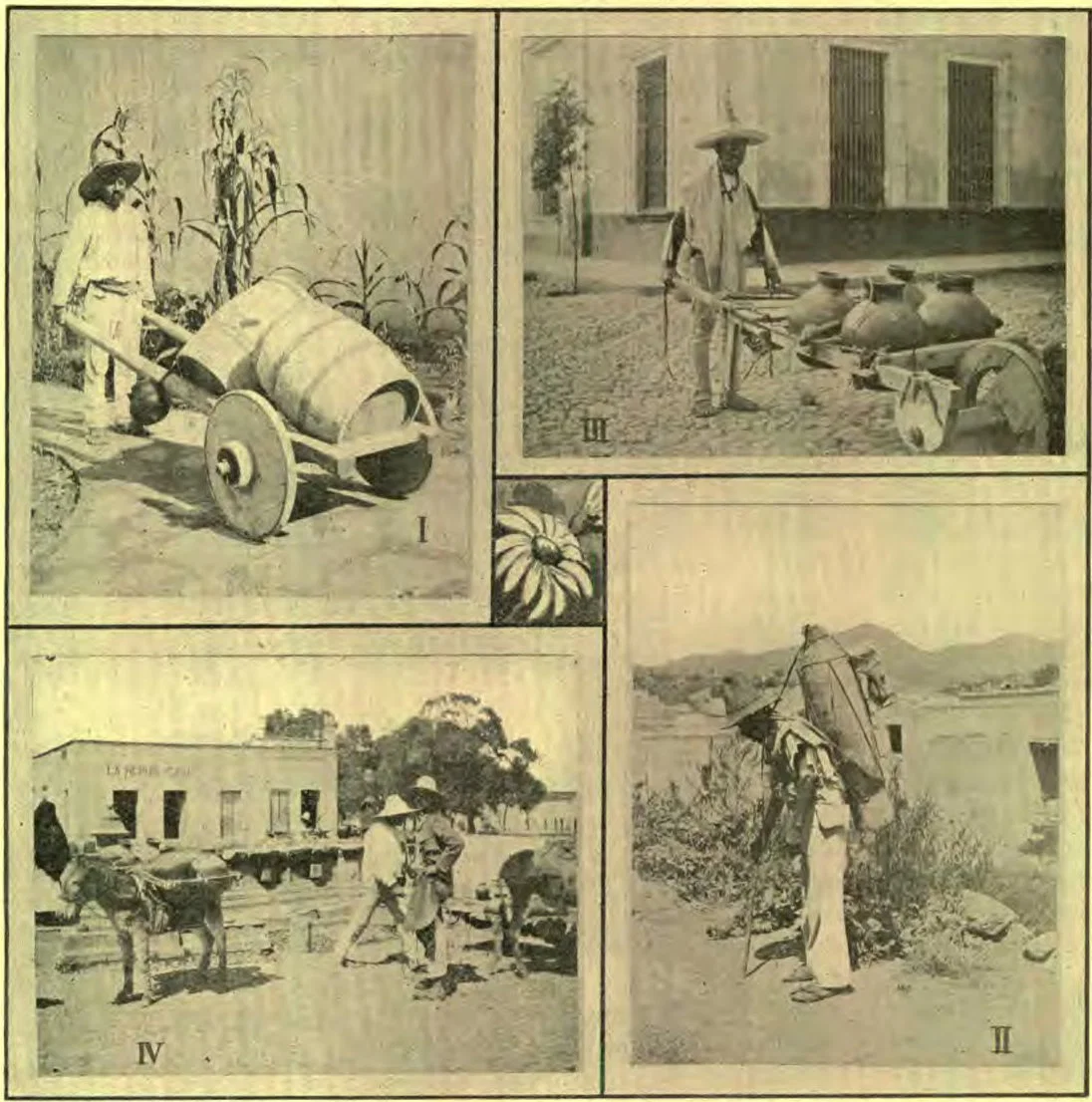
Some of the methods adopted by the Mexicans for carrying water seem very unique to us. In the first picture is shown a water-carrier of northern Mexico. He has utilized some barrels brought over from the “States;” and oddly out of place they look on the rude wheelbarrow, whose wheels are cut out of a solid piece of timber.
The second picture is of a water-carrier of Guanajuato, one of the most picturesque cities of all Mexico. This city has but one main street, which runs up a narrow pass between two mountains. The houses are perched on the sides of these mountains, looking as if one house were built on the back of the one just below it, so steep are the mountain sides. This city has seventy thousand inhabitants, and justly boasts of the most beautiful theater building in Mexico, and one of the most beautiful in the whole world. How strangely out of place with its surroundings appears this beautiful monument of modern architecture, as we see the primitive water-carriers passing in front of it! The first time I saw one of the water-carriers of Guanajuato, I was looking from my door in a hotel. He passed by on the other side of the open court, and emptied the water from the strange bucket of hogskin roped to his back, by bending his body, and letting the water fall over his head.
The water-carrier who brought water to us at the mission in Guadalajara, brought it as you see illustrated in the third picture. The wheelbarrow is rude enough, and the cantaros holding the water are just such jars as we read about in the Bible: they are in common use in Mexico.
Later, when we moved to another street of Guadalajara, water was brought to us by the faithful little burro, with the cantaros fastened to his back.
The peculiar customs and primitive ways of the Mexicans are interesting to us; but when we realize that their lack of knowledge is the result of the oppression they have been subjected to for hundreds of years, we should be anxious to help in some way to reach these poor people with the light of the true gospel.
KATE ROSS MARCHISIO.

MOURNING CUSTOMS OF KOREA.

THE Koreans have some strange mourning customs. Their funerals give the impression of gaiety rather than of grief. Red predominates, and there are loud music, and banners with streamers of bright colors. When a man is dying, no woman is allowed in the room, except his nearest relatives. When a woman is dying, only her husband, son, or brother is permitted to remain.
Bodies are not buried, as with us, shortly after death. When a person dies, his body is usually placed for three days on a board, with a clean white sheet covering it. This board is called the “star board,” because it has seven stars painted on it. If the dead person belonged to the poorest class, the body is kept three days; if to the middle class, nine days. In the case of nobles and very rich persons, burial is delayed from three to four months. During all this time the mourners gather three times each day in the room where the corpse has been placed. Usually they have on robes of sackcloth. They weep and wail loudly, strike themselves upon the breast and head, and call on the name of the departed. Feasts of rice, fruits, etc., are also offered daily. Sometimes paper flowers are placed on the body.
One custom is for a servant to take the underclothes of the dead outside the house and wave them in the air, calling the departed by name, while all about him the various members of the family are standing, adding their moans and wails to his calls. After this, the clothes are thrown on the roof of the house, where the spirit can obtain them if it so desires.
Outside the door of the room in which the corpse lies is placed a table, and on the table are three bowls of rice, a squash, and three pairs of straw sandals. The rice and sandals are for each of the three spirits; for the Korean belief is that after death, man goes away into three souls. One soul occupies the tablet set up for it in the home, the second goes into the grave, while the third departs into the unknown.
At a Korean funeral the mourners are usually all men; but sometimes a widow may attend in a closed chair the burial of her husband. The mourners walk backward, facing the corpse. The grave-clothes are of the most brilliant colors—red, blue, and yellow. The grave of a rich man is dug beforehand, but that of a poor man is not made until the procession arrives. The body is placed in the grave, and a circular mound raised over it. Offerings of wine and fish are then placed before it. The relatives face the grave, prostrating themselves five times. Afterward the wine is poured upon the mound, and the fish given to the attendants.
Often there can be seen walking about the streets of Seoul and other Korean cities, men with immense hats, not only covering their heads, but coming down over their faces. Some of these hats are as large as good-sized parasols. They are usually of bright straw. These are the mourning-hats of Korea. The mourners wear long robes of light gray, and each holds a screen in front of his face. A man losing a parent must mourn in this way for three years, because, according to Korean belief, the gods are angry with him for having caused the death of his father. If, in the meantime, he loses the other parent, he must mourn three years longer. When the king, queen, or crown prince dies, all the people put on mourning for a certain length of time.—A. M. Barnes.

FATHER’S BURDENS.

Does any one care for the father? Does any one think of the one Upon whose tired, bent shoulders The cares of the family come,— The father who strives for your comfort, And toils from day unto day, Although his steps grow slower, And his hair is turning gray?
Does any one think of the due-bills He’s called upon to pay? Milliner-bills, college-bills, book-bills,— There are bills of some kind every day. Like a patient horse in a treadmill, He works from morning till night; Does any one think he is tired? Does any one make his home bright?
Is it right, just because he looks troubled, To say he’s as cross as a bear, When one loving word from his children Might banish his burden of care?
’Tis for you he is ever so anxious, He will toil for you while he may live; In return he asks only kindness, And such pay is easy to give.
— Selected.

THE SOUL'S GATES.

AYE, and it needs strong guards at every gate; Outside are roving warring hosts of sin, Armed to the teeth, who ever watch and wait To steal unhindered in,
There to lay waste the temple and the shrine, To fire with torch, to rob, to smite with sword, To ruin and make desolate this divine, Fair city of the Lord.
Then, O my soul! knowing the fate that waits One careless hour, a faithful vigil keep; Set sentinels at all thy hundred gates, Nor let them faint nor sleep.
— Clara Doty Bates.

THE RESURRECTION OF LAZARUS.

VII.

By raising Lazarus, Christ gave unmistakable evidence that he was the Sent of God. However humble his birth and appearance might be, he was the mighty God, the everlasting Father, the Prince of Peace. Who can fathom his longing desire to save those who had no mercy for themselves? He longed to give these deluded, fanatical people, whose fathers he had led through the wilderness, an evidence of his divinity, a display of his power, that would lead them to accept him. But he knew that though, as the result of this miracle, many souls would afterward be added to the church, the hearts of others would be steeled against him and his work.
Looking over the past, Christ saw how, during the record of a thousand years, the Jews had abused their precious privileges. God had borne long with his erring people. In visible glory he had dwelt in the Shekinah of the mercy-seat. He had sent his Son to redeem them, but in a short time they were to show to the heavenly universe, to the worlds unfallen, that they had chosen Satan to be their leader, and were determined to cherish his attributes. Satan’s best allies are those who will not come to the light, who stubbornly refuse all evidence; and the Jews had long been working in these lines. They would soon make the words of John the Baptist, “Ye generation of vipers,” true in every sense. They would break every God-given command, thus demonstrating the truth of Christ’s words: “Ye are of your father the devil, and the lusts of your father ye will do. He was a murderer from the beginning and abode not in the truth, because there is no truth in him. When he speaketh a lie, he speaketh of his own: for he is a liar, and the father of it.”
Bethany was so near Jerusalem that the news of the miracle was soon carried to the city, and in a few hours the Jewish rulers were in possession of the facts. A meeting of the Sanhedrin was at once called, to decide what should be done. The priests were convinced that the miracle had been wrought by the power of God. They were greatly impressed; for the Holy Spirit convicted them of the sins which they had committed against Christ. But they closed their hearts, lest the beams of the Sun of righteousness should shine into them. They stood behind an impregnable wall of unbelief. They were determined that they would never receive Jesus of Nazareth as the Messiah. Now that his influence had been strengthened by this wonderful miracle, their hatred was, if possible, increased. They were more than ever determined to put a stop to his work. No misinterpretation could be placed on this miracle. It was a work above criticism. They decided that Christ’s work must be stopped; for already many of the Jews had received him.
Though not favorable to Christ, the Sadducees had not been so full of malignity toward him as were the Pharisees. Their hatred had not been so bitter. But they were now thoroughly frightened. They did not believe in a resurrection of the dead. Producing so-called science, they reasoned that it would be an impossibility for a dead body to be brought to life. Thus they showed themselves to be ignorant of the Scriptures and of the power of God. But by a few words from Christ, their theory had been overthrown. Lazarus had passed under the control of death. For four days his body had lain in the grave, yet at a word from Christ he had risen to life, in the presence of many witnesses. But this miracle did not open the eyes of the Sadducees; for they were blinded by prejudice. They could see no possibility of removing the impression made on the people by the miracle; for in no way could they prove it to be a deception. Thus far they had not encouraged the plan of putting Christ to death; but after the resurrection of Lazarus they decided that only by his death could his denunciations against them be stopped.
The Pharisees believed in the resurrection, and they could not but see that this miracle was an evidence that the Messiah was among them. But they had ever opposed Christ’s work. From the first they had hated Christ because he did not exalt them and their boasted righteousness. Instead, he had said to his disciples and to others, “I say unto you, That except your righteousness shall exceed the righteousness of the scribes and Pharisees, ye shall in no case enter into the kingdom of heaven.” In his sermon on the mount, Christ had defined the far-reaching principles of the law of God, and had shown that its requirements do not consist in outward show, but in holiness of heart and life. This Christ placed far above all outward observances. He outlined the qualities that all must possess who would win the approbation of God.
In his scathing denunciation of the labored theology of the Pharisees, Christ said, “In vain they do worship me, teaching for doctrines the commandments of men.” They bound upon others heavy religious burdens, from which, however, they excused themselves. Christ laid bare their avarice; their ambitious, intriguing plans for the priesthood; their exclusiveness, which led them to build a wall of partition between priest and people.
MRS. E. G. WHITE.

MAKING HOME PEACEFUL.

XXIII.

With a cry of anguish and horror, Mrs. Beardsley rushed to the place where the limp form of her child lay.
“Thank God, she is alive!” she cried, as a feeble moan of pain fell on her ear. The child, at first stunned into unconsciousness, was in another moment keenly alive to her pain. But the fact that she was not dead filled the mother’s heart with a deep gratitude, though she saw at once that one arm was broken. “But she lives, thank God!” said Mr. Beardsley, when he reached home in response to a hasty summons. Ah, little Flossie! your mission is not yet accomplished. The angels, of whom you so delight to hear, have been sent to preserve you.
“She will soon be all right again, Mrs. Beardsley,” said Dr. Brown; “all she needs is quiet and good nursing for a while. Young bones soon mend, and the knitting work will soon be done,” he smiled, with an attempt at humor.
But the days and nights seemed longer than ever to the afflicted child, and wore upon the delicate little form greatly.
Of course Grandmother Sharpe did not forget to declare, earnestly and often, that the accident would never have occurred if her advice had been heeded.
But this accident, sad and painful as it was, accomplished at least one good thing: Flossie never grew tired of telling her big brother how the “pretty angels” had saved her life; in fact, the child could not bear to have him out of her sight in the evening. So it came to pass that many an engagement with “the fellows” was broken off, much to Reginald’s chagrin; for he had not the heart, rude and boisterous as he was, to refuse to amuse his little sister. James Beardsley noticed with a thankful heart the unconscious modulation of his son’s loud tones whenever he spoke to the gentle little sufferer, and the air of tenderness which fell upon him. Ah, love is mighty! it transforms the most rebellious heart; it makes sweet and pure the most obstinate spirit. It is the very name of God, and there is power in it. How earnestly the father hoped that Reginald’s love for his little sister might yet prove to be the one tender spot in his rebellious heart.
After some weeks had passed, and Flossie was able to be out again in her little chair, one morning a letter came from Tom Willis, addressed to his old friend and employer.
James Beardsley was sitting with the family at the breakfast-table when the letter came. He recognized the familiar handwriting at once, and knowing the bitter ill-will in the hearts of his wife and his son against the young man whom they had so wronged, he hesitated about opening the letter in their presence. Reginald’s quick eye, however, detected his father’s hesitation in a moment, and one glance at the envelope was enough to assure him that the letter was from Tom.
“Hello! got a letter from our ‘pious friend,’ have you?” questioned Reginald, with a sneer. “Strange, I never could be at peace with that chap, hard as I tried. I expect my exemplary conduct was such a reproof to him, he couldn’t stand it,” he continued, mockingly. “Well, maybe I’ll turn out as well as he does, for all he’s such a goody-goody,” he added, bitterly.
“Your language pains me very much, Reginald. I do not think Tom Willis ever did anything to injure you, and I think the day will come when it will be proved to the satisfaction of every one,” said Mr. Beardsley, slowly unfolding the letter.
Ellen Beardsley’s cheeks had begun to grow hot, and her eyes to flame, before her husband had finished speaking.
“I suppose you allude to me, James,—I must be the ‘every one’ to whom you refer. I can’t understand how you can possibly be such an unnatural father. It is plain to be seen that you prefer the son of a stranger—a poor, miserable drunkard—to your own son; and making such high professions as you do, James, I don’t see how—really, I can’t understand you.”
“No, Ellen, I am sure you don’t understand me. Would to God you did, and that we might both better understand our duty as parents before him,” said Mr. Beardsley, sadly.
“Oh, well, there is no use in talking about it; we shall not see at all alike on this subject. Would you care to read your friend’s letter to your family, or is such a treat to be reserved for more appreciative ears?” sarcastically rejoined Mrs. Beardsley. It could easily be seen from whom Reginald inherited his cutting speech and imperious manners.
I am sure my young readers are anxious to hear from Tom Willis by this time; so we will listen as Mr. Beardsley unfolds his letter and begins to read:—
MILES CREEK, March 14, 18—
Mr. James Beardsley, Harrisburg,——:
My Dear Friend: I am sure you will be glad to hear that my sister and I are very happy in our new home. We have found such friends as we never expected to find on earth. God has been good to us; and after the dark and bitter experience which the last six months in Harrisburg brought us, the change from darkness to light, from bitter to sweet, seems all the more wonderful. Yet I can see that those lonely days of trial were not sent in vain; they were not purposeless. God had a sweet lesson for us to learn,—a lesson of faith and trust,—which I only wish had been better learned.
I thank you for all your kindness to me; and, let me add, I have the fullest confidence that some day it will be clearly proved to Mrs. Beardsley that I have never intended to wrong Reginald in the least. But I can wait the will of the Lord, who says that circumstances are brought about, not by might nor by power, but by his Spirit. Yes, as I said to you once before, I can wait.
Uncle is very kind to us, and I am helping him in his store, and attending evening school. Sister Maggie has improved very much in health and spirits. This warm Southern climate appears to agree with her. Please remember us kindly to any who may inquire about us.
Very sincerely yours,
TOM WILLIS.
The next afternoon after the receipt of this letter, Reginald came home from school at an unusually early hour, and it did not take his partial, keen-eyed mother long to notice a peculiar nervousness and agitation in his manner. The fact was, he had at last been expelled from school.
MRS. L. D. AVERY-STUTTLE.
(To be continued.)

ABOUT HORNBOOKS.

It is difficult to realize nowadays, when books and papers are so cheap, how hard people used to work to make even a few words and letters and figures for the use of children in learning to read.
Hornbooks are an example of ancient bookmaking. Though they are not at all like the modern book, they are always called books. They are rather plates, or tablets. In shape they are like an oblong, square-cornered, hand-mirror, handle and all. Most encyclopedias and dictionaries give pictures of them.
The back of a hornbook was of solid wood, and in it were carved letters, figures, prayers, or whatever it was designed to teach. This carving was covered with a piece of transparent horn, to keep the carving from becoming defaced. The wood and horn were bound together with a narrow brass rim. These were the common hornbooks. Those made for wealthy and titled persons were often richly ornamented with silver in filigree and other fanciful designs.
The oldest hornbooks known are those that were used in the schoolrooms of the great monasteries. These usually contained the alphabet, cut in the form of a Latin cross,—A at the top and G at the bottom,—the nine digits, and a simple prayer. Several fine hornbooks were brought over in the “Mayflower,” and the children of the Pilgrims learned their letters from these tablets.
It is related that Queen Elizabeth gave to Lord Chancellor Egerton a costly and beautiful hornbook, that is a prized relic in the family to this day. One of Leonardo da Vinci’s famous paintings is “The Boy with the Hornbook.” In Rembrandt’s beautiful group, “Christ Blessing Little Children,” one of the small figures is shown with a hornbook suspended from his girdle.
Though these tablets are known to be very old, it seems impossible to know when they first came into use. The carving was difficult, and space was too precious to spare for the date of the work.—Will-Spring.

HOW TO DRAW FLOWERS IN PEN AND INK.

II.
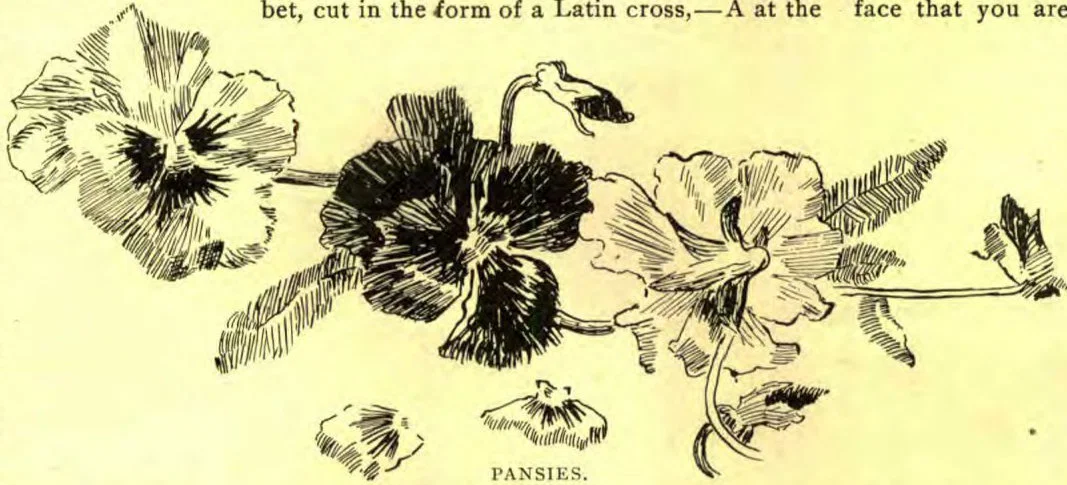
For the benefit of beginners we will explain the meaning of the term “color value” in pen-drawing. The term alludes to the relation of one color to other colors, in varying shades of light and dark. Take, for example, a dark-purple pansy and a white one. We can plainly see that in our drawing in black and white, we must make a strong distinction between the dark color of the purple pansy and the lack of color in the white flower.
But if we should take a yellow pansy and a light-blue one, there would really be a great difference in the color; yet in their comparative degree of light and dark they are about the same. In pen-drawing, therefore, we must constantly bear in mind that two objects may be entirely unlike in color, yet their value in black and white may be the same.
Now we will briefly consider the detail of texture. You can see that the soft texture of the petals, the heavier texture of the foliage, and the rough texture of the stems must be rendered differently. Think only of the surface that you are trying to represent, and not about the lines as lines. Practise patiently until the strongest or most delicate touches can be given with accuracy and ease.
PANSIES.
PANSIES.
Practise and patience are required in order to acquire ability in pen-and-ink work; but if one has a love for nature and the courage to persevere in this study, some good results can not fail to crown his efforts.
It is impossible to give, within a limited space, more than the simplest details on this broad subject. The student must learn to make the most of common material.
One often sees small and apparently simple sketches that fill the heart with a love for the beautiful things that God has created.
EVA M. CARTER.

HOW VENEERS ARE MADE.

Veneering is the art of covering a cheap or inferior grade of wood with a thin leaf, or layer, of a more valuable or ornamental material. It is not a modern invention.
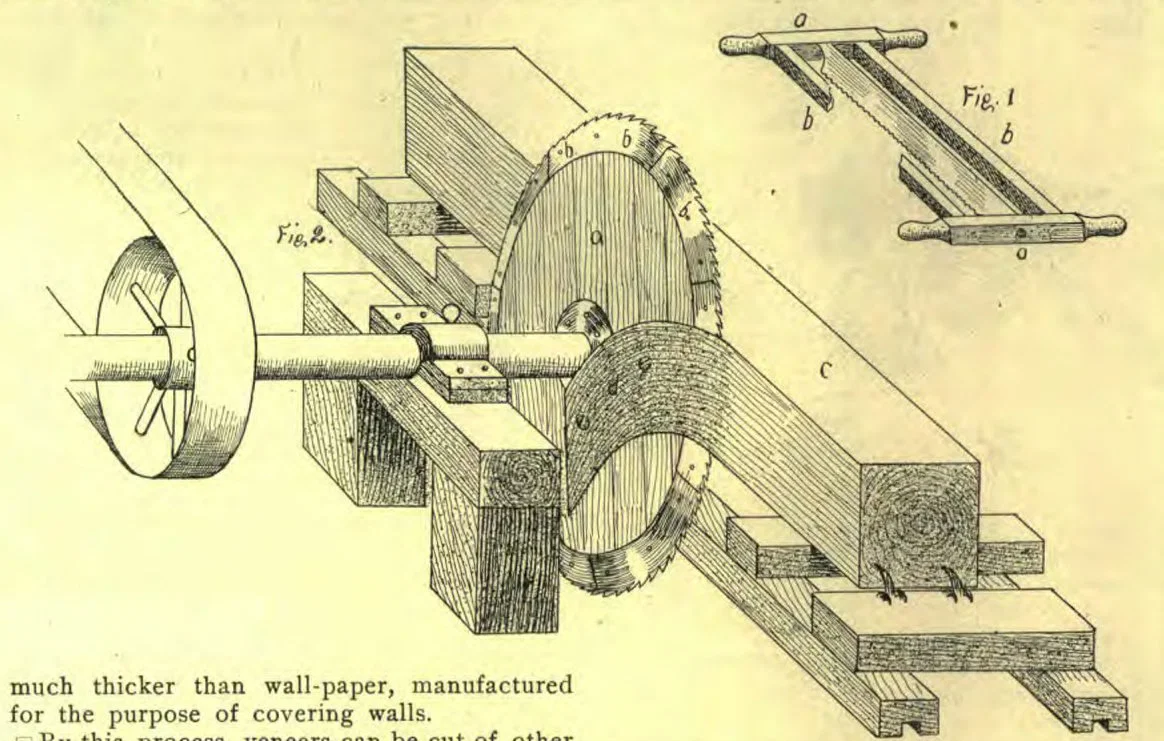
The material of which veneers are made being generally expensive, of course it is desirable to economize as much as possible in cutting it. Formerly veneers were cut at the saw-pit (“a pit over which timber is sawed by two men, one standing below the timber, and the other above”), with very thin plates strained in the common pit-saw frame; or they were cut with a smaller frame-saw, such as is shown in Fig. 1, which represents a saw about four feet long inserted in a frame, to which it is fastened at each end (see a, a), the ends being finished with turned handles. There is also attached at each end of the saw an iron with a nut for the purpose of tightening the saw. You will notice a strip of wood each side of the saw for stretchers (see b, b), the piece on one side being broken off to show the saw. Two men take hold of the saw, and work a board up into veneers about one eighth of an inch thick. My father had one of these saws in his shop. He also used it for resawing one-inch lumber for panels.
When I was a small boy, I visited a mahogany yard in Rochester, N. Y., where there was a saw for sawing logs into veneers. I will try to give some idea of how this was done. The saw differed from saws now used in sawing lumber. There was a large wooden wheel, or what might be called a “face-plate,” made of plank, and fastened together securely with iron clamps. This was turned off perfectly true. See Fig. 2, a. The saw was made in sections, as seen at b, b. The pieces were very thin on the outer edge, but thick where they were screwed to the plate, or wheel. The teeth were fine, with a slight “set.”
In cutting the veneer, the log passed along the side of the saw. See the log, c. As the saw was thick in the center, and upon a flank-wheel, it did not pass through the log like a common buzz-saw; but as the veneer was cut, it was less than one sixteenth of an inch thick. A man stood by the saw, d, and with his hands at e, e, bent the veneer around until it was cut off, thus proceeding until the log was cut up.
You may ask why these saws were put on a wooden wheel. They were large,—sometimes eighteen feet in diameter,—and of course had to be very thin on the edge, to save the timber that would be wasted in sawdust with the ordinary buzz-saw. A few years ago a burl-walnut tree was sold in Indiana for five hundred dollars. When made into veneers, it was worth nearly fourteen thousand dollars. You see, then, that it is important that there be no waste.
□ Within the last few years a machine has been invented for cutting veneers without waste of material. A log is cut the desired length, and boiled or steamed until the wood is soft throughout. It is then placed in this machine, and made to revolve against a knife, which cuts it into very thin strips. I have seen veneers not much thicker than wall-paper, manufactured for the purpose of covering walls.
□ By this process, veneers can be cut of other material than wood. In the United States Department of the great London Exhibition there was an ivory veneer twelve inches wide and forty feet long, cut from a single tusk of an elephant. Some years ago a Mr. Pape, in Paris, veneered a piano with ivory, and advertised to furnish veneering of the same material in sheets thirty by one hundred and fifty inches in size. W. K. Loughborough.

FORGET-ME-NOT

Little flower, pale and fair, Growing by the pathway there, Shedding fragrance round the spot, Beautiful forget-me-not.
I was once as glad as thou, Free from sin and care; but now All my life seems but a blot, Dark and sad, forget-me-not.
Little flower, you seem to be Bringing word from God to me; In your face you tell his thought, “Child, return; forget me not.”
Lord, no longer will I roam, Since thou dost recall me home; Long I strayed, but still thou sought: O, thou couldst forget me not!
HART HALL.

Every Act Rewards Itself

“EVERY act rewards itself.”

MAN'S PLACE IN NATURE.

Man's Relation to Heat.

IN our last study we considered man as related to light. We found that the Creator had placed in the head of man a wonderful instrument for the reception of light. The eye is very much like a camera in its construction, and, indeed, is sometimes called the camera of the body. I did not have time to tell you last week about the means which the Lord has furnished for the protection of the eye. The eyelashes keep out dust and small particles, and the lachrymal, or tear, glands furnish a watery substance that keeps the eye well moistened, so there is no friction produced by the different movements of the eye. The eye is furnished with several pairs of muscles, which enable us to turn it about when we wish to see in different directions, so it is not necessary to turn the head unless we wish to see objects that are behind us.
Connected with the light of the sun are the rays of heat. It seems necessary to have light, but we shall find it equally necessary to have heat. Plants and animals could not exist were it not for the heat given to the earth by the sun. The beautiful spring weather, with its warm, sunshiny days, is a gift to us from the sun. But the Lord made the sun; therefore these days are really a gift from him.
Not only are the rays of heat which come to us a great blessing, but the heat which is generated in the human body is necessary to our existence. If the temperature of the body is taken by placing a thermometer under the tongue, it will be found to be 98.4°F., provided the person is enjoying good health. This temperature remains constant unless the body is affected by some disease. If it should rise above 98.4°, we know the person has a fever. If the temperature should fall below 98.4°, we are warned that something is the matter with the circulation. In order that the temperature of the body shall be kept uniform, it is necessary to wear heavy clothing in the winter and thin clothing in the spring and summer. God has so constructed our bodies that a little deviation from the normal temperature is liable to cause sickness and even death.
Now the question before us, and one which may seem hard to solve, is this: Where and how does the body get its heat? It does not get it directly from the sun, for in the winter we keep our bodies warm by the heat obtained by burning wood and coal. But where did the wood and coal get their heat?—At the time of the flood, vast forests were covered with water and earth. While in this condition, these forests were changed into coal. The wood that we burn is obtained from trees. But how do wood and coal produce heat?—This is brought about by the union of the oxygen of the air with the wood and coal. The fire is started with a match, and the fire of the match is produced by friction. Precisely the same phenomena occurs in the human body. Food is taken into the body by the digestive organs; the oxygen of the air enters the body through the lungs; this oxygen unites with the small food particles which are in the blood, and the union thus formed produces heat.
M. E. CADY.

A FOREST MONSTER.

Many Instructor readers have never seen trees equal in size to those found in our Western forests. It might be of interest to give the dimensions of one of these monsters, and figure the actual lumber that it contains. A few weeks ago a tree that grew on a farm in Washington was cut down. It was four hundred and sixty-five feet high, and had a circumference of thirty-three feet and eleven inches at the base. If sawed into timber, it would make 96,345 feet,—sufficient timber to build eight two-story cottages of seven rooms each. If sawed into inch-square strips, it would fill ten ordinary railroad cars. This gigantic tree was about four hundred and eighty years old, judging from its rings. JAMES C. COLE.

THE CHLOROPHYL CELL.

V.

THE next step in our investigation is to learn how the green cell appropriates the elements it uses in making food. In order to understand this, we must first study osmose,—the process by which cells drink in elements outside their walls.
The protoplasm which forms the body of a cell is of a fluid consistency, but is thicker and denser than water, for which it has a great affinity. Its substance also contains acids that act upon the salts of earth. Around every little grain of earth there is a tiny drop of water, except possibly in time of excessive drought; and each little water-globule touches some other, so there is really, in the earth, a sea of water, in which float, as it were, grains of earth. In the roots of all plants are hair-like appendages which, pushing out in every direction, gather material for the growing vegetable. These little hairs are composed of millions of tiny cells, and their protoplasmic cells touch the globules of water, and the water seeps, or penetrates through the thin walls of the cells, and mingles with the protoplasm inside. In this way one little globule after another is drawn into the cell. While this is going on, the incoming water sets free the acids in the cell, and they slowly, in their turn, seep through the wall to the outside, and attack the grains of earth, breaking them to pieces, and so freeing the salts they contain, which float along with the globules of water into the cell. In this way the cell obtains the hydrogen gas from the water, and the mineral salts from the earth. This action is called “osmose.” From the air the cells inhale oxygen, also carbon from the carbon dioxide that animal cells throw off. From all these materials the green cells form protein, the substance from which white cells construct tissue.
It is true that in the very lowest form of animal life, there are two or three instances in which chlorophyll animal cells are found, but not in any animal connected with man or his life. This is a positive proof that God intended man to draw his sustenance directly from the vegetable world, because it is not possible to obtain food in a proper condition from any other source. Animal cells, although composed of the protein created by the vegetable cells, so change the substance in the recomposition into animal tissue as to present the elements of the protein in unnatural proportions.
If a small portion of green slime is placed under a microscope, little creatures, animated dots of protoplasm, will be seen moving in various directions. These are free cells, and are called ameba. They are entirely destitute of organs, yet they move by prolonging a portion of their body, attaching it firmly, and drawing the balance up to it. They belong to the family of molds, and are the product of decay of either vegetable or animal matter.
In the blood there are little cells similar in construction, called “blood corpuscles,” whose office is entirely different, being that of head animal electricians. They separate the oxygen from the air, and circulate it everywhere in the tissues of the body. The importance of their office will be better understood when I tell you that the white cells, which make up the body of an animal, can not appropriate the protein furnished them by the green cells of the vegetable world until the blood corpuscles charge the protein with oxygen. W. S. CHAPMAN.

Four Things a Man Must Learn

“Four things a man must learn to do If he would make his record true: To think without confusion clearly, To love his fellow men sincerely, To act from honest motives purely, To trust in God and heaven securely.”
Continue reading: A MOTHER-BIRD’S INSTINCT